Beyond Traditional Software Development: Studying and Supporting
the Role of Reusing Crowdsourced Knowledge in Software Development
Rabe Muftah B. Abdalkareem
A Thesis in The Department
of
Computer Science and Software Engineering
Presented in Partial Fulfillment of the Requirements For the Degree of
Doctor of Philosophy (Computer Science) at Concordia University
Montréal, Québec, Canada
February 2019
c
Concordia University
School of Graduate Studies
This is to certify that the thesis prepared
By: Mr. Rabe Muftah B. Abdalkareem
Entitled: Beyond Traditional Software Development: Studying and Supporting the Role of Reusing Crowdsourced Knowledge in Software Development and submitted in partial fulfillment of the requirements for the degree of
Doctor of Philosophy (Computer Science)
complies with the regulations of this University and meets the accepted standards with respect to originality and quality.
Signed by the final examining committee:
Chair Dr. Jun Cai External Examiner Dr. Foutse Khomh Examiner Dr. Roch Glitho Examiner Dr. Yann-Gaël Guéhéneuc Examiner Dr. Todd Eavis Supervisor Dr. Juergen Rilling Co-supervisor Dr. Emad Shihab Approved by
Dr. Volker Haarslev, Graduate Program Director
1 April 2019
Dr. Amir Asif, Dean
Abstract
Beyond Traditional Software Development: Studying and Supporting the
Role of Reusing Crowdsourced Knowledge in Software Development
Rabe Muftah B. Abdalkareem, Ph.D. Concordia University, 2019
As software development is becoming increasingly complex, developers often need to reuse others’ code or knowledge made available online to tackle problems encountered during software development and maintenance. This phenomenon of using others’ code or knowledge, often found on online forums, is referred to as crowdsourcing. A good example of crowdsourcing is posting a coding question on the Stack Overflow website and having others contribute code that solves that question. Recently, the phenomenon of crowdsourcing has attracted much attention from researchers and practitioners and recent studies show that crowdsourcing improves productivity and reduces time-to-market. However, like any solution, crowdsourcing brings with it challenges such as quality, maintenance, and even legal issues.
The research presented in this thesis presents the result of a series of large-scale empirical studies involving some of the most popular crowdsourcing platforms such as Stack Overflow, Node Package Manager (npm), and Python Package Index (PyPI). The focus of these empirical studies is to investigate the role of reusing crowdsourcing knowledge and more particularly crowd code in the software development process.
We first present two empirical studies on the reuse of knowledge from crowdsourcing platforms namely Stack Overflow. We found that reusing knowledge from this crowdsourcing platform has the potential to assist software development practices, specifically through source code reuse. However, relying on such crowdsourced knowledge might also negatively affect the quality of the software projects. Second, we empirically examine the type of development knowledge constructed on crowd-sourcing platforms. We examine the use of trivial packages onnpm andPyPI platforms. We found that trivial packages are common and developers tend to use them because they provide them with well tested and implemented code. However, developers are concerned about the maintenance over-head of these trivial packages due to the extra dependencies that trivial packages introduce. Finally, we used the gained knowledge to propose a pragmatic solution to improve the efficiency of relying on the crowd in software development. We proposed a rule-based technique that automatically de-tects commits that can skip the continuous integration process. We evaluate the performance of the
proposed technique on a dataset of open-source Java projects. Our results show that continuous integration can be used to improve the efficiency of the reused code from crowdsourcing platforms. Among the findings of this thesis are that the way software is developed has changed dramatically. Developers rely on crowdsourcing to address problems encountered during software development and maintenance. The results presented in this thesis provides new insights on how knowledge from these crowdsourced platforms is reused in software systems and how some of this knowledge can be better integrated into current software development processes and best practices.
Acknowledgments
First and foremost, I would like to thank Allah Almighty for giving me the strength and the ability to finish My Ph.D. thesis.
My sincere gratitude goes to my co-advisors Dr. Emad Shihab and Dr. Juergen Rilling, as without their guidance, instruction, support, enlightenment, and patience, this research would not have been completed. Their unique personalities, as supervisors and friends have allowed me to become a successful researcher.
I want to thank my committee members, Drs. Foutse Khomh, Roch Glitho, Yann-Gaël Guéhéneuc, and Todd Eavis for taking the time to read and critique my work and for their valuable suggestions and comments. I would also like to extend my thanks to Drs. Weiyi Shang and Nikolaos Tsantalis for providing me with insightful feedback.
I have also had the privilege to collaborate and discuss my research with great researchers. I want to thank Drs. Ahmed Hassan, Xin Xia, Shane McIntosh, and Alexander Serebrenik for sharing their insights and advice.
My appreciation extends to my colleagues and friends at the DAS lab and at Concordia: Suhaib Mujahid, Sultan Alqahtani, Mohamed Elshafei, Ahmad Abdellatif, Mahmoud Alfadel, Ellis Eghan, Hosein Nourani, Atique Reza, Behzad Dehghani, Xiaowei Chen, Mouafak Mkhallalati, Everton Maldonado, Sultan Wehaibi, Moiz Arif, Olivier Noury, and Giancarlo Sierra Monge.
Finally, this thesis would not be possible without the continuous care from my parents and family, and the support of my friends. My mother and father, without your constant prayers, encouragement, and love, I would not have been able to continue my Ph.D. journey. And, to my beloved wife, who has stood by my side throughout this journey.
Dedication
Contents
List of Figures xii
List of Tables xiv
1 Introduction and Problem Statement 1
1.1 Motivating Examples . . . 2 1.2 Problem Statement . . . 4 1.3 Thesis Overview . . . 4 1.4 Thesis Contributions . . . 8 1.5 Related Publications . . . 9 1.6 Thesis Organization . . . 10
2 Background and Related Work 11 2.1 Crowdsourcing Software Development . . . 11
2.2 Work Related to Stack Overflow as a Crowdsourcing Platform . . . 13
2.3 Work Related to Source Code Reuse . . . 16
2.3.1 Empirical Studies of Code Search on the Web . . . 16
2.3.2 Source Code Recommendation from the Web . . . 17
2.3.3 Empirical Studies of Copy and Paste Source Code . . . 18
2.4 Chapter Summary . . . 19
3 Understanding the Usage of Crowdsourced Knowledge 20 3.1 Introduction . . . 20
3.1.1 Organization of the Chapter . . . 22
3.2 Study Design and Approach . . . 22
3.2.1 Selection of Studied Projects . . . 22
3.2.2 Extracting Stack Overflow Related Commits . . . 23
3.2.4 Measuring the Helpfulness and Delay of Stack Overflow Posts . . . 24
3.3 Results . . . 24
3.3.1 RQ1: What are the Main Reasons Developers Resort to Stack Overflow? . . 26
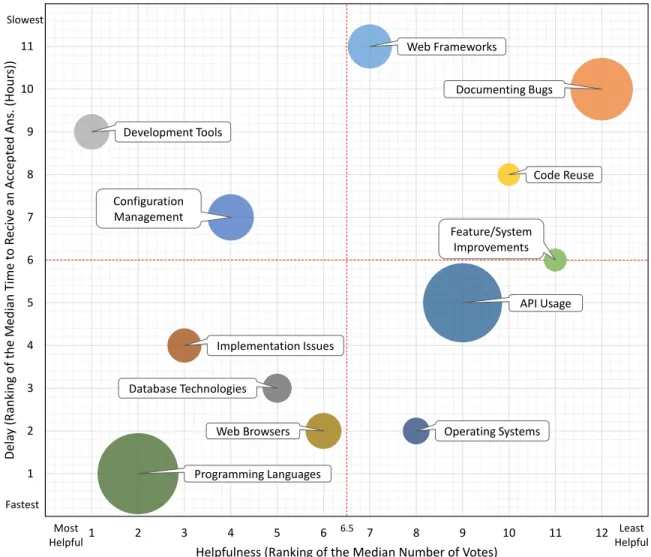
3.3.2 RQ2: What Areas is the Crowd Most Helpful to Developers in? What Areas Takes Longest to Attain Answers for from the Crowd? . . . 27
3.4 Discussion and Implications . . . 30
3.4.1 Using the Crowd for More Than Just Knowledge . . . 30
3.4.2 Linking Changes to Crowd Discussion . . . 30
3.5 Related Work . . . 31
3.6 Threats to Validity . . . 31
3.7 Chapter Summary . . . 32
4 The Impact of Reused Source Code from Crowdsourcing Platforms 33 4.1 Introduction . . . 34
4.1.1 Organization of the Chapter . . . 35
4.2 Motivating Example . . . 35
4.3 Case Study Setup . . . 36
4.3.1 Building Stack Overflow Code Snippets Corpus . . . 37
4.3.2 Extracting Code Snippets from Stack Overflow . . . 37
4.3.3 Selecting Mobile App Projects . . . 38
4.3.4 Detection of Reused Code from Stack Overflow in the Mobile Apps Case-Study 39 4.4 How Much Source Code from Stack Overflow is Reused in Software Systems? . . . . 40
4.5 Case Study Results . . . 41
4.5.1 RQ1: Why do Mobile Developers Reuse Code from Stack Overflow? . . . 41
4.5.2 RQ2: When in a Mobile App’s Lifetime do Developers Reuse Code from Stack Overflow? . . . 43
4.5.3 RQ3: Who Reuses Code from Stack Overflow? . . . 45
4.6 Does Code Reuse from Stack Overflow Impact the Quality of Mobile Apps? . . . 48
4.7 Related Work . . . 50
4.7.1 Origin of Source Code and Code Reuse . . . 50
4.7.2 Work Related to the Use of Stack Overflow . . . 51
4.7.3 Work Related to Mobile Apps . . . 52
4.8 Threats to Validity . . . 52
4.8.1 Threats to Internal Validity . . . 53
4.8.2 Threats to External Validity . . . 53
5 Examining the Type of Constructed Knowledge on Crowdsourcing Platforms 55
5.1 Introduction . . . 56
5.1.1 Organization of the Chapter . . . 58
5.2 Background and Datasets . . . 58
5.2.1 Node Package Manager (npm) . . . 58
5.2.2 Python Package Index (PyPI) . . . 59
5.3 What are Trivial Packages Anyway? . . . 60
5.4 How Prevalent are Trivial Packages? . . . 63
5.4.1 How Many ofnpm’s &PyPI’s Packages are Trivial? . . . 63
5.4.2 How Many Applications Depend on Trivial Packages? . . . 64
5.5 Survey Results . . . 65
5.5.1 Do Developers Consider Trivial Packages Harmful? . . . 67
5.5.2 Why Do Developers Use Trivial Packages? . . . 68
5.5.3 Drawbacks of Using Trivial Packages . . . 71
5.6 Putting Developer Perception Under the Microscope . . . 75
5.6.1 Examining the ‘Well Tested’ Perception . . . 76
5.6.2 Examining the ‘Dependency Overhead’ Perception . . . 80
5.7 Discussion, Relevance, and Implications . . . 84
5.7.1 Relevance: Do Practitioners care? . . . 84
5.7.2 Implications of the Study . . . 84
5.8 Related Work . . . 86
5.8.1 Studies of Code Reuse. . . 86
5.8.2 Studies of Other Ecosystems. . . 86
5.9 Threats to Validity . . . 87
5.9.1 Construct Validity . . . 87
5.9.2 External Validity . . . 89
5.10 Chapter Summary . . . 89
6 Improving the efficiency of Reusing Crowdsourced Knowledge 91 6.1 Introduction . . . 92
6.1.1 Organization of the Chapter . . . 94
6.2 Background and Terminology . . . 94
6.3 Data Collection . . . 95
6.3.1 The TravisTorrent Dataset . . . 95
6.3.2 Aggregating the Travis CI Results . . . 96
6.4 Investigating the Reasons for [CI Skip] Commits . . . 98
6.4.1 Identifying CI Skip Commits in the TravisTorrent Dataset . . . 99
6.4.2 Reasons for CI Skip Commits . . . 100
6.4.3 Operationalization of Rules to Automatically Detect CI Skip Commits . . . . 102
6.5 Case Study Results . . . 104
6.5.1 RQ1: How Effective is Our Rule-Based Technique in Detecting CI Skip Commits?104 6.5.2 RQ2: How Much Effort Can be Saved by Marking CI Skip Commits Using Our Rule-Based Technique? . . . 106
6.6 The Developers’ Perspective . . . 109
6.6.1 How Important is It for Developers to Have the Ability to Automatically CI Skip a Commit? . . . 110
6.6.2 When do Developers Skip the CI Process? . . . 111
6.6.3 Why do Developers Skip the CI Process? . . . 112
6.7 Discussion . . . 113
6.7.1 Special Cases of CI Skip Changes. . . 113
6.7.2 Can Source Code Analysis Enhance the Detection of CI Skip Commits? . . . 115
6.8 Tool Prototype: CI-Skipper . . . 118
6.9 Related Work . . . 119 6.9.1 Improvement of CI Technology. . . 119 6.9.2 Usage of CI. . . 121 6.10 Threats to Validity . . . 122 6.10.1 Internal Validity . . . 122 6.10.2 Construct Validity . . . 122 6.10.3 External Validity . . . 123 6.11 Chapter Summary . . . 124
7 Conclusions and Future Work 125 7.1 Conclusion and Findings . . . 125
7.2 Future Work . . . 127
7.2.1 Investigation the Relation between Different Crowdsourcing Platform . . . . 127
7.2.2 Improving the Structure of Crowdsourcing Platforms . . . 128
7.2.3 Replication in an Industrial Setting . . . 128
7.2.4 Other Type of Crowdsourced Knowledge . . . 128
7.2.5 Improving of Using Test Generation and Quality Management for Crowd-sourced Knowledge/Code . . . 129 7.2.6 Enhancing the Detection of Skip commits Through the Use of Machine learning129
List of Figures
1 Illustration of interaction with a crowdsourcing platform, Stack Overflow as an
ex-ample. . . 12
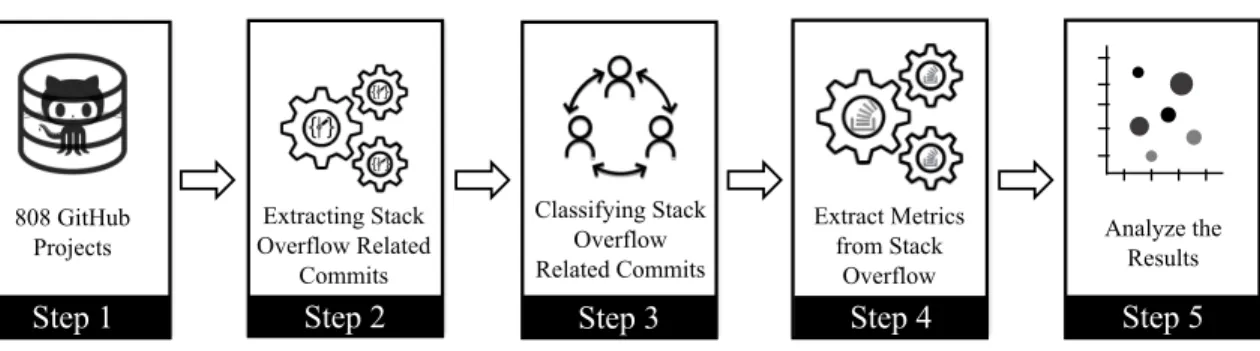
2 Overview of our data extraction and analysis approach . . . 22
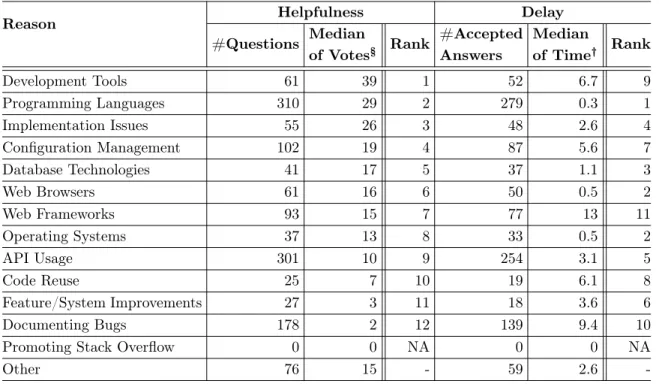
3 The x-axis of the plot shows the average ranking of the median of number of votes for each area (1 is the most helpful). The y-axis shows the median time (hour) for a question to receive an accepted answer for each area (1 as the fastest), while the size of the bubble present the number of commits. . . 29
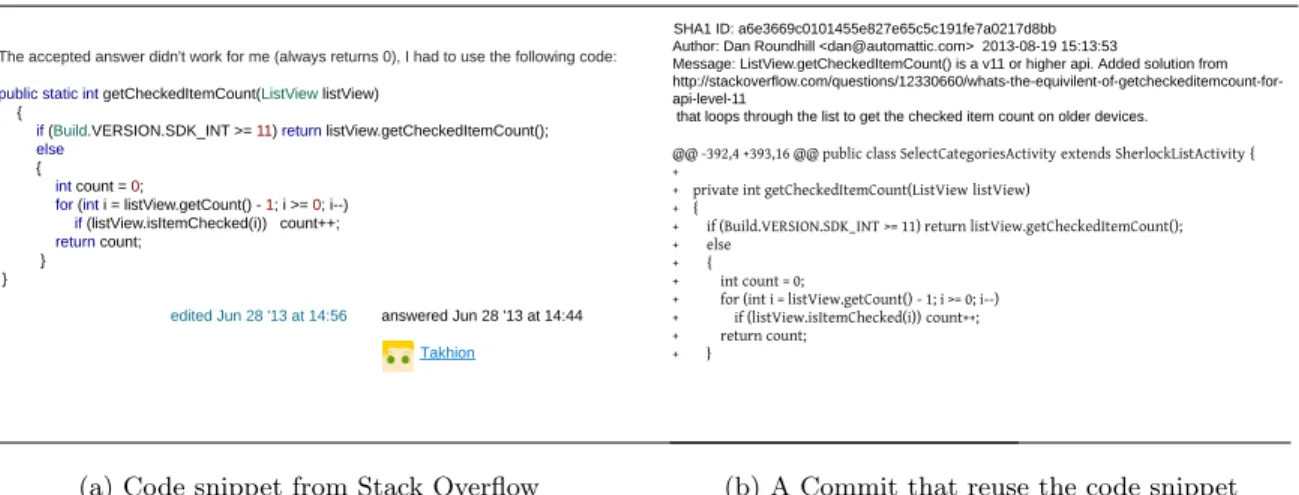
4 (a) Source code snippet posted on Stack Overflow, (b) Description of a commit that reuses the code snippet in WordPress Android . . . 35
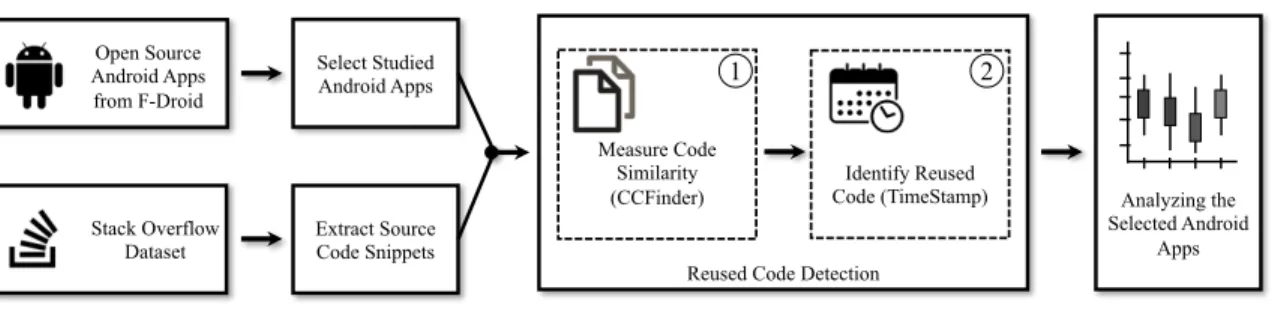
5 Approach overview of our study . . . 36
6 Distribution of the app’s age of the 22 examined mobile apps . . . 44
7 Percentage of reused Stack Overflow code per quartile in apps divided based on the age 44 8 Distribution of the developers’ experience for developers who reuse code from Stack Overflow against the rest of developers in the 22 studied mobile apps . . . 46
9 Distribution of the developers’ experience for developers that reuse code from Stack Overflow . . . 47
10 The approach to compute the percentage of bug fixing commits Before and After reuse per file . . . 49
11 The Percentage of bug fixing commitsBefore andAfter reuse per file . . . 50
12 Package is-Positive onnpm . . . 61
13 Percentage of Published Trivial Packages onnpm. . . 64
14 Percentage of Published Trivial Packages onPyPI. . . 64
15 Developer responses to the question “is using a trivial package bad?”. Most JavaScript developers answered no, whereas most Python developers answered yes. . . 67
16 Distribution of Tests, Community Interest and Download Count Metrics for npm packages management system. . . 77
17 Distribution of Tests, Community Interest and Download Count Metrics for PyPI
packages management system. . . 79 18 Number of Releases for Trivial Packages Compared to Non-trivial Packages. For
npm ecosystem, (p-value<2.2e-16 & Cliff’s Delta (d) -0.312 (small)) while ForPyPI
ecosystem (p-value<2.2e-16 & Cliff’s Delta (d) -0.383 (medium)). . . 81 19 Distribution of Direct & Indirect Dependencies for Trivial and Non-trivial Packages
(log scale). Fornpm(p-value<2.2e-16 & Cliff’s Delta (d) -0.279 (small)) whilePyPI
(p-value<2.2e-16) & Cliff’s Delta (d) -0.246 (small). . . 83 20 Beanplots showing the distributions of effort savings in terms of the number of CI
skip commits and saved time for different values of Projects. The horizontal lines represent the medians. . . 108 21 Survey responses regarding the importance of being able to automatically CI skip a
commit. . . 110 22 The workflow of the designed CI-Skipper tool. . . 118 23 Screen shots ofCI-Skipper. The commit is automatically detected to be CI skipped
List of Tables
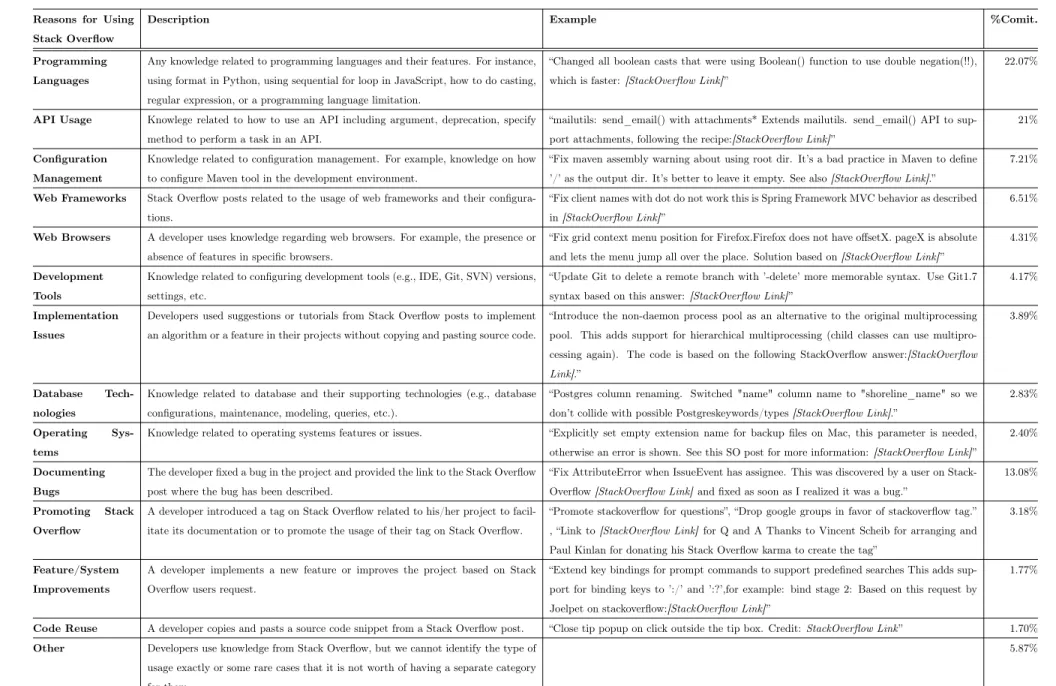
1 The Dimensions of Crowdsourcing and Concrete Examples of Three Crowdsourcing Models [108]. . . 13 2 Statistics of Projects, Languages, and Stack Overflow Commits Analyzed in Our Study. 23 3 Identified reasons for using Stack Overflow with a description, example and the
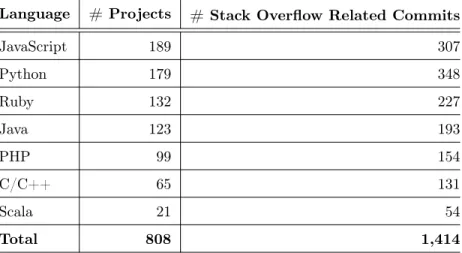
per-centage of commits in each area. . . 25 4 The Helpfulness & Delay classified by the different reasons of using knowledge from
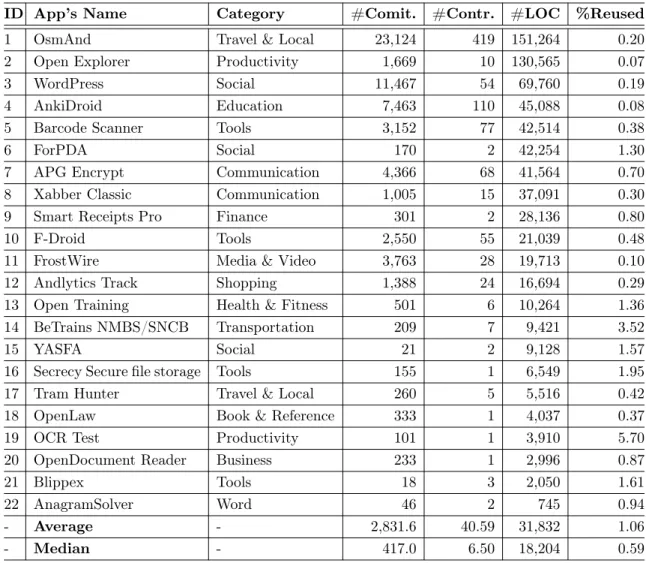
Stack Overflow. . . 28 5 Selection process of Stack Overflow posts . . . 38 6 Selection process of the studied mobile apps . . . 39 7 Descriptive statistics of the 22 mobile apps and the percentage of reused code from
Stack Overflow . . . 40 8 Reuse categories based on coding of commit messages . . . 42 9 Background of Participants in the Two Surveys to Determine Trivial Packages. . . . 59 10 Position and development experience of survey respondents. . . 65 11 Reasons and percentage for using trivial packages in bothnpm andPyPI. . . 68 12 Drawback and percentage for using trivial packages in bothnpm andPyPI. . . 73 13 Mann-Whitney Test (p-value) and Cliff’s Delta (d) for Trivial vs. Non Trivial Packages
innpm. . . 78 14 Mann-Whitney Test (p-value) and Cliff’s Delta (d) for Trivial vs. Non Trivial Packages
inPyPI. . . 80 15 Percentage of Packages vs. the Number of Dependencies Used in thePyPI package
management system. . . 83 16 Percentage of Build Results in All the Java Projects in the TravisTorrent Dataset. . 95 17 Shows Projects in the Testing Dataset. . . 97 18 Summary of the Number of Commits After Introducing Travis CI, the Number and
Percentage of Skip Commit for all Studied Java Projects, and for only Projects Using CI Skip. . . 98
19 Reasons for CI Skipped Commits. . . 99
20 Performance of Rule-Based Technique. . . 105
21 Background of Survey Participants. . . 109
Chapter 1
Introduction and Problem Statement
While software engineering has changed tremendously over the years through the adoption of new technologies and practices, its fundamental premise to deliver high-quality software in a timely and cost-efficient manner has remained the same. At the same time, the emergence of Web 2.0 has provided software developers with the ability to collectively share their software development and programming experience in online communities. The software engineering community has not only adapted but also taken advantage of these newly available technologies in order to achieve the objectives of software engineering by introducing new software development paradigm such as open source [199] and collaborative software development [24].Crowdsourcing, the process of outsourcing software development tasks to developers in online community platforms, is one example of open source development [103, 181]. It has become a common approach in software development, with development tasks being decomposed in smaller, well-defined tasks that can be completed by the crowd [122, 108]. Crowdsourcing in software engi-neering has led to the success of many forms, including open source systems’ development (Linux and Apache) [108]. There are also multiple crowdsourcing platforms that cover coding (e.g,. Top-Coder [2]), testing (e.g,.uTest [6]), and code reuse (e.g,. npm [4]), as well as some general software development tasks (e.g,. Stack Overflow [3]).
Although recent, the phenomenon of crowdsourcing has attracted much attention from both researchers and practitioners. And for a good reason. Recent studies have shown that crowdsourcing improves productivity, reducing time-to-market [107, 180]. However, like any solution, crowdsourcing brings with it many challenges such as quality issues, scalability and performance issues, maintenance issues and even legal issues. For example, one common concern with crowdsourcing is related to the fact that it is hard to ensure developers participate enough and submit good quality work and, therefore, potentially can impact the quality of the final product [107, 180].
In this thesis, we aim to build a solid understanding of how crowdsourcing can help developers build high-quality software. To achieve this goal, we believe that we first need to address the following problems: 1) understand how developers use crowdsourcing platforms, 2) once developers use the crowd knowledge constructed on these platforms, how this knowledge can impact the software quality, and 3) understand what the type of knowledge is constructed on these crowdsourcing platforms. Finally, use the gained knowledge to improve the efficiency of the reused crowdsourcing knowledge in the software development process.
1.1
Motivating Examples
Crowdsourcing is increasingly revolutionizing the ways how software is engineered [181]. Both, the open source community and private software companies have adopted the reuse of crowdsourced knowledge (i.e., source code) by outsourcing development tasks to the crowd. A good example of crowdsourcing is posting a coding question on Stack Overflow and having others contribute code to solve your posted code problem. Such form of knowledge sharing and reuse are the main focus of this thesis. To shed light on issues that can arise when reusing crowdsourced knowledge, we illustrate these problems involving two well-known crowdsourcing platforms and how developers use them.
One example of a commonly used crowdsourcing platform that developers rely on is Stack Over-flow. Stack Overflow is a general crowdsourcing platform that programmers use to benefit from the crowd’s programming knowledge. Developers share on Stack Overflow their knowledge, provide development support, learn new technologies, and search for solutions to both common and specific programming problems [179, 187]. Also, research reported that Stack Overflow has become the largest non-traditional source code repository that developers resort to for code reuse [12, 19]. In fact, the reuse of source code snippets posted on Stack Overflow is reusing crowdsourced knowledge. Thus, the quality of reusing crowdsourced code snippets posted on Stack Overflow is an important concern. Yet little is known about these code snippets (e.g,. the level of experience of the developer who wrote the code, the quality of these code fragments, and if these code fragments are original or cloned from another software systems). In addition, source code published on Stack Overflow is of-ten only for illustrative purpose and may exclude important implementation aspects associated with complete or well-written code (e.g,. no error handling, non-secure programming style, or outdated coding styles/libraries ).
A key challenge associated with this type of code reuse is that programmers often resort to these code snippets in an ad-hoc manner, simply copying-and-pasting these fragments into their own software system without thoroughly testing the copied code [12]. Additionally, developers often adopt code from crowdsourcing platforms without completely understanding and fully testing the copied
code [36]. As a result, such type of reuse can lead to quality issues in software systems which can cause additional future maintenance effort. Prior to assessing the impact of code/knowledge reused from Stack Overflow on current software projects, one has first to detect reused code. Detecting reused source code from Stack Overflow in a software system is a challenging task since: 1) it is a new problem with no previous work on how to identify reused knowledge from Stack Overflow; and 2) programmers who reuse source code from Stack Overflow occasionally perform obfuscation operations (e.g,. renaming variables, adding and removing code) on the reused code. These modifications are sometimes done unintentionally to meet the system’s new context and quality (e.g., programming style) or deliberately by some programmers to hide the reused code, making it difficult to detect the origin of the code to avoid source code licensing or ownership issues.
The second example is to illustrate code reuse from other crowdsourcing resources such as the Node Package Management (npm) [4]. npm is a community based online registry that provides tools for managing packages of JavaScript code and their revisions. The goal of the Node.js/npm
community is to make it easy and fast for developers to publish and use packages. In fact, the act of developing and publishing a package onnpm is a form of crowdsourcing task that the package pro-vide [181]. However, the Node.js/npm platform has a somewhat unusual characteristic. Node.js is a new JavaScript platform which inherited the relative poorness of JavaScript’s standard library [204], that developers provide, such as a missing JavaScript functionalities in a crowdsourcing call. Pack-ages published onnpm cover different development tasks, ranging from simple tasks (e.g., identifying a character as a number) to more complicated tasks (e.g., building a testing framework).
Recent studies show that using npm as a package management system introduces maintenance overhead [32]. For example, multiple revisions of a package can coexist within the same project. A developer may use two packages that each require a different revision of a third package. In that case, npm will install both revisions in distinct places and each package will use a different implementation. Another example, a simple spelling error in a new update of anpm package called debug from version 2.3.3 to 2.4.0 led to the crash of approximately 24 thousand direct dependent packages that tried to download the new version [127]. Even though the bug was fixed within an hour, this bug impacted the installations of thousands of other packages in thenpm platform. While the reuse of such packages tends to reduce development effort and cost [22, 114], this type of reuse might increase both system complexity and future maintenance efforts [10]
These examples show how strongly and drastically crowdsourcing platforms are affecting the software development process. Therefore, we believe that as these platforms continue to play an increasingly important role in our software systems, understanding and effectively using them is of critical importance. More specifically, in this thesis, we uncover insights about how developers use the crowdsourcing knowledge and the type of knowledge constructed from some of the most known
crowdsourcing platforms. We also examine the use of continuous integration process to improve the efficiency of such reuse.
1.2
Problem Statement
Recent studies have shown that crowdsourcing improves productivity, reducing time-to-market. However, like any solution, crowdsourcing also introduces new challenges such as quality issues, potential scalability and performance problems, maintenance and even legal issues. These concerns and motivations led to the formulation of this thesis problem statement, which is stated as follows:
With the popularity of crowdsourcing platforms and given the fact that software developers use crowdsourced knowledge (e.g., source code and development knowl-edge), we hypothesize that the adoption of crowdsourcing in the development and maintenance process has an impact on the quality and maintainability of software systems. We conduct empirical studies to gain insights on the actual use of such crowdsourced knowledge and use the findings from these studies to improve the use of crowdsourcing knowledge in software engineering.
1.3
Thesis Overview
In this section, we provide a brief overview of the thesis. The thesis consists of six chapters, which can be classified into three main parts. In the first part (Chapter 2), we provide background and related work to the thesis. In the second part (Chapters 3, 4, & 5), we present three empirical studies related to the understanding of the use of crowdsourcing knowledge in software engineering. The last part (Chapter 6), presents our contribution to improving the efficiency of reusing crowdsourcing knowledge. Finally, Chapter 7 concludes the thesis and discusses avenues for future work.
Chapter 2: Background and Related Work.
This chapter contains two main sections. The first section presents a broad background of the concept of crowdsourcing and its definition used in software engineering. The second section presents existing work that is related to this thesis. In particular, we review research on integrating crowdsourced knowledge in the software development processes and how it is used to provide recommendation systems. We also discussed work related to existing studies, which have been focusing on Stack Overflow as a crowdsourced platform. In section 2.3, we review research on traditional code reuse
that is also applicable for code reuse from crowdsourcing platform such as Stack Overflow. This includes works related to code search from the web, source code recommendation, and studies related to cloning of source code.
Chapter 3: Understanding the Usage of Crowdsourced Knowledge.
General crowdsourcing platforms such as Stack Overflow, heavily rely on contributions of the crowd to provide accumulated, quality knowledge to the software development community. Typically, users post questions on Stack Overflow, which are answered by one or (often) more participants. In essence, the job of answering the questions is outsourced to the crowd [108]. However, the role of Stack Overflow has evolved to include much more than just answering questions. For example, Treudeet al. [187] qualitatively analyzed a sample of Stack Overflow questions and found that developers use Stack Overflow to share knowledge, provide development support, learn new technologies, and search for solutions to common and specific programming problems. However, aside from this small qualitative study, almost no prior work exists that studied the reasons why developers use the crowdsourced knowledge on Stack Overflow for. Thus, we investigate to understand how developers actually use crowdsourced knowledge. More specifically, this research aims to answer questions such as “What crowdsourced knowledge do developers actually use?” and “What types of this knowledge are most helpful to developers?”
In Chapter 3, we performed one of the first in-depth studies to gain insights on how developers actually use crowdsourced knowledge. We introduce a novel approach in contrast to existing studies and explored in which situations developers use unstructured crowdsourcing knowledge available on Stack Overflow. For our study, rather than mining Stack Overflow content, we mined GitHub commit histories looking for explicit mentions of Stack Overflow in their commit changes. We found that developers most often use Stack Overflow to gain knowledge related to topics such as development tools, APIs usage, and operating systems. More importantly, we found that developers use Stack Overflow to provide a rationale for feature updates or additions. In fact, we are the first to discover that developers even use Stack Overflow as a communication channel to receive user feedback about their software. This work was published in a highly competitive IEEE Software special issue on crowdsourcing in Software Engineering and was featured in an IEEE Software blog [13, 93].
Chapter 4: The Impact of Reused Source Code from Crowdsourcing
Plat-forms.
Most popular crowdsourcing platforms such as Stack Overflow provide developers with source code that they can reuse [108, 13]. However, very little work exists on the actual code reuse from these
crowdsourcing platforms. Furthermore, detecting reused source code from these platforms is a challenging task, as these crowdsourcing platforms are not designed to track the reused source code. Moreover, being able to trace such code reuse from crowdsourcing platform such as Stack Overflow can provide new insights on: 1) How much source code from Stack Overflow is reused in software systems; 2) Why do developers reuse code from Stack Overflow; 3) When in a project’s lifetime do developers reuse code from Stack Overflow; and 4) Who reuses code from Stack Overflow? In addition, having such insights will let us further examine the impact of reusing source code from crowdsourcing platforms on software quality and maintenance of systems, which reuse such crowdsourced code.
In Chapter 4, we propose a systematic detection technique to automatically identify reused crowdsourced code in a software system. Specifically, we focus on detecting reused code from Stack Overflow. Then, we perform a study focusing on code reuse from Stack Overflow in the context of mobile apps to investigate how much, why, when, and who reuses code. Moreover, to understand the potential implications of code reuse, we examine the percentage of bugs in files that reuse Stack Overflow code. We perform a study on 22 open source Android apps. For each app, we mine their source code and use clone detection techniques to identify code that is reused from Stack Overflow. We then apply different quantitative and qualitative methods to answer our research questions. Our findings indicate that 1) the amount of reused Stack Overflow code varies for different mobile apps, 2) feature additions and enhancements in apps are the main reasons for code reuse from Stack Overflow, 3) mid-age and older apps reuse Stack Overflow code mostly later on in their project lifetime and 4) that in smaller teams/apps, more experienced developers reuse code, whereas, in larger teams/apps, the less experienced developers reuse code the most. Additionally, we observed that the percentage of bugs is higher in files after reusing code from Stack Overflow. The results of this research appear in the Journal of Information and Software Technology [12].
Chapter 5: Examining the Type of Constructed Knowledge on
Crowd-sourcing Platforms.
Crowdsourcing has evolved to become an important practice of software development, shaped by the ability to collectively share software development and programming experiences in online code-sharing repositories such as GitHub. Crowdsourcing in software engineering has led to success in many forms, including the Node Package Management (npm). However, it is not always good news, in a recent incident code reuse of a very simple Node.js package called left-pad, which was used by another well-known package called Babel, caused interruptions to some of the largest Internet sites, e.g., Facebook, Netflix, and Airbnb [118, 200]. Many referred to the incident as the case that almost broke the Internet. The dependency that caused Babel to break was on a trivial 11 line package
that implements a left padding string function. Although the issue of using trivial packages has been discussed, most of these discussions have been informal. Basic research questions, such as “What is considered to be a trivial package?” and more important questions about why developers resort to such trivial packages and whether they perceive such reuse to have any drawbacks remain as open questions. To answer these research questions, we conducted one of the largest empirical software engineering studies in this domain to gain a more solid understanding as to why developers may take on additional dependencies to implement trivial tasks.
We first define a trivial package as a package that contains code that a developer can easily code him/herself and hence is not worth taking on an extra dependency for. Then, we employed qualitative and quantitative research methods to examine the prevalence, reasons, and drawbacks of using trivial packages. We performed a large survey involving 125 JavaScript and Python developers who use trivial packages. As part of this study, we mined more than 230,000npm and 63,000 PyPI
packages and 38,000 JavaScript and 14,000 Python projects. We found that trivial packages are commonly and widely used in JavaScript and Python projects. We also observed that, contrary to JavaScript developers beliefs that trivial packages are well-tested, only 45.2% of trivial packages that we mined actually have tests code. Additionally, we found that developers believe that using trivial packages tends to increase the dependency overhead of their software. More detailed analysis also showed that some of the trivial packages have their own dependencies. For example, 11.5% of the trivial packages have more than 20 dependencies. Hence, this work was the first to show that: 1) these trivial packages are commonly used and the left-pad incident was not isolated, 2) one cannot assume these trivial packages are well-tested, and 3) some of these trivial packages can bring more pain than they are worth, since some have as many as 20 dependencies. This work was published in the proceedings of the 2017 11th Joint Meeting on Foundations of Software Engineering [10].
Chapter 6: Improving the Efficiency of Reused Crowdsourced Knowledge.
So far, the previous chapters of this thesis focus on understanding how crowdsourcing knowledge is reused by developers and its impact on software systems. Our findings show that software quality is one of the main concerns of adopting crowdsourcing development in software engineering [10, 12]. While for traditional software development, a number of techniques have been used to ensure the quality of a software system, including testing [62], code reviews [160], and continuous integra-tions [195], little work exists that specifically investigates the applicability of these techniques for such crowdsourced code. In fact, there are two main ways to help developers ensure the quality of the reused crowdsourcing knowledge. First, through the use of tradition quality assurance techniques e.i., code reviews and testing. Second, helping developers to focus on the main task through remov-ing extra noise that developers are required to handle durremov-ing the integration of reused crowdsourcremov-ing
knowledge. In Chapter 6, we propose a technique to help developers eliminate the distraction cause by the noise such as reviewing cosmetic changes.Our objective is to gain an understanding to what extent existing quality assurance techniques can be improve to help developers remove the extra noise and focus on the main development task. Being able to reduce these challenges will help to promote further and encourage such type of code and knowledge reuse.
To do so, we developed a technique to improve the efficiency of the continuous integration (CI) process. Our main argument is that not every commit to the repository needs to trigger the CI process. For instance, developers may modify a project’s documentation and cause the CI process to be triggered. Since such a change does not affect the source code, the result of the build will not change and kicking off the CI process is just a waste of resources. We proposed and evaluated a rule-based technique based on manual analysis of more than 1,800 explicitly CI skip commits. Our evaluation showed that the devised rule-based technique is able to detect and label CI skip commits with an average Areas Under the Curve (AUC) of 0.73. Our results provide insights into the potential importance of modifying CI techniques to ensure the quality of code reuse from crowdsourcing platforms. A manuscript based on this work has been accepted to IEEE Transactions on Software Engineering (TSE) [9].
1.4
Thesis Contributions
The main contributions of the thesis are:
1. We show that developers most often use knowledge from crowdsourcing platforms such as Stack Overflow to gain knowledge related to topics such as development tools, APIs usage, and operating systems.
2. We discover that developers use Stack Overflow as a communication channel to receive user feedback about their software in addition to the usual uses.
3. We propose an approach to trace reused source code form crowdsourcing platforms, namely Stack Overflow.
4. We show that there is a relationship between reused source code from Stack Overflow and software defects.
5. We provide a systematic approach to define and identify trivial packages in software engi-neering. Also, we created the term Trivial Packages, which is now commonly used within the research community.
6. We show that using trivial packages could increase the maintenance effort of software projects since we show that some of the trivial packages have their own dependencies. For example, 11.5% of the trivial packages have more than 20 dependencies.
7. We developed a technique to improve the efficiency of the Continuous Integration (CI) process through skipping commits that do not affect the source code.
1.5
Related Publications
Earlier versions of the work presented in this thesis has been previously published or submitted to different venues include the following ones:
• R. Abdalkareem, E. Shihab, and J. Rilling, “What Do Developers Use the Crowd For? A Study Using Stack Overflow”,Special Issue on Crowdsourcing for Software Engineering, IEEE Software, 34 (2), pages 53-60 (2017).
• R. Abdalkareem, E. Shihab, and J. Rilling, “On code Reuse from Stack Overflow: An Exploratory Study on Android apps”, Information and Software Technology (IST), 88, pages 148-158 (2017).
• R. Abdalkareem, O. Nourry, S.Wehaibi, S. Mujahid, and E. Shihab, “Why Do Developers Use Trivial Packages? An Empirical Case Study on npm”, In Proceedings of the 2017 11th Joint Meeting on Foundations of Software Engineering, ESEC/FSE, pages 385-395 (2017), ACM, Acceptance rate: 24%
• R. Abdalkareem, “Reasons and Drawbacks of Using Trivial npm Packages: The Developers’ Perspective”, In Proceedings of the 11th Joint Meeting of the European Software Engineering Conference and the ACM SIGSOFT Symposium on the Foundations of Software Engineering
- Student Research Competition Track, ESEC/FSE, pages 1062-1064 (2017), ACM.
• R. Abdalkareem, V. Oda, S. Mujahid, and E. Shihab, “On the Impact of Using Trivial Packages: An Empirical Case Study on npm and PyPI”, Springer’s Journal of Empirical Software Engineering (EMSE), Major Revision Recommended, 37 pages (2018).
• R. Abdalkareem, S. Mujahid, E. Shihab, and J. Rilling, “Which Commits Can Be CI Skipped?”, Accepted in IEEE Transactions on Software Engineering (TSE), 17 pages, (2019).
In addition, the following work has been published during my Ph.D. program. These papers are relevant to my research [119, 139, 140, 138]. However they do not form part of the thesis content.
• S. Mujahid, G. Sierra, R. Abdalkareem, E. Shihab, and W. Shang, “An Empirical Study of Android Wear User Complaints”,Accepted in Empirical Software Engineering (EMSE), 24 pages, March, (2018).
• S. Mujahid,R. Abdalkareem, E. Shihab, “Studying Permission Related Issues in Android Wear-able Apps”, Proceedings of 34th IEEE International Conference on Software Maintenance and Evolution, ICSME 2018, 10 pages, Acceptance rate: 25%.
• E. Maldonado,R. Abdalkareem, E. Shihab, A. Serebrenik, “An Empirical Study On the Removal of Self-Admitted Technical Debt”, Proceedings of the 33rd IEEE International Conference on Software Maintenance and Evolution, ICSME 2017, pages 238-248, Acceptance rate: 28%.
• S. Mujahid, G. Sierra,R. Abdalkareem, E. Shihab, W. Shang, “Examining User Complaints of Wearable Apps: A Case Study on Android Wear”, Proceedings of 4th IEEE/ACM International Conference on Mobile Software Engineering and Systems, MOBILESoft 2017, pages 96-99 (2017).
1.6
Thesis Organization
The thesis consists of six chapters that are organized as follows: Chapter 2 provides necessary background related to the crowdsourcing in software engineering and research related to our analysis of crowdsourcing platforms. Chapters 3, 4, and 5 present the results of three empirical studies related to the usage and the impact of using crowdsourcing knowledge in software development. In Chapter 6, we present our results of improving the continuous integration service as away to ensure the quality of reused crowdsourcing knowledge. Finally, Chapter 7 summarized the thesis and discussed some direction of future work.
Chapter 2
Background and Related Work
In this chapter, we provide an overview of relevant background knowledge to our research that includes a brief description of crowdsourcing in software engineering including research on integrating crowd-based knowledge in the software development processes and how this knowledge is used to provide recommendation systems. In Section 2.2 we introduce existing studies on crowdsourcing platforms, namely Stack Overflow. In section 2.3, we review research on traditional code reuse that is also applicable for code reuse from crowdsourcing platforms such as Stack Overflow. This includes work related to code search from the web, source code recommendation, and studies related to source code cloning.
2.1
Crowdsourcing Software Development
The term crowdsourcing refers to the process of taking simple tasks or problems that once were performed internally by a company’s employees and outsourcing them to an undefined group of people in the form of an open call [90]. In general, crowdsourcing platforms leverage the collective intelligence of users who contribute, evaluate or rank items in communities online such as Facebook, Wikipedia, Stack Overflow and others. The benefits of crowdsourcing include easy (and sometimes free) access to a wide range of workers, various solutions, lower labor rates, and reduced time-to-market [174, 100, 106]. Crowdsourcing has been used in a wide variety of domains, such as weather forecasting [41], information retrieval [14, 109] and software engineering [122, 180, 169].
In software engineering, the value of crowdsourcing has been recognized through the success of open source software development [103]. Mao et al. [122] defined crowdsourcing for software en-gineering as “Crowdsourced Software Engineering is the act of undertaking any external software engineering tasks by an undefined, potentially large group of online workers in an open call format.”
Requesters <Users> Crowdsourcing Platform <Stack Overflow> Providers <Users>
Obtain Results <Answers>
Pull Tasks <Questions> Post Tasks <Questions>
Provide Solutions <Answers>
Figure 1: Illustration of interaction with a crowdsourcing platform, Stack Overflow as an example.
to a crowdsourcing platform (e.g., Stack Overflow). The crowd has increasingly used such plat-forms to answer developers’ questions through Q&A sites such as Stack Overflow. Furthermore, crowdsourcing platforms almost cover all aspects of software development such as implementation, requirements, and testing. In their work, Latoza and Hoek [108] defined three models of crowdsourc-ing platforms based on a number of dimensions. Table 1 describes these three crowdsourccrowdsourc-ing models: peer production, competition, and micro-tasking model. The peer production model is suited where the idea of gaining experience mainly motivates contributors, such platforms are Stack Overflow and
npm. The main characteristic of this model is that contributors are in an inactive mode in that they earn no direct benefit. The competitions model is defined when customers publish a task in a competitive way. Its main feature is that the task is complete. Finally, the micro-tasking model is where the crowd contributes to perform and to perfect small tasks.
The emerging number of crowdsourcing platforms that are used in the software development process leads researchers to explored approaches to crowdsourcing software development tasks [122]. Most of this work focuses on examining the use of crowd knowledge in software development tasks rather than understanding its use and impact such as questions & answering programming problems, software verification, testing, or UI design. For example, studies have shown that developers often rely on the crowd knowledge offered on Stack Overflow to find solutions to their to their programming problems (see section 2.2 for an extensive literature review). Crowdsourcing has also been proposed to improve different aspects of testing, such as that include better software tests and mutants [161], performance testing [142], mobile apps testing [123], and GUI testing [197]. Several approaches have been proposed to explore the possibility of using the crowd to recommend bug fixing [141] or finding bug through a crowd-based debugging [82]. Other researchers have examined approaches for crowd-based requirements engineering that aim to increase and improve the involvement of end users in defining the software they use [76]. In this section, we only discuss the most relevant studies; however, we refer the reader to a recent survey by Maoet al.[122] for a more comprehensive list of studies on crowdsourcing in software engineering.
Table 1: The Dimensions of Crowdsourcing and Concrete Examples of Three Crowdsourcing Mod-els [108].
Dimension Explanation
Crowdsourcing Model and Example Peer Production (Stack Overflow &npm) Competitions (TopCoder) Microtasking (UserTesting)
Crowd size The size of the crowd necessary to ef-fectively tackle the problem
Large Small Medium
Task length The amount of time a worker spends
completing a task
Hours to days Week Minutes
Expertise demands The level of domain familiarity required for a worker to contribute
Moderate Extensive Minimal
Locus of control Ownership of the creation of tasks or subtasks
Worker Client Client
Incentives The factors motivating workers to en-gage with the task
Intrinsic Extrinsic Extrinsic
Task interdependence The degree to which tasks in the overall workflow build on each other
Medium Low Low
Task context The amount of system information a worker must know to contribute
Extensive Minimal None
Replication The number of times the same task
might be redundantly completed
None Several Many
2.2
Work Related to Stack Overflow as a Crowdsourcing
Plat-form
The wide-spread use of Stack Overflow among software developers has increased the interest of the software community in this domain, which is reflected by the number of publications using Stack Overflow data in their research [191]. This Stack Overflow related research includes investigating the possibility of integrating Stack Overflow in the software development process and the characteristics of Stack Overflow as Q&A website. In this section, we divided this related work into work on harnessing Stack Overflow data and work that focuses on analyzing Stack Overflow data.
Cordeiroet al.[44] indexed the Stack Overflow data dump to retrieve associated discussions in the context of exception stack traces. The main propose of this research is to assist developers to understand failure that occurred in their code. Their Eclipse plugin extracts keywords from exception traces and automatically generates a request in order to retrieve the most likely related posts from Stack Overflow. The results of their preliminary evaluation showed that their exception
stack trace approach outperforms a simple keyword-based approach.
Ponzanelli et al.[149, 150] devised an Eclipse plugin calledSeaHawk that uses knowledge ex-tracted from Stack Overflow to support programming and documentation. The plug-in automatically formulates queries by extracting keywords from code entities from a user’s current work context. The generated queries run against an indexed Stack Overflow data dump to retrieve related discus-sions. Additionally,SeaHawkattempts to provide support for exploiting Stack Overflow data in a team-setting environment [15]. SeaHawkallows developers to create links between source code and Stack Overflow discussions via annotations in the source code. They conducted three experiments to evaluate 1) the relevance of the retrieved Stack Overflow discussions to the programming task, 2) the impact of SeaHawk when dealing with programming tasks for the first time, and 3) the help provided bySeaHawkto understand an existing and fully implemented method. Despite the fact that their tool might not suggest useful discussions, the results show thatSeaHawkcan assist developers during program comprehension and software development [149, 148].
Example Overflow is a code search that helps programmers in using Q&A websites. Zagal-sky et al. [206, 20] extracted code snippets from the accepted answers, including some metadata (e.g., title, tag, answer) in Stack Overflow via its public API [1]. The search function is based on indexed data (Stack Overflow) using Apache Lucene, and the output search is ranked based on the metadata of the original posts. They empirically evaluate their proposed code search by choos-ing ten programmchoos-ing tasks, and compared the results with other search engines (e.g., Google and Koders). Their results indicated that Example Overflow suggested better results than other existing search engines covered in their experiments.
Rahman et al.[157], proposedSurfClipsea tool that provides immediate assistance to devel-opers when they encounter runtime errors or exceptions. It exploits three search engines and Stack Overflow, considering the exception trace and the associated source code during the search. In their evaluation, they found that the inclusion of different types of contextual information associated with an exception can enhance the accuracy of their recommendations.
Ponzanelliet al.[151, 152, 153] developed a tool calledPrompter, which searches Stack Overflow to recommend related discussions for the developers. Promptergenerates a search query from the developers’ programming context in the IDE using Stack Overflow’s public API [1] to recommend code snippets from Stack Overflow discussions. The recommended discussions are not only based on their text similarities as in [149], also consider other information resources related to Stack Overflow discussions, such as users reputation, questions/answers score and tags. The results of their evaluation showed that Prompter is able to effectively suggest the right Stack Overflow discussions based on a given a code snippet. Additionally, in a control experiment, the results showed thatPromptercan help developers during software development and maintenance.
AutoComment presented by Wonget al.[202] is an automatic comment generation approach based on natural language text available on Stack Overflow. AutoCommentextracts code snippets together with their descriptions, from Stack Overflow, and leverages these descriptions to automat-ically generate comments for similar code segments in open source projects. The authors conducted a user study to evaluate their proposed approach by applyingAutoCommentto Java and Android projects in which they automatically generated 102 comments for 23 projects. It was found that the generated comments are accurate, adequate, concise, and helpful in helping developers to understand the code.
Rahmanet al.[156] proposed an approach to mine users’ comments about source code snippets published on Stack Overflow in order to document deficiencies and quality of the code. Their approach uses information retrieval techniques to find informative users’ comments about the code snippets. This method was applied on 292 Stack Overflow code snippets with their discussions. The results showed that the proposed approach can extract insightful comments with 85.42% recall. In addition, a user study showed that about 80% of the suggested comments about the code were informative and useful.
De Souza et al.[51] developed a search engine that focuses on "how to do it" discussions from Stack Overflow. The ranking criteria used by their approach consists of 1) the textual similarity of the question-and-answer pairs to the query and 2) the quality of these pairs. Their evaluation showed that the approach was able to recommend at least one useful question-and-answer pair which included a reproducible code snippet.
Wang et al. [198], presented an approach to build a bidirectional link between the Android issue tracker and Stack Overflow discussions to facilitate the knowledge sharing between two separated communities. They exploit three techniques to measure similarity (Vector Space Model(VSM), Latent Semantic Indexing(LSI) and Latent Dirichlet Allocation(LDA)) and use temporal-locality method to effectively establish the links. Their evaluation showed that Vector Space Model with temporal-locality outperform the other techniques.
All the aforementioned research has the goal to incorporate knowledge and source code found on Stack Overflow in the software development and maintenance process. Common to this reviewed work is that they provide evidence that crowdsourcing platforms can help developers during learn-ing and improvlearn-ing their programmlearn-ing skills, so as to reuse source code snippets from crowdsourclearn-ing platforms [175, 166]. However, none of this work has studied the implication of using crowd knowl-edge on the software quality. For example, examine the impact of code reuse from crowdsourcing platforms (e.g., Stack Overflow).
One of the main goals of this thesis is to provide empirical evidences on the actual impact of reusing source code snippets from crowdsourcing platforms on software quality.
2.3
Work Related to Source Code Reuse
Research on source code reuse has become an important part of program comprehension and software maintenance research. In fact, reusing source code from the crowd is in its objective similar to traditional source code reuse. Thus, in this section, we briefly review both traditional code reuse within software systems and code reuse from the Web. We discuss first empirical studies covering code search on the Web, then using the Web to recommend source code, finally, review some work related to copy and paste source code.
2.3.1
Empirical Studies of Code Search on the Web
A number of studies exist that focus on understanding the role of source code search in the software development process. An early study conducted by Sim et al. [175], reports on a user survey conducted with programmers to classify reasons why developers resort to online source code search during programming and maintenance tasks. Their study reports that the most common search queries were related to: function definitions, different uses of a function, variable definitions, and different uses of a variable. Furthermore, they observed that most search queries were performed to support defect repair, code reuse, program comprehension, feature addition, and impact analysis. Brandtet al. [36] empirically examined how developers use the Web during programming tasks. In their study they observed the behavior of 20 programmers and analyzed Web query logs from 24,293 programmers. Their findings showed that programmers use the Web to quickly learn technologies, looking for clarification, and to recall a certain programming languages syntax. In addition, they reported that developers do not immediately test copied code from the Web. In [70], an experimental study conducted by Gallardo-Valencia and Sim to investigate the types of problems which motivate developers to do searches on the Web. In their user study, they observed 24 developers in an industrial setting. They reported that around 82% of Web searches are performed in an ad-hock manner also known as opportunistic search. This type of Web search is done to 1) remember syntax details, 2) clarify implementation details including fixing a bug, 3) learning new concepts. Additionally, 18% percent of the Web search conducted to find open source projects or code snippets. Sadowski et al. [166] studied programmers’ behavior when searching for code at Google IncR. They analyzed
survey results. They found that developers at Google search for code very frequently with an average of five session everyday. Furthermore, developers preform code search for different development tasks, including code review, finding a code snippet, and retrieving programming knowledge.
These empirical studies show that software developers frequently resort to code search during programming tasks. However, there are several common threats to validity in these studies, including that the results are based on observing or surveying a limited number of human subjects and that
analysis was conducted whether the code from the crowdsourcing platforms was actually reused in software systems.
2.3.2
Source Code Recommendation from the Web
Empirical studies in software engineering [175, 36] reported that developers often search the Web for example or code snippets. Numerous approaches have been proposed in the literature to support developers during programming tasks by providing code samples they can reuse [88, 186, 89].
To help programmers effectively benefit from the Web search engine, Hoffmannet al.[88] devel-opedAssieme, a Web search interface that combine information from Web-accessible Java Archive files, API documentation and Web pages that include sample code snippets. It uses the Google search engine to find relevant Web pages containing source code. It then parsed the Web pages to create source code databased, and uses text on Web pages to rank code snippets and the libraries that are referenced in that code. Mica is a tool that augments the Web search to find code examples and API documentations [182]. It eliminates irrelevant results from Google Web APIs, and highlights the source code elements. PARSEWeb [186] is a tool that assists programmers in using APIs. It uses online search to recommend relevant method call sequences by applying static analysis on code snippets which return from a search engine. Other approaches aim to recommend code elements or code examples by mining source code in software repositories. For example, Holmes et al. [89] used structure matching from source code in Eclipse IDE to retrieve the most similar code snippets. The approach combines three heuristics to measure similarity between code snippets; 1) inheritance similarity that finds classes with the same parent. 2) method call similarity that retrieve methods with similar call-graph. 3) a use heuristic that find methods using similar data types. Keivanlooet al. [102] proposed a reusable code recommendation by ranking high quality code snippets. Their approach measured the code snippet’s similarity to a query by combining textual similarity and clone detection techniques. The recommended code snippets are ranked according to completeness and popularity of their usage patterns. More recently, Morenoet al. [137] presented MUSE, a tech-nique for mining and ranking actual code examples that show how to use a specific method. Their approach parses existing applications to collect method usages pattern by static code analysis. A clone detection tool is used to group similar code example and MUSE ranks them according to their popularity. MUSE provides users with one code snippets from each group of clone that it selected based on its reusability, understandability, and popularity.
The aforementioned examples focus on recommending source code snippets to developers for learning API usage or source code reuse. Even though these approaches are appropriate for assisting developers in programming tasks, they lack information about the quality of the recommended source code. In addition, developers may reuse the suggested code snippets in a new context without
completely understanding the functionality of the code. One of the main aims of this thesis is to study the impact of integrating reused code from crowdsourcing platforms on the quality of the target software system.
2.3.3
Empirical Studies of Copy and Paste Source Code
Using source code from crowdsourcing platforms sometimes involves code cloning (copy and paste) and detecting code reuse. Research done in this area may also, in some cases, be relevant for studying code reuse form crowdsourcing platforms.
One of the most common code smells in software systems is cloning [104, 164] , copying code fragments and then reuse by pasting with or without minor modifications. Cloning can occur within the same project, or across projects as part of source code reuse. However, research in the area of code cloning lacks the consensus about its impact of clones on the quality of source code. For example, Kapser and Godfrey [99] described several clone patterns, and found that clones have often a positive effect on open source systems. Rahmanet al. [155] empirically studied the relationship between code clones and defect proneness, and found that the majority of defects are not significantly associated with code clones. On the other hand, there are studies that discuss the negative effect of code clone on source code quality. Juergenset al.[94] investigated the occurrence of clones in open and proprietary systems. They found that inconsistent clones introduce defects that are difficult to detect. Lozano and Wermelinger [117] reported that code clones increase the maintenance efforts when compared to non-cloned code. Mondalet al.[136] linked the type of clones (Type-1, Typ2 and Type3) to defect proneness in open source systems, and found Type-3 is the most related to bug fixing change.
Most of the studies focus on the clone existence within the same software. However, developers frequently copy and paste code form outside resource such as Q&A websites [70], and little effort has been devoted to study the impact of such copy and paste action. For example, source code posted on Stack Overflow may not be complete or can contain vulnerabilities.
Other research works focus on the detection and study of code cross software systems boundaries. Inoueet al.[92] developed a prototype called Ichi Tracker to explore the evolution of a code fragments utilizing online code search engines and code clone detection techniques. The tool accepts a code fragment as an input and returns related files containing. Using the Ichi Tracker, developers can identify the origin of a source code fragment or a modified version of the code fragment, including potential license violations. German et al. [72] examined source code migration across three different systems (Linux, FreeBSD and OpenBSD) and its legal implications. They tracked reused code fragments using clone detection methods. Their result showed that code migration occurred between these systems. Additionally, the copying tends to be preformed without violating the license terms.
Davies et al. [48] proposed a signature-based matching technique to determine the origin of code entities. They found that their technique can be utilized to identify security bugs in reused libraries. Kawamitsu et al. [101] proposed a technique to automatically detect source code reuse between two software repositories at the file level. Their approach is based on measuring the similarity between pair of source files and using the commit time to identify the original source file revision. They found that in some instances developers did not record the version of the reused file correctly.
Common to these studies is that they propose techniques to detect and investigate the reuse of software components. One of the main objectives of this thesis is to conduct empirical studies to assess qualitative and quantitative the reuse of code form crowdsourcing platforms such as (e.,npm
and Stack Overflow).
2.4
Chapter Summary
This chapter first reviews the definition of crowdsourcing in software engineering. Second, it surveys prior research on crowdsourcing in the software engineering domain. Specifically, it discussed work related to the integration of crowdsourcing in software development and how it is related to tradi-tional source code reuse. Overall, prior studies on crowdsourcing software development have tended to focus on improving the software development process through the integration of crowdsourcing knowledge in the software development, but these studies do not consider how developers use the crowd knowledge in the software development process and what type of knowledge is provided by the crowd. Chapters 3 and 4 describe two empirical studies on the use of crowdsourcing knowledge from Stack Overflow. In Chapter 5, we examine the type of knowledge constructed on crowdsourcing platforms namely,npm andPyPI. Finally, in Chapter 6, we present our prosed rule-based technique to improve the efficiency of using crowdsourcing knowledge through the detection of commits that can be CI skipped.
Chapter 3
Understanding the Usage of
Crowdsourced Knowledge
Stack Overflow relies on the crowd to construct quality developer-related knowledge. What devel-opers use the crowd constructed knowledge on Stack Overflow for has not yet been fully addressed by existing research. As part of this research, we answer this question, by analyzing 1,414 Stack Overflow related commits and observe that developers use this crowd based knowledge to support development tasks and to collect user feedback. We also studied both the helpfulness and delay of Stack Overflow posts by identifying the type of questions that are more likely to be answered by the crowd. We find that development tools and programming language issues are areas where the crowd is most helpful and that web framework related questions take the longest to receive an accepted answer for. Our findings can help developers to better understand how to effectively use Stack Overflow as a development support tool, help Stack Overflow designers to improve their platform, and the research community to provide important insights on the strengths and weaknesses of Stack Overflow as a development tool.
3.1
Introduction
Question and Answer sites (Q&A), such as Stack Overflow, are extremely popular amongst software developers. Such Q&A sites heavily rely on the contributions of crowds to provide accumulated, quality knowledge to the software development community. Typically, users post questions related to software development topics on these Q&A sites that are answered by one or more participants. In essence, the job of answering the questions is outsourced to the crowd [108].
what role Q&A sites plays in today’s development lifecycle is still an open question. Therefore, the goal of this chapter is to answer the questions “What reasons do developers resort to the crowd on Stack Overflow for?” and “What areas is the crowd most helpful in? and what areas take longer to obtain answers for?” Answering these questions will benefit developers to better understand what knowledge they can obtain from the crowd, what knowledge tends to be most helpful and what knowledge may take longer to attain.
Existing work, for example, Treudeet al.[187] qualitatively analyzed a sample of Stack Overflow questions, and found that developers use Stack Overflow to share knowledge, provide development support, learn new technologies, and search for solutions to both common and specific programming problems. However, a key difference of our study is that we specifically examine cases where a developer who is making a code commit on GitHub has explicitly referenced a Stack Overflow post as the knowledge resource. The explicit mentioning of such Stack Overflow posts 1) provides us with confidence that a Stack Overflow is indeed related to a particular code commit, 2) allows us to build a richer dataset (since we have a link between the commit and the associated Stack Overflow post), and 3) indicates cases where developers see a need for traceability/justification/documentation for their committed changes. Moreover, our study does not focus on a specific type of task like existing studies (e.g., bug triage [16]), domain (e.g., mobile [163]), or programming language, rather we examine all type of commits that explicitly mention Stack Overflow.
Our findings corroborate some of the earlier observations [187], i.e., that developers use Stack Overflow to gain knowledge, and provide additional insights in terms of the actual type of Stack Overflow knowledge that is directly applied by programmers (e.g., we find that knowledge about specific programming language and API usage are the most common types of knowledge use from Stack Overflow). At the same time, some of our findings are novel and have not been reported in any of the earlier work. For example, we find that some developers use Stack Overflow to document known bugs and even implement features based on Stack Overflow posts. Moreover, we find that the crowd is most helpful in resolving questions related to development tools, programming languages, and implementation issues and that the most time consuming posts to answer are posts related to web frameworks and the documentation of bugs. The findings shed light on what developers use Stack Overflow for so that we can gain a better understanding of areas where crowd knowledge is most resorted to. Moreover, our study of the most helpful areas and the areas that take longest to acquire can be used to emphasize knowledge that requires more attention from practitioners and researchers that contribute to Stack Overflow.

![Table 1: The Dimensions of Crowdsourcing and Concrete Examples of Three Crowdsourcing Mod- Mod-els [108].](https://thumb-us.123doks.com/thumbv2/123dok_us/11068536.2993410/28.918.167.810.198.660/table-dimensions-crowdsourcing-concrete-examples-crowdsourcing-mod-mod.webp)