Combinatorial Technology in Heterogenous Copper-Based Catalysis
Azman bin Ma’amor∗ and 1Sharifah Bee Abd HamidNanoC Sdn. Bhd., No. 29, Jln. PJU 3/47, Seksyen PJU 3, Sunway Damansara Technology Park, 47810 Petaling Jaya, Selangor, Malaysia.
1
COMBICAT, 3rd floor, Institute of Post Graduate Studies,Universiti Malaya, 50603 Lembah Pantai, Kuala Lumpur,Malaysia.
Abstract
The combinatorial process allows the exploration of large and diverse compositional and parameter spaces by establishing an integrated workflow of rapid parallel or combinatorial synthesis of large numbers of catalytic materials, subsequent high-throughput assaying of these compounds and large-scale data analysis. The aim of this high-throughput experiment was to develop catalysts with an intrinsically high activity using multiple parallel batch slurry reactors at process condition; pressure at 100 bar H2, temperature at 523K, reaction time of 4
hours and stirring speed at 750 rpm. In this screening phase, over 150 copper based-catalysts have been tested in 2 month. The copper based-catalysts used in the screening were prepared using slurry method at high metal loading. All results from the screening were combined in Access database and analyzed using Spotfire software. The results of catalyst screening were evaluated on the basis of their activity and the trends per family of catalysts. It is found that the catalyst in the family of silica support, Cu-Zn bimetallic and prepared from metal-citrate solution shows better result compared to other catalyst families.
Keywords: catalyst screening, combinatorial technology, slurry process, copper-based catalyst, batch reactor.
1.0 Introduction
The combinatorial approach is a real opportunity to grasp in the initial phase of extension to the vast field of heterogeneous catalysis. The combinatorial process allows the exploration of large and diverse compositional and parameter spaces by establishing an integrated workflow of rapid parallel or combinatorial synthesis of large numbers of catalytic materials, subsequent high-throughput assaying of these compounds and large-scale data analysis which generally are time consuming and too complicated. The number of experiments that can be screened has risen by orders of magnitude resulting in a much higher probability of discovering new catalysts or materials. That is why, high throughput experiment methodologies can be implemented for the discovery and optimization of new catalytic materials for obtaining a period measured in months as opposed to years using traditional approaches. The success of high throughput experimentation is dependent on the careful selection of the parameters and parameters spaces, and also by a knowledge generation approach [1]. In this approach, the data, which is generated in the consecutive campaign is converted into knowledge and fed back into the design of the subsequent experimental campaign.
∗
2.0 Materials and Methods
2.1 Catalyst preparation
The catalysts were prepared using slurry drying method to obtain 20 weight percent (wt %) of metal loading in the catalyst. For metal-citrate in NH4OH solution preparation, metal-citrate
was dissolved in concentrated NH4OH to obtain a specific concentration. Solution was stirred
without heating on a magnetic hot plate for 15 minutes. For metal-nitrate solution preparation, metal-nitrate was dissolved in distilled water to obtain a certain concentration. Solution was stirred without heating on a magnetic hot plate for 15 minutes. For metal-nitrate in citrate acid solution preparation, metal-nitrate was mixed with citric acid and dissolved in distilled water. Solution was stirred without heating on a magnetic hotplate for 15 minutes. The acidic condition of the solution was then adjusted to pH=7, by adding drop wise the aqueous solution of ammonium hydroxide (28-35wt %).
Afterwards, the bi-metallic solution mixtures of Cu-Zn at a specific molar ratio were mixed for 15 minutes at room temperature. The homogenous solution mixture was then added slowly into the pre-wetted support and stirred for 15 minutes. The mixture was poured into ceramic crucible, dried in air oven at 393 K, for 16 hours at a heating rate of 5 Kmin-1 followed by calcination in static oven at 723 K for 2 hours at a heating rate of 2 Kmin-1 . Then, the catalyst was activated at 623 K at a heating rate of 5 Kmin-1. The catalysts were kept under hydrogen flow with flow rate of 17 ml.min-1 for 2 hours.
2.2 Catalyst testing and analysis
All catalytic experiments were carried out in the multi vessel high-pressure slurry reactor, so-called ‘oleobed’. The oleobed workstation comprises of 12 independent reactors, capable to operate at a maximum pressure of 300 barg and maximum temperatures of 573 K. The material of construction is Hastalloy C276. The reactor material offers thermal conductivity and chemical resistance. In this screening reaction, the catalytic hydrogenolysis of long chain methyl ester was applied for the production of fatty alcohols. Each reactor was filled with 40 ml of methyl dodecanoate, as feed and about 0.2 grams of catalyst mounted in the vessel. The screening reaction was conducted at process condition; pressure at 100 bar H2, temperature at
523K, reaction time of 4 hours and stirring speed at 750 rpm. The process conditions have been selected as close as possible to the industrial operating condition. The commercial production of fatty alcohol takes place at high pressure (200 to 300 bar H2) and high
temperature 473 to 573K [2]. All products from screening reaction were analyzed using Agilent’s Gas Chromatography, model unit 6890N iequipped with Flame Ionization Detector and a capillary column INNOwax, length = 30m, i.d=0.25mm, film thickness = 0.25 µm.
2.3 Catalyst selection
The following catalysts with variation in synthesis methodology and compositions were chosen for this screening:
i. Precursor from metal-nitrate (Me-ni) solution, metal citrate in ammonium hydroxide (Me-ci in NH4OH) solution and metal-nitrate in citric acid with
adjustment of pH 7 (Me-ni CA pH7) solution. ii. Monometallic copper on different supports.
iii. Bimetallic Cu-Fe, Cu-Zn catalysts with at/at ratios of 3:1, 1:1 and 3:1 on different supports.
iv. Catalyst supported on silica, zirconia, titania, magnesia and alumina.
3.0 Result and Discussion
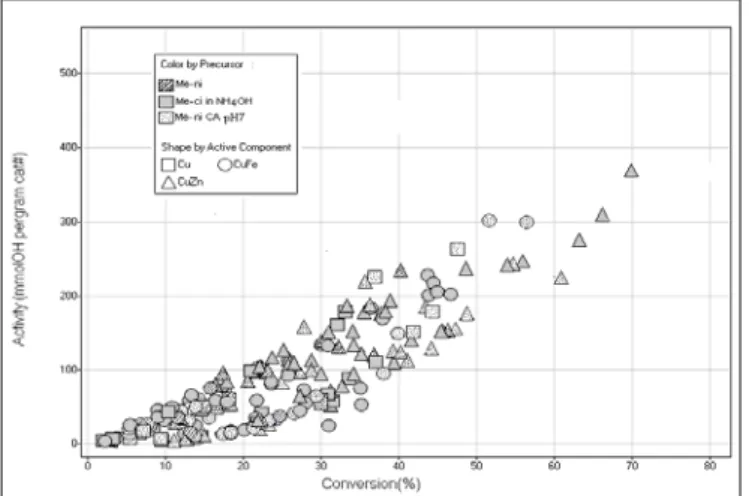
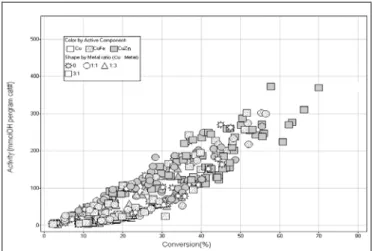
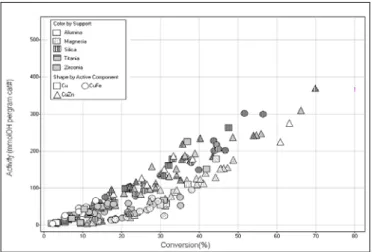
The results of the catalyst screening were evaluated by ranking of catalysts on the basis of their activity as well as on the basis of the trends per family of catalysts. As can be seen from Figures 1, 2, 3, 4, and 6, (plot of activity expressed as mmol OH per gram catalyst versus conversion %) most of the catalysts show high conversion values in tandem with high activity towards the alcohol.
3.1 Effect of precursor and active component
Precursor compound is important to give the required structure of active metal component of catalysts especially in the synthesis of higher alcohol as concluded by W. Moser in 1996 [3]. A good precursor is the one containing good leaving anion group at moderate conditions. Figure 1 shows the influence of catalyst synthesized using different metal precursors. These chelated precursors were reported to give high dispersion of metal (oxide) particles on the support and with a narrow particle distribution [4]. Some Me-ci in NH4OH precursor
especially Cu-Zn catalyst demonstrates conversion more than 60% and activity more than 300 mmol OH per gram catalyst.
Most of the Me-ci in NH4OH precursor of Cu and CuFe demonstrate low conversion and
activity. It seems that CuZn is the most suitable catalyst of the Me-ci in NH4OH precursor.
Besides Me-ci in NH4OH precursor, the catalyst has many advantages and is widely used to
synthesize nanoparticle oxide and produce better homogenous distribution and dispersion of metallic elements on the support compared to Me-ni CA pH7 and Me-ni precursor [4]. It was also reported from SEM observation on calcined Cu-Zn catalyst prepared from Me-ci in NH4OH precursor that Cu oxide could be seen as small particles sitting isolated but well
supported on the coarse structure of the support [5]. Me-ni CA pH7 precursor shows better performance compared to Me-ni precursor with the best catalyst of Me-ni CA pH7 precursor, conversion and activity are at 62% and 206 mmol OH per gram catalyst respectively. All active components in Me-ni CA pH7 precursor have not shown any significant trend for discussion.
It is assumed that maybe Me-ni CA pH7 precursor is mainly suitable in porous supported catalyst. In addition, it is in agreement with the work of Nidhy [5] who reported that the Me-ni CA pH7 precursor is the best precursor in alumina porous supported catalyst in hydrogenolysis of methyl acetate compared to Me-ni and Me-ci in NH4OH precursors.
Furthermore, Me-ni precursor shows low conversion and activity maybe due to the nitrate precursor often resulting in relatively large active particle in catalyst and consequently a small active metal surface [4]. Only several CuZn of Me-ni precursor shows more than 30% conversion and activity higher than 100 mmol OH per gram catalyst. Based from Figure 1 above, the overall trend could be assumed as:
Me-ci in NH4OH > Me-ni CA pH7 > Me-ni
3.2 Effect of active component and ratio
Activity and selectivity correlate well with the crystallinity and properties of the selected active component in the catalyst. Cu-based catalyst has been intensively used due to recent practical uses in promoting steam reforming, dehydrogenation and ester hydrogenolysis [6]. The effects of zinc and iron compound as a second metal in Cu-based catalysts at different ratio were investigated for obtaining useful information. Figure 2 shows the influence of different active component and ratio. Most of the catalysts show some high conversion values in combination with a high activity towards the alcohol. The graph demonstrates that, Cu-Zn catalysts with ratio at 3:1 exhibits good performance and with several catalysts of this type show conversion more than 60% and activity more than 200 mmol OH per gram catalyst. This result is in agreement with other literatures [7-9]. It was reported that Zn assisted the Cu-based catalyst to stabilize the structure and separate the copper crystallites physically thus hindering sintering process.
Figure 2 Effect of catalyst’s activity in different active component and ratio
However, it was also reported that Zn only act as textural promoter because mono-Zn supported catalyst has not shown any activity under same reaction conditions [5]. That is why the activity of the catalyst is largely determined by the amount of copper in Cu-Zn catalyst series. The catalyst activity simply increases by the addition of Cu in the bi-metallic Cu-Zn catalyst.
On the other hand, the amount of copper loading is not much affected in Cu-Fe catalysts series. Cu-Fe catalysts with Cu-Fe ratios at 3:1 and 1:1 show almost the same conversion and
activity. However, Cu-Fe with ratio at 3:1 and 1:1 give better conversion and activity compared to Cu-Fe ratio at 1:3. It was reported that the addition of small amount of Fe is enough to effectively improve the catalyst activity and stability at high temperature reaction conditions [10]. On the other hand, the Cu-Fe ratio at 1:3 leads to low conversion and activity. Overall Cu-Fe catalyst with ratio 1:3 shows conversion less than 30% and activity less than 100 mmol OH per gram catalyst. It is assumed that Fe, which act as textual promoter [5] has taken more surface area on the support compared to Cu, which in turn acts as the main active component. The same observation has also been seen on Cu-Zn catalyst at metal ratio 1:3 that exhibit conversion less than 35% and activity less than 160 mmol OH per gram catalyst.
Mono copper catalyst in Figure 2 has shown the lowest performance compared to Cu-Zn and Cu-Fe catalysts. Most of the mono copper catalysts show conversion less than 40 % and activity less than 200 mmol OH per gram catalyst. It is because copper metal can easily sinter and is also unstable at high temperature during reaction which leads to the loss of Cu surface area and hence poor catalytic activity. It is assumed that mono copper catalyst can be improved by using supported binary system catalyst. Based from the Figure 2 above, the overall trend could be assumed as:
Cu-Zn > Cu-Fe > Cu
3.3 Effect of support and active component
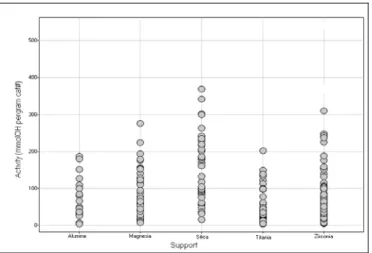
Figure 3 Activity of catalyst ranked by support
Figure 3 and 4 show the effect of using different supports. Gil et al. [10] studied the effect of preparation method and nature of the support for catalysts. They claimed that the metal support interaction is strongly dependent on the preparation method and also the reactivity of the support towards catalysts plays an important role. That is why support is one of the most important variables to achieve an optimal dispersion and minimize the sintering process in catalyst formulation. Figure 3 depicts the ranking of catalyst activity on various supports and it is found that silica support is the best support compared to other support. Cu-Zn supported with silica gives the best activity trend as shown in Figure 4. This is in agreement with the result of Scheur et al. [6]. They reported the irreversible sintering in CuO-ZnO on silica even at reduction at 673 K. The catalyst composition caused stabilization of a specific interaction between Cu-Zn on silica and thus prevents the catalyst from deactivating at high temperature. Some of the supported Cu-Zn on zirconia and magnesia catalysts shows high performance with conversion more than 50%. Zirconia is the second best support and mostly the catalysts
exhibit conversion more than 30%. Based from figure 4, the overall trend could be assumed as:
Silica > Zirconia > Magnesia > Alumina > Titania
Figure 4 Effect of catalyst’s activity in different support and active component 3.4 Comparison between experimental and reference catalysts
The experimental catalysts were benchmarked with against 7 commercial catalysts of unknown composition. Figure 5 shows the comparison between experimental and commercial catalysts. From this figure it can be concluded that the activities of some of the experimental catalysts perform almost at the same level as the commercial catalysts. This result points towards a high potential for experimental catalysts especially for Cu-Zn, also it should be considered that these commercial catalysts are all optimized catalysts and that the catalysts prepared in this screening phase have not been optimized. A1 demonstrates the best performance compared to other experimental catalysts. A1 catalyst, which is Me-citrate 3Cu1Zn supported on silica, gives conversion and activity of 69.9% and 373.1 mmol OH per gram catalyst.
4.0 Conclusion
The combinatorial process greatly facilitates and allows the exploration of large and diverse compositional and parameter spaces by establishing an integrated workflow of high-throughput assaying of catalysts and large-scale data analysis. The screening test shortened the experimental duration with more than 150 catalysts tested within 2 months. It was deduced that the catalyst in the family of silica support, Cu-Zn bimetallic and prepared from metal-citrate solution shows high activity in hydrogenolysis reaction. Thus, it would be very interesting to investigate the optimization of the catalysts in this family by studying in extensively and in detail and on the activity and activation-structural relationship of the lead catalysts. High-throughput catalyst screening allows speed-to-market and increase productivity of catalyst development programme.
Reference
[1] www.frost.com/prod/servlet/market-insight/fattyalcohol.htm. 5 January 2005.
[2] T. Turek, D.L. Trimm.1994.The catalytic hydrogenolysis of esters to alcohols. Catalyst Revision-Science
Engineering. 36(4):645-683
[3] W. Moser. 1996. The preparation of advanced catalytic materials by aerosol processes. Advanced catalysts
and nanostructured materials conference:535-562.
[4] S.T. Lee. 2004. Development of hydrogenation catalyst and application of combinatorial technology. Master of Science Thesis,University Malaya.
[5] N.R. Mohan. 2005. Development of catalyst for the hydrogenation of ester to alcohol using combinatorial technology. Philosophy honour of Degree Thesis, University Malaya.
[6] F. Scheur, V.J. Vreeswijk. 1994. Process for production of alcohols. European Patent 94 06738.
[7] Y. Okamoto. 1983. Copper-ZnO catalyst for methanol synthesis. Journal of Physical Chemistry. 87:3474-3475.
[8] C.H. Travers.1984. The catalytic hydrogenation of esters to alcohols. Journal of Molecular
Catalysis.25:327-336.
[9] S.C. Chen, W.H. Cheng,Lin, S.L. Shou. 2004. Study of iron-promoted Cu/SiO2 catalyst on high
temperature reverse water gas shift reaction. Applied Catalysis A: General.257: 97-106.
[10] R.Gil, M. Arvela, L.P. Tainen, S. Tapio. 1997. Kinetics of the hydrogenation of citral over supported Ni catalyst. Studies in surface science and catalysis. 108: 273-280.