Critical Elements of the Constructive Performance Feedback: An
Integrated Model
Nosheen Nawaz1*Ayesha Jahanian2 Syeda Wajiha Manzoor2
1. The Islamia University of Bahawalpur, Department of Management Sciences, Post code 63100, Bahawalpur, Pakistan
2. Department of management Sciences, The Islamia University of Bahawalpur, Punjab, Pakistan * E-mail of the corresponding author: [email protected]
Abstract
Purpose: The purpose of writing this paper is to give an integrated framework in the form of a model for better understanding of the elements of performance feedback which are reinforcing.
Design/Methodology: A synthesis of existing literature on performance feedback in the form of research papers, consultations and training reports etc. is used to identify critical elements of reinforcing feedback and then integration of all these elements is done after categorizing these elements/variables.
Findings:Findings are presented in the form of model i.e. theoretical framework is developed.
Research Implications: The result of this article can be used to guide an ongoing research in the area of effective performance appraisals in general and performance feedback in specific.
Originality/Value: The research paper tries to increase the conceptual understanding regarding what an effective performance feedback mechanism of organization should consist of.
Keywords: elements, effective, constructive, reinforcing performance feedback
1. Introduction
Owing to the growing importance of human resource a strategic resource whose proper management and effective development can enable an organization to attain such a competitive edge over competitors that can neither be copied nor can it be imitated , the focus on each and every element of performance management has significantly increased. One of the key elements that fall under the umbrella of human resource compass in wider sense and human resource management in narrow terms is performance feedback. Performance feedback is at the heart of performance appraisal process in organizations and no organization can enhance the productivity of their workforce without letting them know where they stand in terms of output that they generate in relation to what they were expected to do , in terms of where and what is lacking in their performance or in terms of what are the positive points of their performance or behavioral aspects of them that contributed to better performance and those that are needed for better future related performance etc and all these things or processes along with many other constitute performance feedback.
Observing the complexity and necessity and significance of ‘performance feedback’ in uplifting performance and grasping the core objective of performance management and performance appraisal systems (i-e performance enhancement), this paper therefore focuses on identifying those variables that are critical and that need to be necessarily present in a feedback mechanism design that is intended to be effective and constructive .The paper goes in the following flow:
The first part of paper puts a gloss on existing literature on performance feedback mechanism and its elements and the second part of the paper is used to present findings in the form of model which will be an integration of critical variables identified from preceding part.
1.1 Effective performance feedback and work related attitudes
Some of the most important things at which manager’s aim are increasing productivity, job, commitment and motivation level of their employees and to be able to achieve this the managers need to take an active role in aiding and supervising their employees to effectively complete their jobs and to attain their career peaks. And this becomes impossible unless the managers talk to employees about how they are performing and how they can perform well i.e. need and core importance of performance feedback in achieving employee commitment, motivation and employees enhanced performance (Freeman ,2004,2007).
The role of one of the important parts of performance appraisal systems i.e. performance feedback in organizations have been continuously investigated and researched during the past few decades (e.g. Nadler ,Schaubroeck ,Ashford and Cummings etc)in order to have a better understandings of the concepts that will load to its optional implementations(S.M Yik,2002). Different authors and researchers have noticed different things in this respect. The enhancement in performance and performance related behaviors have been reported as a result of performance feedback after expensive research(Brand,1905 ;Arps ,1920). It is very important to give and provide employees with such performance feedback that enhance their performance and lead to overall workforce development, it is critical and at the same time it is difficult to do so as well(AIHPB ,2004).
One of the related studies highlighted the critical role of appraise or super-ordinate in giving feedback that is constructive. Before getting into contact with the sub-ordinate the supervisor should clearly understand the reason for meeting with sub-ordinate, what are the reasons for good or bad performance and what really does super-ordinate want to get out of sub-ordinate what behavioral changes does super-ordinate intend to get out of sub-ordinate as a result of communication of feedback or performance review discussion (PRD).
The supervisor should be prepared for expected response of employee to feedback. The super-ordinate must have skills to conceptualize and to prepare oneself for expected and unexpected responses of incumbent (USI,2004). The supervisor is indeed a critical part of reinforcing performance of employee systems and therefore must be provided with training for effectively dealing with employees. Training is given to manager to help them to become able to give constructive feedback in organizations that tend to be pioneers in developing effective and functional performance appraisal systems by deploying best practices (AIHBP,2004).
While communicating feedback with the employees the manager must be emotionally intelligent(i.e. he must be able to understand and handle self and others emotions), he must have the ability of communicating his point effectively (i.e. communication skills), he must be a good listener as it is a key to fruitful communication ,bear a constructive tone ,he must have planned time ,meeting and mode of giving feedback (i.e. he must have a planning skill)and all these skills of manager will play a part in leading an employee to reduced absenteeism ,unprofessional discourteous conduct etc (USI ,2004). The ability of the manager to communicate the information related to performance in an honest and effective way affect the level of engagement and commitment of employees (Freeman, 2004, 2007). Apart from the role of appraiser in giving constructive feedback other things play a vital role in making effective feedback possible. Ways to make performance feedback useful in terms of enhancing employee performance as a core intended result include (1) Developing good relationship between the one who gives and the one who is given feedback before final communication of feedback(i.e. trust building and confidence development) (2)Making possible the feedback that reflects both the strength and improvement by overcoming weaknesses and boosting strengths.(3) Putting a gloss on highly specific and attainable ,objective opportunities for growth and development (4)Assuring employee participation and openness in feedback sessions(i.e. ensure two sided discussions) etc (Greenberg 1986 ;Denisi, 1996).
The focus of the performance feedback should be on the improvement of performance i.e. it should focus on increasing quantity and quality of output from employee by building motivation and enhancing commitment. Good and actionable feedback is based on some significant productive axioms (1) feedback must be objective and factual and must be based on observable behavior (2) it must allow the participation from employee’s side and the super-ordinate should not bar employee’s concerns rather he should encourage participation from employee’s side and try to engage in two sided fruitful discussion etc (VL, 2006).
One unique study identified that timely feedback is helpful for both the individual and suggested that feedback must be given when it is needed in order to achieve the benefits of it. When feedbacks are given on accurate times they tend to develop positive work related attitudes such as commitment, job satisfaction, perceived justice and fairness in employees. And these work related attitudes are indicators of better future performance of employees (M.S Taylor et al 1984).
Rao ,2004 indentified that in order to make performance review discussion (a formal source of performance feedback) successful it should necessarily be based on (1)description rather than self judgment (2)must be focusing on employee’s behavior not his personal life or attitudes (3)must be conducted for the purpose of helping employee to improve his performance (4)acknowledges and is beneficial for both appraiser and appraise (5)is timely and must be conducted in time of need (6)mutuality trust and openness between the two parties i.e. appraise and the appraiser. Personality of employee as well as appraiser also play crucial role in the process of conducting constructive feedback .Personality must be investigated and well researched in the coming times in order to successfully implement feedback process in organizations(Denisi ,1996).
Personality understanding plays a key role in performance management for example the employees having external locus of control must be treated differently as compared to employees with internal locus of control in order to take and get best out of them (Spillane ,2005). Feedback is related to individual differences and personalities of employees. People are mostly interested in knowing about their own selves and want to verify their self-judgment with the judgment of others about themselves (Baumeister 1998, 1999).
People who have adventurous personalities and are open to experience newer things are looking forward for the feedback to know about how well they are doing in the eyes of others and then use this feedback in self enhancement (Barrick et al 1991; Costa et al, 1992). Some researchers (like Synder and Copeland 1989; Waraech, Smither, Reilly, Millsap, 1998) who worked on another personality aspect, they have argued that people who are self monitored care about what others think about them tend to shape their behaviors accordingly in order to meet expectations of people .People who have sensitive personalities are concerned about people’s expectations and make modifications in their behaviors to protect their self egos and overcome uncertainties. This personality characteristic of employees is therefore important to understand in order to conceptualize how employees will react initially to the performance feedback (Levy et al, 1995).
Personalities of employees are important to understand as they guide the way feedback should be given to them like people who have higher level of confidence can easily be reinforced by continuing success (Baumeister, 1998) and its communication to them. Personality and personality related traits have a significant affects on work related attitudes and performance and therefore an understanding of personality is critical in managing performance (Khosla, 2009).
Another important issue base lining constructive feedback is supportive organizational culture. Organizational culture should be supportive in a sense that it should allow and help people to be able to more easily hear or share feedback important for their work performances (Smither, 2002). Feedback provided in an environment of trust, mutuality and the feedback that is behaviorally focused and takes place in non threatening environment, is more productive and fruitful (Smither 2002). A strong feedback culture can be defined as the one that allows employees to receive, sort and use feedback in such a manner that their overall productivity and performance level is raised (Cederblom, 1982).
1.2. Modes of giving feedback
There are several modes of giving performance feedback in organization. Categorization of feedback modes or mechanisms has been done by various authors (e.g. Rao, 2004). Formal and informal sources or mechanisms of communicating and giving performance feedback to employees are the two broad categories of sources of performance feedback in organizations. One of the formal ways of giving feedback to incumbents in organizations includes formal Performance Review Discussion (PRD) at the end of ‘performance period’ (Rao, 2004). PRD’s main focus is to enhance employee performance by providing employees of their performance. For PRD’S to be successful in achieving its intended goal of achieving better employee’s performance it needs necessarily to be conducted in an
environment of trust between the employee and the appraiser. Degree of acceptance of feedback by employee is another important element is conducting successful PRD (Rao, 2004).
Other formal ways of communicating performance result appraisal in organizations are the administrative tools such as Performance Related Pay (PRP, i.e. pay salary is based on employee’s level of performance), Bonuses and Promotions etc (Rao, 2004). Sometimes job enrichment and on/off job training are also used to provide performance feedback (USI, 2004). Administrative decisions related to human resource management like promotions, bonuses, salary, increments, cessation of contracts etc are based on the results of periodic formal appraisals done and are the indications of how good or bad an employee performed (Murphy and Cleveland, 1995), thus they are formal sources of feedback.
The other category of communicating and providing feedback to employees include informal sources of feedback. Some authors identified that feedback cannot only be communicated through formally written rules and regulations rather information on what is and how is going on can be communicated effectively through less formal or sometimes informal interaction between members of the organizations (e.g. Clancy, 2009). Information can be transferred from one to another entity in organizations through informal personal networks and teams. Thus informal personal networks can be a source of giving feedback (e.g. peer channels) (Karlson, 2008).
Information regarding how an individual or an employee is performing in relation to the role or task he is assigned to complete is important factor in making him do his job in better way. (Farr, 1993) identified that day to day interaction can be an important source of communicating such information. Informal day to day interaction must be given importance as it has more potential of shaping and modifying employee work related attitudes and behaviors and thus his performance than that of periodically given formal performance feedback. Thus training should be given to managers on how they can successfully convey feedback using informal modes. (Ashford, 1983) has written manager’s smile or co-worker’s invitation to lunch as indirect modes of feedback, but in order to be able to achieve the intended purpose of feedback they should be inferred correctly and in the right context by the performer.
1.3. Initiators of feedback provision
Work related information is important for the employee as well as for the organizations in order to achieve high levels of performance and thus the feedback of how good or bad the employee is performing is given by the managers to the employees most of the times. So managers need to communicate individuals the feedback of their performance as an integral part of their job as managers (Farr, 1993). So manager is the initiator of feedback most of the times. POSDCORB, the Henri Fayol’s description of major managerial functions included feedback provision as important aspect of managerial job under directing and controlling functions. Thus again the manager has been identified as having feedback provision as important task in his job completion.
Apart from the managers as the initiators of performance feedback the performer himself can be the initiator. Performer can be motivated to and interested in getting informal feedback about his performance in order to either enhance one’s performance by overcoming weaknesses or to encourage one’s own self by positive reinforcement or both. Performer seeks to get such information in two ways.
One of the ways is to keenly observe the environment to look for feedback cues and then draw inferences about his performance, the second way can be direct inquiry from the evaluators (Cuming et al 1983). Yet another method of getting informal performance feedback by performer is to give indirect cues to supervisor and to prompt him to give feedback, this is the less direct method of seeking self initiated feedback (Starnes, 1991).
Proactive feedback seeking is a common and vital phenomenon in organizations that is done by performers in order to get their work related information that guides their behaviors; this is reported in the research conducted by Cuming et al (1985). Thus managers as well as the performers can be the initiators of the feedback provision process. 2. Findings and conclusion
From the literature discussed on performance feedback and the different concepts that underlie it, we are now in a position to develop an integrated model that combines all those elements that are important in making feedback effective and fruitful.
From the literature it can be identified that certain work related attitudes are intended to be generated as a result of successful feedback provision. Feedback is successful and is termed as constructive when it is able to generate certain important attitudes and behaviors in employees that are necessary in enhancing their overall performance. These attitudes include attitude of less absenteeism, decreased turnover intention, enhanced job satisfaction, raised levels of organizational commitment and increased productivity both in terms of quality and quantity as resultant of these attitudes.
From the literature review it can be identified that there is a clear link between these work related attitudes and enhanced productivity and constructive feedback .Other things remaining the same the above mentioned work related attitudes and greater productivity is a function of constructive feedbacks that tends to generate high level of commitments, low absenteeism, low inclination towards turning over, etc and thus better performance or productivity.
(FIG 1.0).
Thus in order to achieve higher level of performance and enhanced productivity the organizations need to conduct and convey performance feedback in such a way that it becomes fruitful and successful in achieving the optimal state of affairs .
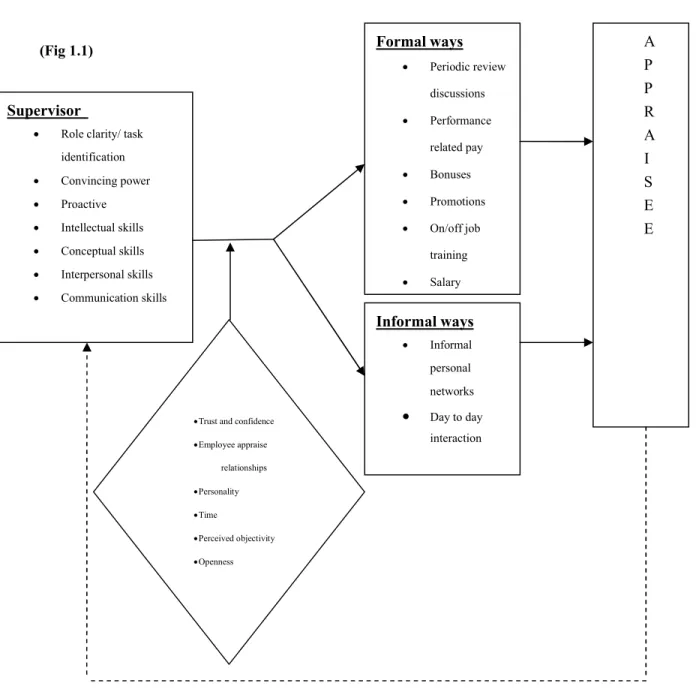
The cursory view of the literature suggests some important elements of feedback that enhance positive work related attitudes .These elements can be integrated in the form of the model to show the constituents of constructive performance feedback and the entities that play vital role in making feedback successful and achieving its intended results, the model is shown in (FIG 1.1)
The two most important entities between whom the conversation of feedback takes place are the supervisor (appraiser) and the appraisee. The supervisor communicates feedback of performance to the appraise using different modes of feedback. These include formal and informal mechanisms.
Formal ways include periodic performance review discussions, performance related pay (PRP), bonuses, promotions, on/off job training ,salary increments ,contract cessation etc. Formal ways of providing feedback are those that are present in organization’s diary of rules.
Informal ways that can be used by managers, supervisors or appraiser to indicate feedback or performance level are informal personal network (i.e. use of peers etc as a medium for conveying appraisee performance), day-to-day interaction etc. Day-to-day interactions is a broad category of informal ways of feedback provision and includes ways such as providing feedback through facial expressions (mood, good or bad mood), through decreased level of interaction than usual in case of poor performance of employees, through encouragement of expression of ideas of employee who is performing well (i.e. increased input taking good performers), through appreciation in social gatherings or through indirect praising statements etc. So managers use one or both formal and informal ways of giving feedback depending upon the situation.
The figure indicates certain factors that are critical in conducting effective performance feedback. These include trust and confidence in systems, the greater the trust an employee has on the results of appraisal and that on appraiser the more likely his behavior will be modified positively by receiving feedback; employee-appraiser relationship do affect feedback effectiveness ;personality understanding of both employee and supervisor is important without it feedback is less likely to achieve its goals; time is important , as only timely feedback leads to improved performance otherwise its of no use.
Perceived objectivity also influences the achievement of objectives of feedback, greater objectivity perception leads to better results; openness between the appraiser and appraise needs to be there; feedback specificity mediates feedback usefulness as more specific feedback is acknowledged more by employees; two sided concern is important, the employees must be aware of how the feedback can benefit them in their personal and career development.
Finally the organization culture should be supportive for feedback provision; efforts should be made to develop such a culture in organizations where everybody wants to seek feedback of his performance in order to improve him and his performance and feels no shame in doing so.
Moral development and skill training of workforce specially managers or supervisors is done to a level that they are never threatening rather give feedback in such a way that it is non-threatening and flexible and hence more productive, in feedback supportive culture feedback seeking and giving is considered as a useful resource rather than a matter of threat or shame.
The figure indicated supervisor as the transmitter of feedback. The role of supervisor cannot be neglected in effective feedback implementation. The supervisor needs to possess necessary skills like conceptual, interpersonal, human skills, communication skills etc as well as he needs to be pro-active and must have the ability to identify when and how feedback is needed. Sometimes feedback is initiated by supervisor or manager as part of his duty.
The feedback may be triggered by some pro-active employees in some cases where employees are self-motivated and are increasingly interested in developing them and their performances. The pro active employees in such cases give clues to the appraiser or directly ask them feedback that results in their enhanced job performance if the feedback is timely ,objective ,specific ,relevant etc and is communicated through right mode by keeping into consideration the personalities of both appraiser and appraise ,the organizational culture ,the organizational and individual concern etc.
3. Implications
The model presented in findings containing the critical elements of the constructive performance feedback can be used to guide an ongoing research in the area of feedback and performance appraisals. The model also provides a room for its empirical validation by applying it into the real world organizations.
References
Acenture institute of high performance business. (2004). Mastering workforce performance appraisal.
Arps, G. F. (1920). Work with knowledge of results versus work without knowledge of results. Psychological
Monographs, 28, 1–41.
Ashford, S. J., & Cummings, L. L. (1983). Feedback as an individual resource: Personal strategies of creating information. Organizational Behavior and Human Decision Processes, 32, 370–398.
Ashford, S. J., & Cummings, L. L. (1985). Proactive feedback seeking: the instrumental use of the information environment. Journal of occupational psychology, 73,199-207
Barrick,M.R., and Mount,M.K.(1991). The big five personality dimensions and job performance: a meta analysis . Personnel psychology,44,1-26
Baumeister,R.F. (1999). The nature and structure of self :an overview. In R.F. Baumeister(Ed).the self in social psychology(pp. 1-20). Philadelphia: Psychology press.
Baumeister,R.F. (1998).The self . In D.Gilbert, S. Fiske, and G. Lindzey (Eds),The handbook of social psychology (volume 1, 680-740). Boston: Mcgraw Hill
Brand, J. E. (1905). The effect of verbal suggestion upon the estimation of linear magnitudes. Psychological
Cederblom, D. (1982). The performance appraisal interview: A review, implications and suggestions. Academy of management review, 7,219-227.
Clancy D.K-Collins F. (1979) informal accounting information systems: some tentative findings.Accounting, organization and society, 4:1/2, pp.21-30
Costa P.T.,Jr.,and McCrae R.R.(1992). Revised NEO personality Inventory (NEO PIR) and the NEO Five-factor inventory (NEO-FFI) professional manual. Odessa, FL: Psychology assessment resources.
Farr, J.L (1993). Personal selection and assessment: individual and organizational perspective. London: psychology press
Freeman, J. (2004). Working in theory but failing in practice? How to make performance management and appraisal programs by overcoming the root cause of problem. Montreal : performance feedback.
Greenberg (1986). Determinants of perceived fairness of performance evaluation. Journal of applied psychology, 340-342
Herold,D.M.,&Parsons,C.K.(1985). Assessing the feedback environment in work organizations: Development of the job feedback survey. Journal of applied psychology,290-305 In K. R. Rowland & G. R. Ferris (Eds.), Research in
personnel and human resource management (Vol. 2, pp. 81–124). Greenwich, CT: JAI press
John schaubroeck , S.S. (2002). Responses to Formal performance appraisal feedback : the role of negative affectivity. Journal of applied psychology , 192-201
Karri Lukka, K. (2008).Retrieved from http://lipas.uwasa.fi/ktt/lasktoim/tuto2008/karlssonhanna2008.pdf Kluger, A. N., & DeNisi, A. (1996). The effects of feedback interventions on performance: A historical review, a meta-analysis, and a preliminary feedback intervention theory. Psychological Bulletin, 119, 254–284
Khosla. (n.d).separating the wheat from chaff: an intelligent sales recruitment and benchmarking system. Expert systems with application.
Levy,P.E.,Albright,M.D.Cawley,B.D.,and Williams , J.R (1995). Situational and individual determinants of feedback seeking: A closer look at the process. Organizational behavior and human decision processes,62,23-37.
Murphy, K. R., & Cleveland, J. N. (1995). Understanding performance appraisal: Social, organizational, and
Rao,T.(2004).Performance management and appraisal systems: H.R tool for global competitiveness. Sage.
Smither.(2002).Feedback orientation, feedback culture and longitudinal performance management process. Human resource management review , 81-100
.
Starnes,W.,&Farr,J.L.(1991).Prompting as a mode of feedback seeking. Unpublished manuscript, Department of psychology, Pennsylvania state university, University park.
Synder,M.,& Copeland(1989).self monitoring processes in organizational settings.In R.A. Giacalone & P.Rosenfeld(Eds.),impression management in the organization (pp. 7-19). Hillsdale, NJ: Erlbaum.
Taylor, M. S., Fisher, C. D., & Ilgen, D. R. (1984). Individuals’ reactions to performance feedback in organizations: A control theory perspective.
US department of interior.(2004).Retrieved from http://www.doi.gov/hrm/guidance/370dm430hndbk.pdf Vital learning business and life.(2006).The role of goal setting and performance feedback in achieving peak performance.
Wareach,M.A.,Smither,J.W.,Reilly,R.R.,Millsap,R.E.,&Reilly,S.P.(1998). Self monitoring and 360-degree ratings. Leadership quarterly, 9,449-473.
(Fig 1.0)
=
f
(constructive performance feedback)
Fig.1.0 Relationship between work related attitudes and constructive feedback
Work related attitudes
Low absenteeism Higher job
commitment
Higher job satisfaction Decreased turnover
intention
(Fig 1.1)
Proactive employees
Fig 1.1
an integrated model showing critical elements of the constructive performance feedback
Supervisor Role clarity/ task identification Convincing power Proactive Intellectual skills Conceptual skills Interpersonal skills Communication skills Formal ways Periodic review discussions Performance related pay Bonuses Promotions On/off job training Salary Informal ways Informal personal networks Day to day interaction A P P R A I S E E
Trust and confidence
Employee appraise relationships Personality Time Perceived objectivity Openness