Automatic Novice Program
Comprehension for Semantic
Bug Detection
Abejide Olu, Ade-Ibijola
School of Computer Science and Applied Mathematics
University of the Witwatersrand, Johannesburg
A thesis submitted to the Faculty of Science in
fulfillment of the requirements for the degree of
Doctor of Philosophy
in Computer Science
Automatic Novice Program Comprehension for Semantic Bug Detection.
Copyright cUniversity of the Witwatersrand, Johannesburg, South Africa.
All rights reserved. No part of this publication may be stored in a retrieval system, transmitted, or reproduced, in any form or by any means, including but not limited to photocopy, photograph, magnetic or other record, without prior agreement and written permission of the copyright holder.
s u p e r v i s o r s:
Professor Sigrid Ewert Professor Ian Sanders
s u p p o r t e d b y:
National Research Foundation Vodacom South Africa
University of the Witwatersrand, Johannesburg JC Carstens Fund
A U T O M AT I C N O V I C E P R O G R A M C O M P R E H E N S I O N F O R S E M A N T I C B U G D E T E C T I O N
a b e j i d e o l u
,
a d e
-
i b i j o l a
[email protected] www.abejide.comA thesis submitted to the Faculty of Science, University of the Witwatersrand, Johannesburg,
in fulfillment of the requirements for the Degree of
Doctor of Philosophy in Computer Science
To every person, living or dead, who has contributedknowledgeto the advancementof mankind.
D E C L A R AT I O N
I, Abejide Ade-Ibijola, hereby declare the contents of this doctoral thesis to be my own work. This thesis is submitted for the degree of Doctor of Philosophy in Computer Science at the University of the Witwatersrand, Jo-hannesburg. This work has not been submitted to any other university, or for any other degree.
Abejide Ade-Ibijola April,2016
A B S T R A C T
A
utomatically comprehending novice programs with the aim of giv-ing useful feedback has been an Artificial Intelligence problem for over four decades. Solving this problem basically entails manipulat-ing the underlymanipulat-ing program plans; i.e. extractmanipulat-ing and comparmanipulat-ing the novice’s plan to the expert’s plan and inferring where the novice’s bug is from. The bugs of interest in this domain are often semantic bugs as all syntactic bugs are handled by automatic debuggers — built in most compilers. Hence, a program that debugs like the human expert should understand the problem and know the expected solution(s) in order to detect semantic bugs. This work proposes a new approach to comprehending novice programs using: regular expressions for the recognition of plans in program text, principles from formal language theory for defining the space of program plan vari-ations, and automata-based algorithms for the detection of semantic bugs. The new approach is tested with a repository of novice programs with known semantic bugs and specific bugs were detected. As a proof of con-cept, the theories presented in this work are further implemented in software prototypes. If the new idea is implemented in a robust software tool, it will find applications in comprehending first year students’ programs, thereby supporting the human expert in teaching programming.P U B L I C AT I O N S
S
ome ideas in this thesis — including verbatim images, equations, and concept descriptions have been featured in the following articles. A number of these articles have been published and others have been completed, submitted, and currently undergoing peer-review as at the time of submitting this thesis.[1] Abejide Ade-Ibijola, Sigrid Ewert, and Ian Sanders. Novice program
comprehension and tutoring.Proceedings of the M&D Symposium of the Annual Conference of the South African Institute of Computer Scientists and Information Technologists, East London, South Africa,pages1–2,2013.
[2] Abejide Ade-Ibijola, Sigrid Ewert, and Ian Sanders. Abstracting and
narrating novice programs using regular expressions.Proceedings of the Annual Conference of the South African Institute of Computer Scientists and Information Technologists, Centurion, South Africa,pages19–28, ACM
In-ternational Conference Series, doi:10.1145/2664591.2664601,2014.
[3] Abejide Ade-Ibijola, Sigrid Ewert, and Ian Sanders. How many ways
can we skin a cat? Searching the space of novice program plan varia-tions. Proceedings of the 2014Joint PRASA, RobMech and AfLaT Interna-tional Joint Symposium, Cape Town, South Africa,page317,2014.
[4] Abejide Ade-Ibijola, Sigrid Ewert, and Ian Sanders. Introducing Code
Adviser: A DFA-driven electronic programming tutor.In Proceedings of the20th International Conference on the Implementation and Application of Automata (CIAA), Umeå, Sweden, pages 307–312, Springer LNCS 9223,
doi:10.1007/978-3-319-22360-525,2015.
[5] Abejide Ade-Ibijola, Sigrid Ewert, and Ian Sanders. Searching the space
of novice program plan variations. Submitted to the South African Com-puter Journal,2015.
[6] Abejide Ade-Ibijola, Sigrid Ewert, and Ian Sanders. Detecting semantic
bugs in novice programs using DFA abstraction.Submitted to the Journal of Frontiers of Computer Science (Springer),2016.
[7] Abejide Ade-Ibijola, Sigrid Ewert, and Ian Sanders. Automata-aided
estimation of similarity in novice programs.Submitted to Journal of Com-puter Science and Information Systems (Serbia),2016.
“A tree cannot make a forest”—An OldYorub` a´ Proverb
A C K N O W L E D G M E N T S
T
his PhD programme will not be successful without the contribution of very important people. Starting with my supervisors, Prof. Sigrid Ewert and Prof. Ian Sanders. I am grateful to Sigrid for giving me the opportunity to work with her, and for all the valuable insights and sup-port, especially for: sponsoring my SAICSIT1conference attendance of2013,
securing my Vodacom scholarship award of 2014, her many editorial
com-ments that have made me a better writer, and the time she spent in helping me with the refinement of the equivalence formalism using formal language notations. Similarly, I appreciate the support of Ian for suggesting this topic to me in the first place; all his contributions from the start to finish of this work, and his career advice.
For their support during this PhD programme, I am grateful to the following people (in random order):
• Referees — Prof. Bruce William Watson (Stellenbosch University), Prof. Turgay Celik, Prof. Gilbert Khadiagala, Dr. Simon Abbott, and Dr. Bern-hard Zipfel.
• WITS Computer Science and Applied Mathematics Staff — Pravesh Ran-chod, Mike Mchunu, Kgomotso Monyepote, Shashilan Singh, Dr. Ben-jamin Rossman, Precious Shabalala, Kebadiretse Mosiane and others.
• Friends — Dr. Niyo Akerele, Dr. Gideon Fareo, Jefferson Imhazenobe, Daniel Kwofie, Michael Bodunrin, Ike Innocent, and Abiodun Mod-upe.
• Abeced Team— Nicol Bell, and others.
• Special Support — Special thanks to: Prof. Mary Scholes for her inter-vention in the travel funding process that aided my participation in the CIAA2
conference in Umeå, Sweden, and to Prof. Ebrahim Momoniat for nominating me for the IBM3
internship programme.
1 South African Institute of Computer Scientists and Information Technologists 2 Conference on the Implementation and Application of Automata
3 International Business Machines Corporation
tainly not least, thanks go to my entire family for their support — in partic-ular to the following: Prof. and Dr. (Mrs) Ibijola, Grace, Albert, Dr. Aderemi, Ololade, Abidemi, Engr. Seyi and Tolu; and others not listed here.
Sponsors.
This research was supported with the following awards/grants/scholarships.
• NRF4
International Conference Travel Grant2015— NRF South Africa, • CoEMaSS5
International Conference Travel Grant 2015 — CoEMaSS,
University of the Witwatersrand, Johannesburg,
• Doctoral Innovation Scholarship Award 2015 — NRF in conjunction
with the Department of Science and Technology (DST), South Africa,
• Postgraduate Merit Award2014 and2015— University of the
Witwa-tersrand,
• Vodacom Scholarship Award2014— Vodacom South Africa,
• Postgraduate Student with the Highest Achievements Award 2014 —
Standard Bank South Africa and WITS School of Computer Science,
• 2014Conference Funding for SAICSIT Conference, Joint PRASA6,
Rob-Mech7
and AfLaT8
International Conference, and ICSG9
Conference — WITS (CoEMaSS) Award, and WITS Financial Aid Local Conference Travel Grant,
• Local and International Publications Award2013and2014— Microsoft
South Africa and WITS School of Computer Science,
• TED10
Fellowship — TED Innovation Community, TEDxJohannesburg, and
• JC Carstens Research Fund2013— University of the Witwatersrand.
4 National Research Foundation
5 Center of Excellence in Mathematical and Statistical Sciences 6 Pattern Recognition Association of South Africa
7 Robotics and Mechatronics 8 African Language Technology
9 International Conference on Serious Games 10 www.ted.com
P R E FA C E
I
n this thesis, we present a new approach to the novice program com-prehension problem. This section highlights the key contributions of this research and theorganisation of this thesis from a broad perspective. We have also added a list of the domains that intersect with, and the non-academic talks presented on, this work.Key contributions.
The key contributions of this work are as follows. We have;
1. Narrations: presented a new tool called NOPRON11 [Ade-Ibijola et al.
2014a] that aids program comprehension by narrating the lines in
pro-grams in natural language.
2. Formalising program variation space: presented new formalisms for
de-scribing program variations using formal language notation and pre-sented algorithms for the iterative generation of the programs in the space of possible solutions to novice programming problems [Ade-Ibijolaet al.2014b2015b].
3. Comprehending novice programs: used DFA12 formalism to represent the
space of program variations — paths from a start state to some accept-ing state in this DFA imply semantically correct programs. This DFA is aknowledge representation of what is expected — or likely solutions — of a novice programmer.
4. Semantic bug detection: devised new algorithms for finding semantic
bugs in novice programs using formal language theory.
5. Applications: presented two more tools: one called theCode Adviserfor
advising novice programmers on how to fix semantic bugs, and the other calledExact Code Matcherfor estimating program similarity us-ing DFA abstractions [Ade-Ibijolaet al.2015a].
Thesis organisation.
This thesis is organised into six parts with varying numbers of Chapters.
Part i contains the introductory chapters such as literature review, and def-inition of terms. The major contributions of this work are inPart ii,Part iii, andPart iv. InPart v, we discuss a number of applications of the new ideas
11 Novice Program Narrator 12 Deterministic Finite Automaton
pendices of supplementary materials.
Domain of research.
Using the2012 ACM13 Computing Classification System, this research falls
under the following categories.
• Theory of computation, semantics and reasoning, program reasoning, abstraction,
• Mathematical logic and formal languages, regular languages,
• Computers and education, computer and information science educa-tion, computer science educaeduca-tion,
The keywords in this thesis are: program comprehension, regular languages/-expressions, novice programs, program abstraction, syntax–free approach, program variations, space search, bug detection, semantic bugs, determinis-tic finite automaton, and automata applications.
Non-academic Talks.
We have presented some of the ideas in this thesis at the following non– academic events.
• First and Second Heats, British Council International Fame Lab Com-petition, Sci-Bono Discovery Centre Johannesburg, 8th February2014. • Finals, German International Falling Walls Lab Competition, World
Trade Centre, Sandton Johannesburg, 13th September,2013.
13 Association for Computing Machinery
C O N T E N T S
i i n t r o d u c t i o n a n d l i t e r at u r e r e v i e w 1
1 i n t r o d u c t i o n 3
1.1 Problem Definition . . . 5
1.1.1 Abstracting and Narrating Novice Programs . . . 5
1.1.2 Automatic Generation of Program Variations . . . 6
1.1.3 Comprehension and Semantic Bug Detection . . . 7
1.1.4 Automatic Tutoring . . . 7
1.2 Research Context . . . 7
1.2.1 Aim and Objectives . . . 7
1.2.2 Assumptions . . . 8
1.2.3 Questions . . . 9
1.2.4 Problems of Interest . . . 9
1.3 Key Contributions . . . 10
1.3.1 Novice Program Abstraction and Comprehension via Narrations . . . 11
1.3.2 Formalisation of the Space of Program Variations . . . 11
1.3.3 Semantic Bug Detection using DFA Formalism and Algorithms . . . 11
1.3.4 Applications . . . 12
1.4 Thesis Organisation . . . 12
2 p r e l i m i na r i e s 13 2.1 General Definitions . . . 13
2.2 Program Comprehension Terms . . . 15
2.3 New Terms . . . 18
2.4 Reflections on Preliminaries . . . 19
3 r e l at e d w o r k 21 3.1 Teaching Novices to Program: The challenges . . . 21
3.2 Cognitive Theories of Novice Program Comprehension . . . . 22
3.2.1 Top-down Comprehension . . . 22
3.2.2 Bottom-up Comprehension . . . 23
3.2.3 Knowledge-base Model . . . 23
3.2.4 Opportunistic and Systematic Strategies . . . 23
3.2.5 Integrated Metamodel . . . 23
3.3 Novice Program Abstraction . . . 24
3.3.1 Abstraction as an aid for Comprehension . . . 24
3.4 Comprehension and Tutoring . . . 25
3.4.1 Study of Variability in Programs . . . 25
3.4.2 Major Successes in Comprehension and Tutoring . . . 27
3.5 Approaches and Methods . . . 31
3.6 The Gap . . . 33
3.7 Solving Problems with Graphs/DFA . . . 34
3.8 Reflections on Related Work . . . 34
ii a b s t r a c t i n g a n d na r r at i n g n ov i c e p r o g r a m s 35 4 n ov i c e p r o g r a m a b s t r a c t i o n 37 4.1 Narrations as Textual Description of Algorithms . . . 37
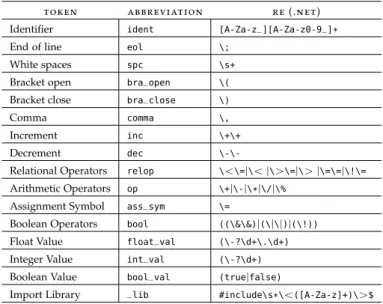
4.2 Regular Expressions for Program Abstraction . . . 39
4.3 Actualisation . . . 40
4.4 Reflections on Program Abstraction . . . 41
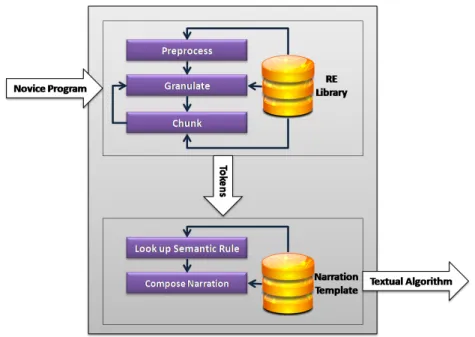
5 c o m p r e h e n s i o n t h r o u g h na r r at i o n s 43 5.1 The Novice Program Narrator . . . 43
5.1.1 Preprocessing . . . 44
5.1.2 Granulation . . . 44
5.1.3 Chunking . . . 44
5.1.4 Semantic Rule Lookup . . . 44
5.1.5 Narration Composition . . . 44
5.1.6 Scope of NOPRON . . . 45
5.2 Implementation and Results . . . 45
5.2.1 Average Problem . . . 45
5.2.2 Soloway’s Rainfall Problem . . . 49
5.2.3 Taste-Compiler’s Sum Program . . . 50
5.2.4 Other Programs in NOPRON’s Domain . . . 52
5.3 Limitations . . . 53
5.4 Reflections on Narrations . . . 53
iii s e a r c h i n g t h e s pa c e o f n ov i c e p r o g r a m va r i at i o n s 55 6 va r i a b i l i t y i n n ov i c e p r o g r a m s 57 6.1 Variability with an Example . . . 58
6.2 Formalisation of Program Equivalence . . . 59
6.2.1 Simple Statement Equivalence . . . 61
6.2.2 Compound Statement Equivalence . . . 62
6.3 Equivalent Programs . . . 72
6.4 Reflections on Variability . . . 72
7 i t e r at i v e g e n e r at i o n o f p r o g r a m va r i at i o n s 73 7.1 The Alternative Programs Enumeration Algorithm . . . 73
7.2 Implementation and Results . . . 77
7.2.1 APE Algorithm on the Modified Factorial Problem . . 78
7.2.2 More Results . . . 81
7.3 Formal Aspects . . . 82
7.3.1 Complexity Analysis . . . 83
7.3.2 Proof of Finiteness of Space . . . 84
7.4 Application of Program Variations . . . 85
7.5 Limitations . . . 85
7.6 Reflections on Enumeration Algorithm . . . 87
c o n t e n t s xix
8.1 Validation with Rules of Discourse . . . 89
8.2 Validation with IO Analyzer . . . 92
8.3 Designing an IO Analyzer . . . 92
8.4 Microsoft Visual C++ IO Analyzer . . . 93
8.5 Race Condition with IO and Resolution . . . 94
8.6 Reflections on Validation . . . 95
iv c o m p r e h e n s i o n a n d s e m a n t i c b u g d e t e c t i o n 97 9 au t o m ata i n p r o g r a m c o m p r e h e n s i o n 99 9.1 Novice Solution Space as a Regular Language . . . 99
9.2 APDFA Construction . . . .100
9.2.1 Algorithms for Constructing APDFAs from Programs 100 9.3 Generating the Alphabet ofLp . . . .103
9.4 Test Cases and Results . . . .103
9.4.1 Next Integer Problem . . . .103
9.4.2 Modified Factorial Problem . . . .105
9.5 Reflections on APDFA Construction . . . .108
10 s e m a n t i c b u g d e t e c t i o n 109 10.1 Bug Categorisation . . . .109
10.2 Matching Program Strings . . . .111
10.2.1 Generating the Alphabet for a Novice Program . . . .111
10.3 Matching Plans over Different Alphabets . . . .112
10.4 Algorithms for Bug Detection . . . .114
10.4.1 Bug-Free Novice Programs . . . .114
10.4.2 Buggy Novice Programs . . . .115
10.5 Introducing SEBUD: The SEmantic BUg Detector . . . .116
10.6 More Results . . . .118
10.6.1 Missing Code Fragments . . . .119
10.7 Reflections on Bug Detection . . . .121
v a p p l i c at i o n s 123 11 au t o m at i c t u t o r i n g 125 11.1 Code Adviser: Design and Scope . . . .125
11.2 Acting Intelligent . . . .126
11.3 One Step Bug Repair . . . .126
11.4 Discussing Bug Repair . . . .126
11.5 Code Adviser in Action . . . .127
11.6 Reflections on Automatic Tutoring . . . .128
12 e s t i m at i n g p r o g r a m s i m i l a r i t y 129 12.1 Overview of Source Code Plagiarism . . . .129
12.2 Picking Similar Programs with SPDFAs . . . .129
12.2.1 Totally Similar Programs . . . .130
12.2.2 No Decisions . . . .130
12.3 SPDFA Construction . . . .131
12.4.1 Next Integer Problem . . . .132
12.4.2 The Sum Problem with a Function . . . .133
12.5 The Exact Code Matcher . . . .135
12.6 Reflections on Program Similarity Estimation . . . .135
13 p r o t o t y p i n g 137 13.1 Recapping Prototypes . . . .137 13.2 Bonus . . . .138 14 c o n c l u s i o n s a n d f u t u r e w o r k 139 14.1 Conclusions . . . .139 14.2 Future Work . . . .140 14.2.1 Narrations . . . .140
14.2.2 Program Variations and Automata Representation . .141
14.2.3 Production Version of Code Adviser . . . .141
14.2.4 Tutoring by Plan Mirroring . . . .141
vi a p p e n d i x 143 a p l a n r e c o g n i z e r s 145 a.1 Regular Expressions for Program Abstraction . . . .145
b v i s ua l c++ c o m p i l e r 149 b.1 The Visual C++ Compiler Batch File . . . .149
L I S T O F F I G U R E S
Figure2.1 Example of DFA that accepts01. . . 14
Figure3.1 Automatic Source Code Summarizer [Haiducet al.2010] 24 Figure3.2 Search Space of Possible Programs . . . 28
Figure3.3 Conceiver vs Adil . . . 30
Figure4.1 A new tool for novice program narration . . . 37
Figure4.2 Structure of program abstraction . . . 40
Figure5.1 The novice program narrator . . . 43
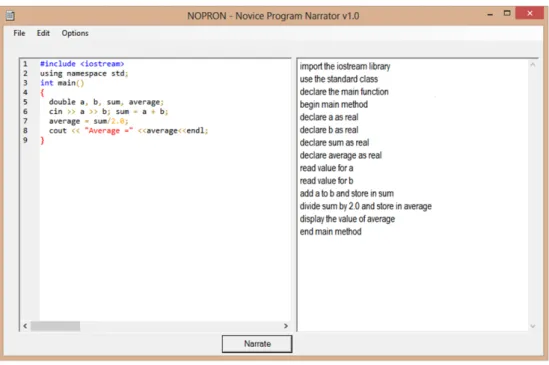
Figure5.2 NOPRON in action, narrating the average of two num-bers . . . 46
Figure6.1 Generating alternative programs . . . 57
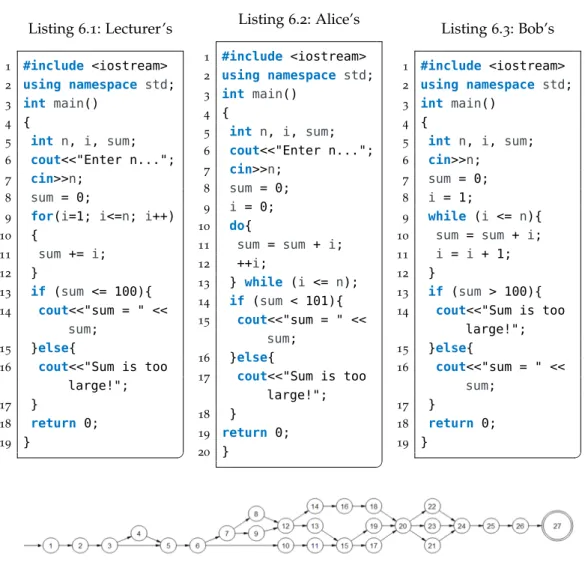
Figure6.2 DFA for the Lecturer’s, Alice’s, and Bob’s Solutions . . 59
Figure6.3 Statement categories . . . 61
Figure6.4 Space of re-ordered implementations . . . 64
Figure7.1 Alternative programs enumeration model . . . 74
Figure7.2 Entity classes . . . 78
Figure7.3 Equivalent programs enumerator . . . 79
Figure7.4 Growth of program space . . . 82
Figure7.5 A repository of generated programs indexed with se-rial numbers . . . 88
Figure8.1 Input-Output Analyzer . . . 92
Figure9.1 Constructing APDFAs from equivalent programs . . . 99
Figure9.2 APDFA for the Next Integer Problem . . . .104
Figure9.3 APDFA for10program strings of the Modified Facto-rial Problem . . . .107
Figure10.1 Finding bugs in novice programs . . . .109
Figure10.2 Bug Categorisation . . . .110
Figure10.3 APDFA’s Alphabet vs. Novice’s Alphabet . . . .112
Figure10.4 Selecting a problem with SEBUD . . . .118
Figure10.5 Program verification with SEBUD . . . .118
Figure10.6 Reporting syntax errors with SEBUD . . . .119
Figure10.7 Detecting semantic errors with SEBUD . . . .119
Figure10.8 Detecting missing code fragments with SEBUD . . . . .120
Figure11.1 Automatic tutoring model . . . .125
Figure11.2 Code Adviser finding no bugs in program . . . .127
Figure11.3 Commenting out a line . . . .128
Figure11.4 Code Adviser suggesting a fix . . . .128
Figure12.1 SPDFA for Alice . . . .133
Figure12.2 SPDFA for Bob . . . .133
Figure12.3 Alice’s vs Bob’s Alphabets . . . .134
Figure12.4 The Exact Code Matcher . . . .136
L I S T O F TA B L E S
Table2.1 Logical equivalence laws . . . 15 Table4.1 First level of abstraction . . . 39 Table4.2 Second level of abstraction . . . 40 Table4.3 Third level of abstraction . . . 40 Table6.1 Abstraction of program lines . . . 60 Table6.2 Equivalent statements . . . 62 Table6.3 Plan for average of numbers problem . . . 63 Table6.4 Negation and converse operators . . . 65 Table6.5 Evaluating equivalent conditional statements with truth
tables . . . 65 Table6.6 Equivalent set from base statement . . . 66 Table6.7 Truth values of p against q . . . 66 Table6.8 Truth values of pORq . . . 66 Table6.9 Truth values of converse of pORq . . . 67 Table7.1 Variations of tested novice programs . . . 82 Table7.2 Redundant compositions . . . 86 Table9.1 ΣP1 of the Next Integer Problem’s APDFA. . . .105 Table9.2 ΣP2 of the Modified Factorial Problem’s APDFA. . . . .106 Table10.1 Iterations of SEBUD when finding missing code
frag-ment . . . .121
Listing4.1 Sum of first10integers . . . 38 Listing5.1 Average of two numbers . . . 46 Listing5.2 Average of n numbers . . . 47 Listing5.3 Computing sum with a while loop . . . 48 Listing5.4 Solution to rainfall problem in C++ . . . 49 Listing5.5 Taste-Compiler: sum of first n numbers . . . 50 Listing6.1 Lecturer’s . . . 59 Listing6.2 Alice’s . . . 59 Listing6.3 Bob’s . . . 59 Listing6.4 Syntax ofifstatement in C++ . . . 68 Listing6.5 Template for equivalentifstatement . . . 68 Listing6.6 Syntax ofif-then-elsestatement in C++ . . . 68 Listing6.7 Template1for equivalentif-then-elsestatement . . . 68 Listing6.8 Template2for equivalentif-then-elsestatement . . . 69 Listing6.9 Template3for equivalentif-then-elsestatement . . . 69 Listing6.10 Base-case of loop-iterators . . . 70 Listing6.11 Loop-iteratorL2 . . . 70 Listing6.12 Iterator:L3 . . . 71 Listing6.13 Iterator:L4 . . . 71 Listing6.14 Iterator:L5 . . . 71 Listing6.15 Iterator:L6 . . . 71 Listing6.16 Iterator:L7 . . . 71 Listing6.17 Iterator:L8 . . . 71 Listing6.18 Iterator:L9 . . . 71 Listing6.19 Iterator:L10 . . . 71 Listing7.1 Sum of firstnintegers using a function . . . 76 Listing7.2 Generated programP1 . . . 79 Listing7.3 Generated programP2 . . . 79 Listing7.4 Generated programP3 . . . 80 Listing7.5 Generated programP4 . . . 80 Listing7.6 Generated programP5 . . . 80 Listing7.7 Generated programP6 . . . 80 Listing7.8 Generated programP7 . . . 81 Listing7.9 Generated programP8 . . . 81 Listing7.10 Generated programP9 . . . 81 Listing7.11 Generated programP10 . . . 81 Listing8.1 A chunk from the modified factorial problem . . . 91 Listing10.1 Missing code fragment test case . . . .120 Listing12.1 Alice’s original program for the next integer problem .133
Listings xxv
Listing12.2 Bob’s program copied from Alice for the next integer
problem . . . .133 Listing12.3 Alice’s original program for the sum problem using a
function . . . .134 Listing12.4 Bob’s program copied from Alice for the sum problem
using a function . . . .134 Listing A.1 Regular Expressions for Plan Recognition . . . .145 Listing B.1 Batch file for Visual C++ Compiler . . . .149
4.1 Sum of first10integers . . . 38
4.2 Narration of the sum of first10 integers . . . 38
5.1 Narration of average of two numbers . . . 47
5.2 Narration of average ofnnumbers . . . 48
5.3 Sum fragment usingwhileloop . . . 49
5.4 Narration of the rainfall program . . . 51
5.5 Narration of Taste-Compiler’s sum program . . . 52
7.1 Alternative Programs Enumeration (APE) . . . 75
8.1 Filtering invalid chunk permutations . . . 90
8.2 Filtering invalid programs . . . 94
9.1 Constructing APDFA from programs of the same length . . . . .101
9.2 Constructing APDFA from programs of varying lengths . . . . .102
9.3 GeneratingΣp, the alphabet ofLp . . . .103
10.1 Generating the alphabet of a novice’s program . . . .111
10.2 Mapping plans from two alphabets . . . .114
10.3 Test of membership for bug-free programs . . . .115
10.4 Detecting missing code fragments . . . .115
10.5 Finding missing fragment . . . .116
10.6 Detecting plan composition errors . . . .116
12.1 Constructing SPDFA from a program . . . .131
Part I
I N T R O D U C T I O N A N D L I T E R AT U R E R E V I E W Automatically understanding and debugging novice programs for the purpose of detecting semantic bugs is one of the con-temporary problems in the fields of Artificial Intelligence and Computer Science Education. This problem is often referred to as novice program comprehension[Johnson and Soloway1985,Johnson 1990,Spohrer1992,Storey2006]. The challenge of this domain is
to devise intelligent computer programs that can take a given novice program and attempt to find semantic errors in it. If this can be done, a desirable application for such an intelligent system is in Tutoring — creating tools for guiding novice programmers to effective learning. In this part of this thesis, we present a gen-eral introduction, preliminary definitions and a review of related work in novice program comprehension.
This part has three chapters. In Chapter 1 we present an intro-duction and the context of this research. InChapter2we set the scene with definitions of notations, and the terms used in this thesis.Chapter3presents related work in the area of novice pro-gram comprehension.
1
I N T R O D U C T I O N
T
eaching a novice how to program is a time consuming task, sometimes requiring some degree of patience [Lahtinen et al. 2005]. Likewise,the learning process (from a novice’s perspective) is often frustrat-ing [Johnson1990]. This gets more challenging as the number of enrollments
in introductory programming courses increases and the ratio of novices to available human tutors gets larger every year [Lahtinenet al.2005]. This
chal-lenge has resulted in a significant number of novices developing a phobia for programming, following their frustration with compilers that provide cryp-tic feedback while debugging programs containing logical errors [Kranch
2012]. However, this is not a compiler issue. Compilers are not designed to
handle programs with semantic bugs —syntactically correct programs that pro-duce incorrect outputs.
A compiler knows much about a program and if this knowledge is not enough to recognise semantic bugs, then it becomes necessary to add some intelligence to aid the inference process of comparing programs to their requirements — incorporating the knowledge of human experts. Soloway and Ehrlich[1984] claim that human experts are better than novices because
they possess two kinds of knowledge that novices do not have — the knowledge of programming plans and rules of discourse. Hence, a program that engages with this knowledge will be regarded as intelligent and should be sufficiently able to act like ahuman programming tutor — a program that tutors programming. Therefore, an interesting question will be: what does it take to teach programming using a program? This is a formal task in Artificial Intelligence (AI) and to answer this question, it would be helpful to look critically at how the human expert would perform this task. To be able to teach programming as a human, what do you need? Several theories have been published on this question, suggesting that some science of cognition to model “novice thoughts”, a good knowledge representation technique to store “lecturer’s programming plans” for a problem and a sufficient data structure to store the “rules of discourse” for the underlying program-ming language are essential concerns in perforprogram-ming this task algorithmically.
In the early days of AI, this problem was referred to as “program under-standing” [Johnson and Soloway 1985, Johnson 1990]. It is now popularly
known as “program comprehension” [Storey 2006]. Comprehension is
regarded as an integral part of learning how to program [Harris and Cilliers 2006]. The challenge posed by program comprehension is (finding
better methods of) developing an intelligent application that attempts to
understand (or extract the meaning from) a program written by a person (often a novice) and matching it to a plan of the expected solution supplied by an expert, based on the requirement specification of the problem. This is clearly different from the work of a compiler since concerns and emphasis are laid on “meaning” rather than “constructs”; that is, “semantics” rather than “syntax”. If the comprehension task is accomplished and knowledge of the program’s logical mistakes (semantic bugs) has been acquired, deciding whether or not tutoring (and/or marking) should be done is a matter of choice.
Consequently, the interest of this work is to devise new techniques to auto-matically understand novice programs written in the C++ programming lan-guage and to build prototypes of software tools based on those techniques to:
1. explain programs to novices bynarratingthe steps in natural language
— thereby aiding comprehension,
2. generate the space of solutions to given programming problems —
au-tomatically creating programming knowledge of what is expected of a novice programmer,
3. detect semantic bugs in novice programs using the created space of
likely solutions,
4. assist — by advising/tutoring — novices in fixing the semantic bugs
in their programs, and
5. use our technique to also find plagiarised programs.
Program comprehension comprises of two major aspects; cognitive theories that explain how programmers conceive their code, and research to develop advanced technological tools to aid the process of comprehen-sion [Storey2006]. A famous question posed by Fincher [1999, p.12a4-1] is
“what are we doing when we teach programming”, while she attempted to reflect on the cognitive aspects of program comprehension. Studying this cognitive process and designing a tool has been regarded as a tough task from inception, for whichthere is no silver bullet [Brooks 1983]. To date, the
various theories, research methods and tools geared towards solving this problem have focused on three major components: characteristics of the programs, ability of the programmers and the software tasks involved in the process. Nevertheless, the issue of “teaching programming using software” will be incompletely discussed without the theories of teaching and learning in Computer Science Education coming into play. Several reviews — which are particular to learning programming — exist in this regard [Fincher1999,
Lahtinen et al. 2005]. One notable study is that of Lahtinenet al. [2005], in
1.1 p r o b l e m d e f i n i t i o n 5
novice programmers by conducting a considerably large survey — with a sample space of500students and teachers — arriving at certain suggestions
on how tools may be built to aid the learning process.
Still in Computer Science Education, a controversial debate amongst re-searchers over the last four decades is: how can programming best be taught? The traditional approach — and still the most dominant — often used to teach programming is via the vehicle of language syntax and this has been faulted by many and regarded as the reason why students think of program-ming as “fighting the compiler” [Fincher 1999, p.12a4-1]. To address this
issue, other methods of teaching the subject have been proposed, such as: theSyntax-Freeapproach (SFA) [Bornat1987,Shackelford1997], theProblem
Solvingapproach [Barnes et al. 1997], the Literacy approach [Juliff 1997,
As-trachan and Reed1995], and the Computation-as-Interactionapproach [Stein 1998]. All these approaches have their respective valid arguments which has
made the desire tobrewthem together quite tempting — so, we have devel-oped the following tools:
1. NOPRON1[Ade-Ibijolaet al.2014a] — a software tool that supports the
syntax-free approach of teaching programming by narrating programs to novices, and
2. Code Adviser[Ade-Ibijolaet al.2015a] — another tool that supports all
other three approaches by interacting with novices, finding semantic bugs and suggesting how they can be repaired.
1.1 p r o b l e m d e f i n i t i o n
In this section, we define the problem solved in this thesis under the cate-gories below.
1.1.1 Abstracting and Narrating Novice Programs
Many tools have been developed to assist novices in understanding pro-grams. However, while struggling to understand the logic underlying some programs, novices also struggle to understand the constructs of the language in which they are learning to program for the first time. Is it then possible to teach novices how to program without using any specific language?Fincher [1999] has referred to the idea of teaching programming without writing
pro-grams as a paradox, and in some way “nonsensical”. However, she agreed that this technique has been reported as a success by Bornat [1987] and
Shackelford[1997], both after integrating it into first year teaching, and
test-ing it for a couple of years at two different universities — they called it the syntax-free approach to teaching the subject. There is other evidence to show that this style of teaching can be successful and tools have been created for it [Pyott and Sanders1991]. One way of implementing the SFA is to provide
the students with automatically generated algorithms. That is,translating pro-grams back to syntax-free algorithms — this is the problem addressed in this aspect of this thesis.
1.1.2 Automatic Generation of Program Variations
This aspect is driven by the need to acquire knowledge about novice pro-grams in order to provide automatic feedback to novice programmers about semantic bugs. In this aspect, we have answered three questions, specifically:
1. given a correct lecturer’s program to a novice programming problem,
how many similar/equivalent programs exist, and what are the pro-grams?
2. can we have a generalised formalism for enumerating all possibilities
in this space?
To answer these questions, we have made the following assumptions, based on established theories in program comprehension [Storey 2006,
Shneider-man and Mayer 1979, Pennington 1987, Mayer 1981, Von Mayrhauser and
Vans 1995] and empirical studies of novice [Soloway and Ehrlich1984] and
expert [Vessey1985] programmers.
c o r r e c t n e s s q u e s t i o n. For an expert to ascertain that a novice program
is semantically correct, he/she will need to know at least one correct program that solves the same problem and attempt to compare or map the novice program to the correct one [Soloway and Ehrlich1984].
n ov i c e s n e e d f e e d b a c k a b o u t s e m a n t i c e r r o r s. Most novice
pro-grammers can handle syntactic errors by themselves by complying with the feedback of automatic debuggers that are associated with modern-day compilers. However, when programs are syntactically cor-rect but have logical errors, the novices often need lecturers (or tutors) to help them find semantic bugs [Kranch2012].
e x p e r t s u s e t h e t o p-d o w n a p p r oa c h. Experts (or lecturers) try to
of-fer help by comparing a novice’s program to their mental model (an idea of what the solution should be like) by first comprehending the novice program using the top-down approach. They start with the biggest chunk in novice programs and de-localise novice program frag-ments into lower levels of abstraction (or chunks) until the entire pro-gram makes complete sense [Brooks 1983, Soloway and Ehrlich 1984,
1.2 r e s e a r c h c o n t e x t 7
e x p e r t s c r e at e a n d s e a r c h a s pa c e. More often than not, lecturers
do not find student programs with an exact replica of their mental model of the solution. However, they try to consider all other possibil-ities and variations of their mental model, trying to find a match for the student’s program [Johnson and Soloway1985,Vessey1985].
Following these assumptions, we have presented a new formalism for enu-merating alternative solutions to a lecturer’s program. Using the resulting enumeration, it is possible to look for students’ solutions within the space of alternative solutions generated from a lecturer’s program.
1.1.3 Comprehension and Semantic Bug Detection
This aspect addresses three questions. How do we:
1. abstract a list ofequivalentprograms, representing the space of possible
solutions to a novice programming problem, to a DFA2
? We worked with an assumption that the list is finite.
2. define an alphabetΣover the semantic tokens (or symbols) of the list
of equivalent programs?
3. find semantic bugs in such a DFA?
1.1.4 Automatic Tutoring
After semantic bugs have been detected, it becomes necessary to point the novice to the source of the bug. The challenge in this section is how to devise tutoring modules that advise novices about program repair steps.
1.2 r e s e a r c h c o n t e x t
1.2.1 Aim and Objectives
The aim of this research work is to establish a new approach (based on formal language theory) to novice program comprehension and also build prototype tools to test the new approach. The specific objectives that make up this aim are to:
1. extensively study the field of Program Comprehension with major
fo-cus on topics such as Cognitive Mental Models in Program Compre-hension, Semantic Analysis of Programs, Intelligent Tutoring Systems, and Technological Tools in Computer Science Education.
2. find better ways of aiding the comprehension process for novice
pro-grammers using textual algorithms.
3. develop a new method for the iterative generation and validation of all
possible variations of programs. Validation is done using Input-Output (IO) analysis of sufficient test cases.
4. taking a complete program as astring and granulated program plans
as semantic tokens, devise algorithms for the dynamic definition of languages3
of program stringsover some alphabetΣof semantic tokens. A languageLpof correct programs is therefore a formal representation of the space of solutions to a novice problem.
5. show thatLpis regularand hence, can be represented with a DFA M. M accepts all valid program strings of a plan4
over the set of semantic tokens in the plan’s alphabetΣ, wherea∈Σ, is a semantic token – e.g. increment a counterof the plan.
6. attempt to find semantic bugs in the DFAM.
7. as a proof of concept, develop a prototype of an ITS5 that uses the
knowledge gathered from M to tutor novices on how to repair their buggy programs.
1.2.2 Assumptions
This research is based on the assumptions that:
1. the scope is restricted to semantic errors and all buggy programs
con-sidered in this thesis are syntactically correct.
2. the focus will be on comprehending only the programs for the
pro-cedural programming paradigm, and as such, all examples/test cases in this thesis are written with the core6
of the C++ programming lan-guage.
3. in representing a program plan semantically, it should be possible to
present all variations of a lecturer’s plan as paths on atransition graph while the student’s plan will be a single path from the state node to the end node of the graph.
3 A language, or formal language, is a set of strings over some alphabetΣ. 4 a plan is a full or part of an algorithm for solving a problem.
5 Intelligent Tutoring System
6 The core of a programming language is the essential subset of the language needed to write simple programs in it [Satir and Brown1995].
1.2 r e s e a r c h c o n t e x t 9
1.2.3 Questions
The questions of interest that we have answered during the course of this research are:
1. can we get a toolkit to compile our C++ programs after generating them? —
We did and did not have to re-invent the wheel. The Visual C++ Com-piler’s DLL7
was used to create an ad-hoc C++ compiler that was used for IO-Analysis.
2. how many ways can a programming problem be solved? Does this grow
exponentially with respect to the size of a program? — We answered this question inPart iii. During testing, we came to the realisation that for large programs, our space enumeration algorithm actually becomes intractable. This raised very little concern because the novice programs targeted are of very small sizes.
3. how do we enumerate (2) algorithmically? Can we feasibly tag the parts (e.g. chunks, statement blocks, functions, and line of codes) of a program and use the obtained symbols in generating all possible permutations of the plan? — yes, this was possible and was done.
4. is the space of solutions to a trivial novice problem a finite one?— yes, it is.
In Part iv, we showed that this space is finite by representing it with Acyclic DFAs8
.
5. can we have prototypes to illustrate these concepts? — yes, a number of
tools are described in this work.
1.2.4 Problems of Interest
The following are the novice programming problems of interest:
1. Next integer problem. Read in a number, add one to it and display the
result.
2. Average problems.
• Average of two numbers. Read two numbers, sum and average them, and display the result.
• Average ofn numbers. Read n numbers (n specified by the user), sum and average these numbers, and display the result.
7 Dynamic Link Library
8 Infinite number of strings imply DFAs with cycles, while Acyclic DFAs can be constructed for any language with a finite number of strings.
3. Soloway rainfall problem. Read the amount of rainfall for each day. A
neg-ative value for the rainfall should be rejected since this is invalid. The program should print out the number of valid recorded days, the num-ber of rainy days, the rainfall average over a period of valid recorded days, and the maximum amount of rain that fell on any one day. Use a sentinel value of9999to terminate the program.
4. Factorial problem. Read in an integernand calculaten!, i.e the factorial
ofn.
5. Modified factorial problem. Read in an integernand calculate 5!+n, i.e
the factorial of5 plus integern. This problem aims at testing the flex-ibility of novice programmers’ thinking by not asking them to write a simple factorial program, but to write a program that adds a constant
n to the factorial of5, i.e calculates5!+n. We have chosen this
prob-lem as a test case because of the following reasons: For students that like memorizing programming examples, or jump at coding at the first sight of a problem without reading carefully, this problem will give a distinct-enough solution to detect if the novice programmer has com-pletely mis-understood the problem. Thus, causing a semantic error due towrong problem interpretation.
In addition to the above problems, the algorithms presented in this work can handle arrays, and therefore the following problems:
1. Sum and average of array elements: a program that computes the sum
and average of the elements in an array.
2. Largest/smallest item of array elements: a program that determines the
largest item (or a similar program that determines the smallest item) in an array.
3. Matrix arithmetic: programs that compute the addition, subtraction or
multiplication of matrices.
4. Search and sort algorithms: programs that implement the bubble sort,
selection sort, insertion sort, and the binary search algorithms.
Furthermore, we could handle any program provided its language con-structs are included in the subset of the C++ language that we have covered — listed inPart ii, pages37—57.
1.3 k e y c o n t r i b u t i o n s
The key contributions are in three major categories: novice program abstrac-tion and comprehension via narraabstrac-tions, formalisaabstrac-tion of the space of pro-gram variations, and semantic bug detection using DFA formalisms and al-gorithms.
1.3 k e y c o n t r i b u t i o n s 11
1.3.1 Novice Program Abstraction and Comprehension via Narrations
InPart ii, we have:
1. used regular expressions in a new way that is quite different from
conventional lexical analysis by recognising programming plans and not just lexemes,
2. created a new software tool that automatically translates novice
pro-grams into more detailed textual algorithms,
3. tested this tool with many novice programs and reported the results, 4. coined the word “narration” and used this word to describe highly
detailed textual algorithms generated with the new tool developed in this work, and
5. argued that narrations of programs can aid comprehension.
1.3.2 Formalisation of the Space of Program Variations
InPart iii, we have:
1. presented a new formalism for defining program equivalence, based
on the top–down program comprehension theory,
2. developed a new algorithm for the automatic generation of variations
of novice programs, and
3. argued that the new algorithm can be used to generate permutations
of correct solutions that, if abstracted to a DFA9
, can be used to answer questions about semantic bugs in novice programs.
1.3.3 Semantic Bug Detection using DFA Formalism and Algorithms
InPart iv, we have:
1. given the novice program comprehension problem an entirely new
per-spective by using DFAs for solution space representation,
2. developed new algorithms for;
a) constructing APDFAs10
from many model programs written in C++, and,
9 Deterministic Finite Automaton
10 Alternative Programs Deterministic Finite Automaton —a type of DFA that represents the solu-tions space of a novice programming problem
b) detecting specific semantic bugs in novice programs.
3. described a tool called SEBUD that reports semantic bugs using the
new algorithms.
1.3.4 Applications
InPart v, we have presented two new applications of the DFA abstraction.
1. Code Adviser, a tool that finds semantic bugs and suggest to novices
how they may be repaired, and
2. Exact Code Matcher, a tool that compares two novice programs and
estimates their similarity.
1.4 t h e s i s o r g a n i s at i o n
This thesis is organised in Parts, each part containing a number of chapters and focused on aspects of this work as follows.
Pa r t i presents general introduction, preliminaries, and related work.
Pa r t i i presents a new form of abstraction that we callednarrationfor aid-ing program comprehension.
Pa r t i i i presents a formalisation of the idea of equivalent programs and how we used this idea to derive new algorithms for the generation of alternative solutions to novice programs, tested and filtered these solutions using newly designed Input–Output program analyzers.
Pa r t i v Here we abstracted the space of program variations to DFAs and defined new algorithms for finding bugs in them.
Pa r t v presents two applications of the new comprehension approach: a new tool for tutoring novice programmers based on the semantic bugs detected, and similarity estimation of novice programs using DFAs. Conclusions and future work are also discussed in this part.
2
P R E L I M I N A R I E S
T
his Chapter presents preliminaries such as notation and general defini-tions of terms used in this thesis across the fields of formal language theory, program comprehension, Propositional logic, and mathemat-ics.2.1 g e n e r a l d e f i n i t i o n s
In this section we present some general definitions.
Definition2.1(Symbol, Alphabet, and String [Martin2003]). A symbol is an
item or a single token. An alphabet, denoted byΣis any finite set of symbols. A string over Σis formed from the concatenation of zero or more symbols ofΣ.
Definition2.2(Regular Language and Regular Expression [Martin2003]). A
regular expression (RE for short or REs in plural) is a string of characters that constitutes a search pattern and is used to describe a regular language
Lover some alphabetΣ. Formally, we define regular expressions according toMartin[2003] as follows:
Let R be a class of regular languages over some alphabet Σ. The corre-sponding regular expressions are defined as:
1. φis an element ofR, denoting the empty set. The corresponding
regu-lar expression isφ.
2. {λ}is an element ofRwith the regular expressionλ.
3. ∀a∈Σ,{a}is an element ofR, with the regular expressiona.
4. LetL1 andL2 be elements ofR, and letr1 andr2 be the corresponding
regular expressions. Then the following operations hold:
a) L1|L2 is an element of R with the regular expression (r1 +r2), representing the union (or alternation) of both languages.
b) L1L2 is an element ofRwith the regular expression(r1r2), repre-senting the concatenation of both languages.
c) L1∗ is an element ofRwith the regular expression(r1)∗.
Remark 2.1. Only the languages described by (1) to (4) and languages de-rived from them are regular languages overΣand nothing else is.
Definition 2.3 (Deterministic Finite Automaton (or DFA) [Brzozowski and Tamm 2012]). A deterministic finite automaton is a 5-tuple
A = (Q,Σ,δ,qo,F), where Q is a finite, non-empty set of states, Σ is a finite set of input symbols known as the alphabet,δ:Q×Σ→Qis the tran-sition function,qois the start state andF⊂Qis a finite set of final/accepting states.
Remark2.2(Language of a DFA). The language of a DFAMis the set of all strings accepted by the DFA, denoted byL(M).
Definition2.4(Minimality of Automata [Watson2010]). A DFAMaccepting
the language L is minimal, written Min(M) or Min, if and only if it is the smallest (measured by the number of states) DFA acceptingL.
Notation 2.1 (Drawing DFAs). DFAs in this thesis are drawn according to the standard convention, with states as circles, start states with an in-edge and final/accepting states with concentric circles. Transitions are portrayed as labeled directed edges.Figure2.1shows an example DFA that accepts the string 01. Other sequences of0s and1s take the DFA to theqd state — the dead state. Once an input takes a DFA to a dead state, the sequence of input read, or to be read, cannot result in a string in the language. The DFAs in this thesis are generated with the Automatic Graph Layout (AGL) tool [AGL].
Figure2.1: Example of DFA that accepts01.
Definition2.5(Logical Equivalence [Mendelson1997]). Given any two
state-mentspandq,pis said to be logically equivalent toqif bothpandqhave the same truth values. The notation≡is used to refer to logical equivalence and the statement,p ≡ qimplies thatpis logically equivalent toq.Table2.1 shows some logical equivalence laws.
Remark 2.3. More logical equivalences can be established using Truth Ta-bles.
Definition2.6(Relation Algebra [Hirsch1996,Tarski1941]). A relation
alge-braLis an algebraic structure over some domainD, closed under the binary relations∧,∨,¬,T,F,·,I,Cand obeys the Tarski axioms. Here conjunction∧, disjunction∨, and negation¬ are Boolean operations, T andF are Boolean constants, converse C and composition · are relational operations, and I is the identity relation.
2.2 p r o g r a m c o m p r e h e n s i o n t e r m s 15 l aw e q u i va l e n c e e x p r e s s i o n Identity p∧T≡p p∨F≡p Domination p∧F≡F p∨T≡T Idempotent p∧p≡p p∨p≡p Double Negation ¬(¬p)≡p Commutative p∧q≡q∧p p∨q≡q∨p Associative (p∧q)∧r≡p∧(q∧r) (p∨q)∨r≡p∨(q∨r) Distributive p∧(q∨r)≡(p∧q)∨(p∧r) p∨(q∧r)≡(p∨q)∧(p∨r) De Morgan’s ¬(p∧q)≡¬p∨ ¬q ¬(p∨q)≡¬p∧ ¬q Absorption p∧(p∨q)≡p p∨(p∧q)≡p Negation p∨ ¬p≡T p∧ ¬p≡F
Table2.1: Logical equivalence laws
Definition 2.7(Inequality [Hardy et al.1952]). This is a relation on two
val-ues,xandy, defined only ifxis not the same asy.
Definition2.8(Cartesian product [Stacho2007]). The Cartesian product (or
cross product) of A and B, denoted by A⊗B, is the set {(a,b)|a ∈ A and
b ∈ B}, satisfying the conditions:(a,b) of A⊗Bare ordered pairs, and for pairs(a,b),(c,d)we have(a,b) = (c,d)⇐⇒a=candb=d.
Definition 2.9(Interval [Thompson and Taylor2008]). This is a set of
num-bers, such that every number that is between two real numbers denoting the upper and lower ranges respectively is in the set, i.e. [a, b] is an interval containing every real numberx, such thata6x6b. Square brackets can be replaced with a parenthesis to specify that one of the endpoints is to be left out of the set.
Remark 2.4. More expressions on intervals are: (a,b) ={x∈ R | a < x < b}, [a,b) = {x ∈ R | a 6 x < b}, (a,b] = {x ∈ R | a < x 6 b}, and [a,b] ={x ∈R|a6x6b}. WhereRis the set of real numbers.
2.2 p r o g r a m c o m p r e h e n s i o n t e r m s
In this thesis, we have used a number of terms from the domain of Program Comprehension. Here we present the definitions of these terms.
Definition2.10(Mental Model [Storey2006,Von Mayrhauser and Vans1995,
Walenstein2003,Wanget al.2013]). This is a mental representation formed
in an instance to solve a problem, and often used to build knowledge at the global-structural level1
.
Definition 2.11 (Cognitive Model and Support [Von Mayrhauser and Vans
1995]). A cognitive model describes the processes and momentary
informa-tion structures in the programmer’s mind, used to formulate the mental model. Cognitive support is the reinforcement given to the cognitive tasks, such as thinking or reasoning.
Definition2.12(Beacons [Brooks1983,Harris and Cilliers2006,Crosbyet al. 2002]). These are important characteristics in programs that serve as
point-ers to a particular programming structure. They convey some reasonable amount of knowledge about the program and are highly recognisable by ex-pert programmers. Most theories of program comprehension are based on the identification of beacons.
Definition 2.13 (Programming Plans (or Plans) [Ebrahimi1994]). A plan is
an idea, with some level of abstraction, of a concept, requirement, source code, or object. A plan could be a single statement, e.g. “increment a counter” or as complex as “sort an array” [Ebrahimi and Schweikert 2006]. The term
“programming plan” is used to refer to template-like solutions used to de-scribe the steps for solving specific problems. They often consist of several sub-plans.
Definition2.14(Distinct and Re-ordered Plans [Ebrahimi1994,Abd-El-Hafiz
and Basili 1993]). A distinct plan is a unique plan that involves a different
approach to solving a problem, while re-ordered plans are several valid vari-ations (or permutvari-ations) of the same plan which is often influenced by the available constructs in a programming language
Definition2.15(Plan Composition [Spohrer and Soloway1986]). This is the
accurate arrangement of local plans (or sub-plans) to produce a correct pro-gram. The same set of plans, if wrongly ordered may produce an incorrect program. An example of this is printing an output when computation is still on.
Definition 2.16 (Rules of Discourse [Soloway and Ehrlich 1984]). This is a
set of rules that capture the principles in programming and govern the for-mulation of programs from plans.
1 Mental model here is defined from a program comprehension perspective and not general teaching/learning. We have presented this definition according to the work of [Storey2006, Von Mayrhauser and Vans1995,Walenstein2003,Wanget al.2013].
2.2 p r o g r a m c o m p r e h e n s i o n t e r m s 17
Definition 2.17 (Program Chunk [Hansen et al. 2012]). This is a group of
coherent statements, often in a structured block. Examples are functions, loops and conditional statements. Chunking is the process of recognising program chunks, and building a mental model from them.
Definition 2.18 (Novice Programming Problem [Johnson 1990]). This is a
programming exercise given to a novice programmer.
Definition 2.19 (Novice Programmer and Novice Programs). A novice pro-grammer is a first time programming student and novice programs are the types of programs they write at the early stages of trying to learn the craft [Johnson1990,Soloway and Spohrer1989]. Novice programs are often
writ-ten with a relatively intuitive subset of the language constructs of a pro-gramming language; that is, a novice program in a language such as C++ may contain loop structures,ifstatements, variable declarations, input and output operations, and so on, but will probably not contain advanced struc-tures or complex operations such as recursion, modular programming us-ing functions, classes, inheritances, and other object-oriented language con-structs. A typical and generally accepted example of a novice program is Soloway’s rainfall problem, which demonstrates all kinds of operations often performed by novices in computer programs [Johnson and Soloway1985].
Remark2.5(Novice Programmer vs Student). A novice programmer in the context of Definition2.19 is therefore a first year student in a computer sci-ence related discipline, taking computer programming for the first time. It may also refer to anyone new to computer programming at any level. The termsnoviceandstudentare used interchangeably in this thesis.
Definition2.20(Semantic Bug [Ebrahimi 1994, Spohrer and Soloway1986]).
This is a logical error in a program. Programs with semantic bugs often compile and are executed but produce incorrect output.
Examples of semantic bugs are:
1. Plan composition errors. Programs containing fragments that are not well
arranged or mis-composed. Other types of errors that fall under this category are:
a) Variable scoping. Errors resulting from mis-referencing variables having the same identifier but with different scope (such as global or local variables),
b) Type casting. Truncation errors from casting real variables to inte-ger values, e.g casting π to an integer will produce 3 instead of approximately3.142. This affects the overall computation result. c) Flipped Boolean. Errors arising from incorrectly stating conditional
statements, e.g a programmer who wants to check if average is less thansummay write:if (sum < average).
d) Operator precedence. Inappropriate use of parentheses to enforce the precedence of operations in assignment statements, e.g calcu-lating the average of two numbers as:average = first + second / 2;instead ofaverage = (first + second) / 2;.
2. Wrong problem interpretation. This is a scenario where the programmer
misinterprets the problem and uses an incorrect algorithm.
Definition 2.21 (Syntax-Free Approach (SFA) [Bornat 1987, Pyott and
Sanders1991,Shackelford1997]). This approach suggests that programming
should be taught with algorithms, thereby protecting novices from the early exposure to a specific language that may limit their perception of problems and hence, improving their problem solving ability.
2.3 n e w t e r m s
Here we present the definition of some new terms that we have introduced. Definition 2.22 (Equivalent Programs [Ade-Ibijola et al. 2015b]). A set of
programs{P1,P2,. . .,Pn}are said to be equivalent, i.eP1≡P2 ≡. . .≡Pn, if and only if two conditions are satisfied:
1. all programsPi, 1 6 i6 nin the set have the same program plan or
algorithm, and
2. for any given set of input and output test cases, all the programs
pro-duce the same output, independent of the difference in the plan compo-sition steps of, or choice of language constructs in any of the programs.
Definition2.23(APDFA). An APDFA or Alternative Programs Deterministic Finite Automaton is a DFA that represents the space of complete programs that lead to the solution of a programming problem.
Remark 2.6 (APDFAs are Acyclic). Every APDFA constructed in this work and featured in this thesis is anacyclic deterministic finite automaton. Proper-ties of, and algorithms to minimize this type of automaton in linear time can be found inWatson[2010].
Definition 2.24 (Alphabet of an APDFA). The alphabet of an APDFA, de-noted byΣis the union of all the semantic tokens of its language.
Definition 2.25 (Language of an APDFA). Let M be an APDFA. The lan-guage ofM, denoted byLM, is the set of program strings accepted byM. Definition2.26(SPDFA). An SPDFA or Single Program Deterministic Finite Automaton is a DFA that represents a program that solves a problem. It has one start state and one final state and it accepts a single program string. Definition2.27(Semantic Token). A semantic token (or semantic symbol) is a line of code at its lowest granular level.
2.4 r e f l e c t i o n s o n p r e l i m i na r i e s 19
Example2.1(Semantic Token). Examples of semantic tokens in C++ are:
1. int sum; 2. void main() 3. i = i + 1;
Definition 2.28 (Program String). A program string w is a sequence of se-mantic tokens (program lines) in a program.
Remark 2.7 (Reference to New Terms). The new terms defined here are used in this thesis as follows. Equivalent program is used inPart iii. APDFA, Semantic Token, and Program String are used in Part iv. SPDFA is used in
Part v.
2.4 r e f l e c t i o n s o n p r e l i m i na r i e s
In this chapter we have presented the preliminaries to the ideas contained and terms used in this thesis. These include definition of well established terms used in the domain of program comprehension, and new terms that we have introduced. In Chapter3, we review the literature in this field and discuss previous work that has been done in an attempt to solve the program comprehension problem.
3
R E L AT E D W O R K
H
ow difficult can it be to teach or learn programming? Teaching pro-gramming has been regarded as a difficult task by many researchers and similarly, many students have developed a dislike for program-ming from taking their first course in the subject. This problem has ex-isted and been considered a big challenge for over40years [Bennedsen andCaspersen2008]. Why is it so hard to learn? Several reviews have attributed
the challenges novices have in learning to issues such as: misunderstanding plan composition or plan comprehension, misinterpretation of language con-structs, difference in perception and complexity of knowledge in long term memory [Ebrahimi 1994, Kranch2012]. These findings have led to a better
understanding of different problem solving techniques, and also suggested the necessary advancement in programming languages, software tools to aid comprehension and instructional methods. In this chapter we discuss related work in these areas.
3.1 t e a c h i n g n ov i c e s t o p r o g r a m: t h e c h a l l e n g e s
The two major categories of common novice programmer errors according toEbrahimi[1994] are:
1. Language construct errors, and 2. Plan composition errors.
The knowledge of language constructs is paramount to understanding computer programs and novices have misconceptions about this. A few syntax and semantics related questions that often lead to confusion from a novice’s perspective are:
1. When should I use aDo-loop instead of aFor-loop? 2. Why should I initialise a variable?
3. Why can’t I initialise anywhere, even within a loop? 4. When loops are nested, how does the control flow?
5. Why are assignment statements different from algebra? Can I write
A=5as5=A?
Novices are often found bringing the knowledge of mathematics and natural language into programming, which tends to lead to misconceptions.
Ebrahimi [1994] added that different programming languages often imply
different programming styles, thereby generating a unique set of errors for code written in the language. It is important for a novice to understand how plans are composed [Johnson and Soloway1985,Ehrlich and Soloway1984].
In the study of human problem solving, it has been found that plans and template-like procedures are often employed to seek solutions to problems. Consequently, what the novice programmer attempts to do is formulate a plan — often in their subconscious — and implement this plan using the Language Constructs of the underlying programming language. In the quest to achieve this goal, most errors of novice programmers often come from putting the fragments of the plan together — Plan Composition. A major program plan may be composed by appending one sort of plan to another, interleaving plans, or branching from one plan to another when a condition is satisfied [Ebrahimi1994]. Common plan composition errors are
often related toomission,misplacement,crooked formulationandmisconceptions; around variable initializations, if structures, loops, variable updates, and input/output operations.
Spohrer and Soloway [1986] presented an analysis of the common errors
made by novices. Their conclusion was that small categories of bugs — re-lated to plan composition — occurred more frequently in novice codes and constitute a higher percentage of errors and also, even though language con-struct misconceptions are sources of errors, this type of error does not seem to be as severe.
3.2 c o g n i t i v e t h e o r i e s o f n ov i c e p r o g r a m c o m p r e h e n s i o n
The quest to provide rich explanations about how novices understand pro-grams and hence suggest how tools can be built to support comprehen-sion has led to several cognitive theories. Some influential cognitive theories of program comprehension are: top-down and bottom-up comprehension, knowledge-base models, opportunistic and systematic strategies, and inte-grated metamodels. In this section, we discuss these theories.
3.2.1 Top-down Comprehension
In this approach, it is postulated that programmers attempt to understand the entire program by starting from the overall outlook of the program, look-ing at the highest abstraction levels (such as functions or subprograms, of-ten referred to as chunks), and probing down the abstraction levels until they reach the lines of code, while gaining more insight about the program’s functionality. The aim of this approach is to build a mental model of the ap-plication domain that is refined along granular levels of the program, from the top and down the program’s abstraction levels [Brooks1983,Storey2006].
3.2 c o g n i t i v e t h e o r i e s o f n ov i c e p r o g r a m c o m p r e h e n s i o n 23
This approach is highly aided byprogram beaconsand mostly used by experts who are familiar with the problem domain [Soloway and Ehrlich1984].
3.2.2 Bottom-up Comprehension
In this approach, it is assumed that programmers attempt to understand the entire program by reading the lines and grouping the lines into higher levels of abstraction (often referred to as chunks). The resulting chunks are further grouped into an abstraction that is a step higher and this process continues until a complete understanding of the code’s functionality is achieved. The aim of this approach is to build a mental model of the application domain [Shneiderman and Mayer1979,Pennington1987,Von Mayrhauser and Vans 1995,Storey2006].
3.2.3 Knowledge-base Model
This is a hybrid of the Top-down and Bottom-up approaches [Letovsky1987].
The Knowledge-base Model enforces three major components, namely: a knowledge base that keeps the programmer’s internal knowledge, a men-tal model that describes what is known about the problem and keeps the formulation process of the solution, and an assimilation process which can either be Top-down or Bottom-up.
3.2.4 Opportunistic and Systematic Strategies
Littman et al. [1987] observed that mental models can also be built based
on a study of control and data flows within a program using both static and dynamic knowledge (resulting in a systematic strategy) or by merely focusing on the task at hand and picking information on a need-to-know basis using static knowledge (resulting in an opportunistic strategy). They documented that the latter approach produces a weaker mental model of the program.
3.2.5 Integrated Metamodel
This model is based on a summary of the previously discussed models and it uses four major components, namely; a top-down model, a program model (used when the program is unfamiliar), a situation model (a trace of data flow and program function) and a knowledge-base model which houses the knowledge used in constructing the program and situation models [Von Mayrhauser and Vans1995].
Some other theories have equally been published on the cognitive ef-fect of learning computer programming, suggesting that it increases or
![Figure 3.3: Conceiver vs. Adil [Al-Omari 1999]](https://thumb-us.123doks.com/thumbv2/123dok_us/10983681.2986214/56.892.187.711.163.449/figure-conceiver-vs-adil-al-omari.webp)