Instructions for authors, subscriptions and further details: http://rimcis.hipatiapress.com
Exploring Students' Learning Styles in Using Mobile Flipped Classroom
Siti Hajar Halili1, Shukri Sulaiman2, Hamidah Sulaiman1, Rafiza
Razak1
1) University of Malaya, Malaysia
2) University Science Malaysia, Malaysia Date of publication: July 30th, 2019
Edition period: July 2019 – November 2019
To cite this article: Halili, S.H., Sulaiman, S., Sulaiman, H., & Razak, R. (2019). Exploring Students' Learning Styles in Using Mobile Flipped Classroom. International and Multidisciplinary Journal of Social Sciences, 8(2), 105-125. doi: 10.17583/rimcis.2019.4070
To link this article: http://doi.org/10.17583/rimcis.2019.4070
PLEASE SCROLL DOWN FOR ARTICLE
The terms and conditions of use are related to the Open Journal System and to Creative Commons Attribution License(CC-BY).
Sciences Vol. 8 No.2 July 2019 pp. 105-125
2019 Hipatia Press ISSN: 2014-3680
DOI: 10.17583/rimcis.2019.4070
Exploring Students' Learning
Styles in Using Mobile Flipped
Classroom
Siti Hajar Halili
University of Malaya
Shukri Sulaiman
University Science Malaysia
Hamidah Sulaiman
University of Malaya
Rafiza Razak
University of Malaya
Abstract
This study aims to identify students’ learning styles of using mobile flipped classroom approach. The theoretical foundation for this study is based on Grasha-Reichmann learning styles and the flipped design of this study is based on Halili flipped learning 4.0 framework. 52 respondents answered the questionnaire distributed to them. The SPSS software version 20 was utilised to analyse the data and collected data were analyzed using descriptive statistics (means, standard deviations). This study showed that collaborative learning style recorder higher mean value as compared to others learning styles such as independent, dependent, competitive, avoidant and participative. It was found that the mobile flipped classroom approach in this research is capable of promoting collaborative learning in teaching and learning process. Researchers suggest that further studies should explore other learning style theories, use varieties of technological tools as well as include a larger sample from different institutions.
Keywords: learning styles, students, mobile flipped classroom approach, Grasha-Reichmann learning styles model
Sciences Vol. 8 No.2 March 2019 pp. 105-125
2019 Hipatia Press ISSN: 2014-3680
DOI: 10.17583/rimcis.2019.4070
Estudio de los Estilos de
Aprendizaje del Alumnado en
Clases Inversas con Móbil
Siti Hajar HaliliUniversity of Malaya
Shukri Sulaiman
University Science Malaysia
Hamidah Sulaiman
University of Malaya
Rafiza Razak
University of Malaya
Resumen
Este estudio pretende indentificar los estilos de aprendizaje de alumnado en clases inversas con móbil. Las fundamentaciones teóricas de este estudio están basadas en los estilos de aprendizaje de Grasha-Reichmann y el diseño inverso de este estudio está basado en el marco de aprendizej inverso 4.0 de Halili. Contestaron los cuestionarios 52 personas. Para el análisis de datos se utilizó el software SPSS versión 20, y los datos se analizaron con estadística descriptiva (medias, desviaciones estándard). Este estudio mostró que el estilo de aprendizaje colaborativo consigue mayores valores medios en comparación con otros estilos de aprendizaje como el independiente, el dependiente, el competitivo, el aislado o el participativo. Se halló que el método de las classes inversas con móbil es capaz de promover aprendizaje colaborativo en los procesos de enseñanza-aprendizaje. Las investigadoras sugieren que futuros estudios deberían explorar otras teorías de estilos de aprendizaje, usar diveridad de herramientas tecnológicas así como incluir mayores muestras provenientes de distintas instituciones.
Palabras clave: estilos de aprendizaje, estudiantes, método de clase inversa con móbil, modelo de estilo de aprendizaje Grasha-Reichmann
ll students have their own learning styles. Grasha and Yangarber-Hicks (2000) explained that learning styles are an individual’s preference for how to learn. Some students are more independent than other learners, some may need guidance from the lecturers or peers, some students may tend to take responsibility for their learning while others may take little responsibility and reluctant to learn. Some students also may want to do better that their peers, whereas others may enjoy working with other students. For instance, if a learner is an independent learner, they can work alone and confident to learn on their own. If they are dependent learner, they need feedback and guidance from the lecturers or peers. Students may prefer one learning delivery mode over another because of the differences in individual learning styles.
Allinson and Hayes (1996), Sadler (1996) and Gardner (1993) stated that every student has different learning styles. Grasha (1996) has defined learning styles as personal qualities that influence the students’ ability to obtain information, to interact with peers and the teacher as well as to participate in the teaching and learning process. Several models of learning styles have been developed to understand the individual learning styles in various scales, instruments and questionnaires (Willingham, Hughes &
Dobolyi, 2015). The most commonly models are the theory of multiple
intelligences by Gardner (1993), the Felder-Silverman Learning Styles Model by Richard Felder and Linda Silverman (1988), the Myers-Briggs Type Indicator by Myers and McCaulley (1985), the Kolb Learning Styles Inventory by Kolb (1984), Gregorec's Style Delineator by Gregorc (1984), the Canfield Learning Styles Instrument by Canfield and Knight (1983), the Learning Style Model of Instruction by Dunn and Dunn (1978), the Grasha-Reichmann Student Learning Styles Scales by Anthony Grasha and Sheryl Hruska-Reichmann (1974) and many more.
According to Pasquinelli (2012) and Seif (2001), an individual employs the learning style based on individual differences such as skill and experience. The findings of Ahmad and Suaini (2010) who studied learning styles of Bachelor of Education degree part time students in Universiti Teknologi Malaysia using the Grasha-Riechmann learning style scale found that collaborative and competitive learning styles were the dominant learning styles among the students. Further, the study by Kumar et al. (2004)
A
involving 65 students at Midwestern University found that students preferred the participant, collaborative and dependent learning styles. Hamidah et al., (2009) in their study involving several educational institutions in the north of Malaysia found that learners were more inclined toward the collaborative, participant, dependent and competitive learning styles.
Flipped Learning
Learning is also defined as the process of human change, including the changing of knowledge, attitude and skill (Spector, 2012). Zamzami and Siti (2016) and Bishop and Berleger (2013) stated that flipped classroom approaches have become more prevalent recently, which the number of studies becomes increasing. Applying flipped classroom is more effective as compared to traditional classroom. Beapler, Walker and Driessen (2014) and Enfield (2013) believed that that student’s outcome in flipped classroom were significantly better than those in conventional classroom or control class and student perceptions of the learning environment also were improved.
A number of reports show that flipped classroom effectively fulfilled students’ learning. A study reported by Davies, Dean and Ball (2013) found that using a technology was effective and scalable in flipped classroom where students’ post-test in flipped classroom improved as compared to pre-test. Another study reported that students could obtain a similar high examination score when the class was flipped and they could prepare the subject before coming to the class (Galway et al., 2014). Findings by Kong (2014) and Talley and Scherer (2013) also showed that students statistically improved in learning and mastering the subject in flipped learning.
Mobile Flipped Learning
Evans and Matthew (2013) stated mobile computing had slowly and steadily gained popularity in the 1990s. Turban et al. (2015) agreed that there has been an incredible growth in research focusing on mobile-based technology area in the past few years, especially in mobile learning, mobile banking and mobile commerce. Hwang et al. (2013) defined mobile learning is the
combination of wireless communication and mobile devices that able to assist the learning flow in a different context, social and physical spaces. By introducing the smartphones and tablets, everyone from the young to the professionals and veterans can now access the technology, depending on their need and usage. In schools and colleges, teachers are actively adapting from the traditional approaches to the current technology used by the nation, in order to encourage students and motivate their learning experience (Evans & Matthew, 2013).
Students can explore on learning content at home using their own mobile devices, prepare the notes and continuously can still learn about the topic at school. They are also able to review the topic on their way to class, with no limitation on places and time. This indirectly encourages them to engage with the learning content within their own capabilities. By using mobile-flipped learning, the mobile applications are available at any time, anywhere, as long as there is internet connection service. Students are able to access the learning sources outside the classroom and no time-bound in getting the knowledge. Not only that, the mobile applications use in a learning activity is also portable, and can be provided at any time without logistic issues. There is no constraint to stay in a classroom or specific venues because its mobility allows students to mobile their learning activities. The emerging use of technology in the education system has growth, however the use of mobile flipped learning in Malaysia still considered as a new method for teaching and learning process. From all studies available in flipped classroom, only Idrus (2015) did a research about mobile flipped learning, which was done within students from Universiti Sains Islam Malaysia.
Purpose of the Study
This study attempts to fill the gap in student learning styles research by investigating the impact of mobile flipped learning on students’ learning styles. Thus, the main objective of this study is to investigate the learning styles in a Malaysian university based on Grasha-Reichmann learning styles model such as independent, dependent, competitive, collaborative, avoidant and participative.
Methodology Procedure
This study is a descriptive study on the learning styles of undergraduate students in one of the Malaysian universities. Descriptive research is suitable for use in research that aimed at describing a scenario that is happening in the population. Researchers used purposive sampling to gather data and 52 students were selected as the subjects. All participants enrolled in an elective course for postgraduate students in the academic year. In this context, flipped classroom approach has been implemented using a mobile phone. Students access the learning material using their own mobile phone and discussed or did a project in the classroom with the lecturer. This study focus on the use of mobile device and a mobile apps platform developed by the researcher to support the teaching and learning process using mobile flipped classroom approach. The use of videos is not the only requirement to implement the flipped learning approach (Ozan & Adile, 2015). Thus, in this study, students were given short message service (SMS), videos, notes or any other link to website (journal article, blog, videos, etc.) before class and during class, lecturer zoomed into learning activities such as discussion, quizzes, presentation and others. The online video lecturers were adopted from YouTube. The selected video provided the information about the course learning lesson. The duration of the video was varied, from a length of 1.00 minutes and the longest was 8:38 minutes. Using short video of 10-15 minutes duration is the best way to incorporate the video (Schmidt & Ralph, 2014).
Grasha-Reichmann learning styles model is used as the theoretical foundation in this study. The model consists of six components such as independent, dependent, competitive, collaborative, avoidant and participative. Students who prefer the independent learning style prefer to work alone and do not depend on their instructors to provide guidance on their learning. For dependent learning style, those who prefer this style usually need direction and feedback from the instructors and their colleagues. They favor to have specific guidance on how to do assignments and to have someone to instruct them in their learning. Students who prefer
avoidant learning style have a tendency to elude responsibility for their learning, do not enjoy learning and do not want to compete with their peers. Further, participative learning styles refer to those students who are responsible in their learning, collaborate well with their colleagues and highly motivated. Competitive learning styles are described as those who want to perform better than their colleagues to get their lecturers’ attention and want to be the top students in class. For collaborative learning styles, students who prefer this learning style tend to learn through sharing and collaborating with the instructors and their colleague.
Flipped Design
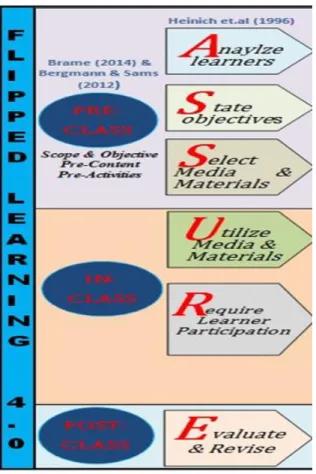
In this study, the activities in and outside the classroom is based on Halili flipped learnin1g 4.0 framework (2018). This flipped learning 4.0 framework is important for educators 4.0 in using flipped classroom approach to support in the teaching and learning process. The structure of the session in this framework is able to assist educators in selecting step available for the needs of learners. Based on this framework, the use of technology in learning must be emphasized in line with technological advancement in education. Educators need to incorporate various technologies to enhance the learners’ success in their studies. This framework can help the educators incorporating the use of latest technologies in teaching and learning processes which can enhance the teaching and learning process. The framework is able to create the interest of learners to participate in the learning materials.
The flipped learning 4.0 framework in this study combines of three models. Two models are from flipped learning model and namely Sams and Bergmann (2012) and Brame (2013) which embedded the pre, in and post-class session. Another model is an instructional model known as ASSURE model by Heinich, Molenda, Russell & Smaldino (1999) which it is one of the flipped learning instructional designs with a more systematic form of instruction in teaching and learning process to design effective learning environment involving technology in the lesson plan. Figure 1 shows the flipped learning 4.0 framework by Halili (2018).
Figure 1. The flipped learning 4.0 framework by Halili (2018)
Data Collection
Source information used in this study consisted of primary and secondary data. Primary data were obtained through the use of a questionnaire. The secondary data were obtained by reviewing reference books, journals, theses, and internet online sources. The instrument used in this study is the
Grasha-Reichmann Student Learning Styles Scale by Grasha and Grasha-Reichmann. (1974). The Grasha-Reichmann Student Learning Styles Scale is an instrument focusing on the interaction and instructional preferences of participants. In this study, this scale is suitable for high school, college or university students in order to determine students’ learning styles when interacting with lecturers and peers using a mobile device. According to Cohen et al. (2000), a questionnaire was utilized in the study because it is a simple tool to collect and record information on a particular issue. The validity and reliability of the questionnaire has been verified. The result of Cronbach’s alpha was .867; hence, these results showed that all items of questionnaires were considered as reliable and could be potentially used in another study. All participants submitted the questionnaire at the end of the final session.
Data Analysis
Descriptive analysis, such as means and standard deviations has been used to analyse the data. Mean was used to obtain the central tendency for the investigated group and standard deviation was used to determine the distribution of scores within the group (Konting,2000). The data were then analyzed using statistical analysis of SPSS software version 20.0.
Findings and Discussion
To examine the most dominant learning styles among students, descriptive analysis, such as mean and standard deviations were used to find the research findings. Referring to the mean score tabulated in Table 1 and Figure 2, the total of mean score for each item is more than 2.50 and standard deviation is between 0.5 - 1.00. The findings found that overall, students emphasize more on the collaborative learning styles 2.88 (0.88), followed by participative 2.80 (0.80), independent 2.76 (0.76), competitive 2.68 (0.69), dependent 2.59 (0.63) and less emphasize on the avoidant learning styles 2.55 (0.60).
Table 1
Means and standard deviations of students’ learning styles
Learning Styles Mean (SD*)
Collaborative 2.88 (0.88) Participative 2.80 (0.80) Independent 2.76 (0.76) Competitive 2.68 (0.69) Dependent 2.59 (0.63) Avoidant 2.55 (0.60) *SD – Standard Deviations
Figure 2. Means and standard deviations of students’ learning styles
The results showed that collaborative learning style recorder higher mean value as compared to others learning styles. This study found that the collaborative learning style was the most applied learning styles of the students. Among the characteristics of students with the collaborative learning style are that they enjoy sharing ideas when learning in groups. Baker (2015) and Storch (2005) stated that collaborative learning helps the students’ understanding when they are engaged in groups. Baker et al. (2012) agreed that with the usage of technology, students scored higher for
the online collaboration as compare to the traditional collaborative learning. Further, Raja Maznah (2004) also agreed that students who followed the web-based collaborative learning activities were able to enhance and develop their creativity to think of innovative ideas. Thus, this finding showed that participants are collaborative learners in teaching and learning using mobile flipped classroom.
The second learning style practiced by the student is the participative learning style. This finding showed that those who employ this learning style are more responsible over their own learning and have a good relationship with other students. According to Garland and Garland (2012), these students will complete all assigned tasks with a positive attitude, are active in all learning activities, obtain valuable and useful experience in every lesson they follow. The findings of this study show that students are more involved when following the teaching and learning process with the use of mobile flipped classroom. Those students who prefer participant learning style usually like to engage in learning activities and are responsible for their own learning. Grasha (1996) stated that such learners often have good relationships with other learners. Besides that, they always complete their assignments and always have a positive attitude. They also are active students in classroom activities both inside and outside activities. This group of students also considers that they will gain experience in every lesson they followed.
Further, the third learning style is the independent learning style. With the usage of mobile flipped classroom approach in their learning process, the students’ experience has allowed them to be independent and take greater responsibility in their own learning process. According to Christine, Liz, Jim & Rob (2018), in independent learning style, students are more independent in pursuing their own learning goals and needs. According to Grasha (1996), students who have independent characteristic prefer to finish their task by themselves and receive less direction from their lecturers. Thomas et al. (2015) also stated that students who are independent usually have their own study materials, work at their own pace and strive not to disturb other students. They also have their own objectives to achieve, have a deep interest, regard their success as dependent on their own ability and also regard their success and failure as unrelated to others.
The fourth learning style is the competitive learning style. In using mobile flipped classroom, students were found to compete among themselves for rewards and recognition in the teaching and learning process. The students who adopt a competitive learning style can motivate themselves in maintaining their performance and set their own targets in learning (Calvin et al., 2018). According to Grasha (1996), students who are competitive in nature will compete among themselves for rewards and recognition. In fact, distrust may crop up even among the same group members. They were always eager to show their prowess such as completing tasks in a better way than others (Cheng, Wu, Liao & Chan, 2009). Besides that, they were always keen to know the achievement level of others in tests or assignments. In this study, learners who employ the competitive style can motivate other learners to maintain their performance in directing the target for the learning being followed. Besides that, they can carry out actions better than other students can, when following the lectures. They will always interact with the lecturer and other students by asking questions in the teaching and learning process and constantly seek praise or appreciation related to activities using mobile flipped classroom approach.
Next, this study found that the dependent learning style was the fifth applied learning style of the students. This is because in using mobile flipped classroom, they are dependent on the lecturer to give them instruction to complete a task and instruction from the lecturer. Grasha (1996) suggested that the dependent students will feel disappointed when faced with challenges in their learning. This is because of their high dependence on their lecturers since they expect clear instructions in completing any task. In fact, they need guidance from their lecturers, and must be told what needs to be learned especially when facing examinations. The lecturer and other students are their sources of reference. Besides that, they also rely only on the prepared learning materials and do not take the initiative to seek out other additional information related to their lessons. The students who adopt a dependent learning style are seen as students who find it difficult to develop self-efficacy in their learning. They do not like to learn how to overcome a certain problem that is unclear. This is because they always need guidance from the lecturer where they regard the lecturer as one who should help them in managing their anxiety and giving clearer instructions (Giles &
Rankin, 2008). These students also often meet with their lecturers and other students to obtain information considering that they need notes from the lecturers to learn the material being taught. They also prefer the student-centered teaching and learning process.
The avoidant learning style was the last preferred learning style practiced by students. The students who adopted this learning style were more inclined to not involve in teaching and learning process using mobile flipped classroom approach, were weak in managing tasks given and avoided establishing more productive goals. According to Grasha (1996), students who had the avoidant learning style had the tendency to achieve low academic achievement and usually had the highest absenteeism in lecture attendance. They also were found to be weak in managing tasks, were less responsible in their learning, avoided participating in any activity in the classroom, lacking in enthusiasm for their chosen course and did not like to face tests or examinations because they usually barely made the passing grade. Chen (2014) also agreed that those with avoidant learning style are not confident of passing with excellence in a subject being learned, are not interested in the learning being followed, lack peers with whom to discuss, and are unready to discuss with other students. However, students who favor the avoidant learning style were found to have ability to avoid any stress or anxiety throughout their teaching and learning process. Nevertheless, the researcher opines that in this study, students with avoidant learning style are more responsible over their learning and they have the ability to avoid having any pressure especially related to their learning
Each student is an individual with different learning style. In this study, it was found that the use of mobile flipped classroom approach is capable of promoting collaborative learning in teaching and learning process. Hong, Yu and Chen (2011) stated that living in a digital age demands the learners to work collaboratively outside the classroom using various technology tools. Collaborative learning could increase social skills among the learners when they engage in groups (Grasha & Yangarber-Hicks, 2000). Holland (2014) also believed that the use of technology able to support collaborative time and feedback from the lecturer to students not only in the class but also outside the class. By using a mobile device, this study also found that students were able to study collaboratively in different location and time.
They can learn and construct their own knowledge through group interaction (Zhu, 2012).
Conclusion
Technology can be used as a valuable tool to promote and strengthen certain learning styles with specific use of technology (King, 2011). For instance, if the lecturer requires the students to interact during the session, it may strengthen the students’ participant in the classroom, minimize those who are avoidant learners and provides opportunity for the competitive learners to do better than their peers. What important is that the use of mobile flipped classroom provides an option for the teachers and students to use effectively in their learning process. This study found that the most dominant learning style adopted by students is the collaborative learning style. This shows that for the effectiveness of a teaching and learning process in using mobile flipped classroom is the collaborative factor. This means collaborative learning styles is important for the student to be more motivated in the teaching and learning process through the use of mobile flipped approach. According to Morgan (2014), flipped classroom establish strong social interaction among students and solving the problem in team with less guidance from the lecturer which it is one of the characteristics of collaborative learning. Roehl, Reddy and Shannon (2013) also agreed that in flipped classroom, the learners need to construct their own learning and work collaboratively with others. This will help them to regard learning activities in teaching and learning process as very valuable, useful and attract their attention to follow the lessons.
Goldhill (2016) and Grasha (1996) stated that students’ learning styles are flexible and can be changed depending on their experience in the classroom. Students who are aware and understand their learning styles can be better learners in their studies (Dandy & Bendersky, 2014). Chen (2014) and Fleming (2012) considered that learning styles are the most important elements that affect learning process and gaining knowledge. Awareness of the students’ learning styles may help the institution to design an effective course and teaching instruction to the students. Perhaps, the institution will provide new methods of instruction for teaching and learning process that
match with the learners’ needs and also provide better student support services. It is important for the lecturers to ensure that their instructional methods match the needs of the learners during the teaching and learning process.
Since the mobile flipped classroom approach is new in Malaysia, the outcome from this study can give a high impact to the university because they can review student’s perception of the mobile flipped learning approach and start to transform from the traditional to the student-centred learning. Not only the university, the students also enjoy the new approach of teaching and learning technique because this can be another option for them to start to explore into the augmented reality technology and the implementation of mobile flipped learning to help them study better. Thus, the researchers suggest that further research should explore the different types of learning styles with other collaborative tools, utilize other learning style theories and models as well as do a comparative study on the learning style differences between students in the distance education program and on-campus students.
Acknowledgements
We would like to acknowledge the financial support provided by University of Malaya under the faculty research grant GPF0020-2018.
References
Ahmad, J.S., & Suaini, Z.M. (2010). Learning style of Part-Time UTM students in Bachelor of Education (Science and Mathematics, Life Skills and Islamic Studies) based on Grasha-Riechmann's learning style scale.
Allinson, C.W., & Hayes, J. (1996). The cognitive style index: A measure of intuition-analysis for organizational research. Journal of Management Studies, 33, 119-135. doi:10.1111/j.1467-6486.1996.tb00801.x
Baepler, P., Walker, J.D., & Driessen, M. (2014). It’s not about seat time: Blending, flipping, and efficiency in active learning classrooms.
Computers & Education, 78, 227-236. doi:
10.1016/j.compedu.2014.06.006
Studies: Social Behaviour and Communication in Biological and Artificial Systems, 16(3), 451-473. doi: 10.1075/is.16.3.05bak
Baker, M.J., Bernard, F.-X. & Dumez-Féroc, I. (2012). Integrating computer-supported collaborative learning into the classroom: the anatomy of a failure. Journal of Computer Assisted Learning, 28, 161-176. doi: 10.1111/j.1365-2729.2011.00435.x
Bishop, J.L., & Berleger, M.A. (2013). The Flipped Classroom: A Survey of the Research. 120th ASEE Annual Conference and Exposition.
Brame, C.J. (2013). Flipping the classroom. Vanderbilt University Centre for Teaching.
Calvin C. Y. L., Zhi-Hong, C., Hercy N. H. C., & Tak-Wai, C. (2018). Effects of friendship relations and gender differences on classroom-based surrogate competitive learning, Journals of Computers in Education, 5(3), 259-277. doi: 10.1007/s40692-018-0108-y
Canfield, A.A., & Knight, W. (1983). Learning Styles Inventory. Los Angeles, CA: Western Psychological Services.
Chen, Z.H. (2014). Learning preferences and motivation of different ability students for social-competition or self-competition. Journal of Educational Technology and Society,17(1), 283–293.
Cheng, H.N., Wu, W.M., Liao, C.C., & Chan, T.W. (2009). Equal opportunity tactic: Redesigning and applying competition games in classrooms. Computers & Education, 53(3), 866–876. doi:
10.10.1016/j.compedu2009.05.006
Christine, H., Liz, T., Jim, O., & Rob, J. (2018). Independent learning – what we do when you’re not there. Teaching in Higher Education,
23(2),145-161. doi: 10.1080/13562517.2017.1332031
Cohen, L., Manion, L., & Morrison, K. (2000). Research Methods in Education 5th Edition. London: RoutledgeFalmer.
Dandy K., & Bendersky K. (2014). Student and faculty beliefs about learning in higher education: implications for teaching. Int. J. Teach. Learn. High. Educ.,26, 358–380.
Davies, R.S., Dean, D.L., & Ball, N. (2013). Flipping the classroom and instructional technology integration in a college-level information systems spreadsheet course. Educational Technology Research and Development,61(4), 563-580. doi: 10.1007/s11423-013-9305-6
Dunn, R., & Dunn. K. (1978). Teaching students through their individual learning styles: A practical approach. Englewood Cliffs, NJ: Reston Book.
Enfield, J. (2013). Looking at the impact of the flipped classroom model of instruction on undergraduate multimedia students at CSUN.
TechTrends, 57(6), 14-27. doi: 10.1007/s11528-013-0698-1
Evans, R., & Matthew, A. (2013). A New Era: Personal Technology Challenges Educational Technology. Macquarie Universiy, Sydney. Felder, R.M., & Silverman, L.K. (1998). Learning and Teaching Styles in
Engineering Education. Engineering Education, 78(7), 674 – 681. Field, A. (2009). Discovering statistics using SPSS. Los Angeles: Sage
Publications
Fleming N.D. (2012). The Case Against Learning Styles. Retrieved from
http://vark-learn.com/
Galway, L.P., Corbett, K.K., Takaro, T.K., Tairyan, K., & Frank, E. (2014). A novel integration of online and flipped classroom instructional models in public health higher education. BMC Medical Education, 14(1), 1-9. doi: 10.1186/1472-6920-14-181
Gardner, H. (1993). Multiple intelligences: The theory in practice. New York, NY: Basic Books.
Garland, P., & Garland, I. (2012). A participative research for learning methodology on education doctoral training programmes.
International Journal for Researcher Development, 3(1), 7-25. doi:
10.1108/17597511211278625
Giles, C., & Rankin, H. (2008). Behavioral Analysis of Learning and Memory. Learning and Memory: A Comprehensive Reference,1, 629-640. doi: 10.1016/B978-012370509-9.00070-X
Goldhill, O. (2016). The Concept of Different “learning Styles” Is One of the Greatest Neuroscience Myths. Quartz. Retrieved from
http://qz.com
Grasha, A.F. (1996). Teaching with style: Practical guide to enhancing learning by understanding teaching and learning styles. Pittsburgh, PA: Alliance Publishers.
Grasha, A.F., & Reichmann, S.W. (1974). A rational approach to developing and assessing the construct validity of a Student Learning Style Scales
Instrument. The Journal of Psychology, 87, 213-223. doi:
10.1080/00223980.1974.9915693
Grasha, A., & Yangarber-Hicks, N. (2000). Integrating teaching styles and learning styles with instructional technology. College Teaching,48(1),
2-11. doi: 10.1080/87567550009596080
Gregorc, A.F. (1984). Style as a symptom: A phenomenological perspective.
Theory into Practice, 23(1), 51-55. doi: 10.1080/00405848409543089
Halili, S.H. (2018). Flipped learning 4.0 framework. Copyright UMCRIC, Kuala Lumpur: University of Malaya.
Hamidah, J.H., Muhamad, N.S., & Kamaruzaman, J. (2009). The social interaction learning styles of science and social science students.
Asian Social Science, 5(7), 58 – 64. doi: 10.5539/ass.v5n7p58
Heinich, R., Molenda, M., Russell, J.D., & Smaldino, S.E. (1999).
Instructional media and technologies for learning. Upper Saddle River, NJ: Prentice-Hall.
Holland, J. (2014) Implications of Shifting Technology inEducation.
TechTrends, 58(3), 16-25. doi: 10.1007/s11528-014-0748-3
Hong, J.C., Yu, K.C., Chen, M.Y. (2011). Collaborative learning in
technological project design. International Journal of Technology and Design Education, 21(3), 335-347. doi: 10.1007/s10798-010-9123-7
Hwang,G., Lai,C., & Wang, S. (2015). Seamless flipped learning: a mobile technology-enhanced flipped classroom with effective learning strategies. Journal of Computer Education,2(4),449-473. doi:
10.1007/s40692-015-0043-0
Idrus, R. M. (2015). The Mobile Learning Flipped Classroom. Recent Advances in Education and Educational Technology, In proceedings of the 14th international conference on education and education
technology (EDU’ 15), Kuala Lumpur, Malaysia, April 23-25.
King, A. (2011). Culture, Learning and Development: A Case Study on the Ethiopian Higher Education System. Higher Education Research Network Journal
Kolb, D. (1984). Experiential learning: Experience as the source of learning and development. Englewood Cliffs, NJ: Prentice Hall.
Kong, S.C. (2014). Developing information literacy and critical thinking skills through domain knowledge learning in digital classrooms: An
experience of practicing flipped classroom strategy. Computers & Education,78, 160-173. doi: 10.1016/j.compedu.2014.05.009
Konting, M.M. (2000). Kaedah penyelidikan pendidikan. Kuala Lumpur: Dewan Bahasa dan Pustaka.
Kumar, P., Anil, K., & Karl, S. (2004). Assessing the impact of instructional methods and information technology on student learning styles.
Journal Of Issues In Informing Science And Information Technology,
1, 533 – 544. doi: 10.28945/758
Maznah, R., & Hussain, R. (2004). A collaborative experience of evaluating a web-based learning tool. Malayisian Online Journal of Instructional Technology, 1(2), 67-72.
Morgan, H. (2014). Focus on Technology: Flip Your Classroom to Increase Academic Achievement: Hani Morgan, Editor, Childhood Education. 90(3), 239-241. doi: 10.1080/00094056.2014.912076
Myers, I. B., & McCaulley, M.H. (1985). Manual: A guide to the
development and use of the Myers-Briggs Type Indicator. Palo Alto, CA: Consulting Psychologists Press.
Ozan, F., & Adile, K. (2015). Flipped learning: Misunderstandings and the truth, 5 (1), Journal of Educational Sciences Research, 215-229. doi:
10.12973/jesr. 2015.51.13
Pasquinelli, E. (2012). Neuromyths: Why do they exist and persist? Mind Brain Educ. 689–96. doi: 10.1111/j.1751-228X.2012.01141.x
Roehl, A., Reddy, S.L., & Shannon, G.J. (2013). The flipped classroom: An opportunity to engage millennial students through active learning strategies. Journal of Family & Consumer Sciences. 105(2), 44-49. Sadler Smith, E. (1996). Learning styles: a holistic approach. Journal of
European Industrial Training, 20, 29- 36. doi:
10.1108/03090599610127891
Sams, A., & Bergmann, J. (2012). Flip your classroom: Reach every student in every class every day. Washington DC: International Society for Technology in Education (ISTE).
Seif, A. (2001). Educational psychology: Learning and education. Tehran, Iran: Agah.
Schmidt, S. M., & Ralph, D. L. (2014). The Flipped Classroom: A twist on teaching. The Clute Institute International Academic Conference, San
Antonio, Texas, USA 2014.
Spector, M. (2012). Foundations of educational technology. Routledge: New York.
Storch, N. (2005). Collaborative writing: Product, process and students’ reflections. Journal of Second Language Writing, 14(3), 153-173. doi:
10.1016/j.jslw.2005.05.002
Talley, C.P., & Scherer, S. (2013). The Enhanced Flipped Classroom: Increasing Academic Performance with Student-recorded Lectures and Practice Testing in a" Flipped" STEM Course. The Journal of Negro Education, 82(3), 339-347. doi:
10.7709/jnegroeducation.82.3.0339
Thomas, L., Hockings, J., Ottoway R., & Jones (2015). Independent Learning: Student Perspectives and Experiences. New York: Higher Education Academy.
Turban, E., King, D. Lee, J.K., Liang, T.P., & Turban, D.C. (2015). Mobile commerce and ubiquitous computing. Switzerland: Springer
International Publishing.
Willingham, D.T., Hughes, E.M., Dobolyi, D.G. (2015). The scientific status of learning styles theories. Teach. Psychol. 42, 266–271. doi:
10.1177/0098628315589505
Zamzami, Z., & Siti, H.H. (2016). Flipped classroom research and trends from different fields of study. The international review of research in open and distributed learning, 17(3), 313-340. doi:
10.19173/irrodl.v17i3.2274
Zhu, C. (2012). Student satisfaction, performance, and knowledge
construction in online collaborative learning. Journal of Educational Technology & Society, 15(1), 127-136.
Siti Hajar Halili is Senior Lecturer at University of Malaya, Malaysia.
Shukri Sulaiman is Professor at University Science Malaysia, Malaysia.
Hamidah Sulaiman is Senior Lecturer at University of Malaya, Malaysia.
Rafiza Abdul Razak is Senior Lecturer at University of Malaya, Malaysia.
Contact Address: Department of Curriculum & Instructional Technology, Faculty of Education, University of Malaya, 50603, Kuala Lumpur, Malaysia. Email: [email protected]