Barcelona, 24-26 October, 2018 ISBN 978-615-5511-25-7
MATURITY MODELS FOR IMPROVING THE QUALITY OF DIGITAL
TEACHING
Felix Sanchez-Puchol, Universitat Oberta de Catalunya (UOC) & SEIDOR SBS Learning Services, Joan A. Pastor-Collado, Universitat Politècnica de Catalunya (UPC), Lourdes
Guàrdia-Ortiz, Universitat Oberta de Catalunya (UOC), Spain
Summary
In this paper we present a primer on the state-of the-art of existing maturity models (MMs) for eLearning. By means of a traditional qualitative literature review, 29 different models are identified. Next, they are analysed and classified on the basis of a framework of 20 common properties derived from general theory on MMs, considering aspects related to their definition, structure and practical use. Results of the analysis suggest that existing eLearning MMs mainly address problems linked to eLearning management and organization at institutional level, educational technology, instructional design and faculty staff professional development. However, they tend to provide relatively moderate support for being effectively applied in practice, which clearly compromises and dismisses their power and utility as prescriptive tools for quality improvement. Our findings contribute to the current body of knowledge on eLearning by providing improved understanding, visibility, transparency and traceability of eLearning MMs designed to date, which may be of interest to both practitioners and researchers.
Introduction
Maturity models (MMs) are well-recognized instruments for systematically assessing and developing quality improvement actions for activities, processes, technologies, skills or any other object existing in an organization (Blondiau, Mettler, & Winter, 2016; Mettler, 2011; Reis, Mathias, & de Oliveira, 2017). Over the last years, a plethora of generic and domain-specific MMs have been designed covering a wide range of application areas, including education (Wendler, 2012; pp.1328–1329). However, progress in the conception of these artefacts tailored to concrete eLearning domains has been rather slower and limited compared with other fields. Hence, the topic of MMs for eLearning is still an insufficiently researched field, which may result in an undervaluation of such artefacts as tools for quality management and improvement in eLearning contexts.
To bridge such a gap, in this paper we review the status quo of existing MMs in eLearning. In so doing, we aim to contribute to the current body of knowledge by (a) raising awareness of their existence and potential practical relevance among the eLearning community, (b) providing a unified and homogeneous reference catalogue of eLearning MMs constructed to
date, (c) increasing the visibility, transparency and traceability of these instruments for the benefit of the different eLearning stakeholders. The innovative aspect of the paper is grounded on the fact that, to the best of our knowledge, no previous attempt has been undertaken to investigate the state of affairs of existing eLearning MMs in depth. Although similar studies have been conducted to compare or critically review eLearning quality assurance models, benchmarking tools or performance assessment methods (Coralesce, 2014; Marciniak, 2018; Marshall & Sankey, 2017; Ossiannilsson, Williams, Camilleri, & Brown, 2015; Scepanovic, Devedzic, & Kraljevski, 2011) none of them has been exclusively focussed on MM artefacts. The content and findings presented in this paper may be of interest to both practitioners and researchers. The former will find a simple and light-weight decision-making tool to easily find and select available MMs which may help them assess and define improvement actions for their eLearning initiatives quickly and economically. Academics can also take advantage of the panoramic view of the eLearning MMs presented in the paper to identify potential weaknesses and drawbacks of the designed models and uncover future research opportunities for building new models targeted at the as yet unexplored sub-domains of eLearning prompted by the study.
Background
MMs are artefacts that represent “phases of increasing quantitative or qualitative capability changes of a maturing element in order to assess its advances with respect to defined focus areas” (Kohlegger, Maier, & Thalmann, 2009; p.59). They are conceptual models showing anticipated, desired, or typical evolution paths of a concrete class of objects, shaped as discrete stages of maturity (Becker, Knackstedt, & Pöppelbuss, 2009; p.213). From a structural point of view, MMs typically consist of two main components (Mettler, 2011; Ofner, Otto, & Österle, 2015; Tarhan, Turetken, & Reijers, 2016): a (reference) domain model, providing one or multiple criteria by which the addressed domain can be partitioned into discrete units to be assessed (what needs to be measured); and an assessment method/model, which takes an inquiring view to evaluate and obtain a mark of the current status (maturity) level achieved by the evaluated item against the reference domain model (how it can be measured).
Depending on their potential usefulness, MMs can be classified as (de Bruin, Freeze, Kaulkarni, & Rosemann, 2005; Pöppelbuss & Röglinger, 2011): (a) descriptive, allowing the current (as-is) state of maturity of a targeted domain or object to be assessed, (b) prescriptive, enabling the definition of concrete roadmaps for improvement towards a desired (to-be) state, as well as checking their effectiveness; or (c) comparative, providing support for conducting internal or external comparative benchmarking. Hence, MMs transcend benchmarking tools as it is possible to adapt them to particular contexts; thus becoming suitable tools for providing practical guidance to develop roadmaps or plans for quality improvement, digital transformation initiatives or facilitating organizational adoption of new technologies. Probably, the most paradigmatic example of MMs is the Capability Maturity Model (CMM), introduced in the early 1990s by the Carnegie Mellon Software Engineering Institute (Paulk, Curtis, Chrissis, & Weber, 1993). CMM is based on a relatively complex and elaborate formal architecture, specifying a number of goals and key practices to reach a predefined level of
maturity (Mettler, 2009; p.377; Paulk et al., 1993). CMM-like MMs are often taken as a reference point for designing new MMs, as, for example, in the case of the well-known eLearning Maturity Model (Marshall, 2010; p.146).
Research approach
To investigate existing eLearning MMs we first conducted an extensive qualitative literature review following general and well-accepted guidelines for undertaking such reviews (Hart, 1998). We searched for potentially relevant information sources made available through digital libraries such as Web of Science, Scopus, Springer Link, Emerald or IEEE Xplore. We also used the general Google web search tool to expand the scope and coverage of our search to non-peer-reviewed sources. Inspired by previous studies, the search strategy was set to find combinations of words and expressions such as “eLearning”, “mLearning”, “distance education”, “online education”, “online learning”, “virtual learning”, “virtual education”, “blended learning”, “blended education”, “web based education” and “open education” with others such as “maturity model”, “maturity matrix”, “maturity assessment”, “maturity instrument”, “maturity grid” and “capability maturity” in the title, keywords or abstract of the source. Due to the limited search features offered by some platforms, minor adjustments had to be made in some cases to the specific final searches executed. No temporal or language restriction was explicitly considered. The searches were executed iteratively between February and May 2018, in order to incrementally identify and accumulate newly emerged potentially relevant information sources. After a perusal analysis of the sources yielded by the previous search, we excluded those related with MMs but targeted at application domains not focussed on eLearning issues. We also excluded some tools such as Pick&Mix and Towards Maturity, as they have traditionally been considered as benchmarking instruments. During this stage we also learned of the existence of a Blended Learning MM (EMBED Project Consortium, 2017) or an MM for E-Learning Classroom, Bimodal & Virtual Courses in HE (Espinoza-Guzmán & Zermeño, 2017). However, we had to exclude them for subsequent analysis as, at the moment of writing the paper, they were still ongoing projects for which insufficient evidence on the structure and content of the MM were found. To conclude with the search process, a snowballing approach was used to track the citations of the sources containing core knowledge of the identified eLearning MMs backward and forward. We did so in order to either uncover additional MMs or to obtain complementary information on existing ones for subsequent analysis. Scopus was used as a support tool for forward tracking purposes. We proceeded iteratively in this way until a saturation point was reached (Boell & Cecez-Kecmanovic, 2014; Webster & Watson, 2002). To organize and classify our findings we adopted a concept-oriented approach (Webster & Watson, 2002) to define an analysis framework. We relied on existing MM theory, and more concretely, on proposals of taxonomies and design principles for characterizing generic MMs (de Bruin et al., 2005; Mettler, 2010; 2011; Pöppelbuss & Röglinger, 2011), which were slightly adapted for our purposes in this study. Grounding the information inductively obtained from the available documentary sources, we finally decided to investigate a set of 20 different properties for each uncovered MM. For the sake of comprehensiveness, selected properties were
grouped into three major blocks of similar characteristics, namely, (a) definition properties, considering basic identifying descriptive attributes of the MMs; (b) design properties, describing the form and organization of the MMs and (c) use properties, considering issues related to deployment and practical application of the MMs. In so doing, we set the MMs as a basic unit for analysis. Due to space restrictions, the concrete properties investigated are described in detail in the additional supplementary material complementing this paper (supplementary material can be accessed at: https://goo.gl/7M98Mv).
Results and discussion
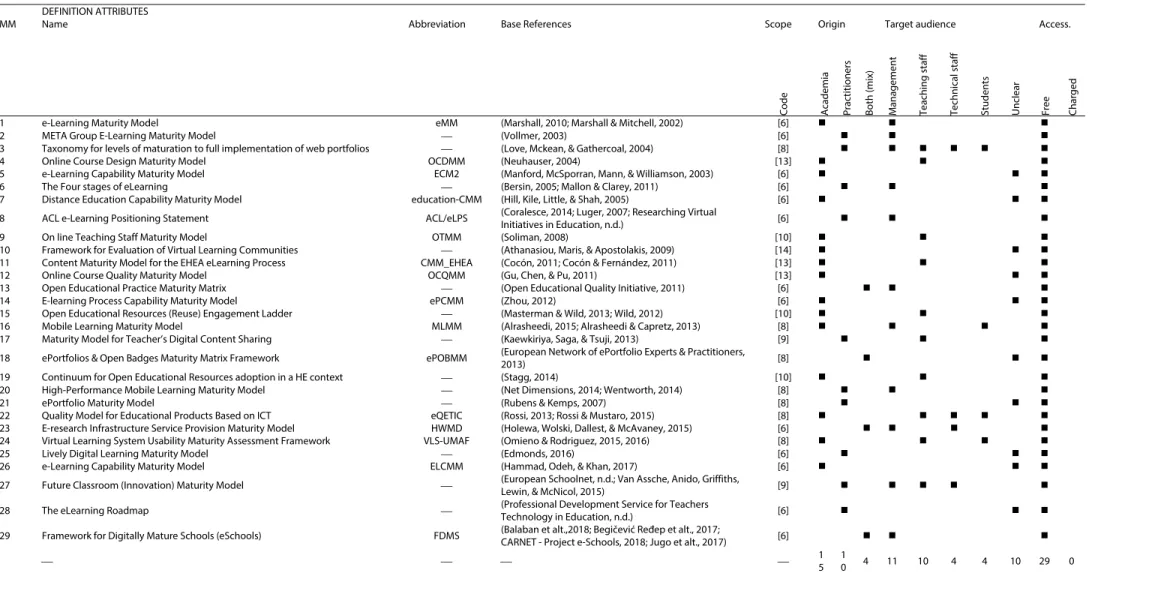
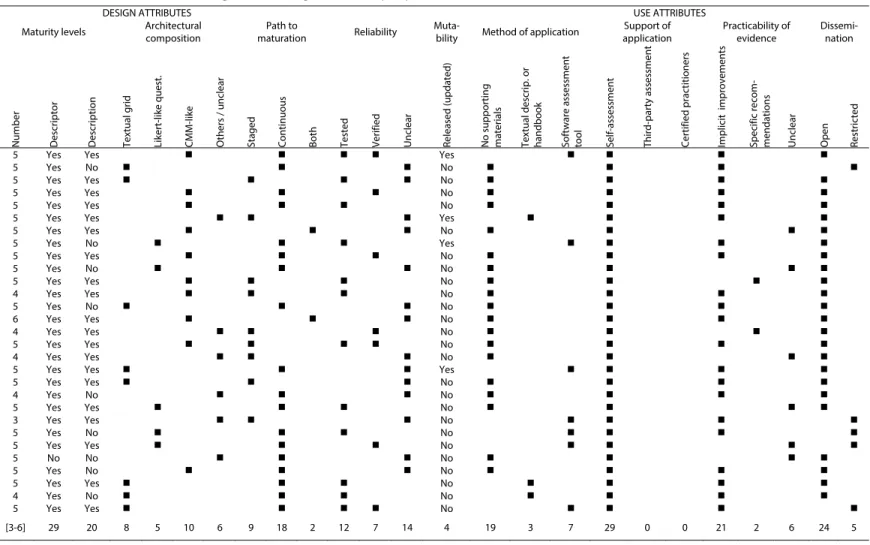
A total set of 29 eLearning MMs were identified grounded on the knowledge that emerged from the information sources collected in the review process. Diversity in the format types of the sources containing relevant information on the MMs (conference and journal articles, book chapters, wikis/web pages, working papers and reports, etc.) suggests that eLearning researchers and practitioners draw on a wide variety of heterogeneous communication mechanisms to disseminate their proposed artefacts. Collectively, it can be concluded that previous work on eLearning MMs has been rather scattered and disperse. Also, we believe that the number of MMs identified in the study is quite significant, as previously referred to studies (see introductory section) tend to compare or analyse cohorts of 8-12 artefacts. If we look at the temporal data for the bibliographic references used in the analysis, it seems that over two-thirds of the eLearning MMs discussed have been constructed between 2011 and 2018. This fact can be interpreted as a clear sign of the eLearning community’s increasing interest in MMs over the last years. An in-depth analysis and classification of the identified eLearning MMs is presented in the following Tables 1 and 2. In the remainder of the section, we discuss the results of the analysis from the aggregate perspective of the three main blocks of properties considered in the previous section.
Definition properties
Our analysis reveals a certain balance regarding the origin of existing eLearning MMs. Hence, it is plausible that they may have been conceived either through academic or from professional initiatives. We also appreciate that developers of existing models tend to omit the target audience they are intended for. Thus, although it was sometimes possible for us to infer the intended audience of the evaluated MM through an in-depth content analysis of the available information sources, future developments should pay special attention to clearly and explicitly stating the audience of the created MM. In terms of accessibility, all the investigated MMs are freely available. In Figure 1, we depict the targeted application scope of the uncovered eLearning MMs based on the taxonomy of research streams proposed by Zawacki-Richter and Anderson (2014). The graphic shows that the main topics addressed by existing models include institutional management and organization of eLearning initiatives, instructional design, educational technologies and teaching staff support and development. Furthermore, it can be clearly noted that there is room for building new MMs in many as yet unaddressed eLearning sub-domains, especially at the macro level (i.e. distance education systems and theories).
Figure 1. Application scope of the investigated MMs, based on the taxonomy by Zawacki-Richter and Anderson (2014)
Table 1: Analysis and classification of the uncovered eLearning MMs: definition properties
DEFINITION ATTRIBUTES
MM Name Abbreviation Base References Scope Origin Target audience Access.
Code Ac a d e m ia Pra cti ti oners Bot h (m ix) Manage me nt T e a ching st aff T ec hni ca l s ta ff Stu d e n ts Unc lea r Free Charge d
1 e-Learning Maturity Model eMM (Marshall, 2010; Marshall & Mitchell, 2002) [6]
2 META Group E-Learning Maturity Model (Vollmer, 2003) [6]
3 Taxonomy for levels of maturation to full implementation of web portfolios (Love, Mckean, & Gathercoal, 2004) [8]
4 Online Course Design Maturity Model OCDMM (Neuhauser, 2004) [13]
5 e-Learning Capability Maturity Model ECM2 (Manford, McSporran, Mann, & Williamson, 2003) [6]
6 The Four stages of eLearning (Bersin, 2005; Mallon & Clarey, 2011) [6]
7 Distance Education Capability Maturity Model education-CMM (Hill, Kile, Little, & Shah, 2005) [6]
8 ACL e-Learning Positioning Statement ACL/eLPS (Coralesce, 2014; Luger, 2007; Researching Virtual
Initiatives in Education, n.d.) [6]
9 On line Teaching Staff Maturity Model OTMM (Soliman, 2008) [10]
10 Framework for Evaluation of Virtual Learning Communities (Athanasiou, Maris, & Apostolakis, 2009) [14]
11 Content Maturity Model for the EHEA eLearning Process CMM_EHEA (Cocón, 2011; Cocón & Fernández, 2011) [13]
12 Online Course Quality Maturity Model OCQMM (Gu, Chen, & Pu, 2011) [13]
13 Open Educational Practice Maturity Matrix (Open Educational Quality Initiative, 2011) [6]
14 E-learning Process Capability Maturity Model ePCMM (Zhou, 2012) [6]
15 Open Educational Resources (Reuse) Engagement Ladder (Masterman & Wild, 2013; Wild, 2012) [10]
16 Mobile Learning Maturity Model MLMM (Alrasheedi, 2015; Alrasheedi & Capretz, 2013) [8]
17 Maturity Model for Teacher’s Digital Content Sharing (Kaewkiriya, Saga, & Tsuji, 2013) [9]
18 ePortfolios & Open Badges Maturity Matrix Framework ePOBMM (European Network of ePortfolio Experts & Practitioners,
2013) [8]
19 Continuum for Open Educational Resources adoption in a HE context (Stagg, 2014) [10]
20 High-Performance Mobile Learning Maturity Model (Net Dimensions, 2014; Wentworth, 2014) [8]
21 ePortfolio Maturity Model (Rubens & Kemps, 2007) [8]
22 Quality Model for Educational Products Based on ICT eQETIC (Rossi, 2013; Rossi & Mustaro, 2015) [8]
23 E-research Infrastructure Service Provision Maturity Model HWMD (Holewa, Wolski, Dallest, & McAvaney, 2015) [6]
24 Virtual Learning System Usability Maturity Assessment Framework VLS-UMAF (Omieno & Rodriguez, 2015, 2016) [8]
25 Lively Digital Learning Maturity Model (Edmonds, 2016) [6]
26 e-Learning Capability Maturity Model ELCMM (Hammad, Odeh, & Khan, 2017) [6]
27 Future Classroom (Innovation) Maturity Model (European Schoolnet, n.d.; Van Assche, Anido, Griffiths,
Lewin, & McNicol, 2015) [9]
28 The eLearning Roadmap (Professional Development Service for Teachers
Technology in Education, n.d.) [6]
29 Framework for Digitally Mature Schools (eSchools) FDMS (Balaban et alt.,2018; Begičević Ređep et alt., 2017;
CARNET - Project e-Schools, 2018; Jugo et alt., 2017) [6]
Table 2: Analysis and classification of the uncovered eLearning MMs: design and use properties
DESIGN ATTRIBUTES USE ATTRIBUTES
M
M Maturity concept
Dimensions
/ attributes Maturity levels
Architectural composition
Path to
maturation Reliability
Muta-bility Method of application
Support of application Practicability of evidence Dissemi-nation Proce ss Pe opl e Obj e ct Unc lea r
Number Number Descriptor Description Te
xt u al grid Likert-lik e qu est. CMM-lik e Oth e rs / u n cl ea r S tage d C o nt inuous Bot h T es te d Ve rifie d Unc lea r Re le ase d (u p d ate d ) No supporting ma ter ia ls T extu a l d e sc ri p. o r handboo k S o ft ware asse ss m e n t tool Se lf -asse ssm ent T hird-p art y asse ssme n t Ce rt ifie d p ract it ione rs Im pl icit imp rovement s S p e cific re com -me ndations Unc lea r Op en Restricted
1 5/35 5 Yes Yes Yes
2 3x5 5 Yes No No
3 14x5 5 Yes Yes No
4 5/68 5 Yes Yes No
5 3/39 5 Yes Yes No
6 12 5 Yes Yes Yes
7 11/46 5 Yes Yes No 8 5/31 5 Yes No Yes 9 5/53 5 Yes Yes No 10 4/18 5 Yes No No 11 2/9 5 Yes Yes No 12 6/18 4 Yes Yes No 13 (3)/17x5 5 Yes No No 14 5/-- 6 Yes Yes No 15 14 4 Yes Yes No 16 1/18 5 Yes Yes No 17 8/-- 4 Yes Yes No
18 (8)/60x5 5 Yes Yes Yes
19 1x5 5 Yes Yes No 20 6/24 4 Yes No No 21 5x5 5 Yes Yes No 22 6/50-89 3 Yes Yes No 23 6/43 5 Yes No No 24 4/10 5 Yes Yes No 25 5/20 5 No No No 26 4/26 5 Yes No No 27 5x5 5 Yes Yes No 28 (5)/27x4 4 Yes No No 29 (5)/38x5 5 Yes Yes No ∑ 1 7 1 0 1 6 3 [2/4 – 11/14] [3-6] 29 20 8 5 10 6 9 18 2 12 7 14 4 19 3 7 29 0 0 21 2 6 24 5
Design properties
The analysis of the design properties of the uncovered MMs shows a great level of heterogeneity in terms of the maturity concept considered. On the one hand, MMs based on a unidimensional maturity conceptualization (18 of the 29 models investigated) principally encompass either a process-oriented or an object- (i.e. technology-) oriented conceptualization of maturity (eight instances for each case). On the other hand, another eight MMs use a rather multidimensional conceptualization of maturity, combining people-, process- and object-centric factors. Much more heterogeneity can be observed regarding the number of dimensions defined by the MMs to configure the maturity assessment, which tends to vary from 2/4 to 11/14 dimensions. In a similar vein, 75.8% of the investigated MMs define five maturity levels. These results are in line with common design parameters characterizing MMs targeted at other application domains than eLearning. 20 of the 29 investigated MMs incorporate a description of the intent of each one of the maturity levels considered, which can be interpreted as a positive sign in terms of clarity and understandability. Finally, and regarding the path to maturation (i.e. principle of maturity) of MMs, our analysis shows a clear imbalance in favour of continuous-oriented MMs versus staged ones (18 vs. 9), with two MMs (education-CMM and ePCMM) simultaneously supporting both configurations.
Concerns about the completeness and rigour of the existing eLearning MMs also arose. On the one hand, the composition of six of the 29 investigated MMs remains unclear to us. This is especially significant for MMs originated from practice, which tend to be poorly documented, and therefore, their composition is sometimes roughly described. On the other hand, and although it is true that 10 of the 29 MMs studied present a CMM-like architectural composition – representing the more formal possible architectural design for a MM –, in many cases they are conceived as either mere derivations or adaptations of existing CMM-like MMs. As derivation is generally done though a rudimentary or informal methodological process, the resulting MMs tend to present a quite simple, incomplete or extremely abstract CMM-like structure. Besides, they also lack (in many cases) a strong theoretical foundation justifying their structural dimensions. Finally, 27.6% of the investigated MMs are just textual maturity grids, which represent the simplest possible architectural structure for a MM. All in all, and under such circumstances, it was not surprising for us to find a high number of MMs (14 of 29) with unclear reliability. Exceptions to this rationale could be the Framework for Digitally Mature eSchools and especially Marshall’s eLearning MM. We found multiple evidence testing and applying the latter MM in many different educational contexts. We interpret this finding as a clear symptom that the model has achieved a certain position of ‘de-facto’ standard in the worldwide eLearning community. This seems to be confirmed in terms of mutability, as it is also one the few MMs that has been released over time, adapting the original defined model’s configuration to the new requirements, practices and technologies that have progressively emerged in the eLearning discipline.
Use properties
Lastly, the analysis of the use properties of the identified eLearning MMs revealed to us that they only provide a moderate level of support for being applied in practice. We must highlight at this point that a great number of the information sources reviewed were exclusively concerned with the description and design of the MMs, but mostly omitted to consider how to apply them (i.e., if they incorporate or include a formal assessment method, how to collect data for assessment, etc.). Hence, it was sometimes quite complicated for us to discover the concrete method of application of the MMs. Therefore, when no information on this matter was provided by the sources, we considered that the MM does not formally provide supporting materials for its application (19 of the investigated MMs). Conversely, we found much more clarity in the fact that the models constructed are primarily intended for self-assessment purposes. However, it must be noted that the lack of formality in defining a clear MM method of application or assessment may lead to inaccurate (maturity) measurements, which in turn, will clearly dismiss and compromise the intended objective of the model as well as its utility for quality improvement.
Another important attribute regarding the operative application of an MM is the practicability of the evidence (i.e., the way suggestions for improvement are made) provided by the artefact. In general, the eLearning MMs investigated tend to provide implicit suggestions and recommendations rather than explicit recommendations for improvement telling users what to do to enhance a particular element or capability (74.2 % of the reviewed MMs). This is typically the case of textual maturity grids, from which implicit improvement actions can be inferred from the descriptions contained in each cell of the matrix. This finding is consistent with the situation that can be found for MMs designed to assess maturity in any other targeted field or domain. In general, establishing explicit improvement recommendations for complex domains or objects of analysis is very complicated, and therefore, explicit recommendations are plausible (and useful) only when relatively concrete objects or delimited domains are being addressed. In terms of our reviewed eLearning MMs, this is the case, for example, when designing an online course (CMM_EHEA model) or when reviewing people’s engagement in terms of Open Educational Resources (OER) reuse practices (OER Engagement Ladder). To conclude, we found five MMs with some kind of access restriction in terms of availability of either the whole content of the model or (especially) the support tool incorporated for conducting the practical assessment.
Conclusion
In this paper, a set of 29 eLearning MMs are investigated and classified by means of a conceptual framework of 20 attributes, considering definitional, structural and applicability issues of the models. Key findings of the analysis show that eLearning MMs (a) have been originated from both academia and practice; (b) mainly address problems concerned with eLearning institutional organization and management, educational technology, instructional design or staff professional development; (c) present a heterogeneous and rather simple structural configuration; and (d) provide moderate support for being applied in practice. Our analysis
suggests that MMs are valuable tools to identify potential areas of improvement in digital teaching and learning activities. Furthermore, they could also act as practical assistance tools to provide guidance on how to progressively enable the adequate conditions for more personalized learning and student support in digital environments. In this sense, we envision tremendous avenues for further research in the development of new and more operative MMs for eLearning domains yet unaddressed by existing ones. Finally, the main limitation of the study lies in the possible subjectivity introduced by the authors’ appreciations when considering each one of the properties analysed.
References
1. Alrasheedi, M. (2015). A maturity model for mobile learning (Doctoral dissertation). Western University, London, Ontario, Canada. Retrieved from
https://ir.lib.uwo.ca/cgi/viewcontent.cgi?article=4422&context=etd
2. Alrasheedi, M., & Capretz, L. F. (2013). An m-learning maturity model for the educational sector. Paper presented at the 6th Conference of MIT Learning International Networks
Consortium, Cambridge, Massachusetts. Retrieved from http://ir.lib.uwo.ca/electricalpub/17
3. van Assche, F., Anido, L., Griffiths, D., Lewin, C., & Mc Nicol, S. (Eds.). (2015). Re-engineering the uptake of ICT in Schools. Springer International Publishing.
doi:10.1007/978-3-319-19366-3
4. Athanasiou, G., Maris, N., & Apostolakis, I. (2009). Evaluation of virtual learning communities for supporting e-learning in the healthcare domain. The Journal on Information Technology in Healthcare, 7(3), 187–192.
5. Balaban, I., Begičević Ređep, N., & Klacmer Calopa, M. (2018). The analysis of digital maturity of schools in Croatia. International Journal of Emerging Technologies in Learning, 13(6), 4–15. doi:10.3991/ijet.v13i06.7844
6. Becker, J., Knackstedt, R., & Pöppelbuss, J. (2009). Developing maturity models for IT management. Business & Information Systems Engineering, 1(3), 213–222.
doi:10.1007/s12599-009-0044-5
7. Begičević Ređep, N., Balaban, I., Žugec, B., Klačmer Čalopa, M., & Divjak, B. (2017). Framework for digitally mature schools. In A. Volungeviciene & A. Szűcs (Eds.), Distance and E-Learning Network European Distance and E-Learning Network, EDEN 2017. Annual Conference (pp. 360–371). 13-16 June, Jönköping, Sweden.
8. Bersin, J. (2005). The four stages of e-learning. A maturity model for online corporate training. Bersin & Associates. Retrieved from
https://immagic.com/eLibrary/ARCHIVES/GENERAL//BERSINUS/B051002B.pdf 9. Blondiau, A., Mettler, T., & Winter, R. (2016). Designing and implementing maturity
models in hospitals: An experience report from 5 years of research. Health Informatics Journal, 22(3), 758–767. doi:10.1177/1460458215590249
10. Boell, S. K., & Cecez-Kecmanovic, D. (2014). A hermeneutic approach for conducting literature reviews and literature searches. Communications of the Association for Information Systems, 34(1), 257–286.
11. De Bruin, T., Freeze, R., Kaulkarni, U., & Rosemann, M. (2005). Understanding the main phases of developing a maturity assessment model. In B. Campbell, J. Underwood, & D. Bunker (Eds.), Australasian Conference on Information Systems (ACIS) (pp. 8–19). Sydney, Australia. Retrieved from https://eprints.qut.edu.au/25152/
12. CARNET - Project e-Schools. (2018). e-Schools [Web Portal]. Retrieved June 1, 2018, from https://www.e-skole.hr/en/results/digital-maturity-of-schools/
13. Cocón, F. (2011). Marco para el soporte de la interoperabilidad en almacenes de objetos de aprendizaje en la docencia e_learning universitaria adaptada al EEES [In Spanish]
(Doctoral dissertation). Escuela Técnica Superior de Ingeniería Informática.
Departamento de Lenguajes y Sistemas Informáticos I, Alcalá de Henares, Madrid, Spain. Retrieved from https://eciencia.urjc.es/handle/10115/11348
14. Cocón, F., & Fernández, E. (2011). MMCbEEES: Maturity model in the e-Learning teaching environment adapted to the EHEA. Paper presented at the 6th Iberian Conference on
Information Systems and Technologies, Chaves, Portugal. Retrieved from http://ieeexplore.ieee.org/document/5974198
15. Coralesce (2014). Review of learning technology self-assessment. Baseline Report July 2014. Coralesce Ltd. Retrieved from
http://www.edtech-assess.com/wp-content/uploads/2014/07/Bound-ETF-Learning-Technology-Self -Assessment-Baseline-Report-proofed-5th-August.pdf
16. Edmonds, S. (2016). Digital learning goodness [Web Page]. Retrieved June 1, 2018, from http://www.livelyco. co/digital-learning-goodness/
17. EMBED Project Consortium (2017). About EMBED. European maturity model for blended education (EMBED 2017-2020) [Web Page]. Retrieved from
https://embed.eadtu.eu/about
18. Espinoza-Guzmán, J., & Zermeño, M. G. G. (2017). Maturity model for e-learning classroom, bimodal and virtual courses in higher education: A preliminary study.
International Journal of Web-Based Learning and Teaching Technologies, 12(1), 19–31. doi: 10.4018/IJWLTT.2017010102
19. European Network of ePortfolio Experts & Practitioners (2013). eportfolios & open badges maturity matrix [Web page]. Retrieved May 30, 2018, from
http://www.eportfolio.eu/matrix
20. European Schoolnet (n.d.). Tool 2.2 - A reference guide to the future classroom model [Web Portal]. Retrieved June 10, 2018, from http://fcl.eun.org/hr/toolset2
21. Gu, D., Chen, J., & Pu, W. (2011). Online course quality maturity model based on evening university and correspondence education (OCQMM). Proceedings of the 2011 IEEE 3rd
International Conference on Communication Software and Networks (ICCSN), 5–9. Xi’an, China. doi: 10.1109/ICCSN.2011.6013763
22. Hammad, R., Odeh, M., & Khan, Z. (2017). ELCMM: An e-learning capability maturity model. In P. Kommers & P. Isaías (Eds.), Proceedings of the 15th International Conference (e-Society 2017) (pp. 169–178). IADIS Press. Retrieved from
http://www.iadisportal.org/digital-library/elcmm-an-e-learning-capability-maturity-model
23. Hart, C. (1998). Doing a literature review: releasing the social science research imagination. SAGE Ltd.
24. Hill, J., Kile, J. F., Little, D., & Shah, S. (2005). A proposal for a distance education capability maturity model (Education-CMM). School of Computer Science and Information Systems, Pace University. Retrieved from
http://citeseerx.ist.psu.edu/viewdoc/download?doi=10.1.1.561.4317&rep=rep1&type=pdf 25. Holewa, H., Wolski, M., Dallest, K., & McAvaney, C. (2015). The HWMD maturity model:
A foundational framework to measure effectiveness of institutional research
e-infrastructures. Proceedings of the 2015 Higher Education Technology Agenda Conference (TETHA 2015), 1–17. Gold Coast, Australia. Retrieved from http://dro.
deakin.edu.au/view/DU:30073806
26. Jugo, G., Balaban, I., Pezelj, M., & Begicevic Redjep, N. (2017). Development of a model to assess the digitally mature schools in Croatia. In A. Tatnall & M. Webb (Eds.), Tomorrow’s Learning: Involving Everyone. Learning with and about Technologies and Computing (pp. 169–178). Springer International Publishing. doi:10.1007/978-3-319-74310-3_19
27. Kaewkiriya, T., Saga, R., & Tsuji, H. (2013). Transparent digital contents sharing for science teachers. In S. Yamamoto (Ed.), Human Interface and the Management of Information. Information and Interaction for Learning, Culture, Collaboration and Business (pp. 53–62). Springer Berlin Heidelberg. doi:10.1007/978-3-642-39226-9_7 28. Kohlegger, M., Maier, R., & Thalmann, S. (2009). Understanding maturity models. Results
of a structured content analysis. Proceedings of I-KNOW ’09 and I-SEMANTICS ’09, 51– 61. Graz, Austria. Retrieved from
http://iwi.uibk.ac.at/download/downloads/Publikationen/KMM.pdf
29. Love, D., Mckean, G., & Gathercoal, P. (2004). Portfolios to webfolios and beyond: Levels of Maturation. EDUCAUSE Quarterly, 2004(2), 24–37.
30. Luger, J. (2007). Supporting the journey towards e-maturity. Key lessons and transferable practice emerging from the NIACE. E-Shift Transformation Projects. National Institute for Adult and Continuing Education (NIACE). Retrieved from
https://api.excellencegateway.org.uk/resource/import-msword:16813
31. Mallon, D., & Clarey, J. (2011). The next generation of e-learning: A primer. Bersin & Associates. Retrieved from
32. Manford, C., McSporran, M., Mann, S., & Williamson, A. (2003). e-learning quality: becoming a level five learning organization. Proceedings of the 6th Annual National Advisory Committee on Computing Qualification (NACCQ), 343–348. July, 2003. Palmerston North, New Zeeland. Retrieved from
http://citeseerx.ist.psu.edu/viewdoc/download?doi=10.1.1.60.7173&rep=rep1&type=pdf 33. Marciniak, R. (2018). Quality assurance for online higher education programmes: design
and validation of an integrative assessment model applicable to Spanish universities. The International Review of Research in Open and Distributed Learning, 19(2).
doi:10.19173/irrodl.v19i2.3443
34. Marshall, S. (2010). A quality framework for continuous improvement of e-Learning: The e-Learning Maturity Model. Journal of Distance Education, 24(1), 143–166.
35. Marshall, S., & Mitchell, G. (2002). An e-learning maturity model? Proceedings of the 19th Annual Conference of the Australian Society for Computers in Learning in Tertiary Education (ASCILITE), Auckland, New Zealand, 1–10. Retrieved from
http://www.ascilite.org/conferences/auckland02/proceedings/papers/173.pdf
36. Marshall, S., & Sankey, M. (2017). The ACODE benchmarks for technology enhanced learning (pp. 1–13). Paper Presented at the 2017 Higher Education Technology Agenda Conference (TETHA 2017), Auckland, New Zealand. Retrieved from
http://handle.westernsydney.edu.au:8081/1959.7/uws:43376
37. Masterman, L., & Wild, J. (2013). Reflections on the evolving landscape of OER use. OER 13, 26 - 27 March 2013, Nottingham, UK.
38. Mettler, T. (2009). A design science research perspective on maturity models in Information Systems. Institute of Information Management, Universtiy of St. Gallen. Retrieved from https://www.alexandria.unisg.ch/214531/
39. Mettler, T. (2010). Thinking in terms of design decisions when developing maturity models. International Journal of Strategic Decision Sciences, 1(4), 76–87.
doi:10.4018/jsds.2010100105
40. Mettler, T. (2011). Maturity assessment models: a design science research approach. International Journal of Society Systems Science, 3(1–2), 81–98.
doi:10.1504/IJSSS.2011.038934
41. Net Dimensions (2014). A Framework for Mobile Learning. Net Dimensions -Brandon Hall Group, Inc. Retrieved from http://www.netdimensions.com/assets/videos/webinars-on-demand/slide-framework-mobilelear ning.pdf
42. Neuhauser, C. (2004). A maturity model: does it provide a path for online course design. The Journal of Interactive Online Learning, 3(1), 1–17.
43. Ofner, M., Otto, B., & Österle, H. (2015). A maturity model for enterprise data quality management. Enterprise Modelling and Information Systems Architectures, 8(2), 4–24.
44. Omieno, K. K., & Rodriguez, A. (2015). Performance-based usability maturity assessment framework for VLS in universities. International Journal of Advanced Research in
Computer and Communication Engineering, 4(12), 6–14. doi:10.17148/IJARCCE.2015.41202
45. Omieno, K. K., & Rodriguez, A. (2016). Usability maturity model and assessment tool for virtual learning systems. International Journal of Advanced Research in Computer and Communication Engineering, 5(12), 86–95. doi:10.17148/IJARCCE.2016.51217
46. Open Educational Quality Initiative (2011). Guidelines for open educational practices in organizations (Vs. 2011). Open Educational Quality Initiative (OPAL), 2011. Retrieved from http://oerworkshop.pbworks.com/w/file/fetch/ 44605120/OPAL-OEP-guidelines.pdf 47. Ossiannilsson, E., Williams, K., Camilleri, A. F., & Brown, M. (2015). Quality models in
online and open education around the globe. State of the art and recommendations. Proceedings of the International Council for Open and Distance Education, Oslo 2015, 52 S. Retrieved from
https://www.pedocs.de/volltexte/2015/10879/pdf/Ossiannilsson_et_al_2015 _Qualitymodels.pdf
48. Paulk, M. C., Curtis, B., Chrissis, M. B., & Weber, C. V. (1993). Capability maturity model for software, version 1.1 (Technical Report No. CMU/SEI-93-TR-024 ESC-TR-93-177). Software Engineering Institute. Carnegie Mellon University. Retrieved from
https://resources.sei.cmu.edu/asset_files/TechnicalReport/1993_005_001_16211.pdf 49. Pöppelbuss, J., & Röglinger, M. (2011). What makes a useful maturity model? A
framework of general design principles for maturity models and its demonstration in business process management. Proceedings of the 19th European Conference on Information Systems (ECIS 2011), 1–12. Helsinki, Finland. Retrieved from
https://eref.uni-bayreuth.de/id/eprint/8260
50. Professional Development Service for Teachers Technology in Education (n.d.). e-Learning roadmap [Web Portal]. Retrieved June 5, 2018, from
http://www.pdsttechnologyineducation.ie/en/Planning/eLearning-Planning-Resources/ 51. Reis, T. L., Mathias, M. A. S., & de Oliveira, O. J. (2017). Maturity models: identifying the
state-of-the-art and the scientific gaps from a bibliometric study. Scientometrics, 110(2), 643–672. doi:10.1007/s11192-016-2182-0
52. Researching Virtual Initiatives in Education. (n.d.). ELPS [Web Page]. Retrieved June 1, 2018, from http://www.virtualschoolsandcolleges.eu/index.php/ELPS
53. Rossi, R. (2013). eQETIC: modelo de qualidade para productos educacionais baseados nas tecnologias de informaçao e comunicaçao [In Portuguese] (Doctoral dissertation).
Universidade Presbiteriana Mackenzie, Sao Paulo, Brazil. Retrieved from http://tede.mackenzie.br /jspui/bitstream/tede/1522/1/Rogerio%20Rossi.pdf
54. Rossi, R., & Mustaro, P. N. (2015). eQETIC: a maturity model for online education. Interdisciplinary Journal of E-Skills and Lifelong Learning, 11, 11–23.
55. Rubens, W., & Kemps, A. (2007). The eportfolio landscape in dutch higher education (2006). In W. Aalderink, M. Veugelers, & S. N. Portfolio (Eds.), Stimulating Lifelong Learning: The ePortfolio in Dutch Higher Education (pp. 13–21). Utrecht: Stichting SURF. Retrieved from https://www.surf.nl/binaries/content/assets/surf/nl/kennisbank/
ouder/Stimulating+Lifelong+Learning++ePortfolio.pdf
56. Scepanovic, S., Devedzic, V., & Kraljevski, I. (2011). E-learning and benchmarking: methodology and tools review. Proceedings of the The Second International Conference on e-Learning (eLearning-2011), 79–84. Belgrade, Serbia. Retrieved from
http://econference.metropolitan.ac.rs/files/pdf/2011/23-snezana-scepanovic-vladan-devedzic-ivan-kraljevski-e-learning-benchmarking-methodology-and-tools-review.pdf 57. Soliman, T. (2008). Online teaching staff maturity model (OTMM) (pp. 211–215).
Proceedings of the 7th World Scientific and Engineering Academy and Society International Conference on E-ACTIVITIES, Cairo, Egypt. Retrieved from http://www.wseas.us/e-library/conferences/2008/cairo/CD-E-ACTIVITIES/E-ACTIVITIES35.pdf
58. Stagg, A. (2014). OER adoption: a continuum for practice. Universities and Knowledge Society Journal, 11(3), 151. doi:10.7238/rusc.v11i3.2102
59. Tarhan, A., Turetken, O., & Reijers, H. A. (2016). Business process maturity models: a systematic literature review. Information and Software Technology, 75, 122–134. doi:10.1016/j.infsof.2016.01.010
60. Vollmer, J. (2003, April 9). The enterprise LMS market: where are we now? Clomedia [Blog post]. Retrieved June 25, 2018, from http://www.clomedia.com/2003/04/09/the-enterprise-lms-market-where-are-we-now/
61. Webster, J., & Watson, R. T. (2002). Analyzing the past to prepare the future: writing a literature review. MIS Quarterly, 26(2), xiii–xxiii.
62. Wendler, R. (2012). The maturity of maturity model research: a systematic mapping study. Information and Software Technology, 54(12), 1317–1339. doi: 10.1016/j.infsof.2012.07.007 63. Wentworth, D. (2014). High performance mobile learning maturity model: framework for
progress. Brandon Hall Group.
64. Wild, J. (2012). OER engagement study: promoting OER reuse among academics. SCORE Research Report. University of Oxford & The Open University. Retrieved from
https://askawild.files.wordpress.com/2017/09/oer-engagement-study-joanna-wild_full-research-report.pdf
65. Zawacki-Richter, O., & Anderson, T. (Eds.) (2014). Online distance education. Towards a research agenda. AU Press, Athabasca University. Retrieved from
http://microblogging.infodocs.eu/wp-content/uploads/2014/07/ Online_Distance_Education.pdf
66. Zhou, Y. (2012). Towards Capability Maturity Model of e-Learning Process. Intelligent Information Management, 4(4), 95–98. doi:10.4236/iim.2012.44015
Acknowledgements
This work has been supported by the Industrial Doctorates Programme – Generalitat de Catalunya (2014 DI 077).