i
CHARACTERISATION DRIVEN PROCESSING OF INDIAN SUB-MARGINAL GRADE OF IRON ORE FOR VALUE ADDITION
Thesis submitted to National Institute of Technology, Rourkela for the award of degree of
DOCTOR OF PHILOSOPHY IN
MINING ENGINEERING by
Nirlipta Priyadarshini Nayak
Under the guidance of Prof. B. K. Pal
& Dr. A. Das
DEPARTMENT OF MINING ENGINEERING NATIONAL INSTITUTE OF TECHNOLOGY
ii
CERTIFICATE
This is to certify that the Thesis entitled “Characterisation driven processing of Indian Sub-marginal grade of Iron ore for value addition” being submitted by Nirlipta Priyadarshini Nayak for the award of Doctor of Philosophy in Engineering to the National Institute of Technology, Rourkela, Odisha, India is a record of bonafide research work carried out by her under our supervision and guidance. The Thesis has fulfilled all the necessary requirements for the award of Ph.D degree at National Institute of Technology, Rourkela as per regulation. It has satisfied the standard pertaining to the required Degree. The results incorporated in the Thesis have not been submitted to any other University or Institution for the award of any Degree or Diploma.
Dr. Avimanyu Das Dr. B. K. Pal Principal Scientist Professor
Co- Supervisor Principal Supervisor National Metallurgical Laboratory Dept. of Mining Engineering
Jamshedpur NIT, Rourkela
iii
ACKNOWLEDGEMENT
I acknowledge the support, critical guidance of my supervisor Prof. B. K. Pal, Department of Mining Engineering, National Institute of Technology, Rourkela for his valuable suggestions and encouragement that motivated me throughout my Ph.D. work.
I am indebted to Dr. Avimanyu Das, Mineral Processing Division, National Metallurgical Laboratory for his support and ever helping attitude throughout the entire period of my Ph.D. Work.
I extend my humble thanks to Prof. S. K. Sarangi, Director, NIT for his kind co-operation and extending all necessary help during my Research work.
I express my deep sense of gratitude to Prof. S. Bhattacharyya, Dean (AA) and members of DSC for their kind co-operation in my Research work.
I thank Dr. B. Nayak, Scientist and Dr. S. Srikanth, Director, National Metallurgical Laboratory (CSIR), Jamshedpur for providing me the facilities for my research work.
I also thank Dr. J. Chatterjee, Geologist, Steel Authority of India, RMD, Barsua who helped me to collect field data through on-site observations & Mr. C. Sengupta, OCL, Rajgangpur for his relentless support to facilitate OCL Laboratory for adding more qualitative improvement to my Research.
I also thank Prof.H.K. Naik and other faculty members of the Department of Mining Engineering, NIT, Rourkela for their help.
I am grateful to Dr. K.K. Bhattacharyya, Head Mineral Processing Division of NML Jamshedpur, Dr. R. Singh, Dr. A. Vidyadhar, Dr. S. Dey & other Scientists for providing technical guidance and help in the execution of various experiments.
I thank my friends for their countless help and encouragement. I express my deep sense of gratitude to my parents for their unlimited source of inspiration, support and guidance throughout my life.
I am emotionally thankful to my husband Amarjeet for his constant encouragement and immense moral support during my Ph. D. work and emotional sacrifice of my beloved son, Arpan who was deprived of his mother due to my long absence for one year constantly during my stay at NML, Jamshedpur.
I am thankful to all those people who helped me directly or indirectly during the period of my Research work.
iv CONTENTS Subjects Page no Certificate ii Acknowledgements iii Contents iv-v List of publication vi Abstract vii
List of figures viii
List of tables ix-x
CHAPTER-I INTRODUCTION 1-7
1.1 PROLOGUES 2-4
1.2 SCOPE OF PRESNT INVESTIGATION 4-5
1.3 OBJECTIVES OF PRESENT RESEARCH 5-6
1.4 INDIAN IRON ORE - GREAT FUTURE WITH MANY PROBLEMS
6-7
1.5 THE PROSPECTS 07
CHAPTER- II GEOLOGICAL FRAMEWORK 08-26
2.1 LITHOSTRATIGRAPHY OF SINGHBHUM-ORISSA CRATON 10-15
2.2 THRUST AREA 15-19
2.3LITHOLOGICAL SUCCESSION IN JILLING-LANGALATA AREA
20-21
2.4LITHOLOGICAL SUCCESSION IN BARSUA AREA 21
2.5 CLASSIFICATION OF THE IRON ORES OF STUDY AREA 22-26 CHAPTER- III IRON ORE RESOURCES INDIAN
PERSPECTIVE 27-45
3.1 RESOURCES 28-29
3.2 IRON ORE DEPOSITS OF INDIA 30-31
3.3 IRON ORE PRODUCTION 31-36
3.4 CONSUMPTION PATTERN 36-40
3.5 FOREIGN TRADE 41
3.6 WORLD PERSPECTIVE 42-43
3.7 STEELMAKING 43-45
3.8 INDUSTRY OUTLOOK –“IRON ORE” 45
CHAPTER-IV LITERATURE REVIEW 46-61
4.1 SET BACKS 60
4.2 SCOPE OF PRESENT WORK 60-61
CHAPTER-V MATERIALS AND METHODS 62-72
5.1 MATERIAL DETAILS 63
5.2 METHODOLOGY 63
5.2.1 MINERALOGICAL ANALYSIS 64-66
5.2.2 CHEMICAL ANALYSIS 66
5.3 BENEFICIATION UNIT OPERATIONS 66-72
CHAPTER-VI CHARACTERIZATION OF IRON ORES 73-101
v
6.1.1 BANDED HEMATITE JASPER 76-83
6.1.2 SILICEOUS BD/ LOW GRADE IRON ORE FINES 84-88
6.1.3 GOETHITIC- LATERITIC ORE 89-95
6.1.4 IRON ORE SLIME 96-101
CHAPTER-VII BENEFICIATION OF IRON ORES 102-132
7.1 BANDED HEMATITE JASPER (BHJ) 103-104
7.1.1 BENEFICIATION OF BANDED HEMATITE JASPER (BHJ) 104-109 7.2 LOW GRADE FINES 110 7.2.1BENEFICIATION OF LOW GRADE BLUE DUST/FINES 110-119
7.3IRON ORE SLIME 120
7.3.1BENEFICIATION OF IRON ORE SLIME 120-127
7.4GOETHITE- LATERITIC ORE 128
7.4.1BENEFICIATION OF GOETHITE-LATERITIC ORE 128-132
CHAPTER- VIII CONCLUSION 133-139
vi
LIST OF PUBLICATIONS
· Nayak (2013) “Mineralogical constraints in beneficiation of Low grade Iron ores of Barsua, Eastern India accepted in International Journal of Engineering & Innovative Technology
· Nayak, N. P and Pal, B. K (2013) “Beneficiation of Goethite-Lateritic ore to produce pellet grade concentrate using Multi Gravity Separator” communicated in International Journal of Mining & Mineral Processing.
· Nayak, N. P., Das.A and Pal, B. K (2013) “Beneficiation of Banded Hematite Jasper using Falcon Concentrator: An alternative to Iron ore Resources”, Research Open Journal of Mineral and Mining Engineering Vol. 1, No. 6, pp.08-14.
· Nayak, N. P., Das.A and Pal, B. K (2013) “Characterization Driven Processing of Indian Iron Ore Slime, International Journal of Research in Chemistry and Environment, Vol.3, Issue 2, pp.120-127.
· Nayak, N. P and Pal, B. K (2013) “separation behavior of iron ore fines in Kelsey centrifugal jig”, Journal of Minerals & Material characterization & Engineering, Vol.1, Issue, pp.85-89.
· Nayak, N. P., Das. A and Pal, B. K (2012) “Mineralogical characterization of goethite- lateritic ore & its implication on beneficiation accepted in Journal of Environmental Research & Development.
· Nayak, N. P., Das. A and Pal, B. K (2012) “Characterization and processing of low grad iron ore fines from jhilling area of India accepted in International Journal of Engineering Science and Advanced Technology.
· Nayak, N. P., Das. A and Pal, B. K (2012) “Pelletisation in Indian context:-Need of the hour”, accepted in Journal of Mine, Metal & Fuels.
· Nayak, N. P., Das. A and Pal, B. K (2012) “Feasibility of Beneficiation of Banded Hematite Jasper of Eastern India”, published in International Journal of Engineering resource & Technology”, Vol.1, Issue 9 pp.01-11.
Papers Published in Conference Proceedings
· Nayak, N. P., Das. A and Pal, B. K (2014) “Eco-friendly utilisation of low grade iron ore fines- a case study” ”, accepted in International Conference on Metallurgical & Material Processes, products and application to be held on 08-10th January, 2014, OPJIT, Raigarh.
· Nayak, N. P., Das. A and Pal, B. K (2013) “Environmental impacts of Iron ore mining in Eastern India-A case Study”, International Conference on Emerging trends in Engineering & Technology (ICETET), 05-06th October, 2013, Munnar, Kerala.
· Nayak, N. P and Pal, B. K (2011) “Feasibility of Beneficiation of Low Grade Iron Ore Fines”, ACE, 2011, International Conference on Advances in Environmental Chemistry, 16-18, November, Aizawl.
vii Abstract
Iron ore resource has its own typical mineral characteristics which require definite beneficiation process to produce quality raw material. India is endowed with large reserves of high grade hematite ore. However, steady consumption of these iron ores is now a concern forcing to develop beneficiation strategies to utilize low grade iron ores. Characterization has become an integral part of mineral processing and beneficiation depends on the nature of the gangue present and its association with the ore. Different characterization aspects like mineralogy, textural relationship, liberation size, chemical analysis and grain size analysis were studied to develop the beneficiation scheme. As reflected in the National Steel Policy, the life of high grade lumpy ore as on April 2010 will be ten more years. In order to ensure longer period of ore availability, it is important to use low grade Banded Hematite Quartzite (BHQ) & Banded Hematite Jasper (BHJ) iron ores after beneficiation. Looking at the present scenario, Indian Bureau of Mines (IBM) has slashed the threshold value of Fe in hematite to 45% from 55 % (t). According to National mineral policy projections, exploitation of the low grade iron ore horizons is necessary to achieve zero waste mining. BHJ assaying up to 40% Fe (T) had upgraded above 60% Fe (T) to use effectively. Technically it is possible to enhance the quality of low grade as well as BHQ/ BHJ iron ores to an acceptable grade using various techniques like Flotation, Enhanced gravity separation, WHIMS etc. In India, iron ores are generally washed to remove the high alumina containing clayey matter. Conventionally, after washing, the lumps are directly fed to blast furnace and the fines are used after agglomerating them into sinter. However, the slimes are being rejected in the tailing ponds. These slimes in most cases contain substantial iron values in the range of 54– 58% Fe. Therefore, it is imperative to recover iron values from these slimes because of high demand on the good grade iron ores day-by-day.
viii
LIST OF TABLES
Table 2.1 Generalised Chronostratigraphic succession of the Singhbhum-Orissa iron ore craton (after Saha et al., 1988)
Table 2.2 Year-wise iron ore reserves in Jilling- Langalata iron ore mines Table 2.3 Year-wise iron ore reserves in Barsua Iron Mine, SAIL
Table 3.1 World iron ore reserves and reserve base as estimated by U. S. Geological Survey (U. S. Geological Survey, 2007, www.fedmin.com, 2008)
Table 6.1 Liberation data of banded hematite jasper, Goethite- lateritic ore, iron ore slime and low grade iron ore fines showing abundance of various phases converted to wt %.
Table 6.2 Sink-Float study results of LIF
Table 6.3 Size distribution and size-wise chemical analyses of BHJ and LIF (Siliceous BD)
Table 6.4 Size distribution and size-wise chemical analyses of Goethite-Lateritic ore & Iron ore slime
Table 7.1.1 Wilfley table test results with3˚ deck and 1.68 cc. per cm/sec water flow
Table 7.1.2 Falcon &WHIMS test results of banded hematite jasper
Table 7.1.3 Flotation test of WHIMS concentrate at a pH of 9.3, with 10% solids, 5 min. conditioning time, 2.0kg/t collector (sodium oleate), 2.5kg/t depressant (sodium silicate), 0.3kg/t frother(MIBC)
Table 7.2.1 Hydrocyclone test results of iron ore fines
Table 7.2.2 WHIMS test with hydrocyclone U/F product of Test 1 with Wash water: 20 lpm, Solid: 10%.
Table 7.2.2.1 Experimental results under different operating conditions Table 7.3.1.1 Hydrocyclone test results of iron ore slime
Table 7.3.1.2 WHIMS test with hydrocyclone U/F product of Test 1 with 1 amp current, Wash water: 20 lpm, Solid: 10%.
Table 7.3.1.3 Wilfley Table test results of Hydrocyclone U/F of Test 2 with 10% solids,0.25 inch inclination, 280 rpm Speed and 3 lpm Wash water. Table 7.3.1.4 Flotation test of Tabling concentrate at a pH of 5.5 with 10% solids, 3
min. conditioning time, 2.5 kg/t collector (Sodium Oleate), 1.5 kg/t Depressant (Sodium silicate), 0.2 kg/t Frother (MIBC)
Table 7.4.1 Result of desliming operation Table 7.4.2 Analysis of the crusher products Table 7.4.3 Jigging results of goethitic-lateritic ore Table 7.9.4 Tabling result of goethite-lateritic ore
ix
LIST OF FIGURES
Fig. 2.1 (a) Generalised Geological Map Showing BIF-I, BIF-II and BIF-III Surrounding the NOIOC (b)Geology of the Singhbhum craton.
Fig. 2.2 Geological map showing BIF and iron ore occurrences along the horse-shoe shaped synclinorium in the Singhbhum-N Orissa Craton, eastern India Fig. 2.3 Field Photographs showing (a) Tightly Folded Banded Hematite Jasper (b) Shale band (ferruginous & white shale) (c) Alternative band between blue dust and white shale (d) Highly siliceous blue dust (e) parting shale besides soft laminated ore (f) Ochre red Lateritic ore.
Fig. 2.4 Field Photographs showing (a) Canga ore as top cappings (b) Biscuity ore along joint pattern (c) Litho contact between hard massive ore &Blue dust (d) Hard massive ore (e) Soft Laminated Ore retaining the banding (f) Highly jointed (2 sets) hard massive ore
Fig. 2.5 Section showing different lithological units (a) across Barsua Iron ore mines (b) Lenticular shape iron ore deposit of SAIL Barsua- Taldih-Kalta Fig. 2.6 Section showing different lithological units across Jhiling- Langalata iron
ore mines.
Fig. 3.1 Graphical representation of (a) Distribution of Hematite ore in India (b) Distribution of Magnetite.
Fig.3.2(a) Total resources of Iron ore in India (Iron & Steel, vision, 2020)
Fig.3.2(b) State wise reserves & total remaining resources of Hematite (As on 1.4.2010)
Fig. 3.3 Zone-Wise distribution of Iron ore in India.
Fig. 3.4 Domestic consumption & Export of Indian Iron ore
Fig. 3.5 Graphical representation of (a) Sector-wise production of iron ore in India (b) State-wise production of iron ore in India.
Fig. 3.6 (a) Graphical representation of (a) Production, Consumption and Export of iron ores in India (b) Production of iron ore lumps, fines, concentrate in India.
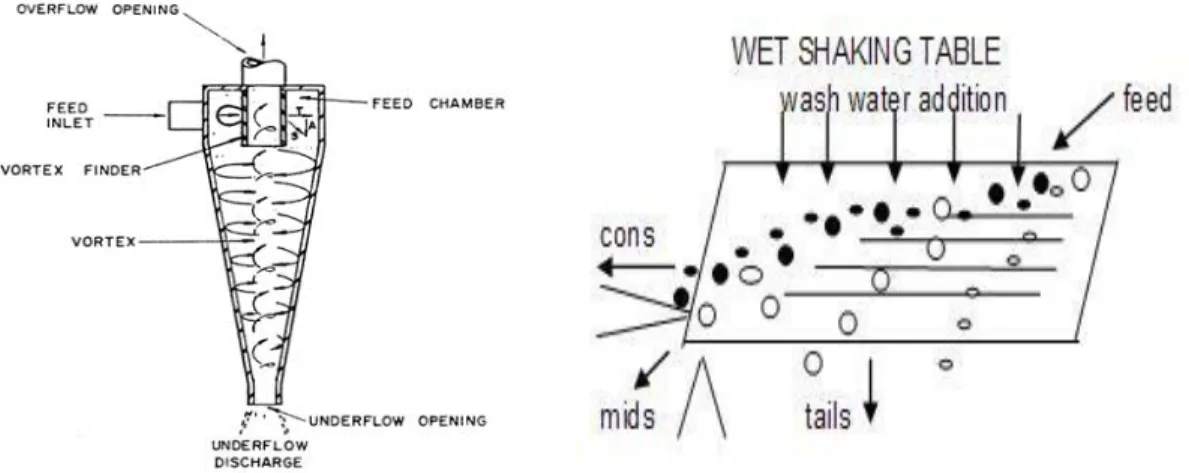
Fig. 5.1.1 Schematic diagram showing different zones and the flow pattern of (a) hydrocyclone (b) wilfley table.
Fig. 5.1.2 (a) Schematic & Various zones of Falcon Centrifugal Concentrator (b) Fluidization Water Injection in Falcon concentrator.
Fig. 5.1.3 (a) Schematic of Kelsey Centrifugal Jig (IMPC, 2012) (b) Kelsey Centrifugal Jig set up at National Metallurgical Laboratory, Jamshedpur. Fig. 6.1 Zeta potential vs pH of BHJ
Fig. 6.2 XRD pattern of (a) banded hematite jasper (b) siliceous blue dust with Identified phases.
x
Fig. 6.3 Photomicrographs of Banded Hematite Jasper under reflected light microscope
Fig. 6.4 SEM photomicrographs with energy dispersive spectroscopy of iron ore samples, (i) hematite grains stalked upon one another in BHJ (ii) siliceous blue dust sample showing microplaty hematite.
Fig. 6.5 Photomicrographs of LIF
Fig. 6.6 SEM photomicrographs of goethite-lateritic ore
Fig. 6.7 XRD patterns of Goethitic-Lateritic ore (a) ore fraction shows presence of hematite and goethite.
Fig. 6.8 Photomicrographs of Goethite- Laterite iron ore under reflected light microscope.
Fig. 6.9 Photomicrographs of Iron ore Slime under Microscope
Fig. 6.10 SEM Photomicrographs with EDS of iron bearing particles of slimes Fig. 6.11 XRD pattern of iron ore slime of Barsua iron ore with different
phases
Fig. 7.1.1 Processing flowsheet of Banded Hematite Jasper
Fig. 7.2.1 Graphical representation of a) Desliming of low grade fines in hydrocyclone (b) WHIMS test results of low grade iron ore fine sample (+150 micron) with 10% solids, 0.8 amp. current, and 20 lpm Wash water, Fig.7.2.2 Processing flow sheet of the low grade iron ore fines.
Fig. 7.2.2.1 Processing flow sheet of the low grade iron ore fines (Single stage operation).
Fig. 7.3.1 Traditional Processing flow sheet of Iron ore slime Fig. 7.3.1.1 Processing flow sheet of Iron ore slime
Fig. 7.3.2 Graphical representation of a) Desliming of iron ore slime in hydrocyclone (b) Tabling result of hydrocyclone U/ F (c) WHIMS test results of iron ore slime sample (+150 micron) with 10% solids, 1 amp. current, and 20 L/pm Wash water.
1
CHAPTER- I
INTRODUCTION
2
INTRODUCTION 1.1 PROLOGUES
Iron is the second most abundant metallic element in the Earth’s crust and by mass the most common element on Earth. It is the fourth most common element in the Earth's crust accounting for around 5 % of it. The principal minerals of iron are the oxides (hematite and magnetite). Hematite and magnetite are the two important iron ores from which iron is extracted. Of these, hematite is considered to be superior owing to its high grade. Iron & steel is the crux for industrial development in a country. The vitality of the iron & steel industry largely influences the economic status of a country. Iron ore being the essential raw-material for Iron & Steel Industry, its mining arguably is the cynosure of all mining activities undertaken by any country. However, being a non-renewable natural resource the reserve of good quality ore is ever dwindling. In order to meet the present and future requirement it is indeed essential to utilize marginal to sub-marginal grade iron ore. Indian iron ore is relatively rich in Fe as well as contains higher proportion of silica, alumina and phosphorous compared to the other major deposits of the world. World steel demand grew by 3.6% in the year 2013[150] owing to the huge requirement of iron ore by China, the major iron ore producing countries have increased their production by adopting the steps to utilize the lean grade iron ores, fines and slime. Iron and steel industry in India grew exponentially during the last decade. India is slated to become the second largest steel producers in the world by 2015. Steel production in the country has increased at a compound annual growth rate (CGAR) of 6.9% over the year 2008-2012[148].On the basis of the growth witnessed, National Steel Policy, 2008 revised the estimated domestic steel projection as 190 Mts by the year 2020.
3
India is endowed with large iron ore reserve of around 26 billion tonnes. Current mining practice adopts a cut off grade of 58% Fe content. As a result of which lot of low grade in-situ deposits are locked in operating mines. Besides these in-in-situ deposits huge stockpiles of low grade ore has been created in all operating mines in course of removal of overburden and selective mining during mine development. This low grade ore can’t be utilised due to low industrial value and marketability. According to industry, the high quality iron ore will be exhausted much before the full operational life of the plants in place today or those being planned to set up.
Indian iron ore is generally friable in nature that results in generation of significant quantity of fines (around 35%) during mining and processing in the country [106]. The ratio of lumps to fines produced in the country is 2:3. These fines however can’t be used for iron making (blast furnace/ direct reduced iron (DRI) units. These fines could be put to use in the domestic iron & steel industry after suitable beneficiation followed by agglomeration. However, the popularity of these routes is yet to gear up/ pick up the momentum in Indian iron and steel industry. In order to produce 1 ton of lump ore, about 1.5 ton fines are generated of which only 0.5 ton are utilized. The rest is either dumped as stocks at the mine or permanently lost due to lack of proper beneficiation facilities. It is estimated that around 20 MT fines are lost every year [53]. Upon crushing and sizing, the high alumina bearing laterite and friable ores have greater propensity to break down into finer sizes as compared to hard ores which leads to concentration of alumina in ore fines; the slime being richest in alumina.
High alumina of the low grade iron ore and in sinters through iron ore fines and coke ash leads to increase in slag viscosity and in turn makes the blast furnace operation difficult. High alumina is undesirable but unavoidable to a certain extent, especially in the Indian context where alumina rich iron ores are to be exploited. The reduction degradation behavior of the
4
sinter can be improved considerably by lowering its alumina content. In view of using the sinter to share the load in blast furnace, there exists a need for lowering the alumina in sinters.
The selection of the right process route for beneficiation of an ore is strongly dependent on their mineralogical characteristics that need careful investigation. Iron ores in general are associated with gangue such as silica, alumina and other oxides. The valuable iron bearing constituents need to be separated out from the gangue to render them economically usable. This is achieved by taking advantages of differences in physical properties such as size and shape, color, specific gravity, magnetic susceptibility, electrical conductivity, and surface properties between the mineral constituents and the gangue. The treatment to which the ores are subjected to achieve such separation is known as beneficiation. Depending upon the nature of the iron ore it can be subjected to various unit operations such as sizing, washing, gravity separation, magnetic separation, flotation, etc. as reflected in the characterization data.
1.2 SCOPE OF PRESNT INVESTIGATION
The present study is both basic and applied in nature. The wheels of progress, in the rapid mobilization of the primary earth resources, cannot be reversed or stopped even slowing down though possible, will have a wide repression in mineral industry and the economy of many developing countries like India. It is for this reason that many consider the rigid rules and regulations of environmental protection as hindrance to progress.
Mineralogical characterization both qualitative and quantitative of iron ore is a very important and basic aspect that has to get due attention before any attempt for its processing and has become even more important these days because of the increasing demand of the ore. Mineral processing technology is evolved to separate and recover ore minerals from gangue
5
in a commercially viable method and is mainly based on the process of mineral liberation and the process of mineral separation. Therefore, it is important to first get a clear understanding about ore- and gangue minerals and their behavior.
The blast furnace route of iron making is predominant in India. It has been established over the years that the productivity of blast furnace increases and energy consumption decreases by using superior quality of raw materials. One percent increase in iron content improves the productivity by 2% and reduces the coke consumption by 1%.Indian hematite though rich in Fe, but the alumina: silica ratio (1.5 to 3.0) for lumpy ore is detrimental to blast furnace as well as sinter plant productivity and should be less than 1.5 and preferably below 1. In the blast furnace, 1% increase in alumina content increase coke rate by 2.2%, a decrease in productivity by 4% and an increase in flux consumption by 30kg/ t of hot metal production [145].
The scope of this research includes physical, mineralogical and geo- chemical characterization. The investigation is also designed to find out the possible ways of beneficiation for their optimal utilization. With these objectives, the work plan under this Research programme has been structured into two parts: characterization and beneficiation. Before discussing the economical utilization of different lean grade ores, their characteristics and origin are briefly discussed.
1.3 OBJECTIVES OF PRESENT RESEARCH The primary objectives of the proposed research is to
· Study of regional geology of Iron ore deposits of Singhbhum-Orissa Iron ore belt for understanding the overall geological environment of the deposition.
· To understand the nature of three sub-marginal grade ores of different types through detailed characterization.
6
· A quantitative and definitive assessment of the extent of silica and alumina reduction possible with state-of-the-art beneficiation technology
· Development of process flow sheet to enrich them to ≥ 64% Fe with low alumina and silica content
· Correlation between characterisation and beneficiation data for ultimate utilization of iron ores and slimes
1.4 INDIAN IRON ORE - GREAT FUTURE WITH MANY PROBLEMS
The huge and high quality iron ore resources of India are often left out of the equation when global iron ore deposits are surveyed. This might have been correct in the past, when India's domestic demands were small and when it’s steel industry was very much closed off from the world. However, in the present situation with Indian steel companies becoming global leaders and with Indian iron ore exports to China surpassing 100 Mt, it is no longer so.
According to the Indian Bureau of Mines (IBM), iron ore resources in the country amount to a total of 26 billion tons, of which 15 billion hematite and 11 billion tons magnetite. The quality of the Indian resources is excellent, with high Fe content and high share lumpy ore. Almost 60 % of the hematite resources have Fe grades above 62 % and 45 % lumpy ore, 33 % fines and 12 % classified as lump with fines and the balance not classified. These are huge figures which are most probably underestimates for several reasons:
· Detailed exploration has been scanty and shallow and almost no modern exploration work has been done.
· Over the past 25 years resources have further grown in spite of quickly rising production levels.
· The cut-off grade used by the IBM is 45 %[147] which is high by all standards in global prospective (earlier 55%).
7
It is clear that India's iron ore resources are of a superior quality and far better located compared to many of the deposits which are at present considered for exploitation. It is indicative of the new climate in Indian mining sector that the hurdles that have to be overcome to reach a production of 500 Mt are now discussed and conventional wisdom contested. To reach this level followings issues should be addressed.
· Increased systematic exploration activities using modern methods to reach deeper and cover larger areas should be started.
· A major potential source of iron ore units for the steel industry in India is fines. At present lump ore accounts for most of the blast furnace feed. With increasing steel production, a surplus of fines has been available for exports to China. If the fines fraction could be utilised, as it is around the world for sinter or pellet production and similar electric arc furnace (EAF) feed, additional volumes of iron ores, which today are either not mined or stored in slime dams and waste heaps would be available for both the domestic steel industry and for exports.
· Domestic iron ore prices must reflect the international market situation. 1.5 THE PROSPECTS
The implementation of large scale beneficiation of lean grade iron ore will result in
· Substantial increase in iron ore reserve base.
· Augmentation of available limited resources.
· Increasing the life of tailing pond & decreasing area requirement for waste disposal.
· Decrease in mining threshold value of Fe & subsequently improving mine economics as well as increasing reserve base.
8
CHAPTER II
GEOLOGICAL FRAMEWORK
9
GEOLOGICAL FRAMEWORK
The Precambrian greenstone belts and similar supracrustals are the main repositories of banded iron formation hosted iron ore deposits world over [26]. Origin of these iron ores are considered as the product of supergene enrichment processes [63, 79, 81] or hydrothermal mineralization processes [16, 98].
Archean supracrustal belts containing banded iron formations in the Jharkhand-Orissa region, India are commonly referred to as Iron Ore Group [118]. These belts skirt an Archean basement block along its east, south and west. The basement block contains early Archaean volcano-sedimentary assemblages (OMG) as rafts within banded granitoids (OMTG) and granites (SBG-A) [119].
The Singhbhum-Orissa craton (Fig.2.1) forms a triangular crustal block between latitudes 21°0' and 23°15' N and longitudes 84°40' and 86°45' E of a surface area ~40,000 sq. km. The lithological-cum-chronostratigraphic succession of this craton, which is widely referred to in geological literature, has been revised more than a decade ago [110] (Table 2.1). Subsequently, a number of new radiometric ages on the different litho-units of this craton have been generated [41, 42, 75, 77, 119, 120, 121]. The chronostratigraphy of the whole Singhbhum-Orissa craton [6] or part of it was attempted to revise.
Orissa-iron-ore-craton [110, 111] or Singhbhum Orissa craton [76] consists of Iron Ore Group, which were deposited over Older Metamorphic Group. They occur in three basins along eastern, western and southern perimeters of Singhbhum granite batholithic complex, defined as Singhbhum-Keonjhar or Jamda-Koira Basin, Gorumahisani- Badampahar Basin and Daitari-Palalahara Basin respectively [3,76]. The western Singhbhum-Keonjhar or Jamda-Koira Basin extends over a strike length of 60-70 km in NNE-SSW direction from Chakradharpur to Malangtoli [140]. The iron formations and associated rocks are found in
10
horseshoe shaped, gently plunging, and sharply bent synclinorium, known as “Bonai Horseshoe Synclinorium” (Fig.2. 1). The early works envisaged a stratigraphic unity within the belt and the metamorphosed supracrustal sequence came to be known as the Iron Ore Group, the mafic volcanic rocks as the Dalma lava, thought to be younger than that Iron Ore Group [35].
(i) JAMDA- KOIRA VALLEY
The type area of Iron Ore Group lies in Noamundi-Jamda-Koira valley in the southern part of this NNE-SSW trending basin.
(ii)GORUMAHISANI-BADAMPAHAR IRON ORE BASIN
The BIF in this section is distinctly intruded by epidiorites, Newer dolerites and ultramafic dykes of younger age, whereas in adjacent Sukinda Valley and Tomka-Daitari range, the iron-formations are intruded by chromiferous ultramafic rocks and dolerite dykes [22]. These altered volcanic tuffs are termed as ‘shales’ but the presence of ubiquitous volcanic material has made is much complicated [68].
(ii) DAITARI-PALA-LAHARA IRON ORE BASIN
It is considered as underlying the IOG of west Singhbhum Keonjhar basin [12, 54]. On this basis, it can be interpreted that the Daitari Iron Formation as well as Gorumahisani-Badampahar formation are older than west Singhbhum- Keonjhar IOG sequences; however this interpretation is quite controversial [109].
These formations form a prominent synform whose axial region is occupied by the Sukinda valley, where chrome bearing ultramafics of ophiolitic affinity occupies the core [14].
2.1 LITHOSTRATIGRAPHY OF SINGHBHUM-ORISSA CRATON Singhbhum craton is also called as Singhbhum-Odisha craton in eastern India.
11
·Singhbhum granite (I, II, III) with enclaves of (i) Older Metamorphic Group (ii) Older Metamorphic Tonalite Gneiss.
·Iron Ore Group (IOG) dominantly Banded Iron formation (BIF) at the margin of Singhbhum granite.
·Volcanics/ Green stone belts
Generalized chrono-stratigraphic succession according to their ages and position is given in Table 2.1.
Older Metamorphic Group
Older Metamorphic Group (OMG) is the oldest known rocks of the Singhbhum craton, [111]. The OMTG rocks are the oldest rocks that occur south of Singhbhum Shear zone which have been named by [32] as the “Older metamorphics”.
Older Metamorphic Tonalite Gneiss (OMTG)
The OMG rocks are synkinematically intruded by Tonalitic Gneiss grading into Trondhjemite and designated as Older Metamorphic Tonalite Gneiss
Singhbhum Granite
The formation of OMG & OMTG was successively followed by emplacement of Singhbhum granite that intruded in 2 phases (SBG-I & SBG-II), deposition and folding of Iron Ore group supracrustals and emplacement of Singhbhum granite phase-III. This granite complex is a part of the earliest continental segment to cratonise and together with the archean supracrustals have been designated the archean cratonic core region by [65].
Iron Ore Group
The Iron Ore Group constitutes the major supracrustal unit in the SOIOC and referred to as “Archean Supracrustals [65]”. The study area of Jilling-Langalata deposits lies in the type
12
area of this basin - the “Noamundi-Jamda-Koira” valley (Fig.2.1a); which extends to a strike length of 100 km in NNE-SSW direction with widths varying from 20 to 30 km.
The banded Iron formation forms a major component of the greenstone belts and similar supracrustal world over [97]. In all the three basins the supracrustal sequence stars with sandstone-conglomerate at the base followed by ferruginous shales, tuffs, lavas and Banded Iron Formation (BIF) [85, 23]. According to [35, 117] all the iron formations of Jharkhand and Orissa belong to one group. The BIFs belong to different age groups, a view supported by [13, 14, 2]. A two-tier system was suggested by [12] while [4, 5, 6] conceived of a three-tier system.
The BIF-1 is narrow, BMQ-type, thin banded and and exhibits at least 6 periods of deformation but with no big ore deposits so far known (Fig.2.1b).
BIF-2 forms Tomka- Daitari basin (Fig.2.1b) dies out at Harichandanpur
BIF-3, the Horse-shoe basin is the youngest with Dhanjori sandstone and younger volcanic at its base. It has the best grade and huge sized ore bodies each of more than one km in length at times.
Singhbhum Group
Rock succession lying to the north of the Singhbhum Shear Zone extends in a series of E-W folds for over 200 km.[116, 117] have named the succession lying to the north of the shear zone as Singhbhum Group.
Dhanjori Group
Another group of supracrustals, overlying the Singhbhum Granite and IOG rocks is the Dhanjori Group [116,117,111]. The succession is unconformably deposited over the Singhbhum Granites and Iron Ore Group.
13
Fig.2.1 (a) Generalised Geological Map Showing BIF-I, BIF-II and BIF-III Surrounding the NOIOC (b)Geology of the Singhbhum craton (modified by Mondal et al. 2006a after Saha, 1994; Sengupta et al. 1997).
14
TABLE – 2.1: GENERALISED CHRONOSTRATIGRAPHIC SUCCESSION OF THE SINGHBHUM - ORISSA CRATON (After Saha et al., 1988)
Newer Dolerite dykes and sills c.1600-950 Ma
Mayurbhanj Granite c.2100 Ma
Gabbro - anorthosite – ultramafics
Kolhan Group c.2100-2200 Ma ~~~~~~~~~~~~~~~~~~~~~~~~~~~~~Unconformity ~~~~~~~~~~~~~~~~~~~~~~~~~
Jagannathpur lava Dhanjori - Simlipal Dhanjori Group Malangtoli Lava lava(c.2300Ma)
Quartzite conglomerate Pellitic & arenaceous
Metasediment with mafic Singhbhum Group Sills (c. 2300- 2400Ma)
~~~~~~~~~~~~~~~~~~~~~~~~~~~~~Unconformity~~~~~~~~~~~~~~~~~~~~~~~~~~~
Singhbhum Granite (Phase II) C. 31.1 Ga
Mafic lava, tuff, acidic volcanics,
Tuffaceous shales, BHJ and BHQ with Iron Ore Group Iron Ores, ferrugenous chert, local
dolomite, Quartzite and Sandstone
---
Singhbhum Granite (Phase I & II) Nilgiri Granite c.3.3 Ga Bonai Granite ---
Folding and metamorphism of OMG and OMTG c.3.4 – 3.5 Ga Older metamorphic tonalite gneiss (OMTG) c.3.775Ga Older metamorphic group (OMG):
15 Kolhan Group
The Kolhan basin intervenes between the IOG of the Noamundi basin and the Singhbhum Granite [34]. It begins with thin plane- and cross-bedded red and purple sandstones consisting of ferric oxide-rich quartz arenite with beds/lenses of conglomerates deposited in shallow, ephemeral braided streams. [83].
Newer Dolerites
The Newer Dolerites occur in two distinct orientations (NE/SW and NW/SE) in the Singhbhum. Granitoid Complex (SBGC). These dikes are mostly tholeiites and quartz-normative dolerites associated with subordinate norites. The SBGC is transected by several dikes of mafic to acidic compositions, collectively known as the Newer Dolerites [34, 111]. 2.2 THRUST AREA
Barsua & Jilling-Langalata the iron ore deposits of Odisha, India are the focus of the present work.
(i) The Jilling-Langalata area is part of the Iron Ore Group of the Precambrian Singhbhum-North Orissa Craton, Eastern India falls in the north east quadrant of Survey of India topographical sheet No. 73 G/5 and is located between Latitudes 21˚ 56´ 15˝ N and 21˚ 59´ 00˝ N and Longitudes 82˚ 25´ 10˝ E and 85˚ 26´ 10˝ E (Fig. 2.2). The study area, mining lease of M/s Essel Mines, is surrounded by leaseholds of M/s H.C. Pandya in East, towards north, west by M/s OMC Limited and M/s Rungta Mines (P) Limited in the south. According to [9], the area is segmented as the North Orissa Sector I. The detail survey of literature also reveals that the sector consists of several major lithologic groups of sedimentary and igneous origin ranging in age from Archean to the younger proterozoic. The major lithological units of the area comprises of mainly the older metamorphic Banded Iron Formation (BIF).
16
Fig. 2.2: Geological map showing BIF and iron ore occurrences along the horse-shoe shaped synclinorium in the Singhbhum-N Orissa Craton, eastern India.
17
(i) Jilling Langalota iron ore deposit comprises six (6) ore bodies.There are three main ore bodies of economic significance out of six. These are – Langalota ore body, Gangaigora ore body and Appahatu ore body. The Langalota ore body further divided into two sections, i.e. Langalota and Jajang. Besides these above three ore bodies, there are three minor ore bodies namely – Jilling (almost exhausted), Rakhaburu and Khuntpani. Exploration has been done all the ore bodies except the Rakhaburu. The ore bodies are bedded and lensoidal with variable dimension. The ore bodies have thickness ranging from 2.20 to 66.7 m occuring in a maximum depth of 76.90 m in Jhiling area and data generated suggests that the total reserves of Jilling-Langalata deposits is 67.1 million tones.
(ii) In Barsua area, the ore body extends over Barsua-Taldih-Kalta. The ore is generally harder at the top and softer at depths. The irregularly lateritised harder ore forms the crest of the ore body following profile of the hills, as thin mantle of about 10-20 m at Barsua. The average thickness of the ore bodies is in the range of 40 m.
(iii) Jilling ore body is oval in shape covering an area of 79,739 sq. m with its longer axis having a length of 520 m. which is parallel to north-south strike of the regional lithounits. The total reserves of Jilling-Langalata deposits are 67.1 million tonnes as per the ACC report, 1997 which is confirmed from geological mapping, followed by drilling (1525.50 m), sampling and chemical analysis in an area of 866700 m2. Basing upon detailed investigations, reserves and quality of iron ore up to a depth of 499m were estimated and given in Table 2.2 & 2.3 for BIM deposits. The iron ore is occasionally inter-bedded with thin bands of shale which has been named as parting shale (Fig. 2.4e).
BHJ along with different types of iron ores are well exposed in the Jilling-Langalata and Barsua region. The principal iron oxide minerals include hematite; martite and hydroxides
18
such as goethite and limonite are predominantly observed in most of the sections of different types of iron ores. Due to high resistance, BHJ generally seen to represent most ridges.
Table 2.2: Annual iron ore reserves in Jilling- Langalata iron ore mines
BHJ grades into Banded hematite quartzite/ chert in the south. Such gradation is also present within the main ore body occurring as roughed irregular masses. BHJ outcrops are seen on both the sides of Jilling as well as Langalata hill occurring as discontinuous bodies. In Dalco nala section, massive iron ore overlies BHJ. BHJ in the deposit is unevenly banded and the thickness of individual bands varies from a few mm to 5 cm.
In Langalata hill, laminated iron ore exposures are seen towards west. The ore shows north-south trend exhibiting variable dips. The friable and biscuity iron ore could be seen in subsurface. In general, friable ore alternate with laminated iron ore.
(ii) The combine leasehold (ML-130) of Barsua-Taldih-Kalta is situated in the classic iron bearing formations of Orissa. The regional geological set up constitutes part of the Precambrian meta- sedimentary sequence known as Iron Ore Series.
AREA YEAR RESERVE
(Mts) GRADE ROM (Mts) PRODUCTION (Mts) 456100m2 2006-07 77.37 58->65%Fe 41,97,451 22,48,588 2007-08 67.11 58->65%Fe 41,92,378 39,98,499 2008-09 58.98 58->65%Fe 50,90,370 45,99,848 2009-10 58.29 58->65%Fe 42,24,984 42,24,984 2010-11 58.03 45->65%Fe 34,31,188 29,80,406 2011-12 57.86 45->65%Fe 17,4355 17,4355 2012-13 57.69 45->65%Fe 23,06,742 23,08,198
19
The lease area extends 18kms North-South on the top of the hill ranges in a narrow strip. Its Eastern and Western boundaries lay on the hill slope. The Barsua Iron ore mine along with Kalta, Kiriburu occupies the western limb of Bonai synclinorium The area is located between Latitudes 210 59’N and 210 50’ 50” N nad Longitudes 850 14’ 07” E and 850 08’ 11”E.
The geological reserves in BIM were estimated to be 212.647 Mt out of which mineable reserves were 139.75Mt (01.01.1973). Since, then mining has depleted the reserves to 82.90 Mt as on 01.04.2004. Further depletion due to mining since then the reserve has reduced to 65.03 Mt as on 01.04.2013.
Table 2.3: Annual iron ore reserves in Barsua Iron Mine, SAIL
AREA YEAR RESERVE
(Mts) GRADE ROM (Mts) PRODUCTION (Mts) 9764300m2 2006-07 79.23 57->65%Fe 16,01,609 15,27,262 2007-08 77.63 57->65%Fe 21,25,469 20,13,613 2008-09 75.51 57->65%Fe 17,98,409 20,58,963 2009-10 73.72 57->65%Fe 21,05,005 18,90,993 2010-11 71.62 45->65%Fe 23,47,022 20,24,983 2011-12 69.28 45->65%Fe 19,79,803 18,00,673 2012-13 67.31 as on 1-04-12 45->65%Fe 22,81,296 21,56,301 2013-14 65.03 as on 1-04-13
20
2.3 LITHOLOGICAL SUCCESSION IN JILLING-LANGALATA AREA Upper Shale Formation
The upper shale resembles lower shale in all its physical aspects and is distinguishable only when it is actually seen to be overlying the iron ore body (Fig. 2.4d).
Iron Ore
Exposures of iron ore bodies are observed on the top of Jilling (almost exhausted) in the lease. Though stratigraphically iron ore overlies BHJ but at many places it directly overlies shale. The iron ore bodies are interbedded with thin bands of shale similar in nature to the bottom or top shale and are extensively lateralized. The shale (top) overlies the iron ore and is similar in physical characteristics to the bottom shale. It is often silicified and hard. The iron ore is occasionally inter-bedded with thin bands of shale which has been named as parting shale (Fig. 2.3b)
Banded Hematite Jasper (BHJ)
The Banded Hematite Jasper (BHJ) formation overlies the shale bottom. Thickness of BHJ varies between 2 m to 30 m. The thickness of individual band, however, varies between few millimeters and 10 cm and do not extend more than 5 meter before they pinch and merge with other band. The outcrop consists of alternating layers of hematite and quartz/ jasper Parting Shale or Middle Shale
Parting shale / middle shale, occuring as thin partings within the iron ore similar to the shale both top and bottom (Fig. 2.3e) and is not restricted to any particular sratigraphic horizon. It is found in the bottom of the active quarry-6 as bottom shale and feruginious shale in between the main Iron ore body as patches.
21 Laterite
Itis found mostly in the surface of the lease area is reddish brown to brown in colour. It is of hard to friable in nature.Some portion consists of lumpy Iron ore. The Fe content varies from high grade to medium grade and below portion of the active quarry consists of blue dust & siliceous blue dust. Laterites blanketing the iron ore deposit and occur in 5 to 15 m. thickness. Goethite (hydrated iron oxide) is the major mineral found in laterites.
2.4 LITHOLOGICAL SUCCESSION IN BARSUA AREA The litho sequence in Barsua- Kalta may be described as follows Epidiorites
Upper Shale
The Upper Shale forms the central shale and clay band in entire Barsua and part of Taldih “A” block after which it gradually swings east and passes along the eastern margin of the ore body in Kalta block
Banded Hematite Jasper/ Quartzite (BHJ/ BHQ)
The BHJ constitutes the hanging wall of the Iron ore deposits, overlooking the western valley. The BHJ grades into Banded hematite cherts and Quartzite (BHQ) in the south. Such gradation is also present within the main ore body occurring as rugged irregular masses in form of tongues and horses indicating the original unaltered rock.
Massive Iron ore (mostly in Barsua)
Massive ore mostly occur as isolated patches in contact with BHJ and sometimes grades to friable and blue dust (Fig. 2.4c).
22
2.5 CLASSIFICATION OF THE IRON ORES OF STUDY AREA
Based on mineralogy and texture, several ore types can be distinguished at the megascopic scale.
2.5.1 Massive Ore
As the name suggests, they are devoid of bands and laminations (Fig. 2.4d). These ores are steel grey in color and are relatively high grade. They are massive, compact and dense with packed hematite minerals.
2.5.2 Hard laminated Ore
The ore is generally dark grey to iron black in colour, massive in nature devoid of any banding/ lamination. The ore is dense and have a high specific gravity, sometimes finely laminated. Very often the ore is highly broken and jointed (Fig. 2.4f) and sometimes lateralized.
2.5.3 Blue Dust
Megascopically siliceous blue dust looks mono-mineralic, but detailed microscopic examination reveals the presence of an admixture of very fine to coarser fragments of hematite and goethite. It mainly occurs as pockets along with other ore type (Fig. 2.3d). 2.5.4 Goethitic-Lateritic ore and Canga Ore
Laterites are soil types rich in iron and aluminium, formed in hot and wet tropical areas. Nearly all laterites are rusty-red because of iron oxides. Lateritic ore is dull earthy in color with limonitic red, yellow and dull white patches. However, in a fresh surface, it appears darker. Canga forms a valuable ore, which may run as high as 68% iron. Canga ores (Fig. 2.4a) are the erosion products of earlier formed laminated and massive ores.
23
Fig 2.3 Field Photographs showing (a) Tightly Folded Banded Hematite Jasper (b) Shale band (ferruginous & white shale) (c) Alternative band between blue dust and white shale (d) Highly siliceous blue dust (e) parting shale besides soft laminated ore
24
Fig. 2.4: Field Photographs showing (a) Canga ore as top cappings (b) Biscuity ore along joint pattern (c) Litho contact between hard massive ore &Blue dust (d) Hard massive ore (e) Soft Laminated Ore retaining the banding (f) Highly jointed (2 sets) hard massive ore.
25
Fig. 2.5: Section showing different lithological units (a) across Barsua Iron ore mines (b) Lenticular shape iron ore deposit of SAIL Barsua- Taldih-Kalta(Source: Survey department,
26
27
CHAPTER- III
IRON ORE RESOURCES- INDIAN
PERSPECTIVE
28
IRON ORE RESOURCES- INDIAN PERSPECTIVE
Iron & steel is the driving force behind industrial development in a country (Indian Minerals Year Book, 2011). The vitality of the iron & steel industry largely influences its economic status. The mining of iron ore, an essential raw material for Iron & Steel Industry is of prime importance among all mining activities undertaken by any country. Iron ore is the basic raw material for iron and steel industry. India is bestowed with good quality iron ore which can meet the growing demand of domestic iron and steel industry and can also sustain considerable foreign trade. With the total resources of over 28.52 billion tones of hematite (Fe2O3) and magnetite (Fe3O4), India is the fourth largest producer of iron ore in the world. United States Geological Survey (USGS) has estimated that the world resources are estimated to exceed 230 billion tons of iron contained within greater than 800 billion tons of crude ore [142]. The global iron ore market earlier was mostly in developed countries including Japan. However, with industrialization in Asian countries, especially in China and to some extent in Republic of Korea, Brazil and India, too the situation has changed giving rise to more consumption in these countries.
3.1 RESOURCES
Magnetite is another principal iron ore that also occurs in the form of oxide, either in igneous or metamorphosed banded magnetite-silica formation, possibly of sedimentary origin. Hematite and Magnetite are the important iron ores in India. About 59% of hematite ore deposits are found in the eastern India and about 92% of magnetite ore deposits occur in southern India, especially in the state of Karnataka. Eastern Indian deposits belong to the Precambrian Iron Ore Group and the ore is within Banded Iron Formations occurring as massive, laminated, friable and also in powdery/blue dust form.
29
As per UNFC system, the total resources of hematite as on 1.04.2010 are estimated at 17,882 million tonnes of which 8,093 million tonnes (45%) are under reserves category and the balance 9,789 million tonnes (55%) are under remaining resources category [53]. By grades, lumps constitute about 56% followed by fines (21%), lumps with fines (13%) and the remaining 10% are black iron ore, not-known and other grades The remaining are low grade, unclassified resources of lumps and fines or high, medium, low or unclassified grades of lumps and fines mixed etc (Fig. 3.1a). Major resources of hematite are located in Odisha- 5,930 million tonnes (33%), Jharkhand-4,597 million tonnes (26%), Chhattisgarh- 3,292 million tonnes (18%), Karnataka-2,159 million tonnes (12%), and Goa-927 million tonnes (5%). (Fig.3.1a). the balance 6% resources are spread in Maharashtra, Andhra Pradesh and Madhya Pradesh. The cut-off grade for estimating the hematite resources has been taken as 45% Fe. At this cut-off grade, the iron ore resources will increase substantially. With the modern technology (like EGS, flotation, magnetic separation) it is possible to utilize iron ore of 45% Fe and above.
The total resources of magnetite estimated at 10,644 million tonnes of which reserves constitute mere 22 million tonnes while 10,622 million tones are placed under remaining resources. Classification on the basis of grade shows 21% resources of metallurgical grade while 79% resources belong to unclassified, not-known and other grades (Indian Mineral Year Book, 2011). India’s 92% magnetite resources are located mainly in 4 states namely Karnataka (7,802MT, 73%), Andhra Pradesh (1464MT, 14%), Rajasthan and Tamil Nadu (527MT,5%).Assam, Bihar, Jharkhand, Kerala, Maharashtra, Meghalaya, Nagaland and Goa together account for the remaining 8% resources (Fig.3.1b). The balance 10,396 million tones constitute remaining resources [52]. Of the total resources, 1,728 million tonnes i.e. only 16% resources are of metallurgical grade while 80% resources are of unclassified grade.
30 3.2 IRON ORE DEPOSITS OF INDIA
The entire country is divided into five zones with respect to iron ore occurrences [146]as indicated below (Fig. 3.3).
Zone-A Orissa and Jharkhand
Zone-B Chhattisgarh and Maharashtra Zone-C Karnataka
Zone-D Goa and Redi, and
Zone-E Kudremukh, Bababudan and Kudachadri of Karnataka.
Zone-wise description of the deposits is given below: ZONE – A
Orissa
The iron ore deposits in Orissa are found in the districts of Keonjhar, Sundargarh, Mayurbhanj, Koraput, Sambalpur and Dhenkanal. Of these, deposits of Keonjhar and Sundargarh districts are worth mentioning. The important deposits containing large reserves of high grade (55% to 69% Fe) are in Thakurani, Joda, Banspani, Joruri, Malangtoli, Khandadhar, Kalmang, Barsua, Bolani, and Kalta. Malangtoli is the largest deposit containing high reserves with Fe content varying from (55% to 63% Fe). Orissa contributes about 50 million tonnes of iron ore production per annum.
Jharkhand
In Jharkhand state, hematite deposits occur in a number of prominent hills in Singhbhum District (east and west Singhbhum). The significant deposits of this district are located in
31
Noamundi, Gua, Barajamda, Kiriburu, Meghahatuburu, Manoharpur and Chiria. The annual production from Jharkhand is around 21 million tonnes in 2014.
ZONE - B
This zone comprises of Bailadila, Dalli, Rajahara, Rowghat, Mahamaya etc. Two important iron ore bearing areas i.e. Bailadilla range and Rowghat are located in Bastar Tribal region of Chhattisgarh state. Six deposits have been identified with total geological reserves of about 711 million tonnes. Dalli – Rajaharacontaining high grade of iron ore.
ZONE – C
Significant deposits are located in Bellary-Hospet sector and those are Donimalai, Ramandurg, Kumaraswami, Thimmappan gudi, Ettinahatti and Belegal.
ZONE – D
Huge quantity of friable/blue dust variety of iron ore deposits is concentrated in a small area of about 3700 sq. km in Goa. The production from Goa region is about 24 million tonnes at present.
ZONE – E
This zone contains mainly magnetite ore deposits at Kudremukh, Bababudan and Kuda chadari.
3.3 IRON ORE PRODUCTION
The production of iron ore consisting of lumps, fines and concentrates at 136.02 million tonnes in 2012-13 decreased by 19% as compared to that in the previous year., mainly on account of suspension of mining operation in Karnataka due to Hon'ble Supreme Court order [52]. On the contrary, in the year 2010-11, the total production was 208 million tonnes, showing a decline of about 5% as compared to preceding year. There were 270 reporting mines in 2012-13 as against 313 mines in the previous year.
32
Fig.3.1 Graphical representation of (a) Distribution of Hematite ore in India (b) Distribution of Magnetite (Indian Mineral Year Book, 2011)
5930MT, 33% 4597MT, 26% 3292MT, 18% 2159MT, 12% 927MT, 5% 6% Hematite Distribution Odisha Jharkhand Chhatisgarh Karnataka Goa Rest of India 7803MT, 73% 1464MT14% 527MT, 15%
Karnataka
A.P
Rajasthan &
Tamilnadu
Rest of India
Magnetite Distributiona
b
33
Fig 3.2(a) Total resources of Iron ore in India (Iron & Steel vision, 2020, IBM)
34
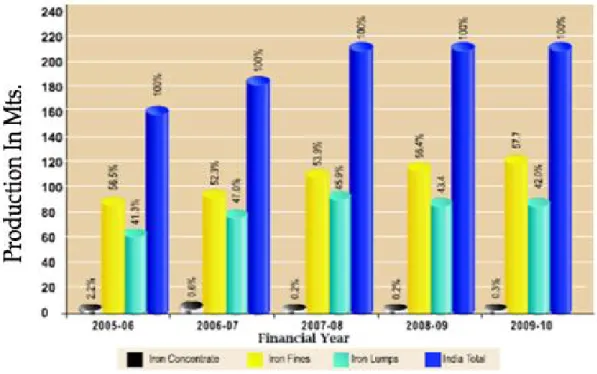
The production trend of iron ore in public sector and private sector mines since 2007-2011 is given in Fig. 3.5a. Production has decreased from 218.6Mt to 208.1Mt in 2010-11 over the previous year. This decrease is more in private sector mines than in public sector. In 2010-11, the share of public and private sector production was 28% against 27% in the preceding year. The remaining 72% production in 2010-11 was from private sector. About 60% of production comes in the form of fines (including concentrates) during the course of mining operations itself. Further, 10-12% lumps become fines while handling, loading/unloading and while converting them into calibrated lump ore (CLO) for sponge/pig iron plants/exports. On an average 2.5 tonnes of run-of-mines (ROM) are required to get one tonne of CLO [146]. Another demarcation of iron ore production is between Captive and Non-captive mines. Orissa is a leading producer state with the highest production, followed by Karnataka, Goa, Chhattisgarh and Jharkhand (Fig. 3.2b). It is also to be noted that out of the total production Captive mines are owned by SAIL’s steel plants and the Tata Steel besides some other small companies. Out of the total ore production in the country, the non-captive mines produce is 78%, while the share of captive mines is only 22%. Of 208million tonnes in 2010-11, the iron ore lumps constituted 82.2 million tonnes or about 39.5% and fine product is 125.1million tonnes or about 60.2%.
The Working Group for 12th Plan, Planning Commission of India has estimated that the production of iron ore would be about 374 million tons by 2016-17 at 8% growth rate. The apparent consumption is estimated at 218 million tons by 2016-17 at 8% growth rate.
35
N.Goa, S.Goa, Redi
Fig. 3.3 Zone-Wise distribution of iron ore in India
Chiriya, Noamundi, Kiriburu, Meghataburu,Thakur ani, Bolani,Gua, Malangtoli, Gandhamardhan, Daiteri Jilling-Langalata Donimalai, Ramandurg, Kumaraswamy, NEB Range, Ettinahatti, Tunti, Belegal Kudremukh, Bababudan, Kudachari
Zone-Wise Distribution of Iron Ore in India
Bailadila, Dalli, Rajhara, Rowghat, Mahamaya, Aridongri, Surajgarh QUATERNARY TERTIARY MESOZOIC
UP. PALAEOZOIC- LR. CRETACEOUS UP. PALAEOZOIC- LR. MESOZOIC PALAEOZIOC
36
Grade wise analysis of the current year’s output reveals that out of total output of 208 million tonnes, iron ore lumps constituted 82.2 million tonnes or about 39.5%, fines 125.1 million tonnesor about 60.2% and concentrates 0.7 million tonnes or about 0.3% of the total output of iron ore lumps. About 23.8 million tonnes or 29.1% was of grade 65% Fe and above, about 30 million tonnes or 36.5% of grade 62% to below 65% Fe, 11.5 million tonnes or 14% was of grade 60% to below 62% Fe and the rest 16.9 million tonnes or about 20.5% of the production was of grade below 60% Fe.
In the case of iron ore fines, 17.2 million tonnes or 13.8% of the production was of grade 65% Fe and above, 53.9 million tonnes or 43.1% of grade 62% to below 65% Fe and balance 53.9 million tonnes or about 43.1% of grade below 62% Fe. Run off mine iron ore, range in size from less than 8 mm to 0.15 mm is designated as fines, whereas, the ore below 0.15 mm are known as slime and slimes are generated in the washing plant. About 70-75% of the total production of iron ore is fines which are generated either at the time of mining or become fines during subsequent handling or conversion of lumps into Calibrated Lump Ore (CLO) [144].
3.4 CONSUMPTION PATTERN
The level of per capita consumption of steel is treated as an important index of the level of socio-economic development and living standards of the people in any country. It is a product of a large and technologically complex industry having strong forward and backward linkages in terms of material flows and income generation. All major industrial economies are characterized by the existence of a strong steel industry and the growth of many of these economies has been largely shaped by the strength of their steel industries in their initial stages of development. Steel industry was in the vanguard in the liberalization of the industrial Sector and has made rapid strides since then the industry has moved up in the value chain and exports have raised consequent to a greater integration with the global economy.
37
In 2010-11 about 104.05 million tonnes of iron ore was consumed in various industries like iron and steel, sponge iron, ferro-alloys, alloy steel, coal washery and cement. The Iron & steel including sponge was the major consumer of iron ore and accounted for over 98% of its consumption.
Source: Metalytics.
Fig.3.4 Domestic consumption & export of Indian Iron ore.
Iron ore demand is linked with the production of crude steel. The steel plants of SAIL in the public sector and Tata Steel in private sector besides some small plants have their own mines for captive consumption. Another public sector steel plant is Visakhapatnam Steel Plant (VSP) which meets its total requirement of iron ore from NMDC mines located in Bailadila sector of Chhattisgarh state. The domestic consumption of iron ore is shown in Fig. 3.6a.
38
Fig.3.5: Graphical representation of (a) Sector-wise production of iron ore in India (b)
39
Fig.3.5: Graphical representation of (a) Sector-wise production of iron ore in India (b)
40
Fig. 3.6a Graphical representation of (a) Production, Consumption and Export of iron ores in India (b) Production of iron ore lumps, fines, concentrate
41 3.5 FOREIGN TRADE
3.5.1 EXPORT:
Exports of iron ore decreased to 46.88 million tonnes in 2010-11 from 101.53 million tonnes in the previous year. In terms of value too, the iron ore exports rose to 21,416 crore in 2010-11 from 28,366 crore in 2009-10. The exports in 2010-2010-11 in terms of volume comprised iron ore fines (92%), iron ore lumps (7%), and iron ore concentrates & iron ore pellets (1%). Exports were mainly to China (91%) and Japan and United Arab Emirates (3% each). If we consider last three financial years, 2008-09, 2009-10 and 2010-11, when the exports demand for iron ore increased from China, still there was a fall in export from 101.53 million tonnes to 46.88 million tonnes which in turn has increased the import of iron ore.
3.5.2 IMPORT:
Imports of iron ore were 1,867 thousand tonnes in 2010-11 as compared to 897 thousand tonnes in the previous year. The imports in 2010-11 comprised of iron ore pellets (60%), fines and non-agglomerated concentrates, etc. The iron was imported from Bahrain, Mali, Brazil and Ukraine. Import of iron ore was 69 thousand tonnes, 897 thousand tonnes, 1,867 thousand tonnes in the year 2008-09, 2009-10, 2010-11 respectively [52, 53]. The imports mainly comprise of iron ore pellets, fines, non-agglomerated concentrates and it was from countries like Bahrain, Brazil, Russia & Ukraine. The export of iron ore in the last nine years is given in Fig. 3.6a. Iron ore production grew gradually and export also increased but the percentage remained almost the same.
42 3.6 WORLD PERSPECTIVE
The developments in the Chinese steel industry have set the pace of iron ore mining globally. World production of iron ore exceeded 1 billion tonne for the first time in 2002 and 1520 million tonnes in 2005. Production has increased in all major iron ore producing countries. World marine trade of iron ore exceeded 600 million tonnes in 2005 and the same is likely to grow to 650 MT by 2007. Three largest companies viz. CVRD, Rio Tinto and BHP Billiton together control about 30% of the global production. Four companies viz. CVRD, Rio-Tinto, BHP Billiton and Mitsui account for 70% of marine iron ore trade. The world iron ore reserves and reserve base as estimated by U. S. Geological Survey (USGS) [144] are shown in Table 3.1.
Table 3.1: World iron ore reserves and reserve base as estimated by U. S. Geological Survey (USGS Mineral Commodity Summaries, 2013).
(Qty.: In Mts)
Mine Production Reserves
2011 2012 Crude Ore Iron content
United States 55 53 6,900 2,100 Australia 488 525 35,000 17,000 Brazil 373 375 29,000 16,000 Canada 34 40 6,300 2,300 China 1,330 1,300 23,000 7,200 India 240 245 7,000 4,500 Iran 28 28 2,500 1,400 Kazakhstan 25 25 2,500 900 Mauritania 12 12 1,100 700 Mexico 15 13 700 400 Russia 100 100 25,000 14,000 South Africa 60 61 1,000 650 Sweden 25 25 3,500 2,200 Ukraine 81 81 6,500 2,300 Venezuela 17 20 4,000 2,400 Other countries 59 61 12000 6,000 World Total(rounded) 2,940 3,000 170,000 80,000
43
The World Steel Association estimated global crude steel production to be 1548 million tonnes in 2012, 1.2% up on the annual 2011 and the highest total ever. The amount of iron ore produced globally in 2011 was 1.92 billion tons, representing a 4.7 per cent increase from 2010[148]. World crude steel production reached 1,548 mega tonnes (Mt) for the year 2012, up by 1.2% compared to 2011. This is a record for global crude steel production.
3.7 STEELMAKING
World’s 80% steel making is through the blast furnace method and hence the role of iron ore as a raw material and its quality becomes very critical to obtain the best quality steel. High Fe content, low alumina and phosphorous contents in iron ore reduce this proportion. Hence, the quality of raw material plays an important role in steelmaking process. Although India is having vast reserves of iron ore, lack of consistency with respect to Al2O3/SiO2 ratio makes these ores unsuitable to use directly in the metallurgical industries without prior beneficiation. It has also been established that the adverse effects of high alumina to silica ratio (ideally it should be < 1) is detrimental to blast furnace as well as sinter plant productivity [107]. Indian iron ores are being beneficiated by washing, scrubbing, hydrocycloning, gravity separation and magnetic separation. During sizing and washing operations the enrichment with respect to iron content is marginal and gangue reduction with particular reference to favorable Al2O3/SiO2 is minimized. Concentration of alumina is the lowest in pure hard ore and blue dust and vice versa in lateritic ores. Indian iron ores consist of higher proportions of impurities in the form of alumina (Al2O3) and phosphorus (P). Their presence adversely affects the performance of blast furnaces and hence it is always preferred to maintain their level as low as possible [70]. The higher content of P increases surface cracking during steel making process at higher temperatures and also increases level of inclusions, which adversely affect the mechanical properties of finished steel [138, 141].