DOTTORATO DI RICERCA IN
Computer Science & Engineering
Ciclo XXI
Settore Concorsuale: 01/B1 - INFORMATICA
Settore Scientifico Disciplinare: INF/01 - INFORMATICA
SOCIO–TECHNICAL SOFTWARE ENGINEERING:
A QUALITY–ARCHITECTURE–PROCESS PERSPECTIVE
Presentata da: Daniel RUSSO
Coordinatore Dottorato
Supervisore
Prof. Paolo Ciaccia
Prof. Paolo Ciancarini
“Particularly alarming is the seemingly unavoidable fallibility of large software.”
ALMA MATER STUDIORUM
Abstract
School of Science
Department of Computer Science & Engineering
Doctor of Philosophy
Socio–Technical Software Engineering: a Quality–Architecture–Process Perspective
by Daniel Russo
This dissertation provides a model, which focuses on Quality, Architecture, and Pro-cess aspects, to manage software development lifecycles in a sustainable way. Here, with sustainability is meant a context-aware approach to IT, which considers all rel-evant socio-technical units of analysis. Both social (e.g., at the level of the stake-holders community, organization, team, individual) and technical (e.g., technological environments coding standards, language) dimensions play a key role to develop IT systems which respond to contingent needs and may implement future requirements
in a flexible manner. We used different research methods and analyzed the
prob-lem from several perspectives, in a pragmatic way, to deliver useful insights both to the research and practitioners communities. The Software Quality, Architecture, and Process (SQuAP) model, highlights the key critical factors to develop systems in a sustainable ways. The model was firstly induced and then deduced from a longitudinal research of the financial sector. To support the model, SQuAP-ont, an OWL ontology was develop as a managerial and assessment tool. A real-world case study within a mission-critical environment shows how these dimensions are critical for the devel-opment of IT applications. Relevant IT managers concerns were also covered with reference to software reuse and contracting problems. Finally, a long-term contribu-tion for the educacontribu-tional community presents accontribu-tionable teaching styles and models to train future professionals to act in a Cooperative Thinking fashion.
Acknowledgements
This research journey was not straightforward from many perspectives. It may sounds pleonastic, but I would not be here, writing these acknowledgments, without the help of great people. Surely, I would not be the scholar I am now without the continuous mentoring of Corrado Mangione. He believed and supported me when few people did at that time. Indeed, Corrado is my model of university professor. My greatest achievement would become, one day, like him.
My relation to Computer Science can be seen as a love story. Until I was 26, I was quite unimpressed from technology, which I truly considered a commodity. For this reason I studied (with great passion) Economics & Management. I do not regret this decision, even today, since I believe that it provided me great insights for my research. Moreover, I learned to find interesting problems to work on, and make them interesting also for other people. After my Master’s, I got aware about the impact and the role technology in general, and Computer Science in particular, will have on our daily lives. I am very grateful to Giancarlo Succi to have mentored me in this crucial phase of my life.
Starting a PhD in Computer Science & Engineering with a MSc in Innovation & Entrepreneurship, and a BSc in Politics, Philosophy, and Economics was not an obvious move. For some unclear reasons, Paolo Ciancarini took me with him to Bologna. Beyond being my advisor, Paolo is much more a mentor. He educated me to become a computer scientist, reshaping my mindset. He taught me what is important and what is not in Computer Science research, and how to contribute to the community’s discussions. Remarkably, he never exercised a strong degree of control on my work. I experienced what academic freedom means. Still he supported and criticized in a constructive way my choices.
Moreover, I would like to thank for the useful suggestions the members of my PhD committee: Roberto Baldoni, Fabio Vitali, and Maurizio Sobrero. For his steady availability and help, I like to thank also the coordinator of the PhD program in Computer Science & Engineering, Paolo Ciaccia and all its members.
My visiting period at the Wirtschaftsuniversität Wien, in Jan Mendling’s group was truly inspiring. Working with an international group of people, at the highest academic level taught me the real sense of being part of an academic community.
My academic achievements would not have been possible without the support and work of my co-authors. Here, I would like to thank Paolo Ciancarini, Franco Raffaele Cotugno, Tommaso Falasconi, Franco Fiore, Saverio Giallorenzo, Ivan Lanese, Vincenzo Lomonaco, Angelo Messina, Marcello Missiroli, Andrea Giovanni Nuzzolese, Francesco Poggi, Valentina Presutti, Mario Ruggiero, Alberto Sillitti, Giancarlo Succi, Gerolamo Taccona, Massimo Tomasi, and Paolo Torricelli.
I had also the great luck to work with a great teaching team at the Faculty of Humanities in the Computer Science courses, thanks to Aldo Gangemi, Damiana Luzzi, Federico Montori, Matteo Pascoli, Francesco Poggi, and Elisa Turrini.
I learned a lot how to become a computer scientists also from my fellow colleagues
of theHardcore Underground. For the (something more and something less) inspiring
discussions I am grateful to Luca Bedogni, Francesco Gavazzo, Saverio Giallorenzo, Micheal Lodi, Vincenzo Lomonaco, Vincenzo Mastroandrea, Federico Montori, Ste-fano Giovanni Rizzo, Luca Sciullo, Liu Tong, Angelo Trotta, SteSte-fano Pio Zingaro, and obviously the BergaBot.
ACM SIGSOFT and the Heidelberg Laureate Forum Foundation granted me full scholarships for the participation to two world class Computer Science events which were truly inspiring for my PhD: the 50th Turing Award Ceremony and the 2018
Heidelberg Laureate Forum. To such awarding institutions I am particularly thankful for those opportunities.
I also like to acknowledge the Autonomous Region of South Tyrol (Italy), which provided me the financial support for this PhD.
Living between Bologna, Bolzano, Milano, and Vienna was not easy. Not only for me but also for my family. My parents never missed to support me in any of my enterprises since my early years: Grazie papà e mamma! Laura,amore della mia vita, thank you for all these great years. You were at my side for every decision I took, supporting and my bearing moods.
It was a truly great time in Bologna. Indeed, it was one of the most enjoyable period of my life. For all the people which made this experience so great I want just to say: grazie di cuore!
Contents
Abstract iii
Acknowledgements v
1 Research Objectives 1
1.1 Motivation and Problem Statement . . . 1
1.2 Contribution . . . 2 1.3 Thesis Organization . . . 3 1.3.1 Chapter 2 . . . 3 1.3.2 Chapter 3 . . . 4 1.3.3 Chapter 4 . . . 4 1.3.4 Chapter 5 . . . 5 1.3.5 Chapter 6 . . . 5 1.3.6 Chapter 7 . . . 6 1.3.7 Chapter 8 . . . 6 1.3.8 Chapter 9 . . . 6
2 Mapping Socio-Technical Software Engineering 9 2.1 Introduction . . . 9 2.2 Research Method . . . 10 2.2.1 Research Questions . . . 10 2.2.2 Systematic Mapping . . . 11 2.2.3 Threats to Validity . . . 13 2.3 Socio–Technical Systems . . . 14 2.3.1 Overview . . . 14
2.3.2 Socio–Technical Software Engineering . . . 15
2.4 Classification Schemes . . . 16
2.5 Mapping . . . 16
2.5.1 Research Area of Software Engineering . . . 17
Software Engineering Management . . . 18
Software Design. . . 21
Software construction . . . 23
Software requirements . . . 25
Software Engineering process . . . 25
Systems engineering . . . 25
Project management . . . 27
Software Engineering economics . . . 27
Software configuration management . . . 28
Software testing. . . 28
General management . . . 28
2.5.2 Publication Fora . . . 28
2.5.3 Citations per publication types . . . 29
2.7 Conclusions . . . 32
3 The Software Quality–Architecture–Process Model 33 3.1 Introduction . . . 33
3.2 Literature Review. . . 35
3.2.1 Information Systems Quality . . . 35
3.2.2 Software Quality . . . 36
3.2.3 Software Process . . . 36
3.2.4 Software Architecture . . . 37
3.2.5 Relationships Among Dimensions . . . 38
Process and Quality . . . 38
Process and Architecture . . . 38
Architecture and Quality . . . 38
Quality – Process – Architecture . . . 39
3.2.6 The IT financial market . . . 39
3.2.7 Systems’ scope . . . 40
3.3 Research Design . . . 41
3.3.1 The Delphi-like Method . . . 42
3.3.2 Selection of Delphi Panelists. . . 42
3.3.3 Data Collection and Analysis . . . 46
3.4 Results. . . 47
3.5 Discussion . . . 61
3.5.1 Theoretical Coding . . . 62
3.5.2 A Model for Information Systems Quality . . . 63
3.6 Theoretical and Practical Contribution . . . 63
3.7 Conclusions and Limitations . . . 67
4 The SQuAP Ontology 71 4.1 Introduction . . . 71
4.2 Related Works . . . 72
4.3 Relational quality factors: the SQuAP Model . . . 73
4.4 SQuAP-Ont: an OWL formalisation of SQuAP . . . 75
4.4.1 Ontology description . . . 75
4.4.2 Formalisation . . . 77
4.4.3 Implementation details . . . 78
4.5 How to use SQuAP-Ont . . . 79
4.6 Potential impact . . . 81
4.7 Conclusion and future development . . . 82
5 Knowledge Engineering for Socio–Technical Software Engineering 83 5.1 Introduction . . . 83
5.2 Complex software systems specification . . . 84
5.2.1 Evolution of a Mission Critical Information System through Agile 85 5.3 Requirements engineering, management & tracking . . . 89
5.4 Use of KBS and OBS within iAgile . . . 92
5.4.1 An Ontology-based Architecture for C2 Systems . . . 93
5.4.2 Developing domain ontologies from user stories with iAgile. . . 95
6 Agile Contracting 99
6.1 Introduction . . . 99
6.2 Related Work . . . 100
6.3 The Law & Economics of Agile contracts. . . 101
6.4 The Italian Case . . . 106
6.4.1 The object of the contract . . . 106
6.4.2 The structure of the contract . . . 107
6.4.3 The competition . . . 108
6.4.4 Economic value . . . 109
6.4.5 Provision of accountable variations . . . 109
6.4.6 Verification . . . 110
6.5 Setting up the contracts . . . 110
6.5.1 Contracts with Function Points . . . 110
6.5.2 Contracts with Scrum Sprints . . . 112
6.6 Case Study . . . 113
6.7 Conclusions . . . 113
7 Legal Implications of Software Reuse 115 7.1 Introduction . . . 115
7.2 Background: Types of software clones . . . 116
7.3 Short comparison of two legal frameworks . . . 116
7.3.1 IPRs in the US . . . 117
7.3.2 IPRs in the EU . . . 119
7.3.3 Consequences for software cloning . . . 119
7.4 The case law . . . 120
7.4.1 Research Protocol . . . 120
7.4.2 First considerations about the outcome. . . 121
7.4.3 The United States . . . 121
7.4.4 Software and hardware cloning related to physical devices . . . 123
7.4.5 Software cloning related to competition and antitrust issues . . 123
7.4.6 Software cloning related to misappropriation of trade secrets and copyright infringements . . . 124
7.4.7 Other cases related to the United States . . . 125
7.4.8 The European Union case law . . . 125
7.5 An ECJ disruptive ruling . . . 127
7.6 Impact on software . . . 128 7.7 Conclusions . . . 130 8 Cooperative Thinking 133 8.1 Introduction . . . 133 8.2 Related works . . . 134 8.3 Research Methodology . . . 135 8.4 Results. . . 136 8.4.1 Individual learning . . . 136 8.4.2 Paired learning . . . 137
8.4.3 Directed group learning . . . 138
8.4.4 Self-directed group learning . . . 140
8.5 Implications for practice . . . 141
8.5.1 Learning path . . . 143
8.5.2 The influence of the context . . . 144
8.7 Conclusions . . . 146
9 An Empirical Validation of Cooperative Thinking 149 9.1 Introduction . . . 149
9.2 Related Work . . . 151
9.3 Research Model and Hypotheses . . . 152
9.3.1 Effect of Computational Thinking on Cooperative Thinking . . 153
9.3.2 Effect of Agile Values on Cooperative Thinking . . . 153
9.3.3 Effect of Cooperative Thinking on Complex Problem Solving . 154 9.4 Research Design . . . 155
9.4.1 Research Questions . . . 155
9.4.2 Partial Least Square path modeling. . . 155
9.4.3 Scale Development . . . 156 9.4.4 Data Collection . . . 156 9.5 Results. . . 157 9.5.1 Measurement Model . . . 158 9.5.2 Structural Model . . . 159 9.6 Discussion . . . 160 9.6.1 Implications . . . 161 9.6.2 Limitations . . . 162 9.7 Conclusions . . . 163 10 Concluding Remarks 165 10.1 Discussion . . . 165 10.2 Conclusion. . . 166 10.3 Future works . . . 167 A Research Materials 169 A.1 Questionnaire . . . 169 A.1.1 Constructs . . . 169
A.1.2 Demographic Information Questionnaire . . . 170
List of Figures
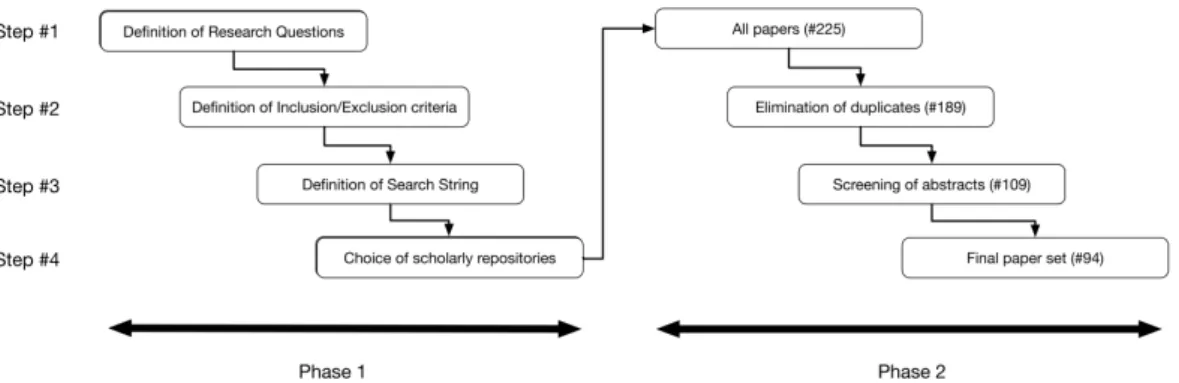
2.1 Systematic mapping search protocol and outcome . . . 12
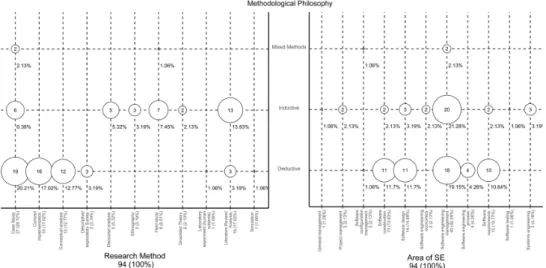
2.2 Map of Methodological Philosophy on Socio-Technical Software Engi-neering. Methodological Philosophy on the Y axis; Research Method on the left side of the X axis, and Area of Software Engineering on the right type of the X axis . . . 17
2.3 Distribution over SE research Areas. . . 17
2.4 Publication Distribution over years . . . 18
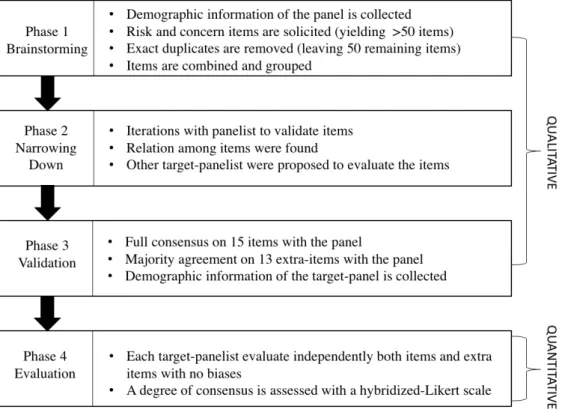
3.1 Delphi–like administration process . . . 43
3.2 SQuAP (Software Quality-Architecture-Process) meta-model. . . 66
4.1 Factor 26: Data analysis vs. Functional analysis. This factor is defined as a relation between three quality characteristics of a software project: Functional Correctness (ISO 25010), Architectural View (ISO 45010), and Development (ISO 12207). . . 74
4.2 Core classes of SQuAP-Ont. . . 76
4.3 Execution of a DL query on the RDF sample. . . 80
5.1 Sprint representation, inspired by [399] . . . 86
5.2 The ontology of the application domain and the system requirements are derived from user stories . . . 93
5.3 A snapshot of the C2 ontology during its development with Protege. The class and property hierarchies are shown on the left, while other contextual information (e.g. annotations, instances and relevant prop-erties) are shown on the right. . . 94
5.4 The C2 system is modeled around the star architecture pattern. The domain ontology is the center of such architecture, and is used to inte-grate different resources and systems. . . 95
5.5 User stories collected with iAgile are used to develop the system domain ontology . . . 96
5.6 A fragment of the developed domain ontology. Three general concepts are represented (i.e. logistic item, location and convoy), and the tra-jectory pattern has been used to model positional information . . . 97
6.1 Iron Triangle [22] . . . 105
6.2 Structure of the contract . . . 107
6.3 SiFP definition structure . . . 111
6.4 Effectiveness of the contract structure . . . 113
7.1 Copyright protected and not protected reengineering according to the ECJ. . . 129
8.1 Teaching activities mapped to learner types, following the taxonomy of [261] . . . 142
8.2 Cooperative Thinking, Computational Thinking and Agile values break-down (according to Computing at School [115] and [43]) . . . 147
9.1 Theoretical framework and hypotheses . . . 154
List of Tables
2.1 Coverage of SWEBOK’s Knowledge Areas . . . 18
2.2 Distribution of research SE Areas’s evolution per year . . . 19
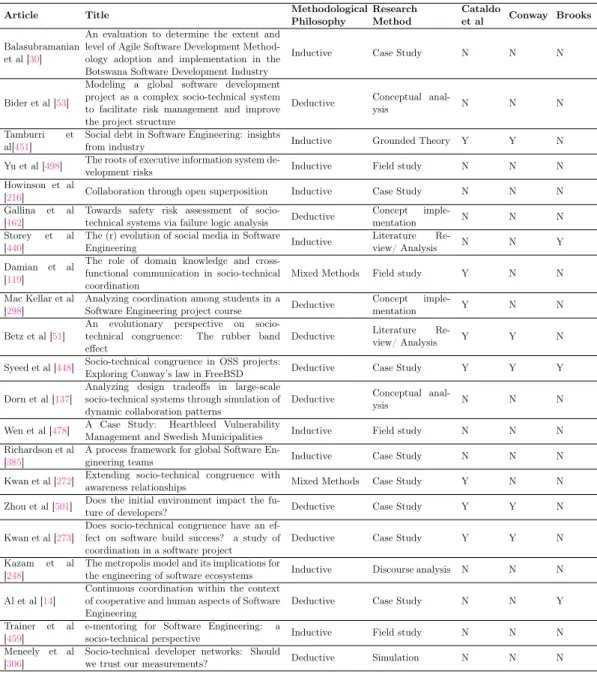
2.3 Papers on Software Engineering management – 1 . . . 20
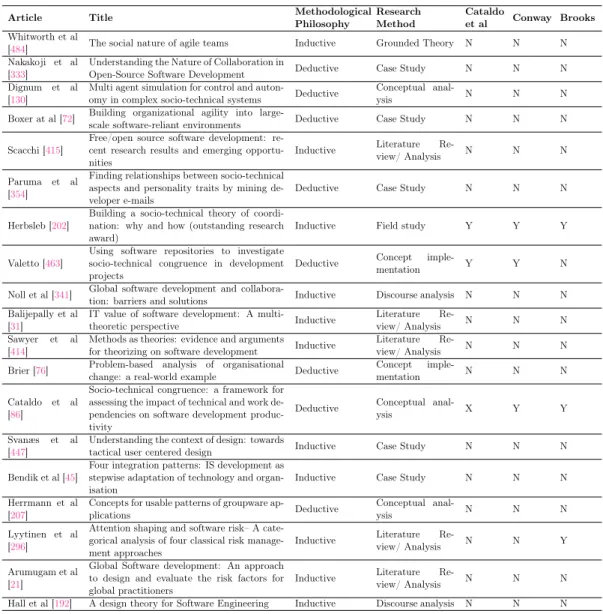
2.4 Papers on Software Engineering management – 2 . . . 22
2.5 Papers on Software design . . . 23
2.6 Papers on Software construction . . . 24
2.7 Papers on Software requirements . . . 26
2.8 Papers on Software Engineering process . . . 26
2.9 Papers on Systems engineering . . . 27
2.10 Papers on Project management . . . 27
2.11 Papers on Software Engineering economics . . . 27
2.12 Papers on Software configuration management. . . 28
2.13 Papers on Software testing . . . 28
2.14 Papers on General management . . . 28
2.15 Distribution of publication fora 1 . . . 29
2.16 Distribution of publication fora 2 . . . 30
2.17 Acknowledgment of previous works per publication types . . . 30
3.1 Panel composition . . . 44
3.2 Target-Panel composition . . . 45
3.3 Concerns and results of the Delphi-like study . . . 48
3.4 Extra-concerns and results of the Delphi-like study . . . 49
3.5 Factor mapping according to ISO/IEC 25010 – System and software quality models . . . 64
3.6 Factor mapping according to ISO/IEC 12207 – Software Life-cycle Pro-cesses . . . 65
3.7 Factor mapping according to ISO/IEC 42010 – Architecture description 65 4.1 Competency questions used for modelling SQuAP-Ont. . . 75
4.2 Alignments between the classes of SQuAP-Ont and DOLCE UltraLight. 77 4.3 Alignments between the properties of SQuAP-Ont and DOLCE Ultra-Light. . . 77
6.1 Divergent interests . . . 104
7.1 Clone types in Rattan et al. (2013) . . . 117
7.2 Advantages and disadvantages of code cloning . . . 117
7.3 Chapters of Title 17 (Copyright Act) . . . 118
7.4 Appendixes of Title 17 (Copyright Act) . . . 118
7.5 EU Directives regarding Copyright . . . 119
7.6 Main differences between the US and EU legal system concerning this chapter . . . 120
7.8 Other US case law. . . 126
7.9 Copyright protection within the EU and the US . . . 130
8.1 Investigation list . . . 136
8.2 Learning model influence on learner and teacher’s role . . . 141
9.1 Demographics . . . 157
9.2 Outer Loadings . . . 158
9.3 Construct Reliability and Validity. . . 159
9.4 Fornell–Lacker Criterion . . . 159
9.5 Heterotrait-Monotrait Ratio of Correlations (HTMT) . . . 159
9.6 Paths Coefficients. . . 160
A.1 Items list . . . 169
List of Abbreviations
AV Agile Values
CT Computational Thinking
CooT CooperationThinking
ISQ Information SystemsQuality
IPR IntellectualPropriety Rights
KBS KnowledgeBasedSystems
OWL Ontology WebLanguage
PLS PartialLeast Squares
SE Software Engineering
SEM Structural Equation Mmodelling
SQuAP Software QualityArchitectureProcess model
SWEBOK SoftWareEngineering Body Of Knowledge
Chapter 1
Research Objectives
1.1 Motivation and Problem Statement
Software Engineering is a human–intensive activity. As such, different social and
technical aspects are involved while engineering software. Collaboration among de-velopers, and cooperation with different stakeholders are crucial activities to lead
complex software projects to success [377]. Indeed, the relation between software
development and the structure of the organizations where the software is effectively developed, has been empirically observed several times in literature [331,451]. This kind of relation is among the oldest Software Engineering laws, known as Conway’s Law. Melvin Conway discovered in 1967 that “organizations which design systems [...] are constrained to produce designs which are copies of the communication structures of these organizations” [107]. According to this insight, software is almost isomorphic to the organizational communication structure, where it is build.
The consequences of this wisdom has a great impact on the entire Software Engi-neering management area. Recently, a long list of scholars and contributions, which are partially listed in the next chapters, supported this critical issue in different ways. In order to have a broad idea of the types of contributions, consider that Nagappan et al provided evidence for causation between organizational structures and software quality [331]. Similarly, Tamburri et al discovered patterns of sub-optimality across organizational structures [451]. Cataldo et al formalized socio-technical congruence, intended as the degree to which technical and social dependencies match when coor-dination is needed, and empirically investigated its impact on software quality [86]. Bird et al used a social network analysis among developers to discover socio–technical dependencies [56]. Whereas, de Souza et al focused on coordination to maintain legacy systems [430].
Indeed, the impact of sub–optimal coordination on software quality is the biggest concern in literature. A better management of socio–technical dependencies through the coordination activity is considered as a key activity to improve software quality, both for development and maintenance. Several solutions have been proposed by literature to tackle this issue. Chapter2 provides a mapping, where such approaches have been listed.
However, a comprehensive perspective of the subject matter is still missing. This means that there is no Software Engineering model to deal with the quality of infor-mation systems. It is a matter of perspectives and unit of analysis. Especially for
complex or legacy systems managing dependencies means to deal with different unit
of analysis at the level of methods, classes, files, packages, or even systems. Therefore, solutions proposed by scholars can hardly cover the degree of complexity of such sub-ject matter. In particular, conceptual analysis and conceptual implementation papers obviously addressed single issues of the debate. Several layers of both technical (e.g., technology used, granularity of dependencies) and social (e.g., organizational issues,
communication, cultural barriers) nature are involved in Socio–Technical Software Engineering. For this reason there is no such one ‘silver bullet’ in this area due to its complexity.
Although we will not solve all problems related to Socio–Technical Software En-gineering, this dissertation proposes a model to firstly understand and manage the subject matter, with particular regard to quality issues. Moreover, typical barriers of practical nature are addressed with the idea to serve, in particular, the practitioners community. Among others, we explained a real-world case study where socio–technical concerns have been solved through a Knowledge Engineering approach. Moreover, two key legal issues, like that related to contracting and software cloning are considered to improve software quality from an organizational perspective. Indeed, the way soft-ware developers cooperate with an organization impacts on systems’ quality. Thus, we developed a contractual framework to improve software quality. Also, we provide guid-ance for developers regarding software cloning related to Intellectual Property Rights issues. Finally, we considered the pedagogical of future computer scientists generations to solve computationally-complex problems in a cooperative fashion. Even though it might be a neglected topic in this research area, we can not think to tackle socio-technical congruence without educating future professional what cooperation means, since we use to teach students to program in an individual way, and not in teams.
1.2 Contribution
This dissertation provides to the reader an understanding on how socio-technical issues can be treated in several ways. Clear take-aways are provided at the end of each chapter, of particular interest for practitioners. Most work done is of empirical nature, following well-defined methodological approaches, described in each chapter.
Among the most relevant contribution of this thesis is the
Quality-Architecture-Process model, induced and deduced in Chapter 3, and conceptualized through an
OWL ontology in Chapter4. However, we did not narrow the discussion on Quality,
Architecture, and Process aspects and their interaction. Rather we were interested to investigate socio-technical related aspects of the Quality-Architecture-Process model. The model, as such, suggests key constructs of software artifacts and their relations.
This work offers a perspective on managing software through Software
Engineer-ing’s key constructs Quality, Architecture, and Process; and key actions to support this perspective. In our view, socio-technical means that software is a (computer-aided) social artifact, which relies on technically-recognized constructs. Accordingly, engineering software means to develop artifacts which are build in a Quality, Archi-tecture, and Process reliable fashion. As highlighted in Chapter3, we do not focus on
these constructsper se. Respective standards have been developed by the community
and are deeply discussed in literature. Interestingly, as any construct, they change over time, and are not fixed. Although this might sound surprising, it is not. Before the XXI century, Waterfall was considered the most reliable process. After the Agile Manifesto [209] this is not true anymore. Similarly, monolithic mainframe architec-tures were mainstream before the Service-Oriented or Microservices paradigms. Alike quality attributes, which evolved other time.
Nevertheless, Quality, Architecture, and Process (in their evolution) are at the center of the Software Engineering process. Moreover, it is still a man-made process.
In this perspective, software can be considered as a social construct, intended as
an object that has been developed and accepted by people in a given environment. As such, Software Engineering deals with several units of analysis of social nature:
organization, team, individual; and of technical ones: code, test, documentation, design, etc. The reason is that is that it is a complex and interconnected discipline. As Mel Conway pointed out in 1968, software can not be considered as detached from its (organizational, social and technological) environment. Thus, in this context,
sustainabilityis intended to adopt a holistic socio-technical perspective on engineering software, having care on all its unit of analysis. A bug-free software with useless requirements for the own organization is useless. However, also a software that have implemented all functional requirements for an organization without any consideration of architectural layering or non-functional requirements will be hardly maintainable.
For these reasons, we are concerned to develop new research insights which help to manage software in a sustainable way. Accordingly, the Meta Research Question (MRQ) of this dissertation is the following:
• MRQ: How can we engineer software in a sustainable fashion?
Reasonably, we do not provide a deterministic answer to our MRQ. Since the concept itself of sustainability changes in time, this question will remain reasonably unanswered. The reason may appears quite straightforward. Assuming that software is a social construct, its characteristics evolve according to future challenges. Here, the understanding of the context plays a major role. Pretending to develop one-catch-all solutions may lead to severe pitfalls. Addressing functional aspects without an under-standing of e.g., the organization, customers, developers, as also coding and testing standards, environment, libraries; is misleading, especially for critical applications. Indeed, there is a growing understanding in the community that through the context– awareness of a domain, it is possible to recognize, explain, experiment, and build systems in a sustainable way. Recently, Gail Murphy suggested that “study, definition and use of context can improve the flow of software development work” [329]. In her vision, software development is not an abstract and deterministic process, rather it is deeply shaped by socio-technical aspects. Therefore, the notion of sustainability is here of particular importance, since it takes into account the need to embed the awareness of the context within the development process, to deliver useful functional-ities (for users) which are also easily maintainable. Thus, providing a holistic vision over the engineering process is a contingent need for all IT managers.
For this reason, this work focuses on providing actionable models, tools, case studies to (some) practitioners’ contingent needs.
1.3 Thesis Organization
This thesis includes eight chapters, plus the present introduction and the conclusion and future works chapter. All chapters benefited from a joint contribution of fellow
colleagues, with the only exception of Chapter2. In order to address our MRQ, we
investigated several aspects of our subject matter. Consequently, our methodological approaches were tailored to our different research questions, according to our prag-matic research perspective [358,113]. Therefore, each chapters outlines and explains the followed approach. Hence, each chapter in contextualized in its problem state-ment and related literature. At the end of each chapter, we present our preliminary conclusions, outlying future directions.
1.3.1 Chapter 2
A literature review is provided in a systematic way. Considering the broadness of the topic, we used an appropriate research method, namely a Systematic Mapping or
Scoping study. Here, we addressed Socio–Technical Software Engineering (STSE) as the way to manage, design, develop, test, and maintain complex software systems with a high degree of technical and human dependencies. This chapter aims at surveying existing research on Socio–Technical Software Engineering to identify the literature debate about this broad topic, providing a rigorous starting point for future contri-butions. Our systematic mapping is launched to find as much literature as possible, finding 94 chapters, which were classified according to their Software Engineering Area, Methodological Philosophy, and Research Method. Most areas of Software En-gineering are concerned with STSE, although 90% of the chapters deals with issues related to Software Engineering management, Software design, Software construction, and Software requirements. Leading publication fora are ICSE, CHASE and IST. Only 29% of the articles recognized at least one relevant contributions, suggesting poor theorization. Most papers are concept implementation, conceptual analysis and literature reviews. To conclude, better theorization and theoretical understanding is needed for scholars working in this area, since the picture is too jeopardized.
1.3.2 Chapter 3
Information Systems Quality (ISQ) is a critical source of competitive advantages for organizations and a primary Socio–Technical Software Engineering issue. In a scenario of increasing competition on digital services, ISQ is a competitive differentiation asset. In this regard, managing, maintaining, and evolving IT infrastructures has become a primary concern of organizations. Thus, a socio–technical perspective on ISQ provides a useful guidance to meet current challenges. The financial sector is paradigmatic, since it is a traditional business, with highly complex business–critical legacy systems, facing a tremendous change due to market and regulation drivers. We carried out a Mixed-Methods study, performing a Delphi-like study on the financial sector. We developed a specific research framework to pursue this vertical study. Data were col-lected in four phases starting with a high level randomly stratified panel of 13 senior managers and then a target-panel of 124 carefully selected and well-informed domain experts. We have identified and dealt several quality factors; they were discussed in a comprehensive model inspired by the ISO 25010, 42010, and 12207 standards, corre-sponding to software quality, software architecture, and software process, respectively. Our results suggest that the relationship among quality, architecture, and process is a valuable technical perspective to explain the quality of an information system. Thus, we introduce and illustrate a novel meta-model, named SQuAP (Software Quality, Architecture, Process), which is intended to give a comprehensive picture of ISQ by abstracting and connecting detailed individual ISO models.
1.3.3 Chapter 4
Building on the previouse chapter, In Chapter 4, we formalized SQuAP-Ont. The SQuAP model (Software Quality, Architecture, Process) describes twenty-eight main factors that impact on software quality in financial systems, and each factor is de-scribed as a relation among some characteristics from the three ISO standards, since their interaction has been scarcely studied, so far. Hence, SQuAP makes such relations emerge rigorously, although informally. In this chapter, we present SQaAP-Ont, an OWL ontology designed by following a well established method based on the re-use of Ontology Design Patterns (i.e. ODPs). SQuAP-Ont formalises the relations emerging
from SQuAP in order to represent and reason via Linked Data about Software Engi-neering in a three-dimensional model consisting of quality, architecture, and process ISO characteristics.
1.3.4 Chapter 5
Chapter 5 explains explains how cooperation issues were solved through ad hoc tech-nologies, namely Knowledge-Based System (KBS). Here, we discuss how a mission critical KBS has been designed and implemented for a real case study of a governa-mental organization. This case study represents a factual reality, where KBS have been used in a real-world scenario, where requirements were changing rapidly and de-velopers’ effort to implement them were non–trivial. The KBS is based on an ontology used to merge the different mental models of users and developers. Moreover, the on-tology of the system is useful for interoperability and knowledge representation. Both the ontology and the main mission critical functionalities have been developed in agile iterations. The KBS has been used for three development activities: (i) requirement disambiguation, (ii) interoperability with some legacy systems, and (iii) information retrieval and display of multiple informative sources. Moreover, the KBS has been developed using a specific agile software development method inspired by Scrum but tailored for Command and Control systems. Due to fast changing operational scenar-ios and volatile requirements, traditional procedural development methods perform poorly. Thus, a Scrum-like method, callediAgile, has been exploited.
1.3.5 Chapter 6
Contracting issues have often been neglected by software engineer. However, legal concerns are compelling to improve socio-technical congruence, in particular collab-oration, within real-world contexts. As discussed in the previous chapter, Agile is a suitable methodology to improve collaboration both among development teams and management. Although Agile is a well established software development paradigm, major concerns arise when it comes to contracting issues between a software consumer and a software producer. How to contractualize the Agile production of software, espe-cially for security & mission critical organizations, which typically outsource software projects, has been a major concern since the beginning of the “Agile Era.” In literature, little has been done, from a foundational point of view regarding the formalization of such contracts. Indeed, when the development is outsourced, the management of the contractual life is non–trivial. This happens because the interests of the two parties are typically not aligned. In these situations, software houses strive for the minimiza-tion of the effort, while the customer commonly expects high quality artifacts. This structural asymmetry can hardly be overcome with traditional “Waterfall” contracts. In this work, we propose a foundational approach to the Law & Economics of Agile contracts. Moreover, we explore the key elements of the Italian procurement law and outline a suitable solution to merge some basic legal constraints with Agile require-ments. Finally, a case study is presented, describing how Agile contracting has been concretely implemented in the Italian Defense Acquisition Process. This work is in-tended to be a framework for Agile contracts for the Italian public sector of critical systems, according to the new contractual law (Codice degli Appalti).
1.3.6 Chapter 7
During the development, most code is reused from previous projects, frameworks or libraries. A compelling cooperation problem is to manage properly Intellectual Propri-ety Rights (IPRs). Although Software Cloning is a widely studied aspect of Software Engineering, little research has been done in its analysis from an IPR perspective An interdisciplinary approach is crucial to better understand the legal implications of software in the IPR context. Interestingly, the academic community of software and systems deals much more with such IPR issues than courts themselves. In this chap-ter, we analyze some recent legal decisions in using software clones from a Software Engineering perspective. In particular, we survey the behavior of some major courts about cloning issues. As a major outcome of our research, it seems that legalfora do not have major concerns regarding copyright infringements in software cloning. The major contribution of this work is a case by case analysis of more than one hundred judgments by the US courts and the European Court of Justice. We compare the US and European courts case laws and discuss the impact of a recent European ruling.
The US and EU contexts are quite different, since in the US software is patentable
while in the EU it is not. Hence, European courts look more permissive regarding cloning, since “principles,” or “ideas,” are not copyrightable by themselves.
1.3.7 Chapter 8
Effective cooperation should be properly taught in Computer Science classes. Accord-ingly, we explore the concept of Computational Thinking in a Software Engineering perspective. Computational Thinking is probably one of the most important skills for XXI centuries citizens, in particular for programmers and software engineers but also for scientists at large. The current teaching practices focus on Computational Thinking and individual programming first, and only later address students to work in teams. However, training students to Computational Thinking might not be enough to tackle contemporary complex challenges in software development, especially those which cannot be won individually. Based on prior studies, we describe and compare four software development learning approaches: solo programmer, pair programmers, self-organized teams, and directed teams. These approaches have been explored in a number of teaching experiments, involving hundreds of students, over several years.
We show that Computational Thinking can be effectively enhanced with with Agile
values, extending it with social skills and teaming practices. We introduce a model of a competence that we call Cooperative Thinking, grounded in literature and vali-dated by our experiments. This paper provides a research synthesis of previous works contextualized in a pedagogical framework, and proposes a new learning paradigm for Software Engineering education.
1.3.8 Chapter 9
In this chapter we use an exploratory Structural Equation Modeling technique to
introduce and analyzeCooperative Thinking (CooT), a model of team-based
compu-tational problem solving. Compucompu-tational Thinking (CT) and Agile Values (AV) focus respectively on the individual capability to think in an algorithmic way, and on the principles of collaborative coding. Although these two dimensions of Computer Sci-ence education complement each other, very few studies explored the interaction of CT and AV. We ground our model on the existing literature and validate it through Partial Least Square modeling. Cooperative Thinking is not just the sum of CT and
AV, rather it is a new overarching competence suitable to deal with complex Com-puter Science problems. This chapter suggests to tackle the CooT construct as an education goal, to train new generations to Pareto-optimize both their individual and teaming performances.
Chapter 2
Mapping Socio-Technical Software
Engineering
2.1 Introduction
Several aspects of both social and technical nature come into question when devel-oping software. How to collaborate with fellow developers, stakeholders, testing and review activities, design, requirements elicitation, are just a few problems software organizations face every day. The aim of the emerging Socio-Technical Software En-gineering (STSE) paradigm is to provide a solution to problems which includes both social and technical aspects of engineering software. Indeed, most of the Empirical Software Engineering effort deals with this topic, at large. Thus, clearly defining this area would misleading. Rather, it might be of interest to understand how the term
socio-technical is used in literature, finding out how such literature refer to previous works. With all the limitations of this approach, this is a pragmatic approach to map the debate about STSE.
Also defining previous work is not a trivial task. After a first round analysis of the selected literature, we knowledge three major works, which had a clear impact on literature. In 1968 Mel Conway introduced the idea of software as a socio-technical problem [107]. He recently affirmed that “Conway’s law was [...] a valid sociological observation, [...] a consequence of the fact that [...] interface structure of a software system necessarily will show a congruence with the social structure of the organization that produced it”1. Later on, Fred Brooks built on this wisdom for his pivotal work,
providing software management insights [77]. Brooks recognized the management
corollaries of Conway’s law, suggesting that “structuring an organization for change is much harder than designing a system for change” [77, p. 242]. Conway’s and Brooks’ ideas highlight the fact that software is a human-made abstraction, and as such, a social construct based on the collective experiences and actions of a community of developers merging with technical instances of the underlying technology involved. The last relevant work on this topic is proposed by Cataldo et al. in 2008 [86]. They build on the idea of congruence, to examine the relationship between the structure of technical and work dependencies, as also the impact of dependencies on software development productivity.
STSE is a interdisciplinary topic, where little systematization has been pursued up to now in literature. Considering the very nature of the topic, it is very hard
to find an unified definition about what is meant with socio-technical. Moreover,
there is no general agreement about the notion of socio-technical within Software
Engineering. Although most empirical studies deals with social and technical aspects,
they might use different notions of phrasing. Indeed, many authors may refer to it
without explicitly mention it. As a result, there are probably thousands of studies dealing with this paradigm. For such reason, claiming to map the entire field of STSE would be an overstatement. However, providing an understanding of how scholars use the notion of STSE, and while doing it, which relevant work they are referring to, still provide a first understanding on the subject matter. Building on this awareness, future researcher will be advised in positioning their work within the domain of STSE. For this reason, planning a mapping study on this subject matter has several in-herent limitations. Accordingly, we have just to focus on these papers who explicitly
acknowledgedSocio-Technical Software Engineering within the paper’s narrative.
Al-though it is a big shortcut, it is a pragmatic solution to map the literature debate. Scholars, which use this paradigm, do not always refer explicitly to a recognized theo-retical framework. The analysis of the bibliography suggests a high variety of different references when hinting to the STSE paradigm. This is a clear signal that a work pro-viding a first mapping of the literature is needed. In order to get a picture of existing literature, we launched a systematic mapping study on the use of the notion of STSE. Therefore, our aim is to get an overview of existing research in order to find deeper insights about the use of this emerging paradigm and identify future research needs.
Systematic mapping is an alternative research method compared to systematic reviews. Especially if the topic is too broad or poorly systematized for a systematic review, systematic mapping is feasible a methodological approach. Indeed, mapping studies are typically performed at a higher granularity level, mainly to identify research gaps and future research direction. From a methodological perspective, guidelines for systematic mapping have been proposed for the Software Engineering domain since
2008 by Petersen et al. [362], and afterwards expanded by Kitchenham et al. in
different contributions [257, 258, 362, 361]. Accordingly, relevant studies has been pursued on Software Engineering topics, like Software Product Lines testing [151].
This chapter follows the recommendation by [362]. To improve reproducibility, we
tried to be as compliant as possible to the chapter structure of [151], adapting the mapping scheme for our topic.
This chapter is organized as follows. The methodology of our mapping is explained in Section2.2. In Section2.3a brief literature review on Socio Technical Systems and Software Engineering is provided. The classification scheme is discussed in Section
2.4. Then, in Section 2.5, all studies are discussed by the categories proposed in the SWEBOK. The answer to the research questions are discussed in Section2.6. Finally, we outline our conclusion in Section2.7 along with our future works.
2.2 Research Method
2.2.1 Research Questions
The goal of this study is to get an overview of the use of the notion of Socio–Technical Software Engineering. Accordingly, we identified the following research questions (RQ):
• RQ1 Which area of Software Engineering have been investigated and to what
extent by using the STSE paradigm? Indeed, STSE relates to several areas of Software Engineering (with reference to the SWBOK [71]), so our aim is to identify which ones have been addressed in previous research, in order to support complementary research.
• RQ2 Which is the most used methodological philosophy and research method? Methodological aspects are the basis for new investigations. This is a pivotal
aspects to strengthen the credibility of research contributions and suggest future space for investigation.
• RQ3Which research fora publish topics where the notion of Socio-Technical
Soft-ware Engineering is used? Notably, there is no one forum devoted to it. Thus, future scholars may be find interesting where to submit their contributions.
• RQ4Does the community recognize milestone contributions? Three works shaped the Software Engineering Socio-Technical paradigm: Conway’s intuition that the way people communicate and collaborate frames software design [107]; Brook’s experience with complex development [77]; and the socio-technical congruence framework of software projects by Cataldo et al [86]. In order to advance inves-tigations on this topic, awareness on crucial literature is important to criticize or build on it.
• RQ5 Which topics regarding Socio-Technical Software Engineering have been
identified by studies using this notion? Challenges for STSE may be identified in several works, helping us to identify relevant past and future research.
2.2.2 Systematic Mapping
Socio-Technical Software Engineering is broad and interdisciplinary topic which would benefit from a first systematization. Accordingly, we carried a systematic mapping study as alternative to a systematic review for the following reasons, as suggested by [362,361].
Ourgoalis not to establish the state of evidence, since we did not study papers in great detail. Rather, we focused on classification, Software Engineering area analysis, and identifying publication fora. Moreover, we did not consider where particular evidence is missing or is insufficiently reported in existing articles.
The research process is also different compared to systematic reviews. Indeed,
we did not evaluate papers as such, as we would have made with a literature review. We just assured a baseline quality provided by peer-review and quality indexing by reliable scholarly repositories. From a data extraction perspective, we focused on thematic analysis, to see which areas of Software Engineering are covered by the use of the STSE paradigm. Systematic literature reviews include a deeper level of data selection and extraction to draw homogeneous conclusions based on the same specific subject matter.
As a consequence, there is a difference in breadth and depth. We analyzed a
large number of papers, compared to a review. The search string and inclusion criteria reflect this, since our aim was to find as many studies as possible to provide to the community the broadest picture. Reviews have a much more stringent search string and exclusion criteria, since the aim is to filter only the most qualified articles for the chosen subject matter.
Also in terms of classification per topic area and research approach maps
have a broader understating of the subject matter. For this reason we used the SWEBOK areas, which are quite broad, while systematic reviews focus only on one particular sub-area. Nevertheless, we spent also some effort to make a finer granular analysis, depicting also the topic. Similarly, we mapped both research philosophy and the research methods used. We believe that this choice strengthen our work, since it provides at a both high and low level a factual representation about STSE. Again, our aim was not to filter studies and represent only the relevant one for e.g., a comparison
Figure 2.1: Systematic mapping search protocol and outcome
about fault prediction metrics [380]; but to provide an overview of ongoing research within one subject matter.
For all these reasons, we pursed a systematic mapping study, pursuing the following activities: search for relevant publications, definition of a classification scheme, and mapping of publications, as suggested by [362].
To do so, we followed the search protocol represented in Figure2.1. It is composed by two phases, the first defines the search criteria, the second applies them, filtering the results according to them. Each phase has three steps, which narrows the search protocol.
At the very beginning of our research journey we questioned about what literature meant with Socio-Technical Software Engineering. Is it a homogeneous paradigm? Which areas are mostly involved? Which are the most relevant advances? Which are publication fora? How does the community deal with STSE from a methodological perspectives? All these question led to the development of our five research question, listed in Sub Section2.2.1.
Since this is a mapping study, we tried to be as inclusive as possible, still main-taining an acceptable quality standard, to not bias our outcome. Consequently, our criteria were the following:
• Inclusion: Peer reviewed publications (including short papers) with a focus on Socio-Technical Software Engineering.
• Exclusion: Publications completely out of focus, with no relation to either socio-technical issues or to Software Engineering. Non-peer reviewed publications. Articles not written in English. Posters, doctoral symposium, editorials, panel summaries, and keynotes, since they do not implement a research process. Also the search string represented the general inclusiveness of our mapping. We searched for ((“socio technical” OR “socio-technical”) AND “Software Engineering”) applied for all titles, abstracts, main texts, and bibliographies. We excluded articles not in English. No time limitation were set in the search.
The choice of the databases was based on the criteria of quality and reproducibility. Accordingly, we choose ACM Digital Library, IEEE Explorer, Scopus, and ISI Web of Science. We explicitly excluded Google Scholar, since it is non-deterministic and does not exclude non–peer review publications.
Once the protocol set up of Phase 1 was completed, we moved to the next one. The first outcome of our string in the chosen repositories produced 225 hints. We did this operation on April, 30 2018. All results are updated to that date. Relevant contributions after that date are not considered in our mapping.
We excluded 36 duplicates. Indeed, we found some semantic inconsistencies among the results of our four repositories. Therefore, we double checked results by both title and DOI. So, duplicates were discarded and abstracts analyzed.
The relevance of the abstract followed the Inclusion/Exclusion criteria rational. We labeled it accordingly, reading each single abstract. To ensure the validity of this screening, the labeling was pursued a second time after one month. In that occasion, the outcome of the first labeling were unknown to the author, to avoid biases. When unclear cases emerged (6 cases), the full paper were read to find out the degree of relevance to our mapping. Borderline papers were kept for this phase. As suggested in [362], we draw a preliminary classification scheme through keywording of abstracts and data extraction.
Finally, we read all full papers. Here, all posters, doctoral symposium, editorials, panel summaries, and keynotes papers, which were not eliminated in the previous step were excluded. The classification scheme were finalized. Two borderline papers were discarded since they were too far from Software Engineering topics. At the end we analyzed 94 articles, which is in line with other similar studies (e.g., Engström & Runeson found 64 contributions for their mapping [151]). Therefore, considering the high number of relevant hits, compared also to other benchmarking studies, the inclusiveness of our search query, we concluded that the search for publications was sufficiently extensive and that the set of publications gives a good picture of the state of art in Socio–Technical Software Engineering. For this reason, we did not opt for snowballing-like techniques [490] in this study.
After all relevant papers were found and the classification scheme were in place, articles were sorted and data extraction took place into the scheme. To maximize validity, this operation was repeated three months later by the author, without know-ing the initial mappknow-ing to avoid biases. Disagreements about mappknow-ing choices were solved with the help of a senior scholar, which led to reclassification and revalidation of previously classified publications.
2.2.3 Threats to Validity
We analyze our threats to the validity, according to the taxonomy used in [151]:
construct validity, reliability, internal validity and external validity.
Construct validity has been considered, in order to be sure that the studied object represents what we wanted to investigate, and if it is coherent with our RQs. In this regard, we notice that the Socio–Technical paradigm in Software Engineering, intended as the link between social and technical dimension, is quite established. Still, a unified use of the notion of STSE missing. Most empirical studies may investigate the social and technical dimension of Software Engineering, without explicitly recog-nizing the notion of STSE. Since the topic is per se of interdisciplinary nature, and the Software Engineering domain is quite broad, reasonably, different aspects of the paradigm are investigated by literature. Moreover, we took into consideration also the assurance that all relevant papers regarding the mapping have been retrieved. To do so, we relied on all major Computer Science repositories, namely ACM DL, IEEE Explorer, Scopus, and ISI Web of Science, which index most well reputed publication peer-reviewed fora. We believe that the long list of the founded publication fora is a significant indicator that the width of the searching is enough.
Reliability, to assure repeatability of the study has also been considered. Search strings and outcomes have been made publicly available. We explicitly did not use non-deterministic databases (i.e., Google Scholar) to avoid non-straightforward re-sults. Although Google Scholar entails a huge volumes of scholarly publication, we
compensated it by using relevant and transparent databases. Furthermore, our re-search was quite broad, since we pursued a mapping study, and not a systematic literature review. Therefore, our inclusion and exclusion criteria were not really strin-gent. Our main point was to retrieve peer-reviewed publications regarding the Socio– Technical paradigm in Software Engineering. With regard to the classification, we are
aware that other scholars may come up with slightly different schemes. However, we
tried to strengthen our scheme by using standard classification labels (e.g., from the SWEBOK), and validating it after three months of the first mapping, also with the help of a senior scholar.
Internal validityis not considered harmful, since it is mostly related to the data analysis. In this regard, we just used some quite basic descriptive statistics. To plot figures, we used R and MS Excel.
External validityis also not considered harmful for our mapping study, since we do not draw any generalization. Rather, we describe the state of the art, answering to our five research questions.
In summary, the most severe limitation of this study is to take into account only papers that explicitly mention the term socio-technical. However, defining the topic in such a way is the only feasible way to investigate the use of this notion by the literature. As such, we do not overstate conclusions regarding STSE, rather the way scholars use it and refer themselves to literature.
2.3 Socio–Technical Systems
2.3.1 Overview
Socio–Technical Software Engineering can be considered a sub-discipline of Socio– Technical Systems, since most of its insights have been transferred to Software Engi-neering. The importance of socio–technical aspects in the work organization emerged in 1951, in contrast to the scientific management principles of Taylor [460]. According to this paradigm, any production process is primarily human-driven and can not be rigidly planned in advanced [7]. The focus is on the role of people to turn needs into products or services. So, self–organization is a key driving factor for socio–technical systems. Teams adopting this paradigm have both the knowledge and the authority to set goals and accomplish them [328].
Four are the research streams of Socio–Technical Systems [40]:
1. Work & Work organization. Scholars in this area focus on the work design to support human-centric manufacturing systems [327]. After the introduction of computers on the workplace, this stream moved towards the analysis of its impact on the new work organization [141].
2. Management Information Systems. This stream is concerned about the use of information systems within organizations, thus these scholars [453] stressed firstly the relevance of socio-technical issues. Most effort is posed on the inte-gration side of these systems within the business, rather than computer-aided work implementation aspects [24].
3. Computer–Supported Cooperative Work. Researchers investigate, mainly through ethnographic approaches, the way of working thorough computers [443]. Cooperation and collaboration issues on a qualitative level are analyzed to im-prove work quality, without considering the impact of organizations’ systems requirements and design [197].
4. Cognitive Systems Engineering. The relationship between human and orga-nizational issues and systems failure is the focus of this area [212]. Information systems as such are not greatly studied, scholars of this domain are mainly concerned with control and health care systems.
2.3.2 Socio–Technical Software Engineering
Also the Computer Science community started to raise concerns about the way of engineering software, since it is a complex human–intensive activity. The increase of complexity and the degree of interdependencies among systems raised the importance of this paradigm. According to Badham et al [28], five are the characteristics of such systems:
1. Components interdependence.
2. Adaptation to external environments.
3. Interdependence with technical and social subsystems.
4. Systems goals are achieved by more than one means where design decisions are taken during the development (equifinality).
5. Performance based on the joint optimisation of the technical and social subsys-tems, since the focus on one subsystem would degraded the overall performance. Accordingly, Socio–Technical Software Engineering addresses the way to manage, design, develop, test, and maintain such systems.
Nowadays, nearly all big organization rely on large legacy software systems with a huge number of interoperable components causing greatest concerns to IT managers [405, 404]. The degree of dependencies are one of these reasons [413]. As a corollary of Conway’s Law [107], the best possible way to manage effectively dependencies, in order to build high quality software with a resilient design, is through coordination. Therefore, the coordination of developers whose technical dependencies affect respec-tively their subsystem improves system’s quality. Consequently, the alignment of the technical structure with social interactions is the ground of socio–technical congruence [203].
Socio–technical congruence has been defined as the match between the coordina-tion needs established by the technical domain and the coordinacoordina-tion among developers [87]. In this scenario a gap emerges if developers have a coordination need but do not actually coordinate. Research in this domain is concerned to let such gaps emerge to minimize them through a variety of techniques aiming to improve coordination or decrease technical dependencies [410].
To conclude, although socio–technical congruence has probably gained more mo-mentum within the community, still the paradigm of Socio–Technical Software Engi-neering is quite broad. Any investigation which focus on Software EngiEngi-neering issues regarding complex systems probably deals at leas with one aspect of Socio–Technical Software Engineering, although they might not recognized it. The way developers interact [72], how they acquire knowledge [148], or deal with geographical separation [152] are STSE concerns. In this sense, Socio–Technical Software Engineering can be intended as a traversal research domain of complex human-driven software systems.
2.4 Classification Schemes
We classified our publications into the following three dimensions: Area of Software Engineering, according to the SWEBOK; Research Philosophy, to see if studies are rather inductive, deductive, or if they follow a Mixed Methods approach; and Research Method, based on the classification scheme of 22 methods by Glass et al [176].
Since STSE impacts potentially on several areas of the Software Engineering do-main, a first concern is about the studies distribution, to address RQ1. From the 22
(15 knowledge areas and 7 related areas) Areas of the SWEBOK [71], 11 were
rel-evant for our mapping, namely Software Engineering management, Software design, Software construction, Software requirements, Software Engineering process, Systems engineering, Project management, General management, Software testing, Software Engineering economics, and Software configuration management.
Methodological Philosophy and Research Method of the articles are useful indica-tors to assess already pursued research and build new one. Indeed, a complementarity of approaches suggests an advanced level of research on the subject matter. The philosophical instances we found were: Deductive, Inductive, and a mix of both. With regard to the Method, we followed the taxonomy of Glass et al [176] according to which we found 11 types, namely: Case study, Literature review/analysis, Con-cept implementation, Field study, Discourse analysis, Ethnography, Grounded theory, Laboratory experiment (human subjects), and Simulation. We used this taxonomy, in stead of that one proposed by Wieringa et al. [485], since we wanted to provide
a deeper understanding about the research methods used. Indeed, great effort have
been made to map correctly the papers, to answer RQ2, since our aim is to high-light methodological instances of STSE. In doing so, we believe to stick better to out research question, being more precise.
Finding out where articles where published and of which type (Journal, Confer-ence, Workshop, Magazine) does also provide an interesting insight for future scholar. They could specifically target those venues, having already a pre-screening of the pub-lications. As suggested by RQ3, this is quite valuable, when writing down the related literature section.
According to RQ4, through a bibliography review, we looked if authors considered the following publications of: Conway [107], Brooks [77], and Cataldo et al [86].
Topics discussed in literature were also mapped at a high level, to provide a fast and effective reference to each work, following the rational of RQ5.
2.5 Mapping
The map of our study is represented in Figure 2.2. Following the recommendations
of [362], and the example of [151], we used a bubble plot (two scatteplots with bub-bles in category intersection, plotted with GGPLOT2 in R) with the following three variables: Methodological Philosophy, Research Method, and Area of Software Engi-neering, where the size of the bubbles is proportional to the number of papers that are in the pair categories corresponding to the bubble coordinates.
An overview of the Area of Software Engineering, where STSE paradigm is more relevant is presented in Section 2.5.1. Accordingly, we discuss all relevant papers
in the relative Subsections, per Area. Afterward, in Section 2.5.2 we discuss the
publication fora which host STSE discussions. Finally, we analyze which research type acknowledges more relevant works, in Section2.5.3.
Figure 2.2: Map of Methodological Philosophy on Socio-Technical Software Engineering. Methodological Philosophy on the Y axis; Re-search Method on the left side of the X axis, and Area of Software
Engineering on the right type of the X axis
2.5.1 Research Area of Software Engineering
A first distribution of the most relevant research areas of Software Engineering in-volved to develop the notion of Socio–Technical Software Engineering is presented in Figure 2.3. From this first insight, almost half of the papers are concerns with Software Engineering management issues. Adding also Software design, construction, and requirements, almost 90% of all articles are covered from these four areas. A first conclusion we can draw from this evidence is that although STSE covers 11 SE research areas, only 4 of them were relevant by previous scholars.
Figure 2.3: Distribution over SE research Areas
Although some papers may have cited e.g., quality or maintenance aspects, they were not the focus of the paper. The assignment to an Area is unique, i.e., we made a choice whenever one paper’s contribution was more relevant to one Area or another.
Table 2.1: Coverage of SWEBOK’s Knowledge Areas
SWEBOK V.3 KAs
Covered
Software Engineering management
X
Software design
X
Software construction
X
Software requirements
X
Software Engineering process
X
Systems engineering
X
Project management
X
General management
X
Software testing
X
Software Engineering economics
X
Software configuration management
X
Software maintenance
X
Software configuration management
X
Software Engineering models and methods
X
Software Engineering professional practice
X
Computing foundations
X
Mathematical foundations
X
Engineering foundations
X
In order to provide an overview of the covered Knowledge Areas (KAs), according to
Version 3 of the SWEBOK, we marked them accordingly in Table2.1.
Moreover, contributions over years show a peak of interest between 2011 and 2016, as a general positive trend, like displayed in Figure2.4.
Figure 2.4: Publication Distribution over years
To provide a better understanding when and on which area previous researchers contributed to the STSE paradigm, Table2.2shows at a lower granularity the article’s distribution per year and area.
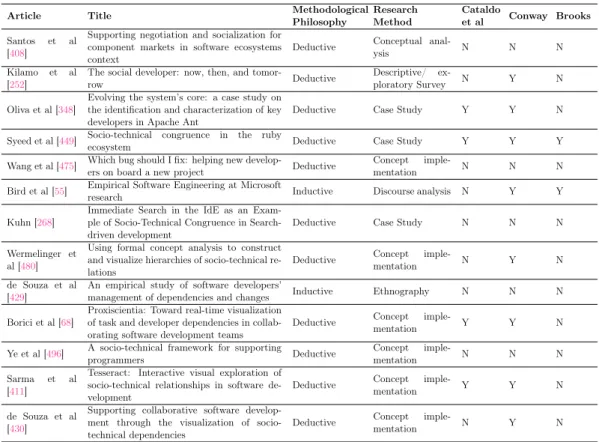
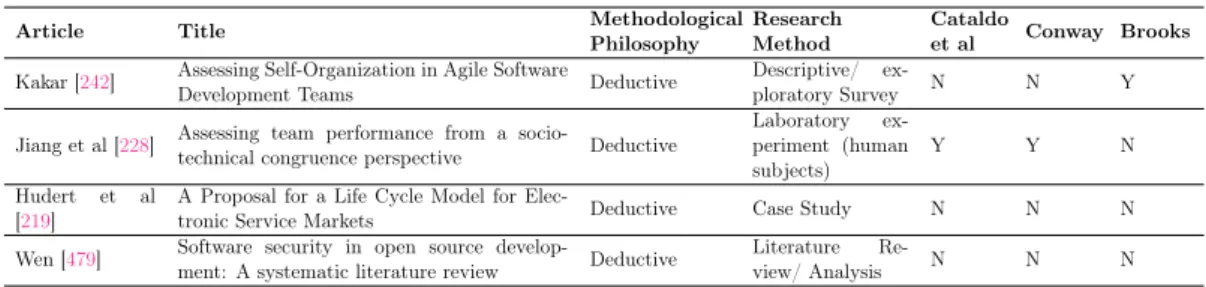
Software Engineering Management
Both Table2.3and Table2.4list articles on Software Engineering management.
Con-sidering the amount of papers, we split the two tables.
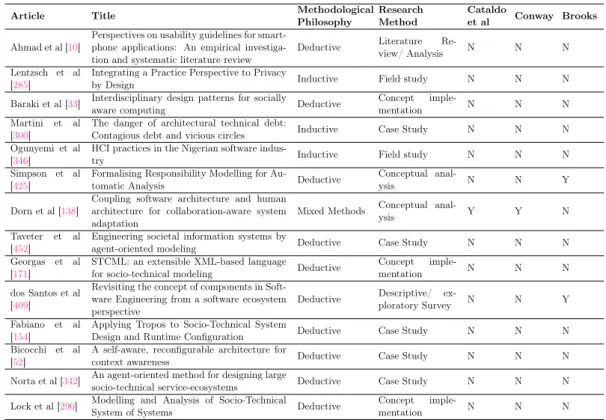
With reference to Table 2.3, Balasubramanian et al [30] described and explained implementation of Agile in Botswana by observing behavioral patterns. Bider et al [53]
Table 2.2: Distribution of research SE Areas’s evolution per year
Research focus 1998 2002 2003 2005 2006 2007 2008 2009 2010 2011 2012 2013 2014 2015 2016 2017 2018 Total Percentage Software Engineering management 1 1 2 2 3 3 2 2 5 2 5 3 3 5 3 42 45%
Software design 1 2 1 1 1 2 4 1 1 14 15%
Software construction 2 1 2 1 2 1 1 2 1 13 14%
Software requirements 1 1 1 1 2 2 2 1 1 12 13%
Software Engineering process 1 1 2 4 4%
Systems engineering 1 2 3 3%
Project management 1 1 2 2%
General management 1 1 1%
Software testing 1 1 1%
Software Engineering economics 1 1 1%
Software configuration management 1 1 1%
Total 1 1 2 3 2 6 7 4 6 12 8 8 7 10 10 6 1 94 100%
developed a modeling technique to explicate and represent various kinds of distances between the functional components to determine which of them constitute risk factors. Tamburri et al[451] found out that social debt is strongly correlated with technical debt and both forces should be reckoned with together during the software process. Yu et al [498] performed a confirmation study of the ability to designate risks through dimension of task, actors, structure and technology. Howinson et al [216] developed a theory of collaboration through open superposition: the process of depositing motiva-tionally independent layers of work on top of each other over time. Gallina et al [162] pursued a model-based analysis that allows analysts to interpret humans and organi-zations in terms of components and their behavior in terms of failure logic, building on the CHESS-FLA tool for component-based system architectures. Storey et al [440] examined the past, present, and future roles of social media in Software Engineering. Damian et al [119] found out that communication only partially matched task depen-dencies and that team members that are boundary spanners have extensive domain
knowledge and hold key positions in the control structure. Mac Kellar et al [298]
described a tool that uses socio-technical congruence measures to support and give advice to students who are learning how to effectively coordinate activities on a group project. Betz et al [51] got the insight that changes in the communication structure alone sooner or later trigger changes in the design structure of the software products to return the socio-technical system into the state of congruence. According to Syeed et al [448], the congruence measure is significantly high in OSS and the congruence value remains stable as the project matured. The paper by Dorn et al [137] proposes a language and methodology for specifying and simulating large-scale collaboration structures, example individual and aggregated pattern simulations, and evaluation of the overall approach. Wen et al [478] performed a socio-technical study of how Swedish municipalities utilizes information channels to handle the OSS security incident and their security posture before, during and after the incident. Global Teaming process areas and associated threats presented in the paper by Richardson et al [385] pro-vides both a guide and motivation for software managers to better understand how to manage technical talent across the globe. A proposal of an aggregated socio-technical congruence measurement that can be used to specify multiple relationships, such as awareness relationships, as interactions that satisfy technical dependencies was out-lined by Kwan et al [272]. Zhou et al [501] supported the importance of the initial environment in determining the future of the developers and may lead to better train-ing and learntrain-ing strategies in software organizations. Kwan et al [273] discovered that there is a relationship between socio-technical congruence and build success probabil-ity, but only for certain build types; in some situations, higher congruence actually leads to lower build success rates. Kazam et al [248] presented the Metropolis Model, which attempts to capture and provide a framework for reasoning about this new and increasingly important form of software-intensive system production. According to Al et al [14], development processes adopted to develop tools need to reflect the