Adults Learning Mathematics
An International Journal
Chief Editor Gail FitzSimons Volume 1 (2) February 2006 ISSN 1744-1803ALM International Journal
Objectives
Adults Learning Mathematics – an International Research Forum (see http://www.alm-online.org) has been established since 1994, with an annual conference and newsletters for members. ALM is an international research forum bringing together researchers and practitioners in adult mathematics/ numeracy teaching and learning in order to promote the learning of mathematics by adults. Since 2000, ALM has been a Company Limited by Guarantee (No.3901346) and a National and Overseas Worldwide Charity under English and Welsh Law (No.1079462). Through the annual ALM conference proceedings and the work of individual members an enormous contribution has been made to making available theoretical and practical research in a field which remains under-researched and under-theorised. Since 2005 ALM also provides an international journal.
Adults Learning Mathematics – an International Journal is an international refereed journal that aims to provide a forum for the online publication of high quality research on the teaching and learning, knowledge and uses of numeracy/mathematics to adults at all levels in a variety of educational sectors. Submitted papers should normally be of interest to an international readership. Contributions focus on issues in the following areas:
• Research and theoretical perspectives in the area of adults learning mathematics/numeracy
• Debate on special issues in the area of adults learning mathematics/numeracy
• Practice: critical analysis of course materials and tasks, policy developments in curriculum and assessment, or data from large-scale tests, nationally and internationally.
The ALM Journal will be published twice a year. ISSN 1744-1803
© Adults Learning Mathematics – an International Research Forum (2006)
Editorial Team:
Dr. Gail FitzSimons, Monash University, Melbourne, Australia [Chief Editor]
Dr. Mieke van Groenestijn, Utrecht University of Professional Education, Netherlands Prof. Dr. Juergen Maasz, University of Linz, Austria
Dr. Janet Taylor, University of Southern Queensland, Toowoomba, Queensland, Australia Dr. Tine Wedege, Malmö University, Sweden
Editorial Board:
Prof. Alan Bishop, Monash University, Melbourne, Australia Prof. Marta Civil, University of Arizona, U.S.
Dr. Diana Coben, Kings College London, UK Dr. Jeff Evans, Middlesex University, London, UK
Prof. Dr. Gelsa Knijnik, Universidade do Vale do Rio dos Sinos, Brazil Prof. John O’Donoghue, University of Limerick, Ireland
Prof. Dr. Wolfgang Schloeglmann, University of Linz, Austria Prof. Ole Skovsmose, Aalborg University, Denmark
Dr. Alison Tomlin, Kings College London, UK
Prof. Dr. Lieven Verschaffel, University of Leuven, Belgium
Prof. Dr. John Volmink, Natal University Development Foundation, Durban, South Africa
Information about contributions for the ALM International Journal is available on www.alm-online.org
Books for review, or completed book reviews, should be sent to the Chief Editor. Email address for enquiries or submission of articles: [email protected]
Adults Learning Mathematics -
An International Journal
Chief Editor Gail FitzSimons Volume 1 (2) - February 2006Contents
Editorial 4 Gail FitzSimonsAdult Students’ Views of Mathematics: Reflections on Projects 6
Dubravka Viskic & Peter Petocz
Cognitive Trajectories in Response to Proportional Situations in Adult Education 16 Javier Díez-Palomar, Joaquim Giménez Rodríguez, & Paloma García Wehrle
Adults’ Resistance to Learning in School versus Adults’ Competences in Work: 28 The Case of Mathematics
Tine Wedege & Jeff Evans
Editorial
Gail E. FitzSimons
Monash University Melbourne, Australia <[email protected]>This is the second number in the first volume of Adults Learning Mathematics — An
International Journal. After a lengthy gestation period the first copy of this ground-breaking
electronic journal was produced in June 2005. Continuing the strong international flavour of the Adults Learning Mathematics [ALM] movement, this edition is comprised of three articles from authors working in Australia, England, Spain, and Sweden. These articles have been developed from conference presentations at the Topic Study Group [TSG 6], Adult and Lifelong
Mathematics Education, at the 10th International Congress on Mathematics Education [ICME 10]
held in Copenhagen, July 2004. [For further information see: <http://www.icme-10.dk>]
Introduction to the articles
Dubravka Viskic and Peter Petocz open with Adult Students’ Views of Mathematics: Reflections
on Projects, an investigation of students’ ideas about mathematics and learning, based on their
written reflections on the process of carrying out projects. These projects formed part of a preparatory mathematics course at an Australian university. Using a hierarchical classification previously developed in the context of undergraduate university study in statistics, they categorise the students’ conceptions and identify three qualitatively different ways in which students understand mathematics, ranging from limiting to expansive views. They discuss the various aspects of the course that contribute towards the adoption of broader conceptions of mathematics with the potential to enrich the future professional and personal lives of the students. Many students reflected on their increased self-awareness, confidence and time-management skills, and on their positive experiences of working in a group. Many also talked about their excitement at discovering the details and applications of mathematics, carrying out the process of research and learning, and deriving intellectual enjoyment from their studies. The authors claim that the kinds of comments presented in this article demonstrate students developing their affective and social relationship with mathematics. In adult mathematics education, if nowhere else, this relationship is critical if learning in the cognitive domain is to flourish.
From Spain, Javier Díez-Palomar, Joaquim Giménez Rodríguez, and Paloma García Wehrle present the results of a case study about the learning of proportional situations in a school for adults in their article: Cognitive Trajectories in Response to Proportional Situations in Adult
Education. Pursuing their objective of finding ways of overcoming the forms of exclusion that
occur in daily mathematics situations — in this case, ones that involve the use of proportions for decision making — they study how dialogue intervenes in the resolution of the problems that are posed. Following the work of Leontiev and Searle respectively, they analyse the classroom activity from the perspective of the development of content, and the interaction and discourse as a speech act. Based on the doctoral dissertation of Díez-Palomar, they propose the use of cognitive learning trajectories as a methodological tool to support the analysis of the discourse, and present two contrasting examples. These lead to the conclusions (among others) that
perlocutionary speech acts can encourage learning, but can also create barriers when the speaker uses a position of power that breaks with egalitarian dialogue.
Since its inauguration, the nature of the ALM community has been such that it is truly supportive of scholars from all backgrounds and at all levels. It is worthy of note that, since completing his doctoral dissertation, Javier Díez-Palomar has been awarded a Fulbright Scholarship to work in the USA with Marta Civil, a long-standing ALM member.
The final article, Adults’ Resistance to Learning in School versus Adults’ Competences in
Work: The Case of Mathematics, by Tine Wedege and Jeff Evans, further underlines the
international co-operation and collaboration among ALM members. Working in Sweden and England respectively, these well-known and highly respected authors build on and extend their previous work around the critical area of the cognitive-affective relationship for adults and the phenomenon of resistance to learning in formal adult education. This resistance is contrasted with the increasing recognition being given to adults’ actual mathematical competences. The arguments and evidence put forward by Wedege and Evans are predicated on the need to take account of the conflicts between the needs and constraints in adults’ lives: seen in its interrelationship with motivation and competence, resistance contains the potential to be a crucial factor in all types of learning.
It must be acknowledged that Tine Wedege and Jeff Evans were the Chairs for the TSG 6, and the articles presented here — and others still to come — are testament to the conscientious work and attention to detail carried out by these two long-term ALM members. Once again, the generosity of support given to others by members of this community has been rewarded by the second publication of this journal. I urge readers to consider seriously joining the organisation, attending its annual conferences, and even contributing to further editions of this journal.
Finally, I must thank the reviewers for volume 1, number 1 & number 2, for their careful, honest, timely and constructive reviewing of manuscripts. Without their tireless efforts there would be no refereed journal continuing the important task developing the research field of adults learning mathematics. [See p. 44 for the complete list of reviewers.] I also extend my heartfelt gratitude to the Editorial Team of Juergen Maasz and Mieke van Groenestijn, as well as Kathy Safford-Ramus, current Chair of ALM, for their ongoing support in this challenging but exciting phase of the journal’s development.
Gail E. FitzSimons Chief Editor
Adult Students’ Views of Mathematics: Reflections on Projects
Dubravka Viskic
NewSouth Global, University of New South Wales, Australia <[email protected]>
Peter Petocz
Macquarie University, Sydney, Australia <[email protected]>
Abstract
In this article, we investigate adult mathematics students’ ideas about mathematics and learning, based on their written reflections on the process of carrying out projects as part of a preparatory mathematics course at an Australian university. On the basis of these reflections, we categorise their conceptions of mathematics using a hierarchical classification previously developed in the context of undergraduate university study in mathematics. We discuss the various aspects of the projects and their studies that help at least some of them to take broader conceptions of mathematics with them into their future professional and personal lives.
Keywords: preparatory (mathematics courses), projects, reflections, conceptions (of mathematics), personal growth, professional preparation.
Introduction
What views do adults returning to study have about mathematics? Does a problem- and project-based approach enhance their learning and their approach to mathematics? And what might adults take with them from their mathematics studies into the wider contexts of their professional, intellectual and social lives? This paper looks for answers to these and similar questions on the basis of our experiences teaching adults, and in the context of our (and others’) research in various aspects of mathematics education. Wedege (2002, p. 63) states that “the overall purpose of mathematics education research can be described as investigating and forming people’s relationship with mathematics.” Here, we look at the developing relationship with mathematics shown by a group of adults who have decided to return to study the discipline for a variety of reasons, and many of whom are aiming to continue into mainstream tertiary study.
For many years, one of us (Dubravka) has run a Preparatory Mathematics course at a large university. The assessment for the course includes opportunities for students to carry out extensive group or solo projects in a variety of areas of application, at various mathematical levels, and utilising various types of mathematical technology. Students are asked to reflect on the work that they have done and to carry out a self-assessment of the success of the projects in developing their mathematical background.
With our students’ permission, we have kept copies of many of their projects over the last decade, and we use these as a basis for our study. Their reflections provide a window onto their views of mathematics and their learning. Previously, we have presented analyses of their reflections on the process of learning using projects (Viskic & Petocz, 2004) and the different
approaches used by groups of different sizes and gender composition (Wood, Viskic, & Petocz, 2003). Here we extend our investigations to an analysis of our students’ views of the nature of mathematics, categorised using results from a previous investigation of undergraduate mathematics students’ conceptions of their discipline (Reid, Petocz, Smith, Wood, & Dortins, 2003).
Although our students’ mathematical abilities are varied, many of them show a maturing understanding of mathematics and its place in their own self development, and various aspects of their lives, including their working life, intellectual life and social life. Students write perceptive commentaries on their mathematical work, their mental development as learners, and the ways in which they incorporate their learning into other aspects of their lives. While many of our students seem to learn a lot about mathematics and their own approach to learning by doing this course, we too learn much about the ways in which adults approach mathematical studies.
Background to the course
The students on which this study is based are a diverse group enrolled for a Preparatory
Mathematics course at a large university. They are “mature-age” students (aged from 21 up, but
sometimes up to 70). They have come from different countries, educational systems and language backgrounds, have generally left school many years before, and have not obtained tertiary qualifications. Although some have recently finished secondary school (within the last two or three years), most have been out of school for many years and have forgotten much of the mathematics they studied there. Some want to study further and are using this course as preparation for entry into various courses at university, some want to change their work situation, some want to review their mathematics to help their children at school; others are doing the course simply for interest or intellectual challenge. One student was a writer who had a mathematician as a character in a novel, and was gathering background information! The class meets once a week for 26 meetings spread over a year. The pedagogic approach is varied, in response to the diversity of the students and their aims, using investigations and discussions, group work and computer laboratories, guest lecturers and videos, as well as more traditional methods.
Although the preparatory mathematics course discussed in this paper has many positive aspects, we must acknowledge that about half of the students who enrol do not finish the course, most of whom drop out early on. There are various reasons for this: some have changes in their circumstances, such as moving to another job in another place, others find it too difficult to balance the demands of study with their work and family life, and yet others simply find it too hard to come to grips with the mathematics. Sometimes they discuss these problems with their teachers, who can occasionally suggest solutions, but for the most part they just leave without comment.
The course focuses on mathematics at the level of senior high school, including algebra, coordinate geometry and trigonometry, followed by functions and calculus with applications. We wrote the textbook (Petocz, Petocz, & Wood, 1992) especially for this course (and others similar to it). There are relatively few books at the preparatory level between secondary school and university, possibly because there is only a small commercial market, but it is an area that is of growing importance as more students arrive at university without the traditional school background in mathematics. We aimed to present mathematics in its historical context, applied to contemporary situations, in order that our students see mathematics as a human activity. Positive reviews of the book (e.g., Mansfield, 1992) have commented on these features. Other users have complained that it contains too much discussion and explanation, and not enough practice exercises for students to become completely familiar with mathematical techniques.
Viskic & Petocz (pp 6 –15)
One particular feature of the book is the two chapters devoted to projects (one chapter pre-calculus, the other calculus based). The topics are selected to cover a range of applications and social concerns that might appeal to adult students, including topics in (pure) mathematics that might be useful to them in their university courses. In the first chapter there are projects on
Managing your mortgage, Women in mathematics, Mathematics of alcohol, Geometry of
fractals, Aboriginal and other counting systems and Complex numbers. In the second, there are projects on Radiocarbon dating, The Greenhouse effect, Elasticity in economics, Newton’s
method and Infinite series. In each project, a overall problem is posed and some background
information and initial references are given. For instance, one project in the earlier chapter asks:
In what ways have different cultures, in particular, the various Australian Aboriginal cultures,
developed and used number systems? It follows this question with a brief discussion of decimal
and other base number systems, and then gives a table of counting numbers from the Gomileroi language (an indigenous group from Northern New South Wales, Australia). This is followed by a series of questions, at first straightforward and well-defined, moving through more extended applied questions that require further information to solve, up to some that could constitute mini research projects. For instance, here are five questions from the project on number systems:
• What is a number system and what is a base?
• What are the advantages of having a base for a number system? What advantages would there be in the Gurindji system with no base? What problems could there be?
• Common bases in other cultures and civilisations include 2, 3, 4, 5, 10, 20 and 60. What are the advantages and disadvantages of each? Investigate the number system of one of these cultures or civilisations.
• The probability that there is intelligent life on some other planet has been calculated to be 0.1. Imagine that you have landed on another planet where the inhabitants have three ‘hands’, each with four ‘fingers’. What sort of number system or systems do you think they would use? Give some examples of their calculations.
• How could you convert numbers from any base into any other base? Give some examples of the method. Can you write a computer program to carry out the conversions?
• Each project states explicitly that “you do not need to answer all the questions and you may want to discuss other discoveries that you have made.”
Question 10, the last in each project, invites students to: “Give a brief account of your
investigations, describing the problems you faced and the successes you achieved.” Discussion
in class points out the importance of such reflection for students’ learning. To encourage students to write a response, the marking criteria explicitly state that there will be 1 mark (out of 10) if a reflection is present: this requirement could be satisfied by a minimal response of a sentence or two, although most students need no more encouragement to write detailed reflections that can be up to two pages in length. Reading through such reflections can also be a very enlightening way for a teacher to get feedback on their teaching and their students’ learning, as other teachers have reported (Varsavsky, 2003).
Theoretical position and previous results
We have set up the total learning environment of the course (as discussed in Petocz & Reid, 2002) to encourage the students to take a deep approach to their learning, and to develop holistic conceptions of learning and of mathematics (Marton & Saljö, 1979; Marton & Booth, 1997). The approach taken throughout the whole course is to encourage students to active and participatory learning (see, e.g., Dubinsky, 1999) and to make connections between mathematics and their own life experiences (for instance, in the selection of topics for the projects). The common approach of school mathematics in many countries – a defined sequence of mathematical techniques reinforced with copious exercises in an abstract or pseudo-applied context (referred to as ‘situation context’ by Wedege, 2002) – is largely replaced with a project- and problem-based approach that aims to foster the development of
mathematical literacy, intellectual autonomy and democracy: Skovsmose (2001) refers to the former approach as the ‘exercise paradigm’ and its replacement as ‘landscapes of investigation’. As adults returning to study, our students are also faced with the problem of connecting the mathematics that they have previously studied at school with the informal and implicit mathematical experiences that they have in their working and personal lives: Wedege (2002) points out that many adults do not consider such experiences to be proper or real mathematics.
One important feature of the projects, supported by much research in learning, is that students are encouraged to work in groups (and most of them do). Jacques (2000) gives practical details and discussion of the benefits of working in groups. Booth, Wistedt, Hallden, Martinsson, and Marton (1999) maintain that there are multiple paths to learning and that encouraging students to work in groups enables them to jointly constitute meaning about mathematics. Keitel (1999) points out that all learning interactions are between persons and that the focus of this interaction is the development and sharing of meaning. Another important point, especially for some students who have not participated in learning for many years, is the use and integration of current technology and the beneficial effects that this can have on learning (discussed in this context in Wood et al., 2003; also by Dubinsky, 1999). The question at the end of each project is designed to encourage students to reflect on their learning experiences and to carry out the self-assessment that is an important component of successful learning at all levels, but particularly in tertiary courses and in further lifelong learning (Boud, 1995). This self-assessment can take a wide variety of forms, as shown, for example, by Reid and Leigh (1999) in the context of studies in management. Their hierarchy of conceptions suggested an initial basis for the organisation of our students’ reflections.
At a conference in 2002 we presented introductory analyses of students’ reflections on the process of learning using projects (Viskic & Petocz, 2004). We found that we could group their reflections into four categories. From narrowest to broadest they were: Basic (writing the minimum to satisfy assessment requirements), Descriptive (discussing or summarising mathematical material studied), Experiential (reflecting on practical and personal difficulties and successes) and Integrated (combining personal understanding of the mathematics with an appreciation of development as learners). The categories reflect an increasing depth of learning experiences during the process of carrying out the project. They show a hierarchical nature, as reflections at the broader, more holistic levels can contain elements from the lower levels. We have also investigated the different approaches used in these projects by groups of different sizes and different gender composition (Wood et al., 2003). We were particularly interested in whether there were systematic gender differences in the way students formed their groups, worked together and utilised the available technology (including computer packages, e-mail and internet) in their learning of mathematics. From a thematic analysis of a large number and variety of reflective comments we concluded that many individuals and groups were extending their familiarity with a range of technologies and that there was no evidence of any gender-based differences.
Here we extend our investigations to an analysis of our students’ views of the nature of
mathematics, testing a framework based on an earlier investigation of university mathematics
students’ conceptions of their subject (Reid et al., 2003). In that study, a series of interviews was carried out with students majoring in mathematical sciences. Students were asked questions such as: What do you think mathematics is about? How do you go about learning mathematics? What do you aim to achieve when you are learning in mathematics? What do you think it will be like to work as a qualified mathematician?. The transcripts were analysed using a phenomenographic approach (Marton & Saljö, 1979; Marton & Booth, 1997). This analysis led to the identification of three qualitatively different ways in which students understand mathematics, ranging from limiting to expansive views.
1. Components: Students see mathematics as made up of individual components; they focus
Viskic & Petocz (pp 6 –15)
notion of calculation, interpreted in the widest sense; nevertheless, these components are viewed as part of a coherent mathematical investigation.
2. Models: Students see mathematics as being about building and using models, translating
some aspect of reality into mathematical form; in some cases, such models are representations of specific situations, such as a production line or a financial process; in other cases, the models are universal principles, such as the law of gravity.
3. Life: Students view mathematics as an approach to life and a way of thinking; they believe
that reality can be represented in mathematical terms and their way of thinking about reality is mediated by mathematics; they make a strong personal connection between mathematics and their own lives.
A previous study (also using a phenomenographic approach) of students’ conceptions of
statistics (Reid & Petocz, 2002), a component of the same mathematics degree and a possible
area of specialisation for them, found a narrower conception of statistics (and hence of an area of mathematics). This would be placed before the first conception (Components) on the list, and we have assigned the level 0 to this conception.
0. Techniques: Students focus on mathematics or statistics as consisting of isolated
mathematical or statistical techniques, without any connection between the techniques and their meaningful use in mathematical or statistical problems.
Further evidence from a larger, international group of students has confirmed the existence of this narrower conception (Petocz, Smith, Wood, & Reid, 2004).
Again, and in common with other phenomenographic outcomes (see Marton & Booth, 1997, for instance), these conceptions seem to be hierarchical and inclusive. Students holding the broader, expansive views are also aware of aspects of the narrower, more limited views, but the converse does not hold: students who view mathematics as techniques or components seem unaware of the broader views. This is the reason why we as educators value the broader conceptions and try to set up learning situations to encourage students towards them.
An aim of the present investigation was to see whether the same framework found using interviews with university mathematics students would be appropriate for discussing our preparatory mathematics students’ ideas about mathematics. We wanted to examine whether adults returning to mathematics study showed the same range of ideas about the discipline as students who were studying mathematics at university. In this case, the information that we had – reflections ranging from a few sentences to a couple of pages – was more limited than half- to one-hour interviews. Nevertheless, it seemed that the views of our preparatory students were able to be described using the same framework.
Students’ conceptions of mathematics
In this section, we examine some of our students’ reflections on their projects in order to investigate their understanding of mathematics itself, and make comparisons with the hierarchy of conceptions that have been found previously in undergraduate mathematics courses. Some of the reflections were written jointly with group members, others were written individually, sometimes even when students had worked together in a group. We start with a reflection from a project carried out on Aboriginal and other counting systems illustrating the Components
conception. The focus is on separate mathematical activities in the context of counting systems (remember, the “Aliens” have three hands with four fingers on each hand).
We started by working out how to change between bases, particularly 5 and 10, and initially found it so difficult it almost hurt. A big breakthrough occurred when we were working on the Alien question, doing a lot of trial-and-error work and having some bizarre discussions! After that, the notion of base and power fell into place, and the ease of calculation between bases increased considerably. We became quite adept at addition and subtraction in various bases without resorting to tables, including our Alien 4/12 system. Multiplication and division remained challenging, and quite difficult
in the Alien system. Finding reference material was quite difficult for this project. Information on bases in general, and changing bases, was either very introductory or in journal articles, way beyond our understanding. From this project, we believe we have a better understanding of the working of powers and bases, and that this will help us in our understanding and use of indices, exponentials and logarithmic functions, and in seeing maths as a representational system, rather than a series of absolutes.
Another example from a project on Infinite Series also illustrates the Components
conception. It shows a similar focus on separate but coherent mathematical activities – arithmetic and geometric series, harmonic series, series expansions for π, using a calculator, writing a computer program.
The concept of an infinite series actually converging to something finite was sort of difficult to grasp at first, but now it seems quite natural. The geometric and arithmetic series were a good place to get into the topic because they were relatively easy to understand. The book by Fitzpatrick was quite helpful for those easier series. Also one of us had studied them overseas in Iran, which was a real big help! Some of the other books we used were difficult, particularly Arfken’s and Protter & Murray’s. Nevertheless, it was good to see where the subject was going and the first one was quite a help in understanding the harmonic series and getting some other nice results, like Euler’s identity. The internet was also helpful, we got various sums and products for pi from there. A big problem was using the calculator to evaluate series: other than being boring, it was easy to get confused and to make a mistake. We felt that it would be best to write some computer programs although we weren’t so confident about how to do so. It was quite a challenge. One of us did have some practice with the Basic and Matlab computing language but even so it was difficult to write the programs. After a lot of error messages we finally got them all running which was very exciting!
The next reflection from a project on Radiocarbon dating shows the Models conception, and gives a clear example of a model that is an application of calculus methods.
This project has shed light into the process of better understanding how relics and antiques are dated and catalogued. I have also learnt about the inconveniences of carbon dating and why sometimes it is better to use other methods. It was interesting for me to see the calculus methods learnt in class applied to everyday use. I can now understand that rates of change are applicable, and not just useless formulas and complicated symbols. Another fascinating thing I learnt in this project was how the calculus theory can be applied to forensic examinations in detecting, for example, how long a body has been dead. Now when I watch Crime Scene Investigation (the TV show) and they are determining how long ago the person died, I know that with Newton’s law of cooling I will be able to work it out too!
Another quote showing the Models conception is this reflection from a project on
Mathematics of alcohol. A particular aspect of reality – the effect of alcohol on the body – has
been translated into a mathematical model encapsulated by the formula for Blood Alcohol Concentration (BAC).
In this project I investigated the effects of alcohol in the body and how we could use mathematics to model items such as absorption and the processing of alcohol in the human body. I examined the BAC in different scenarios, and found that males and females have completely different absorption rates and that females are generally disadvantaged when it comes to drinking. Also I found out that the BAC is a little more complicated than I first expected, with so many unknown factors and estimates, such as the amount of alcohol that was left in the stomach hence not absorbed. This project allowed me to study something that was interesting to me, and I really enjoyed the learning process and took a new perspective of how mathematics was related to a real life situation.
The next reflection is from a male student’s project on Women in mathematics, and shows the strong personal connection that is characteristic of the Life conception.
I guess part of the reason that I chose Women in Mathematics as the topic for my project was curiosity. Who were these women, why haven’t I heard of any of these women mathematicians? It’s safe to say that I embarked on this project from a position of complete ignorance. I thought back to my high school years and realised that from years 7 to 12 all my maths teachers were male. I remember hearing on more than one occasion the statement, which often goes unquestioned in people’s minds, that ‘Girls are good at English and boys are good at maths.’ I have five younger
Viskic & Petocz (pp 6 –15)
sisters, whom I have all heard proclaim at one stage or another with great conviction ‘I hate maths, I’m hopeless at it.’ However, after completing this project and hence rendering myself in a position of slightly less ignorance, I now know that there has been many great female mathematicians. I’m left with a great deal of respect for these women, and the courage and determination they each possessed. After learning about the many barriers that these women faced, in particular the extreme negative attitudes towards women in mathematics, I’m brought back to the question of my sisters. Do they really hate maths? They are all intelligent young ladies, are they really hopeless at mathematics? Or even today does there still exist some kind of subconscious stereotype in our society that conditions some young female students to falsely believe that because they are female they are not supposed to like or be good at mathematics, thus encouraging them to focus their energies on the more traditionally ‘female’ subjects such as English? This is one of the theories that I came across whilst researching the first question of the project.
And finally a reflection from a project on The Greenhouse effect illustrating the Life
conception, showing the student’s growing appreciation of the place of mathematics and mathematical thinking in their life, and its possible role in solving environmental problems.
The reason I selected this project initially was simply due to my genuine interests and concern in our changing environment. I was further drawn to this option as I was most curious to know how mathematics came into the Greenhouse equation. I must certainly say that I got a lot more out of the project than I bargained for. As interesting as it was to learn more about the greenhouse gases that I’d known, the most satisfaction came from learning so much more about the importance and the value of maths. … During my research, I was quite fascinated about the concept of GCMs [Global Climate Models], and will anticipate any improvements being made in the years to come with these models. As expensive as they are, the models aren’t quite enough to make accurate predictions on the Greenhouse. But we must bear in mind that there are many other determining factors as mentioned earlier. It’s also interesting to learn that without global warming we would freeze. But obviously, the bottom line is moderation, and this does rely quite a lot on the human race. Educating people seems the best solution. Perhaps showing society these mathematical figures achieved in the project may open their eyes. They’ve certainly opened mine!
These six quotes were selected from a large number of reflections that could be used to illustrate each of the three conceptions described in Reid et al. (2003). Interestingly, there did not seem to be any evidence of the Techniques conception, although there were some reflections focusing only on practical problems such as getting to the library, or finding convenient times for group meetings (giving no clues about conception of mathematics): for instance, “The project was very time consuming, as a lot of resources that are easy to read do
not go into enough detail, and those that go into enough detail are too difficult to read.” We
believe that the construction of the projects and the various applications featured in each of them (even those focusing on “pure” topics) make it difficult for students to write reflections consisting of isolated mathematical techniques without any meaningful use. In this sense, all of the projects “provide activities and assessment that encourage students towards the broadest
levels of understanding of mathematics, and away from the narrowest levels,” as recommended
in Reid et al. (2003). Further evidence for this comes from several reflections that seem to show students broadening their view of mathematics. There was no evidence that some projects were more likely than others to give opportunities to expand their views to the widest level. As they work through a project, the mathematics that they are using gets connected to their own lives, even if the topic is a “pure mathematics” topic such as infinite series. The following reflection from a project on Mathematics of alcohol seems to show a student moving from a Models to a
Life conception:
Mathematics helps in a number of ways to formulate sensible and legal drinking patterns. Firstly, it’s by being able to measure the amount of alcohol in a given drink we are able to ascertain the effect that this will have on blood alcohol concentration. By being able to calculate the BAC we can then formulate or predict the relationship between certain BACs and accident and mortality rates on our roads. These figures can be entered statistically on graphs. It is the interpolation and extrapolation of such mathematical figures here that allows us to deem what is sensible, thereby enacting those values as legal limits for the benefit of all.
Another reflection on the topic of Managing your mortgage shows an initial focus on mathematics as Components before broadening into the Life conception:
After all of us separately deciding that mortgage formulas were helpful and extremely fascinating (!) we formed a study group in order to complete the project. After calculating and re-calculating most questions in order to achieve five of the same or at least similar results we gave up and decided to go with the majority… At present none of us own our own home and certainly none of us are looking forward to parting with the extreme amounts of interest (hard cash!) necessary to take out a mortgage. We have come to the conclusion that yes, mortgage formulas are extremely helpful (unless you are trying to derive them) and it is fascinating to discover how the bank can end up with so much of our hard-earned money!
Although it is sometimes not straightforward to categorise each student’s individual reflections, the previous framework (from Reid et al., 2003) seems to be adequate to describe the full range of views represented in the overall collection of reflections. On the more practical level, the complete collection of reflections, and even the small set of quotations that we have selected for this paper, provides a useful window into our students’ thinking about mathematics.
Discussion and conclusions
As well as illustrating conceptions of mathematics, these quotations from our students’ reflections also throw light on what adults may take with them from their studies into the wider contexts of their lives. Many of the project topics are concerned with application of mathematics to various social, environmental and civic problems (alcohol, greenhouse effect, mortgages). Some students’ reflections show that they are initially surprised by the social connection with mathematics, in the same way as the adults described by Wedege (2002) who do not consider that what they are doing in their workplaces is actually mathematics: Finally, though, at least some of them are appreciative of the growth in awareness that results from their study.
Of course, we cannot claim that this broader conception of mathematics is necessarily taken unchanged into students’ future personal, academic and professional lives. Yet there is evidence from previous studies (Reid & Petocz, 2003) that students who have developed broader conceptions of mathematics or statistics will use these broader conceptions if they perceive them to be appropriate for their future learning; for instance, in interpreting the meaning of a mathematical model for clients or other people involved in the situation. On the other hand, they can use a narrower approach if they feel that it will be rewarded; for instance, learning formulas, techniques and theorems by rote for a traditional ‘closed-book’ examination (Reid & Petocz, 2002). Nor can we claim that all adults will develop and benefit from such broader conceptions of mathematics. The students who enrol in this preparatory course are generally motivated to undertake further study of mathematics: Yet about half of them do not complete the course for various reasons, and some of those who do complete it seem to remain with the narrower conceptions of the subject.
Nevertheless, many students reflect on the increase in their self-awareness, confidence and time-management skills, and their positive experiences of working in a group. From many such reflections, here are three short comments, one from a solo project, the other two from larger groups of students:
Looking back, I actually appreciate what I have picked up with time management. I don’t know whether I had made many discoveries, rather than what I have been learning about myself. I seem to have a lot more confidence in myself, knowing that I can do the work that is required. Also learning that it will take time, I won’t get it straight away but if I stick to it then it will eventually all unfold. I loved that feeling.
With some material on the table, we were able to start in a somewhat slow fashion. The slow start can possibly be due to the four different cultural backgrounds. One of the over-riding aspects of the
Viskic & Petocz (pp 6 –15)
group was that everyone displayed an overwhelming level of courtesy in order to accommodate the values of each of our divergent backgrounds.
Finally, a brief summary of the group’s experience in working on this project. We all found the topic enthralling and could easily have devoted the entire project to any one aspect or individual [mathematician]. The challenge was working cohesively given the constraints of individual schedules and expectations: a learning experience as much as the project itself, albeit an enjoyable one.
A final and important point was that many students talked about their excitement at discovering the details and applications of mathematics, carrying out the process of research and learning, and deriving intellectual enjoyment from their studies:
I feel that I have gained much in the general understanding of fractals, satisfying an old curiosity in a field I had previously assumed as being beyond my reach. Learning about fractals has been an enjoyable and fascinating experience.
The research I have contributed to this project changed my views about the “out of Africa” theory, that modern humans evolved in Africa about 100,000 years ago and then spread around the globe. How radiocarbon dating and the role of mathematics in obtaining age estimates on organic materials as old as 50,000 years is just amazing.
After reading a small portion of Newton’s achievements, I decided that this was an interesting topic. … I found the topic stimulating, so much so that I am now reading anything remotely connected with mathematical science in that period, and I am considering studying mathematics as a degree rather than finance and economics as I was intending.
Comments such as those presented in this section demonstrate students developing their “affective and social relationship with mathematics” (Wedege, 2002, p. 76) and illustrating its importance in their increasing levels of numeracy and their broadening notions of the nature of mathematics. Our students’ reflections on and self-assessment of their projects yield fascinating and useful insights into their learning. Many students show a maturing understanding of mathematics being integrated into their own self development. For those students who successfully complete the course, these reflections attest to the enhancement of learning that has resulted from their work on projects in Preparatory Mathematics. To our future students we would commend such reflection as a powerful component of learning, and to colleagues running similar courses we would recommend reading and considering their students’ reflections.
Acknowledgements
This article is based on a paper published by Topic Study Group 6, Adult and lifelong mathematics education, at the 10th International Congress on Mathematics Education.
We would also like to acknowledge the important contribution to this study that has been made by our students, particularly in the form of their written reflections on their mathematics learning.
References
Booth, S., Wistedt, I., Hallden, O., Martinsson, M. & Marton, F. (1999). Paths of learning – the joint constitution of insights. In L. Burton (Ed.), Learning mathematics: From hierarchies to networks (pp. 62–82). London: Falmer Press.
Boud, D. (1995). Enhancing learning through self assessment. London: Kogan Page.
Dubinsky, E. (1999). Reflections on Krantz’s ‘How to teach mathematics’: A different view. In S. Krantz (Ed.), How to teach mathematics (2nd ed.) (pp. 197–213). Providence, RI: American Mathematical Society.
Jacques, D. (2000). Learning in groups (3rd ed.). London: Kogan Page.
Keitel, C. (1999). Teaching and learning mathematics. In L. Burton (Ed.), Learning mathematics: From hierarchies to networks (pp. 246–252). London: Falmer Press.
Mansfield, H. (1992, June 4–10). Invitation to a good workout. Australian Campus Review Weekly, p. 14. Marton, F., & Booth, S. (1997). Learning and awareness. Mahwah, NJ: Lawrence Erlbaum.
Marton, F., & Saljö, R. (1979). On qualitative differences in learning: I. Outcome and process. British Journal of Educational Psychology, 46, 4–11.
Petocz, P., Petocz (Viskic), D., & Wood, L. (1992). Introductory mathematics. Melbourne: Thomas Nelson. Petocz, P., & Reid, A. (2002). Enhancing the total learning environment for students. In P. Kahn & J. Kyle
(Eds.), Effective learning and teaching in mathematics and its applications (pp. 106–116). London: Kogan Page.
Petocz, P., Smith, G. H., Wood, L. N. & Reid, A. (2004). On becoming a mathematician: an international perspective for future professionals in the mathematical sciences. Proceedings of International Congress on Mathematics Education, ICME10, Copenhagen, July 4–11. Retrieved March 21, 2005 from the World Wide Web: http://www.icme-organisers.dk/tsg28/.
Reid, A., & Leigh, E. (1999). Three dimensional images as a self assessment of learning. In C. Rust (Ed.), Improving student learning outcomes (pp. 249–259). Oxford: Oxford Centre for Staff and Learning Development.
Reid, A., & Petocz, P. (2002). Students’ conceptions of statistics: A phenomenographic study. Journal of
Statistics Education, 10(2). Retrieved July 10, 2005 from the World Wide Web:
http://www.amstat.org/publications/jse/v10n2/reid.html .
Reid, A., & Petocz, P. (2003). Completing the circle: Researchers of practice in statistics education. Mathematics Education Research Journal, 15(3), 288–300.
Reid, A., Petocz, P., Smith, G. H., Wood, L. N. & Dortins, E. (2003). Maths students’ conceptions of mathematics. New Zealand Journal of Mathematics, 32Supplementary Issue, 163–172.
Skovsmose, O. (2001) Landscapes of investigation. Zentralblatt für Didaktik der Mathematik, 33(4), 123– 132. Retrieved March 21, 2005 from the World Wide Web: http://www.fiz-karlsruhe.de/fiz/publications/zdm/zdm014i2.pdf .
Varsavsky, C. (2003, November). What students say they learned – A case study in first year calculus. Paper presented at Remarkable Delta’03 conference, Queenstown, New Zealand. Abstract retrieved August 7, 2005 from the World Wide Web: http://www.maths.otago.ac.nz/delta03/ .
Viskic, D., & Petocz, P. (2004). Using projects to enhance mathematics learning. In J. Gimenez, G. E. FitzSimons, & C. Hahn (Eds.), A challenge for mathematics education: To reconcile commonalities and differences. Un défi pour l’education mathématique: Le commun et les différences. Proceedings of CIEAEM 54 conference (pp. 122-148). Barcelona: GRAÓ.
Wedege, T. (2002). ‘Mathematics – that’s what I can’t do’: People’s affective and social relationship with mathematics. Literacy and Numeracy Studies, 11(2), 63–78.
Wood, L. N., Viskic, D., & Petocz, P. (2003). Toys for boys? In L. Burton (Ed.), Which way social justice in mathematics education? (pp. 22–27). Westport, CT: Greenwood Publishing Group.
Cognitive Trajectories in Response to Proportional Situations
in Adult Education
Javier Díez-Palomar, Joaquim Giménez Rodríguez,
& Paloma García Wehrle
Department of Experiential Sciences and Mathematics Education Barcelona, Spain
<[email protected]>,<[email protected]>
Abstract
We present the results of a case study about the learning of proportional situations in a school for adults. The objective is to find ways of overcoming the forms of exclusion that occur in daily mathematics situations that involve the use of proportions for decision making. We study how dialogue intervenes in the resolution of the problems that are posed. To this end, we analyse the activity (in line with Leontiev, 1981) from the perspective of the development of content. We analyse the interaction and discourse as a speech act (in line with Searle, 1980). We propose the use of cognitive learning trajectories as a methodological tool to support the analysis of the discourse. Among other conclusions we found that perlocutionary speech acts can encourage learning, but can also create barriers when the speaker uses a position of power that breaks with egalitarian dialogue.
Key words: numeracy, teacher training, adults’ beliefs, learning in everyday life, proportional situations, cognitive trajectories, dialogic learning.
Introduction
Proportional reasoning is a person’s ability to effectively use proportional schemata. This ability plays a central role in the development of mathematical thinking and it is often presented as the cornerstone of higher mathematics as well as the most important of the basic mathematical concepts.
As adults, we function in a world in which proportions constantly arise and it is important for us to know how to use them in order to not feel excluded and to be able to make appropriate decisions, in accord with a correct evaluation of the information provided us. Using the concept of proportion incorrectly can lead to making erroneous decisions, with greater or lesser harmful consequences, depending on the circumstances. For example, putting an additional cup of flour in a culinary recipe can ruin a cake and embarrass us in front of our guests. But making a mistake in the proportion of medication that must be administered to a sick person at home can have fatal consequences for that individual. Furthermore, adults’ understanding of proportional reasoning (following Carraher, Carraher, & Schliemann, 1982; Noss, 2002; Noss & Hoyles, 1996) is a key area in adult education due to the implications that this understanding (or lack thereof) has for everyday life activities.
Writers on proportionality in adult education point out the importance of contextual factors in the learning process. See, for example, Hoyles, Noss, and Pozzi’s (2001) work on proportional reasoning in nursing practice.
Research shows that previous experience is an element that intervenes in proportional reasoning. As Schliemann and Magalhaes (1990) point out, when adults find themselves with proportionality problems that are known to them, they solve them correctly. But when the problems fall out of their prior experience, then they do not recognise that the relation of proportionality is the same one, and tend to make mistakes.
We know from previous research (Post et al., 1998) that instruction with proportional reasoning should begin with situations that can be visualized or modelled. Instruction should build on adults’ intuitive understanding and use objects or contexts that help them make sense. Adults need to understand key ideas in order to have something to connect with procedural rules. To support the development of key aspects of proportional reasoning, adults should explore proportional and non-proportional situations in a variety of contexts using concrete materials, collecting data, building tables, and determining the relationships between the numbers.
In the more extensive research investigation in which this study is framed, we propose to see how dialogic learning functions in a mathematics class for adults where the concept of proportionality is studied. But in this article we study the dialogue that takes place within the group in order to answer questions as to what kind of interactions produce effective learning (or not). What are these interactions? And what implications are there from a practical point of view with regard to pedagogical strategies? In order to achieve this goal, we undertook an in-depth case study. The following sections present the theoretical framework and methodological tools that we used to conduct our research and some findings for discussion.
Theoretical Framework
Our theoretical framework is dialogic learning. Egalitarian dialogue is one of the seven principles of the dialogic learning, developed by CREA – Centro Especial de Investigación en Teorías y Prácticas Superadoras de Desigualdades [Centre of Research in Theories and Practices that Overcome Inequalities] (Flecha, 2000). It is defined as the dialogue that is produced between two or more people, when the value of their contributions is considered as a function of the value of the respective arguments and not according to the position of power or authority within the group. Through dialogue, individuals have the opportunity to make sense of different concepts. They can use different strategies, such as negotiation of meaning (Clarke, 2001), recognition of concepts within the zone of proximal development (Vygotsky, 1979), accommodation of new structures of meaning by the equilibration process (Piaget, 1970), and so forth. But any of these strategies have to be based on an egalitarian process of interaction in order to be effective (because most times unidirectional interactions from teacher to students produce mechanical answers, but not effective understanding). So, in this sense, egalitarian dialogue is a condition for developing effective learning.
In order to attempt to interpret the dialogue produced in the classroom (Alrø & Skovsmose, 2003), by working with young students, Dreyfus, Hershkowitz and Schwarz (2001) refer to three elements: construction, recognition, and building with. They are interested in language as a tool to build cognitive structures related to mathematical understanding. In our case, we consider that people use language as a vehicle for learning, and are able to face difficulties and learn to overcome these through social interaction (Vygotsky, 1979). Therefore, for us, language has two clearly differentiated uses: on the one hand, it is a vehicle for communication; but on the other hand, it is also a constructor of reality (and, in this sense, a tool to learn with). Language is what allows us to build and express abstract ideas, such that words are symbols that are separated from the objects they refer to. Considering that learning is produced when a person is
Díez-Palomar, Rodríguez & Wehrle (pp 16 –27)
able to move from the concrete sphere of practical intelligence to the very abstraction of thought means that language occupies a central role in this process, in accordance with what Luria (1979) and Piaget (1970) contend.
At the same time, from the point of view of interaction, we can talk about functions of
language. Language can be a tool to communicate ideas, but also to impose our point of view
on others. As everybody knows, there are different styles of teaching: some more dialogic and others more unidirectional. To analyze the educational consequences of these we include in our study of the theories of Austin (1971) and Searle (1980). As they claim, there are illocutionary speech acts when we want to transmit information and perlocutionary speech acts when we want to influence the conduct or thinking of others. Searle defines speech acts as the collection of linguistic emissions. He distinguishes two characteristics of the linguistic sounds: on the one hand, the fact that they have meaning (illocutionary acts); on the other hand, the fact that they want to say something (perlocutionary acts). We use this classification because it allows us to see the ways in which power claims affect the dialogue that is produced within the classroom.
Methodology
We carried out an in-depth case study in the School for Adults, la Verneda – Sant Martí, in Barcelona (Spain) in 2003, within the framework of a larger research investigation about dialogic learning. The learning environment was structured so that there were face-to-face meetings between students and the teacher. In addition, there was a website designed for learning mathematical topics of interest to adults. The main objective of this article is to share some insights into adult learning within dialogical frameworks. We want to compare egalitarian strategies to teach and learn mathematics (focused on the concept of proportion) with non-egalitarian strategies. For this reason, we will focus our analysis in concepts such illocutionary and perlocutionary speech acts (Austin, 1971; Searle, 1980). We assume that individuals who are capable of providing concrete explanations of proportionality from the general (abstract) idea of proportionality understand the meaning of this idea (Piaget, 1970). We are interested to see if there is a uni-directional interaction between teacher and students, or bi-directional (i.e., when students use concrete examples, general explanations, and so on).
We observed a group of six women who were studying to obtain the equivalent of the compulsory secondary education certificate (i.e., the level for 16 years of age). These adults worked on the theme of proportionality over several sessions. We illustrate here the first of these sessions where ten tasks were proposed: in the first five, the dialogue is based on written questions, and in the last five on computer support. All activities were about proportions, in which elements of daily life (e.g., activities set in the context of the market place) were combined with more theoretical elements (e.g., questions about the meaning of the constant of proportionality). The first five questions are “textbook problems” that are characterized by presenting an explicit context, with a single formulation and a single possible solution. On the other hand, in the last five, we find problems of daily life in which the context only appears partially, and the solutions can be various. Table 1 shows two examples of activities that were carried out.
Table 1. Examples of Activities1 Task 1
In this stand at the market they have a board on which they have calculated the price of various weights, relieving the sellers from having to calculate the price each time they make a sale.
Complete the following table:
weight (kg) 1 2 3 4 5 6 7 8 Price € 3 6
Task 6
If we approach or move away from things that surround us, they look larger or smaller. Try it out: join someone and together try to measure the height of the classroom door. Which is bigger, your colleague or the door? Do you think if you begin to walk forwards or backwards that there will be a point at which your colleague is the same or equal height as the door? What distance were they from the door in order for this to happen?
Task 1: Example of a task from the mathematics book AA.VV. (2002, p. 152).
Task 2: Example of one of the tasks in the mathematics web.
<http://www.neskes.net/mates>
The session that was analyzed (approximately 70 minutes) was taped with a digital video, and subsequently, transcribed. In order to analyze data collected we used cognitive learning trajectories (CLT). In this, we considered, at the same time the contents of the discourse as well as the functions of the language in the interaction (Díez-Palomar, 2004), in order to understand how interactions through dialogue can allow (or not) effective learning about the concept of proportion.
With respect to the contents of the discourse, following Piaget (1970) we have developed four categories of analysis. These categories are the following: particular case (PC); diverse particular cases (DP); comprehensive interpretation (CI) and generalized recognition (GR). These four categories allow us to distinguish the arguments that correspond to concrete examples or questions from arguments that relate to more abstract ideas. In addition, we have used an extra category, evocation of the constant (Ek), related with the idea of constant of proportionality, as a part of the mathematical content of our research.
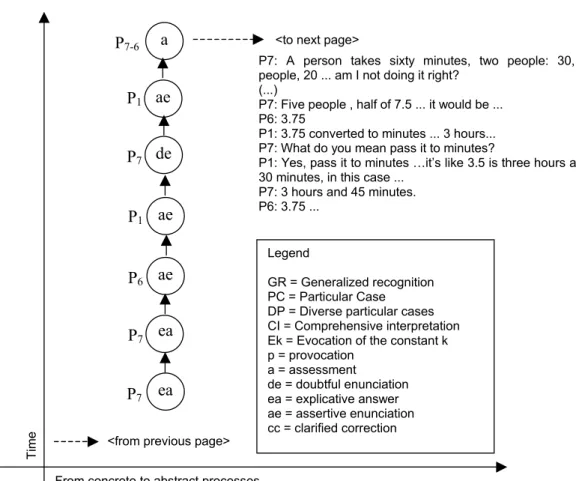
In order to understand how interactions between people within the classroom affect them, we have used some categories focused on the functions of language,following de Saussure (1974; see Introduction). These categories are as follows: provocation (p); agreement (a); explicative response (er); doubting enunciation (de); assertive enunciation (ae) and clarified correction (cc). In order to analyze dialogues utilizing both kinds of categories, we used CLT which served to graphically represent the data collected and to show different types of interaction between individuals. Each CLT represents a sequence of teaching and learning comprised of the involvement of different participants who are identified with a code, such as P1 (person 1). We analyzed the data in order to identify some evidence of concrete reasoning or abstract reasoning in relation to the idea of proportion. In addition, we looked at the meaning of interactions in analyzing the functions of language which individuals used to learn. For this reason, we also identified whether people used language as a tool to explain something related to mathematical concepts, or as a way to express doubt. We wanted to see if all participants were involved in the process of teaching and learning, or only a few. Moreover, we looked to
Díez-Palomar, Rodríguez & Wehrle (pp 16 –27)
see whether or not the teacher (P1) participated more, or less, than students, and in which particular situations this occurred. For example, if the participant explained something, prompted additional dialogue, or gave a clarified correction this would be noted in the analysis. This process was repeated with students. We used codes (as described above) to identify each dialogue, and we drew little circles on a chart where the X-axis symbolized the degree of abstraction and the Y-axis symbolized the time of the sequence. The chart was used to explain who was involved in the interaction and what kind of interaction it was. This methodological tool allowed us to better understand if the interactions were perlocutionary or illocutionary, and if there was an egalitarian situation, or not, in order to achieve our objective.
Results and Discussion
The videotape shows a group of women who were working together on several activities about proportion. They had different backgrounds and prior experiences. Dialogues show that some women were more participative than others. Most of the time the teacher was involved in the action in order to encourage more dialogue through provocations. The dialogues were fluent.
The nature of dialogues
From the analysis of the discourse, one of the first aspects to point out is the difference between the frequency with which the categories of particular cases and generalized recognition appear. We were very interested to find some evidence about the learning process. For this reason our focus of attention was on the nature of dialogues (concrete vs. abstract). What we denote as generalised recognitions are examples of dialogue where it can be seen that the person who is talking uses the general mathematical idea (in this case, the idea of proportionality) in its mathematical sense. The following fragment is an example. The context is an activity in which a person is asked to complete a table in which there appear two variables: the quantity of kilos sold of a product and the total amount of money. Between both variables there exists a relation of proportionality that is functional (one depends on the other). In the comment that P4 makes, it is made clear that she recognizes this mathematical idea of functional relation.
P4: ...that is to say, giving distinct values to K of the first quantity, mass, we obtain the values of the second quantity …
During the session, we observed that the women usually made reference to concrete examples in order to illustrate their arguments. These concrete cases always referred to the concrete implementation of the general norm; in other words, it was about specific examples from the general collection that is the mathematical norm.
In the following example, the teacher uses a specific case to explain the general mathematical norm, which refers to the conversion of a quantity expressed in base 10, to base 60.
P1: ... What we are saying now, the fraction part of 75 is a decimal. To convert it to minutes we have to multiply or divide by 60. If we have 3.75, as a decimal, to convert it to minutes we multiply by sixty ...
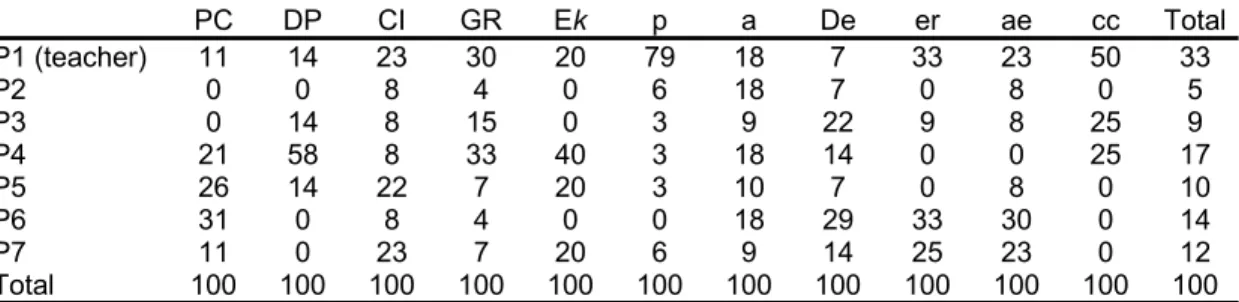
While all participants almost always use particular cases, generalized recognitions are used basically by the teacher and one of the women in the group (person 4, who adopts the main role in the classroom, and is more participative). This brings to light the difficulties that adults have to demonstrate the same type of intervention, even within an egalitarian dialogue. It is evident, however, that there is a fluid dialogue within the classroom, in which more or less everyone in the group participates. In addition to the capacity for abstraction that we all have, such as generalized recognition or evocation of the constant, the teacher does not monopolize them. In this way, we could observe how person 4 intervenes 33% of the times, which is way over the 30% of the teacher. In the category of evocation of the constant the same thing happens:
person 4 intervenes 40% of the time, while the teacher 20%. In Table 2 we can see the global distribution by percentage of the interventions in the different categories of the discourse. Table 2. Percentages by Categories of Analysis from the Total of Interventions
PC DP CI GR Ek p a De er ae cc Total P1 (teacher) 11 14 23 30 20 79 18 7 33 23 50 33 P2 0 0 8 4 0 6 18 7 0 8 0 5 P3 0 14 8 15 0 3 9 22 9 8 25 9 P4 21 58 8 33 40 3 18 14 0 0 25 17 P5 26 14 22 7 20 3 10 7 0 8 0 10 P6 31 0 8 4 0 0 18 29 33 30 0 14 P7 11 0 23 7 20 6 9 14 25 23 0 12 Total 100 100 100 100 100 100 100 100 100 100 100 100
But not everyone intervenes in the same way. Table 3 shows the different types of interventions of each person in the group. Person 2, for instance, tends to agree with the comments that are introduced during class, which suggests that she is following a strategy of economizing her efforts and is simply dedicated to agreeing, or she finds difficulty with regard to the content and is therefore not able to reach the abstract content in most situations. Person 3 also seems to encounter difficulties when resolving the situations, as indicated by the quantity of the doubtful enunciations they make (21%).
Table 3. Percentages by Person from the Total of Interventions
PC DP CI GR Ek p a de er ae cc Total P1 (teacher) 4 2 6 14 2 48 4 2 8 6 4 100 P2 0 0 13 13 0 24 24 13 0 13 0 100 P3 0 7 7 30 0 7 7 21 7 7 7 100 P4 15 15 4 34 8 4 8 8 0 0 4 100 P5 31 6 19 14 6 6 6 6 0 6 0 100 P6 27 0 5 5 0 0 9 18 18 18 0 100 P7 11 0 15 11 5 11 5 11 15 16 0 100 Total 12 4 8 17 3 21 7 9 8 8 3 100
The opposite happens in the case of person 4, who makes many generalized recognitions during the dialogue (34%). Person 5, on the other hand, prefers to make comprehensive interpretations (19%), which is a way of giving meaning to the different mathematical concepts that appear in the activities. In this sense, it is a clear example of creation of meaning, because it means understanding the mathematical content through the use language (in line with Luria, 1979).
Although not everyone participated in the same way, this table shows that all the women were involved in the session. But this first analysis does not allow us to affirm whether these kinds of dialogue were egalitarian (or not), because we have no information about the nature of interactions. For this reason, we need to analyze the dialogues from use of language perspective.