A pilot project to assess community pharmacists’ knowledge and caring behaviors for
recurrent headache sufferers after a migraine-focused educational intervention
Kelly A. Murray, PharmD, BCACP1; Monica L. Skomo, BS, PharmD, BCACP2; and Sandra M. Carter, MLA, MPH1 1University of Oklahoma College of Pharmacy and 2Duquesne University Mylan School of PharmacyAcknowledgements: Shane Desselle, RPh, PhD, FAPhA, for assistance in study design, survey development, and general support for
the project; Megan Scott, PharmD, for assistance in protocol development, continuing education program development/delivery, and data collection; Nancy Brahm, PharmD, MS, BCPP, CGP, Michelle Condren, PharmD, AE-C, CDE, Thomas Rihn, PharmD, and Melissa S. Medina, EdD for faculty/staff member and project support; this research was supported by the University of Oklahoma College of Pharmacy Seed Grant Foundation.
Financial Disclosures: Drs. Skomo and Murray report receiving funding from Merck Foundation for research related to migraine
education after the completion of this study. Ms. Carter reports no conflicts of interest or financial interests related to any product or service mentioned in this article. The funding agency was not involved in study design, conduct, or manuscript preparation.
Keywords: Community pharmacy, community pharmacist, headache, migraine, educational intervention, caring behaviors
Abstract
Objectives: (1) Compare pharmacists’ self-assessed knowledge of migraine before and after an educational intervention; (2) Compare pharmacists’ self-reported care behaviors following an educational intervention with a control group of pharmacists; (3) Identify interactions between the educational intervention results and individual independent variables. Design: Quasi-experimental, parallel design. Setting: Twenty community pharmacies in northeastern Oklahoma from March to May 2010. Participants: 49 pharmacists at one of twenty community pharmacies, with active and in-good-standing Oklahoma pharmacy licenses. Intervention: Two-hour educational session on migraine identification and current treatment. Main outcome measures: Compare pharmacists’ self-assessed knowledge of migraine before and after an educational intervention and compare self-reported care behaviors of these same pharmacists with a control group of pharmacists. Results: Pharmacists’ self-assessed knowledge mean scores were significantly higher post-intervention compared to pre-intervention (p<0.0001). Self-assessed knowledge was higher in the intervention group post-questionnaire scores compared to the control group of pharmacists (p=0.004). Intervention group pharmacists were more confident in their ability to maintain knowledge of migraine (p=0.04). No difference was seen regarding difficulty in providing care for a migraineur (p=0.16) or in how the pharmacists perceived employer culture (p=0.79). No significant interactions were found
between the educational intervention and demographic variables collected. Conclusion: Attending an educational program on migraine improved pharmacists’ knowledge and confidence when providing care to migraineurs.
Introduction
Migraine is a common, chronic, disabling condition characterized by recurrent episodes of headache
accompanied by debilitation, nausea, vomiting, photophobia, and phonophobia. Estimations show that approximately 12% of adults in the United States suffer from migraines.1,2 Evidence in this area suggests that migraine is not well managed in primary care, with only about 50% of migraineurs consulting their physician concerning this condition.2-4
Physicians incorrectly diagnose 50% of migraineurs, and many patients who are correctly diagnosed receive sub-optimal treatment, making migraine an underdiagnosed and undertreated condition.3,5-8 Because of this, some patients
Corresponding author: Kelly A. Murray, PharmD, BCACP
Clinical Assistant Professor; OU College of Pharmacy Emergency Department Clinical Pharmacist; OSU Medical Center, 4502 E. 41st St, Ste 2H35, Tulsa, OK 74135 Office 918.660.3568; Email: [email protected]
with recurrent headaches may actually be suffering from undiagnosed migraines.
Pharmacists have been successful in the management of various chronic diseases including diabetes,9 hypertension,10
and asthma11. Migraine is also chronic in nature. However, few have examined pharmacists’ involvement specifically with recurrent headache sufferers such as migraineurs. Community pharmacists in particular are very accessible healthcare professionals and have the opportunity to interact with diagnosed and undiagnosed migraine sufferers.12
Chronic headache sufferers approach community pharmacists in the United States 14 million times a year for a
recommendation for an over-the-counter (OTC) medication for their headaches.12 A recent study in a community
pharmacy investigating headache sufferers seeking OTC medications for headache identified underdiagnosis of migraine, underutilization of migraine prophylactic agents and triptans, and overuse of medication in that population.13
In addition, the majority of migraine sufferers are not satisfied with their current therapy.7 These trends suggest
that pharmacists may be in an ideal position to improve migraineur outcomes through providing headache sufferer triage, pharmacologic and non-pharmacologic treatment recommendations, and patient counseling.
Appropriate education is necessary for healthcare professionals to successfully manage disease states. Pharmacists who have completed a training program in pharmaceutical care with an emphasis on pain have been shown to make a positive impact on headache and migraine sufferers’ mental health and self-efficacy.14 Ideally, all healthcare professionals, including pharmacists, who come in contact with recurrent headache sufferers should be
educated on migraine identification and treatment
approaches. As very accessible healthcare professionals with extensive knowledge and training, community pharmacists are in an ideal position to combat recurrent headache sufferer underconsulting, underdiagnosis, and
undertreatment. Even though community pharmacists possess the tools necessary to make a positive impact on chronic headache sufferers, many of them are not well versed in migraine identification or current migraine treatment guidelines.15 An educational intervention in the form of a
continuing education (CE) program is a good option to allow pharmacists a chance to practice their skills in working with recurrent headache sufferers.
The Pharmacists’ Care of Migraineurs Scale (PCMS), a valid and reliable instrument, was developed as a tool for documenting pharmacists’ care of migraine sufferers and identifying factors associated with the quality of the care provided.16 Pharmacists’ self-reported knowledge of migraine
was found to be a key factor and accounted for 38% of the variance in responses in the PCMS.17 The areas of the instrument used in the PCMS study that addressed self-assessed knowledge of migraine were multi-faceted and included treatment guidelines, non-pharmacologic management of migraine, abortive and preventative
pharmacologic therapies, as well as prescription drug therapy formulary issues and costs of oral triptan therapies.16,17 In this study, the researchers hypothesized that pharmacists with additional and comprehensive education targeting migraineur care, delivered as a CE program, would report improved migraine knowledge and provide higher quality care to migraine sufferers. Consequently, these pharmacists may be able to positively impact chronic headache sufferers’ outcomes. The researchers also hypothesize that no difference will be seen with regard to the educational intervention and any independent variables, such as sex, age, or history of migraine headaches.
Objectives
The objectives of this study were to:
(1) Compare pharmacists’ self-assessed knowledge of migraine before and after an educational
intervention;
(2) Compare pharmacists’ self-reported care behaviors following an educational intervention with a control group of pharmacists;
(3) Identify inter- and intra-group interactions between the educational intervention results and various individual independent variables.
Methods
Sample population/recruitment
The sample was selected from a regional chain of community pharmacies located in northeastern Oklahoma.
Pharmacists were eligible for inclusion if they were a current pharmacist at one of 20 community pharmacies in the regional chain and if they had an active and in good standing Oklahoma pharmacy license. Excluded from the study were relief pharmacists and those who failed to complete the surveys.
The pharmacists were made aware of the educational program through direct recruitment, fliers, and emails. If pharmacists in a given location were interested in
participating in the educational program, all pharmacists from that store were assigned to the intervention group.
Conversely, if the pharmacists for that location were neither interested nor able to participate in the intervention, they were asked to participate in the control group. Individual pharmacies were selected based on convenience and geographic proximity to where the educational program would be held. A replacement strategy using store proximity was used to reach the desired sample size of 10 pharmacies in both the intervention and control groups. Based on estimates from the pharmacy chain’s upper management, the researchers expected approximately 2.5 pharmacists per store and thus a sample size of 25 pharmacists in each group. Approval for the project was obtained from the University’s institutional review board. Informed consent was obtained from all project participants.
Research design and procedures
This study used a quasi-experimental, parallel design. Questionnaires gathering demographic and migraine specific information were administered to the intervention group of pharmacists at baseline just prior to their participation in a two-hour educational course on migraines. One month following the educational program, the same pharmacists
were hand-delivered and asked to complete the same questionnaire within a two-week time frame. Pharmacists in the control group completed their only questionnaire at the same time the intervention pharmacists completed their follow-up.
Not all pharmacists in a store were available to attend an educational program at the same time, so the program was offered live on two separate dates and pre-recorded online. Pharmacists who were unable to attend either of the live programs were supplied with the baseline questionnaire, allowed time to fill it out, and provided a link to the online program. When the program was complete, the pharmacist was asked to submit assessment question responses to the educational program administrators to prove completion (and to confer CE credits). At one month from educational program completion, the second questionnaire was delivered and the pharmacist was allowed two weeks to complete and return it.
Surveys were stamped with a numeric code known only to a participating research assistant. The research assistant had the ability to link survey questionnaire responses to individual respondents; however, this information was protected and precluded from disclosure to or use by the investigators. The intervention consisted of an Accreditation Council for Pharmacy Education (ACPE)-approved CE program given at the University of Oklahoma Health Sciences Center, Tulsa Campus on March 6 and 7, 2010. The program was primarily didactic and covered migraine pathophysiology, screening headache patients, migraine triggers, pharmacotherapy for treatment and prevention of migraines, and
non-pharmacologic recommendations for migraineurs. The program contained pharmacotherapy pearls important for a community pharmacist, and it also mirrored the many facets of the PCMS tool the investigators used for data collection. Active learning components (e.g., case studies to strengthen knowledge retention and flowcharts for acute and preventive migraine therapy selections) were incorporated to strengthen recommendation clarifications for the intervention group pharmacists. The pharmacist leading the sessions was a migraine expert who works with migraine patients on a daily basis and has substantial experience delivering migraine educational programs.
Pharmacists who participated in the educational program received a meal during the program, two hours of CE credit, and a $50 gift card. Pharmacists in both the intervention and control groups received $5 gift cards when the surveys were delivered one month after the program was held.
Instruments
Demographic information considered to be potentially associated with the outcomes of interest was gathered for each participating pharmacist. Information gathered included gender, age, years as a community pharmacist, years with current employer, and presence/absence of migraines. The PCMS16, a validatedsurvey used to assess self-reported care behaviors, is divided into 6 different parts: (1) perceived difficulty in providing care to recurrent headache sufferers, (2) perceived self-efficacy or level of confidence in providing care to recurring headache sufferers, (3) employer culture, (4) self-assessed knowledge of migraine, (5) actual care provided to recurring headache sufferers, and (6) ability to maintain knowledge of migraine. Each part of the PCMS was included in the survey provided to intervention and control group pharmacists, and the scales of assessment are described below.
Part one, perceived difficulty, and part two, perceived self-efficacy or level of confidence, were each assessed using 9 items measured on a 7-point Likert-type18scale of agreement.
Parts one and two are related but unique components of perceived behavioral control, part of the theory of planned behavior and demonstrate importance in predicting pharmacists’ job performance behaviors.19 Perceived organizational culture, part three, is measured with 3 items using a semantic differential scale anchored with patient and product for orientation, quality and quantity for focus, and professional and technical for pharmacists’ work.20 Part four, self-assessed knowledge of migraine, is measured using 12 items on a 5-point Likert-type scale of agreement. Parts five and six comprise the previously validated PCMS portion of the questionnaire. The PCMS is a 41-item instrument measuring seven unique domains of pharmacists’ care provided to recurrent headache sufferers, including: empathy, prospective drug utilization review (DUR) of newly diagnosed migraineurs, medication counseling,
nonpharmacologic treatment plan, headache sufferer triage, dissemination of public health information, and maintenance of migraine knowledge.
Data analysis
Internal consistency reliability of the overall multiple-item multiple-scale survey instrument and each individual part of the survey was assessed using Cronbach’s alpha (α). A
Cronbach’s alpha of 0.7 or higher is generally viewed as indicating acceptable reliability, but in the case of exploratory studies, 0.6 or higher is considered acceptable.21 An a priori
power analysis was completed, and it was determined a sample size of 25 pharmacists per group would be sufficient to detect a 10 point difference in score with 80% power,
using an unpaired t-test with an alpha level of 0.05. Descriptive statistics were produced to quantify socio-demographic characteristics of the participants collectively and by group. Associations between variables were explored using unpaired t-tests, Mann-Whitney U, chi-square, or Fisher’s exact tests, as appropriate. Intervention pharmacists’ pre-education knowledge scores, part four, were compared to the post-education knowledge scores from the same group of pharmacists using a paired t-test. Parts five and six were separately tabulated from intervention group pre- and post-education surveys and a Student’s t-test was used to compare them to scores tabulated from control group surveys. Parts one, two, and three of the survey were handled in the same manner as parts five and six, including tabulations and comparisons. Additionally, scores were tabulated separately for each part of the survey and correlation coefficients were produced for each pairwise comparison in order to identify any potential associations between the sections. All analyses were performed using SAS v9.3 (SAS Institute, Cary, NC) with an alpha level of 0.05.
Results
Patient demographics
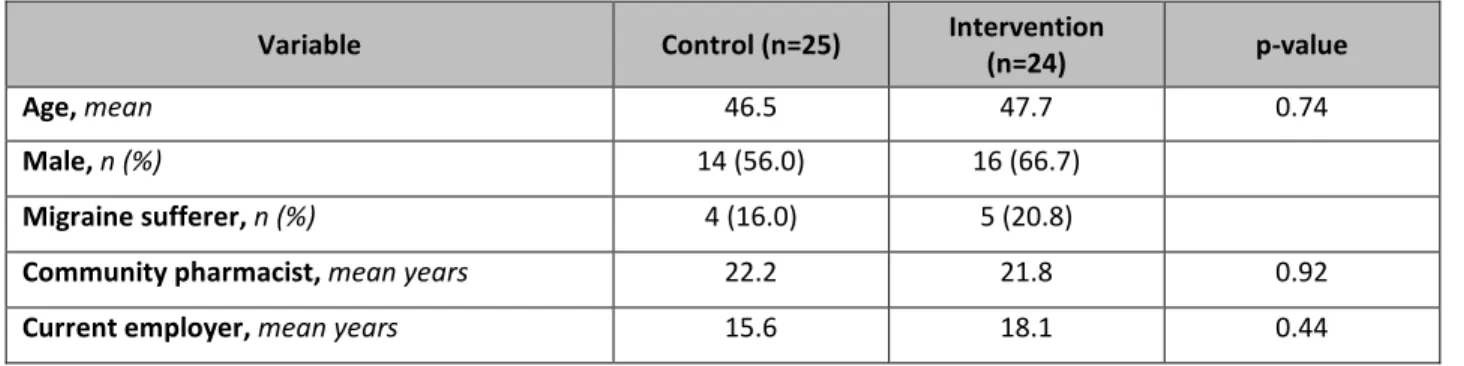
A total of 49 pharmacists were included in the study, with 24 in the intervention group and 25 in the control group. All pharmacists enrolled completed the study. Additional demographics and population characteristics are summarized in Table 1.
Self-assessed knowledge of migraine
The first objective of the study was to compare pharmacists’ self-assessed knowledge of migraine before and after an educational intervention addressing migraine identification and treatment. All 24 pharmacists assigned to the
intervention group participated in the educational program and completed the required surveys. There was a significant increase between pre- and post-intervention scores on 10 of the 12 items related to knowledge, most notably, non-pharmacologic management of acute headaches, the role of complementary and alternative therapies in the treatment of migraine, the role of prescription drugs in migraine
prophylaxis, distinguishing migraine from other types of headache, and formulary status of various migraine treatments. (Table 2) In addition, average post-intervention cumulative knowledge score (43.8) was significantly higher than that of pre-intervention (34.4), with the
post-intervention survey an average 9.4 points higher than the pre-intervention survey (p<0.0001).
Pharmacists in the intervention group showed no significant difference in pre- and post-intervention responses to items regarding knowledge of the role of prescription drugs in acute
migraine therapy and knowledge of the cost to patients of various migraine treatment modalities (p=0.08 and p=0.41, respectively).
Self-reported care behaviors and ability to maintain knowledge of migraine (PCMS)
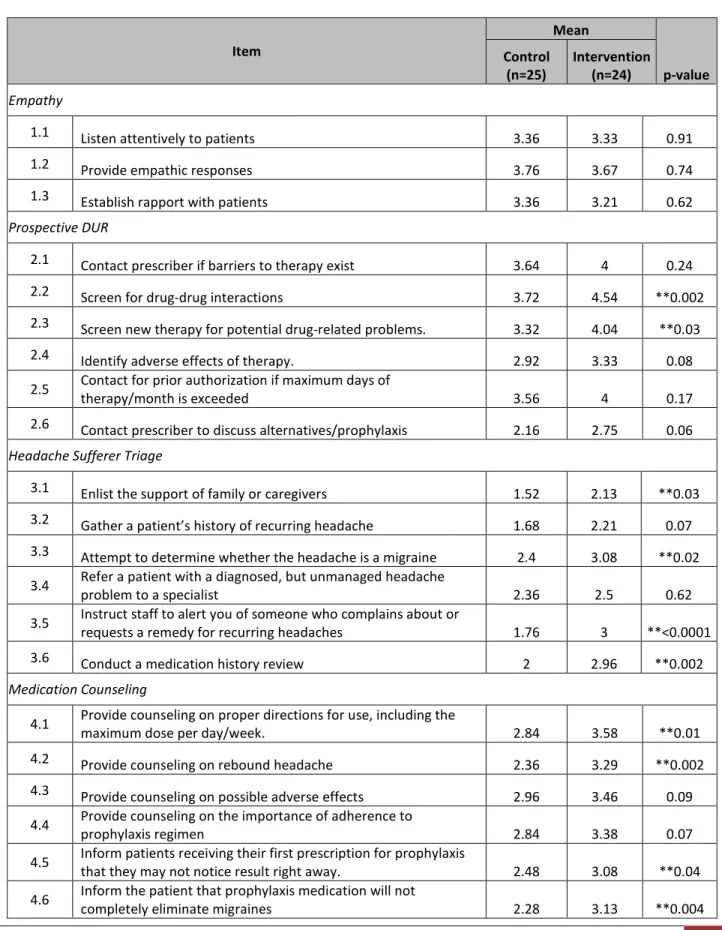
The second objective of the study was to compare self-reported care behaviors from a post-education survey of pharmacists to a group of control pharmacists. While there was no difference in average cumulative score between pre-education intervention pharmacists and control pharmacists (p=0.34), the mean post-education score of intervention pharmacists was 18.9 points higher than that of control pharmacists (p=0.004). (Table 3)
When caring for recurrent headache sufferers, survey part five, pharmacists showed no difference in empathic responses when comparing the control and intervention groups. Pharmacists in the intervention group who were trained on triaging patients with possible migraines did score higher when asked about screening for drug-drug interactions and potential drug-related problems when filling a new migraine prescription (p=0.002 and p=0.03, respectively). Pharmacists who underwent the educational program were more likely to enlist family support (p=0.03), determine if a headache was a migraine (p=0.02), educate staff to alert the pharmacist when a headache sufferer presented to the pharmacy counter (p<0.0001), and conduct a medication history for a migraineur (p=0.002). Pharmacists also reported higher scores with regard to medication counseling,
developing a nonpharmacologic treatment plan such as using a migraine diary, discussing trigger management and the role of complementary and alternative medications. (Table 3) Part six of the survey addressed ability to maintain knowledge of migraine. The comparison between the average
cumulative score of the post-educational survey taken by intervention pharmacists and the average cumulative score of control pharmacists showed that the intervention
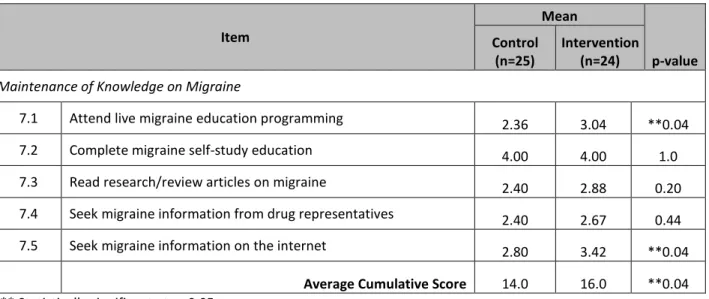
pharmacists had an average score that was 2.0 points higher than the control pharmacists (p=0.04). Pharmacists in the intervention group were more likely to attend live CE programming on migraines (p=0.04) and seek information on the internet regarding migraine headaches (p=0.04). (Table 4)
Perceived difficulty, level of confidence, and employer culture
Analysis of survey part one, perceived difficulty in providing care to recurrent headache sufferers, resulted in no difference in mean cumulative score for post-education intervention group compared to control group (p=0.16). There were no statistically significant differences in scores for
individual questions. The survey instrument is available online. See supplemental information for this study. Self-efficacy (level of confidence) in providing care to recurring headache sufferers was assessed in part two of the survey by asking participants to rate their level of confidence in performing nine functions on a scale of 1 to 7, where one equaled not at all confident and seven represented extremely confident. The pre- and post-intervention group means were compared, revealing a significant difference between scores on the intervention group’s post-education survey, with an average of 49, and the control group’s survey, with an average of 42.3 (range:9-63, p-value=0.03). Out of the nine questions asked, the two that resulted in significant
differences between groups addressed conducting DURs for newly diagnosed migraineurs (p=0.03) and triaging patients complaining of recurring headaches (p=0.003).
Results of part three, assessing employer culture, showed no significant difference in cumulative mean score or mean score for individual questions when comparing the intervention group post-education survey results to the control group survey results (cumulative p-value=0.79). (Figure 1)
Part four compared intervention and control pharmacists’ self-assessed knowledge of migraine. Pharmacists in the intervention group reported a higher knowledge of 8 out of 12 items. The group mean scores were 43.8 for the
intervention group and 35.8 for the control group on a scale of 12-60 (p<0.0001). (Table 2)
Examination of reliability and validity
The assessment of the overall test instrument resulted in a Cronbach’s alpha (α) of 0.94. Additionally, each of the six parts of the survey (perceived difficulty: α=0.88, level of confidence: α=0.94, employer culture: α=0.85, knowledge: α=0.90, care behaviors: α=0.96, and maintenance of knowledge: α=0.62) showed acceptable individual reliability. Item deletions failed to result in any substantial improvement in reliability. The study design did not include multiple administrations of the instrument for data collection to be used in an analysis of test-retest reliability and the
intervention and control group means were not available to test validity beyond face validity (110.4 versus 91.5, respectively). (Table 3)
Analysis of correlation and interaction
Correlation matrices were produced for each survey administered examining potential relationships between survey sections and the independent variables age, gender, years as a community pharmacist, years with current
employer and history of migraines. No correlations were found when analyzing control group surveys (n=25). A moderate positive correlation (p=0.04, p=0.05) between self-reported care behaviors and age was found in both the pre- and post-education surveys administered to the intervention group (n=24). Further investigation identified no associations between age and the remaining demographic variables and confirmed no significant change in comparison of outcomes of interest related to age. The individual location of each pharmacist was not considered to be a variable of interest during the design phase of the study and was not
documented during data collection; therefore no analysis of potential within store correlation was performed. No significant interactions were found between the educational intervention and the demographic variables age, gender, years as a community pharmacist, years with current employer, or history of migraine headaches.
Discussion
Community pharmacists are in a position to positively impact the care of recurrent headache sufferers by staying up-to-date on the current migraine treatment recommendations through educational programs and intervening when a patient presents to the pharmacy counter with the complaint of headache. Attending an educational program on migraine improved pharmacists’ self-assessed knowledge of migraine, between both pre- and intervention as well as post-intervention and control. The gains in knowledge of the intervention group post survey can be directly related back to the educational program in which the pharmacists
participated. The educational program raised awareness of different topics specific to recurrent headache sufferers. It focused on migraine therapies, reminding pharmacists of the nuances of each drug class, but it also developed problem solving skills such as what medication to recommend in certain patient case scenarios. The program gave pharmacists hands-on practice in making recommendations through these cases, and the pharmacists left with flowcharts developed by the presenters of what medications to recommend in certain situations of preventive and acute care of migraine patients. In addition to the in depth medication review, the program also illustrated how to triage a patient at the pharmacy counter with headache or migraine, recommending further work-up from a physician as well as how to educate patients on the management of migraine triggers. Because of the program, the theoretical gains in the areas of knowledge positively impacted specific topics of triggers, diet and exercise, non-pharmacologic management of headaches, OTC medications, complementary and alternative therapies, preventive therapies, medication interactions, specific guideline recommendations, distinguishing migraine from
other headaches and formulary status of migraine treatments.
Interestingly, however, pharmacists did not show a gain in knowledge regarding the role of acute therapies for migraine and the cost of such therapies. The researchers hypothesized pharmacists in the intervention group gained no additional knowledge about these topics compared to the control group pharmacists since acute migraine therapies are a common focus for pharmacy school curricula22 and no research is available on if colleges of pharmacy teach the costs of these more expensive therapies (e.g. triptans), which could explain this lack of significance. Cost of medications was not a focus of the educational program presented. Conversely, it can be postulated that the control pharmacists may have had a better understanding of these components of migraine therapy.
The care of a migraineur is more complicated than simply what medication to prescribe. Pharmacists who gain
knowledge gain one of the many tools necessary to positively impact care of patients who suffer from chronic diseases such as migraine. It is important to note that just improving knowledge does not always translate into improving
pharmacy practice activities. A study by Maio et al. evaluating the effectiveness of pharmacy CE programs showed that symposium-type programs were the most effective at enhancing knowledge. The results also showed that despite all programs being effective, no CE format was effective in helping pharmacists change clinical practice behaviors.23 A program that successfully changes practice behaviors should consist of a variety of CE formats, including but not limited to didactic teaching, reading and handouts, hands-on activities and practice. The program developed for this project contained all of these elements, supporting the positive results seen post-intervention on the pharmacists’ care behaviors.
In order to put into use the knowledge gained in an educational program, a pharmacist must not perceive the task to be too difficult and have confidence in their abilities to properly care for a patient. An educational program helps teach a pharmacist the knowledge needed, but confidence in applying the knowledge to a patient cannot be assumed simply by learning the material. The study population showed that the groups of pharmacists did not differ in the perceived difficulty in providing care to patients who suffer from migraines; however, the intervention pharmacists did show an increase in confidence to provide such care to patients post-intervention. Although pharmacists did not find providing this care difficult, many lacked the confidence to actually approach the care of a migraineur until this
educational program. This program demonstrated positive outcomes to help eliminate barriers for pharmacists. Armed and provided with specific knowledge about migraine management, the researchers theorized these pharmacists will put into practice what they have learned about the management and care of this patient population.
The culture of the employer group is an important facet to providing care to patients. It can be presumed that if a pharmacist feels more supported to leave the pharmacy to discuss headache treatments with a recurrent headache sufferer, he/she will be more likely to do so. The results of the organizational culture questions showed that the groups viewed the organization similarly in the aspects of
orientation, focus, and pharmacists’ work priority, thus minimizing the chance that the intervention pharmacists viewed their culture differently than the control pharmacists. After knowledge, confidence, perceived difficulty, and employer culture were assessed, the next step was to look into the actual care provided to recurrent headache sufferers. The PCMS results showed that pharmacists in the
intervention group scored cumulatively higher in the categories of actual care provided to recurrent headache sufferers, which were broken down into the factors of empathy, prospective DUR, headache sufferer triage, medication counseling, nonpharmacologic treatment plan, dissemination of public health information, and maintenance of knowledge on migraine. Pharmacists reported screening for drug-drug interactions and other drug-related problems more often in this population, possibly because these interactions were highlighted in the educational program. Patient triage was also highlighted in the educational program, including a quick 3-question screening tool called the ID-Migraine that a community pharmacist could use daily when a patient presents to the pharmacy counter with a headache.24 This was discussed as something simple and not time-consuming a community pharmacist can do to change their clinical practice behaviors and get headache sufferers thinking more about what type of headache they may be having. The program also raised awareness of the importance of having staff alert the pharmacists if someone presents to the counter with a complaint of headache, another
intervention highlighted in the educational program. Counseling practices improved for the intervention group as well, along with the nonpharmacologic recommendations for a person suffering with recurrent headache like keeping a headache diary, avoiding triggers, and the role that OTC medications play in prevention and management of migraine. The importance of the timing of the survey deployment in this project should not go overlooked. Immediately after an
educational intervention the participants were expected to demonstrate more post-presentation knowledge than prior to the program. One month after the program the
knowledge and practices learned were still being employed. The educational intervention and the post-surveys were spaced by one month to evaluate whether short-term retention of migraine knowledge and clinical practice skills were present. The results revealed retention did occur up to this one-month mark. This showed that one month after an educational intervention, pharmacists provide care to headache sufferers at a higher level than those that did not attend an educational programming on migraine headaches.
Limitations
Quasi-experimental research has limitations, including not being able to truly control for confounders.25 The researchers controlled for confounders by group randomization of pharmacies, and also by excluding pharmacists who worked at multiple locations, thus attempting to eliminate the chance of knowledge from the CE program traveling from
intervention store to control pharmacists.
Although the research had enough power to detect a significant difference between groups, the sample size was still small. Because of the groups’ sizes, this study can serve as the pilot for a larger scale study to further define the impact of such an intervention for community pharmacists. The results of this study may only be applicable to the population in which the intervention was conducted, which was a regional community pharmacy chain in northeastern Oklahoma. In addition, the convenience sampling may not be truly representative of the general population of pharmacists even in this area. Two elements of the study design may have allowed for the introduction of selection bias into the study. First, by basing group assignment on pharmacist preference rather than random placement, it is possible that the intervention group was composed of pharmacists who were more motivated than pharmacists in the control group. Second, the incentives offered for participation, although viewed as a potential means of partially correcting non-response bias, may have influenced individual inclination toward participation or non-participation. Also, the researchers relied on pharmacists to self-report behaviors, which have the potential to be inflated in the intervention group, introducing self-reporting bias into the results. Contamination bias is a potential concern when conducting an educational intervention study comparing intervention and control groups. This study involved an inherent opportunity for pharmacists in the intervention group to share knowledge acquired at the educational course on migraines with pharmacists in the control group, potentially
decreasing the difference between the groups and resulting in a loss of study validity. In order to control for this, it was necessary to minimize contact between pharmacists in the two groups in the work environment. This was accomplished by assigning all pharmacists from a single location to only one of the two groups and excluding from participation any pharmacist reasonably expected to work at more than one of the pharmacies during the course of the study, although complete protection from contamination bias was not guaranteed with this method.
The educational intervention was offered twice, but the sections occurred on a Saturday and Sunday of the same weekend. This could have posed an attendance issue since it is a common practice for community pharmacists scheduled to work on a given weekend to work both days. For those who were unable to attend a recording of the educational program was made available online, and it is possible that the study results were skewed due to differences in individual learning styles and availability for attendance at live educational sessions. Also, those that participated in the online viewing of the program may have been able to confer with colleagues that already attended the program live or completed it online to ask for help with assessment questions.
Future Directions
Recreating this study can help substantiate the impact seen, not only increasing enrollment but also studying more diverse populations of pharmacists of multiple states, employers, and disciplines (e.g. community pharmacy, ambulatory care, health-systems pharmacists). Future studies should also determine long-term effects of the educational intervention on the actual care provided by pharmacists for recurrent headache sufferers, evaluating continuing positive effect of the intervention after a year or longer. Moreover, future research should focus on data gathered from migraineurs about their perceptions of the care received from
pharmacists trained in headache and migraine management. Valuable insights might also be achieved by evaluating outcomes based on intervention delivery method used.
Conclusion
Attending an educational program on migraine improved pharmacists’ knowledge, confidence, and clinical practice behaviors when providing care to migraineurs and recurrent headache sufferers. This study demonstrated that focused educational initiatives increased patient counseling activities in the cohort of pharmacists participating in the initiative and caring behaviors toward the migraineur population.
References
1. Lipton RB, Stewart WF, Diamond S, Diamond ML, Reed M. Prevalence and burden of migraine in the United States: data from the American Migraine Study II. Headache 2001;41:646-57.
2. Smitherman TA, Burch R, Sheikh H, Loder E. The prevalence, impact, and treatment of migraine and severe headaches in the United States: a review of statistics from national surveillance studies.
Headache 2013;53:427-36.
3. Brandes JL. Global trends in migraine care. CNS Drugs 2002;16:13-8.
4. Lipton RB, Stewart WF, Simon D. Medical
consultation for migraine: results from the American Migraine Study. Headache 1998;38:87-96.
5. Lipton RB, Diamond S, Reed M, Diamond ML, Stewart WF. Migraine diagnosis and treatment: results from the American Migraine Study II.
Headache 2001;41:638-45.
6. Schreiber CP, Hutchinson S, Webster CJ, Ames M, Richardson MS, Powers C. Prevalence of migraine in patients with a history of self-reported or physician-diagnosed sinus headache. Arch Intern Med
2004;164:1769-72.
7. Diamond ML. The role of concomitant headache types and non-headache co-morbidities in the underdiagnosis of migraine. Neurology 2002;58:S3-S9.
8. Lipton RB, Buse DC, Serrano D, Holland S, Reed ML. Examination of unmet treatment needs among persons with episodic migraine: results of the American Migraine Prevalence and Prevention (AMPP) Study. Headache 2013;53:1300-11. 9. Cranor CW, Christensen DB. The Asheville Project:
short-term outcomes of a community pharmacy diabetes care program. J Am Pharm Assoc
2003;43:149-59.
10. Zillich AJ, Sutherland JM, Kumbera PA, Carter BL. Hypertension outcomes through blood pressure monitoring and evaluation by pharmacists (HOME study). J Gen Intern Med 2005;20:1091-6.
11. Saini B, Krass I, Armour C. Development, implementation, and evaluation of a community pharmacy–based asthma care model. Ann Pharmacother 2004;38:1954-60.
12. OTC products: 2004 survey of pharmacist recommendations. Pharmacy Times 2004:1-44.
13. Mehuys E, Paemeleire K, Van Hees T, et al. Self-medication of regular headache: a community pharmacy-based survey. Eur J Neurol 2012;19:1093-9.
14. Hoffmann W, Herzog B, Mühlig S, et al.
Pharmaceutical care for migraine and headache patients: a community-based, randomized intervention. Ann Pharmacother 2008;42:1804-13. 15. Wenzel RG, Lipton RB, Diamond ML, Cady R.
Migraine therapy: a survey of pharmacists' knowledge, attitudes, and practice patterns.
Headache 2005;45:47-52.
16. Skomo ML, Desselle SP, Shah N. Development and construct validation of the pharmacists' care of migraineurs scale. Headache 2009;49:54-63. 17. Desselle SP, Skomo ML. Factors related to
pharmacists' care of migraineurs. Res Social Adm Pharm 2010;6:232-45.
18. Likert R. A technique for the measurement of attitudes. Arch Psychology 1932;140:1-55. 19. Herbert KE, Urmie JM, Newland BA, Farris KB.
Prediction of pharmacist intention to provide Medicare medication therapy management services using the theory of planned behavior. Res Social Adm Pharm 2006;2:299-314.
20. Clark B, Mount J. Pharmacy service orientation: a measure of organizational culture in pharmacy practice sites. Res Social Adm Pharm 2006;2:110-28. 21. Nunnally JC, Bernstein IH, Berge JMt. Psychometric
theory. New York, NY: McGraw-Hill 1967. 22. Wenzel RG, Padiyara RS, Schommer JC. Didactic
Migraine Education in US Doctor of Pharmacy Programs. Am J Pharm Educ 2010;74.
23. Maio V, Belazi D, Goldfarb NI, Phillips AL, Crawford AG. Use and effectiveness of pharmacy continuing-education materials. Am J Health Syst Pharm
2003;60:1644-9.
24. Lipton R, Dodick D, Sadovsky R, et al. A self-administered screener for migraine in primary care The ID Migraine™ validation study. Neurology
2003;61:375-82.
25. Campbell DT, Stanley JC, Gage NL. Experimental and quasi-experimental designs for research. Boston, MA: Houghton Mifflin; 1963.
Table 1: Demographics
Variable Control (n=25) Intervention (n=24) p-value
Age, mean 46.5 47.7 0.74
Male, n (%) 14 (56.0) 16 (66.7)
Migraine sufferer, n (%) 4 (16.0) 5 (20.8)
Community pharmacist, mean years 22.2 21.8 0.92
Current employer, mean years 15.6 18.1 0.44
Table 2: Pharmacists’ self-assessed knowledge of migraine: t-test results for differences in mean score for each question Question
Intervention
(n=24) p-value Control
(n=25) p-value
Pre Post
Potential triggers for migraine headaches/prevention of
attacks 3.1 3.8 **0.0001 3.28 **0.007
Role of diet/exercise/lifestyle in migraine prevention 2.7 3.6 **<0.0001 3.28 0.06 Non-pharmacologic management of acute headaches 2.8 3.6 **0.0009 2.72 **0.005
Role of OTCs 3.3 3.8 **0.004 3.44 0.06
Role of complementary & alternative therapies 2.2 3.5 **<0.0001 2.60 **0.0005 Role of prescription drugs in acute migraine therapy 3.7 4.0 0.08 3.68 0.07 Role of prescription drugs in migraine prophylaxis 3.4 3.9 **0.02 3.36 **0.004 Contraindications/potential interactions with drugs used
in migraine therapy 3.1 3.8 **0.0003 3.08 **0.002 US Headache Consortium treatment guidelines for
migraine 1.8 3.5 **<0.0001 1.76 **<0.0001 Distinguishing between migraine and other headaches 3.0 3.8 **<0.0001 2.92 **0.0006 Formulary status of various migraine treatments 2.3 3.1 **0.004 2.44 **0.04 Patient cost of various migraine treatments 3.1 3.3 0.41 3.32 0.10
Total 34.4 43.8 **<0.0001 35.8 **<0.0001
**statistically significant at α=0.05
Table 3: PCMS Part 5: Actual Care Provided to Recurring Headache Sufferers - t-test results for differences in mean score for each question
Item Mean p-value Control (n=25) Intervention (n=24) Empathy
1.1 Listen attentively to patients 3.36 3.33 0.91 1.2 Provide empathic responses 3.76 3.67 0.74 1.3 Establish rapport with patients 3.36 3.21 0.62
Prospective DUR
2.1 Contact prescriber if barriers to therapy exist 3.64 4 0.24 2.2 Screen for drug-drug interactions 3.72 4.54 **0.002 2.3 Screen new therapy for potential drug-related problems. 3.32 4.04 **0.03 2.4 Identify adverse effects of therapy. 2.92 3.33 0.08 2.5 Contact for prior authorization if maximum days of therapy/month is exceeded 3.56 4 0.17 2.6 Contact prescriber to discuss alternatives/prophylaxis 2.16 2.75 0.06
Headache Sufferer Triage
3.1 Enlist the support of family or caregivers 1.52 2.13 **0.03 3.2 Gather a patient’s history of recurring headache 1.68 2.21 0.07 3.3 Attempt to determine whether the headache is a migraine 2.4 3.08 **0.02 3.4 Refer a patient with a diagnosed, but unmanaged headache problem to a specialist 2.36 2.5 0.62 3.5 Instruct staff to alert you of someone who complains about or requests a remedy for recurring headaches 1.76 3 **<0.0001 3.6 Conduct a medication history review 2 2.96 **0.002
Medication Counseling
4.1 Provide counseling on proper directions for use, including the maximum dose per day/week. 2.84 3.58 **0.01 4.2 Provide counseling on rebound headache 2.36 3.29 **0.002 4.3 Provide counseling on possible adverse effects 2.96 3.46 0.09 4.4 Provide counseling on the importance of adherence to prophylaxis regimen 2.84 3.38 0.07 4.5 Inform patients receiving their first prescription for prophylaxis that they may not notice result right away. 2.48 3.08 **0.04 4.6 Inform the patient that prophylaxis medication will not completely eliminate migraines 2.28 3.13 **0.004
4.7 Discuss effectiveness of therapies 2.72 3.04 0.24 4.8 Look for signs of prophylaxis non-adherence 2.28 3 **0.004
Nonpharmacologic Treatment Plan
5.1 Recommend a headache diary 1.88 2.42 **0.04 5.2 Discuss identification/avoidance of triggers 2.56 3.13 **0.03 5.3 Discuss role of OTC medications 2.72 3.33 **0.04 5.4 Discuss role of complementary/alternative medicines 1.88 2.63 **0.01 5.5 Discuss non-pharmacologic adjunctive therapies for migraine attacks 2.44 2.96 0.05 5.6 Determine effectiveness of nonpharmacologic therapies in ameliorating migraine attacks. 2.64 3.04 0.1 5.7 Look for signs of ineffective migraine therapy 2.32 3.08 **0.004 5.8 Discuss alternatives of ineffective therapy with patients 2.84 3.42 **0.03 5.9 Refer patients to credible internet information 2.52 2.79 0.38
Dissemination of Public Health Information
6.1 Provide written information when dispensing a migraine prescription 2.08 2.92 **0.03 6.2 Make brochures/pamphlets available 1.68 2 0.28 6.3 Refer patients to educational materials 2.2 2.38 0.58 6.4 Participate in screenings/migraine awareness programs 1.44 1.63 0.4
Average Cumulative Score 91.5 110.4 **0.004
** Statistically significant at α=0.05
Table 4: PCMS Part 6: Ability to Maintain Knowledge of Migraine - t-test results for differences in mean score for each question
Item
Mean
p-value Control
(n=25) Intervention (n=24) Maintenance of Knowledge on Migraine
7.1 Attend live migraine education programming 2.36 3.04 **0.04 7.2 Complete migraine self-study education 4.00 4.00 1.0 7.3 Read research/review articles on migraine 2.40 2.88 0.20 7.4 Seek migraine information from drug representatives 2.40 2.67 0.44 7.5 Seek migraine information on the internet 2.80 3.42 **0.04
Average Cumulative Score 14.0 16.0 **0.04
** Statistically significant at α=0.05
Figure 1: Comparison of average scores for questions assessing employer culture 4.76 5.38 5.36 4.71 4.84 4.25 0 2 4 6 8 10 12 14 16
Orientation Focus Pharmacists' work
Sc
or
e
Control Intervention
Describe your pharmacy in terms of its:
Orientation Focus Pharmacists' work
product
patient quality
quantity
professional
technical
Pharmacists' Care of Recurring
Headache Sufferers
Page 2
Extremely Extremely Easy Difficult
1. At my pharmacy demonstrating empathy to recurrent headache sufferers is… 1 2 3 4 5 6 7
2. At my pharmacy conducting prospective DUR for newly diagnosed migraineurs is... 1 2 3 4 5 6 7
3. At my pharmacy I find medication counseling for newly diagnosed migraineurs... 1 2 3 4 5 6 7
4. Discussing non-pharmacologic treatment strate-gies with migraine sufferers for me is... 1 2 3 4 5 6 7
5. At my pharmacy monitoring drug therapy for migraine sufferers is... 1 2 3 4 5 6 7
6. At my pharmacy advocating for the needs of migraine sufferers is... 1 2 3 4 5 6 7
7. At my pharmacy conducting effective triage for patients complaining of headache is... 1 2 3 4 5 6 7
8. At my pharmacy referring migraine sufferers to referent health information is... 1 2 3 4 5 6 7
9. At my pharmacy maintaining current knowledge on migraine and migraine therapy is... 1 2 3 4 5 6 7
Part I. Perceived Difficulty in Providing Care to Recurring Headache Sufferers. We would like to know the level of difficulty you face in providing care to recurring headache sufferers at the pharmacy you primarily work, given that pharmacy’s resources, or lack thereof. Please record your answer on a scale from 1 = Extremely Easy to 7 = Extremely Difficult. Part 2. Level of Confidence in Providing Care to Recurring Headache Sufferers. We would like to know the level of confidence you have in performing each of the following functions for migraine patients, regardless of which pharmacy you work in. Please indicate your answer on a scale ranging from1 = Not at all Confident to 7 = Extremely Confident. Not at all Extremely Confident Confident 10. Demonstrate empathy to potential and actual migraine sufferers. 1 2 3 4 5 6 7
11. Conduct prospective DUR for newly diagnosed migraineurs. 1 2 3 4 5 6 7
12. Provide medication counseling for newly diag-nosed migraineurs. 1 2 3 4 5 6 7
13. Discuss non-pharmacologic treatment strategies with migraine sufferers. 1 2 3 4 5 6 7
14. Monitor drug therapy for migraine sufferers. 1 2 3 4 5 6 7
15. Advocate for the needs of migraine sufferers. 1 2 3 4 5 6 7
16. Effectively triage patients who complain of recur-ring headaches. 1 2 3 4 5 6 7
17. Refer migraine patients to pertinent disease management information. 1 2 3 4 5 6 7
Page 3
Part 4. Self-assessed Knowledge of Migraine. Please self-evaluate your knowledge of the following aspects
of migraine headache and its treatment using the scale below. We ask that you be truthful and accurate as pos-sible in your assessment.
1 = Not a all knowledgeable 2 = A little knowledgeable 3 = Fairly knowledgeable 4 = Very knowledgeable 5 = Completely knowledgeable
Not at all A little Fairly Very Completely knowledge- knowledge- knowledge- knowledge- knowledge- able able able able able
22. Potential triggers for migraine headaches/prevention of attacks. 1 2 3 4 5
23. Role of diet, exercise, lifestyle in prevention of migraine. 1 2 3 4 5
24. Non-pharmacologic management of acute head-aches. 1 2 3 4 5
25. The role of OTCs in migraine therapy. 1 2 3 4 5
26. The role of complementary & alternative thera-pies in the treatment of migraine. 1 2 3 4 5
27. The role of prescription drugs in acute migraine therapy. 1 2 3 4 5
28. The role of prescription drugs in migraine prophy-laxis. 1 2 3 4 5
29. Contraindications and potential interactions with drugs routinely used in migraine therapy. 1 2 3 4 5
30. US Headache Consortium treatment guide-lines for migraine headache. 1 2 3 4 5
31. Distinguishing between migraine and other types of headache. 1 2 3 4 5
32. Formulary status of various migraine treatment modalities. 1 2 3 4 5
33. Patient cost of various migraine treatment mo-dalities. 1 2 3 4 5
Part 3. Employer Culture. We would like to know how you might describe the culture of the pharmacy
organi-zation for whom you work, with regard to its orientation, focus, and the nature of pharmacists’ work. For each of these 3 areas, please place a checkmark [] in the appropriate space.
How would you describe your pharmacy in terms of its: (Place a check [] on each of the 3 lines) 19. Orientation: | | | | | | | | | | | | | | Patient Product 20. Focus: | | | | | | | | | | | | | | Quality Quantity 21. Pharmacists’ Work: | | | | | | | | | | | | | | Professional Technical
Page 4
34. Listen attentively to patients describe frustrations
regarding their headache. 1 2 3 4 5 35. Provide empathic responses to persons
com-plaining of migraine or other recurring headaches. 1 2 3 4 5 36. Establish rapport with patients suffering from
re-curring headaches. 1 2 3 4 5 37. Conduct a medication history review for a newly
diagnosed migraine sufferer. 1 2 3 4 5 38. Screen for drug-drug interactions before
dispens-ing a drug used in migraine therapy. 1 2 3 4 5 39. Screen new migraine therapy prescriptions for
potential drug-related problems. 1 2 3 4 5 40.
When dispensing a migraine patient’s first triptan, I provide counseling on the proper directions for use of the medication, including the maximum dose per day and maximum dose per week.
1 2 3 4 5 41. When dispensing a migraine patient’s first triptan,
I provide counseling on headache rebound. 1 2 3 4 5 42.
When dispensing a migraine patient’s first triptan, I provide counseling on the possible adverse
ef-fects of the medication. 1 2 3 4 5 43.
When a patient initially receives a prescription for migraine prophylaxis, I provide counseling on the importance of adherence to the regimen (taking the medication every day).
1 2 3 4 5
44. I inform patients receiving their first prescription for migraine prophylaxis that they may not notice result right away.
1 2 3 4 5
45.
When a patient initially receives a prescription for migraine prophylactic therapy, I inform the patient that the medication will not completely eliminate his/her migraines.
1 2 3 4 5
46. Provide written information on migraine (disease management, non-pharmacological) when dis-pensing a prescription for migraine.
1 2 3 4 5 47.
I recommend to migraine sufferers that they use a headache diary to identify migraine patterns (frequency, severity, duration) and triggers.
1 2 3 4 5 48. I discuss identification and avoidance of common
migraine triggers with migraine patients. 1 2 3 4 5 49. I discuss the role of over-the-counter medications
in the management of migraine. 1 2 3 4 5 50. I discuss the role of complementary & alternative
medicines in the management of migraine 1 2 3 4 5
Never Nearly All the To Rarely Sometimes Fairly time to Very Rarely Often All the time
Part 5. Actual Care Provided to Recurring Headache Sufferers. Please indicate the relative frequency in
which you currently engage in the following behaviors at your primary pharmacy of employment. Please provide the most truthful and accurate answer, in consideration of the constraints you face in practice and NOT HOW YOU MIGHT IDEALLY LIKE TO PRACTICE. Please indicate your answer to each item below (#s 34-69) using the following scale:
1 = Never to Very Rarely 2 = Rarely
3 = Sometimes 4 = Fairly Often
Page 5 51. I discuss non-pharmacologic adjunctive thera-pies for migraine attacks (heat, cold, relaxation
techniques, rest, etc.) with migraine patients.
1 2 3 4 5 52. Discuss effectiveness of prescribed therapies
for migraine. 1 2 3 4 5 53. Identify any adverse effects or other drug-related problems associated with patients’
mi-graine therapy. 1 2 3 4 5 54.
Determine effectiveness of OTC, alternative & complementary medicine, and other adjunctive
therapy in ameliorating migraine attacks. 1 2 3 4 5 55.
I look for signs that migraine therapy is not as effective as it could be (e.g., frequent use of OTC or prescription analgesics and triptans).
1 2 3 4 5 56.
I look for signs of non-adherence to migraine prophylaxis (e.g., late refills, increased
mi-graine frequency and severity). 1 2 3 4 5 57.
Contact physician and/or health plan for prior au-thorization if the migraineur needs more than the maximum number of medication as covered by the health plan.
1 2 3 4 5 58. Discuss alternatives with patients whose migraine therapy is ineffective. 1 2 3 4 5
59.
I contact the prescriber to discuss alternatives or prophylaxis when acute migraine therapy is insuffi-cient or ineffective (e.g., triptan is not working, patient uses triptan frequently, migraines particu-larly severe and long in duration).
1 2 3 4 5
60. Contact prescriber if patients’ prescribed therapy is not covered by insurance or whose cost may
con-tribute to noncompliance. 1 2 3 4 5 61. Enlist the support of family or caregivers for patients suffering from migraine or recurring
headaches.
1 2 3 4 5
62.
Gather a history of a consulting patient’s recur-ring headache problem who has not yet seen a physician for the headache and make a referral, if necessary.
1 2 3 4 5
63.
Attempt to determine the nature of a consulting patient’s headache to determine whether it is
migraine, or some other type of headache. 1 2 3 4 5 64.
Refer a patient with a diagnosed, but unmanaged headache problem to a specialist (e.g.,
neurolo-gist). 1 2 3 4 5
Part 5. Actual Care Provided to Recurring Headache Sufferers—CONTINUED. Please indicate the relative
frequency in which you currently engage in the following behaviors at your primary pharmacy of employment. Please provide the most truthful and accurate answer, in consideration of the constraints you face in practice and NOT HOW YOU MIGHT IDEALLY LIKE TO PRACTICE. Please indicate your answer to each item below (#s 34-69) using the following scale:
1 = Never to Very Rarely 2 = Rarely
3 = Sometimes 4 = Fairly Often
5 = Nearly all the time to All the time
Never Nearly All the To Rarely Sometimes Fairly time to Very Rarely Often All the time
Page 6
65. Instruct staff to alert you of someone who com-plains about or requests a remedy for recurring
headaches. 1 2 3 4 5
66. Make brochures/pamphlets or other educational material about migraine available in kiosks or
other areas free for public consumption. 1 2 3 4 5 67. Refer patients to educational materials available
at the pharmacy. 1 2 3 4 5 68. Refer patients to credible information about mi-graine on the internet. 1 2 3 4 5 69. Participate in screenings or migraine awareness programs. 1 2 3 4 5
Part 5. Actual Care Provided to Recurring Headache Sufferers—CONTINUED. Please indicate the relative
frequency in which you currently engage in the following behaviors at your primary pharmacy of employment. Please provide the most truthful and accurate answer, in consideration of the constraints you face in practice and NOT HOW YOU MIGHT IDEALLY LIKE TO PRACTICE. Please indicate your answer to each item below (#s 34-69) using the following scale:
1 = Never to Very Rarely 2 = Rarely
3 = Sometimes 4 = Fairly Often
5 = Nearly all the time to All the time
Never Nearly All the To Rarely Sometimes Fairly time to Very Rarely Often All the time
70. Attend live continuing education programming on migraine headache. 1 2 3 4 5 71. Complete self-study continuing education on
mi-graine headache. 1 2 3 4 5 72. Read original research or review articles on
mi-graine headache in peer-review journals. 1 2 3 4 5 73. Seek information from drug sales representatives or medical/clinical liaisons on migraine headache. 1 2 3 4 5 74. Seek information on the internet regarding migraine headache. 1 2 3 4 5
Not at A little
all bit Somewhat A lot Completely like me like me like me like me like me
Part 6. Ability to Maintain Knowledge of Migraine. We would like to know the extent of which you are able to
remain abreast of current developments and issues in the treatment of migraine. Use the following scale to de-scribe your propensity to seek information on migraine.
1 = Not at all like me 2 = A little bit like me 3 = Somewhat like me 4 = A lot like me 5 = Completely like me
Page 7
75. Your gender: (place an “x” or “”)
Male
Female
76. Your age:
_____ years
77. How many years have you been practicing as a community pharmacist?
_____ years
78. How many years have you been with your current employer?
_____ years
79. Do you suffer from migraine headaches yourself? (place an “x” or “”) Yes
No
Part 7. Personal and workplace information. Finally, if you could just tell us: