Newton’s Method Based Optimal Power Flow
Using an Advanced STATCOM
K. G.Manikanta, K Swathi, N.Narasimhulu, Dr.R.Ramachandra
PG Scholar, Dept of EEE (EPS), SKD, Gooty, Andhra Pradesh, India
Assistant Professor, Dept of EEE, SKD, Gooty, Andhra Pradesh, India
Associate Professor & HOD, Dept of EEE, SKD, Gooty, Andhra Pradesh, India
Principal, SKD, Gooty, Andhra Pradesh, India
ABSTRACT: An efficient way of incorporating Static Synchronous Compensator (STATCOM) power flow model into an
existing Newton-Based Optimal Power Flow (OPF) algorithm is presented in this paper. This model introduces the magnitude and angle of the source converter’s voltage as a state variable into the OPF problem formulation. Unlike previous works, where the value for the reactive support required by the STATCOM is specified at the beginning of the solution process, this work considers this value to be an optimal one by representing the source converter of the STATCOM as a generator bus. An existing computer program was modified to accommodate this upgrade. The modified program was applied to a 5-bus test system and the results obtained were compared with the results for an SVC-upgraded OPF algorithm available in open literature The results obtained are presented and discussed.
KEYWORDS: FACTS, Newton’s method, optimal power flows, STATCOM, voltage source converter.
I. INTRODUCTION
In electric power systems, high voltage transmission lines are always categorised as either medium or long. These categories of lines usually have significant shunt capacitances. If the receiving bus of such a line is lightly loaded, it may experience high voltage magnitude. On the other hand, if the receiving bus of a high voltage transmission line is heavily loaded, it may result to a low voltage magnitude on such bus. Both low and high voltage magnitude can trigger protective devices which can interrupt electric supply to the consumers. Regulating voltage magnitude in the network requires the regulation of reactive power flow. Examples of devices that are used for such purpose are shunt reactors, shunt capacitors, SVC’s and STATCOM’s. Shunt reactors are designed to regulate high voltage magnitude while shunt capacitors are designed for low voltage magnitude. Unlike these two devices, the SVC’s and STATCOM’s can conveniently and flexibly perform the functions of these two devices depending on the operating condition of the network. In principle, the STATCOM does the same voltage regulation as the SVC but in a more robust manner. Previous works had explained the incorporation of SVC models into a Newton-Raphson load flow and OPF algorithm. The incorporation of STATCOM into an existing Newton-based power flow algorithm
had also been addressed in the past.
The power flow model developed was used in
the same way as the equation for a generator
bus. It is worthy of notice that the value for reactive power required by the STATCOM is usually specified at the beginning of the solution procedure. Using this same approach for OPF may not yield an optimal solution An existing OPF program [6] was modified to accommodate the STATCOM models. Optimal solutions of the new STATCOM model yield considerable reductions in power system losses and in the converter’s internal power losses, when compared to the solutions furnished by the STATCOM model solved using conventional
power flows. Furthermore, optimal solutions with the new STATCOM model will also yield improved solutions compared to the optimal solutions provided by the voltage source representation of the STATCOM, and with less computational complexity.
II. LITERATURE REVIEW AND RELATED WORKS
1) E. Acha and B. Kazemtabrizi, The paper presents a new model of the STATCOM aimed at power flow solutions using the Newton-Raphson method. The STATCOM is made up of the series connection of a voltage-source converter (VSC) and its connecting transformer. The VSC is represented in this paper by a complex tap-changing transformer whose primary and secondary windings correspond, notionally speaking, to the VSC's ac and dc buses, respectively. The magnitude and phase angle of the complex tap changer are said to be the amplitude modulation index and the phase shift that would exist in a PWM inverter to enable either reactive power generation or absorption purely by electronic processing of the voltage and current waveforms within the VSC. The new STATCOM model allows for a comprehensive representation of its ac and dc circuits-this is in contrast to current practice where the STATCOM is represented by an equivalent variable voltage source, which is not amenable to a proper representation of the STATCOM's dc circuit. One key characteristic of the new VSC model is that no special provisions within a conventional ac power flow solution algorithm is required to represent the dc circuit, since the complex tap-changing transformer of the VSC gives rise to the customary ac circuit and a notional dc circuit. The latter includes the dc capacitor, which in steady-state draws no current, and a current-dependent conductance to represent switching losses. The ensuing STATCOM model possesses unparalleled control capabilities in the operational parameters of both the ac and dc sides of the converter. The prowess of the new STATCOM power flow model is demonstrated by numerical examples where the quadratic convergence characteristics of the Newton-Raphson method are preserved.
2) X. Zhang and E. J. Handshcin,
In this paper, general mathematical models for power converter-based FACTS controllers such as STATCOM, SSSC and UPFC suitable for optimal power flow study are established. There are several solution methods for OPF available, which include interior point methods. In this paper, the optimal power flow problem with these converter based FACTS controllers is solved by the newly developed nonlinear interior point methods, since they have been the most successful OPF methods.
function aggregates all the equality and inequality constraints. The first-order necessary conditions for optimality are reached by Newton's method, and by updating the dual variables and the penalty terms associated with the inequality constraints. The proposed approach does not have to identify the set of binding constraints and can be utilised for an infeasible starting point. The sparsity of the Hessian matrix of the augmented Lagrangian is completely exploited in the computational implementation. Tests results are presented to show the good performance of this approach.
III. EXISTING SYSTEM
In radial interconnected distributed system, voltage is not distributed equally to all the parts of entire system. Due to load changes on every time to time, normally loads are inductive or capacitive loads. Since reactive power are injected in to the system so the system needs compensation for to reduce reactive power. In olden days capacitor banks are utilized at the received end in distribution system. Now a day's static compensators are used i.e., D-STATCOM, UPQC etc. But in inter connection system very difficult to place a compensator at a particular place because of system loads. Real-time applications such as optimization of network, switching, estimation of the state, and so on, requires an efficient and standard power flow technique. Due to special features of distribution systems such as Radial structure, high ratio of R/X and wide-ranging reactance and resistance values. To optimize the inter connected system some techniques are used to find the minimum nodal voltage point.
IV. PROPOSED TECHNIQUE
The three-node system with the STATCOM modeled as a controllable voltage source is shown in Fig. 1. The OPF solution converges in 3 global iterations. These results are compared to those produced by the new STATCOM model. The STATCOM controllable voltage source model generates 0.6110 p.u. of reactive power to maintain the voltage at node 2 at 1.02 p.u. The converter voltage stands at 1.0510 p.u. The converter voltages behind the converter impedance for both models are compared. The powers calculated by both models are presented. he switching losses in this test case are modeled by connecting a shunt conductance of 1% between the coupling impedance and the variable voltage source. In fact, this shunt resistive branch should be connected at the DC bus of the VSC as opposed to its AC side but is precluded because the voltage source converter model does not have such a bus and the results concerning switching losses willbe inaccurate and optimistic.
Fig.1.Fictitious three-node radial system STATCOM controllable voltage source model representation.
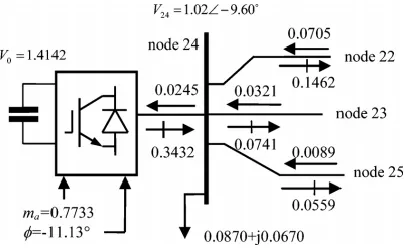
Fig. 2. STATCOM supplying reactive power at node 24 of the modified IEEE 30-node system to regulate voltage magnitude at 1.02 p.u.
In order to test the performance of the new STATCOM model in a larger network, the IEEE 30-node system is selected. The fixed bank of capacitors at node 24 is replaced with a STATCOM, which is used to regulate voltage magnitude at that node at 1.02 p.u. The modified portion of the 30-node system is shown in Fig. 4. The nodal voltage magnitudes are allowed to vary between 0.9 and 1.1 p.u. at all 24 load buses and between 0.9 and 1.05 p.u. at all six generator buses. Node 1 is taken to be the slack bus. The Newton’s OPF arrives to the solution in eight global iterations. The slow convergence rate is the result of enforcing inequality constraints in voltage magnitudes for violated
nodes. The STATCOM consumes 0.0245 p.u. of
V. SIMULATION RESULTS
Fig.5.2 simulation output of statcom out
VI. CONCLUSION
A new STATCOM model using Newton’s method is presented in this paper for optimal power flow solutions. The new model separate from the idealized controllable voltage source concept that has been used so far for representing the fundamental frequency operation of the STATCOM in OPF formulations. It treats the DC-to-AC converter of the STATCOM as a transformer device with a variable complex
tap like step up and step down Transformers. The PWM control of the VSC is modeled explicitly by means of the complex tap of the ideal transformer whose magnitude represents the PWM amplitude modulation coefficient and its phase angle corresponds to the phase shift that would exist between the fundamental frequency voltage and current wave forms. Moreover, the phase angle of the complex tap in the new VSC model coincides with the phase angle of the conventional, equivalent voltage source model of the VSC. The STATCOM-OPF model is tested in a radial system configuration to showcase the regulating properties of the new model. A larger system comprising several generators has been selected to show that the new STATCOM model performs equally well
within Newton’s OPF solution.
REFERENCES
[1] E. Acha and B. Kazemtabrizi, “A new STATCOM model for power flows using the Newton-Raphson method,” IEEE Trans. Power Syst., vol. 28, no. 3, pp. 2455–2465, Aug. 2013.
[2] E. Acha, C. R. Fuerte-Esquivel, H. Ambriz-Perez, and C. Angeles-Camacho, FACTS Modeling and Simulation in Power Networks. New York, NY, USA: Wiley, 2005.
[3] G. N. Hingorani and L. Gyugyi, Understanding FACTS: Concepts and Technologies of Flexible AC Transmission Systems. Piscataway, NJ, USA: IEEE, 2000.
[4] E. Acha, V. Agelidis, O. Anya-Lara, and T. J. M. Miller, Power Electronic Control in Electrical Systems. New York, NY, USA: Newnes, 2002. [5] Y. Zhang, G. P. Adam, T. C. Lim, S. J. Finney, and B. W. Williams, “Voltage source converter in high voltage applications: multilevel versus two-level converters,” in Proc. 9th Int. Conf. AC and DC Power Transmission (Conf. Publ.), Oct. 19–21, 2010, pp. 1–5.
[6] N. Mohan, T. M. Undeland, and W. P. Robins, Power Electronics: Converters, Applications and Design. New York, NY, USA: Wiley, 2003.
[7] L. Gyugi, “Dynamic compensation of AC transmission lines by solid state synchronous voltage sources,” IEEE Trans. Power Del., vol. 9, no. 2, pp. 904–911, Apr. 1994.
[9] X. Zhang and E. J. Handshcin, “Optimal power flow control by converter based FACTS controllers,” in Proc. 7th Int. Conf. AC-DC Power Transmission (Conf. Publ.), Nov. 28–30, 2001, pp. 250–255.
[10] C. Angeles-Camacho, O. L. Tortelli, E. Acha, and C. R. Fuerte-Esquivel, “Inclusion of a high voltage dc-voltage source converter model in aNewton-Raphson power flow algorithm,” IEE Proc. Gen., Transm., Distrib., vol. 150, pp. 691–696, Nov. 2003.
BIOGRAPHY
K G Manikanta has received the B. Tech (Electrical and Electronics Engineering) degree from KSRM College of Engineering, and pursuing M.Tech (Electrical Power Systems) in Srikrishna Devaraya Engineering College, Gooty of Anantapuramu district (AP).
N. Narasimhulu has completed his professional career of education in B. Tech (EEE) from JNTU Hyderabad. He obtained M.Tech degree from JNTU, HYDERABAD. Now he is pursuing Ph.D from JNTU ANANTAPUR. At present working as an Associate Professor and Head of the EEE Department in Srikrishna Devaraya Engineering College, Gooty of Anantapuramu district (AP).
Dr. R. RAMACHANDRA has completed his professional career of education in B. Tech (MECHANICAL) from JNTU