ENERGY EFFICIENT LEACH-C PROTOCOL FOR
CLUSTER BASED ROUTING IN WIRELESS SENSOR
NETWORKS
Neha
1, Sugandha Singh
21
Research Scholar,
2Asso. Professor and Head, CSE Deptt.,PDM College of Engineering,
Bhadurgarh, MDU, Haryana, (India)
ABSTRACT
Energy is the main constraint in wireless sensor network. Hence to increase the lifetime of WSN, the
requirement is to have an energy efficient routing protocol .For this purpose the hierarchical routing
architecture is used wherein the whole network is divided into group of clusters and only cluster head is
responsible for forwarding the data to base station directly. In hierarchical based architecture routing, cluster
head is used to aggregate the data from other nodes and send the aggregated data to base station. Cluster head
is chosen by the nodes of cluster according to the energy of node and the number of nodes in cluster. This paper
presents the modified Leach-C protocol in which cluster head is chosen among the nodes, having energy more
than the threshold level.
Keywords: Energy Efficiency, Flat Routing, Routing Protocols, Wireless Sensor Networks,
Wireless Sensor Node.
I. INTRODUCTION
A sensor network is composed of tens to thousands of sensor nodes which are distributed in a wide area. These nodes form a network by communicating with each other either directly or through other nodes. One or more nodes among them serve as sink(s) which are capable of communicating with the user either directly or through the existing wired networks. According to nodes participation style, routing protocols can be classified into three categories, namely, direct communication protocols, flat protocols and clustering protocols [1].
a) In direct communication protocols, a sensor node sends data directly to the sink. Under this protocol, if the distance between the communicating nodes is large, more power would be required to establish a connection and they send the information and hence power would exhaust quickly.
energy is necessary to increase network lifetime. In hierarchical routing architecture, sensor nodes self-configure themselves for the formation of cluster heads [9].
c) In the clustered routing architecture, nodes are grouped to make cluster, and a dedicated node acting as a cluster head collects, processes, and forwards the data within its cluster. One of the most critical issues in wireless sensor networks is represented by the limited availability of energy on network nodes thus, making good use of energy is necessary to increase network lifetime.
This paper is organized as follows:
Section 2 includes the Literature survey on energy consumption in WSN. Section 3 explains the modified Leach-C algorithm. The implementation of algorithm is shown in section 4. Section 5 concentrates on the results. Finally section 6 concludes the paper.
II. LITERATURE SURVEY
2.1 Energy Consumption Model
Energy efficiency is one of the most important design constraints in wireless sensor network architectures [3]. The lifetime of each sensor node depends on its energy dissipation. In applications where the sensor nodes are totally dependent on no rechargeable batteries, sensor nodes with exhausted batteries will cease operation. A typical sensor node consists mainly of a sensing circuit for signal conditioning and conversion, a digital signal processor and radio links. Hence, during the life cycle of the sensor node each event or query will be followed by a sensing operation, performing necessary calculations to derive a data packet and send this packet to its destination[6].
Although energy is dissipated in all of the models of a sensor node, we mainly consider the energy dissipation associated with the communication energy consumption since the core objective of algorithm is to develop an energy-efficient network layer routing protocol to improve network lifetime.
The energy consumption costs for transfer of k-bit data message between two nodes separated by a distance of d meters is given by Eqs.1 and 2, respectively.
ET (k,d) = ETx k + Eamp(d) k (1)
ER (k) = ERxk (2)
Where ET (k,d) = the total energy dissipated by the transmitter of the source node
ETx = Per bit energy dissipation for transmission
ERx = the per bit energy dissipation at reception
Eamp(d) = energy required to maintain an acceptable signal-to-noise ratio by amplifier
k = data bits
d = distance between two nodes
As is the case in [8], free-space propagation model and two ray ground propagation model both are used to approximate the path loss sustained due to wireless channel transmission. Given a threshold transmission distance of d0, the free-space model is employed when d≤d0, and the two-ray model is applied for cases where
2 0 4 0,
,
FS amp TRd
d
d
E
d
d
d
d
(3)Where
and = Transmit amplifier parameters corresponding to the free-space and the two-ray models.
d = threshold distance
o
Efs
d
Emp
(4)III. CLUSTER BASED ROUTING PROTOCOL
One of the most critical issues in wireless sensor networks is represented by the limited availability of energy on network nodes; thus, making good use of energy is necessary to increase network lifetime. In hierarchical routing architecture, sensor nodes self-configure themselves for the formation of cluster heads [11].
In the clustered routing architecture, nodes are grouped into clusters, and a dedicated node as cluster head collects, processes, and forwards the data from all the sensor nodes within its cluster. A cluster head is chosen from the nodes. Each node decides whether it will become a cluster head or not. If a node become a cluster head for one time, it cannot become cluster head again for P rounds, where P is the desired percentage of cluster head.
3.1 Leach C
Low-Energy Adaptive Clustering Hierarchy (LEACH) protocol proposed in [12] provides a balancing of energy usage by random rotation of cluster heads meanwhile assuring uniform load balancing in one-hop sensor networks.
In general LEACH-C works in rounds. There are two distinct operational phases in each round, namely Cluster Set up phase and Steady-State phases. Cluster Set up phase includes cluster head advertisements and Scheduling of nodes within each cluster by respective cluster heads. Steady-State phase involves transmission of data from nodes to their respective cluster heads at scheduled time intervals.
IV. PROPOSED ALGORITHM: MODIFIED LEACH-C PROTOCOL
According to the algorithm, clusters of nodes are made and the cluster head is chosen according to the energy of nodes. As the nodes send data to respective cluster heads energy dissipation for those nodes is calculated .Then cluster head aggregate the data and send it to the base station and energy consumption is calculated.
The following assumption are to be considered.
A fixed base station is located far away from the sensor nodes.
Initally all sensor nodes are assumed with uniform energy.
The nodes are equipped with power control capabilities to vary their transmission power.
The energy required to transmit a message from a source node to a destination node is same as the energy
required to transmit the same message from the destination node back to the source node for a given SNR (Signal to Noise Ratio). Hence The radio channel is supposed to be symmetrical.
Moreover, it is assumed that the communication environment is contention and error free. The need of
retransmission is out of scope of this paper.
The need of retransmission is out of the scope of this paper.
4.1 Algorithm
This algorithm runs in two rounds.In round 1,cluster head is chosen and energy is calculated for each node on the basis of its transmission.In round 2,
1. Base station is set up at the center of region and each node will have equal energy.
2. In round 1, Cluster Head will be created according to energy of particular node and number of nodes in the
cluster.
3. The decision of each node to become cluster head is taken based on the suggested percentage of cluster.
4. A sensor node chooses a random number, r, between 0 and 1. If this random number is less than a
threshold value T (n), the node becomes a cluster-head for the current round. The calculation of threshold value T(n) is shown in equation 5, that incorporates the desired percentage to become a cluster-head.
,
1
1 * ( mod )
( )
0 otherwise p
if n G p r T n p (5) Where
T (n) = Threshold value of energy to become cluster head p = percentage of cluster head nodes
n = number of nodes
G = set of nodes which has not been selected as cluster head
5. Then, Nodes send the data to their respective cluster heads and energy consumption will be calculated according to the Equ. 6
ETx *k + (ERx*d4*k) (6)
Where
ETx = Per bit energy dissipation for transmission
ERx = the per bit energy dissipation at reception
K = packet size
6. Cluster Head will aggregate the data and send it to the base station and energy consumed will be calculated for each node and cluster heads according to following condition.
ETx + EDA * k
Where
7. In round 2, the nodes will become cluster heads according to probability condition [11] i.e. according to minimum distance from base station.
8. After selection of cluster heads, Nodes send the data to their respective cluster heads, that will be selected according to the minimum distance of a particular node from cluster heads and energy consumption will be calculated.
9. Cluster Head will aggregate the data and send it to the base station and energy consumption will be calculated.
10. This process will be repeated until the whole network gets down or number of rounds finished.
11. Performance will be evaluated according to parameters like network lifetime, energy dissipation, and cluster head in each round.
V. IMPLEMENTATION AND RESULTS
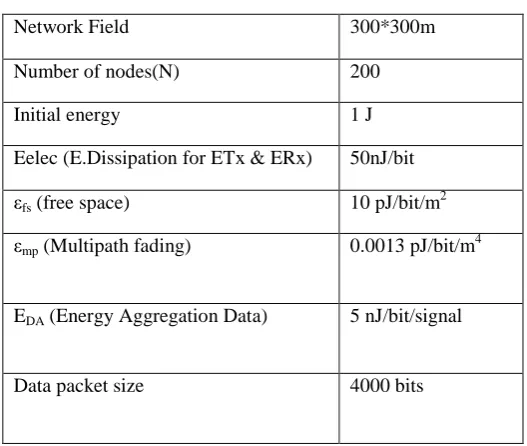
Table 1 represents the parameters used to get the following results.
TABLE 1: Parameter Value
Network Field 300*300m
Number of nodes(N) 200
Initial energy 1 J
Eelec (E.Dissipation for ETx & ERx) 50nJ/bit
εfs (free space) 10 pJ/bit/m2
εmp (Multipath fading) 0.0013 pJ/bit/m4
EDA (Energy Aggregation Data) 5 nJ/bit/signal
Data packet size 4000 bits
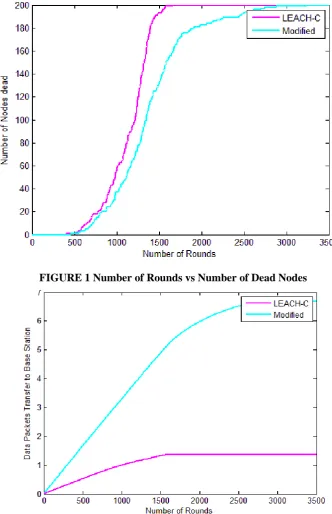
FIGURE 1 Number of Rounds vs Number of Dead Nodes
FIGURE 2 Number of Rounds vs Network Energy Consumption
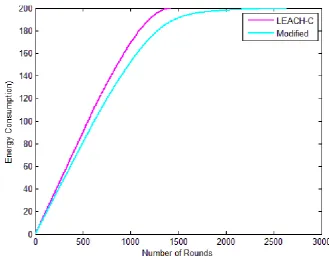
FIGURE 3 Number of Rounds vs Energy Consumption
Figure 3 shows the energy consumption in each round. The energy consumption of LEACH-C protocol is more in comparison to modified LEACH-C protocol. Hence the algorithm of modified LEACH-C protocol will enhance the network lifetime.
Figure 4 shows the cluster head formation in each round. It can be observed that cluster head formation in each round of modified LEACH-C protocol is optimal and hence maximize the network lifetime.
VI. CONCLUSIONS AND FUTURE WORK
WSNs differ from traditional wireless communication networks in several of their characteristics. One of them is power awareness, due to the fact that the batteries of sensor nodes have limited lifetime and are difficult to be replaced. Therefore, the protocols must consume minimum energy and the longevity of the network must also be preserved. This is the reason that routing protocols in WSNs aim mainly to accomplish power conservation while the traditional networks focus primarily on the Quality of Service (QoS). The proposed modified Leach-C routing protocol is a hierarchical routing based protocol, wherein the control is with the base station. The sensor nodes self configure themselves for the cluster head selection in non centralized hierarchical routing. While self configuring them, the nodes are unaware of the whole logical structure of the network. But in the proposed modified Leach-C protocol, the base station first collects information about the logical structure of the network and residual energy of each node and then selects the cluster head. Hence the cluster formation leads to longevity of network also. Finally, modified protocol is compared with already developed routing protocol Low Energy Adaptive Clustering Hierarchy-Centralized (LEACH-C) using MATLAB. A comparison between two is done on the basis of energy consumption with rounds, data packet sent to base station and the system lifetime of network. System lifetime is basically for how long the system works. The results show that modified LEACH-C protocol works better than LEACH-C protocol.
REFERENCES
[1]. G. Anastasi, M. Conti, M. Francesco, A. Passarella, Energy Conservation in Wireless Sensor Networks: A
survey, Journal of Ad Hoc Networks, Elsevier Publishers, May 2009, Vol. 7, No. 3, pp. 537-568.
[2]. Geetha. V,Pranesh. V,Kallapur, Sushma Tellajeera, Clustering in Wireless Sensor Networks: Performance
comparison of LEACH and LEACH-C protocols using NS2, procedia technology, dec 2012,DOI:10.1016/j.protcy.2012.05.024,pp.163-170.
[3]. Huang Lu, Secure and Efficient Data Transmission for Cluster-Based Wireless Sensor Networks, IEEE transactions on parallel and distributed systems , Vol. 25, No. 3, March 2014, pp.750-761
[4]. J. Yick, B. Mukherjee, D. Ghosal, Wireless Sensor Network Survey, International Journal of Computer and Telecommunication Networks, Elsevier Publishers, August 2008, Vol. 52, No. 12, pp. 2292-2330.
[5]. Nikolaos A. Pantazis, Stefanos A. Nikolidakis and Dimitrios D. Vergados, Energy-Efficient Routing Protocols in Wireless Sensor Networks: A Survey IEEE Xplore: Communications Surveys & Tutorials,
May 2013, Vol. 15, No 2, pp 551-591.
[7]. P. Arce, J. Guerri, A. Pajares, O. Lazaro, Performance Evaluation of Video Streaming Over Ad Hoc Networks Using Flat and Hierarchical Routing Protocols, In proceedings of 3rd International Conference on Mobile multimedia communications. Article No. 19, 2008, pp. 333-342.
[8]. R .V. Biradar, V. C.Patil, S. R. Sawant, R. R. Mudholkar, Classifiacation and Comparison of Routing Protocols in Wireless Sensor Networks, Special Issue on Ubiquitous Computing Security Systems, 2009, Vol. 4, Issue 2, pp. 704-711.
[9]. R. Yadav, S. Varma, N. Malaviya, A Survey of MAC Protocols for Wireless Sensor Networks, Ubiquitous
computing and Communication Journal, August 2009, Vol. 4, Issue 3, pp. 827-833.
[10].S. Ehsan, B. Hamdaoui, A Survey on Energy-Efficient Routing Techniques with QoS Assurances for Wireless Multimedia Sensor Networks, IEEE Xplore: Communication Surveys and Tutorials. March 2011, Vol. 14, No. 2, pp. 265-278
[11].Sugandha Singh ,Navin Rajpal ,Ashok Sharma, Address allocation for MANET merge and partition using
cluster based routing, SpringerPlus ,Springer open journal, published online at 16th October 2014,DOI 10.1186/2193-1801-3-605.
[12].Wendi Rabiner Heinzelman, Anantha Chandrakasan, and Hari Balakrishnan, Energy-Efficient