PROCESS SIMULATION OF A ENTRAINED
FLUIDIZED BED BIOMASS GASIFICATION USING
ASPEN PLUS
S.Ilaiah
1, D.Veerabhadra Sasikanth
2, B.Satyavathi
3 1,2University College of Technology, Osmania University, Hyderabad,(India)
3
Indian Institute of Chemical Technology, Hyderabad,(India)
ABSTRACT
Due to the environmental and price issues of current energy crisis, scientists and technologists around the globe are intensively searching for new environmentally less-impact form of clean energy that will reduce the high dependency on fossil fuel. In the near future biomass gasification is likely to play an important role in energy production and conversion. Its application has great potential in the context of climate change mitigation, increasing efficiency and energy security. The gasification of the biomass, karanjacake produces synthesis gas
(syngas) in which CO and H2 are the essential components. The composition of produced gas depends on the
types of gasifier and the gasification conditions among others. This work is developed by using the model of biomass gasification in an entrained fluidized bed gasifier using the ASPEN PLUS simulator. The Gibbs free energy minimization method was used to predict the composition of the produced gas. The influence of operating conditions as temperature (700-1500°C), equivalence ratio (ER) (oxygen/biomass ratio) (0.2 to 0.50), steam-to-biomass ratio (0.2-1),Pressure (1-80 bar) were varied over a wide range on gasifier performance are investigated.The optimal reaction temperature is considered to be 1227°C and the optimal equivalence ratio is 0.225 in that the low heating value of the produced gas, carbon conversion and cold gas efficiency achieve their maximum values. Higher temperature was beneficial to lower the amount of tar.The introduction of oxygen to the gasifier strengthened the gasification and improved the carbon conversion, but lowered the lower heating value and the H2/CO ratio of the syngas. The optimal oxygen/biomass ratio in this study was 0.225. With steam addition, the produced gas yield and in particular the H2 yield increased gradually, while the CO yield
decreased slowly. The optimal steam /biomass ratio in this study was 0.45.Therefore, the developed
model in this study provides a tool for design and optimization of a biomass Entrained fluidized bed
gasifier.
Keywords: Biomass gasification,Aspen plus, Sensitivity analysis
I. INTRODUCTION
Biomass gasification coupled with other renewable energy options would cut dependency on imported energy
and has great potential in the context of climate change mitigation, increasing efficiency and energy security and
Gasification is a process for converting carbonaceous materials to a combustible or synthetic gas [3] using a
gasifying agent such as oxygen or air and/or steam. Although gasification is a relatively old process, the
versatility of the process (with production of syngas, electricity, hydrogen, or chemicals) and the multiplicity of
technological solutions (fixed beds, moving beds, fluidized beds, and entrained flow reactors) make it a current
topic of investigation. As one of the attempt to study performance of gasifier with air as gasifying agent, an
equilibrium model based on minimization of Gibbs free energy was developed for rubber wood and syngas
composition obtained by Paviet et al.[6].This technology can use different reactors, including fixed-bed (Hobbs
et al., 1993), moveable-bed (Beenackers, 1999), fluidized-bed (Natarajan et al., 1998) and entrained-flow-bed
reactors (Chen et al., 2007). Fixed-bed and fluidized-bed reactors are normally employed as gasifiers. However,
due to the low reaction temperature, fixed-bed and fluidized-bed gasification have some disadvantages,
including lower rates of biomass conversion, lower calorific value, and higher tar yield. Hence, entrained-flow
gasification is a promising technology and is becoming increasingly important. This is primarily because
entrained-flow gasifiers operate at high temperatures with small particles and can achieve a high carbon
conversion rate with a low residence time. This feature in turn gives an entrained-flow gasifier a high
capacity.Moreover, higher temperature impels the secondary-cracking of tar to reduce tar production. Much of
the previous research has focused on coal gasification and on numerical simulations, leaving a need for a
systematic study of biomass gasification in an entrained-flow gasifier. As research and development continues
on entrained flow reactors, a mathematical model is necessary for gaining an insight into the influence of design
variables, feed materials, and processing conditions on the reactor performance. Furthermore, such models will
be necessary and powerful tools in optimizing, scaling-up and designing the process.The objective of this
research is to develop a computer simulation model of a entrained fluidized bed biomassgasifier using Aspen
Plus that can accurately predict gasifier performance under various operating conditions.
II. METHODOLOGY
2.1 Description of process
:
Gasifiers are classified in terms of the movement of the fuel through the vessel, the operating pressure and
temperature and the size and condition of the entering fuel. The primary configurations are moving/fixed bed,
fluidized bed and entrained flow. In an entrained flow reactor, small condensed particles (solid or liquid state)
are dispersed into a moving gaseous medium thereby entraining the injected particles. This provides the largest
solid-gas (or liquid-gas) reactive surface area possible and reduces the gas phase diffusional resistances, so that
rapid chemical reactions between the phases can occur.
2.2 Modeling of Biomass Gasifier
Aspen plus provides a unit operation model called RGIBBS that calculates chemical and thermodynamic
equilibrium based on minimizing the Gibbs free energy of the system. Components in Aspen plus are classified
as either conventional or nonconventional.Conventional components are ones with property data contained in
the Aspen plus component database. Nonconventional components are non-homogeneous substances that do not
have a consistent composition and are not contained in the Aspen plus component database. These components,
proximate, and sulfur analyses. Property methods must also be chosen to calculate the enthalpy and density of
the substance. For this work, the property methods HCOALGEN and DCOALIGT were respectively chosen to
calculate the enthalpy and density of biomass. These property methods use statistical correlations to calculate
the specific heat, enthalpy, and density of coal and coal-derived substances based on the ultimate, proximate,
and sulfur analyses.Biomass can be represented as a technical fuel through these analyses, these property
methods were also used for calculating the thermodynamic properties of biomass fuels. Furthermore, the
property method HCOALGEN offers different options for how the enthalpy of formation of the component is
calculated. For this work, the enthalpy of formation was calculated based on the higher heating value of the
substance, which was specified through ultimate analysis ofbiomass.
Figure1.Aspen flow sheet of entrained bed gasification
The equilibrium reactor RGIBBS does not accept nonconventional components as reactants. As a result, the fuel
must be decomposed to conventional components which can be used by the RGIBBS block. The conversion is
accomplished with an RYIELD block for the pyrolysis, labeled DECOMP, which isa reactor model that
generates products based on known yields. The fuel feed stream enters DECOMP where it is decomposed into
its elemental constituents. A FORTRAN calculator script interacts with the RYIELD block such that
decomposition of the fuel is calculated based on the proximate and ultimate analyses of the
nonconventionalcomponent. The carbon content of the feed is converted to solid carbon graphite. The hydrogen,
oxygen, nitrogen, chlorine, and sulfur are converted to gaseous H2, O2, N2, Cl2, and S. Finally the moisture
content is converted to liquid H2O. These species are now contained in an intermediate stream called RYP,
which then become the reactants for the RGIBBS block. An O2/air and steam streams representing the gasifying
oxidant also enters RGIBBS reactor, and a products stream exits it. The heat stream QRYP connect the RYP and
RGIBBS reactor and represents the energy required to decompose the solid fuel. Although QRYP interactswith
RGIBBS reactor, the reactor is still considered to be adiabatic because RYP calculates the amount of heat
required for decomposition and draws it from RGIBS reactor.Gibbs model was used to predict the gasifier
behaviour since many gasifiers produce near equilibrium products. The sensitivity analysis feature of Aspen
Plus is used to study the effect of various combinations of H/C and O/C ratios. For specified H/C and O/C
atomic ratios, the ultimate analysis in terms of mass percentage of the elements carbon, hydrogen, and oxygen is
determined. In each case the total fuel flow rate is kept constant. For each case, a design specification of carbon
entering equal to carbon leaving in gaseous species is used to determine the oxygen flow rate required for
Table 1. Proximate and ultimate analyses
Feed stock Proximate Analysis Composition Ultimate Analysis Composition
FC VM Moisture ASH C H O N S Cl
Karanja oil cake 17.48 70.00 08.12 04.40 56.71 05.30 33.70 04.29 - -
III. RESULTS AND DISCUSSION
Sensitivity Analysis for Biomass Gasifier
The sensitivity analysis tool is used in this study to analyze and predict the behavior of the model to changes in
key operating and design variables such as temperature, oxygen-to-biomass (ER), steam-to-biomass
(S/B),Pressure on product gas composition by keeping fuel feeding rate constant inorder to determine the best
working conditions of the biomass gasifier. During the sensitivity analyses the model input data was kept the
same as for model validation with one parameter being varied at any given time.
3.1 Effect of Gasification Temperature on product gas composition
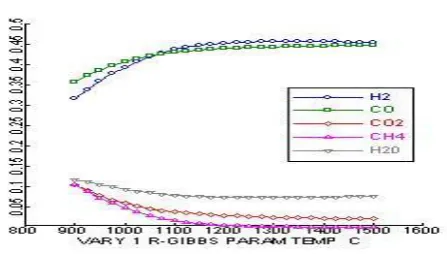
Figure 2. Effect of temperature on product gas composition
Since gasification is an endothermic reaction, the product gas composition is sensitive towards temperature
change. Temperature is crucial for the overall biomass gasification process (Lv et al., 2004) and high
temperature is a notable feature of entrained-flow gasification (usually 1300–1500 °C). It was observed that the
concentration of H2 increases with increase in temperature. The concentration of CO remains almost constant
over the range of temperature. Higher temperature provides more favorable condition for cracking and steam
reforming of methane. So with increase in temperature the concentration of methane decreases in the product
gas and this is attributed to increase in concentration of hydrogen. The CO2 concentration decreases with
increase in temperature because higher temperature favors endothermic formation of CO from CO2 via
boudouard reaction. In the present work, the oxygen/biomass ratio (Kg/Kg) was 0.225.Holding the other
conditions constant, the reactor temperature was increased from 900 to 1500 °C in 25 °C increments. The test
results are presented in Figs. 2 and 3. From Fig. 2, it can be seen that the H2 and CO contents increased
remarkably with temperature, where CO2 and CH4 decreased. According to Le Chatelier's principle, higher
Therefore, increasing the temperature strengthened the endothermic reactions, such as reactions (1)–(3),
resulting in increased H2 and CO contents and decreased CH4 and CO2 contents. Hence the H2 and CO
concentrations reached maxima at 1227 °C. From Fig. 2, it can be inferred that higher temperature improved the
H2 and CO yield. CO2 was produced from the decomposition of carboxyl groups (Huang et al., 2007) and
reactions (4) and (5) at the low-temperature stage. However, higher temperatures were not favorable for the
exothermic reactions (4) and (5), and the CO2 concentration therefore declined with increasing temperature,
while the endothermic Boudouardreaction became more dominant, resulting in an increased CO content at the
high-temperature stage. H2 and CO are the most important gas components of syngas, and determine the syngas
quality. As shown in Fig. 2, the H2 and CO contents increased with the rise in gasifier temperature. As a result,
cold gas efficiency also increased as the temperature increased from 900 to 1500 °C, as shown in Fig. 3.These
results suggest that higher temperatures could improve syngas quality.
3.2. Effect of O/B
It is defined as the amount of O2 added relative to the amount of biomass added to the gasifier. The effect of
equivalence ratio on product gas composition was studied in the range 0.2 to 0.5 at 1227°C with steam to
biomass ratio 0.45.
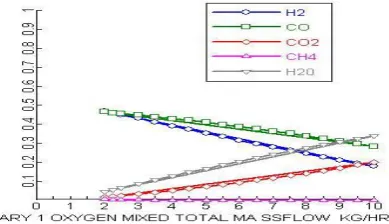
Figure 3.Effect of oxygen fow rate on product gas composition
The Figure3 shows CO2 concentration is directly proportional to the equivalence ratio. With increase in
equivalence ratio more complete combustion of carbon takes place producing more CO2 and this leads to
decrease in concentration of CO. So, less H2 is produced from water gas shift reaction which leads to decrease
in concentration of H2. Methane concentration remains almost constant over the range of equivalence ratio. In a
similar way H2O decreases reach minimum and then increases.With the introduction of O2, the CO
concentration increased slowly and then decreased, CO2 increased sharply, H2 decreased rapidly, and the CH4
content was negligible. When the O2 content was low, H2 consumed part of the O2 to generate H2O. Carbon
particles were incompletely combusted to generate CO, which resulted in CO content reaching a maximum of
about 50%. When O2 was excessive, H2, CH4, CO and gaseous hydrocarbons from pyrolysis were completely
combusted, which resulted in sharp increases in the CO2 concentration and continuous decreases in H2 and CO.
As shown in Fig.3, as O/B increased, H2/CO declined. Hence, the introduction of excessive O2 did not improve
the quality of the syngas. The carbon conversion efficiency increased with O/B and reaction temperature, as
shown in Fig. 8, indicating that more carbon from the biomasswas burnt due to the influence of the O2, and
higher temperature provided more energy for pyrolysis and gasification On the one hand, adequate O2
so improving the carbon conversion. Moreover the H2/CO ratio could be kept nearly constant at values of O/B
between 0. 2 and 0.5. On the other hand, excessive O2 caused more CO2 to be produced, and increased the
content of undesirable components. Considering the gas composition, H2/CO ratio, carbon conversion and LHV
of syngas, 0.225 was found to be the optimal O/B value in this study.The influence of Tg on product gas
composition is illustrated in Fig. 2. Tg depends on the oxygen flow, i.e. it is controlled by the ER. Therefore,
varying ER or Tg will have the same effect on product gas composition, heating value, and CGE. The
corresponding temperatures for ERs between 0.2 and 0.5 are given. In Fig. 2 H2,H2O, CO, CO2, and CH4 are
plotted. The most interesting point from examination of Fig. 2 is that both H2 and CO reach a maximum at a
temperature of 1227°C or at an ER of 0.225, after which their contents decrease steadily. H2O increases over the
whole range but experiences a small decrease close to the H2 and CO peak. CO2 decreases rapidly up to a
temperature of 1227°C and then increases slowly. CH4 decreases and eventually reaches zero between a
temperature of 1227 and 1300°C (ER of 0.225 and 0.25).
3.3. Effect of Steam/Biomass Ratio
Steam to biomass ratio also plays an important role in gasification of biomass. The effect of steam to biomass
ratio on product gas composition was studied over the range 0.2-1 at 1227 with equivalence ratio 0.225.
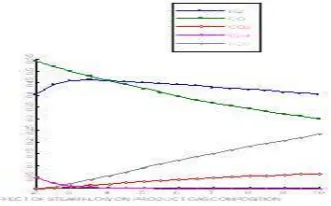
Higher steam to biomass ratio favors more conversion of CO to CO2 and H2 through water gas shift reaction.
So with increase in steam to biomass ratio H2 and CO2 concentration increases and CO concentration decreases
in the product gas.
Figure 4.Effect of Steam flow on product gas composition
Also higher steam to biomass provides more favorable condition for steam reforming of methane. So
methaneconcentration decreases with increase in steam to biomass ratio.
3.4. Gasification pressure
The effects of pressure variations on composition of syngas, its calorific value, and the gasification temperature
are also investigated. While the pressure ranged from
atmospheric pressure 1 bar to 80bar, the equivalence ratio (0.225), gasification agent (pure oxygen), and air
preheating temperature (25 C) were kept unchanged. Fig. 8 gives the syngas composition as a function of
gasification pressure. It is observed that the amount of CO and H2 decrease slightly as the pressure increases.
The CH4, CO2, and H2O contents, however, grow with increasing pressure. This trend, reported in the literature
for other feedstocks can be explained in accordance with Le Chatelier’s principle .Although increasing pressure
generation of CH4.the gasification temperature starts rising as the gasification pressure increases. This is
because the endothermic behavior of the process dilutes with increasing pressure, which is expected as all the
reactions responsible for conversion of char into gaseous product reverse at higher pressures in accordance with
Le Chatelier’s principle.
Figure 5.Effect of Pressure on product gas composition
A close inspection of the detailed results obtained from the simulations show that the gasification efficiency
(both CCE and CGE) is not sensitive to the pressure changes.
The increase of CH4 concentration, which compensates the decrease of H2 and CO, results in such behavior. As
observed, the gasification pressure has no significant effects on gasification characteristics. In reality, however,
the gasification under pressure is economically preferred over pressurizing the syngas in downstream
equipments such that all modern processes are operated at elevated pressures of at least 10 bar and up to a
maximum 100 bar.
In this work 40 bar pressure found to be optimum.
IV. CONCLUSION
An entrained fluidized bed biomass gasifier model wasdeveloped using ASPEN Plus. The results obtained from
the sensitivity analyses are in good agreement with published work. Therefore, the model is capable of
predicting accurately gasifier performance over a wide range of operatingconditions.The influence of
temperature, and level of air preheating on gas composition, oxygen to biomass ratio and steam to biomass ratio
were investigated, the results of which revealed the following:
The optimal reaction temperature is considered to be 1227°C and the optimal equivalence ratio is 0.225.Higher
temperature was beneficial to lower the amount of tar.The introduction of oxygen to the gasifier strengthened
the gasification and improved the carbon conversion, but lowered the lower heating value and the H2/CO ratio
of the syngas. The optimal steam /biomass ratio in this study was 0.45.
REFERENCES
[1] World Energy Technology Outlook - 2050.European Commission, 2006.
[2] J. Rezaiyan, and N.P. Cheremisinoff, “GasificationTechnologies”, CRC Press, Newyork, 2001.
[3] A. Faaij, Modern biomass conversion technologies, Mitigation and Adaptation Strategies for Global
[4] Rezaiyan J., Cheremisinoff N. Gasification Technologies: A Primerfor Engineers and Scientists. FL:
Taylor & Francis / CRC Press, 2005.
[5]. Li, X.; Grace, J. R.; Watkinson, A. P.; Lim, C. J.; Ergudenler, A. Equilibrium modeling of gasification: A
free energy minimization approach and its application to a circulating fluidized bed coal gasifier. Fuel
2001, 80, 195–207.
[6]. Paviet, Chazarency, &Tazeroutz,Thermo chemical equilibrium modelling of a biomass gasifying
processusng ASPEN PLUS. International Journal of chemical reactor engineering, (2009),7(1),