SOLAR-WIND HYBRID MODEL: A CASE STUDY IN
NORTH EAST REGION
Sanjib Hazarika
1, Biplobjyoti Saikia
2 1,2Department of Electrical Engineering, GIMT,Azara, Assam, (India)
ABSTRACT
Energy is considered a prime agent in the generation of wealth and a significant factor in economic
development of a country. Economic use of energy resources can be the prime factor in development. Limited
fossil resources and environmental problems associated with them have emphasized the need for new
sustainable energy supply options that use renewable energies. Solar thermal power generation systems, also
known as Solar Thermal Electricity (STE) generating systems are emerging as renewable energy technologies
and can be developed as viable option for electricity generation in future.
Solar Energy, a clean renewable resource with zero emission has got tremendous potential of energy which can
be harnessed using a variety of devices. With recent developments, solar energy systems are easily available for
industrial and domestic use with the added advantage of minimum maintenance. Most of the developed
countries are switching over to solar energy as one of the prime renewable energy source. The current
architectural designs make provision for photovoltaic cells and necessary circuitry while making building plans.
The National Solar Mission is a major initiative of the Government of India and State Governments to promote
ecologically sustainable growth while addressing India’s energy security challenge. This paper discusses the
technology options, their current status and opportunities and challenges in developing solar thermal power
plants in the context of India. Addition to that it includes the feasibility analysis of hybrid system in Guwahati.
Keywords: Hybrid, Solar, Renewable, Wind, Radiation
I. INTRODUCTION
In recent years availability of power in India has increased and improved but demand has consistently
outstripped supply and substantial energy and peak shortages prevailed in 2009-10. In order to meet the deficit
between demand and supply, 25000 MW to 35000 MW of power is being produced by diesel generation system.
In the past, the selection of an energy resource for electricity generation was dominated by finding the least
expensive power generating plant. Although such an approach is essential, there is growing concern about other
aspects of power generation such as social, environmental and technological benefits and consequences of the
energy source selection.
1.1 Solar Thermal Power Generation Technologies
Solar Thermal Power systems use concentrated solar radiation as a high temperature energy source to produce
electricity using thermal route. Since the average operating temperature of stationary non-concentrating
3000C), the concentrating collectors are used for such applications. These technologies are appropriate for
applications where direct solar radiation is high. In the basic process of conversion of solar into heat energy, an
incident solar irradiance is collected and concentrated by concentrating solar collectors or mirrors, and generated
heat is used to heat the thermic fluids such as heat transfer oils, air or water/steam, depending on the plant
design. This acts as heat carrier and as storage media. The hot thermic fluid is used to generate steam or hot
gases, which are then used to operate a heat engine. In these systems, the efficiency of the collector reduces
marginally with increasing operating temperature, whereas the efficiency of the heat engine increases with the
increase in its operating temperature [1]
II. SCENARIO OF ELECTRICITY GENERATION
Electric energy occupies the top grade in energy hierarchy and per capita electricity consumption acts as an
index of standard of living. The entire world concentrate on the electric energy sector to enhance the process of
development. Fossil fuel based power plant or thermal electric power plants are the major contributors of
electricity generation and recently, importance is shifted to the renewable energy sector, e.g. hydroelectricity,
wind power generation, PV technologies etc. Electricity generation increases all over the world at a faster rate
through the penetration of different technologies. It grew at a rate of 2.5% in 2013, which is ahead of the growth
of primary energy (2.4%). This Growth was slightly better than 2012 (2.2%) but remained below the last ten
year trend (3.3%). The electric energy scenario for OECD countries declined, whereas Non-OECD countries
showing promising and better growth of electricity for the last 10 years (6.3%). China and the US remain the
largest and second largest electricity generators, following by India, Japan and Russia respectively [2].
From the scenario of world electricity generation, it is clear that thermal generation plays huge role in
production as compared to other, that is, renewable sources. Other sources include solar, wind, geothermal,
combustible renewable and waste and heat.
Fig1: World electricity generation by fuel (TWh) [3]
The Indian power sector has made remarkable progress since Independence. The power generation profile in the
March, 2015. The Indian power sector comprising of thermal 188.898GW (70.6%), hydro 41.267 GW (15.4%),
Nuclear 5.780 GW (2.2 %) and New Renewables 31.692 GW (11.8%) [4]. In India solar energy is available
almost in all places and hence solar energy is the most attractive option in India. The most useful way of
harnessing solar energy is by directly converting it into electricity by means of solar photo-voltaic cells. The
photo-voltaic effect is defined as the generation of an electromotive force as a result of the absorption of
ionising radiation
Fig2: Power generation growth in India
2.1. Electrical Energy Demand-Supply Gap In India
The power sector in India comprising of central, state and private sector which contribute 27.1%, 36.2% and
36.7% respectively of total electricity generation [3,4,5]. Though all three sectors work together towards the
common goal of supply of electricity to all, even after this the country is facing power shortage in terms of
energy as well as peak demand, as the demand of electricity has always been overstepping the supply. Though
National Electricity Plan targets to supply electricity for all through efficient generation, transmission and
distribution, still 24.7% people in India are living without access to electricity.
Table 1: Supply-demand gap of India [6]
Year Peak
Demand(MW) Peak Met(MW)
Deficts(-)
(MW) (%)
2009-10 1,19,166 1,04,009 -15,157 -12.7
2010-11 1,22,287 1,10,256 -12,031 -9.8
2011-12 1,30,006 1,16,191 -13,815 -10.6
2012-13 1,35,453 1,23,294 -12,159 -9
2013-14 1,35,918 1,29,815 -6,103 -4.5
2014-15* 1,41,160 1,41,160 -7,006 -4.7
One of the main reason of supply demand gap is inefficient generation. Therefore electricity generation using
2.2. Solar Energy Scenario In India
The installed capacity and respected estimated generation of different existing renewable sources in the year
2013 are tabulated. As discussed earlier, it is observed that the use of solar power is not notable as compared to
wind and biomass.
Table 2: Renewable Scenario in India [7]
Installed Capacity
(MW)
Estimated Capacity Factor Estimated Generation
(GWh)
Wind 18635 14% 22854
Biomass 1264 70% 7751
Bagasse Cogeneration 2301 60% 12094
Small Hydro 3552 40% 12446
Waste to Energy 96 50% 420
Solar PV 1447 20% 2535
Total 27295 25% 58101
2.2.1. Solar Thermal Power Generation Program Of India
Different programs have been installed and operated in India taking solar power as major source. Some of them
are listed below.
In India the first Solar Thermal Power Plant of 50kW capacity has been installed by MNES following the
parabolic trough collector technology (line focussing) at Gwalpahari, Gurgaon, which was commissioned in
1989 and operated till 1990, after which the plant was shut down due to lack of spares. The plant is being
revived with development of components such as mirrors, tracking system etc.
A Solar Thermal Power Plant of 140MW at Mathania in Rajasthan has been proposed and sanctioned by the
Government in Rajasthan. The project configuration of 140MW Integrated Solar Combined Cycle Power
Plant involves a 35MW solar power generating system and a 105MW conventional power component and
the GEF has approved a grant of US$ 40 million for the project. The Government of Germany has agreed to
provide a soft loan of DM 116.8 million and a commercial loan of DM 133.2 million for the project.
In addition a commercial power plant based on Solar Chimney technology was also studied in
North-Western part of Rajasthan. The project was to be implemented in five stages. In the 1st stage the power output
shall be 1.75MW, which shall be enhanced to 35MW, 70MW, 126.3MW and 200MW in subsequent stages.
The height of the solar chimney, which would initially be 300m, shall be increased gradually to 1000m. Cost
of electricity through this plant is expected to be Rs. 2.25 / kWh. However, due to security and other reasons
the project was dropped.
BHEL limited, an Indian company in power equipments manufacturing, had built a solar dish based power plant in 1990’s as a part of research and development program of then the Ministry of Non-conventional
Energy Sources. The project was partly funded by the US Government. Six dishes were used in this plant.
Solar energy plays an important role in developing economic growth of India. Recently, Ex-Prime Minister
Manmohan Singh acknowledge that solar energy will transform rural India as it is used in an increasing trends
and also launched a National Solar Mission in 2010. In 2009, the solar power generation is 12 MW and within
two years it is increased to 190 MW in 2011. By March 2013, it is expected to grow fivefold to 1,000 MW, but
the country has a long way to go to reach its goal of increasing solar-power generation to 20 gigawatts by 2020.
Across India, there are still thousands of villages with plenty of sun but not enough power [8].
Fig3: Renewable share in power in India [6]
Among the various renewable energy resources, India possesses a very large solar energy potential; most parts
of the country are blessed with good amounts of sunshine. There are about 300 clear sunny days in a year in
most parts of country. The average solar radiation incident over India varies from 4 kWh/day to 7 kWh/day. The
solar radiation received over the Indian land area is estimated to be about 5,000 trillion kWh/year. In June, 2008,
a National Action Plan on Climate Change was announced, which included eight major national missions with
the one on solar energy being the centre piece [9,10]. This mission envisages a major step up in the utilization of
solar energy for power generation and other purposes. The Jawaharlal Nehru National Solar Mission (JNNSM)
was launched by the Prime Minister of India in January 2010, with a target of 20,000 MW grid solar power
(based on solar thermal power generating systems and solar photovoltaic (SPV) technologies), 2000 MW of
Offgrid capacity including 20 million solar lighting systems and 20 million sq.m. solar thermal collector area by
2022. The Mission will be implemented in three phases. The first phase will be of three years (up to March,
2013), the second up to March 2017 and the third phase will continue until March, 2022.
3.1. Barriers For Solar Power
Solar thermal power plants need detailed feasibility study and technology identification along with proper solar
radiation resource assessment are the prime factors which decides the feasibilility of the plant. The current status
of international technology and its availability and financial and commercial feasibility in the context of India is
not clear. The delays in finalizing technology for Mathania plant have created a negative impression about the
technology.
The normal incident solar radiation output on north east is in the range between 5-7 KW/hour/day. This intensity
of solar radiation is enough for the production of solar power by using photovoltaic array. But the combined
effect solar and wind power will not be able to play a vital rule in case of north east region. A practical
approach has been taken to analyse the feasibility of this system in Guwahati.
Fig4: Solar and Wind power output in Guwahati.
In the month of April 2010, the field study was performed and the findings are-
(i) Maximum solar power at irradiance is 13.13 W (for 1 hour) with open circuit voltage 22.12 volt.
(ii) Maximum wind power generation is 28.33 W (for 1 hour) with average wind speed 3 m/sec.
Fig5: Practical hybrid model developed for analysis
This study will conclude that although it is possible to obtain solar output in northeast region but due to
insufficient wind speed in Guwahati, wind power is not a viable option. But utilizing hybrid model in hilly areas
of Northeast and in riversides like Brahmaputra Barak where wind speed is maximum, power production is
possible, and if any organization is keen in adopting such power generation scheme then our model will prove to
Fig 6: Open Circuit Voltage of Solar Panel (Two random days)
Fig 7: Short Circuit Current of Solar Panel (Two random days)
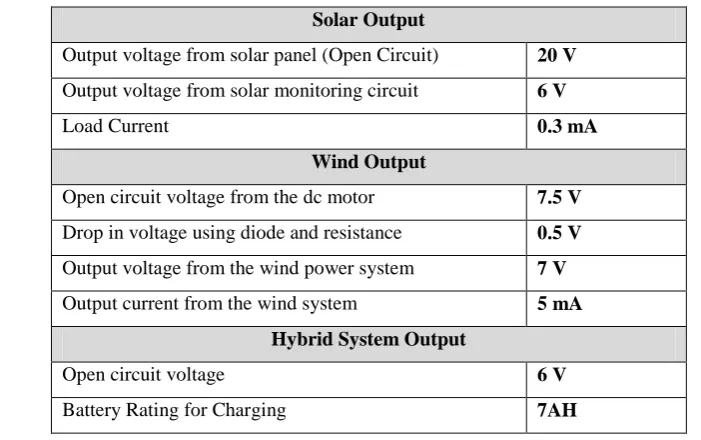
The output of solar panel is obtained about 20 V (OC) from the experimental result. This output is controlled
with the help of a charge regulating circuit to obtain a constant output of 6 volt and fed to a battery of 7AH
rating. Similarly wind output is also controlled and converted to 6V DC with the help of wind voltage regulating
circuit and connected in parallel to the battery output. This is done as solar radiation is available only in daytime
whereas wind output is available for all time. The experimental datas are tabulated below. (Table 3)
Table 3: Experimental output
Solar Output
Output voltage from solar panel (Open Circuit) 20 V
Output voltage from solar monitoring circuit 6 V
Load Current 0.3 mA
Wind Output
Open circuit voltage from the dc motor 7.5 V
Drop in voltage using diode and resistance 0.5 V
Output voltage from the wind power system 7 V
Output current from the wind system 5 mA
Hybrid System Output
Open circuit voltage 6 V
From the battery 42Wh output is available. We considered 90% efficiency of the battery and output is used in a
6W LED (for 6 hours). Depending upon load, the size of hybrid model will vary and can be modified.
IV. CONCLUSION
Potential use of solar plants should be increased for further economic development of the country especially in a
country like India. Three major factors, resource assessment, technological appropriateness and economic
feasibility are the basic requirements of project evaluation. In India, the solar radiation is available sufficiently
over the country. Extraction of solar power should be increased in all respect which will reduce the dependence
on non renewable sources. In long term, it will also reduce amount of CO2 emission to the environment.
Efficient use of hybrid systems in remote places will improve the economic stability of the nation. The solar
tower power and point focusing dish type plants are being popular worldwide. In the pulp and paper industry,
the moderate temperature is required for processing and solar energy can effectively generate this amount of
heat. From this investigation, it is clear that efficient use of solar power in industrial activities will help in
making India a ‘Solar Power Nation’.
REFERENCES
[1] The Energy and Resources Institute, TERI
[2] BP Statistical Review of World Energy June 2014,
http://www.bp.com/content/dam/bp/pdf/Energy-economics/statistical-review-2014/BP-statistical-review-of-world-energy-2014-electricity-section.pdf
[3] J. Bhagwan Reddey, D.N. Reddy ―Probablistic Performance Assessment of a Roof Top Wind, Solar
Photo Voltaic Hybrid Energy System‖, Engineering Science and Education Journal, Vol. 2, No. 4, pp. 281-298,
February 2008.
[4] R.Chedid & H. Akiki, ―A decision Support Technique for the Design of Hybrid Solar-Wind Power System‖, IEEE Transaction of Energy Conversion Vol. 13, No.1,pp. 154-176, March 1998.
[5] Renewable electricity generation climbs to second place after coal
http://www.iea.org/newsroomandevents/news/2015/august/renewable-electricity-generation-climbs-to-second-place-after-coal.html
[6] Executive Summary Power Sector 2015,
http://www.cea.nic.in/reports/monthly/executive_rep/jan15.pdf
[7] Power Sector at a Glance ALL INDIA, http://powermin.nic.in/power-sector-glance-all-india
[8] P. Garg, Energy Scenario and Vision 2020 in India,2012,7-17
[9] Rangan Banerjee, Grid Connected Solar Power in India: Status and Prospects, CEIC Seminar,2013
[10] T.V. Ramachandra, Rishabh Jain, Gautham Krishnadas, Hotspots of solar potential in India, Renewable
![Table 1: Supply-demand gap of India [6]](https://thumb-us.123doks.com/thumbv2/123dok_us/7764475.1275957/3.595.129.467.206.426/table-supply-demand-gap-of-india.webp)
![Table 2: Renewable Scenario in India [7]](https://thumb-us.123doks.com/thumbv2/123dok_us/7764475.1275957/4.595.71.522.208.374/table-renewable-scenario-in-india.webp)