R E S E A R C H
Open Access
Reducing the PAPR in FBMC-OQAM
systems with low-latency trellis-based SLM
technique
S. S. Krishna Chaitanya Bulusu
*, Hmaied Shaiek and Daniel Roviras
Abstract
Filter-bank multi-carrier (FBMC) modulations, and more specifically FBMC-offset quadrature amplitude modulation (OQAM), are seen as an interesting alternative to orthogonal frequency division multiplexing (OFDM) for the 5th generation radio access technology. In this paper, we investigate the problem of peak-to-average power ratio (PAPR) reduction for FBMC-OQAM signals. Recently, it has been shown that FBMC-OQAM with trellis-based selected mapping (TSLM) scheme not only is superior to any scheme based on symbol-by-symbol approach but also outperforms that of the OFDM with classical SLM scheme. This paper is an extension of that work, where we analyze the TSLM in terms of computational complexity, required hardware memory, and latency issues. We have proposed an improvement to the TSLM, which requires very less hardware memory, compared to the originally proposed TSLM, and also have low latency. Additionally, the impact of the time duration of partial PAPR on the performance of TSLM is studied, and its lower bound has been identified by proposing a suitable time duration. Also, a thorough and fair comparison of performance has been done with an existing trellis-based scheme proposed in literature. The simulation results show that the proposed low-latency TSLM yields better PAPR reduction performance with relatively less hardware memory requirements.
Keywords: 5G, Dynamic programming, Computational complexity, FBMC-OQAM, PAPR, SLM, Trellis-based
1 Introduction
Filter-bank multi-carrier (FBMC)-based systems, clubbed with offset quadrature amplitude modulation (OQAM), is being seriously considered for future communica-tion systems. FBMC-OQAM has many attractive features such as excellent frequency localization, a power spec-tral density (PSD) with very low side lobes, an improved robustness to time-variant channel characteristics, and carrier frequency offsets. Armed with these properties, FBMC-OQAM seems to be a more suitable candidate as a radio waveform for 5G radio access technology (RAT) than orthogonal frequency division multiplexing (OFDM), especially for asynchronous devices [1]. How-ever, FBMC-OQAM, as a multi-carrier technique, has a high peak-to-average power ratio (PAPR). There is an essential need to introduce novel methods relevant to
*Correspondence: [email protected]
CEDRIC/LAETITIA Laboratory, Conservatoire National des Arts et Métiers, 292, Rue Saint-Martin, 75003 Paris, France
PAPR reduction. In this paper, we mainly focus on PAPR reduction using probabilistic schemes.
Although several classifications of the PAPR reduction methods for OFDM do exist, there is a notable classifi-cation with five categories which are as follows:clipping effect transformations[2],coding[3],frame superposition: tone reservation (TR) [4],expansible constellation point: tone injection (TI) [5] and active constellation extension (ACE) [6] and probabilistic schemes: selected mapping (SLM) [7] and partial transmit sequence (PTS) [8]. The classical schemes, proposed for OFDM, cannot be directly applied to FBMC-OQAM, owing to their overlapping symbol structure. Off late, some PAPR schemes have been suggested for FBMC-OQAM systems, namely, ACE [9], Iterative clipping [10, 11], ACE combined with TR [12] and TR [13, 14].
Coming to recently proposed probabilistic schemes, three symbol-by-symbol-based schemes have been pro-posed in [15–17]. In [18], a trellis-based PTS scheme with
multi-block joint optimization (MBJO) has been intro-duced. Inspired by this trellis-based approach, a novel trellis-based SLM (TSLM) scheme has been presented in [19]. However, the existing TSLM technique needs very high hardware memory, which also impacts the latency. So, in this paper, we have proposed a low-latency TSLM, which needs very low hardware memory and thereby avoiding latency issues. A thorough and fair comparison of performance has been done with existing probabilis-tic schemes, overlapped SLM (OSLM) [16], dispersive SLM (DSLM) [17], and MBJO-PTS [18]. The simulation results show that there is a tradeoff between hardware memory and PAPR reduction and also that low-latency TSLM yields better performance with relatively low com-putational complexity and low latency and requires less hardware memory.
The rest of the paper is organized as follows: Section 2 gives a brief overview of the FBMC-OQAM signal struc-ture and the impact of their overlapping nastruc-ture. Section 3 presents the analysis of PAPR in FBMC-OQAM signals, along with abridged introduction to the classical SLM scheme. In Section 3.3, we briefly discuss about the exhaustive search. Section 4 presents the idea of trellis-based approach with its capability in achieving an optimal PAPR reduction performance along with the TSLM algo-rithm. In the same section, we propose the low-latency TSLM algorithm. In Section 5, the computational com-plexity of probabilistic schemes are derived. In Section 6, the simulation results are presented, and the conclusion of the paper is given in Section 7.
2 Overview of FBMC-OQAM system
Let us consider that we need to transmit M× N com-plex symbols in a FBMC-OQAM system over N tones. Then, we transmit real symbols at interval T2, whereT is the symbol period [20]. In OQAM mapping, theM com-plex input symbol vectors{X0,X1,. . .,XM−1}are mapped into 2Mreal symbols {a0,n,a1,n,. . .,a2M−1,n}. After this OQAM mapping, the real symbols undergo poly-phase filtering that involves IFFT transformations along with fil-tering by a synthesis filter bank. The obtained continuous-time base-band FBMC-OQAM signalx(t)can be written as [21]
• G{.}is the FBMC-OQAM modulation function
• am,nare OQAM mapped real symbols fromXm
• h(t)is the prototype filter impulse response
• ϕm,nis the phase term, equals toπ2(m+n)−πmn
The prototype filter used in this paper is the one designed in the European PHYDYAS project, whose most significant parameter is the duration of its impulse response also known as overlapping factor,K. ForK =4, theh(t)is given by [22]. FBMC-OQAM signals have over-lapping nature. We can see in Fig. 1 that the duration of the impulse response in the case of rectangular filter used in OFDM isT, whereas the duration ofh(t)spreads beyond one symbol period, and this impacts the FBMC-OQAM signal, causing adjacent FBMC-FBMC-OQAM symbols to overlap.
3 Probabilistic PAPR reduction schemes for OFDM and their adaptation for FBMC-OQAM 3.1 PAPR
For a continuous-time base-band FBMC-OQAM signal x(t) that is transmitted during a symbol period T, the PAPR is defined by
The complementary cumulative density function (CCDF) of PAPR of a signal quantifies how frequent the PAPR exceeds a given threshold valueγ, and it is defined asPr{PAPRx[n]≥γ}.
3.2 Selected mapping for OFDM signals
SLM was introduced in [7], where we generateUcomplex phase rotation vectorsφ(u), for 0≤u≤U−1, of length
φ(u)=
The frequency-domain input symbolsXwith N tones are phase rotated byU phase rotations vectors of sizeN as given below
X(u)=X φ(u), 0≤u≤U−1, (5)
wheredenotes the carrier-wise point-to-point multipli-cation. By applying IFFT operation, we obtain theU time-domain signal patterns{x(0)(t),x(1)(t),. . .,x(U−1)(t)}. The target of the optimization problem is to identify the signal x(umin)(t)that has the least PAPR so that
umin= arg min 0≤u≤U−1
PAPRx(u)(t). (6)
In the index of the respective phase rotation vector,umin is sent to a receiver as side information (SI), comprising log2U bits. If SI is error-protected, then BER of SLM is the same as the original OFDM.
Recently, some symbol-by-symbol based schemes have been proposed for FBMC-OQAM such as, OSLM [16] and DSLM [17]. The sub-optimality of any symbol-by-symbol approach is effectively dealt in [19], where it has been shown that whatever improvement that has been achieved for one symbol can probably be hampered by its immediate next symbol.
3.3 Exhaustive search
In order to achieve the optimal performance in PAPR reduction, one need to consider all the possibleUphase rotations for allMsymbols and pick out the best one out of the UM different combinations. In practical sense, it is meaningless to perform this exhaustive search, since it adds mammoth complexity to the implementation of any SLM-based scheme. To deal with the similar problem in the case of PTS, a trellis-based PTS scheme with multi-block joint optimization (MBJO) has been introduced in [18]. Nevertheless, for small values ofU andM, simula-tion results will be presented in order to quantify the gap between the proposed method, TSLM, and the optimal exhaustive search.
4 Overview on trellis-based approach and TSLM algorithm
In order to circumvent the high computational complex-ity of exhaustive search, we opt for the dynamic pro-gramming, which can help in reducing substantially the number of paths one need to pick [23]. At any transition between two stages, we haveU2paths to compare, and for
MFBMC-OQAM symbols, we have totallyM−1 transi-tions. Therefore, the TSLM scheme needs to search only U2(M−1)paths. This is due to eliminating certain paths by evaluating them based on a metric. If we have to trans-mitMinput symbol vectors{X0,X1,. . .,XM−1}, then we need to find , which is the optimal set ofMdifferent phase rotation vectors that give the best PAPR
=
are the indices of the opti-mal phase rotation vectors for theMinput symbol vec-tors, which are to be sent to the receiver as SI. WithM FBMC-OQAM symbols andUphase rotation vectors, we need to find the best path in the trellis of Fig. 2 that gives the lowest PAPR. Choosing an optimal path in the trel-lis means finding the multiplicative vectors by solving (6), with the help of a trellis diagram.
For 0≤m≤M−1, everymth FBMC-OQAM symbol xm(t), obtained from modulation of input symbol vector
Xm, is represented as themth stage in the trellis at time instantmT. At each stage, there will beUdifferent states, representing the rotated FBMC-OQAM symbols. Among these states, anyith trellis state indicates rotation by phase vectorφ(i). Between every two stages, there existU2 pos-sible paths. The joint FBMC-OQAM modulation of the mth and(m+1)th rotated input symbol vectorsX(mu)and
X(mv)+1, respectively, is represented in the trellis by the path ζ(u,v)
(m⇒m+1)between theuth state in themth stage and the vth state in the(m+1)th stage, where ⇒ represents a transition between two successive stages.
The partial PAPR that has been calculated between two stages with multiple states serves as characteristic of path metric, which can aid at identifying theUoptimal paths that arrive at successive stages. Unlike a full PAPR, a par-tial PAPR of a signal x(t)is computed over a particular time instant T0. For the pathζ((mu,⇒v)m+1), its path metric computed over durationT0as
Fig. 2Illustration of the trellis diagram between M stages composed ofUstates
state metric (u,m)at themth stage as a measure of opti-mality of cumulative path metrics of the optimal paths that arrived to this state from previous stages through various transitions. It can be evaluated simply by adding the path metric((wm,−u)1⇒m) of the arriving optimal pathζ((mw,−u)1⇒m) from the wth state of the previous (m−1)th stage with the state metric (w,m−1)of thewth state from which this
optimal path departs.
The whole optimization problem in this regard can be viewed as a continuum of overlapping optimization sub-problems, i.e., finding a FBMC-OQAM signal with least PAPR is equivalent to obtaining the accumulation of the least peaks. This is reflected in the state metric of a given state at any stage.
4.1 TSLM algorithm
In the TSLM, every two symbols are rotated with different phase rotation vectors that are i.i.d and are FBMC-OQAM modulated. The two optimal states between the two suc-cessive stages are chosen among others, based on the least PAPR criterion that has been computed over a given time instant T0. The TSLM algorithm involves the following steps:
Step 1—Initialization: Firstly, we generateM
complex input symbol vectors{X0,X1,. . .,XM−1}
andU phase rotation vectorsφ(0),φ(1),. . .,φ(U−1)
of lengthN as per (3). We initialize the counter m
and the state metrics for all states of the first stage as below.
m=0, (10)
(u,0)=0, u=0,. . .,U−1. (11)
As long as the condition0≤m≤M−2is satisfied,
we perform steps 2, 3, 4, 5, and 6 in a repeated manner.
Step 2—Phase rotation: Two input symbol vectors
Xm,Xm+1are phase rotated withU different phase
rotation vectors, as per (5), giving
X(m0),Xm(1),. . .,X(mU−1)
and
X(m0+)1,X(m1+)1,. . .,X(mU+−11), respectively. Step 3—FBMC-OQAM modulation: For
0≤u,v≤U−1, FBMC-OQAM modulation is done
jointly for all combination of the patterns of themth
and(m+1)th input symbols, along with the
preceding symbols, such as
x(m,mu,v)+1(t)=G. . .,X(mλ−((2λ(u,m−1)),m−2)),X(mλ−(u,m1 −1)),X(mu),X(mv)+1
,
(12)
whereλ(u,m−1)is the surviving phase rotation at
theuth state of stage m.
Step 4—Path metric calculation: For each of theU2
patterns of the modulated FBMC-OQAM signal
For the pathζ((mu,⇒v)m+1), we calculate its path metric (u,v)
(m,m+1)according to (8).
Step 5—Survivor path identification: The states of
stagemthat are related to the survivor paths leading
to stagem+1are stored in a state matrixλ(v,m)of
orderU×M, as given below
λ(v,m)= min u∈[0,U−1]
(u,m)+((mu,,vm)+1)
,v=0,. . .,U−1. (13)
Step 6—State metric updation: The state metric
(v,m+1), for the stagem+1, can be updated as
follows:
(v,m+1)= (λ(v,m),m)+((mλ(,vm,m+)1,v)), v=0,. . .,U−1.
(14)
Step 7—Incrementation: Increment the value ofmby
1 and if0≤m≤M−2, then go to step 2, or else, if
0≤m=M−1, go to step 8.
Step 8—Traceback: Once state metrics for all the the M th stages has been computed, then identify the state that has the least state metric as shown below
(M−1)= min
u∈[0,U−1] (u,M−1)
. (15)
Then, start tracing back from last stage to the first
one in order to find the unique survivor pathby
identifying the optimal states at each stage as below
(k)=λ((k+1),k), (16)
wherek=M−2,M−3,. . ., 1, 0. This survivor path
is the set of optimal phase rotation vectors that is
obtained after solving the optimization problem by dynamic programming and its indices
{u0min,u1min,. . .,uMmin−1}are supposed to be transmitted to the receiver as SI.
4.2 Proposed low-latency TSLM in terms of hardware memory and latency
When we consider implementation complexity, we need to take two things into account, computational complex-ity and hardware memory. The former shall be dealt in our analysis in the next section. The originally proposed TSLM [19] needs a state matrixλof orderU×M, which means we need to store in totalMNUtime-domain com-plex samples in memory, before we start tracing back. This adds latency by Mstages and requires very huge hard-ware memory. A latency ofMstages means that we have to traceback untilMstages for the identification of sur-vivor paths. Hardware memory can significantly impact the implementation cost, and high latency is undesirable in some critical communication systems.
We have studied the impact of traceback depth parame-ter∂, which heavily impacts not only in the PAPR reduc-tion performance but also in the latency and hardware
memory requirements. It has to be noted that the choice of ∂ depends upon the prototype filter overlapping fac-torK. So, in this paper, we propose a low latency TSLM that requires less hardware memory and also have lower latency when compared to the originally proposed TSLM. In the new proposal, the indices of the survivor paths can be stored, reducing the memory requirements toMU. However, we store the indices of the optimal states. When a new FBMC symbol pair(m,m+1)is processed (step 2 to step 6), we freeze definitely the rotation vector at stage m−∂. It is then possible to compute the modulated signal from(m−∂)Tto(m−∂+1)T. Thus, we can slowly accu-mulate the modulated signal related to individual symbols, in order to obtain the total signal.
Later, in the simulation results, we shall show that for any value of∂ > K, the PAPR reduction performance of the low-latency TSLM is the same as that of the originally proposed TSLM. In our analysis, we have realized that there is a tradeoff between latency and PAPR reduction performance. The PAPR reduction performance of low-latency TSLM varies from being sub-optimal to quasi-optimal, depending upon the choice of∂. However, it has to be noted that both the original TSLM and low-latency TSLM have same computational complexity.
5 Computational complexity analysis of trellis-based probabilistic schemes
This section aims at fair comparison of PAPR reduction performances of TSLM and MBJO-PTS [18] schemes in terms of computational complexity. A fair comparison of any PTS and SLM scheme cannot be possible, if both schemes do not exhibit the same computational complex-ity [24]. The complexcomplex-ity analysis in this paper includes both complex multiplications and additions. The follow-ing consideration holds generally for any SLM and PTS schemes that are applied in FBMC-OQAM systems. How-ever, in the performance comparison between the two schemes, only the complex multiplications are considered, since they dominate the overall complexity in common hardware implementations [25]. We have given general expressions for computational complexity, so that for any given probabilistic scheme, they can be readily derived accordingly.
5.1 Derivation of computational complexity in TSLM for multiplications
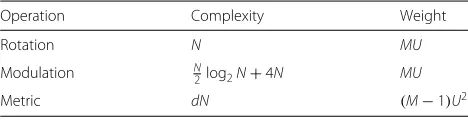
crot=N. (17) In poly-phase filtering operation, we perform IFFT and filtering withh(t). OQAM mapping involves complex-to-real symbol mapping. It may seem that one has to perform two real IFFT operations. Nevertheless, it is possible to compute two real IFFTs simultaneously like a single com-plex IFFT operation without increasing the number of complex multiplications [26]. The same can be applied in filtering withh(t). Thus, the computational complexity involved in FBMC-OQAM modulationcmodis given as
cmod=
In the metric calculation operation, we needNcomplex multiplications to find the peak. Thecmetdepends onT0 and is given as
cmet=dN, (19)
whereT0is the duration of time in terms ofNanddis a constant that represents the number of successive symbol intervals, considered for metric calculation.
The computational complexity in the case of TSLM is summarized in Table 1, and its general expression is given below
5.2 Derivation of computational complexity in MBJO-PTS for multiplications
In PTS scheme, we individually perform phase rotation in time domain to theVsub-blocks and then add them, lead-ing toWV different signal patterns, whereWis the total number of candidate phases that is to be chosen for a sub-block. MBJO-PTS scheme is a trellis-based adaption of classical PTS scheme to FBMC-OQAM system by multi-block joint optimization and is presented in [18]. Unlike SLM, in any PTS-based scheme, we can perform phase rotation in time domain. This avoids the need for multiple FBMC-OQAM modulation operations. Thus, the
com-Table 1Multiplication computational complexity in TSLM
Operation Complexity Weight
Rotation N MU
Modulation N2log2N+4N MU
Metric dN (M−1)U2
plexity due to FBMC-OQAM modulation in a PTS-based schemeˆcmodcan be reduced as NV-point IFFT.
Since we consider a certain time durationT0for partial PAPR calculation, we need dN complex multiplications within that time duration. The computational complex-ity involved in phase rotation operation for MBJO-PTS schemeˆcmetis given by
ˆ
crot=dNV. (23)
The computational complexity involved in metric calcu-lation for MBJO-PTS schemeˆcmet is given by
ˆ
cmet=dN. (24)
General expression for MBJO-PTS computation com-plexity for MFBMC-OQAM symbols has been derived similarly based on the information in Table 2
cMBJO=M
From (20) and (25), it is clear that, in FBMC-OQAM with TSLM and MBJO-PTS, the complexities involved in rotation and metric calculation are linear w.r.tN, whereas the modulation complexity with TSLM and MBJO-PTS are of order O(N2log2(N)) and O(2NV log2(NV)), respec-tively. It implies that the modulation operation has much significant complexity than the remaining ones. From the size of the phase rotation point of view, the complexity is solely dominated byUin TSLM. On the contrary, it is distributed betweenVandWin MBJO-PTS.
5.3 Condition for identical computational complexity In order to avail a fair comparison, the condition for iden-tical computation complexity in both TSLM and MBJO-PTS schemes is given by
cTSLM=cMBJO. (27)
Table 2Multiplication computational complexity in MBJO-PTS
Operation Complexity Weight
Rotation dNV MW
Modulation 2NVlog2NV+4N MV
By substituting (20) and (25) in (27), we obtain therefore, it can be neglected. Eq. 28 is simplified
dU2+
The possible root U in ideal case for the quadratic function (29), denoted byUrootis given by
Uroot=
whereis the discriminant, which is given by
=
5.4 Derivation of addition computational complexity in TSLM and MBJO-PTS
The computational complexity due to complex addi-tions for M FBMC-OQAM symbol, in the TSLM and MBJO-PTS schemes, is summarized in the Table 3. The expressions for computational complexity due to com-plex additions for TSLM and MBJO-PTS can be derived accordingly in a similar fashion to that of complex mul-tiplications. However, in the case of MBJO-PTS, we need to take into account the extra V additions needed per symbol, due to sub-block re-addition.
6 Simulation results
The objective of the simulations is to analyze the per-formance of low latency TSLM scheme in comparison with OFDM when classical SLM scheme is used. Simula-tions are done for a FBMC-OQAM signal that has been generated from 1054QAM symbols with 64 tones. The PHYDYAS prototype filter [22], which spans over 4T was used by default unless specified otherwise. The range of the complex phase rotation vector was chosen such as
Table 3Addition comparison of computational complexities of the TSLM and MBJO-PTS
schemes are implemented over discrete-time signals. So, we need to sample the continuous-time FBMC-OQAM signalx(t), thereby obtaining its discrete-time signals[n]. In order to well approximate the PAPR, we have over-sampled the modulated signal by a factor of 4 [27] and then implemented the TSLM scheme on the discrete-time signal s[n]. Exponential function has been used as the functionf in (8), when calculating the path metrics. We have tried to see the impact of higher constellation on PAPR reduction with TSLM but found 16QAM to be more or less the same as 4QAM.
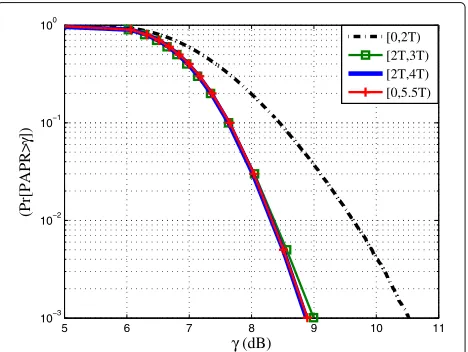
6.1 Impact of variation ofT0duration
When step 3 of the TSLM algorithm is proposed, we are interested with the PAPR related to themth and(m+1)th input symbols over the durationT0∈[mT+Ta,mT+Tb). Looking at Fig. 1, we can notice that these two symbols have an impact on the overall signal mainly in the interval [mT+T,mT+4T] (i.e.,Tamin=TandTbmax=4T. As shown in Fig. 3, choosingTa = 2T andTb = 4T seems to be the lower bound as it yields better performance than the remaining intervals. If we choose intervalsTa > 2T orTb<3T, then there is a significant degradation on the performance. In conclusion, it was found that the inter-valsTa = 2T andTb = 4T are a quasi-optimal choice, meanwhile having a lower complexity.
6.2 Comparison of TSLM and exhaustive search approach In an exhaustive search overMsymbols, allUMpossible phase rotations are tested and the best one is chosen. With the trellis-based approach, onlyU2 possible phase rota-tions are tested in step 3 of the TSLM algorithm andUof them are kept as surviving paths. By avoiding exhaustive search, we hamper optimality in trellis-based approaches.
5 6 7 8 9 10 11
Thus, any trellis-based approach lags behind exhaustive search approach.
So, we tried to analyze how much better the TSLM fares in terms of PAPR reduction, w.r.t. exhaustive search approach. Since, it is not possible to simulate an exhaus-tive search over 105symbols, we have considered 10 sym-bols withU = 2 and performed Monte Carlo simulation for 10000 number of times to be sufficient. It means we have to perform a search over 1024 different patterns and pick the one with the least PAPR. In Fig. 4, we have plotted the CCDF of PAPR for TSLM and exhaustive search. We can notice from this figure that TSLM is indeed a quasi-optimal approach. Because, we loose a mere 0.65 dB at 10−3of CCDF of PAPR, while reducing the computational complexity fromO(UM)toO(M−1)U2.
6.3 Impact of the size ofU
Like any SLM scheme, the size of phase rotation vector impacts the performance of the PAPR reduction. With OFDM, we have only U possible phase rotations for PAPR reduction in the time interval T because we have a symbol-by-symbol approach. Whereas with FBMC-OQAM, we haveUM possible phase rotations for reduc-ing the PAPR in the time interval (M + 3.5)T. The ratio of number of possible phase rotation divided by the impacted time interval is always better for FBMC-OQAM explaining the fact that trellis-based approach can outper-form the peroutper-formance of OFDM for the same number of phase rotation vectorsU.
For an illustration of impact ofU, we have considered T0 =[mT +2T,mT +4T). The different sizes consid-ered are U = {2, 4, 8}. The values at 10−3 of CCDF of PAPR in Fig. 5 has been summarized in Table 4. We can see from this table that the FBMC-OQAM with TSLM has outperformed the OFDM with classical SLM by 0.35,
5 5.5 6 6.5 7 7.5 8 8.5 9 10−3
10−2 10−1 100
(Pr[PAPR>
γ
])
γ (dB)
TSLM SLM (Optimal)
Fig. 4CCDF of PAPR for FBMC-OQAM symbols with TSLM and with an exhaustive search,T0=[2T, 4T)withU=2 and PHYDYAS filter
5 6 7 8 9 10 11
10−3 10−2 10−1 100
(Pr[PAPR>
γ
])
γ (dB)
OFDM FBMC
Original
U=8
U=4 U=2
Fig. 5CCDF of PAPR for FBMC-OQAM symbols,T0=[ 2T, 4T)with
U=2, 4, 8 and PHYDYAS filter
0.24, and 0.02 dB at 10−3value of CCDF of PAPR when U = 2,U = 4, andU = 8, respectively. It is worth not-ing that at 10−3 value of CCDF of PAPR when U = 2, we are able to achieve 1.73-dB PAPR reduction from the original signal with an SI of 1 bit. Such proper exploitation can be possible with the trellis-based approach instead of symbol-by-symbol optimization. Another observation is that the lead gap between CCDF curves of OFDM and FBMC-OQAM gets narrowed asUincreases.
6.4 Impact of traceback depth∂on latency and hardware memory
Even though TSLM is quasi-optimal, as mentioned earlier, it is important to take into account the hardware memory and latency induced by this algorithm. We can observe in Fig. 1 that most of the energy of a FBMC-OQAM sym-bol lies in its succeeding two symsym-bols rather than its own period interval. This is due to the fact that the prototype filter overlapping factorK = 4. So, it is of considerable interest to consider the cases of∂ = {1, 2, 3}. The reason behind choosing∂ = {1, 2, 3}is that the prototype filter overlapping factor K = 4, e.g.,∂ = {2}, means, at any mth stage, we have to traceback until the(m−2)th stage, in order to identify survivor paths. If we do not alter the ∂, then we have to wait for the processing of allM sym-bols (105in our simulation). For these values along with ∂= {105}, we have plotted the CCDF of PAPR in Fig. 6. In the legend of that figure, “∂ =105” indicates the original
Table 4CCDF of PAPR at 10−3value (in dB) forN=64
Modulation type Reduction scheme U=2 U=4 U=8
OFDM Classical SLM 9.21 8.19 7.48
5 6 7 8 9 10 11 10−3
10−2 10−1 100
(Pr[PAPR>
γ
])
γ (dB)
∂=105 ∂=3 ∂=2 ∂=1
Fig. 6CCDF of PAPR for FBMC-OQAM symbols with∂= {105, 3, 2, 1},
T0=[2T, 4T),U=2, and PHYDYAS filter
TSLM and “∂= {1, 2, 3}” indicate low-latency TSLM with different traceback depths.
The case of ∂ = 1 may seem like that of DSLM [17], but it is different. In the case of DSLM, the choice of optimal rotation of a given mth input symbol vec-tor Xm depends only on the past input symbol vectors
Xm−1,. . .,X0, whose optimal rotations have already been fixed, whereas for low-latency TSLM with∂ = 1, at the mth stage, it shall depend not only on past input symbol vectors but also on one succeeding future input symbol vector Xm+1, as we perform joint modulation in step 3 of the TSLM algorithm. So, when we move to the next (m+1)th stage in the trellis, the optimal choice (i.e., the survivor path) may vary and this may have impacted the decision in the previous stage. Then, the choice of themth stage should bear with the incorrect decision, and this in turn will impact the PAPR reduction. Also, the possibility of incorrect decision will increase along withUleading to much sub-optimal performance for higher value ofU. As seen in Fig. 6, the PAPR reduction performance of low-latency TSLM with∂=1 lags the TSLM with∂=105by around 0.8 dB at 10−3value of CCDF of PAPR.
However, for∂=2, we are rectifying the above gap by a large extent. Even though it has sub-optimal performance, it is worth noting that low-latency TSLM with∂ =2 lags the TSLM with∂=105by around 0.37 dB at 10−3value of CCDF of PAPR. Finally, we have observed that low-latency TSLM with∂=3 reaches the quasi-optimal performance of TSLM. But, in this case, the latency is substantially reduced from 105 stages to 3 stages and we need very less hardware memory, since we store just 2NUcomplex time samples instead of 105NU. The latency and the num-ber of complex time samples needed to store for different values of∂ have been summarized in Table 5, where we can see the tradeoff between latency and PAPR reduction
Table 5Impact of∂on latency and hardware memory for
N=64 andU=2
Traceback depth∂ Latency Complex time 10−3value of CCDF samples to be stored of PAPR (dB)
100,000 100, 000T 12.8×10⁶T 8.86
3 3 384T 8.86
2 2 256T 9.23
1 1 128T 9.64
performance. If there is a constraint on latency or hard-ware memory, then a low-latency TSLM with∂ = {2, 3} can be considered, which have tolerable sub-optimal and quasi-optimal performances respectively.
6.5 Impact of choice of the metric function
The choice of metric function f(.) in Eq. (8) seems to have some impact on the performance in terms of PAPR mitigation. Two different functions, namely, linear and exponential functions, have been chosen to understand the impact of choice of the metric functionf(.)on the per-formance of the TSLM scheme. As shown in Fig. 7, for low values of the PAPR, the PAPR reduction performance with exponential function is almost as same as that with the linear one, albeit, lagging minutely. Very small perfor-mance gain can be seen at high values of the PAPR. This can be explained by the fact that the exponential function puts more weightage to higher peaks than the linear one in identifying the set of optimal phase rotation vectors. Although we do consider exponential function in all our simulation, we suggest that it can be sufficient to choose a linear metric function.
5 5.5 6 6.5 7 7.5 8 8.5 9 10−3
10−2 10−1 100
(Pr[PAPR>
γ
])
γ (dB)
Linear Exponential
Fig. 7CCDF of PAPR for FBMC-OQAM symbols,T0=[2T, 4T),U=2,
5 5.5 6 6.5 7 7.5 8 8.5 9 10−3
10−2 10−1 100
(Pr[PAPR>
γ
])
γ (dB)
TSLM, U=3 MBJO−PTS, V=2 TSLM, U=14 MBJO−PTS, V=4
Fig. 8CCDF of PAPR for FBMC-OQAM symbols,T0=[2T, 4T)with
U=8 with PHYDYAS filter
6.6 Comparison of TSLM with existing probabilistic schemes
Among the SLM-based schemes, the TSLM has been already been compared with DSLM in [19], where it have been shown that it is superior to any scheme based on symbol-by-symbol approach. DSLM has superior perfor-mance than OSLM, as shown in [28]. MBJO-PTS is a trellis-based scheme, which yields quasi-optimal perfor-mance among the PTS schemes. In fact, fair comparison of any PTS and SLM scheme cannot be possible, if both schemes do not exhibit the same computational com-plexity [24]. So, we try to compare the multiplications computational complexity of MBJO-PTS with TSLM by keeping the number of tones, type of modulation, the pro-totype filter, andT0 duration identical. The value ofW is 2 as per the proposed MBJO-PTS scheme [18]. The value of Uroot calculated for V = {2, 4} according to (30) is found to be 3 and 14, respectively. The compar-ison of the performance of MBJO-PTS for V = {2, 4} andW = 2 w.r.t. TSLM scheme for corresponding val-ues ofU = {3, 14}can be seen in Fig. 8. The number of complex multiplications and additions needed for imple-mentation of TSLM and MBJO-PTS algorithms over 105 FBMC-OQAM symbols has been summarized in Table 6.
Table 6Computational complexities of the TSLM and MBJO-PTS
forN=64
Complex
PAPR reduction scheme Multiplications Additions
TSLM (U=3) 269×106 211×106
MBJO-PTS (V=2,W=2) 323×106 298×106
TSLM (U=14) 3226×106 986×106
MBJO-PTS (V=4,W=2) 3494×106 3443×106
At CCDF of PAPR equal to 10−3in Fig. 8, we can infer that the FBMC-OQAM with TSLM leads the MBJO-PTS scheme in PAPR reduction by roughly 0.7 and 0.2 dB for U=3 andU=14, respectively.
To do a complex multiplication, we need to per-form three complex additions. So, we can compute from Table 6 the relative reduction in computational complexity of TSLM w.r.t MBJO-PTS. Thus, we have found that the proposed TSLM method with U =
{3, 14} reduces the overall complexity in terms of com-plex additions, by 19.65 and 23.42% compared with the MBJO-PTS method with V = {2, 4} and W = 2, respectively.
7 Conclusions
Since FBMC-OQAM signals have high PAPR, there is a dire need to probe for suitable PAPR reduction schemes. This paper is an extension of the recently proposed TSLM. In this paper, the computational complexity of the TSLM scheme has been derived and low-latency TSLM has been proposed, which not only can yield tolerable sub-optimal or same performance to that of TSLM but also has very low latency and needs less hardware memory. Then, the impact of time duration of partial PAPR on the performance of TSLM is studied and its lower bound has been identified by proposing suitable time duration. A thorough and fair comparison of performance has been done with an existing trellis-based scheme proposed in literature, and the simulation results show that low-latency TSLM yields better performance with relatively low latency.
Acknowledgements
The work done in this paper is financially supported by the French National Research Agency (ANR) project ACCENT5 with grant agreement code:
ANR-14-CE28-0026-02.
Competing interests
The authors declare that they have no competing interests.
Received: 7 November 2015 Accepted: 25 November 2016
References
1. BF Boroujeny, OFDM Versus Filter Bank Multi-carrier. IEEE Signal Proc.Mag.
8(3), 92–112 (2006)
2. X Li, LJ Cimini, Effects of clipping and filtering on the performance of OFDM. IEEE Commun.Lett.2(5), 131–133 (1998)
3. TA Wilkinson, AE Jones, in45th IEEE Veh.Technol. Conf. Minimisation of the peak-to-mean envelope power ratio of multi-carrier transmission schemes by block coding, vol. 2, (Chicago, 1995), pp. 925–829 4. J Tellado, J Cioffi, inIEEE CTMC, GLOBECOM. Peak power reduction for
multicarrier transmission (IEEE Publication, Sydney, 1998) 5. H Ochiai, A novel trellis shaping design with both peak and average
power reduction for OFDM systems. IEEE Trans.Commun.52(11), 1916–1926 (2004)
6. BS Krongold, DL Jones, PAR reduction in OFDM via active constellation extension. IEEE Trans. Broadcast.49, 258–268 (2003)
7. RW Bauml, RFH Fischer, JB Huber, Reducing the peak-to-average power ratio of multi-carrier modulation by selected mapping. IEE Electron. Lett.
8. SH Muller, JB Huber, OFDM with reduction peak to average power ratio by optimum combination of partial transmit sequences. IEEE Electron. lett.33, 368–369 (1997)
9. N van der Neut, B Maharaj, F de Lange, G Gonzalez, F Gregorio, J Cousseau, inEURASIP Journal on Advances in Signal Processing. PAPR reduction in FBMC using an ACE-based linear programming optimization, vol. 2014, no. 172 (Springer Publications, 2014)
10. Z Kollar, P Horvath, inHindawi Journal of Computer Networks and Communications. PAPR Reduction of FBMC by Clipping and its Iterative Compensation, vol. 2012, no. 382736 (Hindawi Publications, 2012) 11. Z Kollar, L Varga, B Horvath, P Bakki, J Bito, inHindawi Scientific World
Journal. Evaluation of Clipping Based Iterative PAPR Reduction Techniques for FBMC Systems, vol. 2014, no. 841680 (Hindawi Publications, 2014) 12. B Horvath, P Horvath, inIEEE European Wireless Conference. Establishing
Lower Bounds on the Peak-to-Average-Power Ratio in Filter Bank Multicarrier Systems, (Budapest, 2015), pp. 1–6
13. S Lu, D Qu, Y He, Sliding Window Tone Reservation Technique for the Peak-to-Average Power Ratio Reduction of FBMC-OQAM Signals. IEEE Wireless Commun. Lett.1(4), 268–271 (2012)
14. KC Bulusu, H Shaiek, D Roviras, inIEEE International Symposium on Wireless Communication Systems. Reduction of PAPR of FBMC-OQAM Signals by Dispersive Tone Reservation Technique, (Brussels, 2015), pp. 561–565 15. G Cheng, H Li, B Dong, S Li, An improved selective mapping method for
PAPR reduction in OFDM/OQAM system. Scientific Research Communications and Network Journal.5(3C), 53–56 (2013) 16. A Skrzypczak, P Siohan, JP Javaudin, in63rd IEEE Veh.Technol. Conf.
Reduction of the peak-to-average power ratio for OFDM-OQAM modulation, vol. 4, (Melbourne, 2006), pp. 2018–2022 17. KC Bulusu, H Shaiek, D Roviras, R Zayani, in11th IEEE International
Symposium on Wireless Communication Systems. PAPR Reduction for FBMC-OQAM Systems Using Dispersive SLM Technique, (Barcelona, 2014), pp. 568–572
18. D Qu, S Lu, T Jiang, Multi-Block Joint Optimization for the
Peak-to-Average Power Ratio Reduction of FBMC-OQAM Signal. IEEE Trans.Signal Process.61(7), 1605–1613 (2013)
19. KC Bulusu, H Shaiek, D Roviras, inIEEE International Conference on Communications. Potency of Trellis-Based SLM over the
Symbol-by-Symbol Approach in Reducing PAPR for FBMC-OQAM Signals, (London, 2015), pp. 4757–4762
20. P Siohan, C Siclet, N Lacaille, Analysis and design of OFDM/OQAM systems based on filter bank theory. IEEE Trans.Signal Process.50, 1170–1183 (2002)
21. BL Floch, M Alard, C Berrou, Coded orthogonal frequency division multiplex. IEEE Proc.83(6), 982–996 (1995)
22. M Bellanger, inIEEE International Conference on Acoustic, Speech and Signal Processing. Specification and design of prototype filter for filter bank based multi-carrier transmission, (Salt Lake City, 2001), pp. 2417–2420 23. R Bellamen,Applied Dynamic Programming. (Princeton University Press,
New Jersey, 1962)
24. C Siegl, RFH Fischer, inIEEE International ITG Workshop on Smart Antennas. Comparison of partial transmit sequences and selected mapping for peak-to-average power ratio reduction in MIMO OFDM, (Darmstadt, 2008), pp. 324–331
25. A Burg, VLSI Circuits for MIMO Communication Systems, Ph.D. Thesis, ETH Zurich (2006)
26. E Chu, A George,Inside the FFT Black Box: Serial and Parallel Fast Fourier Transform Algorithms, Computational Mathematics Series. (CRC Press, Boca raton, 1999)
27. Tellado J, Peak to Average Ratio Reduction for Multi-carrier Modulation, Ph.D. Thesis, Stanford University, Stanford, CA, USA (1999)
28. KC Bulusu, Performance Analysis and PAPR Reduction Techniques for Filter-Bank based Multi-Carrier Systems with Non-Linear Power Amplifiers, Ph.D. Thesis, Conservatoire National des Arts et Métiers, Paris, France (2016)
Submit your manuscript to a
journal and benefi t from:
7Convenient online submission
7Rigorous peer review
7Immediate publication on acceptance
7Open access: articles freely available online
7High visibility within the fi eld
7Retaining the copyright to your article