R E S E A R C H
Open Access
A computer-aided diagnosing system
in the evaluation of thyroid
nodules
—
experience in a specialized
thyroid center
Shujun Xia
†, Jiejie Yao
†, Wei Zhou, Yijie Dong, Shangyan Xu, Jianqiao Zhou and Weiwei Zhan
*Abstract
Background:The evaluation of thyroid nodules with ultrasonography has created a large burden for radiologists. Artificial intelligence technology has been rapidly developed in recent years to reduce the cost of labor and improve the differentiation of thyroid malignancies. This study aimed to investigate the diagnostic performance of a novel computer-aided diagnosing system (CADs: S-detect) for the ultrasound (US) interpretation of thyroid nodule subtypes in a specialized thyroid center.
Methods:Our study prospectively included 180 thyroid nodules that underwent ultrasound interpretation. The CADs and radiologist assessed all nodules. The ultrasonographic features of different subtypes were analyzed, and the diagnostic performances of the CADs and radiologist were compared.
Results:There were seven subtypes of thyroid nodules, among which papillary thyroid cancer (PTC) accounted for 50.6% and follicular thyroid carcinoma (FTC) accounted for 2.2%. Among all thyroid nodules, the CADs presented a higher sensitivity and lower specificity than the radiologist (90.5% vs 81.1%; 41.2% vs 83.5%); the radiologist had a higher accuracy than the CADs (82.2% vs 67.2%) for diagnosing malignant thyroid nodules. The accuracy of the CADs was not as good as that of the radiologist in diagnosing PTCs (70.9% vs 82.1%). The CADs and radiologist presented accuracies of 43.8% and 60.9% in identifying FTCs, respectively.
Conclusions:The ultrasound CADs presented a higher sensitivity for identifying malignant thyroid nodules than experienced radiologists. The CADs was not as good as experienced radiologists in a specialized thyroid center in identifying PTCs. Radiologists maintained a higher specificity than the CADs for FTC detection.
Keywords:Thyroid nodule, CADs, Experienced radiologists
Background
The incidence of thyroid cancer has increased exponen-tially in the past decades and is ascribed to the improved ultrasonographic techniques and the application of
fine-needle aspiration (FNA) [1, 2]. Among these new cases,
papillary thyroid cancer (PTC) accounts for the largest percentage with a high number of papillary thyroid microcarcinomas (PTMCs, < 1 cm) [3]. However, the
overall mortality of thyroid cancer has remained stable during these years [2]. The growing incidence of thyroid nodules also causes an increased burden to radiologists in diagnosing thyroid cancers based on ultrasound (US) imaging, which outperforms other imaging modalities in diagnosing thyroid nodules.
Artificial intelligence (AI) technology has been devel-oped in recent years. Preliminary studies have shown major AI applications in imaging the breast [4], fetus [5], carotid [6], thyroid [7], liver [8], etc. Several deep learn-ing technologies for the ultrasound computer-aided diagnosis system (CADs) are frequently utilized in inves-tigations to support the clinical diagnosis [9]. A new
© The Author(s). 2019Open AccessThis article is distributed under the terms of the Creative Commons Attribution 4.0 International License (http://creativecommons.org/licenses/by/4.0/), which permits unrestricted use, distribution, and reproduction in any medium, provided you give appropriate credit to the original author(s) and the source, provide a link to the Creative Commons license, and indicate if changes were made. The Creative Commons Public Domain Dedication waiver (http://creativecommons.org/publicdomain/zero/1.0/) applies to the data made available in this article, unless otherwise stated. * Correspondence:[email protected]
†Shujun Xia and Jiejie Yao contributed equally to this work.
CADs for thyroid ultrasound imaging, also known as
“S-detect,” has been recently introduced to improve the
thyroid US interpretation and provide assistance in the morphologic analysis of thyroid nodules. The proposed CADs provides preprocessing and refines segmentation processing before the ultrasonographical features are ex-tracted from thyroid ultrasound images. The automatic classification system was developed after reviewing the extracted ultrasonographic features and validating the performance by comparing the results to the patho-logical results.
The CADs was designed with the purpose of increas-ing the diagnostic confidence for accurate and consistent recommendations. S-detection was preliminarily tested in a small number of patients [10]. In the current study, we extended the sample volume and aimed to investigate the diagnostic performance of this novel CADs in pre-dicting thyroid nodules. This is the first report of the CADs evaluating pathological subtypes of thyroid nod-ules. Moreover, we compare the abilities of the CADs and experienced radiologists in a specialized thyroid cen-ter for thyroid US incen-terpretation.
Methods Patients
A total of 180 thyroid lesions in 171 consecutive patients who were scheduled for US-guided FNA or US examina-tions prior to scheduled surgery in our department from June 12, 2017,~June 30, 2017, were enrolled in this study. None of the patients had previously undergone surgeries in the neck. There were 32 male and 139 fe-male patients, and the mean age was 47.2 years (range 21–83 years). This prospective study was approved by the Institutional Review Board of our hospital, and writ-ten informed consent was acquired from patients before the US examination.
Pathological analysis was performed to diagnose sus-pected nodules that underwent surgery. Benign nodules were diagnosed based on any of the following criteria: (1) benign according to FNA cytology or postoperative pathology or (2) benign US features including purely cystic or partially cystic nodules with comet tail artifacts or a spongiform appearance.
US examination
RS80A with Prestige (Samsung Medison, Co., Ltd., Seoul, Korea) ultrasound diagnostic equipment was ap-plied for the thyroid image acquisition with a 3–12 MHz linear array probe. The US features of the thyroid nod-ules were analyzed by one experienced radiologist with 20 years of experience in US thyroid examinations. The clinical history of the patients, including the results of prior US examinations and blood tests, was presented to the radiologist before imaging. The patients were placed
in a supine position, and the anterior neck area was fully exposed. Dynamic scanning from the superior of the thyroid lobe to the inferior of the thyroid lobe and from the lateral neck to trachea was performed. Static images of the transverse and longitudinal dimensions of each target thyroid nodule were routinely collected. The gray-scale ultrasonographic features of the thyroid nodules were observed, including composition (solid: no obvious cystic content, mainly solid: < 50% cystic, mainly cystic: > 50% cystic or spongiform appearance), echogenicity, margin (well-defined, lobulated, or ill-defined), calcifica-tion (microcalcificacalcifica-tions, macrocalcificacalcifica-tions, eggshell calcifications, mixed calcifications that contain both mi-cro- and macrocalcifications, none), orientation, and shape. Color Doppler ultrasound was also included to analyze the degree of blood flow in the suspected thyroid nodule. We divided the blood flow according to a previ-ous report [11], as follows: grade 0, without blood flow; grade I, low blood flow with 1–2 punctuate or rod-like blood vessels; grade II, medium blood flow with three or four blood vessels, one of which is longer than the radius of the nodule; and grade III, high blood flow with more than four visible blood vessels or interconnected angio-genesis pattern, interwoven into a network. (Fig.1).
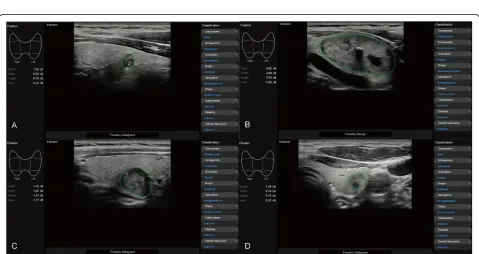
Application of the computer-aided diagnosing system Real-time CAD system software (S-Detect for Thyroid; Samsung Medison, Co. Ltd., Seoul, Korea) using artificial intelligence was integrated into the RS80A with Prestige (Samsung Medison, Co. Ltd., Seoul, Korea) US diagnos-tic system. The US features of the thyroid nodules iden-tified by the CADs were reviewed by another senior radiologist who had 20 years of experience in diagnostic thyroid imaging. When the CADs was applied, a region of interest (ROI) was automatically drawn along the border of the target nodule by the US unit, and several candidates were available for the selection (Fig.2). When the boundary of the nodule that was automatically drawn by the CADs was considered insufficient for the evaluation, a manual drawing of the boundary was ap-plied. The US features, including composition, echogeni-city, orientation, margin, spongiform appearance, shape, calcifications, and vascularity, were used for the analysis. The final evaluations from the CADs were in dichoto-mized form as possibly benign or possibly malignant.
Statistical analysis
All tests and calculations were performed with Statistical Program for Social Sciences 19.0 software (SPSS, Chi-cago, IL, USA). Descriptive variables are presented as the mean ± SD. Categorical variables are described as
proportions. Chi-square (X2) tests and Fisher’s exact
tests were applied to compare the categorical variables.
Fig. 1Grayscale and Doppler US examination of thyroid nodules.a,bA solid hypoechoic nodule with microcalcifications, a nonparallel pattern and low blood flow;c,dA well-defined heterogeneous nodule with macrocalcifications, a parallel pattern and high blood flow;e,fAn ovoid to round hypoechoic nodule with low blood flow
Fig. 2Application of the CADs on thyroid nodules.aA PTC nodule was identified as possibly malignant with the CADs;bA follicular thyroid adenoma was identified as possibly benign with the CADs;cA follicular thyroid carcinoma was identified as possibly malignant with the CADs.d
the nodule sizes between two independent groups. ROC curves and AUCs were used to compare the diagnostic efficiencies of the CADs and the radiologists. The sensi-tivity, specificity, positive predictive value (PPV), nega-tive predicnega-tive value (NPV), and diagnostic accuracy were calculated with diagnostic testing. Cohen’s kappa coefficient was used to analyze the interobserver agree-ment for each US feature of the thyroid nodules.P< 0.05 was considered statistically significant.
Results
Of these 180 nodules, the malignant thyroid nodules
were papillary thyroid carcinomas (PTCs, n= 91) and
follicular thyroid carcinomas (FTCs,n= 4), while the be-nign thyroid nodules were follicular thyroid adenomas (FTAs, n= 25), goiters (n= 46), cysts (n= 10), subacute thyroiditis (n= 2), and Hashimoto’s thyroiditis (n= 2). In total, 75 benign nodules were confirmed with FNA or a postoperative pathological diagnosis, and 10 were con-firmed with benign US features. PTCs accounted for 50.6% of all thyroid nodules, and FTCs accounted for
2.2% of all thyroid nodules. There were 16.1% (n= 29)
follicular thyroid neoplasms, including FTAs and FTCs.
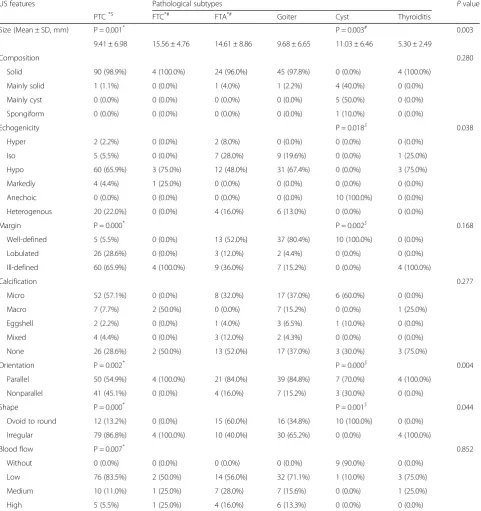
Table 1 summarizes the grayscale and color Doppler
ultrasonographic features of the thyroid nodules based on different subtypes. Solid nodules with hypoechogeni-city accounted for the largest proportion among the 180 lesions. The follicular neoplasms were significantly larger than PTCs and benign lesions, such as goiters, cysts, and
thyroiditis (P= 0.001), whereas the FTAs were almost
the same size as FTCs. Ill-defined margins were more likely to be found in PTCs (P= 0.000) than in follicular neoplasms and were often observed in thyroiditis than in other benign neoplasms; nevertheless, well-defined mar-gins were more frequently observed in follicular neo-plasms, goiters, and cysts than in other subtypes. The four FTCs were all found to have ill-defined margins. Nonparallel patterns were more often observed in PTCs than in the other subtypes (P= 0.002). Additionally, fol-licular neoplasms were more likely to have an ovoid to
round shape (P= 0.000) and medium to high blood flow
(P= 0.007) than PTCs in the current study. There were
no significant differences regarding composition and cal-cifications among all the thyroid nodule subtypes.
Table 2 presents the assessments of the CADs and
radiologist of the 180 thyroid nodules based on different subtypes. When evaluating PTCs, the CADs had a higher rate of malignancies than the radiologist (90.1% vs 83.5%). Among the follicular thyroid neoplasms, the CADs correctly diagnosed all four FTCs, while the radi-ologist found only one FTC; however, the radiradi-ologist correctly evaluated 23 (92.0%) FTAs, while the CADs di-agnosed only 10 (40.0%).
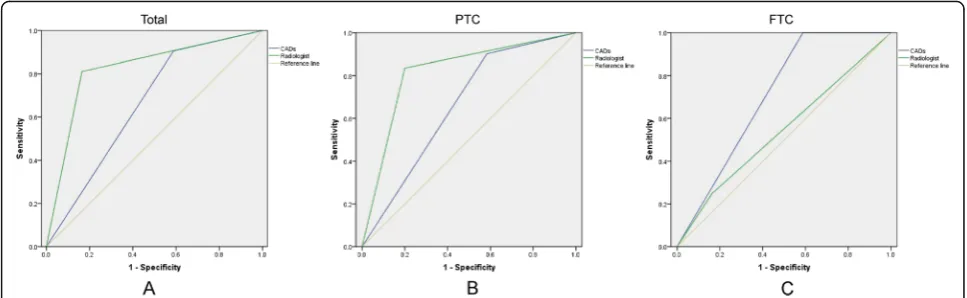
The diagnostic performance of the CADs and
radiolo-gist was compared and is shown in Table 3 and Fig. 3.
When FTCs were excluded, the sensitivity of the CADs in diagnosing malignancies (PTC) was higher than that of the radiologist (90.1% vs 83.5%), while the specificity of the CADs in diagnosing malignancies (PTCs) was much lower than that of the radiologist (41.7% vs 80.0%); the accuracy of the CADs was not as good as that of the radiologist in diagnosing PTCs. When PTCs were excluded, the sensitivity of the CADs in diagnosing malignancies (FTCs) was higher than that of the radiolo-gist (100.0% vs 25.0%), while the specificity of the CADs in diagnosing malignancies (FTC) was much lower than that of the radiologist (41.2% vs 83.5%). Both the CADs and radiologist had quite high NPVs (100.0% vs 95.9%) but quite low PPVs (7.4% vs 6.7%). When diagnosing FTCs, both the CADs and radiologist presented rela-tively low accuracies (43.8% vs 60.9%), and with no dif-ferences (P= 0.166). Among all of these thyroid nodules, the CADs presented a higher sensitivity and lower speci-ficity than the radiologist (90.5% vs 81.1%; 41.2% vs 83.5%); however, the overall accuracy of the radiologist was higher than that of the CADs (82.2% vs 67.2%) for diagnosing malignant thyroid nodules.
The interobserver agreement between the CADs and radiologist in terms of US features was fair-to-substantial (kappa = 0.40~0.75): composition (kappa = 0.694), echo-genicity (kappa = 0.742), orientation (kappa = 0.703), and spongiform appearance (kappa = 0.551). Poor interob-server agreement was considered“marginal,”as the kappa value was lower than 0.40 (kappa = 0.332). The extent of interobserver agreement between the CADs and radiolo-gist in terms of the final evaluation was substantial (kappa = 0.719).
Discussion
relatively lower performance than the experienced radiolo-gist in identifying FTCs.
Sonographic patterns of thyroid cancers were estab-lished and pubestab-lished by the American Thyroid Associ-ation in 2015 to estimate the risk of malignancy and to guide FNAs [15]. The Thyroid Imaging Reporting and
Data System (TI-RADS), a well-known quantitative risk stratification system for thyroid nodules, was also estab-lished based on the specific sonographic features of PTCs [16,17]. The basic ultrasonographic features of evaluated thyroid nodules include composition, echogenicity, mar-gin, calcifications, taller-than-wide appearance, shape, and Table 1US features of thyroid nodules based on pathological subtypes
US features Pathological subtypes Pvalue
PTC*$ FTC*# FTA*# Goiter Cyst Thyroiditis
Size (Mean ± SD, mm) P = 0.001* P = 0.003# 0.003
9.41 ± 6.98 15.56 ± 4.76 14.61 ± 8.86 9.68 ± 6.65 11.03 ± 6.46 5.30 ± 2.49
Composition 0.280
Solid 90 (98.9%) 4 (100.0%) 24 (96.0%) 45 (97.8%) 0 (0.0%) 4 (100.0%)
Mainly solid 1 (1.1%) 0 (0.0%) 1 (4.0%) 1 (2.2%) 4 (40.0%) 0 (0.0%)
Mainly cyst 0 (0.0%) 0 (0.0%) 0 (0.0%) 0 (0.0%) 5 (50.0%) 0 (0.0%)
Spongiform 0 (0.0%) 0 (0.0%) 0 (0.0%) 0 (0.0%) 1 (10.0%) 0 (0.0%)
Echogenicity P = 0.018$ 0.038
Hyper 2 (2.2%) 0 (0.0%) 2 (8.0%) 0 (0.0%) 0 (0.0%) 0 (0.0%)
Iso 5 (5.5%) 0 (0.0%) 7 (28.0%) 9 (19.6%) 0 (0.0%) 1 (25.0%)
Hypo 60 (65.9%) 3 (75.0%) 12 (48.0%) 31 (67.4%) 0 (0.0%) 3 (75.0%)
Markedly 4 (4.4%) 1 (25.0%) 0 (0.0%) 0 (0.0%) 0 (0.0%) 0 (0.0%)
Anechoic 0 (0.0%) 0 (0.0%) 0 (0.0%) 0 (0.0%) 10 (100.0%) 0 (0.0%)
Heterogenous 20 (22.0%) 0 (0.0%) 4 (16.0%) 6 (13.0%) 0 (0.0%) 0 (0.0%)
Margin P = 0.000* P = 0.002$ 0.168
Well-defined 5 (5.5%) 0 (0.0%) 13 (52.0%) 37 (80.4%) 10 (100.0%) 0 (0.0%)
Lobulated 26 (28.6%) 0 (0.0%) 3 (12.0%) 2 (4.4%) 0 (0.0%) 0 (0.0%)
Ill-defined 60 (65.9%) 4 (100.0%) 9 (36.0%) 7 (15.2%) 0 (0.0%) 4 (100.0%)
Calcification 0.277
Micro 52 (57.1%) 0 (0.0%) 8 (32.0%) 17 (37.0%) 6 (60.0%) 0 (0.0%)
Macro 7 (7.7%) 2 (50.0%) 0 (0.0%) 7 (15.2%) 0 (0.0%) 1 (25.0%)
Eggshell 2 (2.2%) 0 (0.0%) 1 (4.0%) 3 (6.5%) 1 (10.0%) 0 (0.0%)
Mixed 4 (4.4%) 0 (0.0%) 3 (12.0%) 2 (4.3%) 0 (0.0%) 0 (0.0%)
None 26 (28.6%) 2 (50.0%) 13 (52.0%) 17 (37.0%) 3 (30.0%) 3 (75.0%)
Orientation P = 0.002* P = 0.000$ 0.004
Parallel 50 (54.9%) 4 (100.0%) 21 (84.0%) 39 (84.8%) 7 (70.0%) 4 (100.0%)
Nonparallel 41 (45.1%) 0 (0.0%) 4 (16.0%) 7 (15.2%) 3 (30.0%) 0 (0.0%)
Shape P = 0.000* P = 0.001$ 0.044
Ovoid to round 12 (13.2%) 0 (0.0%) 15 (60.0%) 16 (34.8%) 10 (100.0%) 0 (0.0%)
Irregular 79 (86.8%) 4 (100.0%) 10 (40.0%) 30 (65.2%) 0 (0.0%) 4 (100.0%)
Blood flow P = 0.007* 0.852
Without 0 (0.0%) 0 (0.0%) 0 (0.0%) 0 (0.0%) 9 (90.0%) 0 (0.0%)
Low 76 (83.5%) 2 (50.0%) 14 (56.0%) 32 (71.1%) 1 (10.0%) 3 (75.0%)
Medium 10 (11.0%) 1 (25.0%) 7 (28.0%) 7 (15.6%) 0 (0.0%) 1 (25.0%)
High 5 (5.5%) 1 (25.0%) 4 (16.0%) 6 (13.3%) 0 (0.0%) 0 (0.0%)
PTCpapillary thyroid carcinoma,FTCfollicullar thyroid carcinoma,FTAfollicullar thyroid adenoma,USultrasound *
PTC vs FTC + FTA $
PTC vs goiter, cyst, and thyroiditis #
blood flow, with different weights for each feature [18]. The most important aspect of these risk stratification sys-tems is whether they offer a better diagnostic performance than the other systems and whether they are simple, which will provide easy implementation in everyday prac-tice. The CADs in this study reviewed the images and ex-tracted these basic ultrasonographic features, and the performance was validated according to the final patho-logical diagnosis. An intermediate suspicion (10–20%) of thyroid cancer is considered for solid and hypoechoic nodules. When irregular shapes, ill-defined margins, or taller than wide signs were present for the same nodule, a higher suspicion for malignancy is recommended [19]. The composition, echogenicity, orientation, margin, and shape were automatically analyzed by the CADs. Micro-calcifications are also regarded as a suspected feature of thyroid malignancies [20, 21]. Vascularity could also be a complementary tool in the differentiation of thyroid nod-ules [22, 23]. Elasticity could be detected, but it was not included in the analysis at this time. As stiffness could be an indicator of aggressiveness [24], an evaluation of elasti-city may improve the performance of the CADs in diag-nosing thyroid nodules.
Follicular neoplasms presented a unique pattern of ultrasonographic characteristics. The follicular thyroid neoplasms were reported to be much larger in size than PTCs. Well-defined margins and regular shapes are com-monly considered indications of benign thyroid nodules, but they are frequently observed in follicular adenomas and carcinomas [25], leading to an underestimation of the
follicular thyroid nodule classifications. Our study also showed a different ultrasonographic pattern of follicular neoplasms from PTCs and goiters. This study demon-strated that follicular neoplasms were larger in size and more often ovoid or round in shape with well-defined margins than PTCs and goiters, which was consistent with previous studies [26]. Thus, follicular carcinoma, which can only be confirmed by histopathology, was highly likely to be considered benign under the TI-RADS risk stratifi-cation, which is a widely used categorization system in China. In our study, follicular neoplasms were more likely to be found with a larger size, ovoid shape, and well-defined margins, which are regarded as benign ultrasono-graphic features of thyroid nodules. In this study, only four FTCs were included; the CADs correctly diagnosed all four FTCs, while the radiologist found only one FTC. However, the radiologist correctly evaluated most of the FTAs (92.0%), while the CADs diagnosed no more than half of these lesions (40.0%). For follicular neoplasms, the CADs had a lower accuracy than the experienced radiolo-gist in detecting FTCs, as radioloradiolo-gists maintained a higher specificity in identifying FTCs. However, there was a lim-ited number of FTCs in our study, which may lead to bias. A larger sample size of FTCs could be included for future analyses.
Several studies have reported the performance of dif-ferent types of CADs platforms for thyroid nodules, but most of these data were acquired only in the lab without clinical training. S-detect is a commercially used CADs; thus, it acquires data from patients. Our study showed Table 2Assessment of thyroid nodules according to CADs and radiologist
Pathological subtypes Pvalue
PTC* FTC*# FTA*# Goiter Cyst Thyroiditis
CADs P = 0.040* P = 0.020# 0.267
PTCpapillary thyroid carcinoma,FTCfollicullar thyroid carcinoma,FTAfollicullar thyroid adenoma,CADscomputer-aided diagnosis system,PBpossibly benign,PM possibly malignant
*
PTC vs FTC + FTA #
FTC + FTA vs goiter, cyst, and thyroiditis
Table 3Performance of CADs and radiologist in evaluation of malignant thyroid nodules
CADs Radiologist
Sensitivity (%) Specificity (%) NPV (%) PPV (%) Accuracy (%) Sensitivity (%) Specificity (%) NPV (%) PPV (%) Accuracy (%)
All 90.5 41.2 79.5 63.2 67.2 81.1 83.5 79.8 84.6 82.2
PTC 90.1 41.7 73.5 70.1 70.9 83.5 80.0 76.2 86.4 82.1
FTC 100.0 41.2 100.0 7.4 43.8 25.0 83.5 95.9 6.7 60.9
that the performance of the CADs was not as good as that of the experienced radiologist in our center, which is a specialized center for thyroid ultrasound. The US CADs provided considerable sensitivity (> 0.0%), which was better than that of the experienced radiologist. Considering the labor required to interpret thyroid US images, using the CADs for a pre-evaluation could po-tentially save some time, with the radiologist making the final decision for the positive cases identified by the CADs. The specificity of the experienced radiologist was higher for identifying thyroid malignancies than that of the CADs. Thus, an experienced radiologist could rule out the benign thyroid nodules identified by the CADs. However, a comparison of the CADs and inexperienced radiologists in diagnosing thyroid nodules has not been conducted in this study.
There are still several limitations in this study. First, we included nodules subjected to US-guided FNAs or US examinations prior to scheduled surgery. Therefore, the proportion of malignancies was rather high, which may have influenced the diagnostic performance of the CADs. Second, non-mass lesions were not included in the study population since the analysis of the CADs was limited for non-mass lesions. Third, most of the malig-nancies were classical PTCs. As the US features of follicular variant PTCs, follicular thyroid carcinomas, medullary thyroid carcinomas, and other malignancies differ somewhat from those of classical PTCs, large population studies are required.
In conclusion, the ultrasound CADs (S-detect) pre-sented a higher sensitivity in identifying malignant thy-roid nodules than experienced radiologists. This study showed that the CADs was not as good as experienced radiologists in a specialized thyroid center in identifying PTCs. Radiologists maintained a higher specificity than the CADs for FTC detection.
Acknowledgements
None.
Authors’contributions
SX and JY contributed to the manuscript preparation and data analysis. WZ contributed to the study design. JZ contributed to the manuscript editing. WZ, YD, and SX contributed to the image collection. All authors read and approved he final manuscript.
Funding
This work was supported by the National Natural Science Foundation of China (81671688) and Shanghai Jiao Tong University Medicine-Engineering Cooperation Program (YG2017QN56).
Availability of data and materials
Not applicable.
Ethics approval and consent to participate
Institutional Review Board of Rui Jin Hospital and written informed consent was acquired from patients before the US examination.
Consent for publication
Not applicable.
Competing interests
The authors declare that they have no competing interests.
Received: 14 July 2019 Accepted: 14 November 2019
References
1. Grainger S, Traver D, Willert K. Wnt signaling in hematological malignancies. Prog Mol Biol Transl Sci. 2018;153:321.
2. Chen W, Zheng R, Baade PD, Zhang S, Zeng H, Bray F, et al. Cancer statistics in China, 2015. CA Cancer J Clin. 2016;66:115.
3. Kitahara CM, Sosa JA. The changing incidence of thyroid cancer. Nat Rev Endocrinol. 2016;12:646.
4. Kim K, Song MK, Kim EK, Yoon JH. Clinical application of S-detect to breast masses on ultrasonography: a study evaluating the diagnostic performance and agreement with a dedicated breast radiologist. Ultrasonography. 2017; 36:3.
5. Yaqub M, Kelly B, Papageorghiou AT, Noble JA. A deep learning solution for automatic fetal neurosonographic diagnostic plane verification using clinical standard constraints. Ultrasound Med Biol. 2017;43:2925.
and carotid atherosclerosis using ultrasound images: a review. Phys Med. 2017;33:1.
7. Acharya UR, Sree SV, Krishnan MM, Molinari F, Zieleźnik W, Bardales RH, et al. Computer-aided diagnostic system for detection of Hashimoto thyroiditis on ultrasound images from a polish population. J Ultrasound Med. 2014;33:245. 8. Byra M, Styczynski G, Szmigielski C, Kalinowski P, MichałowskiŁ,
Paluszkiewicz R, et al. Transfer learning with deep convolutional neural network for liver steatosis assessment in ultrasound images. Int J Comput Assist Radiol Surg. 2018.
9. Huang Q, Zhang F, Li X. Machine learning in ultrasound computer-aided diagnostic systems: a survey. Biomed Res Int. 2018;2018:5137904. 10. Yoo YJ, Ha EJ, Cho YJ, Kim HL, Han M, Kang SY. Computer-aided diagnosis
of thyroid nodules via ultrasonography: initial clinical experience. Korean J Radiol. 2018;19:665.
11. Adler DD, Carson PL, Rubin JM, Quinn-Reid D. Doppler ultrasound color flow imaging in the study of breast cancer: preliminary findings. Ultrasound Med Biol. 1990;16:553.
12. Stepan-Buksakowska IL, Accurso JM, Diehn FE, Huston J, Kaufmann TJ, Luetmer PH, et al. Computer-aided diagnosis improves detection of small intracranial aneurysms on MRA in a clinical setting. AJNR Am J Neuroradiol. 2014;35:1897. 13. Moga TV, Popescu A, Sporea I, Danila M, David C, Gui V, et al. Is contrast
enhanced ultrasonography a useful tool in a beginner’s hand? How much can a computer assisted diagnosis prototype help in characterizing the malignancy of focal liver lesions? Med Ultrason. 2017;19:252. 14. Melany M, Chen S. Thyroid cancer: ultrasound imaging and fine-needle
aspiration biopsy. Endocrinol Metab Clin N Am. 2017;46:691. 15. Clark TJ, McKinney K, Jensen A, Patel NU. Risk threshold algorithm for
thyroid nodule management demonstrates increased specificity and diagnostic accuracy as compared with American College of Radiology Thyroid Imaging, reporting and data system; Society of Radiologists in ultrasound; and American Thyroid Association Management Guidelines. Ultrasound Q. 2019.
16. Tessler FN, Middleton WD, Grant EG, Hoang JK, Berland LL, Teefey SA, et al. ACR Thyroid Imaging, Reporting and Data System (TI-RADS): white paper of the ACR TI-RADS committee. J Am Coll Radiol. 2017;14:587.
17. Zheng Y, Xu S, Kang H, Zhan W. A single-center retrospective validation study of the American College of Radiology Thyroid Imaging Reporting and Data System. Ultrasound Q. 2018;34:77.
18. Jun P, Chow LC, Jeffrey RB. The sonographic features of papillary thyroid carcinomas: pictorial essay. Ultrasound Q. 2005;21:39.
19. Haugen BR, Alexander EK, Bible KC, Doherty GM, Mandel SJ, Nikiforov YE, et al. 2015 American Thyroid Association management guidelines for adult patients with Thyroid nodules and differentiated thyroid cancer: the American Thyroid Association guidelines task force on thyroid nodules and differentiated thyroid cancer. Thyroid. 2016;26:1.
20. Uyar O, Cetin B, Aksel B, Dogan L, Beksac K, Akgul GG, et al. Malignancy in solitary thyroid nodules: evaluation of risk factors. Oncol Res Treat. 2017;40:360. 21. Topaloglu O, Baser H, Cuhaci FN, Sungu N, Yalcin A, Ersoy R, et al.
Malignancy is associated with microcalcification and higher AP/T ratio in ultrasonography, but not with Hashimoto’s thyroiditis in histopathology in patients with thyroid nodules evaluated as Bethesda Category III (AUS/ FLUS) in cytology. Endocrine. 2016;54:156.
22. Rosario PW, Silva AL, Borges MA, Calsolari MR. Is Doppler ultrasound of additional value to gray-scale ultrasound in differentiating malignant and benign thyroid nodules? Arch Endocrinol Metab. 2015;59:79.
23. Colakoglu B, Yildirim D, Alis D, Ucar G, Samanci C, Ustabasioglu FE, et al. Elastography in distinguishing benign from malignant thyroid nodules. J Clin Imag Sci. 2016;6:51.
24. Nguyen AV, Nyberg KD, Scott MB, Welsh AM, Nguyen AH, Wu N, et al. Stiffness of pancreatic cancer cells is associated with increased invasive potential. Integr Biol (Camb). 2016;8:1232.
25. Park JW, Kim DW, Kim D, Baek JW, Lee YJ, Baek HJ. Korean thyroid imaging reporting and data system features of follicular thyroid adenoma and carcinoma: a single-center study. Ultrasonography. 2017;36:349. 26. Jeong SH, Hong HS, Lee EH. Can nodular hyperplasia of the thyroid gland
be differentiated from follicular adenoma and follicular carcinoma by ultrasonography? Ultrasound Q. 2016;32:349.
Publisher’s Note