WikiParq: A Tabulated Wikipedia Resource Using the Parquet Format
Marcus Klang, Pierre Nugues
Lund University, Department of Computer science,
Lund, Sweden
[email protected],[email protected]
Abstract
Wikipedia has become one of the most popular resources in natural language processing and it is used in quantities of applications.
However, Wikipedia requires a substantial pre-processing step before it can be used. For instance, its set of nonstandardized annotations, referred to as the wiki markup, is language-dependent and needs specific parsers from language to language, for English, French, Italian,
etc. In addition, the intricacies of the different Wikipedia resources: main article text, categories, wikidata, infoboxes, scattered into the article document or in different files make it difficult to have global view of this outstanding resource. In this paper, we describe
WikiParq, a unified format based on the Parquet standard to tabulate and package the Wikipedia corpora. In combination with Spark, a map-reduce computing framework, and the SQL query language, WikiParq makes it much easier to write database queries to extract specific information or subcorpora from Wikipedia, such as all the first paragraphs of the articles in French, or all the articles on persons
in Spanish, or all the articles on persons that have versions in French, English, and Spanish. WikiParq is available in six language versions and is potentially extendible to all the languages of Wikipedia. The WikiParq files are downloadable as tarball archives from
this location:http://semantica.cs.lth.se/wikiparq/.
Keywords:Wikipedia, Parquet, query language.
1.
Introduction
1.1.
Wikipedia
Wikipedia is a collaborative, multilingual encyclopedia
with more than 35 million articles across nearly 300
lan-guages. Anyone can edit it and its modification rate is of
about 10 million edits per month1; many of its articles are categorized; and its cross-references to other articles (links) are extremely useful to help name disambiguation.
Wikipedia is freely available in the form of dump archives2 and its wealth of information has made it a major resource
in natural language processing applications that range from
word counting to question answering (Ferrucci, 2012).
1.2.
Wikipedia Annotation
Wikipedia uses the so-called wiki markup to annotate the
documents. Parsing this markup is then a compulsory
step to any further processing. As for the Wikipedia
ar-ticles, parts of this markup are language-dependent and
can be created and changed by anyone. For
exam-ple, the {{Citation needed}}template in the English Wikipedia is rendered by {{Citation nécessaire}} in French and {{citazione necessaria}} in Italian. Many articles in French use a date template in the form
of {{Year|Month|Day}}, which is not used in other Wikipedias.
Moreover, the wiki markup is difficult to master for the
mil-lions of Wikipedia editors and, as a consequence, the
arti-cles contain scores of malformed expressions. While it is
relatively easy to create a quick-and-dirty parser, an
accu-rate tool, functional across all the language versions is a
ma-jor challenge.
In this paper, we describe WikiParq, a set of Wikipedia
archives with an easy tabular access. To create WikiParq,
we reformatted Wikipedia dumps from their HTML
render-ing and converted them in the Parquet format. In addition
1
https://stats.wikimedia.org/
2
http://dumps.wikimedia.org/
to the Wikipedia original content, WikiParq makes it easy
to add any number of linguistic layers such as the parts of
speech of the words or dependency relations.
The WikiParq files are available for download as tarball
archives in six languages: English, French, Spanish,
Ger-man, Russian, and Swedish, as well as the Wikidata
con-tent relevant to these languages, from this location:http: //semantica.cs.lth.se/wikiparq/.
2.
Related Work
There are many tools to parse and/or package Wikipedia.
The most notable ones include WikiExtractor (Attardi and
Fuschetto, 2015), Sweble (Dohrn and Riehle, 2013), and
XOWA (Gnosygnu, 2015). In addition, the Wikimedia
foundation also provides HTML dumps in an efficient
com-pression format called ZIM (Wikimedia CH, 2015).
WikiExtractor is designed to extract the text content, or
other kinds information from the Wikipedia articles, while
Sweble is a real parser that produces abstract syntactic trees
out of the articles. However, both WikiExtractor and
Swe-ble are either limited or complex as users must adapt the
output to the type of information they want to extract. In
addition, they do not support all the features of MediaWiki.
A major challenge for such parsers is the template
expan-sion. Dealing with these templates is a nontrivial issue as they can, via the Scribunto extension3, embed scripting lan-guages such as Lua.
XOWA and ZIM dumps are, or can be converted into,
HTML documents, where one can subsequently use HTML
parsers to extract information. The category, for instance, is
relatively easy to extract using HTML CSS class
informa-tion. However, neither XOWA nor ZIM dumps make the
extraction of specific information from Wikipedia as easy
as database querying. In addition, they cannot be easily
ex-tended with external information.
3
3.
The Wikipedia Annotation Pipeline
The Wikipedia annotation pipeline consists of five different
steps:
1. The first step converts the Wikipedia dumps into
HTML documents that we subsequently parse into
DOM abstract syntactic trees using jsoup.
2. The second step consists of a HTML parser that
tra-verses the DOM trees and outputs a flattened
unfor-matted text with multiple layers of structural
informa-tion such as anchors, typeface properties, paragraphs,
etc. At the end of this step, we have the text and easily
parseable structural information.
3. The third step consists of a linking stage that associates
the documents and anchors with unique identifiers,
ei-ther Wikidata identifiers (Q numbers) or, as a fallback,
Wikipedia page titles.
4. The fourth step annotates the resulting text with
gram-matical layers that are entirely parametrizable and that
can range from tokenization to semantic role labelling and beyond. The linguistic annotation is provided by
external language processing tools. This step is
op-tional.
5. The fifth and final stage links mentions of proper nouns
and concepts, possibly ambiguous, to unique entity
identifiers. As in the third step, we use the Wikidata
nomenclature to identify the entities. This fifth step is
also optional.
3.1.
Wiki Markup and HTML Parsing
The first and second steps of the annotation pipeline parse
and convert the dumps into an intermediate document
model. As input data, the markup parser uses either HTML
documents from ZIM archives or XOWA outputs. It then
uses the jsoup HTML parser4to build the document object model (DOM) of every page, where we extract the text,
sec-tions, paragraphs, infoboxes, anchors (the wiki links),
ta-bles, and lists.
The parser recursively traverses the HTML DOM and uses
heuristic hints based on the CSS classes and HTML tags
such as <table>, <p>, <ol>, and <ul> to carry out the information extraction. It outputs the flattened text and
nine independent sequences of ranges, where the sequences
describe respectively the tokens, sections, paragraphs, list
items, list sections, anchors, headings, italic and bold
char-acters. This structured data is an intermediate format that
we call the Multilayer Document Model (MLDM), which
is similar to a property graph model. Figure 1 shows the
conversion pipeline from the Wikimedia dumps to the
ab-stract syntactic trees (AST) and MLDM layers.
3.2.
Anchor Resolution
The third step links the documents and anchors to their
en-tityid, a unique entity identifier across Wikipedia language editions available from Wikidata.
4
http://jsoup.org/
Prior to the linking step, we collected a set of entities from
Wikidata, a freely available graph database that connects the
Wikipedia pages across languages. Each Wikidata entity
has a unique identifier, a Q-number, that is shared by all the
Wikipedia language versions on this entity.
The Wikipedia pages onBeijingin English,Pékinin French,
Pequimin Portuguese, and北京in Chinese, are all linked to the Q956 Wikidata number, for instance, as well as 190
others languages. In total, Wikidata covers a set of more
than 16 million items that defines the search space of entity
linking. In the few cases where a Wikipedia page has no
Q-number, we replace it by the page name. In addition to
the Q-numbers, Wikidata structures its content in the form
of a graph, where each node is assigned a set of properties
and values. For instance, Beijing (Q956) is an instance of
a city (Q515) and has a coordinate location of 39°54’18”N,
116°23’29”E (P625).
We implemented the anchor resolver through a lookup
dic-tionary that uses all the Wikipedia page titles, redirects, and
Wikidata identifiers. The page labels,i.e.the page titles and all their synonyms, form the entries of this dictionary, while
the Wikidata identifiers are the outputs. In case a page label
has no Wikidata number, the dictionary uses its normalized
page title.
3.3.
Grammatical Annotation
Once we have extracted and structured the text, we can
ap-ply a grammatical annotation that is language specific.
De-pending on the language, and the components or resources
available for it, the annotation can range from a simple to-kenization to semantic-role labels or coreference chains.
Multilinguality. We implemented the grammatical anno-tation so that it has a multilingual support at the core. All the
language-dependent algorithms are stored in separate
pack-ages and tied to the system through abstractions that operate
on the Multilayer Document Model. More specifically, the
token annotations include a dictionary loosely inspired by
the CoNLL format (Buchholz and Marsi, 2006) extended
with naming conventions from Exner and Nugues (2014).
Dependency Injection. The annotators apply the depen-dency injection(Fowler, 2004) pattern that solves the prob-lem of hard-coded dependencies by making the code only
depend on a dependency injector. The dependency injector is constructed once and reused multiple times. The
injec-tor can be configured to provide different concrete
imple-mentations which allow a high-level way of switching the
implementation of an abstraction. The role of the injector
is to provide instances of requested abstractions as well as
concrete classes. The injector also injects the
dependen-cies needed to construct these instances. We used Guice
(Google, 2011) as base library on top of which we
devel-oped thread-safe constructions to be able to process indices
and storage.
Tool chains. The tool chains are instances of annotators and are specific to the languages we process. For English,
Spanish, and German, we use CoreNLP (Manning et al., 2014). For French, we use CoreNLP for tokenizing the
text and MATE for parsing (Björkelund et al., 2010). For
Wiki markup
}
Nine sequences of ranges describing the structural informationFigure 1: Conversion of Wikipedia dumps into abstract syntactic trees and the Multilayer Document Model (MLDM)
(Nivre et al., 2006). For Russian, there is no linguistic
an-notation and the tool chain is reduced to nothing as of today.
3.4.
Entity Linking
The final step links mentions of named entities and
con-cepts to unique Wikidata identifiers. This last
opera-tion is an opopera-tional step. While Wikidata defines
unam-biguous mappings between a Q-number and
language-dependent strings, strings may have ambiguous Q-numbers. For example, the mention Göran Persson in the Swedish Wikipedia refers to at least four different entities with three
different Q-numbers: A former Swedish prime minister
(Q53747), a progressive musician (Q6042900), a politician
(Q5626648), and a Swedish statesman from the 16th
cen-tury (Q2625684). The latter is also being spelledJöran Per-son.
To carry out the mention disambiguation, we
reimple-mented a variant of TagMe (Ferragina and Scaiella, 2010).
TagMe requires minimal grammatical information as it only
needs a dictionary of mention-entity pairs and of incoming
links. We can then apply it to any of our language versions.
3.5.
Visualizing the Annotations
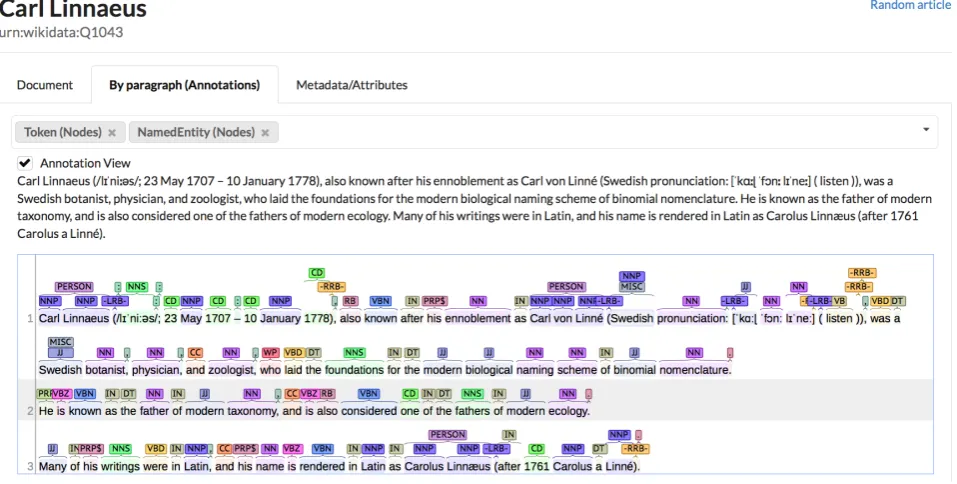
We created a tool to visualize the annotations of the
Mul-tilayer Document Model. The layers are selectable from a
dropdown menu and their visualization uses brat
compo-nents5. Figures 2, 3, and 4 show screenshots with differ-ent layers. They all refer to the Wikipedia articleCarl von Linnéin English.
Figure 2 shows the first paragraph of the article with the
token and named entity layers, while Fig. 3 shows the
en-tity links with those manually marked as anchors in the text
superimposed to the automatically assigned entity links.
The numbers refer to the Wikidata nomenclature. Finally,
Fig. 4 shows the dependency relations. This layer is
op-tional and depends on the availability of a parser for the
language version. This visualization tool is available at: http://vilde.cs.lth.se:8080/.
4.
Parquet: A Storage and Extraction
Format
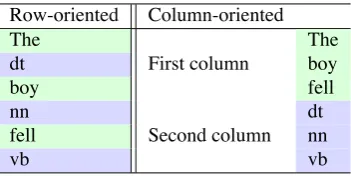
Parquet6 is a popular column-oriented storage format, i.e. a columnar format, where instead of storing a file by row,
the data is structured by column. Table 1 shows a simple
example of data tabulated in two columns, where the first
one consists of words and the second one, of their parts of
5
http://brat.nlplab.org/
6
https://parquet.apache.org/
speech, and Table 2 shows how the first table is stored
us-ing a row-oriented format and a columnar one, where the
columns are stored sequentially.
Word POS
The dt
boy nn
fell vb
Table 1: An example of tabulated data.
Row-oriented Column-oriented
The The
dt First column boy
boy fell
nn dt
fell Second column nn
vb vb
Table 2: Storage organization in row- and column-oriented
formats.
In files with large numbers of columns, the Parquet format
enables a program to read the columns as needed and skip
the others. In addition to providing a faster access to the
selected columns, such a format is also very efficient for
compressing redundant data; something extremely useful in
our case.
5.
The WikiParq Format
We created a program to tabulate and store all the annotation
layers we described in Sect. 3. using the Parquet format.
5.1.
The WikiParq Columns
In its current version, the WikiParq format consists of ten main columns. Some columns borrow concepts from graph
database structures in the form of source nodes, target
nodes (values), and predicates (or properties) between these
nodes:
uri: The wikidata identifier of the document, for instance urn:wikidata:Q34;
lang: The language of the document, for instancedefor German,frfor French;
Figure 2: Visualizing tokens and named entities
Figure 3: Visualizing the links: Anchors and disambiguated mentions of entities and concepts
source: The layer we are annotating. There are two main types of layers consisting of either nodes or edges. The
token layer contains nodes:node/token. It is equiv-alent to a node in a graph, while the dependency layer
uses edges;
sourceId: The identifier of an element in the layer, for in-stance 1 for the first token in a layer;
predicate: The relation annotating the node, for instance the part of speech:token:pos. We use similar proper-ties to annotate a token with its lemma,token:lemma, a head in a dependency graph,token:head, or a re-solved Wikipedia link,link:resolved_target;
value[1-9]: The values of the target node, normally one: value1. For instance, for a token and a part-of-speech property, the value can be a common noun: NN. Some relations, such aslink:resolved_target, have more than one value. In this case, we have value1for the target,value2for the text, etc.
type: The format of the value, which can either be string,range, orreference,doclink,weblink, wikilink(anchor),
valuei1: Start of the range of the node, if this is relevant,
Figure 4: Visualizing the grammatical dependencies
valuei1 = 1andvalue1 = node/token;
valuei2: End of the range of the node, if this is relevant (range).
Table 3 shows examples of Wikiparq annotations for a
whole document, a token, its range and part of speech, as
well as an anchor to theFinlandentity.
5.2.
The WikiParq Predicates
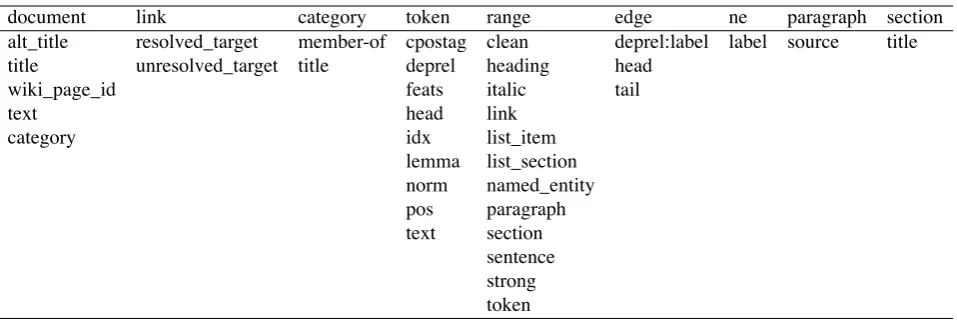
We used a set of predicates to describe the relations linking
a node to its values. This allows us to represent data in the
form of triples consisting of a node, a predicate, and a value.
For instance, the token in Table 3 has a text, a range, and a
part of speech that conceptually correspond to:
wd:Q34/sv/article/node/3614, token:text, "officiellt" wd:Q34/sv/article/node/3614, range:token, "18-28" wd:Q34/sv/article/node/3614, token:cpostag, "ADJ"
This representation is very flexible. For instance, we
desig-nate and annotate token sequences or sentences through the
creation of nodes with ranges corresponding to the spans
of the groups or the sentences. We can also easily merge multiple editions of Wikipedia by just considering the lang
prefix. Table 4 shows the list of all the predicates we are
using so far.
We converted the Wikipedia versions of six languages:
En-glish, French, Spanish, German, Russian, and Swedish,
from archives in the Multilayer Document Model into
WikiParq. We also created a WikiParq version of the
Wikidata content relevant to these languages. We used
Wikipedia dumps from February 3rd or 4th, 2016 and a
Wikidata dump from February 22nd, 2016.
The English WikiParq tar file gives an idea of the resulting
data volume: It is 15 Gbytes large, has 4.8 million articles,
49.8 million paragraphs, and 175 million resolved links. For
Swedish, the total number of triples is of 7.8 billions for the
language-annotated version.
6.
Querying WikiParq
The Parquet format has been integrated in a number of
pro-cessing frameworks including map-reduce based databases.
It is the default storage format of Spark SQL (Armbrust et
al., 2015), a module to query structured data using Spark
(Zaharia et al., 2012). Spark is a memory-based implemen-tation of the map-reduce framework (Dean and Ghemawat,
2008) that has become a very popular tool in cluster
com-puting.
Spark SQL makes it very easy to extract information from
WikiParq as it follows the familiar SQL syntax and, at the same time, is very fast. In addition, processing can
trans-parently be distributed on a cluster. Spark uses the concept
of dataframe, similar to that of R or Python pandas, for
load-ing and savload-ing Parquet files. We can consider dataframes as
wrappers to Spark resilient datasets (RDD) with structured
schemas.
In the next sections, we provide query examples to show
how to extract information from Wikipedia using WikiParq
and the Spark (Scala) API.
6.1.
Loading a File
The API is straightforward and loading a file, here the
En-glish Wikipedia (en_wiki), only needs two instructions:
val en_wiki = sqlContext.read.parquet(filenames) en_wiki.registerTempTable("enwiki")
which result in a table.
6.2.
Extracting Text
To extract all the articles from a Wikipedia version, here
Swedish, we use this simple query:
SELECT uri, lang, value1 AS text FROM svwiki
WHERE predicate = 'document:text'
inside asqlContext.sql().
To count all the nouns in a collection, we use:
SELECT COUNT(*) FROM svwiki
WHERE predicate = 'token:cpostag' AND value1 = 'NOUN'
which results in about 116 millions for Swedish. The
cor-responding number for verbs is 34 millions.
In the subsequent examples, we used the Parquet files of six
languages: de, en, es, fr, ru, and sv, as well as the Wikidata parquet file.
6.3.
Counting the Articles per Language
Once the files are loaded, we can extract data or information
using SQL queries as for instance for this request:
Ann. target uri doc source sourceId predicate value1 valuei1 valuei2 type lang
Document wd:Q34 article null null document:text Sverige... null null string sv
Token text wd:Q34 article node/token 3614 token:text officiellt null null string sv
Token range wd:Q34 article node/token 3614 range:token null 18 28 range sv
Token POS wd:Q34 article node/token 3614 token:cpostag ADJ null null string sv
Link wd:Q34 article node/anchor 2329 link:resolved_target wd:Q33 null null wikilink sv
Table 3: Examples of the Wikiparq annotations for a whole document, here the articleSverige‘Sweden’ in the Swedish Wikipedia, a word in it, hereofficiellt, its range, and part of speech, as well as an anchor (wiki link) toFinland. We abridged urn:wikidata in wd
document link category token range edge ne paragraph section
alt_title resolved_target member-of cpostag clean deprel:label label source title
title unresolved_target title deprel heading head
wiki_page_id feats italic tail
text head link
category idx list_item
lemma list_section
norm named_entity
pos paragraph
text section
sentence
strong
token
Table 4: List of available predicates organized by prefix. To have the full name, the prefix is concatenated to the relation
name, i.e. document:title or link:resolved_target
To carry this out, we first extract the persons from the
Wiki-data ontology. We use theinstance of property (P31) and we keep the entities having the property of being an instance
of a human (Q5). This is translated in SQL as:
sqlContext.sql(""" SELECT uri FROM wikidata
WHERE predicate = 'wd:P31' AND value1 = 'urn:wikidata:Q5'
""").cache().registerTempTable("persons")
and results in a table calledpersons.
We then extract the language versions associated with each
of these entities (persons). We run the extraction using this
query:
sqlContext.sql("""
SELECT wikidata.uri AS uri, lang FROM wikidata
JOIN persons
ON persons.uri = wikidata.uri WHERE predicate = 'wd:sitelink'
""").registerTempTable("person_sitelinks")
that produces a table of entity identifiers (Q-numbers) and
languages. Thewd:sitelinkpredicate enables us to find the language versions of an entity according to Wikidata.
Finally, we count the persons per language using this query:
sqlContext.sql("""
SELECT lang, COUNT(lang) as count
FROM person_sitelinks GROUP BY lang
ORDER BY lang """).show()
This results in a table with the number of persons per
lan-guage version:
+----+---+ |lang| count| +----+---+ | de| 597515| | en|1339313| | es| 274878| | fr| 462839| | ru| 313566| | sv| 183926| +----+---+
6.4.
Counting the Language Versions of an
Article
Going on with this dataset, a second question we may pose
is:
For a given article, how many language versions
are there?
which is translated in SQL as:
sqlContext.sql("""
GROUP BY uri
""").registerTempTable("lang_person")
The excerpt below shows a subset of the first answers to this
question:
The Q-number is the Wikidata identifier of a Wikipedia
en-tity. For instance, Q101916 is the identifier of Friedrich von
Weech, a German regional historian and archivist, who has
German and Swedish versions.
6.5.
Counting Articles with a Constraint on the
Language Versions
At this point, we may wonder:
How many articles are available in the six
ver-sions?
This question is rendered by the following SQL query:
sqlContext.sql(""" SELECT COUNT(uri)
FROM lang_person WHERE numLangs = 6""")
and the answer is: 41,509 articles.
6.6.
Extracting the Text of the Articles
So far, we carried out extractions that could have also been done from Wikidata using the SPARQL language.
WikiParq merges Wikidata and Wikipedia and extends the
query possibilities to span both resources seamlessly as for
instance with this request whose goal could be to build
loosely parallel corpora in six languages:
Extract the text of all the articles with six
lan-guage versions
Such a request is translated by these two following SQL
queries, where the first one selects the articles with six
lan-guage versions:
sqlContext.sql("""
SELECT * FROM lang_person WHERE numLangs = 6
""").cache().registerTempTable("lang6_person")
and the second one outputs the text, here in Swedish:
sqlContext.sql("""
SELECT lang6_person.uri, value1 AS text FROM svwiki
JOIN lang6_person
ON svwiki.uri = lang6_person.uri
WHERE svwiki.predicate = 'document:text' """).show()
6.7.
Extracting all the Mentions of an Entity
A last example shows how to build dictionaries of the wordsor phrases used in Wikipedia to name an entity: A
dictio-nary of mentions. To carry this out, we need to extract all
the labels of a entity in Wikipedia. This operation is easy
to carry out, for instance for Barack Obama in the English
Wikipedia. Barack Obama has Q76 as Wikidata identifier.
This leads to this query:
sqlContext.sql("""
SELECT value1 AS target, value2 AS mention, COUNT(*) AS freq
FROM enwiki
WHERE enwiki.predicate = 'link:resolved_target' AND value1 = 'urn:wikidata:Q76' GROUP BY value1, value2
ORDER BY value1, freq DESC """).show()
that results in a table, where we show the first lines below:
+---+---+---+
| target| mention| freq|
+---+---+---+ |urn:wikidata:Q76| Barack Obama|14960|
|urn:wikidata:Q76| Obama| 887|
|urn:wikidata:Q76| President Obama| 546| |urn:wikidata:Q76|President Barack ...| 142| |urn:wikidata:Q76| Barack H. Obama| 64| |urn:wikidata:Q76| Obama, Barack| 45| |urn:wikidata:Q76| Barack Obama's| 40| |urn:wikidata:Q76| President Obama's| 21|
|urn:wikidata:Q76| Barack| 21|
|urn:wikidata:Q76|President Barack ...| 13| |urn:wikidata:Q76|Obama administration| 9|
|urn:wikidata:Q76| Obama's| 8|
|urn:wikidata:Q76|President-elect O...| 8|
|urn:wikidata:Q76| President| 7|
|urn:wikidata:Q76| Sen. Barack Obama| 7| |urn:wikidata:Q76|Barack Hussein Obama| 7| |urn:wikidata:Q76|Barack Hussein Ob...| 6| |urn:wikidata:Q76|U.S. President Ba...| 6| |urn:wikidata:Q76|Senator Barack Obama| 6| |urn:wikidata:Q76| Barack Obama’s| 5| +---+---+---+
7.
Conclusion
We have described WikiParq, a unified tabulated format that
uses the Parquet standard to package the Wikipedia
framework, and the SQL query language, this format makes
it easy to write concise database queries to extract specific
information from Wikipedia and have the answer in a few
minutes.
Currently, six versions of Wikipedia are available as tarball
archives in the WikiParq format from this location: http: //semantica.cs.lth.se/wikiparq/. We also provide a Parquet version of Wikidata, as well as a Scala program
and a Jupyter notebook to run the examples described in this
paper. We ran and tested all the examples on a laptop with
an Intel i7 processor and 16 Gbytes of memory.
Acknowledgments
This research was supported by Vetenskapsrådet, the
Swedish research council, under the Det digitaliserade samhälletprogram.
8.
Bibliographical References
Armbrust, M., Xin, R. S., Lian, C., Huai, Y., Liu, D.,
Bradley, J. K., Meng, X., Kaftan, T., Franklin, M. J.,
Ghodsi, A., and Zaharia, M. (2015). Spark sql:
Rela-tional data processing in spark. In Proceedings of the 2015 ACM SIGMOD International Conference on Man-agement of Data, SIGMOD ’15, pages 1383–1394. Attardi, G. and Fuschetto, A. (2015). Wikiextractor.
https://github.com/attardi/wikiextractor/.
Björkelund, A., Bohnet, B., Hafdell, L., and Nugues, P.
(2010). A high-performance syntactic and semantic
de-pendency parser. In Coling 2010: Demonstration Vol-ume, pages 33–36, Beijing, August 23-27. Coling 2010 Organizing Committee.
Buchholz, S. and Marsi, E. (2006). CoNLL-X shared task
on multilingual dependency parsing. InProceedings of the Tenth Conference on Computational Natural Lan-guage Learning (CoNLL-X), pages 149–164, New York City, June. Association for Computational Linguistics.
Dean, J. and Ghemawat, S. (2008). Mapreduce: simplified
data processing on large clusters.Communications of the ACM, 51(1):107–113.
Dohrn, H. and Riehle, D. (2013). Design and
implementa-tion of wiki content transformaimplementa-tions and refactorings. In
Proceedings of the 9th International Symposium on Open Collaboration, WikiSym ’13, pages 2:1–2:10.
Exner, P. and Nugues, P. (2014). KOSHIK: A large-scale
distributed computing framework for NLP. In Proceed-ings of ICPRAM 2014 – The 3rd International Confer-ence on Pattern Recognition Applications and Methods, pages 464–470, Angers, March 6-8.
Ferragina, P. and Scaiella, U. (2010). Fast and accurate
annotation of short texts with wikipedia pages. In Pro-ceedings of CIKM’10, Toronto.
Ferrucci, D. A. (2012). Introduction to “This is Watson”.
IBM Journal of Research and Development, 56(3.4):1:1 –1:15, May-June.
Fowler, M. (2004). Inversion of control containers and the
dependency injection pattern. Last accessed:
2013-12-20.
Gnosygnu. (2015). Xowa.
https://github.com/gnosygnu/xowa.
Google. (2011). Guice (version 3.0). Last accessed:
2013-11-10.
Manning, C. D., Surdeanu, M., Bauer, J., Finkel, J.,
Bethard, S. J., and McClosky, D. (2014). The
Stan-ford CoreNLP natural language processing toolkit. In
Proceedings of 52nd Annual Meeting of the Association for Computational Linguistics: System Demonstrations, pages 55–60, Baltimore, Maryland.
Nivre, J., Hall, J., and Nilsson, J. (2006). MaltParser: A
data-driven parser-generator for dependency parsing. In
Proceedings of LREC-2006, pages 2216–2219.
Östling, R. (2013). Stagger: an open-source part of speech
tagger for Swedish. Northern European Journal of Lan-guage Technology, 3:1–18.
Wikimedia CH. (2015). Openzim.
http://www.openzim.org.
Zaharia, M., Chowdhury, M., Das, T., Dave, A., Ma, J.,
McCauley, M., Franklin, M. J., Shenker, S., and Stoica,
I. (2012). Resilient distributed datasets: A fault-tolerant