R E S E A R C H
Open Access
A construction of the high-rate regular
quasi-cyclic LDPC codes
Qi Meng
1, Jia Xiang Zhao
1*, Wei Xu
2and Liang Li
3Abstract
In this paper, a scheme to construct the high-rate regular quasi-cyclic low-density parity-check (QC-LDPC) codes is developed based on the finite geometry low-density parity-check (LDPC) codes. To achieve this, we first decompose the EG-LDPC code into a set of the block submatrices with each of them being cyclic. Utilizing the decomposed structure, we then construct an auxiliary matrix to facilitate us for identifying and eliminating 6-cycles of the block submatrices. In the simulation, seven regular QC-LDPC codes with code rates being 4/5, 7/8, 10/11, 11/12, and 12/13 of moderate code lengths are constructed with this scheme. The performances of these codes demonstrate the effectiveness of the proposed scheme.
Keywords: High-rate, Regular, Quasi-cyclic, Low-density parity-check (LDPC) code
Introduction
Low-density parity-check (LDPC) codes [1], which is one of the main error-correcting codes, has been widely used in various practical applications [2,3]. However, the high-rate regular QC-LDPC codes which are prone to the hard-ware implementation [4] and particularly suited for many practical applications can be constructed only for very restricted code parameters, such as code rate and code length. This is primarily due to the fact that for a given code length, especially short or moderate code lengths, the parity-check matrices of high-rate codes are far more dense than those of low-rate codes, which could lead to making more short cycles. Therefore, it is imperative to research on the schemes that offer a flexibly choosing the code rate and length of the high-rate regular QC-LDPC codes.
Although both QC-LDPC and turbo codes [5, 6] are capable of achieving the near Shannon limit perfor-mances, the QC-LDPC codes in general are easier to implement in practices [7, 8]. For this reason, many schemes have been developed for designing regular QC-LDPC codes, such as FG-QC-LDPC codes [9,10] and LDPC codes of combinatorial designs [11]. These schemes are
*Correspondence:[email protected]
1College of Electronic Information and Optical Engineering, Nankai University, 38 Tongyan Road, Jinnan District, Tianjin 300350, People’s Republic of China Full list of author information is available at the end of the article
also employed in constructing the high-rate regular QC-LDPC codes [12,13].
However, the high-rate regular QC-LDPC codes con-structing from the above schemes usually have very restricted code parameters. That is, for a given cod-ing rate, the above schemes only offer extremely limited choices of the code length. Some examples of these are the class-I circulant EG-LDPC codes [9, 12] and cyclic difference families (CDFs) [14].
In this paper, we utilize the construction of the FG-LDPC codes [9, 10] to develop a scheme for designing the high-rate regular QC-LDPC codes. The design-ing procedure proceeds as follows: We first decom-pose the EG-LDPC or PG-LDPC code into a set of the block submatrices with each of them being cyclic. We then construct a ϕ transformation which acts on the first line of the obtained block subma-trices to yield an auxiliary matrix T
ˆ h
for identify-ing and cancellidentify-ing 6-cycles of the block submatrices. In the simulation, we use this scheme to construct four regular QC-LDPC codes with the code rates being 11/12 and 12/13 which have the code lengths 7560, 1092 and 4095, 8190, respectively. Furthermore, we also employ the same scheme to construct three regular QC-LDPC codes with code rates being 4/5, 7/8, and 10/11 whose lengths are 2925, 7280, and 6930. The performances of these codes demonstrate the effectiveness of the proposed scheme.
A review of cyclic finite geometry LDPC codes
This section gives a brief review of FG-LDPC codes and introduces some definitions as well as notations that are used throughout the rest of the paper.
An m-dimensional finite Euclidean geometry over the field GF(2s) with m and s being the two posi-tive integers, denoted EG(m, 2s), is a set of 2s m-tuples
(a0,a1,· · ·,am−1) where ai ∈ GF(2s) for each i =
0, 1,. . .,m−1 .
Defining the entry-wise addition and multiplication for m-tuples of EG(m, 2s), the set EG(m, 2s)forms a vector comprised of 2spoints is:
Lα(β) = α+aβ|a∈GF2s. (1) belong to the same coset if and only if they are parallel to each other.
Recall thatα is a primitive element of EG(m, 2s). The
parity-check matrixHEGof the Euclidean geometry code is ak×(2ms−1) matrix whose columns correspond to the ordered 1 = α0,α,. . ., α2ms−2. The rows ofHEG correspond to the cosets in EG(m, 2s)which do not con-tain the lines passing through the origin. That is, the
(i,j) entry in HEG is equal to 1 if the ith coset con-tains a line passing the jth point, and is equal to 0 otherwise.
Construction method
In this section, we proceed with the procedure of the construction of the high-rate regular (QC-LDPC) codes through the following three steps: (1) Construct ann×n EG code and transform it into a proper form. (2) Utilize the transformed EG code matrix to construct an auxil-iary matrix for identifying 6-cycles of it. (3) Eliminate the 6-cycles .
Decomposition of EG code matrix
Following [9], we can construct an×nEuclidean geom-etry code Wover the field EG(m = 2 , 2s), where n = 2ms−1 . The constructed matrixWwhich is cyclic can be expressed by its first roww=(ω0,ω1,. . .,ωn−1)as:
For simplicity, we define an operationto represent:
W=(w), (5)
which implies that each row of the cyclic matrixWhas the identical weight.
We assume that the positive integerncan be factored as n=c×bwhereb=1 andc=1 are positive integers with bbeing odd throughout the rest of this paper. Define the subset: Using this partitioning, we obtain a b × n quasi-cyclic matrixHqcas:
λsatisfyingc<2s/λthat ensures the subset (10) is not a
null set.
We define ab×bk1matrixHqcas:
Hqc = [(wi0),(wi1),. . .,(wik1−1)] . (11) Identifying the 6-cycles
In this section, we develop a procedure to eliminate 6-cycles in (11). For this purpose, without loss generality, we assume that we are given:
Hqc=[(v0),(v1),. . .,(vk−1)] , (12)
The first row of (12) is therefore equal to:
h=[v0,v1,. . .,vk−1] . (14) In order to eliminate 6-cycles, we transform matrix (12) into a new matrix of form (17). This leads us to introduce the operationϕwhich is defined as:
ϕ(vi)=
Therefore, we transform (14) into:
ˆ
h=[ϕ(v0),ϕ(v1),. . .,ϕ(vk−1)] . (16) The transformationT mapshˆin (16) to ab×(kb+b−1) matrix is defined as:
Examing (17), we see that the first row of T(hˆ) is obtained through addingb−1 zeros to the end of the vec-torhˆ. Each of the rest rows ofT(hˆ)is the circular shift of the row above it.
The setL(hˆ)comprised of the indices corresponding to the nonzero entries ofhˆin (16) is defined as:
L(hˆ)= {p0,p1,. . .,pρ−1}, (18)
where we have ρ =
k−1
i=0
ri with ri representing the row
weight of(vi). We define an oblique line segment lpi
which starts from pi and forms a descending diagonal
from left to right inT(hˆ),i.e.,lpiconstituting of the set of
Clearly, from the definition, the total number of the oblique line segments of the form (19) isρ. Thus, the set of all the oblique line segments is:
lp0,lp1,. . .,lpρ−1
. (20)
We define the distance between two oblique lines as:
|lpi0 −lpi1| = |pi0−pi1|. (21) From [15], it follows that the possible of 6-cycles appeared in a parity-check matrix is one of the following forms shown in Fig.1.
Case 1: Assume that 6-cycle is comprised of three oblique line segments from (20) . Therefore, from (20), the total number of subsets comprised of three oblique
line segments is ρ
3
. For each subset comprised of three
Fig. 1Six possible loops that yield 6-cycles
If d0
d1 is not equal to either 1
2 or 2, then we delete such a subset comprised of these three oblique line segments. The remaining subsets constitute3which can be repre-sented as:
3=
lpi0,lpi1,lpi2
,lpi3,lpi4,lpi5
,. . .. (23)
Clearly, each subset of three oblique line segments {lpij,lpij+1,lpij+2}in3satisfies:
|lpij+1 −lpij|
|lpij+2 −lpij+1| =
|pij+1−pij|
|pij+2−pij+1|
= 1
2 or 2 . (24)
Figure 2 shows that 6-cycles are constituted by three oblique lines.
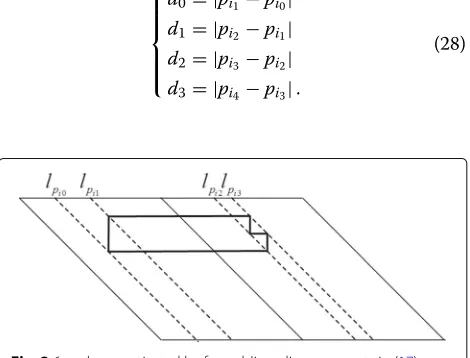
Case 2: Assume that 6-cycle is comprised of four oblique line segments from (20). Therefore, from (20), the total number of subsets comprised of four oblique
line segments is
ρ
4
. For each subset comprised of four
oblique line segments {lpi0,lpi1,lpi2,lpi3} from (20), we
employ (21) to compute:
⎧ ⎪ ⎨ ⎪ ⎩
d0= |pi1−pi0| d1= |pi2−pi1| d2= |pi3−pi2|.
(25)
If the computed distanced0,d1, andd2are not satisfied to any of these equations listed in the following set:
Fig. 26-cycles constituted by three oblique line segments in (17)
⎧ ⎨ ⎩
d0=d1+d2, d1=d0+d2, d2=d0+d1, d0=2d2, d2=2d0, d0=d1+2d2, d2=2d0+d1, d0=d1, d1=d2
⎫ ⎬ ⎭,(26)
then we delete such a subset comprised of these four oblique line segments. The remaining subsets constitute
4which can be represented as:
4=
lpi0,lpi1,lpi2,lpi3
,lpi4,lpi5,lpi6,lpi7
,. . ..
(27)
Figure 3 shows that 6-cycles are constituted by four oblique line segments.
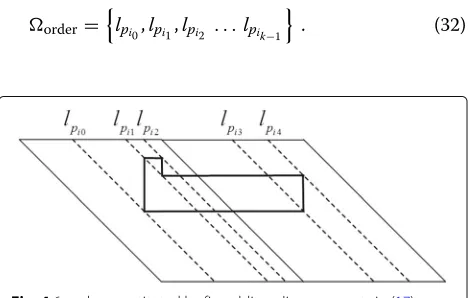
Case 3: Assume that 6-cycle is comprised of five oblique line segments from (20) . Therefore, from (20), the total number of subsets comprised of five oblique line segments
is ρ
5
. For each subset comprised of five oblique line
seg-ments{lpi0,lpi1,lpi2,lpi3,lpi4}from (20), we employ (21) to
compute:
⎧ ⎪ ⎪ ⎪ ⎨ ⎪ ⎪ ⎪ ⎩
d0= |pi1−pi0| d1= |pi2−pi1| d2= |pi3−pi2| d3= |pi4−pi3|.
(28)
If the computed distanced0,d1,d2, andd3are not satisfied to any of these equations listed in the following set:
⎧
then we delete such a subset of these five oblique line seg-ments. The remaining subsets constitute5which can be represented as:
Figure4shows that 6-cycles are constituted by five oblique line segments.
Eliminating 6-cycles
In the following, we proceed with the procedure to elimi-nate 6-cycles.
Step 1: Constructwhich is defined as:
=3∪4∪5, (31)
where3,4, and5are defined by (23), (27), and (30), respectively.
Step 2: Find the oblique line segmentlpi0 that appears in
the maximal number subsets of. Delete all the subsets of containing this oblique line segmentlpi0 and collect
all the remaining subsets ofto form an new subset1. Repeat this process on the subset1to obtainlpi1 and2.
We continue this process tillkforkbeing some positive
integer becomes a null set. In this process, we also obtain an ordered set of oblique line segments which is:
order=
lpi0,lpi1,lpi2 . . .lpik−1
. (32)
Fig. 46-cycles constituted by five oblique line segments in (17)
Step 3: In view of (12), we construct k subsets Q0,Q1,. . .,Qk−1withQj for 0 ≤ j ≤ k−1 being
com-prised of the oblique line segmentslpijinordersatisfying: pij/b =j, (33)
where · denotes the rounding down operation. Recall thatrj for 0 ≤ j ≤ k−1 is the row weight of (vj) in
(12) andλis the pre-chosen positive integer introduced above Eq. (9). If there are more than(rj−λ)oblique line
segments ofordersatisfy (33), then only the first(rj−λ)
oblique line segments appeared in the ordered setorder are chosen to formQj. If there are less than(rj−λ)oblique
line segments oforder satisfy (33), we arbitrarily choose oblique line segments satisfying (33) from (20) that do not belong toorder.
For eachsj, we utilize the inverse of the mapϕdefined in
(15) to yield ab×bmatrixSjas follows:
where the operationis defined in (5). Thus, the quasi-cyclic matrixS
S=[S0,S1,. . .,Sk−1] . (36) In view of Hqc and S defined in (12) and (36), respec-tively, the quasi-cyclic encoding parity-check matrixH(qc1) is therefore equal to:
H(qc1)=Hqc⊕S. (37)
The operator⊕in (37) is defined as the entry-wise XOR operations of matricesHqcandS. From the construction procedure from (12) to (37), it follows that matrixH(qc1)is regular and quasi-cyclic with its column and row weight beingλandkλ, respectively.
Another regular quasi-cyclic parity-check matrix
SubstitutingH(qc1) forHqc and proceeding the procedure from (12) to (36) withλ= 0, we can get a newS(1)from (36). Then, we can construct another regular quasi-cyclic parity-check matrixH(qc2)as follows:
Result and discussion
In example 1 of this section, we utilize the procedure from (4) to (37) to construct a regular quasi-cyclic(4095, 3781) LDPC code as well as (38) to construct regular quasi-cyclic(7560, 6931) and(8190, 7561)LDPC codes where the coding rates of all these three codes are 12/13 .
In example 2, we utilize the procedure from (4) to (37) to construct a regular quasi-cyclic(2925, 2341)LDPC code and a regular quasi-cyclic(4095, 3781)LDPC code where the coding rates of all these two codes are 4/5 and 11/12, respectively.
In example 3 and example 4, the procedure of (4)–(38) is also employed to separately construct a regular quasi-cyclic(6930, 6301)LDPC code and a regular quasi-cyclic
(7280, 6370)LDPC code with the coding rate 10/11 and 7/8, respectively. As a comparison of the performance, we also utilize the schemes from [16–18] to construct six
(4095, 3771), (4095, 3729), (16383, 14923), (8176, 7156),
(1020, 935), and(2850, 2280)QC-LDPC codes. The sim-ulation results in the following examples show that the procedure from (4) to (38) is an effective scheme to yield the high-rate regular QC-LDPC codes with moderate code lengths.
Example 1:Following the scheme of [9], we first con-struct a regular(4095, 3367)EG-LDPC code over the field EG(2, 26). Since we have 4095 = c×bwithc = 13 and b = 315, the procedure from (4) to (8) suggests that the parity-check matrix of the constructed(4095, 3367) EG-LDPC code can be decomposed into 13 submatrices of size b × b shown in (8). Of the 13 submatrices of size b×b, choose the parameterλ= 4 to perform (9) to (11)
where parameterλis introduced above Eq. (9). Then, we select the firstk = 13 submatrices and perform (12) to (37) and (38) separately which yields a regular quasi-cyclic 315× 4095 parity-check matrixH(qc1) defined in (37) as well as a 630×8190 parity-check matrixH(qc2)defined in (38) respectively. The null spaces ofH(qc1)andH(qc2)render a regular quasi-cyclic(4095, 3781)LDPC code as well as a
(8190, 7561)LDPC code with the coding rate 12/13 . Sim-ilarily, we also choose the firstk = 12 submatrices and perform (12) to (38) which yields a regular quasi-cyclic 630×7560 parity-check matrixH(qc2)defined in (38). The null space of thisH(qc2) also renders a regular quasi-cyclic (7560, 6931)LDPC code with the coding rate 11/12 . As a comparison, we also employ the procedure of [16] to con-struct the(4095, 3771)QC-LDPC code with the coding rate being 0.92 .
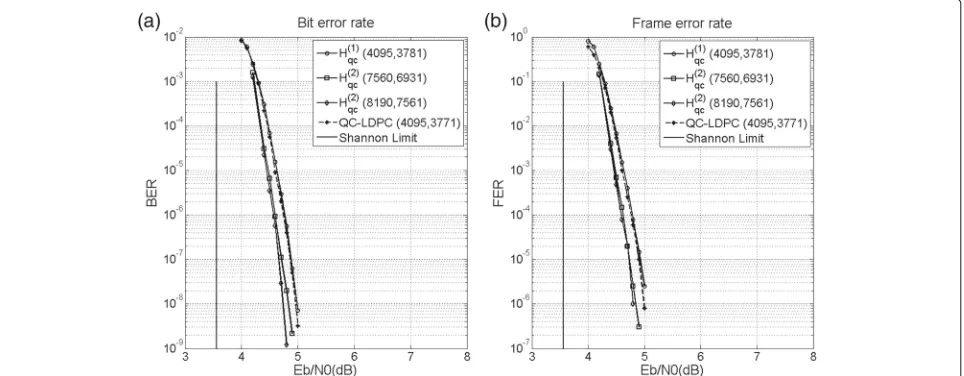
Figure5shows the performances of these codes where it (a) represents the bit error rate (BER) and (b) depicts the frame error rate (FER). In these figures, the cir-cle, box, and diamond solid lines respectively represent the performances of the regular quasi-cyclic(4095, 3781),
(7560, 6931), and (8190, 5161) LDPC codes. The star dotted line corresponds to the performance of the
(4095, 3771)QC-LDPC code generated by [16].
Example 2:Following the scheme of [9], we first con-struct a regular(4095, 3367)EG-LDPC code over the field EG(2, 26). Since we have 4095 = c × b withc = 7, b = 585, and c = 45,b = 91, the procedure from (4) to (8) suggests that the parity-check matrix of the con-structed(4095, 3367)EG-LDPC code can be decomposed
into 7 and 45 submatrices of sizeb×bshown in (8). Of 7 and 45 submatrices of sizeb×b, choose the parameters
λ= 4 andλ= 3 to perform (9) to (11) where parameter
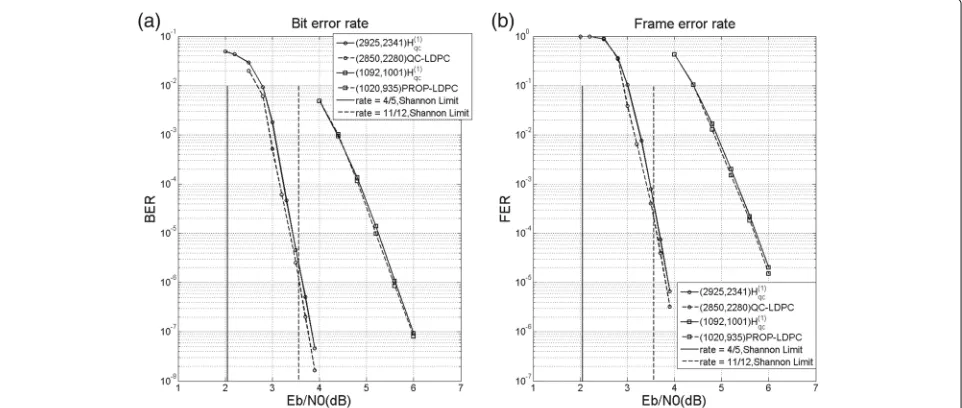
λis introduced above Eq. (9). Then, we select separately the firstk = 5 andk = 12 submatrices then perform (12) to (37) which yields a regular quasi-cyclic 585×2925 and 91×1091 parity-check matrix H(qc1) both defined in (37). As a comparison, we also employ the procedure of [17, 18] construct the (2850, 2280) and(1020, 935) QC-LDPC code with the coding rate being 4/5 and 11/12, respectively .
Figure6shows the performances of these codes where it (a) represents the bit error rate (BER) and (b) depicts the frame error rate (FER). In these figures, the circle and box solid lines respectively represent the performances of the regular quasi-cyclic(2925, 2341)and(1092, 1001)LDPC codes. The circle and box dotted line corresponds to the performance of the(2850, 2280)and 1020,935 QC-LDPC code generated by [17,18].
Example 3:Following the scheme of [9], we first con-struct a regular(4095, 3367)EG-LDPC code over the field EG(2, 26). Since we have 4095 = c×bwithc = 13 and b = 315, the procedure from (4) to (8) suggests that the parity-check matrix of the constructed(4095, 3367) EG-LDPC code can be decomposed into 13 submatrices of sizeb×bshown in (8). Of 13 submatrices of sizeb×b, choose the parameterλ=4 to perform (9) to (11) where parameterλis introduced above Eq. (9). Then, we select the first k = 11 submatrices and perform (12) to (38) which yields a regular quasi-cyclic 630×6930 parity-check
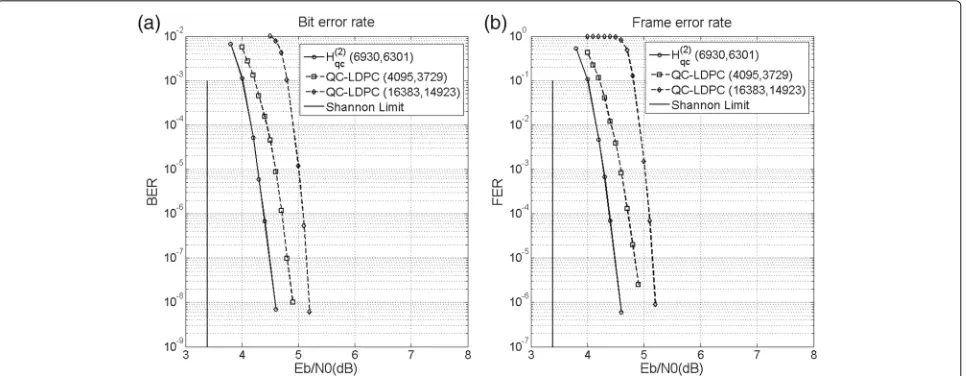
matrixH(qc2) defined in (38). The null space ofH(qc2) ren-ders a regular quasi-cyclic(6930, 6301)LDPC code with the coding rate 10/11 . As a comparison, we also employ the procedure of [16] to construct the (4095, 3729) and
(16383, 14923)QC-LDPC code with the coding rates of both codes being 0.91 .
Figure7shows the performances of these codes where it (a) represents the bit error rate (BER) and (b) depicts the frame error rate (FER). In these figures, the circle solid line represents the performance of the regular quasi-cyclic(6930, 6301)LDPC code constructed from the pro-cedure from (4) to (38). The box and diamond dotted lines respectively correspond to the performances of the
(4095, 3729)and(16383, 14923)QC-LDPC codes yielded from [16].
Example 4:Following the scheme of [9], we first con-struct a regular(4095, 3367)EG-LDPC code over the field EG(2, 26). Since we have 4095 = c×b withc = 9 and b = 455, the procedure from (4) to (8) suggests that the parity-check matrix of the constructed(4095, 3367) EG-LDPC code can be decomposed into nine submatrices of sizeb×bshown in (8). Of the nine submatrices of size b ×b, choose the parameterλ = 4 to perform (9) to (11) where parameterλis introduced above Eq. (9). Then, we select the firstk = 8 submatrices and perform the procedure from (12) to (38) which yields a regular quasi-cyclic 910 × 7280 parity-check matrix H(qc2) defined in (38). The null space of thisH(qc2) renders a regular quasi-cyclic(7280, 6371)LDPC code with the coding rate 7/8 . As a comparison, we also employ the procedure of [16]
Fig. 7 aThe bit error rate andbframe error rate performances of three LDPC codes in example 2 . In these figures, the circle solid line represents the performance of the regular quasi-cyclic(6930, 6301)LDPC code with coding rate 10/11 generated by the procedure from (4) to (38) . The box and diamond dotted lines separately correspond to the(4095, 3729)and(16383, 14923)QC-LDPC codes which are constructed from the procedure of [16]. These 3 LDPC codes are all decoded with 50 iterations of the SPA
to construct the (8176, 7156) QC-LDPC code with the coding rate being 0.875.
Figure8shows the performances of these codes where it (a) represents the bit error rate (BER) and (b) depicts the frame error rate (FER). In these figures, the circle solid line represents the performance of the regular quasi-cyclic
(7280, 6371) LDPC code yielded from the procedure of (4)–(38). The box dotted line corresponds to the perfor-mance of the(8176, 7156)QC-LDPC code (example 7 of [16]) generated by the scheme of [16].
Conclusion
We have presented a scheme to construct the high-rate regular quasi-cyclic low-density parity-check QC-LDPC codes. The construction procedure is based on the FG-LDPC codes in which we first decompose the EG-FG-LDPC code into a set of the block submatrices with each of them being cyclic. Then, we exploit the decomposed structure to produce an auxiliary matrix to facilitate us for identifying and eliminating 6-cycles of the block submatrices. Three regular QC-LDPC codes with code
rates being 7/8, 10/11, and 11/12 of moderate code lengths are constructed in the simulation. The performances of these codes demonstrate the effectiveness of the proposed scheme.
Abbreviations
BER: Bit error rate; CDFs: Cyclic difference families; EG-LDPC: Euclidian geometry low-density parity-check; FER: Frame error rate; FG-LDPC: Finite geometry low-density parity-check; LDPC: Low-density parity-check; PG-LDPC: Projective geometry low-density parity-check; QC-LDPC: Quasi-cyclic low-density parity-check
Acknowledgements
We would like to thank the anonymous reviewers for their insightful comments on the paper, as these comments led us to an improvement of the work.
Funding
This work was supported by the National Natural Science Funds for the Nankai University (No. 61771262).
Availability of data and materials
Not applicable.
Authors’ contributions
JXZ and QM contributed to the main idea and drafted manuscript. QM and WX contributed to the algorithm design, performance analysis, and simulations. LL helped revise the manuscript. All authors read and approved the final manuscript.
Authors’ information
QM is a graduate student at the College of Electronic Information and Optical Engineering at Nankai University. His research interests include digital signal processing and error control coding.
JXZ is a professor at the College of Electronic Information and Optical Engineering at Nankai University. His research interests include biological signal processing, high-speed digital transmission algorithm, and error control coding.
WX is a professor at Tianjin Polytechnic University. Her research interests include digital signal processing and error control coding.
LL is serving as a communications engineer in IP Technology Research Department at Huawei Technologies Co., Ltd.
Competing interests
The authors declare that they have no competing interests.
Publisher’s Note
Springer Nature remains neutral with regard to jurisdictional claims in published maps and institutional affiliations.
Author details
1College of Electronic Information and Optical Engineering, Nankai University,
38 Tongyan Road, Jinnan District, Tianjin 300350, People’s Republic of China.
2Tianjin Polytechnic University, Xiqing District, Tianjin 300387, People’s
Republic of China.3IP Technology Research Department, Huawei
Technologies, Shenzhen 518000, People’s Republic of China.
Received: 19 April 2018 Accepted: 11 December 2018
References
1. R. Gallager, Low-density parity-check codes. IRE Trans. Inform. Theory.
8(1), 21–28 (1962)
2. N. Balasuriya, C. B. Wavegedara, Improved symbol value selection for symbol flipping-based non-binary LDPC decoding. EURASIP J. Wirel. Commun. Netw.2017(1), 105 (2017)
3. K. Kwon, T. Kim, J. Heo, Pre-coded LDPC coding for physical layer security. EURASIP J. Wirel. Commun. Netw.2016(1), 283 (2016)
4. A. Tasdighi, A. H. Banihashemi, author=Sadeghi, M.R., Symmetrical constructions for regular girth-8 QC-LDPC codes. IEEE Trans. Commun.
65(1), 14–22 (2017)
5. S. K. Chronopoulos, G. Tatsis, V. Raptis, P. Kostarakis, inProceedings of the 2nd Pan-Hellenic Conference on Electronics and Telecommunications. A parallel turbo encoder-decoder scheme (Thessaloniki, 2012) 6. S. K. Chronopoulos, G. Tatsis, P. Kostarakis, Turbo codes—a new PCCC
design. Commun. Netw.3(4), 229–234 (2011)
7. B. Bangerter, E. Jacobsen, Ho. Minnie,et al, High-throughput wireless LAN air interface. Intel Technol. J.7(3), 47–57 (2003)
8. IEEE Standard for Local and Metropolitan Area Networks Part 16: Air Interface for Fixed and Mobile Broadband Wireless Access Systems Amendment 2: Physical and Medium Access Control Layers for Combined Fixed and Mobile Operation in Licensed Bands and Corrigendum 1," in IEEE Std 802.16e-2005 and IEEE Std 802.16-2004/Cor 1-2005 (Amendment and Corrigendum to IEEE Std 802.16-2004) , vol., no., pp.0_1-822, 2006 https://doi.org/10.1109/IEEESTD.2006.99107.http://ieeexplore.ieee.org/ stamp/stamp.jsp?tp=&arnumber=1603394&isnumber=33683 9. Y. Kou, S. Lin, M. P. C. Fossorier, Low-density parity-check codes based on
finite geometries: a rediscovery and new results. IEEE Trans. Inform. Theory.47(7), 2711–2736 (2001)
10. H. Tang, J. Xu, Y. Kou, S. Lin, K. Abdel-Ghaffar, On algebraic construction of Gallager and circulant low-density parity-check codes. IEEE Trans. Inform. Theory.50(6), 1269–1279 (2004)
11. B. Vasic, O. Milenkovic, Combinatorial constructions of low-density parity-check codes for iterative decoding. IEEE Trans. Inform. Theory.
50(6), 1156–1176 (2004)
12. N. Kamiya, High-rate quasi-cyclic low-density parity-check codes derived from finite affine planes. IEEE Trans. Inform. Theory.53(4), 1444–1459 (2007)
13. M. Fujisawa, S. Sakata, A construction of high rate quasi-cyclic regular LDPC codes from cyclic difference families with girth 8. IEICE Trans. Fundam. Electron. Commun. Comput. Sci.90(5), 1055–1061 (2007) 14. C. J. Colbourn, J. H. Dinitz, CRC handbook of combinatorial design. Math.
Gaz.81(81), 44–48 (1996)
15. W. Wen, M. Ai, J. Qiu, L. Liu, in2015 IEEE International Conference on Progress in Informatics and Computing (PIC). Novel construction and cycle analysis of quasi-cyclic low-density parity-check codes (Nanjing, 2015), pp. 230–233
16. Q. Huang, Q. Diao, S. Lin, K. Abdel-Ghaffar, in2011 Information Theory and Applications Workshop. Cyclic and quasi-cyclic LDPC codes: new developments, (La Jolla, 2011), pp. 1–10