Bit Error Rate Performance Analysis of a
Threshold-Based Generalized Selection Combining
Scheme in Nakagami Fading Channels
Ahmed Iyanda Sulyman
Electrical and Computer Engineering Department, Faculty of Applied Science, Queen’s University, Kingston, ON, Canada K7L 3N6
Email:[email protected]
Maan Kousa
Electrical Engineering Department, College of Engineering Sciences, King Fahd University of Petroleum & Minerals, Dhahran 31261, Saudi Arabia
Email:[email protected]
Received 2 September 2004; Revised 25 January 2005; Recommended for Publication by C. C. Ko
The severity of fading on mobile communication channels calls for the combining of multiple diversity sources to achieve ac-ceptable error rate performance. Traditional approaches perform the combining of the different diversity sources using either the conventional selective diversity combining (CSC), equal-gain combining (EGC), or maximal-ratio combining (MRC) schemes. CSC and MRC are the two extremes of compromise between performance quality and complexity. Some researches have proposed a generalized selection combining scheme (GSC) that combines the bestMbranches out of theLavailable diversity resources (M≤L). In this paper, we analyze a generalized selection combining scheme based on a threshold criterion rather than a fixed-size subset of the best channels. In this scheme, only those diversity branches whose energy levels are above a specified threshold are combined. Closed-form analytical solutions for the BER performances of this scheme over Nakagami fading channels are derived. We also discuss the merits of this scheme over GSC.
Keywords and phrases: diversity systems, generalized selection combining, threshold-based GSC, mobile communications, Nakagami-mfading.
1. INTRODUCTION
Diversity techniques are based on the notion that errors occur in reception when the channel is in deep fade—a phenomenon more pronounced in mobile communication channels. Therefore, if the receiver is supplied with several replicas, say L, of the same information signal transmitted over independently fading channels, the probability that all theLindependently fading replicas fade below a critical value is pL (where p is the probability that any one signal will
fade below the critical value). The bit error rate (BER) of the system is thus improved without increasing the transmit-ted power [1]. This is traditionally referred to as the diver-sity gain of the system. Most diverdiver-sity considerations have always assumed that the spatial separations among the
(mul-This is an open access article distributed under the Creative Commons Attribution License, which permits unrestricted use, distribution, and reproduction in any medium, provided the original work is properly cited.
tiple) diversity antennas are large enough so that the di-versity branches experience uncorrelated fading, and there-fore the signals received from the different diversity anten-nas are independent. In some practical mobile systems; how-ever, large antenna spacings are not feasible, and therefore the fading statistics of the diversity branches in such cases may be correlated. The impact of fading correlation on the performance of diversity systems has been well studied in the literature (see, e.g., [2,3] and references therein). The gen-eral conclusion from these studies is that the diversity gain of the system is reduced when the diversity branches are cor-related. The severity of this performance gain reduction is usually in correspondence with the level of the fading cor-relations among the diversity channels [2,3]. In this work, however, we focus mainly on the case of uncorrelated diver-sity branches.
traditional combiners are conventional selective combiner
(CSC) which selects the signal from that diversity branch with the largest instantaneous SNR; equal-gain combiner
(EGC) which coherently combines all Ldiversity branches weighting each with equal gain; andmaximal-ratio combiner
(MRC) which coherently combines allLdiversity branches but weighs each with the respective gain of the branch. CSC gives the most inferior BER performance, MRC gives the best and the optimum performance, and EGC has a performance quality in between these two [1].
CSC and MRC are the two extremes of complexity-quality tradeoff. CSC on one end is extremely simple, but the contributions from the other branches are wasted, ir-respective of their strength. MRC on the other end com-bines the outcome of all branches regardless of how poor some of them may be, resulting in the best possible combin-ing performance gain. The cost for this performance is the heavy processing complexity and extremely complicated cir-cuitry required for phase coherence and amplitude estima-tion on each branch. It should be noted that the lower the received SNR, the less efficient the phase and amplitude esti-mation circuit will be; therefore presence of accurate chan-nel state information, often presumed in analytical proce-dures, will not be valid for such branches. Also, processing power and other resources dissipated into combining very weak branches are more costly for wireless and high-order di-versity systems than the marginal contribution such branches make to the total combined SNR. MRC is known to be opti-mal in the BER performance sense. However, when both the BER performance and complexity should be considered, as is the case in mobile systems, then a scheme that has good bal-ance between BER performbal-ance and complexity is required. Mobile units using high-order receiver diversity can rarely af-ford MRC because of power limitations. In addressing this problem, [4] proposes a suboptimal scheme that retains most of the advantages of the MRC scheme, and has been widely studied [5,6,7].
The scheme proposed in [4] combines a fixed number of branches, sayM, that have the largest instantaneous SNR out of theLavailable branches. As 1≤M ≤L, the scheme was called a generalized diversity selection combining (GSC) scheme;M = 1 corresponds to CSC, whileM = L corre-sponds to MRC. Here we refer to that scheme asM-GSC (i.e.,
M-based GSC).
Combining a fixed number of branches, however, has ob-vious shortcomings. At times of deep fade, some of the M
selected branches will still have marginal contribution to the total combined energy and they could be discarded to sim-plify processing. At other times when the channels are good, some of the L−M discarded branches, although inferior to the M selected branches, have significant contribution, and combining them will then be advantageous. AnM-GSC scheme cannot make any advantage of such improvements in channel conditions since M is fixed, and the remaining
L−Mbranches must be discarded regardless of their energy levels. Furthermore, we show later thatM-GSC incurs a ma-jor processing complexity increase in ordering the branches’ SNRs.
The authors have proposed a threshold-based generalized selection combining (T-GSC) scheme that overcomes the aforementioned shortcomings [8]. The T-GSC scheme com-bines all the strong diversity branches available at any time instant, discarding only the weak ones. The proposed scheme is more suitable for mobile channels, which frequently and intermittently improve and degrade during usage, and where power resource savings are critically important and must be made without compromising performance quality. The BER performance of T-GSC was simulated over a Nakagami fad-ing environment, and compared with M-GSC. Apparently, the system in [8] has attracted other researchers [9,10]. In [10], Simon and Alouini analyzed the system for Rayleigh fading channels with a slight modification to the threshold definition.
In this work, we extend our work in [8] by providing a detailed analysis of the BER performance of T-GSC over Nak-agami fading channels. The rest of the paper is organized as follows. In Section 2, we review the combining rules of T-GSC. Detailed analysis of the BER performance of the system is furnished inSection 3. Some results are presented and dis-cussed inSection 4. A comparison between T-GSC andM -GSC is provided inSection 5. Main conclusions of this work are finally summarized inSection 6.
2. PROPOSED T-GSC SCHEME
The proposed scheme combines diversity branches based on a criterion which we call “branch relative strength” (BRS). The BRS is the ratio of the SNR of each branch to the SNR of the best branch at the same instant of time [8]:
BRSi= γi
γmax
, i=1, 2,. . .,L, (1)
whereγmax =max{γ1,γ2,. . .,γL}is the maximum SNR
re-ceived at each time instant, and γi is the SNR in the ith
branch, i = 1, 2. . .,L. The combining rule is then stated as follows: if the BRSiis larger than or equal to a specified
thresholdT (where 0 ≤ T ≤ 1), the branch is combined; otherwise, it is discarded. Equivalently, one could compare eachγitoγth, whereγth=T·γmax.
The T-GSC scheme thus combines only the significant branches at any time, discarding the weak ones whose en-ergy are below the threshold value. Processing resources, no-tably power, are therefore not dissipated in combining very weak branches that have no appreciable contribution to the total combined SNR—extending battery life for mobile units. Significant branches for different mobile situations can be selected by proper choice ofT suitable for the fading envi-ronment and the mobile scenario concerned. A novel advan-tage here is that if all the branches’ SNRs meet the specified threshold (i.e., they are all strong), they are all combined and no useful information is “thrown off.” It is then obvious that
B5
Figure1: Block diagram of the T-GSC scheme (L=5).
channel conditions will thus be reflected in the system per-formance all the time. The scheme is as illustrated inFigure 1 forL=5. In the figure, only branches 1, 2, and 4 are above threshold, and are therefore combined.
Next we derive the BER performance for the above scheme. Nakagamim-fadingis assumed for the channel fad-ing model [11]. Them-distributionproposed by Nakagami [12] is a general fading statistics from which other fading statistics approximating the mobile communication environ-ments can be modeled by setting the Nakagami parameterm
to an appropriate value. We recall thatm = 1 corresponds to Rayleigh, and as mis increased, the fading becomes less severe. Binary PSK signal is used throughout the analysis.
3. BER PERFORMANCE: ANALYTICAL DERIVATION
Given L available diversity branches at the receiver, each branch having instantaneous SNR per bit, γl = α2Eb/N0,
l = 1,. . .,L, whereαis the fading coefficient andEb/N0 is
the transmitted bit-energy-to-Gaussian-noise spectral den-sity ratio. The T-GSC receiver searches for the branch with the maximum SNRγmaxand chooses a threshold based on it.
In contrast to M-GSC in which a fixed number of di-versity branches M is combined, the number of diversity branches to be combined in the T-GSC scheme is a random variablel,l∈ {1,L}. Using the theorem on total probability [13], the average BER for T-GSC can be derived as a weighted sum of the average BER for the M-GSC corresponding to
M=1, 2,. . .,L. Hence,
given that the number of branches combined,M, is equal to the variablel.
Pr(M = l) denotes the probability of the event that l
branches have their SNRs equal to or exceedγthand are
com-bined, whileL−lbranches have their SNRs lower thanγth
and are thus discarded. The probability of this event is given by [13]
For Nakagami-m branch fading coefficients, each branch’s SNR,γl, is a gamma random variable with pdf given as [1]:
where the lowercase lettermrefers to the Nakagami param-eter, and ¯γ = E[α2](E
b/N0). Substitution of (4) in (3) and
making use of the reduction formula [14] in evaluating the integrals in the resulting expression, we arrive at
whereβmax=γmax/γ¯andβth=γth/γ¯. Note that the solution
in (5) for Nakagami fading is valid only for integer values of the Nakagami parameterm.
Substitution of (5) into (2) gives the desired result for the average BER of T-GSC,Pb,T(E), over Nakagami-mfading
channels, in terms of the average BER ofM-GSC,Pb,M(E|M).
Expressions for Pb,M(E|M) over Rayleigh fading and
Nak-agami fading channels can be obtained from works in [15, 16], respectively.
As an illustration of the evaluation ofPb,T(E) using (2)
and (5), we consider the case of Nakagami-mbranch fading withm=1 (which is equivalent to Rayleigh fading). For this
example,Pb,M(E|M=l) is obtained from [16, equation (40)]
after substitutingl=Lcas
Pb,M(E|M=l)=
closed-form result for this integral has been obtained in [15]. Settingm=1 in (5) and expanding the result in binomial series leads to
Note from (7) thatT = 0, corresponding to MRC, yields Pr(M = l) = 0, l = 1, 2,. . .,L−1, Pr(M = L) = 1. Similarly, forT =1, corresponding to CSC, Pr(M=l)=0,
l=2, 3,. . .,L, Pr(M =1)=1, thus verifying the upper and lower bounds on the BER for the T-GSC scheme.
Substituting (6) and (7) into (2) yields the following ex-pression for the average BER of T-GSC:
Pb,T(E)=
4. RESULTS AND DISCUSSION
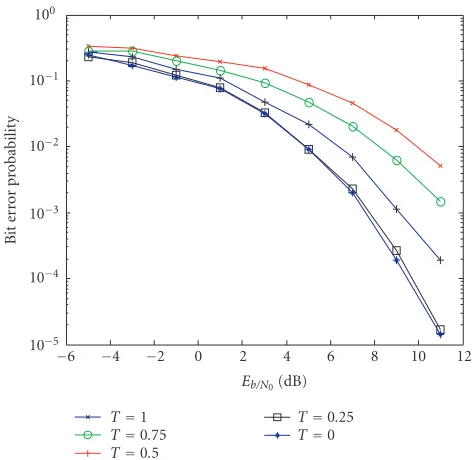
The T-GSC system was evaluated over Nakagami-mchannels for the Nakagami parametersm=1 (Rayleigh),m=2, and
−5 0 5 10 15 Eb/N0(dB)
10−6
10−5
10−4
10−3
10−2
10−1
100
B
it
er
ror
pr
obabilit
y
T=1 T=0.75 T=0.5
T=0.25 T=0
Figure2: BER performances of T-GSC in Nakagami channelm=1 for different values ofT.
−6 −4 −2 0 2 4 6 8 10 12
Eb/N0(dB) 10−5
10−4
10−3
10−2
10−1
100
B
it
er
ror
pr
obabilit
y
T=1 T=0.75 T=0.5
T=0.25 T=0
Figure3: BER performances of T-GSC in Nakagami channelm=2 for different values ofT.
the curves forT=0 andT =1 correspond to MRC and SC, respectively. The following observations are evident.
(1) For any particular fading channel, the performance of the T-GSC improves as the threshold level is varied fromT = 1 toT = 0. The figures also indicate that at the threshold valueT =0.25, most useful diversity branches that can appreciably contribute to the com-bined SNR would have been selected and comcom-bined. This value of T is valid for all the types of channels
−6 −4 −2 0 2 4 6 8 10 12
Eb/N0(dB) 10−6
10−5
10−4
10−3
10−2
10−1
100
B
it
er
ror
pr
obabilit
y
T=1 T=0.75 T=0.5
T=0.25 T=0
Figure4: BER performances of T-GSC in Nakagami channelm=4 for different values ofT.
studied—ranging from the (severe) Rayleigh fading to the less severe Ricean fading channels.
(2) For any particular threshold level considered, the BER performance improves as the fading becomes less se-vere.
(3) It is interesting to note that as the channel fading be-comes less severe, the performance of the system at low threshold values becomes indistinguishable from that of MRC. Note the closeness of the curves atT =0.25 andT = 0 in both Figures3and4. This can be ex-plained as follows. As all diversity channels are not that bad for these values ofm, they will be most of the time above threshold, and will be combined as in MRC. This is a significant merit of T-GSC overM-GSC that will be illustrated further in the next section.
5. COMPARISON BETWEEN T-GSC ANDM-GSC
We have already stated that T-GSC results in power conser-vation as it does not combine the weak branches, thereby ex-tending battery life for mobile units. In this section, we state other significant differences between the T-GSC andM-GSC schemes.
Figure 5shows the BER curves of T-GSC for three values ofT: 0.25, 0.5, and 0.75 and two values ofM: 2 and 3. Again we are assuming thatL=5. Also shown, as benchmarks, are the BER curves of SC (corresponding toT =1 orM = 1) and MRC (corresponding to T = 0 or M = 5). From the figure, we observe the following.
−5 0 5 10 15 Eb/N0(dB)
10−6
10−5
10−4
10−3
10−2
10−1
100
B
it
er
ror
pr
obabilit
y
SC
GSC (M=2) GSC (M=3) T-GSC (T=0.75)
T-GSC (T=0.5) T-GSC (T=0.25) MRC
Figure5: Comparing BER performances of T-GSC with M-GSC (m=1).
BER by one order of magnitude at Eb/N0 = 15 dB,
for example. However, T-GSC permits any gradual change in BER (and hence processing) by selecting the appropriate thresholdT. For example,T=0.75 would provide less improvement in BER over SC as compared toM-GSC withM=2, but will keep the processing in-tensity lower as it will be combining two channels oc-casionally. This will obviously has its impact on power consumption.
(2) We have seen in the previous section that for a particu-lar value ofT, most useful diversity branches would be combined for various degrees of fading. This is how-ever not the case with theM-GSC, in which a value of
Mthat suits one fading channel can be grossly inad-equate for another. Clearly, the T-GSC scheme uses a sound criterion for defining the significant and the in-significant branches that will lead to no loss of appre-ciable information at any time instant, while operating in any mobile communication channel.
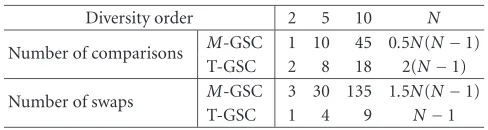
(3) It is possible to choose a value ofT that yields a BER value identical to someM. For example, inFigure 5 T-GSC withT=0.5 has a performance close toM-GSC withM=2. The same observation is true forT=0.25 andM = 3. Yet, under these identical performance conditions, the M-GSC has slightly higher complex-ity since it requires the ranking of all diverscomplex-ity branch strengths, whereas T-GSC requires only the knowledge of the branch with the maximum SNR and does not rank the remainingL−1 branches after the branch with the maximum SNR is known (i.e., T-GSC does not require full ranking). ForL=5,M-GSC requires a precombining processing of 10 comparisons and 30 data swaps, whileT-GSC requires 8 comparisons and
Table1: Precombining processing ofM-GSC and T-GSC. Diversity order 2 5 10 N
Number of comparisons M-GSC 1 10 45 0.5N(N−1) T-GSC 2 8 18 2(N−1)
Number of swaps M-GSC 3 30 135 1.5N(N−1) T-GSC 1 4 9 N−1
4 data swaps. The difference in complexities becomes more significant and influential at largeL, as shown in Table 1.
6. CONCLUSION
This paper analyzes a threshold-based generalized selection combining (T-GSC) scheme, which combines all, and only, the significant diversity branches at any given time instant. The scheme compares the strength of each branch to a prede-fined threshold, and combines only those branches that pass the threshold test. Compared to the general selective diver-sity scheme based on combining the bestMout ofL chan-nels (M-GSC), T-GSC saves power resources that would have been dissipated into combining very weak branches, thereby extending battery life for mobile receivers. Also, T-GSC has less precombining operations, and provides a gradual mech-anism for exchanging quality with processing intensity.
ACKNOWLEDGMENT
The authors acknowledge the support of King Fahd Univer-sity of Petroleum and Minerals (KFUPM).
REFERENCES
[1] G. L. Stuber, Principles of Mobile Communication, Kluwer Academic Publishers, Boston, Mass, USA, 2nd edition, 2001. [2] G. K. Karagiannidis, D. A. Zogas, and S. A. Kotsopoulos,
“Sta-tistical properties of the EGC output SNR over correlated Nakagami-mfading channels,”IEEE Trans. Wireless Commu-nications, vol. 3, no. 5, pp. 1764–1769, 2004.
[3] R. K. Mallik, M. Z. Win, and J. H. Winters, “Performance of dual-diversity predetection EGC in correlated Rayleigh fading with unequal branch SNRs,” IEEE Trans. Commun., vol. 50, no. 7, pp. 1041–1044, 2002.
[4] N. Kong and L. B. Milstein, “Average SNR of a generalized diversity selection combining scheme,” IEEE Commun. Lett., vol. 3, no. 3, pp. 57–59, 1999.
[5] M. Z. Win and J. H. Winters, “Analysis of hybrid selection/maximal-ratio combining in Rayleigh fading,”IEEE Trans. Commun., vol. 47, no. 12, pp. 1773–1776, 1999. [6] M. Z. Win, G. Chrisikos, and N. R. Sollenberger,
“Perfor-mance of RAKE reception in dense multipath channels: impli-cations of spreading bandwidth and selection diversity order,” IEEE J. Select. Areas Commun., vol. 18, no. 8, pp. 1516–1525, 2000.
[8] A. I. Sulyman and M. Kousa, “Bit error rate performance of a generalized diversity selection combining scheme in Nak-agami fading channels,” inProc. IEEE Wireless Communica-tions and Networking Conference (WCNC ’00), pp. 1080–1085, Chicago, Ill, USA, September 2000.
[9] A. Annamalai, G. Deora, and C. Tellambura, “Unified analy-sis of generalized selection diversity with normalized thresh-old test per branch,” inProc. IEEE Wireless Communications and Networking Conference (WCNC ’03), pp. 752–756, New Orleans, La, USA, March 2003.
[10] M. K. Simon and M. S. Alouini, “Performance analysis of gen-eralized selection combining with threshold test per branch (t-gsc),” IEEE Trans. Veh. Technol., vol. 51, no. 5, pp. 1018– 1029, 2002.
[11] S. Okui, “Probability of co-channel interference for selection diversity reception in the Nakagamim-fading channel,” IEE Proceedings Part I: Communications, Speech and Vision, vol. 139, pp. 91–94, 1992.
[12] M. Nakagami, “The M distribution—a general formula of intensity distribution of rapid fading,” inStatistical Study of Radio Wave Propagation, W. C. Hoffman, Ed., pp. 3–36, Perg-amon Press, New York, NY, USA, 1960.
[13] A. Papoulis and S. U. Pillai, Probability, Random Variables and Stochastic Processes, McGraw-Hill, New York, NY, USA, 4th edition, 2002.
[14] B. J. Rice and J. D. Strange,Technical Mathematics and Calcu-lus, Prindle, Weber, and Schimdt, Boston, Mass, USA, 1983. [15] M. S. Alouini and M. K. Simon, “An MGF-based performance
analysis of generalized selection combining over Rayleigh fad-ing channels,” IEEE Trans. Commun., vol. 48, no. 3, pp. 401– 415, 2000.
[16] M. S. Alouini and M. K. Simon, “Performance evalua-tion of generalized selecevalua-tion combining over Nakagami fad-ing channels,” inProc. IEEE Vehicular Technology Conference (VTC ’99), vol. 2, pp. 953–957, Amsterdam, The Netherlands, September 1999.
Ahmed Iyanda Sulymanwas born in Nige-ria in 1968. He obtained a Bachelor of Engineering (B.Eng.) degree in electrical engineering from the University of Ilorin, Nigeria, in 1995. Between 1995 and 1997, he worked with the Nigerian Steel Rolling Company, Katsina, and the Eleganza In-dustry, Lagos, as a Factory Engineer. In 1997, he joined the Kwara Television Au-thority, Nigeria, where he held a position
as a Transmission Engineer II till he joined King Fahd University of Petroleum and Minerals (KFUPM), Saudi Arabia, as a graduate student in September 1998. He obtained his M.S. degree in electri-cal engineering (with bias in communications) at KFUPM in May 2000, and worked at the same university as a Lecturer between 2000 and 2002. He joined Queen’s University, Kingston, in September 2002 for his Ph.D. studies, and he is currently teaching in the same university as an Adjunct Instructor. He has coauthored many con-ference and journal papers spanning the areas of adaptive signal processing, diversity systems, wireless networks, space-time coding, and recently MIMO transmission over nonlinear wireless channels.
Maan Kousawas born in Aleppo, Syria, in 1963. He received a B.S. degree in physics, and B.S. and M.S. degrees in electrical en-gineering from King Fahd University of Petroleum and Minerals (KFUPM), Saudi Arabia, in 1985, 1986, and 1988, respec-tively, all with first honors. He obtained a Ph.D. degree in electrical engineering from Imperial College, London, in 1994. Dr. Kousa is currently an Associate