S H O R T R E P O R T
Open Access
Full sequence analysis and characterization of the
South Korean Norovirus GII-4 variant CUK-3
Jeong-Woong Park
1, Sung-Geun Lee
2, Young-Min Lee
3, Weon-Hwa Jheong
4, Sangryeol Ryu
1*and
Soon-Young Paik
2*Abstract
Background:Many of researchers have focused on the emerging pathogen, Norovirus, since its first identification as the causing agent of nonbacterial acute gastroenteritis in humans. One of the virulence factors of norovirus, the great genetic diversity attributed to point mutations and recombinations, has brought forth the result of significant changes in the circulating norovirus genotype patterns.
Findings:In recognition of the necessity for tracking and monitoring of genetic diversity, a norovirus variant among the most prevalent genotype GII-4, Norovirus Hu/GII-4/CUK-3/2008/KR (CUK-3), was isolated from stool samples and analyzed on the level of whole genome sequence. Whole genome sequence analysis revealed three ORF composites of the whole genome, ORF1 (5100 bp), ORF2 (1623 bp), and ORF3 (807 bp). Each genetic relationship of CUK-3 variant analysis located the ORF1 (5,100 bp) in Cluster I, ORF2 (1623 bp) in Cluster I (2006b), ORF3 (807 bp) in Cluster I, and the whole genome sequence (about 5.1 kb) in Cluster I in the phylogenetic tree. And the phylogenetic analyses showed the same location of CUK-3 strain with the GII-4/2006b cluster in the phylogenetic tree.
Conclusions:In This study, a first concerning the full-length sequence of a NoV variant in South Korea is meaningful in that it can be used not only as a full-length NoV variant sequence standard for future comparison studies, but also as useful material for the public health field by enabling the diagnosis, vaccine development, and prediction of new emerging variants.
Keywords:Norovirus Sequence, Phylogenetic tree
Findings
Noroviruses (NoVs) are the most important viruses that cause nonbacterial acute gastroenteritis in humans. In addition to increased susceptibility, the elderly are at increased risk for more severe disease and death, as are the very young and the immunocompromised [1,2]. They are small, and non-enveloped viruses which and belong to the family Caliciviridae, genus Norovirus. Noroviruses have a single positive-strand NoV RNA genome of about 7.6 kb in size. Three open reading
frames (ORFs) have been identified in the NoV gen-omes. ORF1 encodes a polyprotein that is cleaved into six non-structural (NS) proteins, which carry amino acid sequence motifs conserved in NTPase, protease and RNA-dependent RNA polymerase (RdRp) [3,4]. ORF2 encodes a major structural protein, Viral Protein (VP1), which consist of two domains-the shell domain (S) and the protruding arm (P) that is again divided into two subdomains, P1 and P2. The S domain is highly con-served while the P domain is variable. P2 of the P domain is hypervariable and carries immune and cellular recognition sites [5-7]. ORF3 encodes minor capsid tein, VP2, which is rich in basic amino acids and is pro-posed to have a role in viral stability [8,9]
Recently, NoVs were recognized as novel emergent pathogens. The main route of transmission is suspected to be person-to-person, but food and water-borne * Correspondence: [email protected]; [email protected]
1Department of Food and Animal Biotechnology, Department of Agricultural
Biotechnology, Center for Agricultural Biomaterials, and Research Institute for Agriculture and Life Sciences, Seoul National University, Seoul 151-921, Republic of Korea
2
Department of Microbiology, College of Medicine, The Catholic University of Korea, Seoul 137-701, Republic of Korea
Full list of author information is available at the end of the article
transmission is also important [1,10,11]. According to nucleotide sequence analysis of the capsid regions, noro-viruses are classified into five genogroups, GI to GV, each of which can be further divided into several clus-ters or genotypes [12]. Among the five genogroups, three genogroups (GI, GII and GIV) are known to cause clinical illness in humans, and genotype GII-4 has been the predominant circulating strain to the present [13]. The error-prone RNA replication and recombination between viruses is what drives noroviruses to its the great diversity. Furthermore, the accumulated mutations of the hypervariable P2 domain of the VP1 protein pro-duced different GII-4 NoVs [14]. The most representa-tive of the resulting variant GII-4 strain, GII-4/2006b, with 3 nucleotide insertions in the P2 domain at posi-tion 6265, emerged in the summer of 2002 which lead to a major gastroenteritis outbreak as well as an epi-demic gastroenteritis worldwide in the winter of 2002/ 2003 [15,16]. In South Korea, gastroenteritis outbreaks by GII-4/2006b variants have been reported from Sep-tember of 2007 to July of 2008 had been reported [17].
In this paper, the whole genome sequence of another isolated variant of the emerging strain type, the GII-4 variant, was analyzed and compared with other variants to reveal the genetic relationship and to predict the ten-dency of GII-4 variants in South Korea.
NoV positive-stool sample was isolated from patients with acute gastroenteritis in Daejeon, South Korea in November 2008. The sample was obtained from the Waterborne Virus Bank (Seoul, Korea). The stool sample was stored at -70°. The viral genomic RNA was extracted from 140μl of 10% fecal suspension with the QIAamp® Viral RNA Mini kit (Qiagen, Hilden, Germany) in accor-dance with the manufacturer’s instructions.
For the detection of NoV, reverse transcription PCR (RT-PCR) was performed with the One Step RT-PCR kit (Qiagen, Hilden, Germany) with primers based on the sequence of the norovirus capsid region (Table 1).
To analyze the whole genome sequence of the detected norovirus strain, reverse transcription PCR (RT-PCR) was performed with the One Step RT-PCR kit (Qiagen, Hilden, Germany) with 10 pairs of newly designed primer sets (Table 1). Ten fragments were amplified; eight fragments for ORF1, one fragment for ORF2, and one fragment for ORF3. The PCR products were then analyzed by electrophoresis on 1.5% agarose gel and ethidium bromide staining. The amplified frag-ments were purified with HiYield™ Gel/PCR DNA Extraction kit (RBC, Taipei, Taiwan) from the gel. Then, the products were cloned into the pGEM-T Easy vector (Promega, USA) and were sequenced by Genotech (Dae-jeon, South Korea).
Sequence data analysis of the composite sequence of ten plasmids aligned with Clustal W method using the
DNAStar software (DNAStar Inc.) revealed that the whole genome was composed of three ORFs, 5100 bp (ORF1), 1623 bp (ORF2), and 807 bp (ORF3).
The dendrograms were constructed with the neighbor-joining method. The nucleotide sequence data reported in this study have been deposited into GenBank (acces-sion number; FJ514242).
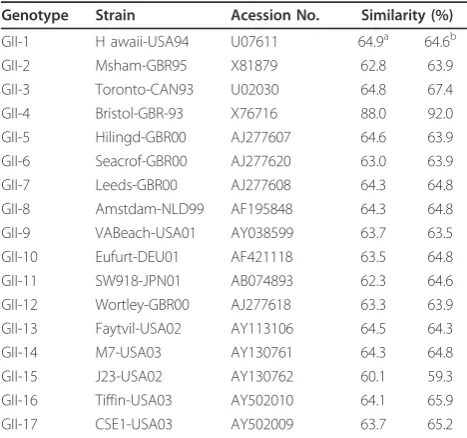
A comparison of the nucleotide and amino acid sequences of the entire ORF2 with reference strains showed that CUK-3 strain had the highest sequence similarity to the NoV GII-4 reference strain X76717. The nucleotide similarity with CUK-3 was 60.1 - 88.0% with the reference strains. A protein database search (BLASTX) for the product of ORF2 yielded 59.3 - 92.0% similarity. However, the cut-off value for amino acid similarity between the CUK-3 variant and the GII-4 reference strains showed low identity (92.0%) for the genomic sequences (Table 2).
To analyze the genetic relationship between the CUK-3 variant and the other variants reported worldwide, the sequences of ORF sequences and the whole genome were processed with multiple sequence alignment. Each analysis of CUK-3 located the ORF1 (5,100 bp) in Clus-ter I, ORF2 (1623 bp) in ClusClus-ter I (2006b), and ORF3 (807 bp) in Cluster I as well as the whole genome sequence (about 5.1 kb) in Cluster I (Figure 1).
As shown on the case analysis of ORF1, Cluster I con-tains Hiroshoma1, Kumamoto1, Saga1, Hokkaodo1, Aomori4, Miayagi5, Akita1, Aichi3 and showed the highest similarity range (98.0~98.9%) (Figure 1A).
As shown on the case analysis of ORF2, Cluster I (2006b) contains emerged the GII-4 varints in Japan and showed the highest similarity range (97.7 - 99.0%), whereas Cluster II (2006a) showed low similarity range (91.7 - 92.3%) (Figure 1B).
As shown on the case analysis of ORF3, Cluster I showed the highest similarity range (97.9 - 99.3%). Inter-estingly, 02/03 group contains emerged the GII-4 vaiants in Europe showed more higher similarity range (93.1 - 93.6%) than Cluster II contains emerged the GII-4 variants in Japan (Figure 1C).
As shown on the case analysis of full length, the CUK-3 strain showed the highest similarity (98.CUK-3%) with the 2006 epidemic strain, Aichi3/2006/JP strain, whereas Ehime/5-30/2005/JP strain and Lordsdale/1993/UK strain showed the lowest similarity (89.2%) (Figure 1D).
the epidemic strains in 2006. These strains were com-mon in Hong Kong, Japan, and other regions of North East Asia during the same period [12,18]. Such similari-ties in analyses between CUK-3 and GII-4/2006b strain are evidence of the reemergence of GII-4 variant.
In Europe and Asia, most norovirus outbreaks that occurred after 2002 have been caused by GII-4 variant strains (Figure 2). In addition, biennial emergences of pandemic NoV GII-4 variants have been reported in 2002, 2004, 2006 and 2008 [12,18,19]. These GII-4 var-iants have also been identified in South Korea and are rapidly spreading worldwide.
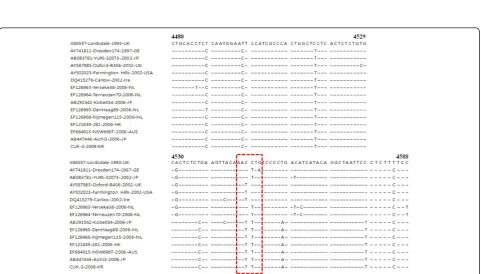
Amino acid sequences of the capsid region encoded by ORF2 was compared with a total of 39 GII-4 variants reported from various countries including US, UK, Japan, China, Germany etc. Date of 540 amino acid analyses showed the pattern of changes of two amino acid in first P1 domain, aa238 (SGII-4- >2002®TGII-4- <2002), aa250 (Y
GII-4- >2002 ® F GII-4- <2002). The P2 domain showed five substitutions of amino acids, aa280 (AGII-4- >2002® PGII-4- <2002), aa346 (AGII-4- >2002®PGII-4- <2002), aa367 (FGII-4- >1995 ® Y GII-4- >2002®FGII-4- <2002), aa376 (QGII-4- >2002 ®EGII-4- <2002), and aa394 (G or S
GII-4->2006®TGII-4- <2006). In addition, the second P1 domain
Table 1 Primer sets used in this study
Primer Sequence (5’®3’) Polarity Regiona
Diagnosis primer sets GIF1M CTG CCC GAA TTY GTA AAT GAT GAT + 5342-5365
GIRIM CCA ACC CAR CCA TTR TAC ATY TG - 5649-5671
GIIF1M GGG AGG GCG ATC GCA ATC T + 5049-5067
GIIRIM CCR CCI GCA TRI CCR TTR TAC AT - 5367-5389
Designed primer sets ORF1-1F GTG AAT GAA GAT GGC GTC TAA C + 1-22
ORF1-1R AGT TCC ACT GCA AGG TCC TCA G - 999-1020
ORF1-2F CTG AGG ACC TTG CAG TGG AAC T + 999-1020
ORF1-2R ATG AGG GAA CCA GTG GTG AGA GT - 2018-2040
ORF1-3F CGT GCT CGA GGC GCA TCG ATT T + 1821-1842
ORF1-3R TTG TAC TCA TCA TAC TCT TCA - 2701-2721
ORF1-4F CAT TGC TCG AGC ATC AGG GCT AC + 2038-2060
ORF1-4R TTG ACT ATC CTC GAC CAG ATG CT - 3038-3060
ORF1-5F AGC ATC TGG TCG AGG ATA GTC AA + 3038-3060
ORF1-5R GTG GCA CAT ATG ACA GTG TTT CC - 3518-3540
ORF1-6F GGA AAC ACT GTC ATA TGT GCC AC + 3518-3540
ORF1-6R CAG TCG TTC TTC CGC ATG TGG TGC GG - 3935-3960
ORF1-7F CTC AGC ACC AAG ACT AAA TTC TGG A + 3635-3659
ORF1-7R TGG GCG ATG GAA TTC CAT TGA GAG G - 4485-4509
ORF1-8F ATG GTT AAA TTC TCC CCA GAA CC + 4355-4377
ORF1-8R CCA CCT GCA TAA CCA TTG TAC AT - 5367-5389
ORF2-F ATG AAG ATG GCG TCG AAT GGC + 5085-5105
ORF2-R TTA TAA TGC ACG CCT GCG CCC CGT - 6681-6704
ORF3-F ATG GCT GGA GCT TTC TTT GCT + 6704-6724
ORF3-R AAA GAC ACT AAA GAA AGG AAA GAT - 7532-7555
a
Each of sequence number of primer sets region is indicated with Lordsdale strain (X86557) except that of GIF1M and GIR1M set indicated with Norwalk strains (M87661).
Table 2 Nucleotide and amino acid sequence similarities between CUK-3 strain and the full length ORF2 sequences from different Genogroup GII reference strains
Genotype Strain Acession No. Similarity (%)
GII-1 H awaii-USA94 U07611 64.9a 64.6b
GII-2 Msham-GBR95 X81879 62.8 63.9
GII-3 Toronto-CAN93 U02030 64.8 67.4
GII-4 Bristol-GBR-93 X76716 88.0 92.0
GII-5 Hilingd-GBR00 AJ277607 64.6 63.9
GII-6 Seacrof-GBR00 AJ277620 63.0 63.9
GII-7 Leeds-GBR00 AJ277608 64.3 64.8
GII-8 Amstdam-NLD99 AF195848 64.3 64.8
GII-9 VABeach-USA01 AY038599 63.7 63.5
GII-10 Eufurt-DEU01 AF421118 63.5 64.8
GII-11 SW918-JPN01 AB074893 62.3 64.6
GII-12 Wortley-GBR00 AJ277618 63.3 63.9
GII-13 Faytvil-USA02 AY113106 64.5 64.3
GII-14 M7-USA03 AY130761 64.3 64.8
GII-15 J23-USA02 AY130762 60.1 59.3
GII-16 Tiffin-USA03 AY502010 64.1 65.9
GII-17 CSE1-USA03 AY502009 63.7 65.2
a
The nucleotide sequences of the ORF2 regions starting at nucleotide 1620 were analyzed.
b
Figure 1Phylogenetic trees of the nucleotide sequences of the complete regions of NoV GII/4. Phylogenetic tree generated based on the complete sequence of the ORF1 (about 5.1 kb) (A), ORF2 (about 1.6 kb) (B), ORF3 (about 0.8 kb) (C), and near-full-length genome (7.5 kb) (D)
also showed two amino acid substitutions, aa459 (L
GII-4->1995®QGII-4- >2002) and aa504 (PGII-4- >2002®Q GII-4-<2002). These analytic data showed that there had already been numerous mutations, which lead to the production of a wide range of variants, already before 2002 and pro-duced various variants. And as shown on the case of aa394 of P2 domain which inserted novel amino acid, G or S, and then substituted to T after 2006 (data not shown). Although previous studies have indicated that the sequence for the NoV capsid region is useful for the diag-nosis of NoV variants, no studies have analyzed the RdRp region of the South Korean NoV GII-4 variant. This is the first report that describes the full-length sequence of a NoV GII-4 variant that was isolated from clinical samples in South Korea. We suggest that this sequence can be used as a standard for the comparison of full-length NoV GII-4 variant sequence with other strains.
The information acquired from whole genome sequencing in this study can be useful not only for a more accurate diagnoses of NoVs but also for the basic research for the elucidation genetic functions. Further-more, it will be helpful for the prediction of newly appearing pandemic variants through comparison with GII-4 variants in neighboring countries, fundamental research for vaccine development, and eventually , for the field of public health through with the provision of new emerging strains of NoV.
Acknowledgements
This work was supported by Mid-career Researcher Program (2008-0061575) and Basic Science Research Program (2009-0062720) through NRF grant funded by the MEST.
Author details
1Department of Food and Animal Biotechnology, Department of Agricultural
Biotechnology, Center for Agricultural Biomaterials, and Research Institute for Agriculture and Life Sciences, Seoul National University, Seoul 151-921, Republic of Korea.2Department of Microbiology, College of Medicine, The
Catholic University of Korea, Seoul 137-701, Republic of Korea.3Department of Microbiology, College of Medicine and Medical Research Institute, Chungbuk National University, Cheongju, Chungcheongbuk-do 361-763, Republic of Korea.4Environmental Infrastructure Research Department,
National Institute of Environmental Research, Incheon, 404-708, Republic of Korea.
Authors’contributions
SRR and SYP conceived this study. YML, WHJ and designed and conducted the experiments. SGL and JWP analyzed the sequence data and carried out the molecular phylogenetic analysis. SGL and SYP wrote the manuscript. All authors read and approved the final manuscript.
Competing interests
The authors declare that they have no competing interests.
Received: 28 October 2010 Accepted: 14 April 2011 Published: 14 April 2011
References
Donaldson, EF, LC Lindesmith, AD Lobue, and RS Baric. 2008. Norovirus pathogenesis: mechanisms of persistence and immune evasion in human
populations. Immunol Rev 225: 190–211. doi:10.1111/j.1600-065X.2008.00680. x.
Yoon, JS, SG Lee, SK Hong, SA Lee, WH Jheong, SS Oh, MH Oh, GP Ko, CH Lee, and SY Paik. 2008. Molecular epidemiology of norovirus infections in children with acute gastroenteritis in South Korea in November 2005 through November 2006. J Clin Microbiol 46: 1474–1477. doi:10.1128/JCM.02282-07. Lee, YF, A Nomoto, BM Detjen, and E Wimmer. 1977. A protein covalently linked
topoliovirus genome RNA. Proc Natl Acad Sci USA 74: 59–63. doi:10.1073/ pnas.74.1.59.
Rueckert, RR, and E Wimmer. 1984. Systematic nomenclature of picornavirus proteins. J Virol 50: 957–959.
Tan, M, P Huang, J Meller, W Zhong, T Farkas, and X Jiang. 2003. Mutations within the P2 domain of norovirus capsid affect binding to human histo-blood group antigens: evidence for a binding pocket. J Virol 77: 12562–12571. doi:10.1128/JVI.77.23.12562-12571.2003.
Nilssson, MK, O Hedlund, M Thorhagen, G Larson, K Johansen, A Ekspong, and L Svensson. 2003. Evolution of human calicivirus RNA in vivo: accumulation of mutations in the protruding P2 domain of the capsid leads to structural changes and possibly a new phenotype. J Virol 77: 13117–13124. doi:10.1128/JVI.77.24.13117-13124.2003.
Lochridge, VP, KI Jutila, JW Graff, and ME Hardy. 2005. Epitopes in the P2 domain of norovirus VP1 recognized by monoclonal antibodies that block cell interactions. J Gen Virol 86: 2799–2806. doi:10.1099/vir.0.81134-0. Glass, PJ, LJ White, JM Bull, I Leparc-Goffart, ME Hardy, and MK Estes. 2000.
Norwalk virus open reading frame 3 encodes aminor structural protein. J Virol 74: 6581–6591. doi:10.1128/JVI.74.14.6581-6591.2000.
Bertolotti-Ciariet, A, SE Crawford, AM Hutson, and MK Estes. 2003. The 3’end of Norwalk virus mRNA contains determinants that regulate the expression and stability of the viral capsid protein VP1: a novel function for the VP2 protein. J Virol 77: 11603–11615. doi:10.1128/JVI.77.21.11603-11615.2003.
Kearney, K, J Menton, and JG Morgan. 2007. Carlow virus, a 2002 GII-4 variant norovirus strain from Ireland. Virol J 4: 61. doi:10.1186/1743-422X-4-61. La Rosa, G, M Pourshaban, M Iaconelli, and M Muscillo. 2008. Detection of
genogroup IV noroviruses in environmental and clinical samples and partial sequencing through rapid amplification of cDNA ends. Arch Virol 153: 2077–2083. doi:10.1007/s00705-008-0241-4.
Motomura, K, T Oka, M Yokoyama, H Nakamura, H Mori, H Ode, GS Hansman, K Katayama, T Kanda, T Tanaka, N Takeda, and H Sato. 2008. Identification of monomorphic and divergent haplotypes in the 2006-2007 norovirus GII/4 epidemic population by genome wide tracing of evolutionary history. J Virol 82: 11247–11262. doi:10.1128/JVI.00897-08.
Hale, A, K Mattick, D Lewis, M Estes, X Jiang, J Green, R Eglin, and D Brown. 2000. Distinct epidemiological patterns of Norwalk-like virus infection. J Med Virol 62: 99–103. doi:10.1002/1096-9071(200009)62:13.0.CO;2-0.
Glass, RI, UD Parashar, and MK Estes. 2009. Norovirus gastroenteritis. N Engl J Med 361: 1776–1785. doi:10.1056/NEJMra0804575.
Lopman, B, H Vennema, E Kohli, P Pothier, A Sanchez, A Negredo, J Buesa, E Schreier, M Reacher, D Brown, J Gray, M Iturriza, C Gallimore, B Bottiger, KO Hedlund, M Torvén, CH von Bonsdorff, L Maunula, M Poljsak-Prijatelj, J Zimsek, G Reuter, G Szücs, B Melegh, L Svennson, Y van Duijnhoven, and M Koopmans. 2004. Increase in viral gastroenteritis outbreaks in Europe and epidemic spread of new norovirus variant. Lancet 363: 682–688. doi:10.1016/ S0140-6736(04)15641-9.
Allen, DJ, R Noad, D Samuel, JJ Gray, P Roy, and M Iturriza-Gómara. 2009. Characterisation of a GII-4 norovirus variant-specific surface-exposed site involved in antibody binding. Virol J 6: 150. doi:10.1186/1743-422X-6-150. Chung, JY, TH Han, SH Park, SW Kim, and ES Hwang. 2010. Detection of GII-4/
2006b Variant and Recombinant Noroviruses in Children With Acute Gastroenteritis, South Korea. J Med Virol 82: 146–152. doi:10.1002/jmv.21650. Ho, EC, PK Cheng, AW Lau, AH Wong, and WW Lim. 2007. A typical norovirus
epidemic in Hong Kong during summer of 2006 caused by a new genogroup II/4 variant. J Clin Microbiol 45: 2205–2211. doi:10.1128/ JCM.02489-06.
Tu, ET, RA Bull, GE Greening, J Hewitt, MJ Lyon, JA Marshall, CJ McIver, WD Rawlinson, and PA White. 2008. Epidemics of gastroenteritis during 2006 were associated with the spread of norovirus GII.4 variants 2006a and 2006b. Clin Infect Dis 46: 413–420. doi:10.1086/525259.
doi:10.1186/1743-422X-8-167
Cite this article as:Parket al.:Full sequence analysis and characterization of the South Korean Norovirus GII-4 variant CUK-3.