R E S E A R C H
Open Access
Performance analysis of ultra-reliable
short message decode and forward relaying
protocols
Parisa Nouri
*, Hirley Alves and Matti Latva-aho
Abstract
Machine-type communication (MTC) is a rapidly growing technology which covers a broad range of automated applications and propels the world into a fully connected society. Two new use cases of MTC are massive MTC (mMTC) and ultra-reliable low latency communication (URLLC), where mMTC supports a large number of devices with high reliability and low rate connectivity while URLLC refers to excessively low outage probability under very stringent latency constraint. Herein, we examine the URLLC through three cooperative schemes, namely dual-hop decode and forward, selection combining, and maximum ratio combining, and compare to direct transmission under Rayleigh fading. We compare the performance of studied cooperative protocols under two distinct power constraints with respect to latency and energy efficiency. Moreover, we illustrate the impact of coding rate on the probability of successful transmission in ultra-reliable region in addition to the effect of power allocation on the outage probability. We also provide the performance analysis of cooperative schemes in terms of energy efficiency and latency
requirements.
Keywords: Machine-type communications, Ultra-reliable low latency communication, Energy efficiency, Cooperative diversity, Outage probability, Rayleigh fading
1 Introduction
The fifth generation (5G) of cellular networks for beyond 2020 envisages to handle two new use cases in machine-type communications (MTC), namely ultra-reliable low latency communications (URLLC) and massive MTC (mMTC) [1]. In MTC, MTC devices autonomously com-municate with minimum human cooperation [2, 3]. 5G communication technology should be flexible enough to support ultra-reliable low latency communications by guaranteeing reliability greater than 99.999% [4]. Key chal-lenges and requirements of 5G technology such as latency, data rate, energy, and cost issues are discussed in more details in [1,5,6].
In recent years, MTC has gained much attention from the mobile network operators, equipment vendors, and academic researchers due to such novel communication paradigm, the capability of exchanging short data mes-sages and also being cost-effective, energy efficient [7,8],
*Correspondence:[email protected]
Centre for Wireless Communications (CWC), University of Oulu, Oulu, Finland
reliable, and within a stringent delay requirement. MTC takes advantage of several distinctive properties such as group-based communications, low mobility, and time-controlled, time-tolerant, and secure connection which are at the same time challenging tasks since technically advanced solutions are needed to deliver the required tasks. Within the application requirements, hence, open-ing up different research areas is currently beopen-ing carried out in academia, industry, and standard bodies [9]. Cur-rent technologies cover a small range of applications and services while the upcoming MTC should be able to cover a broad range of services with multiple forms of data traf-fic in order to deal with different service requirements as data rate, latency, reliability, energy consumption, and security [6,10]. Future MTC improvements will be con-spicuous in health care, logistics, process automation, transportation, e.g., [6, 11]. In mMTC, a huge number of devices in a specific domain are connected to the cel-lular network with low-rate and low-power connectivity, different quality-of-service (QOS) requirements, and high
reliability to support demanding situations, e.g., smart meters and actuators [12,13].
Moreover, MTC services have to met stringent timing constraints from few seconds to even excessively low end-to-end deadlines in mission critical communications [14], connection between vehicles, remote control of robots in addition to an extreme low end-to-end latency in the scope of less than a millisecond which is a key enabler in several services including cloud connectivity, indus-trial control, and road safety [1,11,15]. Latency refers to the time duration between transferring the message from the transmitter and receiving correctly at the receiver where some messages drop due to the buffer overflows, unsuccessful synchronizations, and unsuccessful decod-ing which result in unlimited delay [1]. Hence, we can define the reliability as the probability of successful trans-mission under the predetermined delay constraint [1,16]. In URLLC, high probability of successful transmission indicates low outage probability (or packet drop) while the opposite does not always hold as the reliability is restricted to a specific latency budget due to the limited amount of channel uses [1]. Hence, one of the major require-ments of URLLC is an extremely low outage probability under a very demanding latency budget where retrans-missions are not always available. In the use of short messages under URLLC, new robust channel codes are needed; otherwise, the performance of the system will be even further away from the Shannon limit with long data packets [17].
Under Shannon’s channel coding theorem, error-free communication is attained when the blocklength goes to infinity [18]. For instance, authors in [19] provide a tight approximation of achievable coding rate under finite blocklength (FB) regime and indicate a noticeable per-formance loss compared to the Shannon coding. This motivates us to analyze the performance of MTC under FB regime since in URLLC, due to the equal packet length of metadata and information bits, an unsuccessful encod-ing of the metadata decreases the system efficiency [15]. In the past few years, several works have studied differ-ent aspects of FB coding since majority of the theoretical results assume infinite blocklength (IFB). For instance, authors in [20] examine some possible FB coding schemes which may be applied in 5G technology. They show that novel coding schemes with better minimum distance between the codewords improve the efficiency of system at the cost of more sophisticated decoders. Moreover, the performance of spectrum sharing networks with FB codes are studied in [21]. The blocklength of information bits highly affects the system quality where an optimal power allocation technique improves the system efficiency with short message transmissions. Furthermore, authors in [22] propose a new power allocation technique, so-called mod-ified water-filling in order to maximize the lower bound
of the coding rate with short packet transmission com-pared to the common water-filling method. In addition, performance of ARQ protocol in terms of throughput and average latency is studied in [23]. Authors determine the optimal lengths of the codeword which minimize the latency and maximize the throughput per-user for a spe-cific number of information bits. They illustrate that with optimal codes, the shorter the codeword is, the lower outage probability attains.
1.1 On the impact of cooperative diversity
the throughput for either FB or IFB assumptions. In addi-tion, they indicate that the FB throughput is quasi-concave in the overall outage probability and coding rate. Further-more, authors illustrate that the multi-hop network is less affected by the blocklength under the constant coding rate assumption compared to the target overall outage prob-ability scenario. Moreover, [30] studies the performance of DF relay network in dissimilar Rayleigh fading chan-nels. Although authors attain the closed form expression of the outage probability, they do not consider the impact of finite blocklength coding. Furthermore, authors in [31] study the achievable coding rate and ergodic capacity of non-orthogonal amply-and-forward (AF) multi-relay net-work subject a total average power constraint (TAPC) and an individual average power constraint (IAPC). They indicate that the ergodic capacity can be attained by an iterative water-filling-based algorithm. In addition, they show that in a multi-relay NAF network, the transmit power at the source should be equally allocated in all broadcasting phases to cover the capacity at sufficiently high SNRs.
Moreover, our previous work [32] introduces relaying as means to achieve ultra-reliability. We study the per-formance of cooperative relaying protocols, supposing Rayleigh fading channels. We show that relaying tech-nique improves the reliability and how we can meet the ultra-reliable communication requirements. We examine the impact of coded blocklength and number of infor-mation bits on the probability of successful transmission. In addition, it is shown that relaying requires less trans-mit power compared to the direct transmission (DT) to enable ultra-reliability under FB regime. We also pro-vide an approximation to the outage probability in closed form. We extend our work in [32], by considering ultra-reliable MTC with incremental relaying technique in [33]. We define the overall outage probability in each stud-ied relaying scheme, assuming Nakagami-mfading. We investigate the impact of fading severity and power alloca-tion factor on the outage probability. We also provide the outage probability in closed form. Our works in [32,33] show that cooperative diversity is useful to meet URLLC requirements.
1.2 Energy efficiency of cooperative communication Another key characteristic of wireless communications that highly affect the performance of 5G networks is the energy efficiency (EE) due to the limited energy resources in energy-constraint networks [34, 35]. EE, which has been widely studied recently in literatures, is defined as the ratio of successfully transmitted bits to the total con-sumed energy [36, 37]. Hence, reducing the amount of energy per bit improves EE at low SNR regime [35], par-ticularly in wireless networks where the batteries which are not rechargeable or easy to charge supply the wireless
components [36]. The reason which motivates us to study EE in the context of URLLC is that URLLC is achieved at the cost of high transmit power [38, 39], but we aim to show that cooperative diversity alleviates these demands.
In early works, authors in [37] examine EE in tactile Internet under queuing and transmission delays to design an energy-efficient resource allocation strategy. They pro-pose an optimal resource allocation strategy where the average total consumed power under stringent latency constraint equals to that with unlimited queuing latency requirement with plenty of transmit antennas. More-over, [36] provides a comprehensive overview of energy-efficient networks and determines the trade-off between energy efficiency and spectrum efficiency and their appli-cations in 5G networks.
1.3 Our contribution
In this work, we further study three cooperative proto-cols, namely DF, selection combining (SC), and maxi-mum ratio combining (MRC). Furthermore, we indicate the superiority of MRC over SC and DF protocols in terms of coding rate and reliability. We also show the optimal value of power allocation at the source and relay in each of studied protocols. Moreover, we exam-ine the minimum latency and energy efficiency in coop-erative schemes under two different power allocation constraints.
The following are considered the contributions of this work.
• We provide the general expression of the outage probability for each relaying scheme studied in this work.
• We extend the work in [18], by proposing the closed form expression for the outage probability.
• We extend our previous works in [32,33] by studying the minimum latency and energy efficiency under two distinct power constraints, so-called (i) equal power allocation (EPA) and (ii) optimal power allocation (OPA) strategies which are allocated numerically.
• We provide the asymptotic analysis of studied cooperative schemes.
Table 1Summary of the functions and symbols
bpcu Bit per channel use
CSI Channel state information
DF Decode and forward
DT Direct transmission
EE Energy efficiency
EPA Equal power allocation
FB Finite blocklength
IFB Infinite blocklength
mMTC Massive machine-type communication
MRC Maximum ratio combining
MTC Machine-type communication
OPA Optimal power allocation
PDF Probability density function
QOS Quality of service
RV Random variable
SC Selection combining
SH Single hop
SNR Signal to noise ration
URLLC Ultra-reliable low latency communication
URR Ultra reliable region
fW(.) Probability density function
E(.) Expectation
Q(.) Q-function
C(ρ) Shannon capacity
V(ρ) Channel dispersion
Q−1(.) Inverse of Q-function
e Exponential Euler’s number
y Received signal
h Fading channel
w AWGN noise
k Information bits
xi Transmitted signal
n Number of channel uses
log2 Logarithm to the base 2
nS Number of channel uses for source
nR Number of channel uses for relay
dSD Distance of source-destination link
dSR Distance of source-relay link
dRD Distance of relay-destination link
E Energy efficiency
P Total power
PR Power of relay
PS Power of source
PTX Power of transmitter
Table 1Summary of the functions and symbols (Continued)
PRX Power of receiver
PPA Power of amplifier
Psucc Probability of successful transmission
Pmax Maximum total power
N0 Power of noise
Instantaneous SNR
γ Average SNR
ρ Average power constraint
η Power allocation factor
R Maximum coding rate
φ Drain efficiency
Outage probability
2 Preliminaries
2.1 System model
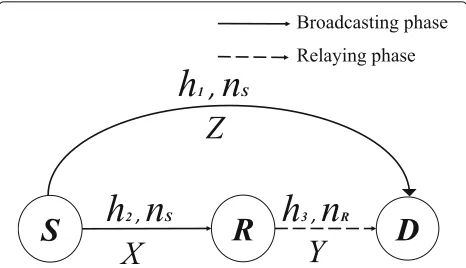
Figure 1 illustrates a DF relaying scenario including a source S, destination D, and a decode-forward relay R. We normalize the distance of S to D as dSD = 1 m and thatRcan move in a straight line betweenS andD, while the distance betweenSandRis denoted bydSR =
βdSD and the distance of the relaying link is denoted by dRD=(1−β)dSD. The links denoted by the following ran-dom variablesX,Y, andZrepresent theS-R,R-D, andS-D
links respectively, and each transmission usesnichannel uses wherei∈ {S,R}. This means thatnSchannel uses in the broadcasting phase andnRchannel uses for the relay-ing phase. In this scenario, first,S sends the message to theDandRin the broadcasting phase and ifRsuccessfully decodes the message, forwards it to theDin the relaying phase [18]. The received signals in the broadcasting phase are denoted asy1andy2, and only ifRcollaborates withS,
the received signal atDisy3as follows [18]
y1=h1x+w1, y2=h2x+w2, and y3=h3x+w3,
(1)
wherexis the transmitted signal with powerPandwiis the AWGN noise with powerN0=1 wherei∈ {X,Y,Z}.
Quasi-static Rayleigh fading channels in theS-D,S-R, and
R-Dlinks are denoted as h1,h2, andh3, respectively. In
this work, we consider two distinct power constraints, namely (i) EPA where equal powers are allocated toSand
R and (ii) OPA where total power of S and R is equal to the maximum power. In a DF-based relaying proto-col, the instantaneous SNR depends on the total power constraint P = PS + PR = ηP + (1− η)P, which is given by Z = ηP|h1|2/N0, X = ηP|h2|2/N0, and
Y = (1−η)P|h3|2/N0, where 0 < η 1 is the power
Fig. 1System model for relaying with a source, destination, and a decode-forward relay. This figure illustrates the system model for cooperative decode-and-forward relaying scenario including a source, a relay, and a destination. The links betweenStoD,StoR, andRtoD are referred as the direct linkh1, broadcasting linkh2and relaying link h3each of which withnichannel uses respectively, wherei∈ {S,R}
with EPA. Hence, the average SNR in each link isγZ =
ηP/N0,γX =ηP/N0, andγY =(1−η)P/N0.
2.2 Performance analysis of single-hop communication under the finite blocklength regime
In this section, we revisit the concept of FB coding. In a single-hop communication, first,kinformation bits are mapped to a sequence, namely codeword includingn sym-bols. Afterwards, the created codeword passes the wire-less channels and channel outputs map into the estimate of the information bits. Thus, for a single-hop communi-cation with blocklengthn, outage probability, and the average power constraintρ, where 1nni |xi|2 ≤ ρholds, [15]. According to (2), the outage probability is given by
=Q
which holds for the AWGN channels where the channel coefficienthiis equal to one. While for quasi-static fading channels, we attain the outage probability as follows [15]
≈E AWGN channels [19, Figures 12 and 13], as well as for
fading channels as discussed in [40]. In addition, in the relaying schemes, we assume thatS can encode k infor-mation bits intonSchannel uses, whileRusesnRchannel uses. Hence, S and Rcould employ more sophisticated encoding technique than [18,41].
2.3 Closed-form expression of the outage probability Unfortunately, (4) does not have a closed-form expression, but it can be tightly approximated as we shall see next.
Lemma 1The outage probability is approximated as
=1−√ζ resort to a linearization of the Q-function [21,42]
K(t)≈Q(g(x))= where fX(x)is the probability density function (PDF) of the SNR of the linkX, and the solution is given in (5).
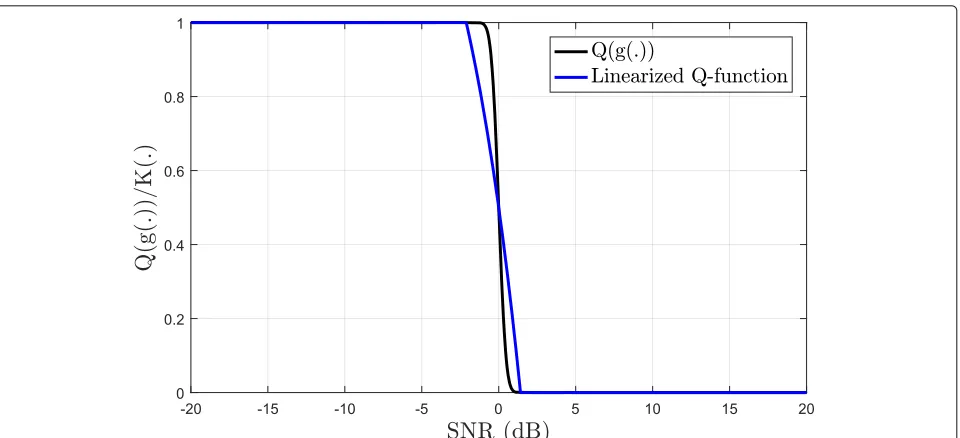
RemarkMoreover, we compare the accuracy of lin-earized Q-function in (6) to original Q-function in (3) as indicated in Fig.2. The difference between these two plots does not have a noticeable impact on the outage probabil-ity since we find the approximated outage probabilprobabil-ity in (5) via integrating over the SNR range and due to the symmet-ric property of the function as evinced by Fig.2, regions that show the difference between the original and linearized Q-function, cancel each other and so, this difference becomes negligible as illustrated in Fig. 3. Thus, we can notice that error defined by error = −app is approx-imately equal to zero which shows the accuracy of the linearized Q-function applied in the closed form expres-sion of the outage probability. Fore example, the maximum error over the entire SNR range is about 0.03%. Similar conclusion holds for other values ofR.
3 The proposed method
Fig. 2Accuracy of linearized Q-function compared to the original Q-function. This figure illustrates the accuracy of Q-function linearization applied in closed form expression of outage probability
regime. The direct transmission model is used here as the basis of the comparison.
3.1 Direct transmission
The source sends the message directly to the destination, where Z = Z/η = P|hSD|2/N0, with average SNR
γZ =P/N0, where the outage probability is calculated as
in (5) butζ withPS=Pandμwithn=nS.
3.2 Dual hop decode and forward (DF)
In this scheme, since the S-D distance is too large, it assumes that the direct link is in the outage; thus,Ralways
collaborates with the source. Hence, S sends the mes-sage to bothRandDin the broadcasting phase. Then,R
transfers the message toD[43]. The overall outage proba-bility is given by
DF =SR+(1−SR)RD, (7)
whereSRandRDare calculated according to (5). Notice that we update ζ with PS = ηP, PR = (1 −η)P and
μwith n = nS,n = nR, respectively. This scenario can be analyzed as selection combining (SC) or maximum
ratio combining (MRC) depending on how the destina-tion combines the original transmitted signal and the retransmitted signal.
3.3 Selection combining (SC)
In this protocol, R starts to collaborate with S if the destination confirms that the source transmission was unsuccessful and so, the destination requests for retrans-mission from R to receive the frame correctly. Coop-eration occurs if R decodes the received message from
S correctly and so transfers the message to D. There-after, ifDconfirms that the transmission fromRis also failed,Drequests for the next subsequent message from
S. Thus, the outage probability happens only if bothS-D
andR-Dlinks are in outage [44,45]. The overall outage is given by
SC=SDSR+(1−SR)SDRD, (8)
whereSDis equal to (5) whereζ is updated withPS=ηP andμwithn=nS.
3.4 Maximum ratio combining (MRC)
In this scenario, relay always collaborates with the source and so, the channel gains ofS-DandR-Dlinks are com-bined at the receiver. Thus, the aggregated SNR is big-ger than the primary attempted transmission rate as the
S-D transmission failed. In addition, the outage proba-bility occurs ifS-DorR-Dtransmission fails. Hence, the instantaneous SNR isW =Z+Y[44,45]. The outage probability is [44]
MRC=SD
where SRD is the outage probability of the source-to-relay-to destination link, notice that the term SRDDF refers to the probability thatDwas not able to decodeS mes-sage alone. In order to calculate the (9), first we need to attain the PDF ofW, and then, we calculate the out-age probability as proposed in Proposition 1. To do so, let W denote the sum of two independently distributed exponential random variables (RV),ZandY. Then,fW(w)
Since the RVs are independent, the proof is straightfor-ward solution offW(w)=0∞fZ(w−y)fy(y)dy[46].
Proposition 1The outage probability of the MRC of the S-D and R-D linksSRD, is equal to linearized Q-functionK(t), we attain
=
which is solved with help of ([47], Eq. 2.321) and after some algebraic manipulations we attain (11) [32].
3.5 Asymptotic analysis
The outage probability in (5) can be defined as P[i ≤ γth] as the SNR goes to infinity, where
γth = 2R −1 . Thus, the approximated asymptotic
out-age probability per link in Rayleigh fading channels is
i = 1−exp(−γth/γi), whereγiis a function ofβandP ([38], §10). Thereafter, we resort to Taylor series asγth/γi approaches zero as SNR → ∞, and so, exp(x) ≈ 1+x
and attain an asymptotic expression asi≈(γth/γi)([38], §11). The asymptotic expression ofafter maximum ratio combining ofSandRtransmissionsSRDis given in ([44],
§7). Therefore, the outage probability is approximated as
∞
SRD≈
γ2 th
2γZγY, resorting to series expansion asγi→ ∞.
4 Numerical results and discussion
4.1 URLLC via cooperative diversity
of our analytical model through the Monte-Carlo simula-tions. Unless stated otherwise, assume maximum transmit power per link as 20 dB,n = 500,k = 500, andRis in betweenSandD, withβ = 12. The URR is shaded purple area in the following plots, and its most loose constraint is denoted with a red line where the outage probability is 10−3; thus, 1−=99.9% reliability is feasible.
4.1.1 Reliability vs. coding rate
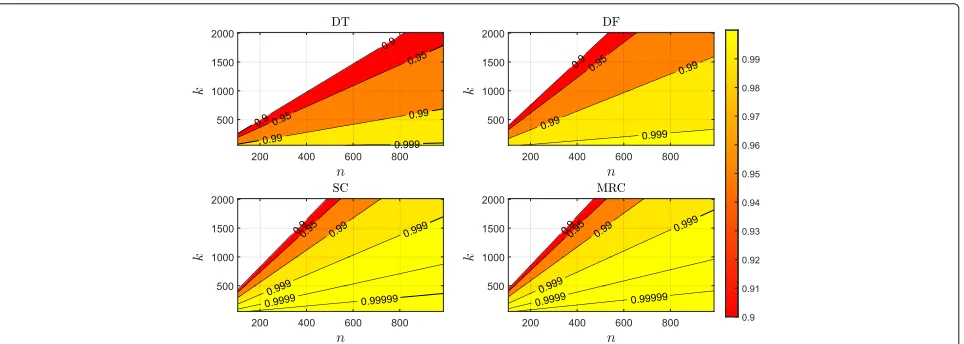
Figure4compares the probability of successful transmis-sion (Psucc = 1−) as a function of coding rate in URR.
We can clearly see that MRC supports URLLC with higher coding rates compared to DT, DF, and SC schemes which is more evident with short packet lengths under the FB regime. Hence, MRC is less affected by the coding rate growth under the URR. For instance, withn = 400 and
R= 0.43, MRC covers 99.999% reliability, while SC pro-vides equal reliability as MRC but with lower coding rate ask = 153 and n = 400. In addition, withn = 400, reliability decreases to 99.9% and 99% withk = 133 and
k = 293 for DF and DT schemes, respectively. Thus, URLLC is feasible via the cooperative schemes and we can apply each of these schemes based on our require-ments such as reliability, packet length, and number of transmitted information bits.
In Fig. 5, we examine the impact of power allocation factorηon the probability of successful transmission. As mentioned earlier in Section2, in order to provide a fair comparison between DT and cooperative schemes, we allocate powers toSandRaccording to the power allo-cation factor. In DF, outage probability is minimized via equal power allocation strategy while in SC and MRC, we exploit additional diversity of the direct link; thus, less power should be allocated to R as shown in Fig.5. We
also illustrate that URLLC is feasible through the coop-erative schemes, particularly with SC and MRC where the outage probability is minimized to 0.2 and 0.1%, respectively. As we indicated in our previous work in [32], these results holds for other values of SNR and coding rate.
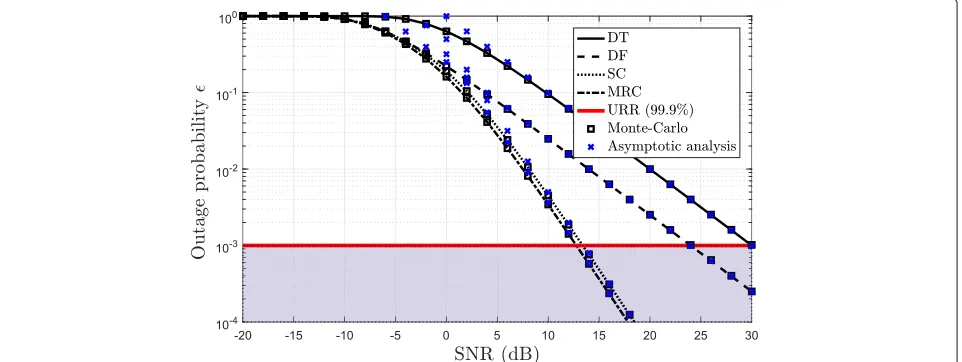
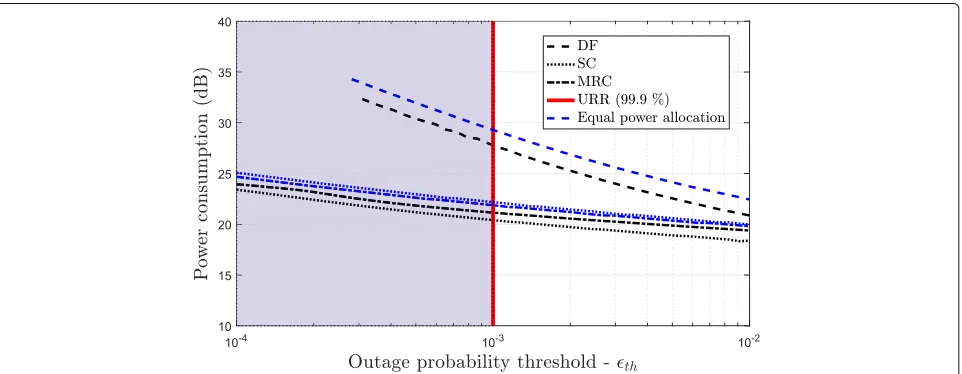
In Fig.6, we compare the ultra-reliable performance of cooperative schemes to DT in terms of transmit power under equal power allocation constraint. We can clearly see the power gain attained via the cooperative proto-cols at high SNR regime where there is huge performance gap between cooperative schemes and DT. In addition, we indicate that MRC and SC protocols perform closely in the entire SNR range and consumes less transmit power to communicate under the URR in comparison to DF and DT.
In addition, we indicate the possibility of using asymp-totic expressions in ultra-reliable region. In other words, at high SNR regime, the maximum achievable coding rate (2) converges the asymptotically long codewords as
Rasym(n,)=C, whereC = sup{R: Pr[log2(1+ρ) <
R]< }. In Fig.6, we show that the asymptotic expres-sions approach the analytical results as the transmit power increases.
Figure7indicates the performance advantage of coop-erative schemes over DT. Coopcoop-erative schemes exploit diversity gain which decreases the outage probabil-ity remarkably. As we expected, the outage probabilprobabil-ity decreases in blocklength. In addition, SC and MRC pro-tocols are able to support URLLC under FB regime with very short packet lengths.
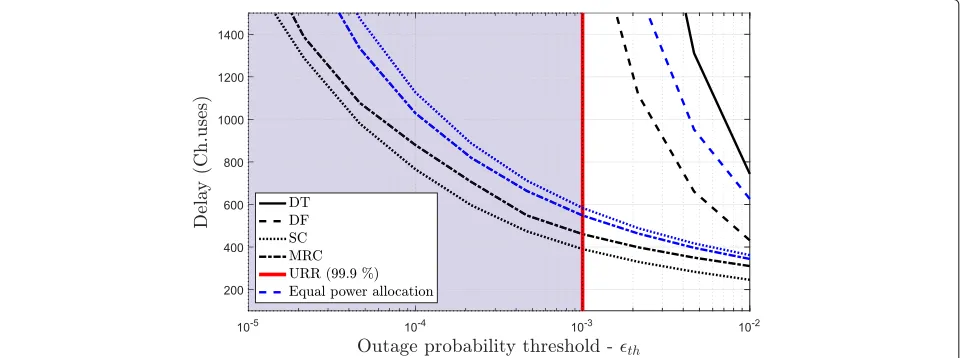
Figure8indicates the total minimum latency required for URLLC under the FB regime with two distinct power constraints as (i) EPA:P=ηP+(1−η)P, whereη=0.5,
Fig. 5Impact of power allocation factorηon the outage probability withk=250. This figure illustrates the optimal value of power allocation factor for each of studied relaying scenarios where the outage probability is minimized. We show that we have to allocate more power to the source to work in ultra-reliable region and MRC requires more power at the source compared to the other studied protocols
and (ii) OPA: PS + PR ≤ P. The choices of the mini-mum latencyδand optimal powers are in such a way that minimizes the outage probability constraint to a specific interval of interest and holds the power constraints which gives the optimal values of nand P, and is a nonlinear optimization problem as follows.1
minimize (n,P)
subject to PS+PR≤P, 100≤n≤10000.
We set the minimum blocklength to 100 since (4) is accurate for n > 100, as proved for AWGN channels
([19], Figures 12 and 13) as well as for fading channels as discussed in [40], and to a maximum of 104so to reduce the search range, and to be within URLLC boundaries.
It shows that DT is not able to cope with the strin-gent latency constraint and need a large tolerance of delay; thus, we resort to cooperative protocols in order to reduce the latency in URR. It can be clearly seen that SC works highly better than DF and performs closely to MRC in the entire range but with higher latency requirements when we allocate equal powers to the S andR. We also indi-cate that under OPA constraint, SC outperforms MRC in terms of channel uses and is more energy efficient than MRC as we discuss about it in the following section, while
Fig. 7Outage probability analysis for DT, DF, SC, and MRC under EPA. This figure compares the performance of cooperative schemes to direct transmission in terms of outage probability under the finite blocklength regime. We indicate that URLLC is feasible via cooperative diversity technique. We show the superiority of MRC and SC over DF and DT schemes under the finite blocklength regime
with equal power allocation strategy, MRC requires less channel uses and consumes less transmit power as we can see in Fig.6. Here, with equal power allocation strategy, the total power ofSandRmay be less than the maximum total power (20 dB) but in Fig.6, we forcePSandPR to be equal with total power ofPmax. Therefore, according to
the simulations, whenR=1 bpcu andP=20 dB, higher reliability is feasible in Fig.6compared to Fig.8.
4.2 Energy efficiency analysis
Energy efficiency (EE) determines the trade-off between throughput gains and total energy consumed. Let us first define the total energy consumption per bit of each scenario. The total power consumed includes power of
transmission with no dependency on the distance of relay nodes, consumed power in radio frequency(RF) cir-cuitry and also coding rate [48,49]. Here, we ignore the baseband processing consumption since its value is neg-ligible in comparison to the energy consumption of RF circuitry [50].
Then, the total energy consumption per bit of a single-hop transmission is
ESH=
PPA+PTX+PRX
R , (15)
where PPA = P/φ is the power amplifier consumption for a single-hop transmission andφis the drain efficiency of the amplifier, PTX and PRX are the power consumed
for transmitting and receiving in the internal circuitry, respectively. In a similar way, we can also find the total power consumption of multi-hop schemes by determin-ing the outage probability onS-Rlink in each cooperative schemes.
4.2.1 Cooperative transmissions
The total power consumption for DF protocol depends on the outage probability ofS-Rlink as follows
EDF=SRDF×
where the first term indicates that the consumed energy on theS-Rlink, while the second term shows thatRcould decode the message correctly and send the packet toD.
In the case of SC and MRC, the total power consump-tion is formulated as follows
Ej=SRj× ingly to each method. The additionalPRX in each term of (17) compared to the (16) corresponds to the transmis-sion ofS, which is heard by bothRandDand destination decodesS-DandR-Dtransmissions, simultaneously.
Hence, the EE for each protocol is formulated as
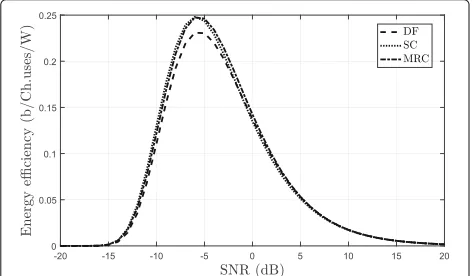
EE= Throughput convex in the SNR, while the outage probability is mono-tonically decreasing in the SNR and energy consumption is monotonically increasing, which is observed in Figs.6
Fig. 9Energy efficiency analysis of cooperative schemes under equal power allocation. This figure compares the energy efficiency in DF, SC and MRC schemes under EPA as a function maximum transmit power
and11, respectively. We maximize the energy efficiency as follows
Maximize EE(,E)
subject to PS+PR≤P,
(n,P)≤th,
100≤n≤10000.
This problem is equivalent to minimize the outage prob-ability with respect toP∗S,P∗R, and blocklengthn∗. Since we aim to compare the performance of cooperative schemes, we do not focus on the proposal of a particular solu-tion, but we resort to numerically efficient algorithm. Therefore, we resort to fmincon implemented in Matlab and use interior point algorithm to solve the nonlinear optimization problem as detailed in [51]. We consider outage probability threshold in an interval of interest as 10−5 < th < 10−2. At each outage probability value,
we numerically determineP∗S,P∗R, and blocklengthn∗that maximize the energy efficiency. We apply the numeri-cal optimization due to the nonlinear constraint on the outage probability(n,P)≤th.
Figure10compares the energy efficiency of cooperative schemes in terms of probability of successful transmission under two distinct power constraints. In this paper, we assumePTX =97.9 mW,PRX =112.2 mW, and the drain efficiencyφ = 0.35 according to the power consumption values reported in [50]. Under EPA strategy, MRC is the most energy-efficient scenario among other cooperative scenarios as it consumes less transmit power shown in Fig.6, and has lower latency in URR while under OPA, SC becomes the most energy-efficient protocol as we show in Fig.8, it reduces the latency and the total power con-sumption is less than that of MRC. Since Fig.5indicates that in order to perform in URR, we should allocate more power to the source whereηis equal to 0.6 and 0.7 for SC and MRC, respectively. Hence, more power is allo-cated to the source of MRC than that of SC; thus, MRC becomes less energy efficient compared to SC under OPA strategy.
Fig. 10Energy efficiency of DF, SC, and MRC scenarios under EPA and OPA strategies. This figure compares the energy efficiency in DF, SC and MRC cooperative schemes under EPA and OPA strategies as function of reliability. We show that under EPA, MRC is the most energy-efficient strategy while with OPA strategy, SC becomes the most energy-efficient protocol
5 Conclusions
In this paper, we assess the relay communication under the finite blocklength regime under Rayleigh fading. Per-formance of three relaying scenario, namely DF, SC, and MRC is compared to direct transmission under two dis-tinct power constraints so-called EPA and OPA. Based on the outage probability analysis of each transmission pro-tocol, we show that relaying improves the probability of a successful transmission and guarantees ultra-high reli-ability with FB codes. MRC protocol is less affected by the coding and provide higher reliability compared to DT and two other relaying scenarios. In addition, we numer-ically show the optimal power allocation for the relaying
protocols under study in order to operate in URR. Our results shows that operation at URR is feasible by allo-cating more power to the source; however, relay node is considered to provide additional diversity gain compared to the DT which is more evident at high SNR regime. We compare the studied cooperative schemes in terms of latency and energy efficiency under the two distinct power constraints. According to the results, with equal power allocation at source and relay, MRC is the most energy-efficient protocol with lower latency and power consumption compared to the other scenarios while SC has the highest energy efficiency and lowest latency under optimal power allocation strategy. Moreover, we provide
the outage probability in closed form and prove the accu-racy and appropriateness of our analytical model through numerical results. Finally, in our future work, we will focus on the impact of imperfect channel state information on URLLC.
Endnote
1We solve the optimization problem numerically with
the Matlab functionfmincon. Interior point algorithm is used to solve the nonlinear optimization problem [51].
Funding
This work has been partially supported by Finnish Funding Agency for Technology and Innovation (Tekes), Huawei Technologies, Nokia and Anite Telecoms, and Academy of Finland (under Grant no. 307492)
Availability of data and materials
The manuscript is self-contained. Simulations description and parameters are provided in details in Section4.
Authors’ contributions
All authors have contributed to this manuscript and approved the final submitted manuscript.
Competing interests
The authors declare that they have no competing interests.
Publisher’s Note
Springer Nature remains neutral with regard to jurisdictional claims in published maps and institutional affiliations.
Received: 16 October 2017 Accepted: 30 July 2018
References
1. P Popovski, JJ Nielsen, C Stefanovic, E de Carvalho, E Ström,
KF Trillingsgaard, A-S Bana, DM Kim, R Kotaba, J Park, et al., Ultra-reliable low-latency communication (URLLC): principles and building blocks (2017). arXiv preprint arXiv:1708.07862
2. H Shariatmadari, R Ratasuk, S Iraji, A Laya, T Taleb, R Jäntti, A Ghosh, Machine-type communications: current status and future perspectives toward 5G systems. IEEE Commun. Mag.53(9), 10–17 (2015) 3. Y Mehmood, C Görg, M Muehleisen, A Timm-Giel, Mobile M2M
communication architectures, upcoming challenges, applications, and future directions. EURASIP J. Wirel. Commun. Netw.2015(1), 250 (2015) 4. AE Kalør, R Guillaume, JJ Nielsen, A Mueller, P Popovski, Network slicing for ultra-reliable low latency communication in industry 4.0 scenarios (2017). arXiv preprint arXiv:1708.09132
5. JG Andrews, S Buzzi, W Choi, SV Hanly, A Lozano, AC Soong, JC Zhang, What will 5G be? IEEE J. Sel. Areas. Commun.32(6), 1065–1082 (2014) 6. Z Dawy, W Saad, A Ghosh, JG Andrews, E Yaacoub, Toward massive
machine type cellular communications. IEEE Wirel.Commun.24(1), 120–128 (2017)
7. B Lee, S Park, DJ Love, H Ji, B Shim, inGlobal Communications Conference (GLOBECOM), 2016 IEEE. Packet structure and receiver design for low-latency communications with ultra-small packets (IEEE, Washington DC, 2016), pp. 1–6
8. T Taleb, A Kunz, Machine type communications in 3GPP networks: potential, challenges, and solutions. IEEE Commun. Mag.50(3), 178–184 (2012)
9. M Condoluci, M Dohler, G Araniti, A Molinaro, K Zheng, Toward 5G densenets: architectural advances for effective machine-type communications over femtocells. IEEE Commun. Mag.53(1), 134–141 (2015)
10. JF Monserrat, G Mange, V Braun, H Tullberg, G Zimmermann, Ö Bulakci, METIS research advances towards the 5G mobile and wireless system definition. EURASIP J. Wirel. Commun. Netw.2015(1), 53 (2015)
11. C Bockelmann, N Pratas, H Nikopour, K Au, T Svensson, C Stefanovic, P Popovski, A Dekorsy, Massive machine-type communications in 5G: physical and MAC-layer solutions. IEEE Commun. Mag.54(9), 59–65 (2016) 12. Popovski P, in5G for Ubiquitous Connectivity (5GU), 2014 1st International
Conference on. Ultra-reliable communication in 5G wireless systems (IEEE, Akaslompolo, 2014), pp. 146–151
13. B Singh, O Tirkkonen, Z Li, MA Uusitalo, R Wichman, inPersonal, Indoor, and Mobile Radio Communications (PIMRC), 2016 IEEE 27th Annual International Symposium on. Selective multi-hop relaying for ultra-reliable communication in a factory environment (IEEE, Valencia, 2016), pp. 1–6 14. A Biral, H Huang, A Zanella, M Zorzi, inGlobecom Workshops (GC Wkshps),
2016 IEEE. On the impact of transmitter channel knowledge in energy-efficient machine-type communication (IEEE, Washington DC, 2016), pp. 1–7
15. G Durisi, T Koch, P Popovski, Toward massive, ultrareliable, and low-latency wireless communication with short packets. Proc. IEEE. 104(9), 1711–1726 (2016)
16. O Yilmaz, inEuropean Conference on Networks and Communications (EuCNC), vol. 2016. Ultra-reliable and low-latency 5G communication (IEEE, Athens, 2016)
17. M Sybis, K Wesolowski, K Jayasinghe, V Venkatasubramanian, V Vukadinovic, inVehicular Technology Conference (VTC-Fall), 2016 IEEE 84th. Channel coding for ultra-reliable low-latency communication in 5G systems (IEEE, Montreal, 2016), pp. 1–5
18. Y Hu, J Gross, A Schmeink, On the performance advantage of relaying under the finite blocklength regime. IEEE Commun. Lett.19(5), 779–782 (2015)
19. Y Polyanskiy, HV Poor, Verdú S, Channel coding rate in the finite blocklength regime. IEEE Trans. Inf. Theory.56(5), 2307–2359 (2010) 20. O Iscan, D Lentner, Xu W, inGlobecom Workshops (GC Wkshps), 2016 IEEE.
A comparison of channel coding schemes for 5G short message transmission (IEEE, Washington DC, 2016), pp. 1–6
21. B Makki, T Svensson, Zorzi M, inCommunications (ICC), 2015 IEEE International Conference on. Finite block-length analysis of spectrum sharing networks (IEEE, London, 2015), pp. 7665–7670
22. J-H Park, D-J Park, A new power allocation method for parallel AWGN channels in the finite block length regime. IEEE Commun. Lett.16(9), 1392–1395 (2012)
23. R Devassy, G Durisi, P Popovski, EG Strom, inCommunications, Control and Signal Processing (ISCCSP), 2014 6th International Symposium on. Finite-blocklength analysis of the ARQ-protocol throughput over the Gaussian collision channel (IEEE, Athens, 2014), pp. 173–177
24. S Ikki, MH Ahmed, Performance analysis of cooperative diversity wireless networks over Nakagami-m fading channel. IEEE Commun. Lett.11(4), 334–336 (2007)
25. E Zimmermann, P Herhold, G Fettweis, On the performance of cooperative relaying protocols in wireless networks. Trans. Emerg. Telecommun. Technol.16(1), 5–16 (2005)
26. F Mansourkiaie, MH Ahmed, Cooperative routing in wireless networks: a comprehensive survey. IEEE Commun. Surv. Tutor.17(2), 604–626 (2015) 27. VN Swamy, S Suri, P Rigge, M Weiner, G Ranade, A Sahai, B Nikoli´c, in
Communications (ICC), 2015 IEEE International Conference on. Cooperative communication for high-reliability low-latency wireless control (IEEE, London, 2015), pp. 4380–4386
28. Y Hu, A Schmeink, Gross J, inSensor Array and Multichannel Signal Processing Workshop (SAM), 2016 IEEE. Relaying with finite blocklength: challenge vs. opportunity (IEEE, Rio de Janerio, 2016), pp. 1–5 29. F Du, Y Hu, L Qiu, A Schmeink, inInternational Symposium on Wireless
Communication Systems (ISWCS), 2016. Finite blocklength performance of multi-hop relaying networks (IEEE, Poznan, 2016), pp. 466–470 30. NC Beaulieu, J Hu, A closed-form expression for the outage probability of
decode-and-forward relaying in dissimilar Rayleigh fading channels. IEEE Commun. Lett.10(12), 813–815 (2006)
31. TX Tran, NH Tran, HR Bahrami, S Sastry, On achievable rate and ergodic capacity of NAF multi-relay networks with CSI. IEEE Trans. Commun.62(5), 1490-1502 (2014)
32. P Nouri, H Alves, M Latva-aho, inEuropean Conference on Networks and Communications (EuCNC), 2017. On the performance of ultra-reliable decode and forward relaying under the finite blocklength (IEEE, Oulu, 2017), pp. 1–5
message cooperative relaying protocols under Nakagami-m fading (IEEE, Bologna, 2017)
34. D Qiao, MC Gursoy, S Velipasalar, inGlobal Telecommunications Conference, 2009. GLOBECOM 2009. IEEE. Energy efficiency of fixed-rate wireless transmissions under queueing constraints and channel uncertainty (IEEE, Honolulu, 2009), pp. 1–6
35. MC Gursoy, On the capacity and energy efficiency of training-based transmissions over fading channels. IEEE Trans. Inf. Theory.55(10), 4543–4567 (2009)
36. G Wu, C Yang, S Li, Li GY, Recent advances in energy-efficient networks and their application in 5G systems. IEEE Wirel. Commun.22(2), 145–151 (2015)
37. C She, C Yang, inCommunications in China (ICCC), 2016 IEEE/CIC International Conference on. Energy efficient design for tactile internet (IEEE, Chengdu, 2016), pp. 1–6
38. E Dosti, M Shehab, H Alves, M Latva-aho, inNetworks and Communications (EuCNC), 2017 European Conference on. Ultra reliable communication via CC-HARQ in finite block-length (IEEE, Oulu, 2017), pp. 1–5
39. E Dosti, UL Wijewardhana, H Alves, M Latva-aho, Ultra reliable communication via optimum power allocation for type-I ARQ in finite block-length (2017). arXiv preprint arXiv:1701.08617
40. W Yang, G Durisi, T Koch, Y Polyanskiy, Quasi-static multiple-antenna fading channels at finite blocklength. IEEE Trans. Inf. Theory.60(7), 4232–4265 (2014)
41. Y Hu, A Schmeink, J Gross, Blocklength-limited performance of relaying under quasi-static Rayleigh channels. IEEE Trans. Wirel. Commun.15(7), 4548–4558 (2016)
42. B Makki, T Svensson, M Zorzi, Finite block-length analysis of the incremental redundancy HARQ. IEEE Wirel. Commun. Lett.3(5), 529–532 (2014)
43. JN Laneman, DN Tse, GW Wornell, Cooperative diversity in wireless networks: efficient protocols and outage behavior. IEEE Trans. Inf. Theory. 50(12), 3062–3080 (2004)
44. H Alves, RD Souza, G Fraidenraich, ME Pellenz, Throughput performance of parallel and repetition coding in incremental decode-and-forward relaying. Wirel. Netw.18(8), 881–892 (2012)
45. H Alves, RD Souza, G Brante, ME Pellenz, inVehicular Technology Conference (VTC Spring), 2011 IEEE 73rd. Performance of type-i and type-ii hybrid ARQ in decode and forward relaying (IEEE, Yokohama, 2011), pp. 1–5 46. A Papoulis, SU Pillai, Probability, random variables, and stochastic
processes. (Tata McGraw-Hill Education, 2002)
47. IS Gradshteyn, IM Ryzhik,Table of Integrals, Series, and Products. (Academic press, United States, 2014)
48. GG de Oliveira Brante, MT Kakitani, RD Souza, Energy efficiency analysis of some cooperative and non-cooperative transmission schemes in wireless sensor networks. IEEE Trans. Commun.59(10), 2671–2677 (2011) 49. H Alves, RD Souza, G Fraidenraich, Outage, throughput and energy
efficiency analysis of some half and full duplex cooperative relaying schemes. Trans. Emerg. Telecommun. Technol.25(11), 1114–1125 (2014) 50. S Cui, AJ Goldsmith, A Bahai, Energy-constrained modulation
optimization. IEEE Trans. Wirel. Commun.4(5), 2349–2360 (2005) 51. RA Waltz, JL Morales, J Nocedal, D Orban, An interior algorithm for