Volume 2007, Article ID 41401,7pages doi:10.1155/2007/41401
Research Article
An Energy-Efficient Adaptive Modulation Suitable for Wireless
Sensor Networks with SER and Throughput Constraints
J. Joaqu´ın Escudero Garz ´as, Carlos Bouso ˜no Calz ´on, and Ana Garc´ıa Armada
Department of Signal Theory and Communications, University Carlos III of Madrid, Avda de la Universidad 30, 28911 Legan´es, Madrid, Spain
Received 16 October 2006; Revised 14 March 2007; Accepted 6 April 2007
Recommended by Mischa Dohler
We consider the problem of minimizing transmission energy in wireless sensor networks by taking into account that every sensor may require a different bit rate and reliability according to its particular application. We propose a cross-layer approach to tackle such a minimization in centralized networks for the total transmission energy consumption of the network: in the physical layer, for each sensor the sink estimates the channel gain and adaptively selects a modulation scheme; in the MAC layer, each sensor is correspondingly assigned a number of time slots. The modulation level and the number of allocated time slots for every sensor are constrained to attain their applications bit rates in a global energy-efficient manner. The signal-to-noise ratio gap approximation is used in our exposition in order to jointly handle required bit rates, transmission energies, and symbol error rates.
Copyright © 2007 J. Joaqu´ın Escudero Garz´as et al. This is an open access article distributed under the Creative Commons Attribution License, which permits unrestricted use, distribution, and reproduction in any medium, provided the original work is properly cited.
1. INTRODUCTION
Wireless sensor networks are susceptible to many different applications in diverse fields such as areas of industry and commerce (i.e., environment monitoring and control), home automation and intelligent buildings (i.e., security, lighting, air conditioning), PC peripherals (i.e., mouse, printer), con-sumer electronics, medicine and personal health care (i.e., monitors, diagnostics, medical body sensors), and surveil-lance and maintenance among others [1–6]. Furthermore, the availability of commercial products has fostered poten-tial applications; examples are given in [7–11]. Particularly, wireless devices conforming to IEEE 802.15.4 standard and ZigBee specifications seem to be gaining market due to their characteristics of low power, low cost, and low rate. These features make them very well-suited as well for most WSN applications in the so-called personal area networks (PAN).
Some relevant parameters are usually considered in the context of PANs such as the type and quality of service, scal-ability, maintainscal-ability, and, specially, lifetime of batteries. Therefore, energy-efficient communication schemes have be-come a main challenge in the design of these networks. One straight approach towards energy efficiency would be the use of long transmission time intervals, however many applica-tions impose hard delay contraints. This energy-efficiency
delay tradeoff has been recently studied in [12]. An other different appproach [13] examines single-hop sensor com-munications using time division multiple access (TDMA), proposing optimal and suboptimal algorithms to minimize the energy to transmit data with a given capacity in the ad-equate time. Theoretical energy gains are thus obtained for optimal and suboptimal schemes as compared to the TDMA ideal capacity. Other approaches for multihop networks have been developed in [14,15].
As for centralized WSN, there exist different works fo-cused on single layer design to tackle the energy minimiza-tion problem. Examples of PHY-oriented approaches are given in [16,17]. Similarly, energy minimization can be ac-complished through MAC layer protocols as in [12,13,15,
18, 19]. Cross-layer design has been typically focused on MAC and routing layers but does not touch upon the PHY layer [20–23]. Nevertheless, we consider that PHY layer is of paramount importance as to cross layer design when energy efficiency is the aim to tackle. Some recent works on multi-hop networks follow this same line by using power manage-ment [24] or coding [25].
implemented services and applications. We will deal with two essential aspects related to reliability in real wireless chan-nels for WSN: path loss and symbol error rate. In this pa-per, to face the aforementioned problems, we propose a prac-tical and energy-efficient adaptive scheme using cross layer design. It works as follows: firstly, we estimate the channel gains between every node and the sink; then, this informa-tion is used by MAC layer to design the time slots lengths in an energy-efficient manner; finally, joint consideration of the calculated time slots lengths and the bit rates determines the suitable modulation level for the PHY layer.
Due to its high energy efficiency, we have selected multi-level quadrature amplitude modulation (MQAM). The mod-ulation level will be adapted to fulfill transmission require-ments for each sensor by means of SNR gap approximation. We apply this approximation because it allows to relate a con-stant application quality (SER) with a concon-stant throughput straightforwardly. In order to show the performance of the proposed scheme, the energy needed for our adaptive mod-ulation scheme will be compared to that of the fixed-slot TDMA scheme within a PAN environment.
IEEE 802.15.4 MAC protocol [26] provides a mode of op-eration for sensors requiring service guarantees, making use of “guaranteed time slots” (GTS) and slotted CDMA. How-ever, such guaranteed service requests may be rejected by the PAN coordinator, so these guarantees are not assured. Even though GTSs are accepted for a certain sensor, energy min-imization could only be implemented by means of power transmission control whilst no power management is con-sidered in the standard. With the TDMA variable-time-slot-length scheme we propose, optimal energy consumption is achieved simply by adjusting the time slots durations, keep-ing the transmitted power constant.
Since the range of modulation levels in practice is mod-erate, adaptive schemes can be implemented in a straightfor-ward manner through a parallel hardware architecture. Yet, another recent alternative for adaptive modulation is soft-ware radio: its use in the WSN sink can be adopted very easily and, although its implementation in sensors may not seem so immediate, some proposals have already been given in this area [27].
The remaining of the paper is organized as follows.
Section 2reviews SNR gap approximation. InSection 3, we formulate the problem and the system description for the WSN scenario. InSection 4, we present the proposed energy-efficient adaptive modulation scheme while simulations, and results are shown inSection 5. Finally, some conclusions are outlined inSection 6.
2. REVIEW OF SNR GAP APPROXIMATION
SNR gap approximation provides a simple way to relate SNR (signal-to-noise-ratio), bit rate Rb and SER (symbol error Rate) for a given modulation (e.g., M-QAM) and coding scheme [28]. It has been generally used for bit-loading pur-poses because it makes algorithms easier to implement [29]. Different multilevel modulations can be used for adap-tive modulation.M-QAM provides a lower probability
sym-bol error compared toM-PSK for the same SNR.M-FSK is a priori more energy-efficient compared toM-QAM; however, the bandwidth efficiency (bps/Hz) can be a drawback, up to 8 times less thanM-QAM (M=16) [30], resulting then that we would need 8 times more bandwidth. As our system is narrowband and, in addition, the bandwidth is constant, our interest falls on an efficient-bandwidth modulation, so M -QAM is more adequate. Additionally, if we consider the dis-tance of the link, energy can be optimized usingM-QAM and
M-FSK [17]; the energy per bit is lower forM-QAM for dis-tance less than 30 m, which is our range of interest. Other re-lated works consider alsoM-QAM as the multilevel modula-tion to be used for energy efficient communications [31,32]. Then, in this paper we will use M-QAM modulation because of its higher-energy efficiency for centralized WSN with PAN coverage. IfM-QAM modulation is used, SNR gap approximation states that the number of bits per symbolΛ may be found as
Λ=log2
bits per symbol achieving a given error probability SER in a flat-frequency propagation channel corrupted by AWGN,Γ is the SNR gap [33] andQ(x) is also defined in [33]. In prac-tical applications, ΛandM take real values but have to be discretized. We will useΔMas the increment between con-secutive allowed values ofM and we will examine the pro-posed scheme performance depending on this value.
In real applications, however, the usual way to specify the data-rate is in bits per second (bps), so for our convenience we will useRin these units considering a symbol periodTS:
R= 1
3. PROBLEM FORMULATION AND SYSTEM DESCRIPTION
3.1. Problem formulation
Let us consider a centralized WSN where a central node or sink needs to collect information fromN sensors. Each of these sensors potentially could be implementing a different application or service, resulting in different data-ratesRnand symbol error rates SERnfor each one, where subindex “n” is
used to denote different users. Let us assume a total frame duration T, and a time interval of variable lengthTnis as-signed to sensorn; consequently, the sum of all time intervals equalsT:
N
n=1
For energy minimization purposes, we will calculate the en-ergyEnassociated to nth sensor as the energy used for the transmission in the correspondingnth time slot:
En=EStx·Tn
TS. (4)
We will base then our analysis of energy on the trans-mitted symbol energyEStxand the relationTn/TS, which
de-termines the number of symbols transmitted during thenth time slotNn:Nn=Tn/TS. This energy model is a simplified one, since total energy consumption in the sensor encom-passes also active-sleep transitions power and circuit power consumption [17,31]; then, a fully realistic model would take them into account.
It is clear that some entity in the network must coordi-nate the time assignments, that is, the time-slots duration
Tn, and estimate the channel parameters we will need for the adaptive modulation scheme (seeSection 3.2). Therefore, some signaling system must be implemented in order to in-form the sensors about these assignments. Since the network topology is centralized, these tasks (included channel estima-tion) are assumed by the sink, because sensors are intended to be as simple as possible and may have limitations in pro-cessing; the feedback information can be implemented with-out significant traffic load [34].
In this paper, the function to be minimized is the sum of individual energies needed by each sensor per time inter-val given by (4); Rnand SERn will be guaranteed for each
sensor despite changes in SNRndue to channel variations by
adapting the modulation and the transmission time. Then, the problem to solve can be formulated as the following con-strained minimization problem:
minimize
N
n=1
En=
N
n=1
EStx·Tn
TS
subject to
N
n=1
Tn=T.
(5)
3.2. System description
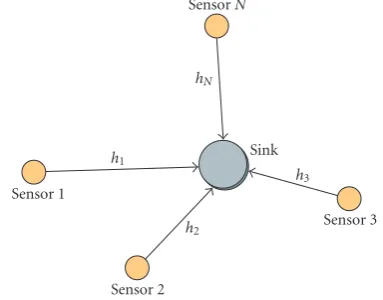
Our system model is a centralized wireless sensor network (Figure 1) made up of sensors whose transmission require-ments may differ with respect to each other in bit rate and quality of service, since the implemented applications may be different.
We state our problem from the receiver point of view, so a loss model must be defined to estimate the received energy. The reason for this is that SER is a key parameter in the pro-posed energy-efficient adaptive modulation scheme and we will formulate it as a function of the received symbol energy (seeSection 4). Then, if the energy transmitted by each sen-sor can be calculated asEn=Pn·Tn, beingPnthe nominal transmission power of the device, a path loss needs to be in-cluded to estimate the received power. The average path loss
PLncan be calculated according to the propagation model described in [35], where distance from each transmitter to
h1
hN
h3
h2 Sensor 1
SensorN
Sensor 3
Sensor 2
Sink
Figure1: Wireless sensor network scheme: a centralized configura-tion.
the receiver (dn) is in the order of personal communications range (up to 10 m):
PLn=S0+ 10alogdn+b(dB) (6)
being in the previous expressionS0the path loss at 1 m
dis-tance, a and b correspond to parameters for LOS (line of sight) scenario in the ISM band (2.4 GHz) in indoor envi-ronment. The height of antennas is assumed to be 1 m for the receiver and between 1–3 m for the transmitters.
In addition to path loss, a Rayleigh distribution has been used in order to model small-scale fading for each transceiver. This fading will be represented by the coefficients
hn.
The consideration of both loss factors (path loss and small-scale fading) leads to a modification of the optimiza-tion problem (5). The received energy per symbol can be cal-culated then asESrx = EStx/(αn· |hn|2), whereEStxdenotes
the transmitted energy per symbol andαn=10PLn/10;
refor-mulating (5):
minimize
N
n=1
En=
N
n=1
ESrx·Tn
Ts ·hn
2 αn
subject to
N
n=1
Tn=T.
(7)
4. ADAPTIVE MODULATION WITH SER AND THROUGHPUT CONSTRAINTS
As has been mentioned in the previous sections, the design of the time slots length is performed using SNR gap approxi-mation as a means to relate the quality of service parameters we wish to guarantee (SER and bit rate). In contrast to fixed TDMA, in which all time intervals have the same duration, with the energy-efficient scheme, the length of time intervals
Tnwill be a function of the required bit rateRnand the SERn.
The difference between transmission frames can be seen in
T/N T/N · · · T/N T
Fixed time slot length TDMA frame
T1 T2 · · · TN
T
Variable time slot length TDMA frame
Figure2: Fixed and variable time-slots length TDMA frames.
be “stealing” time for transmission each other, every node is maintaining the required quality specified byRnand SERn.
Thenth sensor bit rateRnis calculated using (2):
Rn=Nn
Analyzing (8), we observe that requiredRnis assured per-forming adaptive modulation: we assume invariant propaga-tion channel during frameT, and if channel conditions get worse from frame to frame, the SNRndecreases as well as the
number of bits per symbol given by log2(1 +γ/Γ). In order to keepRnconstant, the transmission interval must increase via
Nn.
Recalling thatγ =ESrx/N0, the required energy per user
to be minimized of (7) can be expressed as:
Without loss of generality,Enhas been normalized with re-spect toN0. Written formally, we need to solve the following
constrained optimization problem:
The solution to (10) can be founded using Lagrangean’s mul-tipliers method, and the set of{Nn}N
n=1which optimize the
total energy must satisfy
λ=Γ·hn2αn where Lagrangean multiplierλcan be obtained by numerical search. It is straightforward to calculate the time duration of each interval asTn=TS·Nn.
Furthermore, the correspondingEnwill decrease accord-ing to (9), as can be expected since the level of theM-QAM modulation will decrease (M =1 +γ/Γ) but to preserve the bit rate, the transmission time must increase.
5. SIMULATION SETUP AND RESULTS
The system described has been simulated taking as a ref-erence IEEE 802.15.4 standard in order to make a realis-tic choice of the simulation parameter values. The band
2.4
Rndeviation (bps)
Variable TDMA,M=16 Fixed TDMA,M=16
Figure3: Energy gain with respect to fixed TDMA and variable length TDMA with 16-QAM modulation,N=896 symbol periods.
for transmission is the ISM band (2.4 GHz), defined as the primary band for this type of networks. The bandwidth is 62.5 KHz, and the symbol period equals the 802.15.4 sym-bol period TS = 16μs. In order to consider the channel invariant during a frame transmission, coherence time Tc
must be larger than the duration of the frame, andTc can be calculated as [36]Tc = 0.423/ fm, being fm = v·fc/c,
c = 300000 m/s, v = 3 Km/h (walking velocity), and fc
the carrier frequency 2.4 GHz; then Tc = 63.45 ms. The frame length has been chosen considering that 802.15.4 states a length from 15 milliseconds to 250 seconds; according to the value obtained forTc, we have chosen a duration frame about 15 milliseconds, corresponding to 896 symbols of 16μs (14.336 ms). The rest of parameters have the following val-ues: the total bit rate of the network is 250 Kbps and SER= 10−3.
5.85 5.8 5.75 5.7 5.65 5.6
Energ
y
gain
(dB)
14000 12000 10000 8000 6000 4000 2000 0
Rndeviation (bps)
Variable TDMA,M=64
Figure4: Energy gain with respect to variable length TDMA with 64-QAM modulation,N=896 symbol periods.
2.4 2.2 2 1.8 1.6 1.4 1.2 1
Energ
y
gain
(dB)
14000 12000 10000 8000 6000 4000 2000 0
Rndeviation (bps)
Variable TDMA,M=16 Fixed TDMA,M=16
Figure5: Energy gain with respect to fixed TDMA and variable length TDMA with 16-QAM modulation,N=64 symbol periods.
sensors environment, as Bluetooth; in this case, the possibil-ities for duration frame are. 0.625/1.875/3.125 milliseconds, so we have selected a frame of 64 symbols, corresponding to 1.024 millisecond. Figures5and6shows the energy gain in the mentioned (a) and (b) situations with the new parame-ters.
The effect of correlation among the propagation small-scale (Rayleigh) channels sensor-sink hn, is taken into ac-count. Parameter σ indicates the correlation among chan-nels. The energy gain is shown inTable 1for frame duration
N=896 symbols, and it could be expected a significant
dif-5.61 5.6 5.59 5.58 5.57 5.56 5.55
Energ
y
gain
(dB)
14000 12000 10000 8000 6000 4000 2000 0
Rndeviation (bps)
Figure6: Energy gain with respect to variable length TDMA with 64-QAM modulation,N =64 symbol periods.
Table1: Energy gain for energy-efficient adaptive modulation com-pared to conventional TDMA with different correlations between channels (σ2),N=896 symbols.
M Deviation (Kbps) σ2 Gfixed (dB) Gvariable (dB)
16 0 1 1,15 1,02
16 0 20 1,24 1,06
16 5.8 1 1,44 1,07
16 5.8 20 1,34 1,07
16 13 1 2,11 1,19
16 13 20 2,12 1,23
64 0 1 — 5,6
64 0 20 — 5,62
64 5.8 1 — 5,68
64 5.8 20 — 5,7
64 13 1 — 5,81
64 13 20 — 5,93
ference favourable to the uncorrelated case that in practice does not occur. The explanation to this is that the path loss coefficients (αn) are much larger than the Rayleigh fading co-efficients (hn) and, as can be observed in (9), the optimized energyEnis strongly dominated by path loss effect. Related to this, sensors in the lowest distance (d=1 m) use a very low number of time slots (3, 4, 5 symbols per time slot), and con-sequently the level of modulationM is high. Similar results and conclusions apply for the case ofN=64 symbols.
In simulations, discrete bit-loading has been addressed in order to preserve practicality; we have usedΔM =1 en-suring always a bit rate higher than the searchedRn, taking into account that any integer value ofMcan be achieved us-ing an appropriate codus-ing. Additionally, we have explored the energy consumption of the uncoded case with the restriction
M=2k(beingkan integer) with respect toΔM=1, and we
It is important to consider power limitations that are gen-erally and worldwide imposed by regulating agencies to ra-diofrequency transmissions. In IEEE 802.15.4 applications, the maximum allowed transmit power is 100 mW, but in practical 802.15.4 networks usual values of about 1 mW are very common. In the simulations carried out using the proposed energy-efficient scheme, the needed power was checked to be below this practical limit value. The result is that the maximum transmit power obtained is slightly larger than 1 mW and usual values are a few hundreds of mi-crowatts.
6. CONCLUSIONS
Energy efficiency is critical to lifetime and performance of wireless sensor networks. In this work, we have developed an energy-efficient cross layer adaptive modulation scheme that minimizes the total energy utilized by the network. This scheme is based on bit rate and reliability: SER is main-tained for the required bit rate of the implemented applica-tion adapting theM-QAM modulation. As a consequence, the design of WSN can be realized assuring the quality of ser-vice for the different implemented applications.
It must be noted that although we have chosenM-QAM as the modulation scheme,M-PSK modulation can be a pos-sibility to be considered [37]. The choice of M-QAM has been made because of its higher-energy efficiency, since this is the parameter we are focusing our interest on. Neverthe-less, M-PSK may be useful for other reasons: it can offer advantages in some other situations due to its behavior in terms of Peak-to-average power ratio (PAR); this possibility remains to be explored.
Another important topic to consider is mobility in this type of networks: the channel model we have considered as-sumes that sensors are static (or restricted to very slow move-ment). Our system model and the energy-efficient scheme developed in this paper may be suitable for the case of mo-bile sensors. However, the gain in this case should be eval-uated with the inclusion of an appropriate channel model; this scenario could be of great interest for a wide range of different applications, such as mobile body sensors, mobile home personal devices, image transmission in surveillance systems, and mobile security sensors, always considering not high speeds.
ACKNOWLEDGMENTS
The authors wish to thank the anonymous reviewers for their very helpful suggestions and comments. This work has been partially funded by CRUISE NoE (IST-4-027738), MAMBO2 (CCG06-UC3M/TIC-0698) and MACAWI (TEC-2005-07477-C02-02) projects.
REFERENCES
[1] C. Sharp, S. Schaffert, A. Woo, et al., “Design and implemen-tation of a sensor network system for vehicle tracking and au-tonomous interception,” inProceedings of the 2nd European
Workshop on Wireless Sensor Networks (EWSN ’05), pp. 93– 107, Istanbul, Turkey, January-February 2005.
[2] G. Werner-Allen, J. Johnson, M. Ruiz, J. Lees, and M. Welsh, “Monitoring volcanic eruptions with a wireless sensor net-work,” inProceedings of the 2nd European Workshop on Wireless Sensor Networks (EWSN ’05), pp. 108–120, Istanbul, Turkey, January-February 2005.
[3] M. M. Nordman and M. Lehtonen, “A wireless sensor con-cept for managing electrical distribution networks,” in Pro-ceedings of IEEE PES Power Systems Conference and Exposition (PSCE ’04), vol. 2, pp. 1198–1206, New York, NY, USA, Octo-ber 2004.
[4] H. Bai, M. Atiquzzaman, and D. Lilja, “Wireless sensor network for aircraft health monitoring,” in Proceedings of the 1st International Conference on Broadband Networks (BroadNets ’04), pp. 748–750, San Jose, Calif, USA, October 2004.
[5] Y. Li, S. S. Panwar, and S. Burugupalli, “A mobile sensor net-work using autonomously controlled animals,” in Proceed-ings of the 1st International Conference on Broadband Networks (BroadNets ’04), pp. 742–744, San Jose, Calif, USA, October 2004.
[6] V. Rajaravivarma, Y. Yi, and Y. Teng, “An overview of wireless sensor network and applications,” inProceedings of the 35th Southeastern Symposium on System Theory, pp. 432–436, Mor-gantown, WVa, USA, March 2003.
[7] L.-J. Hwang, S.-T. Sheu, Y.-Y. Shih, and Y.-C. Cheng, “Group-ing strategy for solv“Group-ing hidden node problem in IEEE 802.15.4 LR-WPAN,” inProceedings of the 1st International Conference on Wireless Internet (WICON ’05), pp. 26–32, Budapest, Hun-gary, July 2005.
[8] G. Pekhteryev, Z. Sahinoglu, P. Orlik, and G. Bhatti, “Im-age transmission over IEEE 802.15.4 and ZigBee networks,” in Proceedings of IEEE International Symposium on Circuits and Systems (ISCAS ’05), vol. 4, pp. 3539–3542, Kobe, Japan, May 2005.
[9] J. A. Gutierrez and D. B. Durocher, “On the use of IEEE 802.15.4 to enable wireless sensor networks in pulp and pa-per industrys,” inProceedings of Annual Pulp and Paper Indus-try Technical Conference, pp. 105–110, Jacksonville, Fla, USA, June 2005.
[10] S. Hara, D. Zhao, K. Yanagihara, et al., “Propagation charac-teristics of IEEE 802.15.4 radio signal and their application for location estimation,” inProceedings of the 61st IEEE Vehicu-lar Technology Conference (VTC ’05), vol. 1, pp. 97–101, Stock-holm, Sweden, May-June 2005.
[11] N. F. Timmons and W. G. Scanlon, “Analysis of the perfor-mance of IEEE 802.15.4 for medical sensor body area network-ing,” inProceedings of the 1st Annual IEEE Communications So-ciety Conference on Sensor and Ad Hoc Communications and Networks (SECON ’04), pp. 16–24, Santa Clara, Calif, USA, October 2004.
[12] Y. Yu, B. Krishnamachari, and V. K. Prasanna, “Energy-latency tradeoffs for data gathering in wireless sensor networks,” in Proceedings the 23rd Annual Joint Conference of the IEEE Com-puter and Communications Societies (INFOCOM ’04), vol. 1, pp. 244–255, Hong kong, March 2004.
[13] Y. Yao and G. B. Giannakis, “Energy-efficient scheduling for wireless sensor networks,”IEEE Transactions on Communica-tions, vol. 53, no. 8, pp. 1333–1342, 2005.
networks,” inProceeedings of the 2nd European Workshop on Wireless Sensor Networks (EWSN ’05), pp. 33–44, Istanbul, Turkey, January-Feburary 2005.
[15] Z. Shelby, C. Pomalaza-Raez, and J. Haapola, “Energy op-timization in multihop wireless embedded and sensor net-works,” inProceedings of the 15th IEEE International Sympo-sium on Personal, Indoor and Mobile Radio Communications (PIMRC ’04), vol. 1, pp. 221–225, Barcelona, Spain, Septem-ber 2004.
[16] S. Cui, A. J. Goldsmith, and A. Bahai, “Energy-efficiency of MIMO and cooperative MIMO techniques in sensor net-works,” IEEE Journal on Selected Areas in Communications, vol. 22, no. 6, pp. 1089–1098, 2004.
[17] S. Cui, A. J. Goldsmith, and A. Bahai, “Energy-constrained modulation optimization,” IEEE Transactions on Wireless Communications, vol. 4, no. 5, pp. 2349–2360, 2005.
[18] R. Jurdak, P. Baldi, and C. V. Lopes, “State-driven energy op-timization in wireless sensor networks,” inProceedings of IEEE Systems Communications (ICW ’05), pp. 356–363, Montreal, Canada, August 2005.
[19] S. C. Evans, N. Van Stralen, J. Hershey, and H. Tomlinson, “Energy minimization in wireless sensor networks through an adaptive connectionless scheduling protocol (adaptive CSP),” inProceedings of IEEE Military Communications Conference (MILCOM ’05), vol. 5, pp. 2990–2996, Atlatnic City, NJ, USA, October 2005.
[20] C.-F. Chou and K.-T. Chuang, “CoLaNet: a cross-layer design of energy-efficient wireless sensor networks,” inProceedings of IEEE Systems Communications (ICW ’05), pp. 364–369, Mon-treal, Canada, August 2005.
[21] Q. Liang, “Fault-tolerant and energy efficient wireless sensor networks: a cross-layer approach,” inProceedings of IEEE Mil-itary Communications Conference (MILCOM ’05), vol. 3, pp. 1862–1868, Atlatnic City, NJ, USA, October 2005.
[22] X. Lu, Y. Sun, J. Yu, and W. Yan, “An energy efficient cross-layer routing algorithm for wireless sensor networks,” inProceedings of the 1st IEEE Conference on Industrial Electronics and Appli-cations (ICIEA ’06), pp. 1–5, Singapore, May 2006.
[23] I.-Y. Kong and W.-J. Hwang, “Lifetime maximization by cross-layer interaction in wireless sensor networks,” inProceedings of the 8th International Conference Advanced Communication Technology (ICACT ’06), vol. 3, pp. 2055–2060, Phoenix Park, Korea, February 2006.
[24] H. Kwon, T. H. Kim, S. Choi, and B. G. Lee, “A cross-layer strategy for energy-efficient reliable delivery in wireless sen-sor networks,”IEEE Transactions on Wireless Communications, vol. 5, no. 12, pp. 3689–3699, 2006.
[25] H. Karvonen and C. Pomalaza-Raez, “A cross layer design of coding and awake/sleep periods in WSNS,” inProceedings of the 17th IEEE International Symposium on Personal, In-door and Mobile Radio Communications (PIMRC ’06), pp. 1–5, Helsinki, Finland, September 2006.
[26] IEEE Std 802.15.4-2003, IEEE Standard for Information technology—telecommunications and information exchange between systems—local and metropolitan area networks— specific requirements—part 15.4: Wireless LAN Medium Ac-cess Control (MAC) and Physical Layer (PHY) Specifications for Low-Rate Wireless Personal Area Networks (LR-WPANS). [27] J. Shen, X. Yuan, L. Shen, D. Yao, and H. Liu, “An energy-efficient node for wireless sensor networks using software ra-dio,” inProceedings of the 6th IEEE International Conference on Electro/Information Technology (EIT ’06), pp. 245–249, East Lansing, Mich, USA, May 2006.
[28] J. M. Cioffi, G. P. Dudevoir, M. V. Eyuboglu, and G. D. Forney Jr., “MMSE decision-feedback equalizers and coding—part II: coding results,”IEEE Transactions on Communications, vol. 43, no. 10, pp. 2595–2604, 1995.
[29] A. G. Armada, “A simple multiuser bit loading algorithm for multicarrier WLAN,” inProceedings of IEEE International Con-ference on Communications (ICC ’01), vol. 4, pp. 1168–1171, Helsinki, Finland, June 2001.
[30] A. Y. Wang, S.-H. Cho, C. G. Sodini, and A. P. Chandrakasan, “Energy efficient modulation and MAC for asymmetric RF microsensor systems,” inProceedings of the International Sym-posium on Low Power Electronics and Design (ISLPED ’01), pp. 106–111, Huntington Beach, Calif, USA, August 2001. [31] E. Shih, S.-H. Cho, N. Ickes, et al., “Physical layer driven
protocol and algorithm design for energy-efficient wireless sensor networks,” in Proceedings of the 7th Annual Inter-national Conference on Mobile Computing and Networking (MOBICOM ’01), pp. 272–287, Rome, Italy, July 2001. [32] C. Schurgers, O. Aberthorne, and M. B. Srivastava,
“Mod-ulation scaling for energy aware communication systems,” inProceedings of the International Symposium on Low Power Electronics and Design (ISLPED ’01), pp. 96–99, Huntington Beach, Calif, USA, August 2001.
[33] T. Starr, J. M. Cioffi, and P. J. Silverman,Understanding Digital Subscriber Line Technology, Prentice Hall PTR, Upper Saddle River, NJ, USA, 1999.
[34] M. Johansson, “Diversity-enhanced equal access-considerable throughput gains with 1-bit feedback,” inProceedings of the 5th IEEE Workshop on Signal Processing Advances in Wire-less Communications (SPAWC ’04), pp. 6–10, Lisbon, Portugal, July 2004.
[35] G. J. M. Janssen, P. A. Stitger, and R. Prasad, “Wideband in-door channel measurements and BER analysis of frecuency se-lective multipath channels at 2.4, 4.75 and 11.5 GHz,”IEEE Transactions on Communications, vol. 44, no. 10, pp. 1272– 1288, 1996.
[36] T. S. Rappaport,Wireless Communications: Principles and Prac-tice, Prentice Hall PTR, Upper Saddle River, NJ, USA, 2nd edi-tion, 2002.