FULL PAPER
Modulation of the ionosphere by Pc5
waves observed simultaneously by GPS/TEC
and EISCAT
V. Belakhovsky
1,4, V. Pilipenko
2,4*, D. Murr
3, E. Fedorov
4and A. Kozlovsky
5Abstract
Earlier studies demonstrated that the monitoring of the ionospheric total electron content (TEC) by global satel-lite navigation systems is a powerful method to study the propagation of transient disturbances in the ionosphere, induced by internal gravity waves. This technique has turned out to be sensitive enough to detect ionospheric signatures of magnetohydrodynamic waves as well. However, the effect of TEC modulation by ULF waves is not well examined as a responsible mechanism has not been firmly identified. During periods with intense Pc5 waves distinct pulsations with the same periodicity were found in the TEC data from high-latitude GPS receivers in Scandinavia. We analyze jointly responses in TEC variations and EISCAT ionospheric parameters to global Pc5 pulsations during the recovery phase of the strong magnetic storms on October 31, 2003. Comparison of periodic fluctuations of the electron density at different altitudes from EISCAT data shows that main contribution into TEC pulsations is provided by the lower ionosphere, up to ~150 km, that is the E-layer and lower F-layer. This observational fact favors the TEC modulation mechanism by field-aligned plasma transport induced by Alfven wave. Analytical estimates and numeri-cal modeling support the effectiveness of this mechanism. Though the proposed hypothesis is basinumeri-cally consistent with the analyzed event, the correspondence between magnetic and ionospheric oscillations is not always perfect, so further studies need to be conducted to understand fully the TEC modulations associated with Pc5 pulsations. Keywords: Ionosphere, GPS, TEC, EISCAT, ULF waves, Pc5 pulsations, Alfven waves
© 2016 The Author(s). This article is distributed under the terms of the Creative Commons Attribution 4.0 International License (http://creativecommons.org/licenses/by/4.0/), which permits unrestricted use, distribution, and reproduction in any medium, provided you give appropriate credit to the original author(s) and the source, provide a link to the Creative Commons license, and indicate if changes were made.
Introduction
The ionosphere represents an inner boundary of the near-Earth environment where the energy exchange occurs between the neutral atmosphere and the plasma of outer space. MHD waves provide an effective channel of the energy transfer from the outer magnetosphere to the bot-tom of the ionosphere. The interaction between the solar wind and magnetosphere acts as a permanent source of various types of MHD waves in the ultra-low-frequency (ULF) band, which fill the entire magnetosphere and reach its inner boundary, the ionosphere. While ground magnetometers and magnetospheric satellites provided tremendous amount of information about ULF wave properties in the magnetosphere and on the ground, the
wave properties in the ionosphere remained unavail-able to in situ observations. Low-Earth orbit satellites can detect a high-frequency part only of ULF spectrum (Pc1–3 waves). Ionospheric signatures of long-period ULF waves (Pc4–5, Pi2–3) can be detected by modern HF radio sounding techniques: Doppler sounders (Menk et al. 2007; Waters et al. 2007; Pilipenko et al. 2013) and SuperDARN HF radars (Lester et al. 2000; Ponomarenko et al. 2001; Teramoto et al. 2014). The ever-growing array of global satellite navigation systems (GPS, GLONASS, etc.) provide information on variations of a radiopath-integrated ionospheric parameter—the total electron content (TEC). GPS/TEC observations are becoming a powerful tool to monitor the propagation of acoustic and internal gravity waves along the ionosphere (Afraimovich et al. 2013; Komjathy et al. 2012).
The GPS/TEC technique turned out to be sensitive enough to detect ionospheric signatures of ULF waves
Open Access
*Correspondence: [email protected] 2 Space Research Institute, Moscow, Russia
with geostationary beacons, reported TEC fluctuations related to geomagnetic variations in the Pc3–4 range (30- to 50-s period) (Davies and Hartman 1976; Okuzawa and Davies 1981). The TEC modulation by intense Pc5 pulsa-tions was found by Pilipenko et al. (2014a) and Watson et al. (2015). Thus, the standard TEC/GPS technique is sufficiently sensitive to detect ULF waves in some cases.
However, a physical mechanism of TEC periodic modulation associated with ULF waves has not been established yet. Additional periodic ionization and con-sequently TEC variations may occur owing to the ULF-modulated precipitation of energetic electrons into the ionosphere (Watson et al. 2015). Other possible mecha-nisms of TEC modulation by incident MHD waves comprise (a) plasma compression by evanescent fast compressional mode wave arising from the interaction of an Alfven wave with the anisotropic ionosphere (Pili-penko and Fedorov 1995); (b) periodic advection across a lateral gradient of the ionospheric plasma (Waters and Cox 2009); (c) periodic vertical shift and reconfiguration of the plasma vertical profile (Poole and Sutcliffe 1987); (d) frictional heating of ionospheric ions owing to peri-odic dragging through neutrals, and (e) field-aligned plasma transport by an Alfven wave (Pilipenko et al. 2014a). These possible mechanisms of TEC modulation by magnetospheric ULF waves provide main contribution either to the upper ionosphere (F-layer) or to the lower ionosphere (E-layer and bottom of F-layer). A possibil-ity to reveal a contribution of ionospheric plasma denspossibil-ity oscillations at different altitudes into the total TEC fluc-tuations may help to identify a responsible mechanism.
Here we analyze a unique event when the same global Pc5 waves were detected in the ionosphere by the GPS/ TEC technique (Pilipenko et al. 2014a) and EISCAT radar (Pilipenko et al. 2014b). We analyze these observa-tions simultaneously which has provided an additional information on the relationship between geomagnetic and ionospheric variations. Observational results are val-idated by numerical modeling of Alfven wave interaction with a realistic ionosphere profile.
Observational data
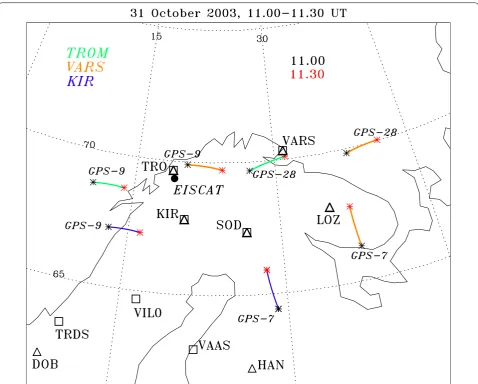
We use the standard TEC data with 30-s resolution from an array of GPS receivers in Scandinavia (see map in Fig. 1). Dual-frequency GPS method uses the phase information from radio signals transmitted from GPS satellites at the L1 (1575.42 MHz) and L2 (1227.60 MHz) frequencies for estimating the slant TEC. The slant TEC along a radiopath can be converted into the verti-cal vTEC, denoted here as NT, by assuming the altitude
of pierce points to be 250 km. As a measure of columnar density NT the TEC unit (1 TECu = 1016 m−2) is used.
covering the range of geographic latitudes from ~79° to ~58°, are used (Fig. 1). The magnetometer observa-tions are augmented with the multi-beam IRIS riometer data from Kilpisjarvi (KIL) that monitor a cosmic noise absorption caused by the energetic (>30 keV) electron precipitation into the ionosphere. The magnetometer data have been decimated to a common 30-s step with TEC data.
We use the data with 30-s cadence from the UHF radar EISCAT, comprising the receivers at Sodankyla (SOD) and Kiruna (KIR), and receiver–transmitter at Tromso (TRO) (Fig. 1). EISCAT radar beam was directed along the geomagnetic field line. Intersection of receiving paths from SOD and KIR is located nearly above the magnetic station TRO (geographic coordinates 68.0°N, 19.1°E) at altitude ~290 km. This radar system enables one to deter-mine the vector of the ionospheric plasma drift velocity V and corresponding electric field E. The EISCAT radar system also measures the altitude profile of electron den-sity Ne(z), ion temperature Ti(z), and electron
tempera-ture Te(z) along the beam up to ~400 km.
October 31, 2003, ULF event
During the recovery phase of large magnetic storm on October 31, 2003, very intense (up to a few hundred nT) global quasi-monochromatic Pc5 waves were observed (Kleimenova and Kozyreva 2005). Typically, global Pc5 waves are observed during high solar wind streams, and they are about an order of magnitude more intense than common Pc5 pulsations. The reason for such outstanding intensity has not been found yet. Global Pc5 waves are coherent over a wide range of geomagnetic latitudes, dur-ing morndur-ing and post-noon hours (Potapov et al. 2006). Detailed studies of this event indicated that global Pc5 pulsations are probably caused by oscillations of the mag-netospheric MHD waveguide, engulfing an entire magne-tosphere, up to equatorial latitudes (Marin et al. 2014). At high latitudes, magnetospheric waveguide oscillations are strongly coupled with field line Alfven oscillations (Pili-penko et al. 2012).
During the periods with elevated Pc5 activity, 1100– 1200 and 1200–1300 UT, TEC fluctuations have been compared with ground geomagnetic variations at station KIR (geographic latitude 67.8°) and ionospheric param-eters determined by EISCAT radar. The tracks of inter-section with the ionosphere of radio paths from satellites GPS7 and GPS9 to ground GPS receivers KIRU, VARS, and TROM (pierce points) are shown in Fig. 1.
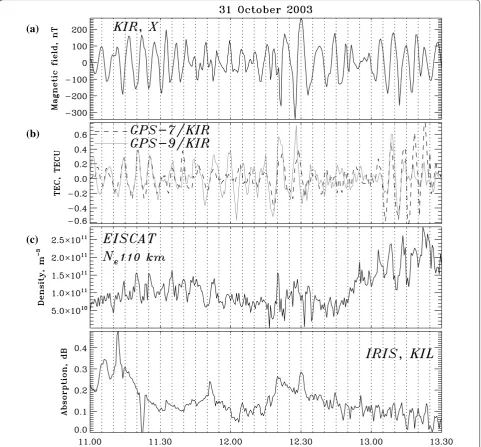
Quasi-periodic TEC pulsations have been revealed over a wide latitudinal range. The comparison for the period 1100–1330 UT of TEC fluctuations along paths GPS7/ KIRU, GPS9/KIRU with magnetic variations at KIR and EISCAT-derived ionospheric density Ne in the lower
ionosphere, shows the occurrence of persistent perio-dicity in all these parameters (Fig. 2). The peak-to-peak amplitudes of oscillations of the TEC are ΔNT ~ 0.6
TECU (GPS7/KIRU), and ~1.0 TECU (GPS9/KIRU), and magnetic pulsations ΔB ~ 400 nT (X component) at KIR. According to visual inspection the phase relation between magnetic (X component) and TEC variations is not very stable: It varies from roughly out-of-phase during ~1100–1200 and ~1215–1235 UT to roughly in-phase during ~1200–1215 and ~1305–1330 UT.
At the same time, the riometer data do not demonstrate the periodicity evident in magnetometer data (bottom panel in Fig. 2). Just few peak-to-peak correspondence may be found, representing weak signatures of ULF mod-ulation of energetic electron precipitation.
Spectral analysis confirmed the occurrence of the same periodicity with f ~ 2.4 mHz in variations of the geomag-netic field, TEC (GPS7, GPS9), and EISCAT Ne (Pilipenko
this frequency was ΔNT(f)/ΔB(f) ~ 2 × 10⁻³ TECu/nT.
Magnetic pulsations (X component, KIR) and EISCAT electric field Ex had coherency γ ~ 0.8. The
cross-corre-lation between TEC variations from GPS9/KIRU and EISCAT field Ex had a high coherency γ(f) ~ 0.86. The
ratio between spectral amplitudes at this frequency was ΔNT(f)/Ex(f) ~ 4 × 10⁻³ TECu/(mV/m).
An important parameter of ULF wave structure is its scale in the latitudinal (radial) and longitudinal
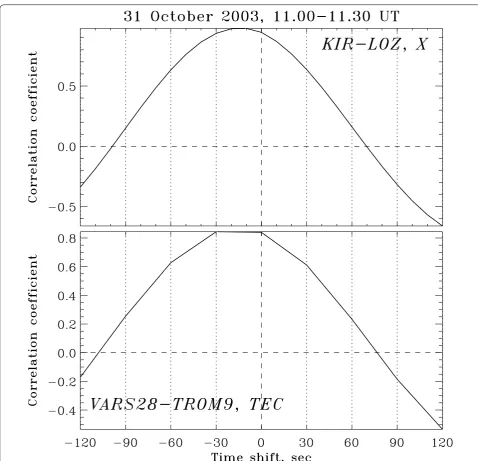
(azimuthal) directions. The longitudinal propagation features are characterized by the azimuthal wave num-ber m, which can be determined from a cross-correla-tion time shift Δτ between two detrended time series with T-periodic variations at sites separated in longitude by ΔΛ, as follows m = (Δτ/T)(360°/ΔΛ). The cross-cor-relation function R(Δτ) for magnetic and TEC variations during time interval 1100–1130 UT has been estimated using the magnetic stations KIR-LOZ at geographic
(a)
(b)
(c)
latitude ~67.8°, longitudinally separated in geographic coordinates by ΔΛ ~ 15.4°, and the longitudinally sepa-rated pierce points along receiver/satellite paths TROM/ GPS9 and VARS/GPS28 at geographic latitude ~69.7° and separated in longitude by ΔΛ = 27.2° (Fig. 1). The
cross-correlation function of both magnetic and TEC variations has asymmetric form (Fig. 3), indicating west-ward propagation. The 10-s magnetic data reveal time delay Δτ = 15 s (Fig. 3, upper panel). The correlation threshold at 95 % confidence level, estimated by means a Monte Carlo test (Regi et al. 2015), at this lag is ~0.2. Thus, the cross-correlation coefficient ~0.9 is statisti-cally significant. Though the 30-s time resolution of TEC data is not sufficient to determine exactly a time shift, R(Δτ) reaches extreme values Rmax ~ 0.8 also around
Δτ ~ 15 s (Fig. 3, bottom panel). For the wave frequency f ~ 2.5 mHz (T ~ 400 s) this time shift corresponds to the azimuthal wave number (in geographic coordinates) m ≈ 0.9 for magnetic data and m ≈ 0.5 for TEC data. However, assuming that the error on the TEC delay time Δ(Δτ) = 15 s the estimated azimuthal wave number m has relative error Δm/m ~ 100 %. Thus, both magnetic and TEC data show a Pc5 wave propagation in the same westward direction, and no reliable conclusion about correspondence of the m values from ionospheric TEC data and geomagnetic data can be made.
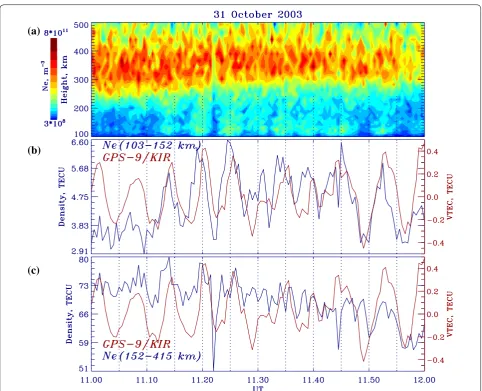
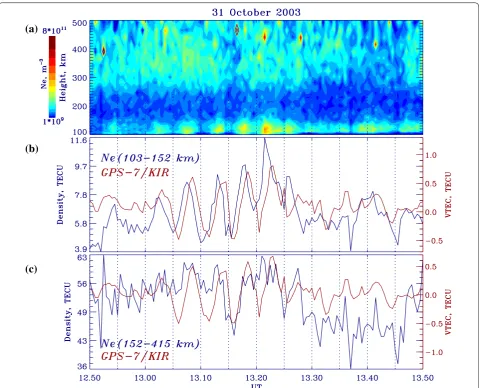
To find out which altitudes contributes most to the TEC variations, we have integrated ionospheric Ne(z)
data from EISCAT over two different altitude range: the bottom ionosphere from 103 to 152 km and the F-layer from 152 to 415 km. The height-time diagram of Ne(t)
variations and altitude-integrated ionospheric densities
Ne (in TECu) are compared with actual vTEC variations
for two time intervals: 1100–1200 UT for GPS9 (Fig. 4) and 1250–1350 UT for GPS7 (Fig. 5). Though short-lived Pc5 geomagnetic pulsation burst during 1220–1240 UT is also accompanied by TEC variations, the response at EIS-CAT is not very clear, so this time interval has not been included in a detailed analysis. Comparison of the EIS-CAT-derived quasi-TEC fluctuations Ne with periodic
vTEC variations shows that a closest match is observed for the bottom ionosphere, evidencing that the main contribution is provided by the lower ionosphere, up to ~150 km (that is the E-layer and lower F-layer). However, the correspondence is not perfect, and maximal cross-correlation coefficient between vTEC and Ne is R ~ 0.75
for the first interval and R ~ 0.72 for the second interval.
Possible mechanisms of TEC modulation by MHD waves
The temporal variations in the TEC evaluated along the line between a source (S) and receiver (R), NT(t), is given by
the linearized path-integrated electron continuity equation
(1)
the background ionospheric density. Assuming Q(z) and L(z) are steady and equal, variations in TEC arise from the advection (∝V∇N0) and divergence (∝ ∇V) terms.
Variations in TEC along the signal path introduce time/ phase delays for high-frequency (HF) radio wave propa-gation through the ionosphere. The modulation of the ionospheric plasma density is due to the interaction of an incident MHD wave with the ionosphere–atmosphere– ground system. In this event no noticeable riometer variations with the same periodicity as geomagnetic pul-sations were observed, so the mechanism of the periodic precipitation of energetic electrons is not considered, though the lack of soft (<1 keV) electron precipitation cannot be guaranteed.
We use a standard model of the magnetosphere–ion-osphere–atmosphere–ground system to describe the properties of MHD waves in a realistic ionosphere. We use the non-rectangular coordinate system {x1, x2, x3},
where coordinate lines x3 coincide with magnetic field
lines, x1 is measured along north–south direction, and x2
is measured eastward. The atmosphere and the ground are assumed to be isotropic conductors with conductivi-ties σa and σg. The system parameters do not vary in the
horizontal direction, i.e., along x1 and x2. The ionospheric
plasma has anisotropic conductivity: Pedersen σP(z) and
Hall σH(z). The magnetospheric plasma above the
iono-sphere is characterized by an Alfven velocity VA and
wave number kA = ω/VA.
The TEC and magnetometers observations at longi-tudinally widely separated sites have shown a large azi-muthal scale of both ionospheric and magnetic Pc5 pulsations, corresponding to m ≤ 1. Therefore, it may be
supposed that k2 ~ m→ 0. The scale in radial
(latitudi-nal) direction is characterized by the wave vector k ≅ k1.
The incident Alfven mode elongated in the azimuthal direction has an azimuthal magnetic component b2 only,
whereas the wave electric field component E1 lies in the
meridional plane and is transverse to B0. The fast
magne-tosonic (FMS) mode has non-vanishing azimuthal elec-tric component E2, magnetic radial b1, and compressional
b3≡b� components.
The components of electron velocity induced by the wave electric field E are determined by local plasma mobility tensor µˆ(e)
The corresponding electron density perturbation N(e)=N1(e)+N2(e)+N3(e) is produced by three currents (Pedersen, Hall, and parallel) as follows
The ion density perturbation N(i)=N1(i)+N2(i)+N3(i) keeps the plasma electroneutrality.
(2)
V1(e)=µ(1e)E1+µ(2e)E2
V2(e)= −µ(2e)E1+µ(1e)E2
V3(e)=µ(3e)E3
(3) N1(e)
N0 = k
ωµ (e) 1 E1,
N2(e)
N0 = k
ωµ (e) 2 E2,
N3(e)
N0 =
1
iω∂3µ (e) 3 E3
The magnetic field and plasma compression can be pro-duced by an incident fast mode wave �NT/NT ≃b�/B0.
Such effect of the ionospheric plasma periodic compres-sion by Pc5 pulsations, associated with the fast mode, was indeed observed with GPS observations at low lati-tudes, where Pc5 wave frequency is much lower than the Alfven field line eigenfrequency (Vorontsova et al. 2016).
However, even an incident Alfven wave can produce a secondary fast compressional mode upon the inter-action with the anisotropic ionosphere. This evanes-cent fast mode wave is excited in the ionosphere by incident Alfven wave owing to the ionospheric Hall conductance. Thus, TEC modulation may be related to the compression of plasma caused by this secondary
(a)
(b)
(c)
fast compressional mode [the term N2 in (3)]. Indeed,
if we substitute E2=(ω
k)b3 in N2= k
ω
N0
B0E2, we obtain N2
N0 =
b3
B0, where b3 is the compressional magnetic component. Pilipenko and Fedorov (1995) estimated the modulation of plasma owing to a partial conver-sion of an incident Alfven wave into an evanescent fast mode wave and showed that it might be significant for small-scale incident waves. Such small-scale waves are to be screened by the ionosphere from ground magnetometers.
Other possible mechanism of TEC modulation by an incident Alfven wave (Waters and Cox 2009) may comprise a periodic drift (advection) across a lateral gradient of the ionospheric plasma [second right-hand term in (1)]. This mechanism can be expected to
be important only for more localized and steep iono-spheric inhomogeneities. We have no information about lateral gradients of Ne during this event.
How-ever, the largest effect produced by this mechanism is expected to be in the F-layer, where plasma concentra-tion is highest.
The finite east–west E2 component of an
inci-dent Alfven wave causes a vertical plasma drift
Vz=E2cosI
B0, where I is the geomagnetic field
incli-nation. This vertical shift causes a plasma modification due to the changes of ionization–recombination bal-ance owing to a strong dependence of the ionization Q(z) and recombination L(z) rates on altitude (Poole and Sutcliffe 1987). Periodic vertical shift of ionospheric plasma, which is accompanied by a reconfiguration of the
(a)
(b)
(c)
ionization–recombination balance, can provide a notice-able contribution to the TEC modulation by Pc5 electric field, but around the maximum of ionization (F-layer). Though, E2 component of the large-scale Alfven wave
(k2 → 0) is to be small.
The periodic heating of ionospheric ions can occur during times when plasma is dragged through neutrals by the Pc5 wave electric field (Lathuillere et al. 1986). This additional plasma heating may shift the ionization– recombination balance due to the dependence of the recombination coefficient β(T) on temperature and cause plasma density variations (Pilipenko et al. 2014a). The periodic ion heating in the bottom ionosphere during October 31, 2003, event by Pc5 wave electric field indeed can be seen in the EISCAT data (Pilipenko et al. 2014b).
In a realistic ionosphere all the above mechanisms may operate simultaneously, so it is hard to distinguish their contribution into the TEC variations and to compare their efficiency, because many specific parameters are not well known for an event under study. Combined EISCAT and TEC observations have indicated that the plasma modulation by Pc5 wave is most significant in the lower ionosphere. This fact contradicts the predictions of TEC modulation theories, based on the F-layer vertical shift and lateral gradient. At the same time, this observational fact favors the mechanism of field-aligned plasma trans-fer induced by Alfven wave. Further we present a simple theoretical model to examine this mechanism in a greater detail.
Field‑aligned plasma transport
Though all of the above-mentioned mechanisms may somewhat contribute to the periodic TEC variations, here we concentrate on another possible mechanism, related to field-aligned plasma transport (Cran-McGree-hin et al. 2007). To give an insight into its basic physics, we first provide a simple analytical estimate in a model with vertical geomagnetic field B0 = B0e3. The
field-aligned current j3≡jZ transported by an Alfven wave, incident onto the ionosphere from the magnetosphere, provides an additional periodic plasma flow in/out the ionosphere. As a result, the plasma density in the bottom ionosphere periodically increases/decreases. An upper estimate of this effect can be obtained from the height-integrated balance equation
where e = 1.6 × 10⁻¹⁹ C is the electron charge. The
elec-tron transverse diffusion across B0 during a wave period
is assumed to be small. From Eq. (4) it follows that an oscillating current j3 =j(0)3 exp(−iωt) causes periodic
fluctuations of TEC with amplitude �NT=ij(30)/eω. The current j3 transported by an Alfven wave is related to
(4)
∂tNT=j3/e
the wave magnetic field b2 in the ionosphere as follows
j3= −ikb2/µ0. Combination of these two relationship yields
where T is the wave period and λ is the wave latitudinal scale corresponding to the characteristic wave num-ber k ~ 2π/λ. The relationship (5) gives an upper-limit order of magnitude estimate of the ionospheric effect. Let us suppose that a typical peak-to-peak H-component amplitude of global 400-s Pc5 pulsations on the ground is b(1g)≃400 nT. For simplicity, a radio path between
a satellite and ground receiving station is assumed to be vertical. Because the transverse scale of global Pc5 waves under study, ~103 km (Kleimenova and Kozyreva
2005), is much bigger than the height of the ionospheric conductive layer, ~100 km, the magnetic field in the ionosphere is related to the response on the ground as b(g)1 /b2≃(�H/�P)sinI (Hughes and Southwood
1976). For typical at high latitudes ΣH/ΣP ~ 1.6, and sin
I ~ 0.9, the magnetic field disturbance in the ionosphere is b2 ~ 290 nT. According to (5) an Alfven wave with the
given amplitude should cause fluctuations in the bot-tom ionosphere with ΔNT ~ 0.2 TECu. This
order-of-magnitude estimate indicates that the effect of periodic pumping/depleting into the lower ionosphere of the field-aligned electron flux, transported by an Alfven wave, in principle can be responsible for the TEC lation by global Pc5 pulsations. In reality, the TEC modu-lation rate is determined by a spatial integration along a radio path of local plasma response to an inhomogene-ous wave E-field and thus should be strongly dependent on the satellite elevation angle and wave transverse scale. These factors can be taken into account with the help of a numerical model only.
Numerical model of Alfven wave interaction with the realistic ionosphere
The above simplified estimate has been validated with numerical modeling. We consider the incidence of Alfven wave with a large azimuthal scale (k2 = 0) onto the
iono-sphere. For such wave structure the E–W electric field component E2 → 0, so the mechanism of vertical drift is
inoperative. The heating of the ionosphere by wave has been neglected as well. Thus, this simplified case enables us to isolate and examine the mechanism of the field-aligned plasma transport.
The ionospheric medium parameters have been derived from the IRI-2012 model. The modeling procedure com-prises the following steps: (1) For a given geophysical conditions the IRI-derived altitude profile (80–2000 km) of ionospheric parameters is constructed; (2) the wave
calculated using the numerical solution of a set of cou-pled MHD wave equations in the ionosphere, whereas incidence of Alfven wave with horizontal wave vector k has been assumed; (3) using the mobility tensor the plasma vertical and horizontal fluxes are determined via (2) throughout the ionosphere; (4) using the continuity equation the local disturbance of plasma density Ne(z) is
determined; and (5) the vertical structure of local plasma density disturbance is height-integrated to provide a dis-turbance of TEC, NT. The magnetic field geometry
(incli-nation of B0 is I = 61.9°) and IRI parameters correspond to
the observational period 2003.10.31, 11.5 UT near TRO. The IRI model yields the height-integrated Pedersen and Hall conductance as follows P=2.2 S and H=3.6 S.
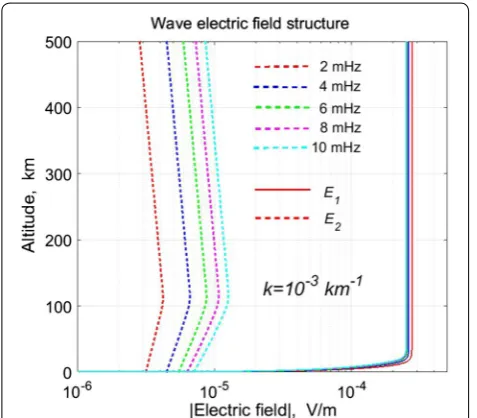
When MHD waves interact with the ionosphere, their wave properties are modified. The calculated verti-cal structure of the wave electric field for various fre-quencies of incident Alfven wave with transverse wave vector k = 10−3 km−1 is shown in Fig. 6. For a chosen
azimuthally large-scale structure, the N–S electric field component is dominating, E1≫E2. Along z the E1(z) component is nearly constant thanks to the field line equipotentiality. A weaker E2 component of a secondary
fast mode emerges thanks to the mode coupling in the anisotropically conductive ionosphere. The fast mode is evanescent and decays with altitude.
by the wave E-field, are shown in Fig. 7. The field-aligned electron fluxes result in enhancements of Ne in
the E-layer and bottom of F-layer. The vertical profile of disturbed plasma density Ne(z) has local maxima at
alti-tudes ~300, ~200 km, and order of magnitude larger at ~120 km. Calculations show that the contribution to the electron plasma density disturbance by the Pedersen cur-rent and plasma compression are small as compared with the contribution from the field-aligned electron flux. Thus, the periodic field-aligned electron flux produces local variations of electron density in the E-layer and bot-tom of the F-layer.
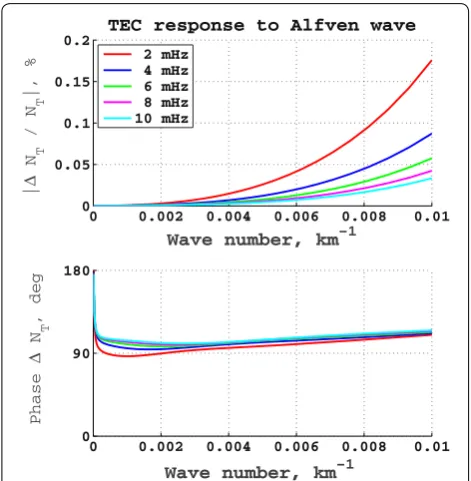
The resultant height-integrated effect is presented in Fig. 8. This figure shows the calculated dependence of the TEC amplitude fractional modulation, ΔNT/NT, on the
transverse wave number k induced by an incident Alfven wave with total horizontal magnetic component on the ground b1 = 1 nT (peak-to-peak amplitude 2 nT) for
vari-ous frequencies. In the range up to k = 10−2 km the TEC
modulation rate increases with k owing to the increase of the wave-transported field-aligned current (Fig. 8a). The modulation rate is higher for lower frequencies. For k = 0.006 km (wave scale ~2π/k ~ 103 km) the predicted
TEC modulation depth is ~0.025 %. Therefore, for peak-to-peak 400 nT Pc5 pulsations, recorded during October 31, 2003, event, the TEC fluctuations are expected to be ~5 %. This value is about the observed peak magni-tudes during the analyzed event: NT ~ 40 TECu, ΔNT ~ 1
TECu, hence ΔNT/NT ~ 2.5 %. The theoretical value is
Fig. 6 Wave electric field vertical structure, produced by incident Alfven wave with k= 10−3 km−1: Solid lines correspond to E
1
compo-nent, and dashed lines correspond to E2 component. Different colors
denote different frequencies (shown in the inset). All wave fields in the ionosphere have been normalized to the magnitude of the total horizontal magnetic field on the ground b1= 1 nT
|N|, m-3 ×10⁸
500 Electron density perturbation caused by Alfven wave
2 mHz 4 mHz 6 mHz 8 mHz 10 mHz
Fig. 7 Wave-induced plasma density perturbation, produced by incident Alfven wave with k= 10−3 km−1. Different colors denote
probably somewhat overestimated because only the ver-tical radiopath satellite-receiver is considered.
Our idealized model predicts a phase shift between the TEC variations and ground magnetic pulsations (H component) about Δφ ~ 100° (Fig. 8b). However, a cross-spectral estimate of Δφ(f) is not very reliable because the phase delay between TEC and B time series fluctuates considerably during the analyzed events. Therefore, the relative phase information cannot tell anything definitive to be compared with the model prediction.
Discussion
Our current knowledge of the ULF wave physics has been acquired mainly with the help of ground-based or satellite-borne magnetometers. However, their capa-bilities are limited, because even low-orbiting satellites cannot detect in situ long-period ULF waves in the ion-osphere—the region where energy flows from the mag-netosphere into the upper atmosphere. Moreover, the ionosphere screens transversely small-scale structures (<100 km) from ground magnetometers. Ionospheric radars have emerged as a valuable source of additional information for ULF wave studies. GPS/TEC observa-tions are expected to provide similarly new information about MHD wave interaction with the ionosphere.
Long-period pulsations are the most powerful wave process in the near-Earth environment. The radar obser-vations showed that Pc5 waves can noticeably modulate the ionospheric plasma: the electric field E, plasma con-vection velocity V, E-layer electron density Ne and the
ionosphere conductance Σ, and electron Te and ion Ti
temperatures in both F- and E-layers (see references in Pilipenko et al. 2014b). Recent observations by Pilipenko et al. (2014a) and Watson et al. (2015) have demonstrated that Pc5 waves are capable to modulate TEC as well.
One may expect that all the Pc5 wave-induced frac-tional variations of plasma and magnetic field should be of the same magnitude, like in any linear wave. However, GPS observations have revealed that the depth of peri-odic TEC modulation is sometimes even somewhat larger (e.g., in the event of October 31, 2003, ΔNT/NT ~ 2.5 %)
than the geomagnetic field modulation (ΔB/B0 ~ 1 %).
In principle, ULF modulation of energetic electron pre-cipitation, inducing an additional periodic ionization of the lower ionosphere, can cause periodic TEC variations with much higher depth than geomagnetic field varia-tions (Watson et al. 2015). However, during the event under consideration no periodic electron precipitation occurred as evidenced by simultaneous riometer obser-vations. The mechanism of the field-aligned plasma transport by Alfven waves, described in “Numerical model of Alfven wave interaction with the realistic iono-sphere” section, can theoretically produce relative ampli-tudes of TEC variations larger than that of geomagnetic pulsations. However, we have analyzed GPS/TEC data during an event with very intense Pc5 waves. Whether TEC modulation by less intense ULF waves would be revealed by standard GPS technique is an open question.
Consideration of possible mechanisms of TEC modula-tion by a magnetospheric Alfven wave (“Possible mecha-nisms of TEC modulation by MHD waves” section) has shown that in principle the plasma heating, vertical drift, steep gradient, and field-aligned transport can pro-vide a noticeable input into the TEC variations. In some cases, a periodically modulated precipitation of mag-netospheric electrons can be effective, too. A feature of the field-aligned electron transport mechanism is that it contributes mainly into the plasma density of the bot-tom ionospheric layers. This feature is basically in accord-ance with the combined GPS/EISCAT/magnetometer observations. However, as the correlation between Ne
and vTEC is R ~ 0.75, the field-aligned transport mech-anism is responsible for ~56 % of TEC variations. Thus, though the proposed hypothesis on field-aligned plasma transport is basically consistent with the analyzed event, the correspondence between magnetometer, EISCAT, and GPS/TEC oscillations is not always perfect. For
0 0.002 0.004 0.006 0.008 0.01 0
TEC response to Alfven wave 2 mHz
4 mHz 6 mHz 8 mHz 10 mHz
0 0.002 0.004 0.006 0.008 0.01 0
1220–1240 UT is accompanied by TEC variations, but the response at EISCAT is not clear. Probably, some of the mentioned above mechanisms also contribute to TEC periodic modulation by ULF wave, though a limited avail-able information does not enavail-able us to single them out.
The phase relation between magnetic and TEC varia-tions is not very stable and does not allow to use it for the model validation and discrimination of possible mechanisms. Moreover, the phase information is rather subtle, and its consideration must be done with a great caution. The developed model is still too simplified: Pc5 transverse spatial structure is modeled as plane wave, and TEC is calculated along a vertical path. Therefore, the phase information can be used as a tool for the dis-crimination of possible mechanisms only on the basis of a more advanced model. More conclusive judgments can be stated only after detailed studies with the use of other ionospheric instruments that will provide additional information about ionospheric plasma parameters and incident particle fluxes.
Conclusion
Long-period geomagnetic Pc5 pulsations being the most powerful wave process in the terrestrial environment can significantly modulate the local densities of the mag-netospheric and ionospheric plasma. Even radiopath-integrated TEC has turned out to be sensitive enough to respond to intense Pc5 waves. So far, the effect of TEC modulation by ULF waves is a challenge for the MHD wave theory, because responsible mechanisms of such modulation have not been firmly established yet. Analy-sis of the altitude profile of the electron density fluctua-tions derived from EISCAT data during the global Pc5 wave event has shown that main contribution into the periodic TEC variations is provided by lower ionosphere, up to ~150 km, that is the E-layer and lower F-layer. This observational fact favors the field-aligned plasma transfer induced by Alfven wave as a dominant modula-tion mechanism. The analytical estimate and numerical modeling have shown a high efficiency of this mecha-nism. However, sometimes the correspondence between magnetometer, EISCAT, and GPS/TEC oscillations is not perfect, which indicates that some other modulation mechanisms could come into play.
Authors’ contributions
BV made GPS and magnetometer data analysis, VP made analytical estimates and drafted the manuscript, DM participated in the GPS and riometer data analysis, EF performed numerical modeling, AK carried out the EISCAT data analysis. All authors read and approved the final manuscript.
Author details
1 Polar Geophysical Institute, Apatity, Russia. 2 Space Research Institute, Mos-cow, Russia. 3 Augsburg College, Minneapolis, MN, USA. 4 Institute of Physics
Acknowledgements
This study was funded by the RF President Grant MK-4210.2015.5 (BV), RFBR Grants 14-05-00588 (VP), 15-05-01814 (EF), and NSF Grant ATM-0827903 to Augsburg College (DM). Dual-frequency 30-s rate GPS daily data files in RINEX format are freely available from the IGS (ftp://cddis.gsfc.nasa.gov). We are indebted to the staff of EISCAT for operating the facility and supplying the data. We thank the institutes who maintain the IMAGE magnetometer array (www.ava.fmi.fi/image). The riometer data originated from the IRIS, operated by the Lancaster University in collaboration with the Sodankyla Geophysical Observatory. We appreciate detailed comments of both reviewers.
Received: 19 December 2015 Accepted: 25 May 2016
References
Afraimovich EL, Astafyeva EI, Demyanov VV et al (2013) A review of GPS/GLO-NASS studies of the ionospheric response to natural and anthropogenic processes and phenomena. J Space Weather Space Clim 3:A27 Cran-McGreehin AP, Wright AN, Hood AW (2007) Ionospheric depletion in
downward currents. J Geophys Res 112:A10309
Davies K, Hartman GK (1976) Short-period fluctuations in total columnar electron content. J Geophys Res 81:3431–3434
Fedorov E, Mazur N, Pilipenko V, Engebretson M (2016) Interaction of magne-tospheric Alfven waves with the ionosphere in the Pc1 frequency band. J Geophys Res 121:321–337
Hughes WJ, Southwood DJ (1976) The screening of micropulsation signals by the atmosphere and ionosphere. J Geophys Res 81:3234–3240 Kleimenova NG, Kozyreva OV (2005) Spatial-temporal dynamics of Pi3 and Pc5
geomagnetic pulsations during the extreme magnetic storms in October 2003. Geomagn Aeron (Engl Transl) 45:71–79
Komjathy A, Galvan DA, Stephens P et al (2012) Detecting ionospheric TEC perturbations caused by natural hazards using a global network of GPS receivers: the Tohoku case study. Earth Planets Space 64:1287–1294 Lathuillere C, Glangeaud F, Zhao ZY (1986) Ionospheric ion heating by ULF Pc5
magnetic pulsations. J Geophys Res 91:1619–1626
Lester M, Davies JA, Yeoman TK (2000) The ionospheric response during an interval of Pc5 ULF wave activity. Ann Geophys 18:257–261
Marin J, Pilipenko V, Kozyreva O, Stepanova M, Engebretson M, Vega P, Zesta E (2014) Global Pc5 pulsations during strong magnetic storms: excitation mechanisms and equatorward expansion. Ann Geophys 32:319–331 Menk FW, Waters CL, Dunlop SI (2007) ULF Doppler oscillations in the low latitude ionosphere. Geophys Res Lett 34:L10104. doi:10.1029/200 7GL029300
Okuzawa T, Davies K (1981) Pulsations in the total columnar electron content. J Geophys Res 86:1355–1363
Pilipenko V, Fedorov E (1995) Modulation of total electron content in the ionosphere by geomagnetic pulsations. Geomagn Aeron (Engl Transl) 34:516–519
Pilipenko V, Belakhovsky V, Kozlovsky A, Fedorov E, Kauristie K (2012) Determi-nation of the wave mode contribution into the ULF pulsations from com-bined radar and magnetometer data: method of apparent impedance. J Atmos Sol-Terr Phys 77:85–95
Pilipenko VA, Fedorov EN, Teramoto M, Yumoto K (2013) The mechanism of mid-latitude Pi2 waves in the upper ionosphere as revealed by combined Doppler and magnetometer observations. Ann Geophys 31:689–695 Pilipenko V, Belakhovsky V, Murr D, Fedorov E, Engebretson M (2014a)
Modulation of total electron content by ULF Pc5 waves. J Geophys Res 119:4358–4369
Pilipenko V, Belakhovsky V, Kozlovsky A, Fedorov E, Kauristie K (2014b) ULF wave modulation of the ionospheric parameters: radar and magnetom-eter observations. J Atmos Sol-Terr Phys 108:68–76
Poole AWV, Sutcliffe PR (1987) Mechanisms for observed total electron content pulsations at mid latitudes. J Atmos Terr Phys 49:231–236
Potapov A, Guglielmi A, Tsegmed B, Kultima J (2006) Global Pc5 event during 29–31 October 2003 magnetic storm. Adv Space Res 38:1582–1586 Regi M, De Lauretis M, Francia P (2015) Pc5 geomagnetic fluctuations in
response to solar wind excitation and their relationship with relativistic electron fluxes in the outer radiation belt. Earth Planets Space 67:9. doi:10.1186/s40623-015-0180-8
Teramoto M, Nishitani N, Pilipenko V et al (2014) Pi2 pulsation simultaneously observed in the E and F region ionosphere with the SuperDARN Hok-kaido radar. J Geophys Res 119:3444–3462
Vorontsova E, Pilipenko V, Fedorov E, Sinha AK, Vichare G (2016) Modulation of total electron content by global Pc5 waves at low latitudes. Adv Space Res 57:309–319
Waters CL, Cox SP (2009) ULF wave effects on high frequency signal propaga-tion through the ionosphere. Ann Geophys 27:2779–2788
Waters CL, Yeoman TK, Sciffer MD, Ponomarenko P, Wright DM (2007) Modulation of radio frequency signals by ULF waves. Ann Geophys 25:1113–1124