A comparative study of the integer ambiguity validation procedures
J. Wang, M. P. Stewart, and M. Tsakiri
School of Spatial Sciences, Curtin University of Technology, GPO Box U1987, Perth, WA 6845, Australia
(Received December 20, 1999; Revised July 19, 2000; Accepted July 21, 2000)
In GPS and GLONASS satellite-based positioning, the correct determination of the integer carrier phase ambigu-ities is the key to achieve precise positioning results. The process of determining the ambiguambigu-ities, called ambiguity resolution, is usually separated into three steps: (a) estimating the float or real-valued ambiguities, (b) searching the best integer ambiguity set, (c) validating the best ambiguity set. Whilst the theory and methodology for ambiguity estimation and search are well documented, the ambiguity validation issue is still under investigation. Existing ambiguity validation procedures are based on various statistical assumptions and therefore, may have different per-formances in practical applications. In this paper, the major ambiguity validation procedures are analysed and their performances in both GPS and GLONASS ambiguity resolution are numerically compared. It is concluded that both the probability of estimating ambiguities correctly and confidence levels of the ambiguity discrimination tests are both important indicators of the reliability of ambiguity resolution.
1.
Introduction
Satellite navigation systems GPS and GLONASS have been widely used in precise geodetic positioning and nav-igation. In the case of the GPS and GLONASS systems, two fundamental measurements can be decoded from the satel-lite signals, namely the pseudo-ranges and the carrier phases. Carrier phase measurements are much more precise than the pseudo-ranges, thus they are the primary measurements for precise positioning. However, the problem is that the carrier phase measurements are ambiguous, with the ambiguity (the integer number of signal wavelengths between satellite and antenna) being an unknown value a priori. Hence, the deter-mination of the integer ambiguities, commonly referred to as ambiguity resolution (AR), is the most critical data analysis step for either the GPS or the GLONASS satellite positioning operation.
The concept of ambiguity resolution has its origins in Very Long Baseline Interferometry (VLBI) data processing (Rogerset al., 1978). From the very inception of GPS car-rier phase positioning, the importance of ambiguity resolu-tion for precise static relative posiresolu-tioning was emphasised (Counselman and Shapiro, 1979). With fixed integer ambi-guities, the carrier phases can be used as unambiguous pre-cise range measurements. Consequently, the geometry of the mathematical models of the carrier phases is strengthened. Therefore, ambiguity resolution can be also considered as part of the mathematical modelling of the carrier phases.
In ambiguity resolution, integer ambiguity parameters are initially treated as real (continuous) parameters. The real-valued ambiguity parameters, together with other unknown parameters such as the coordinates of the roving receiver can be estimated using least-squares or Kalman filtering
algo-Copy right cThe Society of Geomagnetism and Earth, Planetary and Space Sciences (SGEPSS); The Seismological Society of Japan; The Volcanological Society of Japan; The Geodetic Society of Japan; The Japanese Society for Planetary Sciences.
rithm. In the case of using least-squares, the so-called Gauss-Markov model for linearised GPS/GLONASS (single- or double-differenced) measurements is written as
l= Acxc+Akxk+v, (1)
D=σ2Q=σ2P−1, (2)
where
l is the n×1 vector of the difference between the dif-ferenced GPS/GLONASS code and carrier phase mea-surements and their computed values, simply called the measurement vector, andn is the number of the mea-surements;
v is then×1 vector of the random errors;
xk is the m×1 double differenced ambiguity parameter vector, andmis the number of the ambiguity parame-ters;
xc is thet×1 vector of all other unknown parameters in-cluding position and other parameters of interest andt is the number of all other unknowns except ambiguities;
Ak is the design matrix for the ambiguity parameters;
Ac is the design matrix for the other unknown parameters;
D is the covariance matrix;
Q is the cofactor matrix;
σ2 is thea priorivariance factor.
Based on the principle of least squares (vTPv =
minimum), the estimates of the unknownsxˆ in Eq. (1) can be obtained by:
matrix of the estimated vectorxˆ, which can be represented by the following partitioned matrices:
Qxˆ =
Qxcˆ Qxcˆxkˆ Qxˆkxˆc Qxˆk
!
. (5)
Furthermore, from Eqs. (1), (3) and (5), the least-squares residuals are obtained as:
ˆ
v=l−Axˆ =QvˆPl, (6)
where Qvˆ = Q− A QxˆAT is the cofactor matrix of the
residuals. With the estimated residual vectorvˆand weight matrixP, thea posteriorivariance cofactor can be estimated as:
The abovefloat solution of the real-valued ambiguity esti-mates and their associated statistics is then used to construct a search window, which is assumed to contain the correct integer ambiguities. The process of searching all possible integer ambiguity combinations within the search window is then performed using a search criterion based on the minimi-sation of the quadratic form of the least-squares residuals. The best integer ambiguity combination that results in the minimum quadratic form of the least-squares residuals will be considered as the most likely (best) solution. Normally, thefirst two best ambiguity combinations are identified for validation purposes.
Ambiguity validation, however, is still a controversial problem under investigation. Existing ambiguity validation procedures are based on various statistical assumptions and therefore, may have different performances in practical ap-plications. In this paper, these ambiguity validation proce-dures are analysed and their performances in both GPS and GLONASS ambiguity resolution are numerically compared.
2.
Ambiguity Validation Procedures
Traditionally, ambiguity validation test procedures have been based on the so calledF-ratio of the second minimum quadratic form of the least-squares residuals and the mini-mum quadratic form of the least-squares residuals (Counselman and Abbot, 1989). Recently, an ambiguity validation (discrimination) test procedure has been proposed
uals and its standard deviation.
In the aforementioned two procedures, thefixed integer ambiguities are treated as non-random values. Another re-cent development focuses on the success probability of ambi-guity resolution (or the probability of estimating the integer ambiguities correctly), in which integer ambiguities are con-sidered as stochastic quantities (Teunissen, 1998).
Before discussing the results from a comparative study, a brief introduction of these ambiguity validation test proce-dures is given.
2.1 F-ratio test
When the ambiguity parameter unknownsxkare assumed
to befixed toKi, from a statistical point of view, it means
that the following constraint equation:
H x =Ki, with H=[0,Ek] (8)
is imposed to the original functional model represented by Eq. (1). In Eq. (8),Ekis anm×midentity matrix. For such an ambiguity-fixedsolution, the corresponding quadratic form of the residuals can be calculated with:
i =0+Ri, (9)
where
Ri =(ˆxk−Ki)TQxk−ˆ1(xˆk−Ki). (10)
Assuming that the best and second best ambiguity com-binations are Km and Ks, respectively, the corresponding
quadratic forms aremands. TheF-ratio is defined as
F = s
m.
(11)
The critical value of theF-ratio is often arbitrarily chosen as 2.0 (e.g. Euler and Landau, 1992). In this study, theF-ratio is approximately treated as a Fisher statistic for comparison.
2.2 W-ratio test
δ2 is the so-called variance factor. Three different variance
cofactors can be chosen (Wanget al., 1998). In this study, thea posteriorivariance cofactorsˆ2
0is used. In this situation,
theW-ratio has a Student’stdistribution.
2.3 Success probability of ambiguity resolution
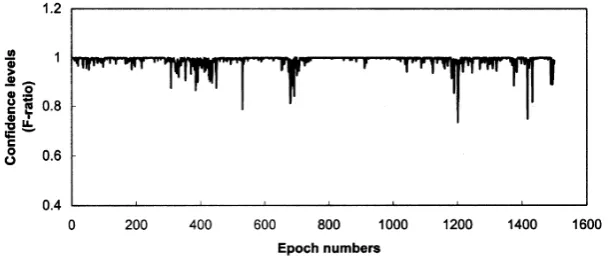
Fig. 1. Confidence levels (F-ratio) for data set A.
Fig. 2. Confidence levels (W-ratio) for data set A.
Fig. 3. Success probability for data set A.
the methods resolving the ambiguities. In the case of us-ing the integer ambiguity bootstrappus-ing method, the success probability can be exactly formulated as (Teunissen, 1998)
P(Km=a)= m
'
i=1
2
1 2σxi\I
−1
. (15)
Where
a is the true but unknown integer ambiguities;
(x) is the integral of standard normal distribution from minus infinity tox;
σxi\I is the conditional standard deviations of the
esti-mated ambiguities.
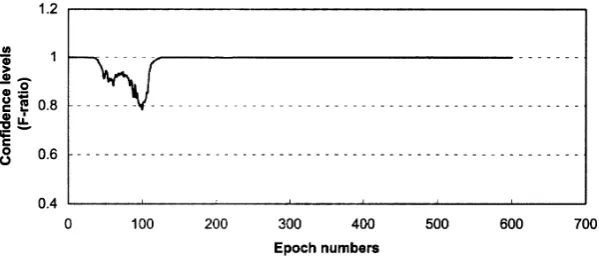
Fig. 4. Confidence levels (F-ratio) for data set B.
Fig. 5. Confidence Levels (W-ratio) for data set B.
Fig. 6. Success probability for data set B.
3.
Testing Results and Analysis
To compare the aforementioned ambiguity validation test procedures, both GPS dual-frequency data set and combined GPS/GLONASS single-frequency data set have been anal-ysed.
3.1 Description of the data sets
Data set A: the combined GPS/GLONASS data set was collected on a 1.2 km (static) baseline, on February 16, 1998, in Perth, Australia, using two Ashtech GG24 GPS/ GLONASS receivers. The data span was 25 minutes with the data interval of 1 second. During the whole session of
observation, 7 GPS and 5 GLONASS satellites were tracked.
Data set B: the dual-frequency GPS data set was collected on a 9 m (static) baseline, on January 24, 1997, in Perth, Australia, using two Ashtech Z12 GPS receivers. The data span was 10 minutes with the data interval of 1 second. Dur-ing the whole session of observation, 6 GPS satellites were tracked.
3.2 Data processing
0.010 m and 0.012 m, respectively. In ambiguity validation tests, the estimated variance factor was used.
Confidence levels (see Pearson and Hartley (1972) for their definitions) of the ambiguity validation tests using both the
F- andW-ratios are shown in Figs. 1, 2, 4 and 5. Figures 3 and 6 indicate the success probability values for the two test data sets.
3.3 Discussions
The abovefigures show that, overall, the confidence levels and the success probability values have a similar trend. This indicates that the compared ambiguity validation test proce-dures provide similar, but not necessary relevant statistics.
In some situations, there are big differences between the confidence levels and the success probability values. For ex-ample, in the case of data set B, significant discrepancy of the solutions between epochs 50 and 100 was noted. Actu-ally, among these solutions, 5 best ambiguity combinations were incorrect, whilst the success probability values were very high (close to 1.0). In contrast, the confidence levels of the ambiguity validation tests usingW- orF-ratios were relatively much lower for these incorrect ambiguity combi-nations (see Figs. 4, 5 and 6). One possible reason for this is that the success probability, which is mainly dependent on the precision of ambiguities, is not sensitive to the model errors.
In GPS/GLONASS data processing, due to the existence of unmodelled systematic errors in measurements, the pre-cision of estimated parameters may not always reflect their accuracy. Therefore, it is even likely that the best ambi-guity combination is wrong. Actually, in some cases, it is extremely difficult to distinguish the correct ambiguity com-bination from wrong ones (Wanget al., 1998). An ambiguity discrimination test will function as a check on the reliability of ambiguity resolution.
4.
Concluding Remarks
Ambiguity validation test is one of the critical steps in am-biguity resolution. This is thefirst effort to compare three different ambiguity validation procedures. From our inves-tigations, the results of which have been presented in this paper, we can see that the confidence levels of the ambigu-ity discrimination tests basedF- andW-ratios are generally close to the success probability of ambiguity resolution.
However, ambiguity resolution with a high success
prob-ability may end up with incorrect ambiguities due to various reasons, such as systematic errors in the measurements. The ambiguity discrimination test can be used as a second check on the reliability of the resolved integer ambiguities.
It is noted that the ambiguity discrimination test statis-tic (W-ratio) is derived under the assumption that thefixed ambiguities are deterministic quantities. It is also of im-portance to make sure that the probability of correct integer ambiguity resolution is sufficiently close to one. Therefore, both the probability of estimating ambiguities correctly and confidence levels of the ambiguity discrimination tests are important indicators of the reliability of ambiguity resolu-tion.
It should be pointed out that Eq. (15) is derived using a priori variance factor, which is mainly used in the stage of positioning design. However, in the stage of data processing, a posteriori (or estimated) variance factor may be used. In this situation, a rigorous formula for computing the success probability needs to be further investigated.
References
Counselman, C. C. and R. Abbot, Method of resolving radio phase ambiguity in satellite orbit determination,J. Geophys. Res.,94(B6), 7058–7064, 1989.
Counselman, C. C. and I. I. Shapiro, Miniature interferometric terminals for Earth surveying,Bulletin G´eod´esique,53, 139–163, 1979.
Euler, H. J. and H. Landau, Fast GPS Ambiguity Resolution On-the-fly for Real-time Applications, Proceedings of 6th International Symposium on Satellite Positioning, Columbus, Ohio, 17–20 March, 650–659, 1992. Hassibi, A. and S. Boyd, Integer parameter estimation in linear models
with applications to GPS,IEEE Transactions on Signal Processing,46, 2938–2952, 1998.
Pearson, E. S. and H. O. Hartley, Biometrika Tables for Statisticians (Volume II), pp. 53–66, Cambridge University Press, Cambridge, UK, 1972. Rogers, A. E. E., C. A. Knight, H. F. Hinteregger, and A. R. Whitney,
Geodesy by radio interferometry: Determination of a 1.24 km base line vector with∼5 mm repeatability,J. Geophys. Res.,83(B1), 325–334, 1978.
Teunissen, P. J. G., Least-Squares Estimation of the Integer GPS Ambigui-ties, Invited Lecture, Section IV, Theory and Methodology, IAG General Meeting, Beijing, China, August, 16 pp., 1993.
Teunissen, P. J. G., Success probability of integer GPS ambiguity rounding and bootstrapping,J. Geod.,72, 606–612, 1998.
Wang, J., M. Stewart, and M. Tsakiri, A discrimination test procedure for ambiguity resolution on-the-fly,J. Geod.,72, 644–653, 1998.