R E S E A R C H
Open Access
A low-complexity algorithm for the joint
antenna selection and user scheduling in
multi-cell multi-user downlink massive
MIMO systems
Saidiwaerdi Maimaiti
*, Gang Chuai, Weidong Gao, Kaisa Zhang, Xuewen Liu and Zhiwei Si
Abstract
The massive MIMO (multiple-input multiple-output) technology plays a key role in the next-generation (5G) wireless communication systems, which are equipped with a large number of antennas at the base station (BS) of a
network to improve cell capacity for network communication systems. However, activating a large number of BS antennas needs a large number of radio-frequency (RF) chains that introduce the high cost of the hardware and high power consumption. Our objective is to achieve the optimal combination subset of BS antennas and users to approach the maximum cell capacity, simultaneously. However, the optimal solution to this problem can be achieved by using an exhaustive search (ES) algorithm by considering all possible combinations of BS antennas and users, which leads to the exponential growth of the combinatorial complexity with the increasing of the number of BS antennas and active users. Thus, the ES algorithm cannot be used in massive MIMO systems because of its high computational complexity. Hence, considering the trade-off between network performance and computational complexity, we proposed a low-complexity joint antenna selection and user scheduling (JASUS) method based on Adaptive Markov Chain Monte Carlo (AMCMC) algorithm for multi-cell multi-user massive MIMO downlink systems. AMCMC algorithm is helpful for selecting combination subset of antennas and users to approach the maximum cell capacity with consideration of the multi-cell interference. Performance analysis and simulation results show that AMCMC algorithm performs extremely closely to ES-based JASUS algorithm. Compared with other algorithms in our experiments, the higher cell capacity and near-optimal system performance can be obtained by using the AMCMC algorithm. At the same time, the computational complexity is reduced significantly by combining with AMCMC.
Keywords:5G, Massive MIMO systems, Antenna selection, User scheduling, Adaptive Markov chain Monte Carlo algorithm
1 Introduction
In order to satisfy the rapidly increasing requirements for high data rate in current wireless communication systems, a new massive MIMO (multiple-input multiple-output) technology was introduced in [1–3]. Massive MIMO tech-nique plays a key role to enhance the cell capacity without increasing system bandwidth or base station (BS) trans-mission power for the 5G network systems [4]. The key idea of the massive MIMO technique is to install a large
amount of transmit antennas at the BS of a cellular and provide services for several users sharing the same spectrum resources. However, as the number of BS anten-nas and users increases, the combination complexity and hardware cost also increase dramatically. Therefore, when the numbers of BS transmit antenna and active users are extremely large, the joint antenna selection and user scheduling (JASUS) algorithm [5–8] can be adopted as an approach to decide the radio frequency (RF) chain config-uration to improve the cell capacity in multi-cell massive multi-user MIMO systems.
In a practical network, one of the key challenges in multi-cell multi-user massive MIMO systems is the
© The Author(s). 2019Open AccessThis article is distributed under the terms of the Creative Commons Attribution 4.0 International License (http://creativecommons.org/licenses/by/4.0/), which permits unrestricted use, distribution, and reproduction in any medium, provided you give appropriate credit to the original author(s) and the source, provide a link to the Creative Commons license, and indicate if changes were made.
* Correspondence:[email protected]
hardware cost and power consumption because the element of each antenna needs a complete RF chain that consists of RF amplifiers and analog-to-digital con-verters, which are very pricey and are the main elements of the power consumption at the BS [9]. Different schemes were used in many types of research, such as hybrid precoding and spatial modulation, to reduce the cost of the hardware and the power consumption of the system [10]. One of the best schemes to solve this prob-lem is to applying antenna selection [11–13] to decide optimal subset of BS transmit antennas for decreasing the required number of high pricey RF chains while de-creasing the resulting network performance loss.
However, in multi-cell multi-user massive MIMO sys-tems, only a limited number of transmit antennas are se-lected to provide services for active users scheduled. Hence, if the number of users exceeds, the number of selected transmit antennas, user scheduling must be per-formed because different wireless channels have different properties. High cell capacity can be obtained by sched-uling users with the high channel quality. Therefore, the research of JASUS method for multi-cell multi-user massive MIMO systems is necessary.
Recently, only a few types of research have studied a low complexity JASUS for downlink massive multi-user MIMO systems. Benmimoune et al. [14] proposed a two-step JASUS scheme for downlink multi-user massive MIMO systems. It successively closed unnecessary an-tennas and removes undesired users which contribute little to system performance. However, due to the high computational complexity, this algorithm can only be employed to the scenarios with a smaller number of can-didate antennas and user sets. Thus, using this algorithm in practical multi-cell multi-user massive MIMO system scenarios is difficult. Olyaee et al. [15] proposed a JASUS method based on zero-forcing (ZF) precoding algorithm for single-cell multi-user massive MIMO downlink tems. Though the ZF precoding method has a high sys-tem performance, it also has a very high computational complexity. For distributed downlink multi-user massive MIMO system, a JASUS method was proposed in [16] by Xu. et al. It successively obtains the majority of gain with limited backhaul capacity. Lee et al. [17] proposed a random antenna selection algorithm, the algorithm can provide significant capacity efficiency gain, but it is diffi-cult to use for multi-cell multi-user massive MIMO sys-tems. However, the above researches focused on single-cell multi-user massive MIMO systems. Thus, the re-search of JASUS method for multi-cell multi-user massive MIMO systems remains a largely open area. Therefore, the novel JASUS algorithm with considered multi-cell interference, which causes no or only a few decreases of system performance, represents a new promising research topic.
In this paper, we consider the problem of JASUS in multi-cell multi-user massive MIMO downlink system op-erating with TDD mode. Considering the trade-off be-tween cell capacity and complexity, we proposed a low-complexity algorithm for JASUS method based on AMCMC. In our proposed method, only a small subset of BS transmit antennas is selected to serve predetermined active users, thus reduces the number of RF chains, avoids uneconomical hardware costs, and reduces power con-sumption caused by the selection of unnecessary transmit antennas to provide the required services. The main con-tributions of our work are as follows.
1. A low complexity JASUS method based on AMCMC algorithm is proposed for downlink multi-cell multi-user massive MIMO systems. AMCMC algorithm is helpful for selecting combination subset of antennas and users to approach the maximum cell capacity while decreasing the resulting network performance loss.
2. In this paper, we proposed updating rules for the selection probability of each base station transmit antenna and the scheduling probability for each user. In addition, we also proposed a new projection strategy to satisfy the constraints of antenna and user selection.
3. Performance analysis and simulation results show that our proposed algorithm produced promising results. Compared with ES-based JASUS algorithm, the proposed algorithm achieved comparable
performance with low complexity. In addition, the AMCMC-based JASUS algorithm outperforms greedy-based JASUS and norm-based JASUS methods in terms of cell capacity and SER (symbol error rate) performance.
Notation: Symbol ℂ denotes the set of complex num-bers, vectors are denoted by using lower-case bold letters, matrices are denoted by using bold letters, |.| denotes the absolute value of a scalar,‖·‖Fdenotes the Frobenius norm
function, and (.) represents the binomial coefficient. The remaining content is organized as follows. In
Section 2, the system model and capacity maximize
problem formulation are described. In Section3, we for-mulate the problem of JASUS method based on AMCMC in multi-cell multi-user massive MIMO systems. Section4 presents the simulation setup and assumption. In Section 5, we discuss the simulation results and analyze the com-plexity; finally, this work is concluded in Section6.
2 System model and problem formulation
MIMO downlink systems with the system capacity formulation model with consideration of the multi-cell interference.
2.1 System model
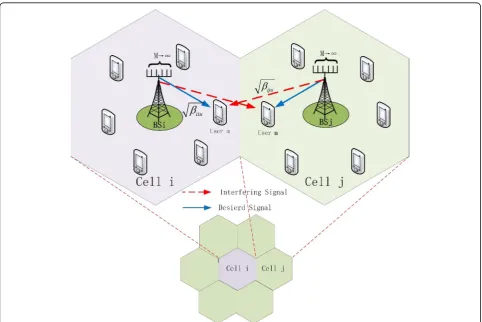
As shown in Fig. 1, the considered scenario is a multi-cell multi-user massive MIMO downlink system operat-ing in TDD mode, and the cell capacity maximizoperat-ing problem is studied with consideration of the inter-cell
interference. The system is composed of Β hexagonal
cells. All B BSs, where B= {1, 2,…,Β} are installed with
M antennas and serves U (M≥U≥1) single-antenna
users in each cell. The block-fading channel model is assumed. We assume that BS can select N transmit
an-tennas among the M transmit antennas and schedule
K(K≤N) users among the Uusers within the cell to be served simultaneously. The channel vector giju∈ℂM
from thejth BS and useruin cellican be expressed as
giju¼ ffiffiffiffiffiffiffiβiju q
hiju ð1Þ
where βiju denotes the large scale channel fading
be-tween jth BS and user u in cell i, including shadowing
and path loss. hiju is the small-scale fading vector, and hiju= [hiju1,hiju2,…,hijuM]T∈ℂM. Then, the overall
downlink transmission matrix Gij∈ℂM×U between the
BS in celljand all users in cellican be expressed as
Gij¼ gij1;gij2;…;gijU
h i
¼HijD
1 2
ij∈ℂMU ð2Þ
where Hij= [hij1,hij2,…,hijU]∈ℂM×U is the overall
small-scale fading matrix andDij= diag(βij1,βij2,…,βijU). Our objective is to find optimum combinations subset of BS antennas and users to approach the maximum cell capacity while decreasing the resulting network perform-ance loss. Furthermore, we will decrease the number of expensive RF chains and avoid the uneconomic costs of the hardware and decrease power consumption caused by selecting undesired antennas to provide the require-ment of service.
2.2 Problem formulation
In the downlink system, the signal received by users in cellican be written as
ri¼pffiffiffiffiptX user in cell i. The downlink signal received by useru in cellican be written as
riu¼pffiffiffiffiptgH
where wjb is the bth column of precoding matrix Wj.
Formula (4) including the desired signal for the useruin cell i, intra-cell interference signal (comes from other users in the same cell), and inter-cell interference signal (comes from other cells), respectively.
Since we used the zero-forcing (ZF) methods and sup-posing that the channel state information (CSI) is per-fectly known at the BS, the intra-cell interference signal (second term) in function (4) drops to zero according to prevenient works [14, 18–20]. Therefore, function (4) becomes
We assume that BS can choose N transmit antennas
among the M transmit antennas, and scheduleK(K≤N) users among the U users within the cell to be served simultaneously. For convenience, we give the selected subset of the antenna and scheduled subset of user indi-cator functions areωandω,
ω¼fωmgMm¼1 ð6Þ
ω¼fϖugUu¼1 ð7Þ
where ω and ω are binary vectors that include two values 0 and 1 to indicate if a given antenna or a given user is selected. (e.g., 1 → selected, 0 → unselected).
For making an easy description, we will define to two indicator functions, which are Im(ω)≜ωm∈{0, 1} and
IuðωÞ≜ϖu∈f0;1g, respectively. We use these to indicate whether themth BS antenna and theuth user are selected or not, respectively. sifωg∈ℂK denotes transmit signal
vector, sub-block channel matrix of corresponding
denotes byGijfω;ωg∈ℂNKandnifωg∈ℂKis noise vector,
respectively. Finally, in order to denote the joint antenna and user selection, we employ the 2-tuple Ω≜ðω;ωÞ. In order to have an easy explanation, we will interchangeably useΩand ðω;ωÞ for the following part. After using an-tenna selection and user scheduling method, function (5) becomes
2.3 Capacity of massive MIMO
According to the aforementioned discussion, the re-ceived signal-to-interference-plus-noise ratio (SINR) for the user u∈U (which is connected to cell i) with a
se-Considering the inter-cell interference, the formula of sum capacity for cellican be expressed as
Ci
Our target is to jointly select the optimal combination sets of BS transmit antenna and active user to approach the maximum cell capacity while decreasing the compu-tational complexity. Hence, the problem of JASUS can be written as
φ≜CN
MCKU joint antenna and user combinations, where CN
M and CKU are the binomial coefficient. This fact indi-cates that the ES method cannot be used in current the
massive MIMO systems whereUandM are very
numer-ous, it leads to high computational complexity. Thus, a low complexity algorithm for JASUS is needed in order to obtain the best network performance with low computa-tional complexity.
Obviously, formula (11) serves as the target function in this study. Therefore, address the problem (11) in multi-cell multi-user massive MIMO systems, we need to solve the following three main problems:
1. Inter-cell interference: the first problem is the inter-cell interference coming from other cells. In order to solve this problem, cells can adjust their precoding matrices, thus can eliminate or decrease the interference from all users. In order to make better use of the coordinated massive MIMO technology, a group of users in the cells should be scheduled so that each group of users in the cell has the biggest spatial separation with the interference channels of users in neighboring cells.
2. Computational complexity: the second problem is how to obtain the best combination subset of antenna and user in each cell with lower computational complexity so as to decrease or eliminate the inter-cell interference and maximize the sum capacity of all cells. We know that in multi-cell massive MIMO systems, the various path loss between the antennas coming from neighboring cells and users coming from target cell also bring to much computational complexity same to the antenna selection and user scheduling. Thus, the computational complexity of the ES algorithm becomes very large than of a single-cell JASUS. 3. CSI feedback cost: for massive MIMO systems, the
perfect CSI feedback depends mainly on the number of active antennas and the users they support. Hence, in order to centralize processing for selecting antennas and scheduling users across cells, the BS needs to exchange the overall CSI of overall combined subset antennas and users at each scheduling period, it brings more burden for BS. In addition, when the number of BS antennas and users in each cell increases, the cost of CSI increases accordingly.
On the base of the aforementioned discussion, a low complexity scheme is needed from the practical point of view for JASUS in multi-cell multi-user massive MIMO scenarios to reduce the complexity of
function (11) while decreasing the cost of the CSI feedback.
3 Joint antenna selection and user scheduling algorithm
In this part, we presented two suboptimal iterative algo-rithms for JASUS before a discussion of the proposed AMCMC method.
3.1 Norm-based JASUS algorithm
Firstly, we presented a norm-based JASUS method for ad-dressing the objective function (10). The norm-based JASUS scheme maximizeskGfω;ωgk
F, where‖.‖Fis the Frobenius norm function. Let CNB
sumðGfω;ωgÞ ¼ kGfω;ωgkF. This
scheme including initialization step and iterative up-dating step, respectively. This both steps use the vec-tor norm as criteria which considerably decrease each iterative computation complexity. The norm-based JASUS problem is modeled as
ωNB¼ arg max
where ωNB is the combination selection indicator.
Nevertheless, it has still a problem that when performing transmit antenna selection and user scheduling simply based on the F-norm criteria, it would sacrifice some cell capacity. In sum, the norm-based JASUS method has ex-tremely low complexity, but it cannot guarantee a high sum capacity performance.
3.2 Greedy-based JASUS algorithm
In order to enhance the cell capacity over norm-based JASUS, we presented a greedy-based JASUS algorithm. Unlike to the norm-based JASUS algorithm, the greedy-based JASUS algorithm maximizes the cell capacity in each step. This method also includes initialization step and iterative updating step. The greedy-based JASUS problem is modeled as
whereωGRis the combination selection indicator.
Com-pared with the norm-based JASUS algorithm, this method has a good capacity performance, but it has high computational complexity.
3.3 AMCMC-based JASUS algorithm
and complexity, we proposed a low-complexity JASUS method based on AMCMC algorithm and its description is as follows.
MCMC [21] is a method of generating random sam-ples, which is often used to calculate statistical estima-tion, marginal probability, and conditional probability. MCMC algorithms depend on (Markov) sequences with limit distributions corresponding to interest distribu-tions. In the past decades, it has been widely used in many fields such as engineering and statistics [22]. The key idea of the MCMC method is that Markov chains are simulated in state space X, and the stable distribu-tion of the chains is the target distribudistribu-tionπ[23].
In order to address our objection problem in (11), we must tackle tow essential issues when applying AMCMC algorithm. The first problem is how to provide a pro-posal distribution of candidate samplesLMCMC. The
sec-ond problem is how to design the most suitable updating rule for the proposal distribution.
3.3.1 Derivation of the candidate sampling distribution for the MCMC method
The biggest advantage of the MCMC method is that it can search the “elite samples” instead of exhaustively searching the whole samples. At iterationt, the samples
fΩℓ;t ¼ fωℓ;t;ωℓ;tggLℓ¼MCMC1 from an MCMC method can be employed to estimate the maximum value of the tar-get functionCisumðGfω;ωgÞ
whereLMCMC denotes the total number of samples, and
Φ
Cis the estimated value of formula (11).
Given that scheduled of per user ϖu and selection of
each antenna ωm are binary variables, we use the
Boltz-mann distribution of the objective function Cisumð Gfω normalization constant in the MCMC method that can be neglected. Thus, maximizing CisumðΩℓ;tÞis equivalent to maximizing π(Ωℓ, t), and π(Ωℓ, t) is the target
distribution.
In order to prove the MCMC method for searching the distributionπ(Ωℓ,t), we use a MIS (metropolized in-dependence sampler) [23], which is a generic MCMC method. The step is as follow. An initial value Ω[0], tis
chosen randomly. Given the current sampleΩ[ℓ],t,
A candidate sampleΩ[new],tis drawn from proposal
distributionΨ(Ωℓ,t;Rt−1).
Simulateu uniform[0, 1], and according to the accepting probabilityα(Ω[ℓ],t,Ω[new],t), let
After LMCMC iterations, we can achieve a set of sam-ples fΩ½0;t;Ω½1;t;…;Ω½LMCMC;tg, which is subjected to
distributionπ(Ωℓ,t).
3.3.2 Derivation of updating rule for the AMCMC algorithm
In this part, we provide updating rule for the pro-posal distribution. For the AMCMC method, the joint proposal distribution is proportional to the product of Bernoulli distributions, namely
where pu denotes the probability of the uth user
be-ing selected for communicatbe-ing with the BS. That is, ϖu∼Ber(pu) for u= 1, 2, …, U, and gm is the
prob-ability of the mth BS antenna being selected. That is, ωm∼Ber(gm) for m= 1, 2, …, M. We use the indicator
functions Im(ωℓ, t) and Iuðωℓ;tÞ to indicate whether the
mth BS antenna and theuth user are selected or not, re-spectively. Rt−1≜{Pt−1,gt−1}, where Pt ¼ fpu;tgUu¼1, gt
¼ fgm;tgMm¼
1, and Γ
′ is a normalization constant that
can be ignored in the AMCMC. The adaptation scheme is employed to adjust the parameterized pro-posal distribution Ψ(Ωℓ, t;Rt−1) and minimize the
Kullback-Leibler divergence [24, 25] between the tar-get distribution π(Ωℓ, t) and the proposal distribution
It is observed thatD~ ¼πðΩℓ;tÞ logπðΩℓ;tÞ−D½πðΩℓ;tÞ kΨðΩℓ;t;Rt−1Þ is a convex function [26]. Hence, the
minimization of the Kullback-Leibler divergence
D[π(Ωℓ,t)‖Ψ(Ωℓ,t;Rt−1)] w.r.t. R can be achieved when
We set the partial derivative of (22) to zero with re-spect toR. Then, the Eq. (22) can be written as
spect topuandgmare respectively given by
∂
By substituting (24) and (25) into (23), we obtain
X
drawn from target distributionπ(Ωℓ,t), the Monte Carlo
estimate of∂D~=∂puand∂D~=∂gmare
Applying the Robbins-Monro stochastic approxima-tion scheme [26], we can achieve the recursive up-date function to close to the root of ∂D~=∂pu¼0 and
where rt denotes the sequence of decreasing step sizes
[27]. In addition, we can simplify formulas (30) and (31), because (1−pu, t−1)pu, t−1 and (1−gm, t−1)gm, t−1 has
no significant impact on the convergence of (30) and (31). Hence, Eqs. (30) and (31) becomes
The updated proposal distribution Eqs. (32) and (33) are iteratively used with the objective to close to the tar-get distribution.
3.4 Constraints for the AMCMC-based JASUS problem For the JASUS problem, the vectorsωand ωare subject to constraint functions (12) and (13), respectively. How-ever, employing functions (32) and (33) with MIS to generate samples, but we cannot ensure that the samples meet the constraints (12) and (13). In order to ensure that the samples drawn from (32) and (33) meet the constraints (12) and (13), we propose a new projection strategy. For convenience, we only introduce the pro-posed projection strategy forω because the similar pro-jection strategy can be used toω.
Assume the sample ωℓ, t drawn from Ψ(·;gt−1) at the tth iteration. We define the two sets, which are
ϕ0= {m :Im(ωℓ, t) = 0} and ϕ1= {m :Im(ωℓ, t) = 1},
re-spectively. We use these to collect the indices for the unse-lected and seunse-lected BS antennas, respectively. The following projection strategy is applied ifPMm¼1Imðωℓ;tÞ≠N:
IfPMm¼1Imðωℓ;tÞ<N, then the proposed projection
|ϕ1| =N, whereϕ1is the number of elements of the setϕ1.
IfPMm¼1Imðωℓ;tÞ>N, then the BS antennas with
the smallest probability in the setϕ1are closed sequentially according to the proposed projection strategy until |ϕ1| =N.
3.5 Convergence analysis for the AMCMC-based JASUS algorithm
In order to obtain a higher convergence rate, the probability parameters Rt−1 of the proposal distribu-tion Ψ(Ωℓ, t;Rt−1) are adjusted. In this paper, we use literature [28] to explain the convergence problem, because our proposed method gives a similar descrip-tion of the convergence problem and proves the ef-fectiveness of the method through analysis. Besides, the complexity of the MCMC algorithm has been
proved to be only related to sample size LMCMC in [22]. The proposed adaptive strategy requires less sample size and iteration times, which can significantly improve the convergence speed of the MCMC algorithm.
3.6 Constrained AMCMC-based JASUS algorithm
On the base of the aforementioned discussion, we can be written the proposed AMCMC-based JASUS algo-rithm by the following steps. At iteration t, LMCMC samples fΩℓ;t¼ fωℓ;t;ωℓ;tggLℓ¼MCMC1 from the MCMC
4 Simulation configuration
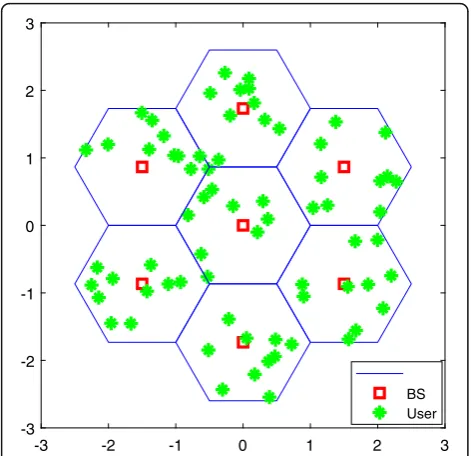
In this section, the simulation configuration and simula-tion parameters are described. The considered scenario is a multi-cell multi-user massive MIMO downlink
sys-tem operating in TDD mode with Β = 7, as shown in
Fig. 2. The simulation is done with a static network simulator. The key simulation parameters are summa-rized in Table1. In this simulation, we assume that the CSI is perfectly known at the transmitter, the total power is uniformly allocated among the transmit anten-nas. The system composed of Β hexagonal cells. All B BSs, where B= {1, 2,…,Β} are installed with Mantennas and serveUsingle-antenna users in each cell. Each BS is located at the cell center while U single-antenna users are randomly located in the cell. There is no user move-ment and handover during the simulation process.
5 Simulation results and analysis
In this section, we provide numerical results and compu-tational complexity analysis of the proposed algorithm by simulative evaluation.
5.1 Performance evaluation
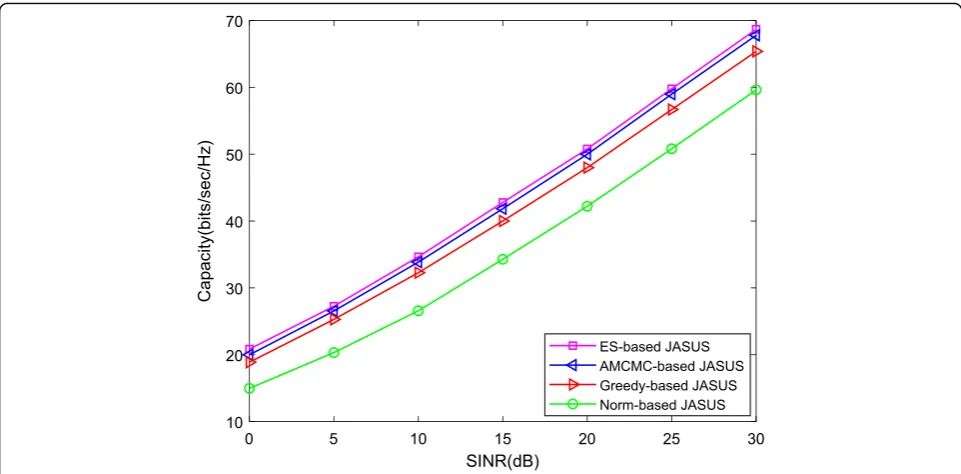
As can be seen the result from Fig.3, the cell multi-user massive MIMO downlink system using different JASUS method at various SINR. We find that the sum capacity of the AMCMC-based JASUS algorithm is very close to the maximum capacity result obtained by the ES-based JASUS algorithm with a wide range of SINRs. For example, when the SINR is 20 dB, the achieved values of cell capacity by using ES and AMCMC algorithms are
50.7 and 49.9 b/s/Hz, respectively. Ninety-eight percent of the optimal capacity is obtained by our proposed method. The result shows that the AMCMC-based JASUS method has a good performance compared to the greedy-based JASUS method with the wide range of SINRs, both AMCMC-based JASUS and greedy-based JASUS methods have better capacity performances compared to the norm-based JASUS algorithm. This simulation result shows that, when the SINR is 30 dB, ES, AMCMC, and greedy algo-rithms enhanced cell capacity of approximately 9.1, 8.2, and 5.8 b/s/Hz, respectively.
Figure4 shows the increase of sum cell capacity dur-ing each iteration for AMCMC-based JASUS algorithm with SINR = 20 dB. As can be seen from Fig. 4, we find that the AMCMC-based JASUS converges after about t= 30 iterations. As expected, the sum cell capacity ob-tained by AMCMC-based JASUS strictly monotonically increased with a number of iteration.
Now, the assumed scenario is a multi-cell multi-user massive MIMO downlink system with 50 active users
(U= 50) at SINR = 20 dB, and we assume a different
number of transmit antenna, M, from 16 to 60. Sixteen antennas (N= 16) were selected to be used by the trans-mitter and ten users (K= 10) were served. As can be seen in the result from Fig.5, the cell capacity difference between the ES-based JASUS and AMCMC-based JASUS scheme is relatively small, and the cell capacity achieved by the aforementioned algorithms slightly
grows with M. In summary, when numbers of the
se-lected BS antennas (N) and scheduled users (K) are con-firmed, the increase of the number of transmitting antennas (M) has little effect on the system capacity per-formance. Thus, it can be proven from the result that activation of more transmit antennas at the BS side is unnecessary.
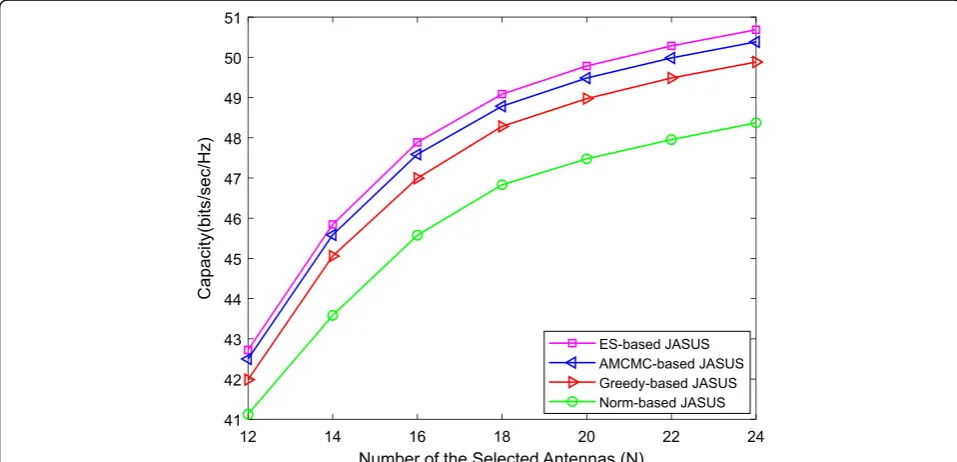
A cell capacity performance comparison of each JASUS algorithms with various numbers of the selected antennas at SINR = 20 dB is shown in Fig.6. The various
-3 -2 -1 0 1 2 3
Fig. 2Multi-cell multi-user massive MIMO system withB= 7 andK= 10
Table 1Simulation parameters setting
Parameters Values
No. of cells in the simulationΒ 7
Average no. of UEs in one cell 2≤U≤50
Number of BS antennasM 10≤M≤64
Inter-site distance 500 m
Cell radius 295 m
Path loss 128.1 + 37.6×log10(distance(km))[dB]
Each BS transmission power 10 dB
Shadowing standard derivation 7 dB
Noise spectral density −174 dBm/Hz
Users’speed 0
numbers of the selected antennas (12≤N≤24) corres-pond to the different maximum cell capacity of the net-works. Compared with the norm-based JASUS, the JASUS algorithms, which are ES, AMCMC, and greedy, had more significant enhancement for the system per-formance. For example, the maximum cell capacity en-hancements, which are approximately 2.5, 2.2, and 1.7 b/ s/Hz at SINR = 20 dB, are achieved when 18 (N= 18) BS antennas are selected. From the figure, it can be ob-served, when N> 18, the cell capacity achieved by the JASUS algorithms is slightly growing when the number of selected antenna goes large. Thus, it can be proven from the result that when numbers of the scheduled users Kare confirmed, the system capacity sequentially increases until the numbers of selected BS antenna close to theN= 18, whenN> 18, the increasing number of se-lected antennas has no significant effect on the system
capacity performance. Therefore, the results show that more antenna selection is unnecessary at the base sta-tion. Thus, the proposed algorithm is demonstrated to be effective. In addition, we considerably decreased sys-tem cost and power consumption while approach the maximum cell capacity by selected suitable transmit an-tennas at BS side.
Figure 7 shows that the cell capacity different K at SINR = 20 dB, for user scheduling and with transmit antenna selection. It can be observed that the cell sum capacity increases with increasing of user K. The different numbers of the scheduled users (2≤K≤16) correspond to the different maximum cell capacity of the networks. Compared with the norm-based result, ES, AMCMC, and greedy algorithms enhanced the system performance. For example, the maximum cell capacity enhancement, which are approximately 6.2, Fig. 3Ergodic capacity versus SINR withB= 7,M= 64,U= 50,N= 16, andK= 10
5.5, and 4.0 b/s/Hz at SINR = 20 dB, are achieved when ten (K= 10) users are scheduled. From the fig-ure, it can be observed that when K > 10, the cell capacity achieved by the aforementioned algorithms slightly grows when the number of the scheduled user goes large. This result proves that the behavior of JASUS algorithm does not change drastically when the scheduled user number becomes large.
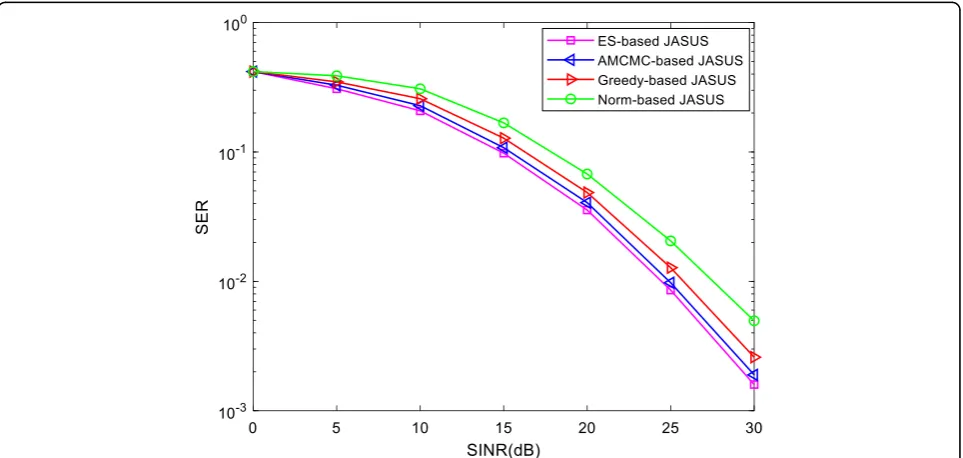
Finally, we discuss on SER of different JASUS algo-rithms. A 16-QAM scheme is used with a ZF receiver. The SER performance of the linear ZF receiver system is
shown in Fig. 8. Compared with the results of
norm-based JASUS algorithm, ES, AMMC, and greedy algo-rithms improved the SER of the system. Same to the case of the cell capacity performance, the system SER of the AMCMC-based JASUS algorithm is close to that of Fig. 5Ergodic capacity of different algorithms with versus transmit antenna numbers withB= 7,U= 50,N= 16,K= 10, and SINR = 20 dB
the ES-based JASUS algorithm. At the same time, we find that ES-based JASUS and AMMC-based JASUS have better SER performance than greedy-based JASUS and norm-based JASUS, especially the SINR to high. When the SINR is 20 dB, the SER performances of the ES-based JASUS, AMCMC-based JASUS, greedy-based JASUS, and norm-based JASUS algorithms are approxi-mately 3.5 × 10⁻², 3.9 × 10⁻², 4.9 × 10⁻², and 6.8 × 10⁻², respectively.
5.2 Computational complexity analysis
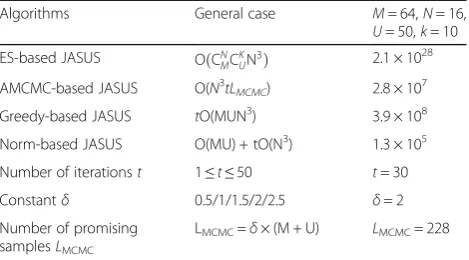
The computational complexities of the introduced differ-ent JASUS algorithm are analyzed in this section. Table2 summarizes the computational complexity of our pro-posed algorithm along with the complexity of another al-gorithm. The asymptotic notations, which reflect the computational complexity, was used to evaluation how the scheme responds to changes of parameters which are M, N,U, andK. From Table2, we can easily observe the Fig. 7Ergodic capacity of different algorithms with different scheduled number of users withB= 7,M= 64,U= 50,N= 16, and SINR = 20 dB
computational complexity gap between the four methods. Note that CNM denotes the binomial coefficient, and the matrix inverse operation [29–32] makes the computa-tional complexity of per sample up to O(N3). Thus, the overall complexity of our proposed Algorithm 1 for the problem of (11) isO(N3tLMCMC), wheret×LMCMCis the total number of target function evaluations. Ultimately, we can be observed from Table2that our proposed algo-rithm has a very low computational complexity compared to ES-based JASUS and greedy-based JASUS algorithms. However, the norm-based JASUS algorithm has a very low computational complexity compared to our proposed al-gorithm, but it also has a very low cell capacity. This result shows that our proposed algorithm is suitable for practical multi-cell multi-user massive MIMO system.
6 Conclusion
In this paper, we studied the problem of JASUS in a multi-cell multi-user massive MIMO downlink system operating with TDD mode. Considering the trade-off be-tween network performance and computational com-plexity, we proposed a low-complexity algorithm for JASUS method based on AMCMC algorithm in the downlink multi-cell multi-user massive MIMO systems. AMCMC algorithm has been proven helpful for select-ing combination subset of antennas and users to ap-proach the maximum cell capacity with consideration of the inter-cell interference. In our algorithm, the updating rules of the selection probability of each base station an-tenna and scheduling probability for each user are pro-posed. In addition, we proposed a new projection strategy to satisfy the constraints of selection. Performance analysis and simulation results show that our proposed algorithm can produce promising results and achieve a good trade-off between complexity and performance. Compared with ES-based JASUS algorithm, the proposed algorithm achieved comparable performance with very low complexity. In addition, we demonstrate that our proposed algorithm
outperforms greedy-based JASUS and norm-based JASUS methods in terms of cell capacity and SER performance with under poorly conditioned channels. At the same time, the computational complexity is reduced signifi-cantly by combining with the proposed algorithm.
Abbreviations
AMCMC:Adaptive Markov chain Monte Carlo; BS: Base station; CSI: Channel state information; ES: Exhaustive search; JASUS: Joint antenna selection and user scheduling; MIMO: Multiple-input multiple-output; MU: Multi-user; RF: Radio frequency; SINR: Signal-to-interference-plus-noise ratio; TDD: Time division duplexing; ZF: Zero-forcing
Acknowledgements
This work described in this paper was supported by the National Science and Technology Major Project: No. 2018ZX03001029-004.
Authors’contributions
WG conceived and designed the study. SM and KZ performed the simulation experiments. SM and KZ wrote the paper. XL and ZS reviewed and edited the manuscript. All authors read and approved the final manuscript.
Authors’information
Saidiwaerdi Maimaiti received the M.Sc. degree in signal and information processing from Southwest Jiaotong University, Chengdu, China, in 2014. He is currently working towards the Ph.D. degree in Information and
Communications Engineering, Key Laboratory of Universal Wireless Communications, Ministry of Education, Beijing University of Posts and Telecommunications Beijing, China. His research interests include massive MIMO, interference management, radio network planning, resource management, and intelligent network optimization in 5G network systems.
Funding
The funding for the research reported is provided by the National Science and Technology Major Project: No. 2018ZX03001029-004. The funds are mainly used for simulation hardware support.
Competing interests
The authors declare that they have no competing interests.
Received: 10 March 2019 Accepted: 25 July 2019
References
1. T.A. Sheikh, J. Bora, A. Hussain, inCCTCEEC. A survey of antenna and user scheduling techniques for massive MIMO-5G wireless system (Mysore, 2017), pp. 578–583.https://doi.org/10.1109/CTCEEC.2017.8455177
2. T.L. Marzetta, Noncooperative cellular wireless with unlimited numbers of base station antennas. IEEE Trans. Wirel. Commun.9(11), 3590–3600 (2010) 3. E.G. Larsson, O. Edfors, F. Tufvesson, T.L. Marzetta, Massive MIMO for next
generation wireless systems. IEEE Comun. Mag.52(2), 186–195 (2014) 4. S. Han, I. Chih-Lin, Z. Xu, C. Rowell, Large-scale antenna systems with hybrid
analog and digital beamforming for millimeter wave 5G. IEEE Comun. Mag.
53(1), 186–194 (2015)
5. Y. Dong, Y. Tang, K.Z. Shenzhen, inIEEE/ACIS International Conference on
Computer and Information Science IEEE. Improved joint antenna selection
and user scheduling for massive MIMO systems (2017)
6. M. Torabi, D. Haccoun, Performance analysis of joint user scheduling and antenna selection over MIMO fading channels. IEEE Signal Process. Lett.
18(4), 235–238 (2011)
7. C. Bandeira, D. Moreira, P. Normando, et al., inProc. IEEE Vehicular Technology
Conf. (VTC-Spring). Performance of joint antenna and user selection schemes for
interference alignment in MIMO interference channels (2013)
8. S. Xue, Z. Qian, W. Shao, et al., inProc. IEEE International Conf. Computational
Electromagnetics (ICCEM). Distributed joint antenna and user selection for
MIMO broadcast channels (2016)
9. J.-C. Chen,“Joint Antenna Selection and User Scheduling for Massive Multiuser MIMO Systems With Low-Resolution ADCs,”IEEE Trans. Veh. Technol.68(1) 1019–1024 (2019)
Table 2Computational complexity analysis
Algorithms General case M= 64,N= 16,
U= 50,k= 10
10. X. Gao, L. Dai, A.M. Sayeed, Low RF-complexity technologies to enable millimeter-wave MIMO with large antenna array for 5G wireless communications. IEEE Commun. Mag.56(4), 211–217 (2018) 11. T.-H. Tai, W.-H. Chung, T.-S. Lee, "A low complexity antenna selection
algorithm for energy efficiency in massive MIMO systems", Proc. IEEE Int. Conf. Data Sci. Data Intensive Syst. 284-289 (2015)
12. X. Gao , O. Edfors, F. Tufvesson, and E. G. Larsson,“Massive MIMO in real propagation environments: Do all antennas contribute equally?,”IEEE Trans. Commun.63(11) 3917–3928 (2015)
13. B. Makki, A. Ide, T. Svensson, T. Eriksson, M.-S. Alouini, A genetic algorithm-based antenna selection approach for large-but-finite MIMO networks. IEEE Trans. Veh. Technol.66(7), 6591–6595 (2016)
14. M. Benmimoune, E. Driouch, W. Ajib, D. Massicotte, inProc. IEEE WCNC. Joint transmit antenna selection and user scheduling for massive MIMO systems (2015), pp. 381–386
15. M. Olyaee, M. Eslami, J. Haghighat, An energy-efficient joint antenna and user selection algorithm for multi-user massive MIMO downlink. IET Commun.12(3), 255–260 (2018)
16. G. Xu, A. Liu, W. Jiang, H. Xiang, W. Luo, Joint user scheduling and antenna selection in distributed massive MIMO systems with limited backhaul capacity. China Commun.11(5), 17–30 (2014)
17. B.M. Lee, J. Choi, J. Bang, B.-C. Kang, inIEEE Int. Symp. On Circuits and
Systems (ISCAS). An energy efficient antenna selection for large scale green
MIMO systems (2013), pp. 950–953
18. Q.H. Spencer, A.L. Swindlehurst, M. Haardt, Zero-forcing methods for downlink spatial multiplexing in multiuser MIMO channels. IEEE Trans. Signal Process.52(2), 461–471 (2004)
19. G. Dimic, N.D. Sidiropoulos, On downlink beamforming with greedy user selection: performance analysis and a simple new algorithm. IEEE Trans. Signal Process.53(10), 3857–3868 (2005)
20. M. Al-Saedy, M. Al-Imari, M. Al-Shuraifi, et al. Joint User Selection and Multi-Mode Scheduling in Multicell MIMO Cellular Networks[J]. IEEE Transactions on Vehicular Technology, 1-1 (2017)
21. J.C. Spall, Estimation via Markov chain Monte Carlo. Control Syst. IEEE
23(2), 34–45 (2003)
22. W.R. Gilks, S. Richardson, D.J. Spiegelhalter,Markov Chain Monte Carlo in
Practice(Chapman and Hall, London, 1996)
23. J. Liu,Monte Carlo Strategies in Scientific Computing(Springer-Verlag, New York, 2001)
24. S. Kullback, R. Leibler, On information and sufficiency. Ann. Math. Stat.
22(1), 79–86 (1951)
25. R.Y. Rubinstein, D.P. Kroese,The Cross-Entropy Method: A Unified Approach to Combinatorial Optimization, Monte-Carlo Simulation and Machine Learning (Springer-Verlag, Berlin, 2004)
26. H. Robbins, S. Monro, A stochastic approximation method. Ann. Math. Stat.
22(3), 400–407 (1951)
27. H. Kushner, G. Yin,Stochastic Approximation Algorithms and Applications, 2nd edn. (Springer-Verlag, New York, 2003)
28. Y. Liu, Y.Y. Zhang, C.L. Ji, W.Q. Malik, D.J. Edwards, A low complexity receive-antenna-selection algorithm for MIMO-OFDM wireless systems. IEEE Trans. Veh. Technol.58(6), 2793–2802 (2009)
29. X. Gao, L. Dai, Y. Ma, Z. Wang, Low-complexity near-optimal signal detection for uplink large-scale MIMO systems. Electron. Lett.50(18), 1326–1328 (2014) 30. X. Gao, L. Dai, Y. Hu, Y. Zhang, Z. Wang, Low-complexity signal detection for
large-scale MIMO in optical wireless communications. IEEE J. Sel. Areas Commun.33(9), 1903–1912 (2015)
31. L. Dai, X. Gao, X. Su, S. Han, I. Chih-Lin, Z. Wang, Low-complexity soft-output signal detection based on Gauss-Seidel method for uplink multiuser large-scale MIMO systems. IEEE Trans. Veh. Technol.64(10), 4839–4845 (2015) 32. Z. Wu, C. Zhang, Y. Xue, S. Xu, Z. You, "Efficient architecture for soft-output
massive MIMO detection with gauss-seidel method", Proc. IEEE Int. Conf. Circuits Syst. (ISCAS), 1886-1889 (2016)
Publisher’s Note