Discriminative Feature Selection via Multiclass
Variable Memory Markov Model
Noam Slonim
School of Engineering and Computer Science and Interdisciplinary Center for Neural Computation, The Hebrew University of Jerusalem, Jerusalem 91904, Israel
Email:[email protected] Gill Bejerano
School of Engineering and Computer Science, The Hebrew University of Jerusalem, Jerusalem 91904, Israel Email:[email protected]
Shai Fine
IBM Research Laboratory in Haifa, Haifa University, Mount Carmel, Haifa 31905, Israel Email:[email protected]
Naftali Tishby
School of Engineering and Computer Science and Interdisciplinary Center for Neural Computation, The Hebrew University of Jerusalem, Jerusalem 91904, Israel
Email:[email protected]
Received 18 April 2002 and in revised form 15 November 2002
We propose a novel feature selection method based on a variable memory Markov (VMM) model. The VMM was originally proposed as a generative model trying to preserve the original source statistics from training data. We extend this technique to simultaneously handle several sources, and further apply a new criterion to prune out nondiscriminative features out of the model. This results in a multiclass discriminative VMM (DVMM), which is highly efficient, scaling linearly with data size. Moreover, we suggest a natural scheme to sort the remaining features based on their discriminative power with respect to the sources at hand. We demonstrate the utility of our method for text and protein classification tasks.
Keywords and phrases:variable memory Markov (VMM) model, feature selection, multiclass discriminative analysis.
1. INTRODUCTION
Feature selection is one of the most fundamental problems in pattern recognition and machine learning. In this approach, one wishes to sort all possible features using some prede-fined criteria and select only the “best” ones for the task at hand. It thus may be possible to significantly reduce model dimensions without impeding the performance of the learn-ing algorithm. In some cases one may even gain in gener-alization power by filtering irrelevant features (cf. [1]). The need for a good feature selection technique also stem from the practical concern that estimating the joint distribution (between the classes and the feature vectors), when either the dimensionality of the feature space or the number of classes is very large, requires impractical large training sets. Indeed, increasing the number of features while keeping the number of samples fixed can actually lead to decrease in the accuracy of the classifier [2,3].
(0.2,0.2,0.2,0.2,0.2)
λ a
r
(0.05,0.5,0.15,0.2,0.1)
a
r
(0.6,0.1,0.1,0.1,0.1) (0.05,0.25,0.4,0.25,0.05)
ra r c ca
(0.05,0.4,0.05,0.4,0.1)
b bra
(0.1,0.1,0.35,0.35,0.1)
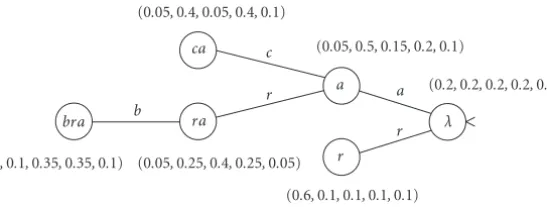
Figure1: An example of a PST. The root node corresponds to the empty suffix, the nodes in the first level correspond to suffixes of order
one, and so forth. The string inside each node is a memorized suffix and the adjacent vector is its probability distribution over the next symbol of the alphabetΣ = {a, b, c, d, r}. For example, the probability to observecafter the substringbara, whose largest suffix in the tree isra, isP(c|bara)=Pra(c)=0.4. Similarly, since suff(bacara)=ra, the probabilitiesP(σ|bacara)= {0.05,0.25,0.4,0.25,0.05}for σ∈ {a, b, c, d, r}, respectively.
Ron et al. introduced a learning algorithm using a construc-tion called predicconstruc-tion suffix tree (PST), which preserves the minimal subsequences (of variable lengths) that are neces-sary for precise modeling of the given statistical source (see
Figure 1).
While the motivation of Ron et al. was to provide genera-tivestatistical modeling for a single source, the current work uses the PST construction to address supervised discrimina-tion tasks. Thus, our first step is to extend the original gen-erative VMM modeling technique to handle several sources simultaneously. Next, since we wish to use the resulting mul-ticlass model to classify new (test) sequences, we are less con-cerned with preserving source statistics. Rather, we focus on identifying variable length dependencies, that can serve as gooddiscriminativefeatures between the learned categories. This results in a new algorithm, termeddiscriminative VMM (DVMM).
Our feature selection scheme is based on maximizing conditionalmutual information (MI). More precisely, for any subsequenceswe estimate the information between the next symbol in the sequence and each statistical source c ∈ C, given that subsequence (or suffix)s. We use this estimate as a new measure for pruning less discriminative features out of the model. This yields a criterion which is very different from the one used by the original generative VMM model. In particular, many features may be important for good model-ing of each source independently although they provide mi-nor discrimination power. These features are pruned in the DVMM, resulting in a much more compact model which still attains high classification accuracy.
We further suggest a natural sorting of the features re-tained in the DVMM model. This allows an examination of the most discriminative features, often gaining useful in-sights about the nature of the data.
1.1. Related work
The use of MI for feature selection is well known in machine learning realm, though it is usually suggested in the context of “static” rather than stochastic modeling. The original idea may be traced back to Lewis [5]. It is motivated by the fact
that when the a priori class uncertainty is given, maximizing the MI is equivalent to the minimization of the conditional entropy. This in turn links MI maximization and the decrease in classification error,1
HPerr
+Perrlog(C−1)≥H(C|X)≥2Perr, (1)
where
H(·)= −P(·) logP(·),
H(·|·)= −P(·,·) logP(·|·)
(2)
are the entropy and the conditional entropy, respectively. Since then, a number of methods have been posed, dif-fering essentially by their method of approximating the joint and marginal distributions, and their direct usage of the mu-tual information measure (cf. [8,9,10]). One of the diffi -culties in applying MI based feature selection methods, is the fact that evaluating the MI measure involves integrat-ing over a dense set, which leads to a computational over-load. To circumvent that, Torkkola and Campbell [11] have recently suggested to perform feature transformation (rather than feature selection) to a lower-dimensional space in which the training and analysis of the data is more feasible. Their method is designed to find a linear transformation in the feature space that will maximize the MI between the trans-formed data and their class labels, and the reduction in com-putational load is achieved by the use of Renyi’s entropy based definition of mutual information which is much more easy to evaluate.
Out of numerous feature selection techniques found in the literature, we would like to point out the work of Della Pietra et al. [12] who devised a feature selection (or rather, induction) mechanism to buildn-grams of varying lengths, and McCallum’s “U-Tree” [13], which build PSTs based on
1The upper bound is due to Fano’s inequality (cf. [6]), and the lower
the ability to predict the future discounted reward in the con-text of reinforcement learning.
Another popular approach in language modeling is the use of pruning as a mean for parameter selection from a higher-ordern-gram backoff2model. One successful prun-ing criterion, suggested by Stolcke [15], minimizes the “dis-tance” (measured by relative entropy) between the distribu-tions embodied by the original and the pruned models. By relating relative entropy to the relative change in training set perplexity,3a simple pruning criterion is devised, which re-moves from the model alln-grams that change perplexity by less than a threshold. Stolcke shows [15] that in practice this criterion yields a significant reduction in model size without increasing classification error.
A selection criterion, similar to the one we propose here, was suggested by Goodman and Smyth for decision tree de-sign [7]. Their approach chooses the “best” feature at any node in the tree, conditioned on the features previously cho-sen, and the outcome of evaluating those features. Thus, they suggested a top-down algorithm based on greedy se-lection of the most informative features. Their algorithm is equivalent to the Shannon-Fano prefix coding, and can also be related to communication problems in noisy chan-nels with side information. For feature selection, Goodman and Smyth noted that with the assumption that all features are known a priori, the decision tree design algorithm will choose the most relevant features for the classification task, and ignore irrelevant ones. Thus, the tree itself yields valu-able information on the relative importance of the various features.
A related usage of MI for stochastic modeling is the maximal mutual information (MMI) approach for multi-class model training. This is a discriminative training ap-proach attributed to Bahl et al. [16], designed to directly approximate the posterior probability distribution, in con-trast to the indirect approach, via Bayes’ formula, of maxi-mum likelihood (ML) training. The MMI method was ap-plied successfully to Hidden Markov Models (HMM) train-ing in speech applications (see, e.g., [17, 18]). However, MMI training is significantly more expensive than ML train-ing. Unlike ML training, in this approach all models af-fect the training of every single model through the denom-inator. In fact this is one reason why the MMI method is considered to be more complex. Another reason is that there are no known easy re-estimation formulas (as in ML). Thus we need to resort to general purpose optimization techniques.
Our approach stems from a similar motivation but it sim-plifies matters: we begin with a simultaneous ML training for all classes and then select features that maximize the same
ob-2Thebackoff recursive rule (cf. [14]) representsn-gram conditional
probabilitiesP(wn|wn−1· · ·w1) using (n−1)-gram conditional
probabili-ties multiplied by a backoffweight,α(wn−1· · ·w1), associated with the full
history, that is,P(wn|wn−1· · ·w1) =α(wn−1· · ·w1)P(wn|wn−1· · ·w2),
whereαis selected such thatP(wn|wn−1· · ·w1)=1.
3Perplexity is the average branching factor of the language model.
jective function. While we cannot claim to directly maximize mutual information, we provide a practical approximation which is far less computationally demanding.
2. VARIABLE MEMORY MARKOV MODELS
Consider the classification problem to a set of categories C = {c1, c2, . . . , c|C|}. The training data consists of a set of labeled examples for each class. Each sample is a sequence of symbols over some alphabet Σ. A Bayesian learning frame-work trains generative models to produce good estimates of class conditioned probabilities, which in turn, upon receiv-ing a new (test) sampled, are employed to yield Maximum A Posteriori (MAP) decision rule
max
c∈C P(c|d)∝maxc∈C P(d|c)P(c), d∈Σ
∗. (3)
Thus, good estimates ofP(d|c) are essential for accurate clas-sification. Letd = σ1, σ2, . . . , σ|d|,σi ∈Σ, and letsi ∈ Σi−1 denote the subsequence of symbols preceding toσi, then
P(d|c)= next symbol usingsi is equivalent to a prediction using the shorter context given by suff(si). Thus, in this case it is clear that keeping only suff(si) in the model should suffice for the prediction.
The VMM algorithm [4] aims at building a model which will hold only a minimal set of relevant suffixes. To this end, a suffix treeTˆis built in two steps. First, only suffixess∈Σ∗for which the empirical probability in the training data, ˆP(s), is nonnegligible, are kept in the model. Thus, rare suffixes are ignored. Next, all suffixes that are not informative for pre-dicting the next symbol are pruned out of the model. Specif-ically, this is done by thresholdingr ≡P(σ|s)/P(σ|suff(s)). Ifr≈1 for allσ ∈Σ, then predicting the next symbol using suff(s) is almost identical to usings. In such casesswill be pruned out of the model.
3. MULTICLASS DISCRIMINATIVE VMM
The VMM algorithm is designed to statistically approximate a single source. A straightforward extension to handle mul-ticlass categorization tasks would build a separate VMM for each class, based solely on its own data, and would classify a new example to the model with the highest score (a one-versus-all approach, e.g., [19]).
Motivated by a generative goal, this approach disregards the possible (dis)similarities between the different categories. Each model aims at best approximating its assigned source. However, in a discriminative framework these interactions may be exploit to our benefit. As a simple example, assume that for some suffixsand every symbolσ ∈ Σ, ˆP(σ|s, c)=
ˆ
Initialization and first step—tree growing:
Algorithm1: Pseudo-code for the DVMM training algorithm.
areindependent givens. Since we are only interested in the rel-ative order of the posteriors ˆP(c|s), these terms may as well be neglected. In other words, preservingsin the model will yield no contribution to the classification task, since this suffix has no discrimination power with respect to the given categories. We now turn to generalize and quantify this intuition. In general, two random variablesX andY are independent if and only if the MI between them is zero (cf. [6]). For every s∈Σ∗, we consider the following (local)conditionalMI,
Is≡I(Σ;C|s)= ative number of training examples labeled with the category c, or from domain knowledge, and ˆP(s)=c∈CP(c) ˆˆ P(s|c). IfIs =0, as above,scan certainly be pruned. However, we may define a stronger pruning criterion, which consider also the suffix ofs. Specifically, ifIs−Isuff(s)≤ε2, whereε2is some threshold, one may prunesand settle for the shorter mem-ory suff(s). In other words, this criterion implies that suff(s) effectively induces more dependency betweenΣandCthan its extensions. Thus, preserving suff(s) in the model should suffice for the classification task.4
Finally, note that as in the original VMM, the pruning criterion defined above is not monotone. Thus, it is possible to get Is1 > Is2 < Is3 fors3 = suff(s2) = suff(suff(s1)). In this case we may be tempted to prune the “middle” suffix s2 along with its child,s1, despite the fact thatIs1 > Is3. To avoid that we define the pruning criterion more carefully. We denote by ˆTsthe subtree spanned bys, that is, all the nodes in ˆTscorrespond to subsequences with the same suffix,s. We can now calculate ¯Is =maxs∈Tsˆ Is, and define the pruning criterion by ¯Is−Isuff(s) ≤ ε2. Therefore, we prunes(along
4Indeed, in general, conditioning reduces entropy, and therefore
in-creases MI, but this does not say anything about the individual terms at the MI summation which may exhibit an opposite relation (cf. [6]).
with all its descendants), only if there is no descendant ofs (includingsitself) that induces more information (up toε2) between ΣandC, compared to suff(s), the parent ofs. We term this algorithm DVMM training (seeAlgorithm 1).
4. SORTING THE DISCRIMINATIVE FEATURES
The above procedure yields a rather compact discriminative model between several statistical sources. Naturally not all its features have the same discriminative power. We denote the information content of a feature by
Iσ|s≡ independent givens, thenIσ|swill be relatively small, and vice versa.
This criterion can be applied to sort all the DVMM features. Still, it might be thatIσ1|s1 =Iσ2|s2, while ˆP(s1)
ˆ
P(s2). Clearly in this case one should prefer the first feature, {s1·σ1}, since the probability to encounter it is higher. There-fore, we should balance betweenIσ|sand ˆP(s) when sorting. Specifically, we score each feature by ˆP(s)Iσ|s, and sort in de-creasing order.
The pruning and sorting schemes above are based on lo-cal conditional mutual information values. We review the process from a global standpoint. Theglobalconditional mu-tual information is given by (see, e.g., [6])
I(Σ;C|S)=
contribution to the global conditional mutual information, given by ˆP(s)Iσ|s. Thus, we aim for a compact model that still strives to maximizeI(Σ;C|S).
Expressing the conditional MI as the difference between two conditional entropies,I(Σ;C|S)=H(C|S)−H(C|S,Σ), we see that maximizingI(Σ;C|S) is equivalent to minimizing H(C|Σ, S). In other words, our procedure effectively tries to minimize the entropy, that is, the uncertainty, over the cat-egory identity C given the new symbolΣand the suffixS, which in turn decreases the classification error (see (1)).
5. EXPERIMENTAL RESULTS
To test the validity of our method we performed a com-parative analysis over several data types. In this section, we describe the results for protein and text classification tasks. Other applications, such as DNA sequence analysis, will be presented elsewhere.
5.1. Experimental design
In every dataset the DVMM algorithm is compared with two different (although related) algorithms. A natural compar-ison is of course with the original generativeVMM model [4]. In a recent work, Bejerano and Yona [19] successfully applied a one-versus-all approach to protein classification, building agenerativeVMM for each family, in order to esti-mate the membership probability of new protein to that fam-ily. Specifically, it was shown that one may accurately identify whether a protein is a member in that family or not. In our context, we build |C| different generative models, one per class. A new example is then classified into the most prob-able class using these models. We will term this approach GVMM.
We further compared our results to A. Stolcke’s perplex-ity pruning SRILM language modeling toolkit5(discussed in Section 1.1). Here, again,|C|generative models are trained and classification is to the most probable class. Since the SRILM toolkit is limited to 6-grams, we bounded the max-imal depth of the PST’s (for both DVMM and GVMM) to the equivalent suffix length 5. For all three models, we neglected in the first step (of ignoring small ˆP(s)) all suf-fixes appearing less than twice in the training sequences. In principle, these two parameters can be fine tuned for a specific data set using standard methods, such as cross validation.
For pruning purposes we vary the analogous local deci-sion threshold parameter in all three methods to obtain dif-ferent model sizes. These areε2, r, and the perplexity thresh-old for DVMM, GVMM, and SRILM, respectively. In order to compute model sizes we sum the number of class specific features (s·σcombinations) in each model.6
Finally, there is the issue of smoothing zero probabili-ties. Quite a few smoothing techniques exist, some widely
5Seehttp://www.speech.sri.com/projects/srilm.
6For the DVMM this will be the number of retained nodes multiplied by |Σ||C|.
Table1: Details of the protein super-family test.
Class Protein family name #Proteins
c1 Fungal lignin peroxidase 29
c2 Animal haem peroxidase 33
c3 Plant ascorbate peroxidase 26
c4 Bacterial haem catalase/peroxidase 30
c5 Secretory plant peroxidase 102
used by language modeling researchers (see [14] for a sur-vey). Most of these incorporate two basic ideas: modifying the true counts of then-grams to pseudo counts (which es-timate expected rather than observed counts), and interpo-lating higher-order with lower-ordern-gram models to com-pensate for under sampling. For SRILM we used a standard absolute-discounting (see [14]). The GVMM uses propor-tional smoothing (see [19]). For the DVMM we applied a simple plus 0.5 smoothing.7
5.2. Protein classification tests
The problem of automatically classifying proteins into bio-logically meaningful families has become very important in the last few years. For this data, obviously, there is no clear definition of higher-order features. Thus, usually each pro-tein is represented by its ordered sequence of amino acids, resulting in a natural alphabet of all 20 different amino acids plus 3 ambiguity symbols.
There are various approaches to the classification of pro-teins into families, however most of these methods agree on a wide subset of the known protein world. We have chosen to compare our results to those of the PRINTS database [20] as its approach resembles ours. This database is a collection of protein family fingerprints. Each family is matched with a fingerprint of one or more short subsequences which have been iteratively refined using database scanning procedures to maximize their discrimination power in a semi-automatic procedure involving human supervision and intervention.
5.2.1 A protein super-family test
We first used a subset of five related protein families, all members of the Haem peroxidase super-family, taken from the PRINTS database (seeTable 1for details). Peroxidases are Haem-containing enzymes that use hydrogen peroxide as the electron acceptor to catalyse a number of oxidative reactions. We randomly chose half of the sequences as the training set and used the remaining half as test set. We repeated this pro-cess 10 times and averaged the results. For each iteration we used the training set to build the (discriminative/generative) training model(s), and then used these model(s) to classify the test sequences. DVMM and GVMM prediction were ob-tained using (4), wheresicorresponds to the maximal suffix kept in the model during training.
7Notice that in all our experiments the alphabet size is fairly small (below
In Figure 2a we compare the classification accuracy of all algorithms for different model sizes (by sweeping the pruning parameter). All algorithms achieved perfect (or near perfect) classification using the minimally pruned model. However, using more intensive pruning (and hence, smaller models), DVMM consistently outperforms the other two al-gorithms. This is probably due to the fact that the DVMM is directly trying to minimize the discrimination error, while the other two are not. Interestingly, for the GVMM the results are not monotonic. Very small models outperform medium-sized models. This phenomenon, apparent also in the text example that follows, merits further investigation.
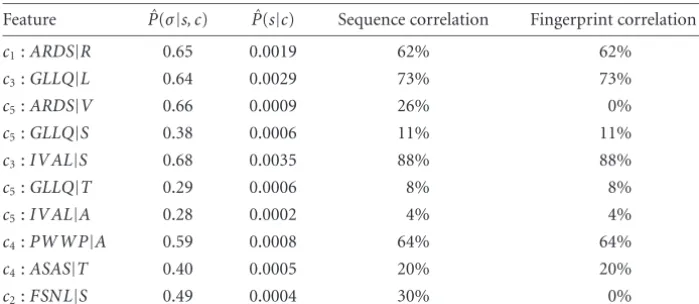
Equally interesting here is the list of best discriminating features. In Table 2we present the top 10 features with re-spect to all suffixes of length 4, found by the DVMM algo-rithm (using all the data for this run). Eight of them coin-cide with the fingerprints chosen by the PRINTS database to represent the respective classes. The other two short mo-tifs which have no match in the PRINTS database are how-ever good features as they appear in no other class but their respective one. In general these can suggest improvements for the PRINTS fingerprint, which is usually started from a manually crafted set of subsequences. It can also draw at-tention to conserved motifs, of possible biological impor-tance, which a multiple alignment program (a generative method) or a human curator may have failed to notice. Fi-nally, notice that the first seven entries in our table share but three different suffixes between them, where in each case the next symbol separates between two different classes (e.g., R, V separateARDSinto classes 1 and 5, respectively. Nei-ther appear in any of the oNei-ther 4 classes). This allows to highlight polymorphisms which are family specific and thus of special interest when considering the molecular reason-ing behind a biological subclassification. When a polymor-phic site is not surrounded by a rather large conserved region which serves to guide a generative model such as an align-ment tool or an HMM, these methods may very well fail to recognize it.
5.2.2 A protein domain test
As a second, harder test we used another subset of five pro-tein groups taken from the same PRINTS database [20] (see Table 3 for details). However these five groups do not share a super-family. Rather, they all share a common do-main (a dodo-main is an independent protein structural unit). The distinction becomes clearer when we notice the mem-bers of the S-crystallin group share the same domain (and thus an evolutionary origin) with the other four groups, and yet the domain appears to perform a different function in them. In all other groups the glutathione S-transferase (GST) domain participates in the detoxification of reac-tive electrophilic compounds by catalysing their conjuga-tion to glutathione. We specifically chose this test since a well-established database of protein families HMMs,8 cur-rently considered the state-of-the-art in generative modeling
8The Pfam database, available athttp://www.sanger.ac.uk/Pfam.
102 103 104 105 106
Text classification test (F1)
DVMM SRILM PST
(c)
Table2: Correlation between the top sorted features extracted by the DVMM and known motifs, for the protein super-family test. The left column presents the top 10 features among all features with memory length 4. For example, the first feature corresponds to the suffix s =ARDSfollowed by the symbolR(the characters represent different amino acids). Additionally, the category for which ˆP(σ|s, c) was maximized is indicated (categories are ordered as inTable 1). For the other categories, ˆP(σ|s, c) was usually close to zero, and never exceeded
0.1. Second and third columns present ˆP(σ|s, c) and ˆP(s|c) for the same (maximizing) category. The next column give the percentage of occurrences for this feature in the complete set of protein sequences in this category. The last column indicate the percentage of occurrences for this feature only in the PRINTS fingerprint of this family. For example, the featureARDS|Ris a subsequence of a motif of the first family. It appears in this motif for 62% of the proteins assigned to it. In this table all features either came for a PRINTS motif or from elsewhere in the protein sequences (and thus the all or nothing correspondence between the last two columns).
Feature Pˆ(σ|s, c) Pˆ(s|c) Sequence correlation Fingerprint correlation
c1:ARDS|R 0.65 0.0019 62% 62%
c3:GLLQ|L 0.64 0.0029 73% 73%
c5:ARDS|V 0.66 0.0009 26% 0%
c5:GLLQ|S 0.38 0.0006 11% 11%
c3:IV AL|S 0.68 0.0035 88% 88%
c5:GLLQ|T 0.29 0.0006 8% 8%
c5:IV AL|A 0.28 0.0002 4% 4%
c4:PWWP|A 0.59 0.0008 64% 64%
c4:ASAS|T 0.40 0.0005 20% 20%
c2:FSNL|S 0.49 0.0004 30% 0%
Table3: Details of the protein domain test.
Class Family name #Proteins
c1 GST—no class label 298
c2 S crystallin 29
c3 Alpha class GST 40
c4 Mue class GST 32
c5 Pi class GST 22
of protein families, has chosen not to model these groups separately, due to high sequence similarity between mem-bers of the different groups. Additionally, the empirical prior probability ˆP(C) in this test was especially skewed, since we used all GST proteins with no known subclassification as one of the groups. This is also a known difficulty for clas-sification schemes. The experimental setting, including the parameter values, were exactly the same as for the previous test (i.e., 10 random splits into equally sized training and test set, etc.).
In spite of the above-mentioned potential pitfalls, we still found DVMM to perform surprisingly well in this test (see
Figure 2b). Using the minimally pruned model, the DVMM attained almost 98% accuracy. Moreover, for all obtained model sizes, the DVMM clearly outperformed the other two algorithms. For example, the accuracy of the DVMM while using only≈500 features was comparable to the accuracy of the GVMM while using≈400,000 features.
This relation may be explained by the high similarity be-tween members of all classes. Since, in particular, each class
displays a rich conserved structure—the GVMM concen-trates on modeling this structure, disregarding the fact that it is commonly shared by all five classes. The DVMM on the other hand ignores all common statistical features, homing in only on the discriminative ones, which we know to be few in this case.
Again, inTable 4 we discuss the top 10 sorted features with respect to all suffixes of length 4, and their correlation with known motifs.
5.3. Text classification test
Finally, we demonstrate the performance of the DVMM algo-rithm in a standard text classification task. In this experiment we setΣto be the set ofcharacterspresent in the documents. Our pre-processing included lowering upper case characters and ignoring all non-alpha-numeric characters.
Obviously, this representation ignores the special role of the blank character as a separator between different words. Still, in many situations (as in the above protein classifica-tion task) the correct segmentaclassifica-tion is unknown, leaving one with the basic alphabet. It should be interesting to examine text classification using the DVMM, where we takeΣto be the set of differentwordsthat occurred in the documents.9 There we expect the DVMM to extract the most discriminant word phrasesbetween the different categories. However, this implementation (which will probably call for sophisticated smoothing as well) is left for future research.
9The alphabet size (and node out degree) is in general not bounded in
Table4: Correlation of the top sorted features extracted by the DVMM and known motifs for the protein domain test. The column headings are the same as inTable 2. Classc1was constructed from all GST domain-containing proteins not sharing any class specific, PRINTS or other
protein database, signature. Thus they do not have a PRINTS fingerprint. Testimony of the relative difficulty of this task can be found in the fact that now only 3 of the top 10 features are unique to their class. Moreover, 6 of these features appear solely outside the PRINTS fingerprints, giving leads to a finer analysis of the GST sequences which will be done elsewhere.
Feature Pˆ(σ|s, c) Pˆ(s|c) Sequence correlation Fingerprint correlation
c3:AAGV|E 0.74 0.0037 77% 52%
c2:AAGV|Q 0.38 0.0020 31% 0%
c2:Y IAD|C 0.49 0.0016 34% 31%
c5:LDLL|L 0.43 0.0029 45% 0%
c1:Y IAD|K 0.46 0.0003 4% —
c3:Y FPV|F 0.42 0.0011 20% 0%
c2:GRAE|I 0.70 0.0043 93% 0%
c5:DGDL|T 0.49 0.0031 54% 50%
c5:Y FPV|R 0.45 0.0026 45% 0%
c5:KEEV|V 0.51 0.0029 54% 0%
We used the standard Reuters-21578 collection.10In par-ticular, we took the ModeApte split and concentrated on the 10 most frequent categories. This resulted with a training set of 7194 documents and a test set of 2788 documents. We note that about 9% of these documents are multi-labeled while our implementation induces uni-labeled classification (where each document is classified only to its most probable class).
In general, we used the same parameter settings for all algorithms as in the previous section. However, to avoid ex-ceeding memory capacity, in the first stage of the DVMM and GVMM algorithms we neglected all suffixes which appeared less than 50 times in the training set. In this setting, the run time of the DVMM (including classification) over the whole corpus was about two minutes (using a 733 MHz PC running Linux).
InFigure 2cwe present the micro-averaged F1 results for different model sizes for all algorithms.11As in the previous tests, the DVMM results are consistently comparable or su-perior to the other algorithms. Specifically, while using the minimally pruned model, the micro-averaged precision and recall of the DVMM are 95% and 87%, respectively. This implies a break-even performance of at least 87% (proba-bly higher). We therefore compared these results with the break-even performance reported by Dumais et al. [23] for
10Available athttp://www.daviddlewis.com/resources/testcollections/
reuters21578/.
11The F1 measure is the harmonic average of the standard recall and
pre-cision measures:F1=2pr/(p+r) (see, e.g., [22]). It is easy to verify that for a uni-labeled dataset and a uni-labeled classification scheme, the micro-averaged precision and recall are equivalent, and hence equal to the F1 mea-sure. Therefore, for the protein classification tests we simply reported the micro-averaged precision (which we termed “accuracy”). However, since the Reuters corpus is multi-labeled, our Recall performance was typically lower than our Precision.
the same task. In that work the authors compared five diff er-ent classification algorithms: FindSim (a variant of Rocchio’s method), Naive Bayes, Bayes nets, Decision Trees, and SVM. The (weighted) averaged performance of the first four were 74.3%, 84.8%, 86.2%, and 88.6%, respectively. The DVMM is thus superior or comparable to all these four. The only al-gorithm which outperforms the DVMM was the SVM with averaged performance of 92%.
We see these results as especially encouraging, as all of the above algorithms were used with the wordsrepresentation, while the DVMM was using the low-level character repre-sentation.
6. DISCUSSION AND FUTURE WORK
The main contribution of this work is in describing a well-defined framework for learning variable memory Markov models in the context of discriminative analysis.12 The DVMM algorithm enables to extract features with variable length dependencies which are highly discriminative with re-spect to the statistical sources at hand. These features are kept while other, possibly numerous features common to all classes, are shed. They may also gain us additional insights into the nature of the given data.
The algorithm is efficient and could be applied to any kind of data (which exhibits the Markov property), as long as a reasonable definition of (or quantization to) a basic alpha-bet can be derived. The method is especially appealing where no natural definition of higher level features exists, and in classification tasks where the different categories share a lot of structure (which generative models will capture, in vain).
Several important directions are left for future work. On
12For a related approach to discrimination, using competitive learning of
the empirical side, more extensive experiments are required. For the protein data, a thorough analysis of the top discrim-inating features and their possible biological function is ap-pealing.
On the theoretical aspect, a formal analysis of the algo-rithm is missing. It may even be possible to extend the theo-retical results presented in [4], in the context of discrimina-tive VMM models.
ACKNOWLEDGMENTS
Useful discussion with Y. Bilu, R. Bachrach, E. Schneidman, and E. Shamir is greatly appreciated. The authors would also like to thank A. Stolcke for his help in using the SRILM toolkit.
REFERENCES
[1] H. Almuallim and T. G. Dietterich, “Learning with many ir-relevant features,” inProc. 9th National Conference on Arti-ficial Intelligence (AAAI ’91), vol. 2, pp. 547–552, Anaheim, Calif, USA, July 1991.
[2] G. F. Hughes, “On the mean accuracy of statistical pattern recognizers,” IEEE Trans. on Information Theory, vol. 14, no. 1, pp. 55–63, 1968.
[3] E. B. Baum and D. Haussler, “What size net gives valid gen-eralization?,”Neural Computation, vol. 1, no. 1, pp. 151–160, 1989.
[4] D. Ron, Y. Singer, and N. Tishby, “The power of amne-sia: learning probabilistic automata with variable memory length,”Machine Learning, vol. 25, pp. 237–262, 1997. [5] P. M. Lewis, “The characteristic selection problem in
recogni-tion systems,”IRE Trans. on Information Theory, vol. 8, no. 2, pp. 171–178, 1962.
[6] T. M. Cover and J. A. Thomas,Elements of Information Theory, John Wiley & Sons, New York, NY, USA, 1991.
[7] R. M. Goodman and P. Smyth, “Decision tree design from communication theory stand point,”IEEE Trans. on Informa-tion Theory, vol. 34, no. 5, pp. 979–994, 1988.
[8] R. Battiti, “Using mutual information for selecting features in supervised neural net learning,”IEEE Transactions on Neural Networks, vol. 5, no. 4, pp. 537–550, 1994.
[9] G. Barrows and J. Sciortino, “A mutual information measure for feature selection with application to pulse classification,” inIEEE Intern. Symposium on Time-Frequency and Time-Scale Analysis, pp. 249–253, 1996.
[10] H. Yang and J. Moody, “Feature selection based on joint mu-tual information,” inProc. International ICSC Symposium on Advances in Intelligent Data Analysis, Rochester, NY, USA, June 1999.
[11] K. Torkkola and W. M. Campbell, “Mutual information in learning feature transformation,” inProc. 17th International Conference on Machine Learning (ICML ’2000), pp. 1015– 1022, Stanford, Calif, USA, 2000.
[12] S. Della Pietra, V. Della Pietra, and J. Lafferty, “Inducing fea-tures of random fields,” IEEE Trans. on Pattern Analysis and Machine Intelligence, vol. 19, no. 4, pp. 380–393, 1997. [13] A. K. McCallum,Reinforcement learning with selective
percep-tion and hidden states, Ph.D. thesis, University of Rochester, Rochester, NY, USA, 1996.
[14] S. F. Chen and J. T. Goodman, “An empirical study of smooth-ing techniques for language modelsmooth-ing,” Tech. Rep. TR-10-98, Harvard University, Mass, USA, August 1998.
[15] A. Stolcke, “Entropy-based pruning of backofflanguage mod-els,” inProc. DARPA Broadcast News Transcription and Under-standing Workshop, pp. 270–274, Lansdowne, Va, USA, Febru-ary 1998.
[16] L. R. Bahl, P. F. Brown, P. V. de Souza, and R. L. Mer-cer, “Maximum mutual information estimation of hid-den Markov model parameters for speech recognition,” in Proc. IEEE Int. Conf. Acoustics, Speech, Signal Processing, vol. 1, pp. 49–52, Tokyo, Japan, October 1986.
[17] Y. Normandin, R. Cardin, and R. De Mori, “High-performance connected digit recognition using maximum mutual information estimation,”IEEE Trans. Speech, and Au-dio Processing, vol. 2, no. 2, pp. 299–311, 1994.
[18] P. C. Woodland and D. Povey, “Large scale discriminative training for speech recognition,” inProc. Int. Workshop on Automatic Speech Recognition (ASR), pp. 7–16, Paris, France, September 2000.
[19] G. Bejerano and G. Yona, “Variations on probabilistic suffix trees: statistical modeling and prediction of protein families,” Bioinformatics, vol. 17, no. 1, pp. 23–43, 2001.
[20] T. K. Attwood, M. J. Blythe, D. R. Flower, et al., “PRINTS and PRINTS-S shed light on protein ancestry,”Nucleic Acids Res., vol. 30, no. 1, pp. 239–241, 2002.
[21] F. Pereira, Y. Singer, and N. Tishby, “Beyond wordN-grams,” in Natural Language Processing Using Very Large Corpora, K. Church, S. Armstrong, P. Isabelle, E. Tzoukermann, and D. Yarowsky, Eds., pp. 95–106, Kluwer Academic, Dordrecht, 1999.
[22] Y. Yang, “A study on thresholding strategies for text catego-rization,” inProc. 24th Annual International ACM SIGIR Con-ference on Research and Development in Information Retrieval, pp. 137–145, New Orleans, La, USA, September 2001. [23] S. Dumais, J. Platt, D. Heckerman, and M. Sahami, “Inductive
learning algorithms and representations for text categoriza-tion,” inProc. International Conference on Information and Knowledge Management, pp. 148–155, Bethesda, Md, USA, November 1998.
[24] G. Bejerano, Y. Seldin, H. Margalit, and N. Tishby, “Marko-vian domain fingerprinting: statistical segmentation of pro-tein sequences,” Bioinformatics, vol. 17, no. 10, pp. 927–934, 2001.
Noam Slonim received his B.S. degree in computer science, physics, and mathemat-ics in 1995 from the Hebrew University of Jerusalem, Israel. He submitted his Ph.D. thesis, entitled “The Information Bottle-neck: Theory and Applications” at the He-brew University in 2002. He is currently a Research Associate with the Biophysics Group of the Princeton University Physics Department. The primary aim of his
re-search is the development of new, theoretically well founded ods for complex data analysis. In particular he is interested in meth-ods that are based on information theory and statistical learning theory.
Shai Finereceived his Ph.D. degree in computer science from the Hebrew University in 1999. Since then he has been a research mem-ber at IBM Research Labs. His primary research interests are ma-chine learning problems that arise in human-mama-chine interaction and incorporate temporal modeling, statistical inference, and dis-criminative methods. Related applications are the modeling of text, natural language understanding, speaker and speech recognition. More recently he has been working on applying machine learning techniques to problems in simulation-based functional verification of hardware design.
Naftali Tishby is currently the Chair of the Computer Engineering Program at the School of Computer Science and Engineer-ing and a member of the Interdisciplinary Center for Neural Computation at the He-brew University. He received his Ph.D. de-gree in theoretical physics from the Hebrew University in 1985 and has been a research member of staffat MIT, Bell Labs, AT&T, and NECI since then. His current research is