Multi Objective Probabilistic Perspective for
Optimal Distributed Generation Unit Siting
Ajai Varghese Alex
1, Mithun Madhukumar
1UG Student, Dept. of Electrical and Electronics, Amal Jyothi College of Engineering, Kerala, India1
ABSTRACT:In this modern world, distributed generation Units (DGs) have so far proved to be an essential requirement in a power distribution system because of the increase in demand of electrical energy .The crux of the research study is oriented for attaining a dependent and consistent power system through optimal siting of a DG unit. The process of optimal DG unit siting is directly related to optimising both technical and economic objectives comprehensively. The paper describes a Multi Objective Probabilistic Approach for optimising the accounted objective functions in a superior way with at most efficiency. The objective functions that are defined include both technical and economic aspects in optimisation. They are delineated as total network loss, absorbed private investment rate, gross investment cost and customer outage cost. The proposed scheme also describes a genetic sorting algorithm namely (Non Dominated Genetic Sorting Algorithm II) for the optimisation technique.
KEYWORDS:DGs, optimization, Non-Dominated Genetic Sorting Algorithm II, Multi-Objective Probabilistic Approach
I.INTRODUCTION
DG units are small scale electricity generating units that are located close to the loads. Both the Introduction of new load in a power system and rise in demand of peak load have contributed to the popular use of DG in a distribution network. The extensive use of DG units has improved the reliability in a power system [4]. Moreover, its usage has differed the transmission and distribution network investment, reduced network line losses, brought down the network charges, avoided the construction of large generating unit facilities and provided alternative sources of energy with clean eco-friendly environment. The type of DG units used in different countries can vary drastically depending upon the electricity requirement. The commonly used DG units include micro turbines, photo voltaic devices, wind generations, hydro turbines and combined cycle gas turbines. DG penetration in to the power system is consequential due to several driving forces broadly categorised into commercial or economic, technical, regulatory and environmental factors, out of which technical and economic factors contribute the most [6]. The commercial driver is associated with the deregulation of the electricity market and energy price. Environmental driving factor is associated with the construction of small scale generating stations with less or no greenhouse gases. Technical aspects include the flow of real and reactive power, power losses, voltage profile, power system protection and stability. Diversifying the energy sources to more renewable outcomes and support for regulatory energy economics and policies contribute to the regulatory schemes. There has been a lot of research study organised in the area of siting, sizing, penetrating, and integrating DG units into the distribution network of a power system. However, the paper describes the proper allocation of DG unit in a power system in consideration with optimising technical and economic objectives with a fast elitist Non Dominated Genetic Sorting Algorithm (NSGA II) method.
II.LITERATURE SURVEY
approach has been introduced. Many effective algorithms are devised for carrying out the function of optimisation which includes Particle Swarm optimization, Evolutionary programing, Ant Colony Optimisation approach, leaping frog method of optimisation and some other examining approaches. The topic delineates the NSGA II algorithmic approach for optimisation.
III.PAPER TARGETS AND CONTRIBUTION
To manage these conflicting unavoidable objectives a robust MO optimisation technique is used. MO approach is the suitable method for dealing with optimising disproportionate objectives either with supporting or conflicting relations [7]. Distinctive strategies are used for such kinds of optimisation which include priori and posterior method, Priori method Priori method is also called weighted sum method or constraint method where a preference information or
vector is taken from the decision maker without giving any information of the possible results and then a best solution satisfying the preferences are established Posterior method Posterior method is a method in which a representative set of optimal solutions is first found and a decision is taken by the decision maker to choose the best out of them. This method often uses Pareto solutions by administering non dominancy concepts
IV.OBJECTIVE FUNCTIONS
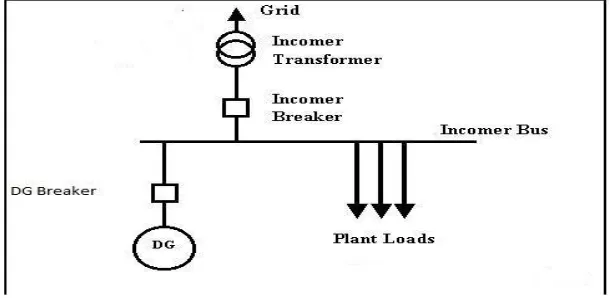
The basic single line diagram of a DG configuration is as shown in figure 1. The challengeable job of most of the distribution companies is the proper allocation of the DG unit, whose benefits and drawbacks encourage them to investigate more about the profitability of the using this technology. Reliability improvements, less reliance to the electrical energy market price, improved voltage profile and less distribution network losses are among the common incentives that the distribution companies look up to. Hence a comprehensive methodology must be adopted to cover the above mentioned technical and economic targets. The objectives associated with designing and planning process of DGs in the power system distribution network can play a crucial role with the utility perspectives [1].
Figure 1 single line diagram of a DG configuration
1) Total imposed costs
In a restructured environment framing the electrical energy price is an important fallout making profit performance. The uncertainties in the electricity market price can seriously affect the profit of the DG owners. This is mainly because their revenue dependency is directly related to the power output. The variation in the DG output power is modelled with the help of capacity factor (CF).
2) Total Network Losses
A considerable reduction in network loss is representing a power distribution network with higher efficiency and reliability. Load is fed by both real and reactive power from an adjacent embedded generator, and hence the network losses will be reduced if the generator is located near to a large load. On the other hand, a large embedded generator placed far away from the load centres, is more likely for increasing the loss in distribution network. There can be a lot of complexities associated with the expansion of network and growing energy demands. Hence, the capacity of the DG units, DG locations in a distribution network and the amount of load are considered the important factors that influences the network real power losses. Thus DG penetration can lead to change in voltage and power flow magnitudes [4]. These directly affects power system losses. It is impossible to completely eliminate the losses in a power system. However, it can be brought down to feasible levels. Installing DG in a non-optimum location can accentuate the system loss and further can increase the cost. Loss reduction is one among the most crucial aspects which needs to be acknowledged for DG placement problem. In this paper, this objective function is mathematically. The total network losses is assigned as a function f2. The mathematical expression of the total network losses is written as follows:
1) Power balance constraint:
2) Voltage limits:
3) Real Power Generation Limits:
4) Reactive Power Generation Limits
3) Customer outage cost
Figure 2 Graph of investment cost and customer outage cost
Figure 2 Graph of investment cost and customer outage cost The customer outage cost is hence defies as a classical objective function that should be minimised. It is defined as the function f3 as given below.
Here EENS represents the expected energy not supplied of the distribution network and EENSD the network reliability desired level.
4) Absorbed Private Investment Maximisation
Deregulation is the de monopolisation and liberalisation of the regulations, policies and rules associated with electrical energy production companies, providing the customers the right to choose from different traders of electrical energy. Deregulation promotes competition in the energy market, supplies electricity at reasonable rate, improves efficiency and reliability. The unwillingness to invest in huge expensive projects is the problem faced by the private investors This happens because of the uncertainties associated with this business and lack of economic incentives [1]. As we know the energy consumption and the revenues associated are speculative, applying a probabilistic strategy helps the private investors to validate the most opportunistic and practical time to start a project by and achieving maximum revenue returns by then. Apart from that the projects with both sufficient and insufficient economic incentives can be well identified. The private investment maximisation function is defined as f4 and the following defined equation is given below
Elitist non dominated genetic sorting algorithm (NSGA II)
Figure 3 Figure 4
After that different no domination fronts are created starting from the first non-dominated front to second to third and so on. The fronts will be assigned with the points in which the non-dominated ones are eliminated and are not accommodated on to the N population. Thus the 2N population size of the (Rt) is reduced to N are. This method illustrated in Figure 3. Instead of arbitrarily eliminating some members from the last front, the highest are chosen from the points which will make the diversity of the selected points[3]. The crowded-sorting methodology of the points from the last front which could not be accommodated fully is achieved in the descending order of their crowding distance values and points from the top of the ordered list are chosen. The crowding distance di of the point is calculated by taking the perimeter of the cuboid with the nearest neighbours in the space as portrayed in figure 4
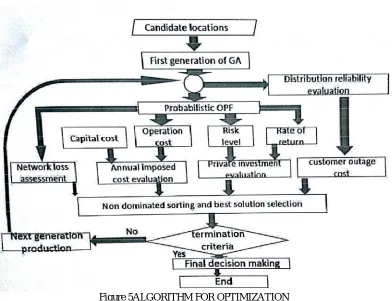
each candidate buses. Apply the first genetic algorithm to create the first population [5]. A POPF is performed which is a probabilistic optimum power flow method to calculate the operation cost and the total cost. It also evaluates the risk level and the rates of return. Capital cost and the operation costs together contributes for the annual imposed cost evaluation. Risk level and rate of returns give the private investment evaluation. The customer outage cost is obtained from the distribution reliability evaluation. Thus all the objective functions are obtained for optimisation which is then sorted with non-dominancy concepts for the best solution selection. If the iteration number of the genetic algorithm is finalized or if the termination criteria is satisfied, the final decision with optimal solution is obtained. If not, genetic operators have to be employed for further continuing the process of creating new generation.
V. CONCLUSIONS
A multi objective optimising approach is presented for properly allocating the DG units in a power system. It can easily handle both technical and economic aspects in allocating the DG unit. For carrying out the planning policies of distribution companies the proposed scheme provides them with valuable information regarding the total network losses, total imposed costs and the private investment maximising requirements. Non dominated genetic sorting algorithm proposed in the paper is one of the popular EMO techniques which finds Pareto solutions for multi-objective optimisation problem. It concentrates on using non- dominancy concepts, it uses as elitist or superiority principle and supports a diversity preserving mechanism. It can also be used for handling large scale optimisation problems. With little modifications it can also be applied for various other technologies involving DG units.
REFERENCES
[1].Optimal siting of DG units in power systems from a probabilistic Multi-objective optimization perspective Payman Dehghanian , Seyed Hamid Hosseini ,Moein Moeini-Aghtaie a, Amirsaman Arabali Department of Electrical Engineering, Sharif University of Technology, Tehran, Iran Department of Electrical and Biomedical Engineering, University of Nevada, NV, USA.
[2].Using genetic alghoritm for distributed generation Allocation to reduce losses and improve voltage profile Y. Alinejad-Beromi , M. Sedighizade , M. R. Bayat, M. E. Khodayar University of Semnan, Semnan, Iran Islamic Azad University of Saveh, Iran, Sharif University of Technology, Tehran, Iran
[3]Multi-Objective Optimization Using Evolutionary Algorithms: An Introduction: Kalyanmoy Deb, Department of Mechanical Engineering Indian Institute of Technology Kanpur
[4]. Distributed generation:Definition, benefits and issues G. Pepermans, J. Driesen, D. Haeseldonckx W. D’haeseleer and R. Belmans
[5].A Fast and Elitist Multiobjective Genetic Algorithm: NSGA-II Kalyanmoy Deb, Associate Member, IEEE, Amrit Pratap, Sameer Agarwal, and T. MeyarivanB. Pal and B. Chaudhuri, Robust control in power systems, Springer Science and Business Media, Inc 2005.
[6] Centralized and Distributed Generated Power Systems - A Comparison Approach Prepared for the Project“The Future Grid to Enable Sustainable Energy Systems” Funded by the U.S. Department of Energy