ISSN 2286-4822
www.euacademic.org DRJI Value: 5.9 (B+)
Application of Interactive Reading Model (IRM) and
Lecture Method as a Tool to Secondary School
Students’ Performance on Reading Comprehension
B. A. OGUDE Dr. J. U. ANEKWE
Department of Curriculum Studies and Educational Technology University of Port Harcourt, Choba, Port Harcourt
Abstract:
Reading Model be integrated in teaching of Reading comprehension, if students’ performance would improve.
Keywords: Interactive Reading Model (IRM), lecture method, secondary school students’ performance, reading comprehension
INTRODUCTION
Emphasis has always been placed on the use of English language in teaching at the various school levels. Even at the nursery or lower primary where the national language policy prescribes the use of the mother tongue, English language seems to have dominated. The reason being that ability to speak English language was recorded as an important yardstick for academic performance at that level by parents. English language communicative competence developed at this level by children is considered very crucial for further academic pursuits.
Reading comprehension is the construction of meaning from materials: It is an interactive process that requires the use of background knowledge, which the reader brings, in combination with the material that is found on the printed page. Readers connect what they already know with information in the text (Oxford English Dictionary, 2010). Reading comprehension depends on many factors: the student’s knowledge and experiences, word recognition strategies, thinking abilities, perpetual and sensory abilities, as well as their purpose for reading and familiarity with various comprehension (learning) strategies. There are also text-based factors to consider, including gender, quality of the text, and the difficulty of the concepts being taught (Gas-coigne, 2015). It does not consist of a single ability as most people think. It include recognizing individual words, group words into thought units and relating the thought units into a meaningful sentence, paragraph, chapter or book.
phrases and segmented parts of sentences as well as the relationship between graphemes and phonemes in phonics instruction. Reading is achieved through the effective application of the two traditions of whole word instruction and phonics instruction.
The extensive contemporary use of technology in education ICT in schools as innovative teaching strategy for concept delivery was mainly to educate students and generate knowledge for advancement of national development. In teaching, it ensures the improvement of quality of teaching, learner centeredness and ameliorates difficulties in effective learning encountered by learners. Olele and Nwabueze (2015) stated that two important advances over the last twenty-five years call for change in methods, techniques and teaching in the classroom is to remedy through proper understanding of how people learn (where students engage in learning activities actively) and their active engagement in information retrieval especially in the digital era. ICT-based instructional strategies scaffold students learning, enabling them construct meaning, knowledgeable, and collaborate with others using visual and audio materials (Tiene and Ingram, 2014). This has in recent times transformed the traditional classroom and teaching methods to exciting innovations that has made learning rewarding.
differences. Instructional technique inspires or motivate students to concentrate, organize information for proper comprehension and remembering, control and assess their learning. To turn out as successful technical learners, students require stages of strategic instruction, various instructional methods and detailed rich learning materials; suitable support which includes guided practice, modelling and independent practice; chances to transfer knowledge and skills; expressive connections between idea and skills and real-life circumstances, opportunities to become independent and display what they have in terms of knowledge; encourage personal monitor and personal correct, tools to reflect on and assess their learning. Effective instruction-based and learning technique are used across grade levels and subject areas and can accommodate range of learner’s differences. Models are prototype designs aimed at solving identified problems and differ among learner’s audiences and Learning environment. Kemp (1994) designed a model with a holistic approach to instructional design. In this model all factors such as the learning environment, learning, teaching activities and resources are incorporated to identify reading and comprehension problems and aid effective learning.
learning. It exposes the disability among readers hence exposing the difficulties students have in reading comprehension. The difficulties common with reading comprehension are text comprehension and interpretation. Students rely so much on single information hence creating reading difficulty.
Reading is passive where meaning of statements in the passage is not monitored, and inability to elaborate content and strategies (Walker, 1989).
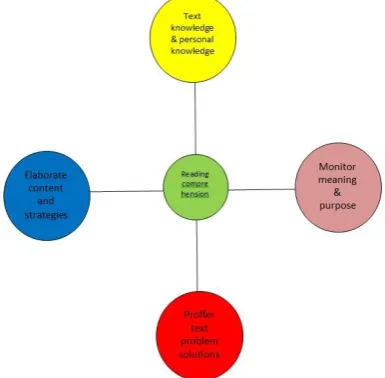
The interactive Reading Model for this work will be the adaptation of the Interactive Reading Models: the Rodondo (1997) Interactive Reading Model and Walker (1989) Four Cardinal Loop Interactive Reading Model
Figure 1: Adapted Comprehension Model (Walker, 1989)
The pedagogical implications of the use of Walker (1989) interactive model is that L2 are trained in both the practice of memory and the skills of summarizing. There is the use of appropriate tools that aid comprehension especially using meanings explained in English Language Dictionary. It is cheaper and interactive.
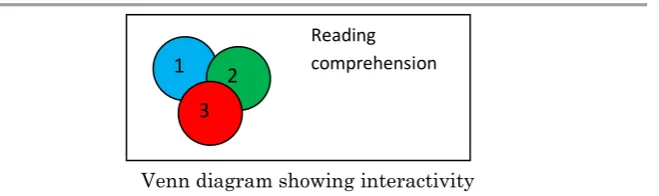
Fig 2: Redondo (1997) model of interactive reading comprehension.
The model is termed psychopragmatic and aimed at unraveling students’ difficulty in reading comprehension. Students read a group of words by looking up at their meaning in loop (I), while in loop (2) students practice getting the actual meaning of the texts, and the teacher gets illustrations and graphics to aid this group. In Loop (3) students give or make inference and explain grammatical and background knowledge in order for them to benefit in comprehension. The group must be actively involved for a successful implementation of the model. The teacher is also instrumental to the orderly use of this model if students’ deficiency in reading and L2 comprehension would improve.
This model brings to an end the debate about whether reading is a bottom-up language process or top-down knowledge based process. It combines the features of the bottom-up and top-down models. At the initiation stage of reading some adopt the bottom up or top-down reading process, whether as an first language (L1) or second language (L2) learners. The learner would exercise some control over the choice of the process. The control which readers exercise in understanding the text is referred to as meta-cognition (Block, 2002).
The engagement theory was relevant for learning in a technology-based environment (Kearsley and Shnciderman, 1978). The theory posits that students must be engaged in their course work in order for effective learning to occur. The main thrust of the theory is that this engagement can occur using technology, which can facilitate learning in ways which are difficult to achieve. According to the theorists, learning occurs through collaboration, use of project-based approach and use of an authentic focus. The project-project-based approach requires students taking more time to explore particular
1 2
3
Reading comprehension
project hence increasing the personality of a mastery of work done. Every program in an engagement circuit must be meaningful and rewarding.
Furthermore, Marshall (2007) confirmed the relevance of the engagement theory in a study of web Communication Technology (CT) to improve students’ use of ICT facilities to achieve conceptual understanding through engaged learning process. The use of technology in reading comprehension would require expertise in design of the instructional menu. The process, the learner and the materials for construction and the instructor must have adequate knowledge of the technology, learners’ familiarity with the operations and the genuineness of the materials for instruction. According to Dick, Carey and Cary (2001), the advantage of engaging students in conceptual understanding using technology is to allow learners interact actively with the instructional materials rather than simply allowing them to read the materials, passively.
Moreso, the engagement theory is based on the idea of creation of collaboration teams that work towards meaningful learning outside the classroom, summarized communication and creation of interactive atmosphere. Students contribute to acquisition of their knowledge, identify problems and bring about useful outcome. With respect to technology in education, emphasis is on appeal, interactively, awareness and motivation. Stages of interest in the four potential stages of engagement are the point of initiation of engagement, period of engagement disengagement and re-engagement (O’Brien. & Torns, 2008). Individuals in the interactive learning environment station rotation model of the environments come with their naive knowledge about the world around them. When efforts are integrated and input from individuals made, then knowledge gained become concrete, representational and adequate for storage.
Theory is applied in the blended learning strategy and interactive Reading models as independent variables of the study.
The Constructivist Theory
Anderson, Maddock, Swaffield, Warin & Waraick, 2018). The theory is based on the idea that people construct their own knowledge through their personal experience. According to Schuman, (2014) the theory become effective for students’ problem solving effectiveness since the child is actively involved in the gaining of understanding of the task before him and create knowledge individually and socially based on their experiences and interpretation.
In a constructivist classroom the teachers role is to try to understand how students interpret knowledge and to guide them to refine their understanding and interpretations so as to correct any misconception at their initial stage of learning and improve them later in the learning process. One key way noticeable in the constructivist environment is that the teacher support students as they construct meaning from gathered information and their experiences (Olele and Nwabueze, 2015). The cognitive level of readers in reading comprehension can be improved using the station rotation model and the interactive reading model. Learners integrate their prior knowledge, brainstorm and obtain information’s more concrete than the what is learnt individually, as word meanings, content meaning and interactivity proffer. Selective meaning to questions in comprehension. Meaning learning can be achieved if the use of station Rotation model and interactive reading model would improve learners’ performance and retention.
In the blended learning environment, generally, the key active ends that facilitate learning are improved discussion, communication and knowledge construction processes with a support of ICT facilities-This instills collaboration among learners. Student’s application of the model (Station Rotation Model of the blended learning) in an asynchronous discussion is beneficial to student’s knowledge building. The constructivist characteristics and learning activities of students in a blended learning classroom is emphasized in table 2.1.
Statement of the Problem
secondary school students have adversely affected enrollment in higher education courses where English language is compulsorily demanded at credit level-this has often limited the chances of these students to gain entry into the universities or polytechnics. The persistence of poor performance of students have been linked with poor teaching methods (Awiri & Okey, 2012) hence the use of innovative teaching strategy such as the interactive reading model The statement of the problem is therefore, would the application of Interaction Reading Model (IRM) positively effect improved academic performance of students in reading comprehension in the research area.
Therefore, the aim of the study is to determine the effect of Interactive Reading Model (IRM) on secondary school students’ performance in reading comprehension and determine the difference in mean academic performance scores of students taught reading comprehension using the Interactive Reading Model (IRM) and those taught using the Lecture Method (LM). Also to evaluate the difference in mean academic performance scores of male and female taught reading comprehension using the Interactive Reading Model (IRM) and those taught using the Lecture method (LM).
Research Questions
The following research questions were formulated to guide the study. 1. What is the difference between the mean academic
performance scores of students taught reading comprehension using the Interactive Reading model (IRM) and those taught using the Lecture Method (LM)?.
2. What is the mean academic performance scores difference between male students and their female counterparts taught reading comprehension using Interactive Reading Model (IRM)?
Research Hypotheses
The following hypotheses were stated and tested at 0.05 significant level for the study
interactive reading model strategy and those taught with the Lecture Method (LM).
H02. There is no significant difference between the mean academic performance scores of male and female students taught reading comprehension using interactive reading model strategy and those taught using lecture method.
METHODOLOGY
In order to evaluate students’ performance in reading comprehension using the interactive reading strategy, a quasi-experimental design of the pretest, post test control type is used on 100 students randomly selected using the purposive random technique and paper balloting randomization method. The instrument Reading Comprehension Performance Test (RCPT) consisting of 14 questions, Pretest (WAEC 1998) and post test (RCPT) validated by three experts in the university of Port Harcourt, dept. of English studies. RCPT and CPTV have reliability coefficients of 0.82 and 0.78 obtained using the test-re-test method and Pearson Product Moment reliability formula (PPMC). The pretest (WAEC) was administered on the students’ before teaching using instructional packages, lesson plans on Station Rotation Model (LPSRM) and Lesson Plan on Lecture Method (LPLM) on concept of domestic violence, corruption and gender and access to secondary education. The post test RCPT was administered. The maximum score of RCPT is 28 marks. Each item scores 2 marks. The responses of students on RCPT (pretest and post test) were collated and analyze using descriptive analyses of mean (Mean%) and inferential analysis of Covariance(ANCOVA).
RESULT
Research Question 1:
Table 1. Mean scores of students taught Reading comprehension using interactive reading model and those taught using lecture method (LM)
S/N GROUP TEACHING
STRATEGY
MEAN
PRE-TEST SCORES MEAN POST- TEST MEAN DIFFERENCE D i. Experiment Control IRM LM 11.82 10.32 13.18 11.06 1.36 0.74
Interactive Reading Model (IRM) Lecture Method (LM)
Table 1. Revealed that the mean pretest score of the experimental group (Interactive Reading Model) is 11.82 while the mean post test score is 13.18. In the control group (Lecture Method), mean pretest score is 10.32 while the post test score is 11.06. The mean academic performance score difference of the experimental group 1.36 is greater than the mean academic performance score difference of the control group (Lecture Method) 0.74, hence students taught reading comprehension performed better when taught using Interactive Reading Model (IRM) than those taught using lecture Method (D:1.36> 0.74).
Research Question 2:
What is the mean academic performance scores difference between male students and their female counterparts taught reading comprehension using Interactive Reading Model (IRM).
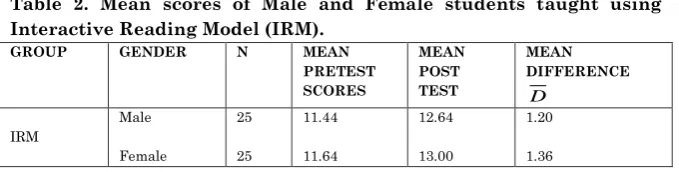
Table 2. Mean scores of Male and Female students taught using Interactive Reading Model (IRM).
GROUP GENDER N MEAN
PRETEST SCORES MEAN POST TEST MEAN DIFFERENCE D IRM Male Female 25 25 11.44 11.64 12.64 13.00 1.20 1.36
score of 13.00. The mean performance difference of the male students is 1.20 and that of their female counterpart is 1.36. The female mean difference score is slightly greater than the male mean difference score, hence the female students performed better than their male counterparts who were exposed to teaching of reading comprehension using the Interactive Reading Model (IRM) strategy (D:1.36> 1.20).
Test of Hypotheses
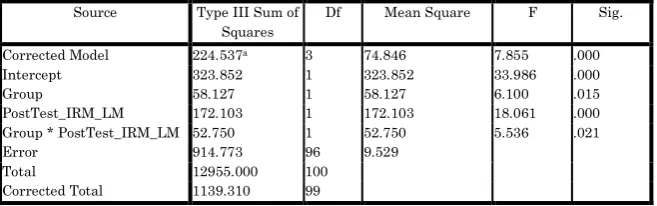
Hypothesis 1 (HO1): There is no significant difference exists between the mean scores of students taught reading comprehension using Interactive Reading Model (IRM) and those taught with the lecture method (LM).
Table 3. Summary of Analysis of Covariance (ANCOVA) on mean scores of students taught Reading comprehension using Interactive Reading Model (IRM) and those taught using Lecture Method (LM).
Tests of Between-Subjects Effects
Dependent Variable: PreTest_IRM_LM
Source Type III Sum of
Squares
Df Mean Square F Sig.
Corrected Model 224.537a 3 74.846 7.855 .000
Intercept 323.852 1 323.852 33.986 .000
Group 58.127 1 58.127 6.100 .015
PostTest_IRM_LM 172.103 1 172.103 18.061 .000
Group * PostTest_IRM_LM 52.750 1 52.750 5.536 .021
Error 914.773 96 9.529
Total 12955.000 100
Corrected Total 1139.310 99
a. R Squared = .197 (Adjusted R Squared = .172)
Research Hypothesis 2 (Ho2): There is no significant difference between the mean scores of male and female students taught reading comprehension using interactive Reading Model (IRM) strategy.
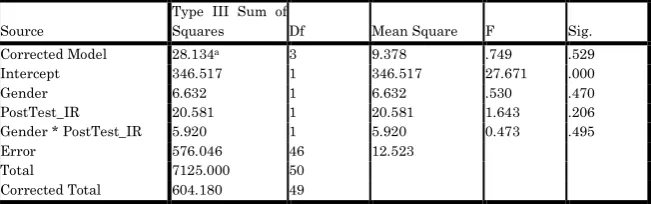
Table 4. Summary of ANOVA on mean scores of male and female student taught Reading Comprehension using Interactive Reading Model (IRM) strategy.
Tests of Between-Subjects Effects
Dependent Variable: PreTest_IR
Source
Type III Sum of
Squares Df Mean Square F Sig.
Corrected Model 28.134a 3 9.378 .749 .529
Intercept 346.517 1 346.517 27.671 .000
Gender 6.632 1 6.632 .530 .470
PostTest_IR 20.581 1 20.581 1.643 .206
Gender * PostTest_IR 5.920 1 5.920 0.473 .495
Error 576.046 46 12.523
Total 7125.000 50
Corrected Total 604.180 49
a. R Squared = .047 (Adjusted R Squared = -.016)
Table 4. shows that the F-calculated value is 0.473 while the F- critical value at degree of freedom df (3, 49) is 2.79. Since the F-calculated value < F-critical value (0.473<2.79). The null hypothesis that there is no significant difference between the mean scores of male and female students taught reading comprehension using interactive Reading Model (IRM) strategy is upheld, hence, There is no significant difference between the mean scores of male and female students taught reading comprehension using interactive Reading Model (IRM) strategy.
DISCUSSION
gender, reading comprehension and reading strategies in descriptive and narrative macro genres in which statistically significant difference exists between experimental group and control in reading. The findings of the study agrees with Yusuf (2014) on impact of interactive activities on students performance in reading comprehension among senor secondary schools in Kaduna which showed that students exposed to collaborative or interactive activities performed better than those exposed to conventional teaching method. Interactive learning strategy is advantaged in fostering students collaboration using questioning techniques, critical thinking and excellent problem solving technique hence they are capable of understanding the quality of instruction as they contribute their individual knowledge differences of opinion and integrate efforts to proffer solution to their comprehension problems.
Findings of this study reveals that there is no significant difference between the mean scores of male and female students taught reading comprehension using Interactive Reading Model (IRM) and Station Rotation Model of blended learning Strategy. This agree with the gender of Asgarabadi (2018)that gender made no statically significant difference in reading comprehension when taught using blended learning strategy. The findings also do not agree with that of Ochuba (2014) that females use of meta-cognitive approach improved on L2 reading comprehension more than their female counterparts. However, Mirafvates and Ypanto (2017) had findings that are contrary to the findings of this study, in that the male students had statistically significant mean performance score than their female counterpart in reading comprehension.
The findings also showed that the use of Station Rotation Model, Interactive Reading Model and the lecture method in teaching reading comprehension had no significant interactive effects on gender of the participant, despite the fact that the female student has greater mean scores than their male counterpart who were taught reading comprehension using interactive reading model, descriptively.
CONCLUSION
comprehension, hence the model should be adopted in combination with the Station Rotation Model in order to improve students active participation in acquisition of their reading comprehension and literacy in English as a second language.
RECOMMENDATIONS
Based on the findings of this study, the following recommendations were made:
i. Teachers should avail themselves with the relevance and potential of Interactive Reading Model to improve students’ performance in reading comprehension, hence, making a shift in pedagogy from lecture method to collaborative teaching strategy that is child- centered. ii. Teachers should endeavour to apply technology based learning
strategies, encourage the use of computer, diverse software’s and computer-mediated modules for learning. It is meaningful for teachers to obtain adequate training for computer aided instructions (CAI).
REFERENCES
1. Asagarabadi, Y. H. Rouhi, A, & Jafarigoher, M. (2015). Learners Gender, reading comprehension, and reading strategies in descriptive and Narrative Macro-genres. Theory and practice in language studies (5)12;2557-2564.
2. Gascoigne, C. (2015). Toward an understanding of the relationship between L2 reading comprehension and grammatical competence. The reading matrix, 5(2)1-14.
3. Marshall, S. (2007). Engagement theory, Web CT and academic writing in Australia. International journal of Education and Development using Information and communication technology (IJEDICT), 3 (2) 109-115.
5. O’Brien, H.L and Toms, E.G (2008). What is user Engagement? A conceptual framework for defining user engagement with Technology. Journal of the American south for information, science and technology 59(6) 938-955.
6. Ochuba, O. O. (2014). Effects of collaborative and Meta-cognitive learning strategies on English language students’ achievement in Reading comprehension in OBALGA.
Unpublished Ph.D. dissertation, University of Port Harcourt, Choba, Rivers Sate.
7. Olele, C.N. & Nwabueze, A. I. (2015). Audio and visual technologies in Digital era: implications for teaching and learning in universities in Rivers State: Nigeria. In S.O Oluwo, N. J. Okoli, Osaat, S.D and Uche, C.M (eds) years of education in Nigeria: science, ICT and Environmental issues.
8. Oxford, R. L. (1990). Language learning strategies: What every teacher should know. Boston-Massuchusetis: Heinle & Heinle Publishers.
9. Pollard, Anderson, Maddock, Swaffield Warin & Warwick. (2018). Reflective Teaching, Evidence-informed Professional Practice, London: Continuum International Publishing group. 10. Rodondo, M. (1997). Reading Models in Foreign Language
Teaching. Revista Alicantina de Estudion Ingleses(10), 139-161.
11. Tiene, D. and Ingram, A. (2016). Exploring current issues in Educational technology. Boston: McGraw Hill. (red. Edition). 12. Walker B. J. (1989). The interactive model of reading:
Deciding how Disability occur. Columbus, Obio: Charles Merillcoy.
13. West African Examinations Council: Chief Examiners Report-(2011-2016)
14. Woolfok, A.E. Winrie, P.H; Perry, N.E and Shapka, J. (2010)