Western University Western University
Scholarship@Western
Scholarship@Western
Electronic Thesis and Dissertation Repository
4-10-2012 12:00 AM
Multi-Core Unit Propagation in Functional Languages
Multi-Core Unit Propagation in Functional Languages
Jonathan Alexander Leaver
The University of Western Ontario
Supervisor
Dr. Robert E. Mercer
The University of Western Ontario Graduate Program in Computer Science
A thesis submitted in partial fulfillment of the requirements for the degree in Master of Science © Jonathan Alexander Leaver 2012
Follow this and additional works at: https://ir.lib.uwo.ca/etd
Part of the Artificial Intelligence and Robotics Commons
Recommended Citation Recommended Citation
Leaver, Jonathan Alexander, "Multi-Core Unit Propagation in Functional Languages" (2012). Electronic Thesis and Dissertation Repository. 510.
https://ir.lib.uwo.ca/etd/510
This Dissertation/Thesis is brought to you for free and open access by Scholarship@Western. It has been accepted for inclusion in Electronic Thesis and Dissertation Repository by an authorized administrator of
MULTI-CORE UNIT PROPAGATION IN FUNCTIONAL LANGUAGES
(Spine title: Multi-core Unit Propagation in Functional Languages)
(Thesis format: Monograph)
by
Jonathan Leaver
Graduate Program in Computer Science
A thesis submitted in partial fulfillment
of the requirements for the degree of
Master of Science
The School of Graduate and Postdoctoral Studies
The University of Western Ontario
London, Ontario, Canada
c
THE UNIVERSITY OF WESTERN ONTARIO
School of Graduate and Postdoctoral Studies
CERTIFICATE OF EXAMINATION
Supervisor:
. . . .
Dr. Robert E. Mercer
Examiners:
. . . .
Dr. Graham Denham
. . . .
Dr. Marc Moreno Maza
. . . .
Dr. Stephen M. Watt
The thesis by
Jonathan Alexander Leaver
entitled:
Multi-core Unit Propagation in Functional Languages
is accepted in partial fulfillment of the
requirements for the degree of
Master of Science
. . . .
Date
. . . .
Chair of the Thesis Examination Board
Abstract
Answer Set Programming is a declarative modeling paradigm enabling specialists in
diverse disciplines to describe and solve complicated problems. Growth in high
perfor-mance computing is driving ever smarter and more scalable parallel answer set solvers.
To improve on today’s cutting-edge, researchers need to develop increasingly intelligent
methods for analysis of a solver’s runtime information. Reflecting on the solver’s search
state typically pauses its progress until the analysis is complete. This work introduces
methods from the domain of parallel functional programming and immutable type theory
to construct a representation of the search state that is both amenable to introspection and
efficiently scalable across multiple processor cores.
Keywords:Answer set programming, functional languages, parallel programming,
sat-isfiability theory, immutable types, multi-core solvers
Acknowlegements
Two are better than one, because they have a good reward for their labor.
For if they fall, the one will lift up his fellow; but woe to him who is alone when
he falls, and doesn’t have another to lift him up. - Ecclesiastes
In this spirit, I would like to thank my supervisor, Dr. Bob Mercer, for his endless
pa-tience and attentiveness in the face of whichever topic excited me from one week to the next
- no matter how whimsical or dry it was in actuality - something I feel has an immeasurable
bearing on the character and outcome of this work. My professors at Western University,
two of whom agreed to be my departmental examiners, inspired this unique research by
sharing their passion for functional programming, parallel computing and artificial
intelli-gence.
Over the course of this research, I also had occasion to work with our colleages at the
University of Potsdam, Germany, whose open and kind welcome to an inquisitive
new-comer in this field was deeply appreciated.
I would additionally like to acknowledge my family for their tireless support and
en-couragement throughout this entire undertaking. I am truly grateful, for without them it
would not have been possible. And finally, I reserve a special word of appreciation for my
mice: Melissa, Sophie, and Florence; and my puppy Alexander. Their unconditional love
made even the hardest day a joy.
Contents
Certificate of Examination ii
Abstract iii
Acknowlegements iv
List of Figures x
List of Tables xii
1 Introduction 1
1.1 Answer Set Programming . . . 2
1.2 SAT Solving and CNF . . . 2
1.2.1 DIMACS Format . . . 2
1.3 Search . . . 3
1.3.1 Depth First Search . . . 3
1.3.2 DPLL . . . 4
1.3.3 Unit Literals and Propagation . . . 5
1.3.4 Recursive Clause Rewriting . . . 6
1.3.5 Two-Literal Watch Lists . . . 6
1.4 Modern CDCL Solvers . . . 7
1.5 Parallel CDCL Solvers . . . 8
1.6 Summary . . . 10
2 Motivation 11
2.1 Systems Architectures . . . 11
2.1.1 Memory Contention . . . 11
2.1.2 Multi-core Runtime Analysis . . . 12
2.2 Functional Languages . . . 13
2.2.1 Multi-threaded Programming . . . 14
2.3 MiniSAT Decomposition . . . 15
3 Strategy 16 3.1 MiniSAT Propagation Procedure . . . 17
3.2 Locus of Control . . . 18
3.3 Clause Locus . . . 19
3.4 Variable Locus . . . 20
3.4.1 Conflict Detection . . . 21
3.4.2 Unit Detection . . . 23
3.4.3 Speculative Unit Propagation . . . 24
3.4.4 Watched Clause Rewriting . . . 25
3.4.5 Advanced Search Strategies . . . 26
3.4.6 Considerations . . . 26
4 Method 27 4.1 Benchmarking . . . 27
4.1.1 Selections . . . 28
4.1.2 Platform . . . 29
4.2 F# Language . . . 30
4.2.1 Immutable Types . . . 30
4.2.2 Map and Reduce . . . 31
4.2.3 Recursion and Affinity . . . 32
4.2.4 Closures andλs . . . 33
4.2.5 Async and MailboxProcessors . . . 33
4.3 Unit Propagation Experiments . . . 34
4.3.1 Development Plan . . . 34
4.3.2 Experimental Versions . . . 35
4.3.3 C#: Mus Musculus . . . 36
4.3.4 F# Clause Locus: Murinae . . . 36
Affinity . . . 37
Repetitions . . . 37
Thread Management . . . 38
Data Structures . . . 38
4.3.5 Concurrent DIMACS Processor . . . 39
4.3.6 F# Variable Locus: Apodemus . . . 39
Search Strategy . . . 40
Node Type . . . 40
Affinity . . . 40
4.4 Measures . . . 40
4.4.1 Systemic . . . 41
4.4.2 Search . . . 41
4.5 Parameters . . . 42
4.5.1 Constant . . . 42
4.5.2 Varied . . . 43
4.6 Tools for Analysis . . . 44
5 Measurement 45 5.1 Discussion of Murinae . . . 45
5.1.1 vs. Mus Musculus . . . 45
5.1.2 Threading Techniques and Memory Locality . . . 46
5.1.3 Mutable vs. Immutable Procedures . . . 48
5.1.4 Scalability . . . 49
5.1.5 Parallel DIMACS Processing . . . 50
5.1.6 Summary of Murinae . . . 51
5.2 Discussion of Apodemus . . . 52
5.2.1 vs. Murinae . . . 52
5.2.2 Memory . . . 53
32 and 64 Bit Performance . . . 53
Initial Allocation Size . . . 55
Progressive Allocation Size . . . 57
Cache Behavior . . . 59
5.2.3 Summary of Apodemus . . . 60
5.3 Overall Throughput . . . 61
5.4 Final Considerations . . . 62
6 Future Research 64 6.1 Watch Dispersion . . . 64
6.2 Enclosed Two-Watch Literal Inversion . . . 64
6.2.1 Inversion . . . 64
6.2.2 Enclosure . . . 65
6.3 Portfolio-Based Heuristic Phasing . . . 66
6.4 Application To Competition Solvers . . . 67
7 Summary 68
Bibliography 71
A Profile of Initial Benchmark Problems 75
B Selected Measurements 77
C Object-Oriented UML Diagrams 80
Curriculum Vitae 83
List of Figures
1.1 Depth First Search Assignment . . . 4
1.2 Unit Propagation From Partial Assignment . . . 5
1.3 Reading Two Watches . . . 7
1.4 Guiding Path vs. Portfolio Search . . . 9
2.1 Multi-core Clasp 2.0 - Sequence Benchmarks . . . 13
3.1 Watch List Dispatch Under MiniSAT . . . 18
3.2 Watch List Dispatch With Clause Concurrency . . . 19
3.3 Single-Watch Conflict Under Variable Concurrency . . . 23
3.4 Two-Watch Unit Under Variable Concurrency . . . 24
5.1 Unit Propagations Per Second (Single-core Murinae) . . . 46
5.2 AES 128 10 KeyFind 1.cn f . . . 46
5.3 Implicit vs. Explicit Threading (Multi-core Murinae) . . . 47
5.4 Best Scores - Threading Proportions . . . 48
5.5 Mutable vs. Immutable Data-Types (Multi-core Murinae) . . . 49
5.6 Summary of 64 Bit Murinae . . . 50
5.7 Parallel DIMACS Processing . . . 51
5.8 Best Scores - Data Type Proportions . . . 53
5.9 Best Solver - 32 vs. 64 Bit . . . 54
5.10 Memory Usage - goldb-heqc-alu4mul . . . 58
5.11 Performance Comparison - goldb-heqc-alu4mul . . . 59
5.12 Cache Faults - goldb-heqc-alu4mul . . . 60
5.13 Best Score Counts - By Solver and Cores . . . 61
A.1 Variable-Clause Distribution . . . 75
B.1 Summary of 32 Bit Murinae . . . 77
C.1 C# Mus Musculus - Structures (1 of 2) . . . 80
C.2 C# Mus Musculus - Structures (2 of 2) . . . 81
C.3 C# Mus Musculus - CDCL Solver . . . 82
List of Tables
2.1 MiniSAT - % Time In Propagation . . . 15
5.1 Portfolio Allocation Sizes (Mb) . . . 56
A.1 Clause and Literal Distributions . . . 76
B.1 Multi-core F# DIMACS Processing (ms) . . . 78
B.2 Best Solver - For Each Benchmark . . . 79
Chapter 1
Introduction
This research centers around a unique confluence among the fields of logic programming,
distributed systems and programming languages. Its driving factors include the advent
of ubiquitous many-core computing, languages designed for parallel processing free of
side effects, and tremendous demand for the benefits of these capabilities from the logic
programming community.
In this context, we examine the most costly aspect of modern solvers, their unit
propaga-tion engines. This thesis presents two concurrent models, each centered around a different
locus of control. The first, based on a clause-locus, represents the most natural extension of
existing implementations into concurrency. The second, based on a variable-locus, draws
inspiration from our ongoing research in the area of enclosed two-watched literal inversion.
The ongoing work seeks to fully enclose the structure of a logic problem using functional
constructs, freeing it from the underlying data. Grounded in lambda calculus, its patterns
of partial application show themselves in the immutable remainders that are the foundation
for this second technique. We comparatively evaluate the merits of both models and outline
their implications for future work.
Chapter1. Introduction 2
1.1
Answer Set Programming
Answer Set Programming (ASP) is a type of declarative logic programming, similar in
syntax to Prolog, that enables its user to describe the domain and constraints of an arbitrary
problem [1]. Once a problem has been described as an input program, it can be solved by
any one of a variety of solvers. The runtime procedure used to satisfy this input program is
decided automatically making use of sophisticated search techniques and heuristics. Some
solvers are optimized for sequential operation on a desktop computer whereas others are
suitable for large scale scientific clusters. In practice, an appropriate solver is selected
based on the expected difficulty (i.e. solving time) of the input program.
1.2
SAT Solving and CNF
An important field of related research is the study of the Boolean Satisfiability Problem, or
SAT problem. Modern SAT and ASP solvers use many of the same techniques to explore
the search space of their problems, and much of the following research is developed using
SAT terminology.
Given a logic formula in conjunctive normal form (CNF), a SAT solver attempts to find
an assignment for variables of the formula so that all clauses in the CNF program can be
satisfied. For every assignment, if some clause of the input program cannot be satisfied,
then the input program is said to be unsatisfiable. For example, we consider two clauses of
the boolean CNF formula (A∨B)∧(¬B∨ ¬C∨D). For this formula, at least one of the
literalsAorBmust be true in the first clause. Similarly, at least one of the literals¬B,¬C
orDmust be true for the second clause.
1.2.1
DIMACS Format
To a SAT solver, input problems are most often represented in the DIMACS CNF format.
Chapter1. Introduction 3
literals of the problem appear in clauses, their integer variable is presented with a positive
or negative sign to carry the literal’s polarity. Individual clauses are post-fixed with the
unsigned value 0 in place of the delimiting conjunction operator [2].
The formula (A∨ B)∧(¬B∨ ¬C ∨D), above, would be represented in DIMACS as
the sequence 1 2 0−2−3 4 0. This representation is important for two reasons. First, it
illustrates the deceptive simplicity of an input SAT problem. Second, this representation is
carried forward into the implementation details of nearly every modern solver’s
intermedi-ate data structures.
1.3
Search
In this context, search techniques are strategies for selecting literal values to assign true
or false in order to satisfy the formula under consideration. Several techniques will be
introduced in the following sections, including DFS, DPLL, CDCL and Parallel CDCL.
1.3.1
Depth First Search
One of the best known algorithms in computer science, depth-first search (DFS) can be used
as a simple method for obtaining these assignments. An example implementation of DFS
might start by assigning variables to true, one at a time, until either some clause cannot be
satisfied or a solution is found. If a clause cannot be satisfied, the specific instance of this
assignment is in conflict. Under conflict, depth-first search will attempt a false assignment
for the most recently assigned variable. If the conflict persists, it will clear that variable
and attempt to falsify the preceding variable of the assignment. Once a conflict has been
resolved, it continues forward with additional true assignments. When the first variable,
or root of the search tree, results in conflicts under both true and false assignments, the
problem is said to be unsatisfiable.
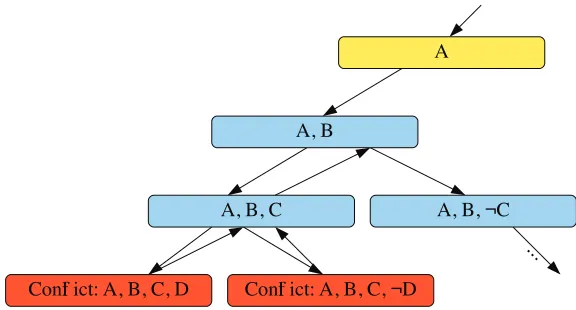
This assignment procedure is illustrated in Figure 1.1, which backtracks when a conflict
Chapter1. Introduction 4
A
A, B
A, B, C
Confl ict: A, B, C, D Confl ict: A, B, C, ¬D
A, B, ¬C
Figure 1.1: Depth First Search Assignment
tree under partial assignment{A,B,C}. Given its tree structure, search procedures based on
DFS can be easily implemented recursively.
1.3.2
DPLL
Modern search algorithms are descendants of the well-known
Davis-Putnam-Logemann-Loveland (DPLL) procedure [3][4]. It uses additional information encoded in the structure
of the formula to integrate the consequences of an assignment decision, called unit
propa-gation, discussed further in Section 1.3.3. Based on a depth first search, it is outlined as a
recursive function in the F# programming language below:
l e t r e c DPLL a s s i g n m e n t =
i f c o n t a i n s A n U n s a t i s f i a b l e C l a u s e ( ) t h e n f a l s e
e l s e i f i s C o m p l e t e l y A s s i g n e d ( ) t h e n t r u e
e l s e
f o r c l a u s e i n u n i t C l a u s e s ( )
p r o p a g a t e ( u n i t L i t e r a l O f c l a u s e )
l e t d e c i s i o n = c h o o s e U n a s s i g n e d ( )
i f DPLL ( a s s i g n m e n t + d e c i s i o n ) t h e n t r u e
Chapter1. Introduction 5
It recursively assigns values to unassigned variables in the input formula. If a complete
assignment can be made, the problem is solved. It will backtrack each time an assignment
causes a clause of its input formula to become unsatisfiable. It then tries the opposite
as-signment at each level, backtracking further if neither asas-signment is suitable for a solution.
The notable extension to DPLL from DFS is the propagation of unit literals from unit
clauses on lines five and six of the preceding algorithm. Central aspects of this procedure
are outlined next.
1.3.3
Unit Literals and Propagation
Recall the CNF formula (A∨B)∧(¬B∨ ¬C∨D) discussed in Section 1.2. The propagation
of unit literals at each decision is an important aspect of this procedure. A SAT formula in
CNF is the conjunction of all clauses and the disjunction of all literals within each clause.
For this formula to be satisfiable all clauses must be satisfied, but only one literal from
each clause needs to be satisfied. This principle is the basis of unit propagation. If an
assignment has eliminated all but one literal in a clause, the only remaining literal - no
matter how improbable - must be true [5]. This remaining literal is called a unit, and the
process of propagation adds it to the partial assignment.
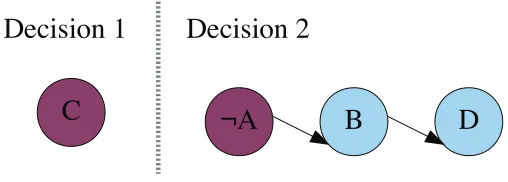
C
¬A
B
D
Decision 1
Decision 2
Figure 1.2: Unit Propagation From Partial Assignment
Under assignment {C,¬A}, for instance, we might rewrite the example CNF formula
as simply (B)∧(¬B∨D). By process of elimination, the literal Bbecomes a unit literal
of the first clause. It must be true under this assignment, leaving the partial assignment
Chapter1. Introduction 6
unit in the second clause. Without further search, unit propagation helps the solver move
from a partial assignment of {C,¬A} to a satisfying assignment of {¬A,B,C,D} for this
formula.
1.3.4
Recursive Clause Rewriting
Some early descriptions of the Davis-Putnam-Logemann-Loveland procedure are defined
recursively such that reduced incremental state is passed forward during search and then
restored on backtracking. Implementations of this type treat input problems as a
mathe-matical set of clauses wherein each clause is a set of literals. Literals are removed from
each clause in which they appear false. Similarly clauses with at least one true literal are
removed from the problem set. This technique is used in the example from Section 1.3.3
when illustrating unit propagation.
These recursive algorithms backtrack when any clause becomes the empty set, having
eliminated all possible literal assignments capable of satisfying that clause. Similarly if the
problem itself becomes the empty set, then all clauses are seen to have been satisfied by
the working assignment. Search would then stop and the resulting assignment would be
returned.
Memory, several times the initial problem size, is required to store intermediate
config-urations and this is an important reason why this approach is not typically used in practice.
It does, however, reduce the working size deep in search by removing from consideration
all clauses and literals whose state has been decided.
This type of rewriting is not used by modern solvers which instead use the two-literal
watch scheme, but its pattern is nonetheless important going forward.
1.3.5
Two-Literal Watch Lists
The use of two-literal watch lists is a technique crucial to high performance unit
Chapter1. Introduction 7
and unit clauses [6].
The procedure for maintaining watches relies on two simple assumptions. First, if a
literal being watched becomes unsatisfied, any other literal of that clause that is not already
unsatisfied will be watched instead. Second, each clause must be watching two different
literals. Watches are placed on lists for each literal, so that a solver will visit only those
clauses whose watches are affected by an assignment.
A
¬C
...
A
A
A
A
A
A
A
A
A
A
A
A
A
A
A
A
A
A
A
A
A
A
A
A
A
A
A
A
¬C
...
...
...
A
A
A
A
A
A
A
A
A
A
A
A
A
A
A
A
A
A
A
A
A
A
A
A
A
A
A
...
...
A
¬C
...
...
...
w
1 w2
¬
¬
¬C
C
C
C
C
C
C
C
C
C
C
C
C
¬
¬
¬
¬
¬C
C
C
C
C
w
1 w2
w
1 w2
Figure 1.3: Reading Two Watches
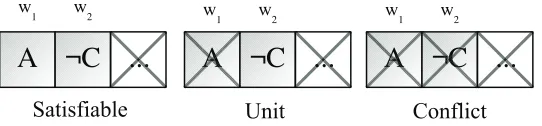
If these conditions are maintained under this procedure, the state of a clause can be
derived simply by evaluating its two watched literals. The three possible scenarios are
illustrated in Figure 1.3. Having eliminated all other satisfiable or unassigned literals within
the clause, if both watches are left unsatisfied, then the clause is in conflict with the current
assignment. If, however, only one is left unsatisfied then the other watched literal is unit for
that clause. In all other cases, the clause is still satisfiable and requires no further attention
under this assignment.
1.4
Modern CDCL Solvers
Tremendous advancements have been made over the traditional DPLL procedure in the
last decade leading up to today’s conflict-driven clause-learning (CDCL) solvers. Most
important among these breakthroughs is a technique to calculate the sequence of unique
implication points (UIPs) at the moment when an assignment renders some clause
unsatis-fiable [7]. The first UIP of this conflicting assignment enables solvers to construct a new
clause that most precisely describes its source. Consequently, a solver can use this new
Chapter1. Introduction 8
leading to this conflict [8].
State-of-the-art solvers continuously generate new conflict clauses to skip over entire
regions of a problem’s search space. To facilitate this, they use sophisticated heuristic
techniques, such as Berkmin [9] and VSIDS [6], to select literals for assignment that are
most frequently involved in conflicts. This can dramatically reduce the time to compute a
solution. While this shift in design de-emphasizes the rigid binary search used by DPLL,
the solver now needs to actively manage a clause database of monotonically increasing size.
This is a fundamental time and space trade-offunderscoring the importance of efficient unit
propagation and watch maintenance across the clause database.
As the space required to store clauses grows continuously, modern CDCL solvers
em-ploy various strategies to prune their learned clause database [6]. For practical reasons, a
solver should retain only those learned clauses which prove useful to its ongoing search
efforts. Unfortunately, calculating a clause’s level of abstraction to determine how much of
the search space it defers is computationally difficult. Clause length [10] and literal block
distance (LBD)[11] are common techniques that have met with some empirical success.
Other techniques evaluate the degree to which a clause contributes to the generation of
new conflicts. Clauses that frequently participate in the implication graph leading up to
a conflict and those comprised of literals with high heuristic value are more likely to be
retained.
1.5
Parallel CDCL Solvers
Early parallel solvers based on DPLL focused on distributing the recursive branches of their
search among parallel nodes in order to reduce the time to compute solutions [10][12][13].
This is analogous to the clich´e horror movie phenomenon of splitting up to search for a
missing comrade. Although this mode is still supported in modern parallel CDCL solvers
like Claspar, recent work has focused on using competing solver instances with differing
dele-Chapter1. Introduction 9
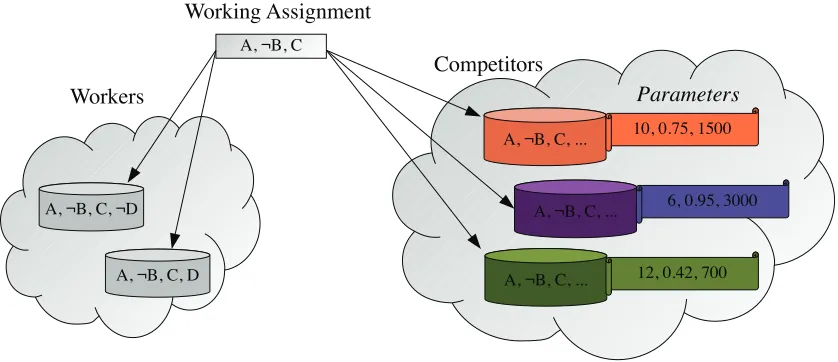
tion strategies [11] can all be modified to give multiple concurrent CDCL solvers different
behaviors when faced with a previously unseen problem. These two major parallel search
strategies are contrasted here in Figure 1.4.
Guiding Path Search
Competitive/Portfolio Search
A, ¬B, C
Working Assignment
Workers
A, ¬B, C, ¬D
A, ¬B, C, D
Competitors
A, ¬B, C, ...
A, ¬B, C, ... A, ¬B, C, ...
10, 0.75, 1500
6, 0.95, 3000
12, 0.42, 700
Parameters
Figure 1.4: Guiding Path vs. Portfolio Search
As a consequence of this competitive portfolio mode, the different behaviors for each
concurrent solver can result in different conflict clauses. Since a learned clause is a
problem-scoped statement about some combination of literals, it is valid no matter where a solver is
in the search space. As a result, cutting-edge CDCL solvers include various mechanisms
for cooperatively exchanging and integrating clauses among competitors [10][14].
Although the potential benefits of clause exchange are clear, numerous challenges
ex-ist. Learned clause databases may largely intersect if concurrent solvers reach similar
con-flicts. Duplication of clauses in memory may also influence the maximum size of a clause
database and consume unnecessary throughput during exchange. Moreover, the rate of
dis-covery for new clauses may exceed the competitor’s ability to successfully transmit them.
Although advanced techniques for selection and flow control exist, the opportunity cost of
selecting, transmitting, and integrating clauses is time a solver would have spent searching
Chapter1. Introduction 10
1.6
Summary
Having provided a brief look at the core topics underlying the domain of this research,
a further examination of its motivation will be provided. Further aspects of systems
ar-chitecture, functional languages, logic problem solving and parallel programming will be
introduced as the overall strategy is developed and presented. These core topics will be
expanded and additional literature introduced to support our conclusions as new elements
are brought to the surface. Detailed coverage of the employed methodology will be
pro-vided along with a discussion of the measurements which were taken and the implications
of those results. Finally, a discussion of the unresolved issues as potential future work will
Chapter 2
Motivation
The last decade has seen remarkable strides in all three areas surrounding this research:
logic problem solving, functional languages, and multi-core programming. What follows is
a brief introduction to these in order to address the impetus for this research, what changed,
and why this topic becomes important today.
2.1
Systems Architectures
With the recent acquisition of forty-eight-core compute nodes at the University of Western
Ontario, the challenge of coordinating competing solvers within a single process is
moti-vating fundamental changes to the architecture of our parallel solvers. The duplication of
clause databases among competitors and the problem of memory locality and contention to
each of the four twelve-way processing units are key issues influencing this work. In order
to operate effectively on these systems, data structures and the patterns for processing them
need to be carefully studied.
2.1.1
Memory Contention
The problem of memory contention has been a topic of ongoing discussion in the
com-munity for several years. Concrete measurements were published in 2009 illustrating the
Chapter2. Motivation 12
magnitude of various memory inefficiencies as they apply to a variety of then-current logic
problem solvers [19].
Today, this problem is magnified as processor manufacturers have multiplied the
num-ber of available cores without correspondingly dramatic expansion in memory access.
Quad-socket Opteron servers, like the compute nodes of Western’s new cluster, provide
four channels to separate banks of system memory. As a consequence, there exists a
signif-icant contention among the CPU cores for access to uncached memory at a ratio of nearly
twelve to one.
Resulting from ongoing work in this area, CDCL solvers aggressively apply heuristics
to prune their clause databases with a preference for those clauses most often involved in
conflicts. The multi-core version of Clasp 2.0 uses this technique in portfolio mode to
maximize its performance by maintaining a small local working set for each of its
concur-rent workers. The intention is to retain as much local solving state in cache as possible
while avoiding clauses that act as dead weight – a strategy which has proven effective in
competition [20].
Multi-core Clasp 2.0 was also studied by our research group as part of a landmark paper
on the patched hybrid-core of Platypus 0.2.8. These studies were carried out on twenty-four
core Magny-Cours Opteron servers in varying configurations. A benchmark summary of
solution time forsequence1-ss1through sequence4-ss4from the measurements taken for
this paper appears here in Figure 2.1. It illustrates both that scalability in portfolio search
can be achieved but that the reduction in solving time per core on complex problems can
vary non-linearly with additional compute power.
2.1.2
Multi-core Runtime Analysis
The sophistication of a solver’s runtime analysis and decision-making will grow beyond
just heuristics for clause retention and pruning. Clause exchange, as discussed previously,
is an ongoing area of work. Even more recent work on clause freezing and activation
multi-Chapter2. Motivation 13
Solution
T
ime
(s)
0
20
40
60
80
100
120
1
2
4
8
12
16
24
# of Cores
Figure 2.1: Multi-core Clasp 2.0 - Sequence Benchmarks
core chips - up to 16 cores for mainstream x86-64 chips - offers plenty of resources for
these tasks. On the other, an unfortunate side-effect of existing solver designs is that the
solver execution must be interrupted for a coherent view of its state. The problem of
self-reflection becomes even more problematic given not just mutation but also concurrency.
2.2
Functional Languages
The selection of an ideal research platform is an important consideration for this kind of
work. Nearly all cutting edge solvers are written in C-derived languages in order to
max-imize performance on their target platforms. To stand out in solver competitions like the
SAT-Race, it is often necessary to compromise aspects of the design in favor of the best
possible speed. Isolating core functions of these solvers for parallelization is problematic
due to unintended side-effects induced by their optimized implementation.
impor-Chapter2. Motivation 14
tant to consider whether the experimental environment should be the same as a production
environment. Moreover, improvements in runtime compilers and optimizations to
mem-ory access and task delegation in these languages offer some compelling advantages to the
research.
We selected F# as a language of interest for a variety of reasons. It is an ML-family
functional language derived from OCaml that is designed to operate on the proven
Mi-crosoft .NET framework [22]. It is also the first fully-integrated functional language in the
Microsoft ecosystem with full platform and tool support. It enables programming free of
side-effects, language features for implicit asynchronous programming, immutable
data-types and a syntax that is both condensed and expressive [23]. Non-blocking
compare-and-swap (CAS) data structures are also available [24]. The .NET framework uses the same
high performance runtime compilers, memory managers and libraries across a variety of
languages including C# [25]. These kinds of environments are not typical choices for SAT
and ASP solvers. However, we feel that once the scalability and characteristics of
vari-ous designs have been established, the precise implementation can be adapted to fit more
conventional C-derived competition solvers.
2.2.1
Multi-threaded Programming
Although we felt that F# represented the most exciting choice for our theoretical research
given its many compelling features, a diverse selection of alternative concurrency platforms
are used by the community to achieve similar goals. For instance, multi-core Clasp 2.0
uses the Intel Threading Building Blocks (TBB) to achieve its high level of concurrent
performance. The TBB library offers many powerful tools and structures to support this
kind of parallel programming [26].
Other recent work towards developing a parallel version of MiniSAT has used Cilk-5
extensions to the C language and its work-stealing scheduler [27] [28]. Additional
re-sources such as Cilk++provide advanced concurrency to C++software [29]. Newer work
Chapter2. Motivation 15
of competition solvers once appropriate strategies have been developed [30].
Hybrid solvers such as Platypus 0.2.8 which combine MPICH2 for clustered
coordi-nation with local multi-threading adapt their own custom portable threading libraries for
parallel answer set solving. This enabled Platypus to support a wide variety of platforms
after its introduction in 2005 [13].
2.3
MiniSAT Decomposition
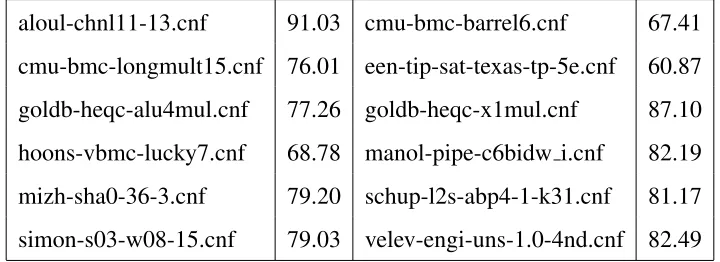
A measurement of the solving time for a sampling of problems in serial MiniSat 2.2.0 has
shown approximately 80% of processor cycles are spent during unit propagation and watch
maintenance as opposed to a combined 20% for all other tasks. This observation suggests
that experimental work focused on a scalable unit propagation engine will target the most
costly task of the CDCL search procedure.
aloul-chnl11-13.cnf 91.03 cmu-bmc-barrel6.cnf 67.41
cmu-bmc-longmult15.cnf 76.01 een-tip-sat-texas-tp-5e.cnf 60.87
goldb-heqc-alu4mul.cnf 77.26 goldb-heqc-x1mul.cnf 87.10
hoons-vbmc-lucky7.cnf 68.78 manol-pipe-c6bidw i.cnf 82.19
mizh-sha0-36-3.cnf 79.20 schup-l2s-abp4-1-k31.cnf 81.17
simon-s03-w08-15.cnf 79.03 velev-engi-uns-1.0-4nd.cnf 82.49
Table 2.1: MiniSAT - % Time In Propagation
Moreover, improved unit propagation is thought to be especially important for problems
which require larger clause databases in order to compute solutions with completeness —
as not all problems can be easily solved using a smaller working-set of clauses [31]. If the
cost of maintaining the clause database can be reduced, the size of that database may also
Chapter 3
Strategy
The approach to this work is largely a comparative study that explores several parallel
de-signs using functional language constructs in deviation from conventional parallel solvers.
The desire is to demonstrate patterns appropriate to this environment and evaluate their
merits.
Existing logic problem solvers written in functional languages tend to fall into two
distinct qualitative categories. Solvers of the first type exhibit the language rather than the
solver. Although they make good use of functional elements, their feature-set as solvers
is often limited to classical Davis-Putman search. They are also typically sequential in
design. Solvers of the second type implement the latest search strategies but with an almost
monastic transcription of design patterns that have proven effective in procedural C-based
competition solvers.
The goal of our research is to focus on the most costly aspect of modern solvers, to
develop strategies for its concurrency and to do so in a manner that is expressed naturally in
a functional paradigm so as to surface the many compelling advantages of these languages
for multi-core problem solving.
Chapter3. Strategy 17
3.1
MiniSAT Propagation Procedure
Since the most costly aspect of today’s solvers is unit propagation, we recall that there are
only a few fundamental building blocks for a unit propagation engine:
Variables are the underlying items of assignment, in the setV = {v1,v2, ...,vn} for some
number of variablesn, whose values are true, false, or not yet assigned.
Literals are signed occurrences of a variable in the setL, such that∀vi ∈V•vi ∈L∧−vi ∈L
having |L| = 2|V|. The value of each literal l ∈ L is determined by the underlying
variable’s assignment in two scenarios: 1)v1 = f alse =⇒ l1 = f alse∧ −l1 = true,
and similarly 2)v1 =true =⇒ l1= true∧ −l1= f alse.
Clauses are sets of literalsC ={l1, ...,lc}where∀li ∈C• −li <C. Each clause requires at
minimum one literal to be true for a satisfying assignment to exist.
However, two additional components are necessary for unit propagation engines which
implement the two-watched literal scheme.
Watched Literals (two per clause) track variable assignments which may cause that clause
to become satisfied, unsatisfied or unit.
Watch Lists (one per variable) retain an inventory of clauses whose watches depend on a
particular variable’s assignment.
Not all solvers retain the notion of assignment variables. For example, assigning some
variable, say v2, the value true is equivalent to assigning all occurrences of literal l2 the
value true and all occurrences of literal−l2 the value false. It nonetheless remains a useful
abstraction for our purposes in order to maximize watch list length.
The MiniSAT procedure draws unit assignments from a propagation queue which
con-tains new units in the order they were obtained. After drawing a unit, MiniSAT updates
Chapter3. Strategy 18
Figure 3.1: Watch List Dispatch Under MiniSAT
watch list. Each clause in turn may select new watches, add a unit to the propagation queue
or raise a conflict.
In Figure 3.1, we see that when variable v1 is assigned some value, consequences for
each clause are computed sequentially. New watches are selected in clauses c1 and c2,
but propagation aborts when a conflict is encountered in clause c3 — thus rendering the
problem unsatisfiable under the current assignment.
3.2
Locus of Control
The two-watched literal scheme presents two points of control to a concurrent propagation
engine, namely the pair of watch lists to which a single clause belongs. In order to avoid
locks, it is helpful to provide a single locus of control so that no two concurrent workers
will compute the state of a clause under propagation simultaneously — introducing the risk
Chapter3. Strategy 19
Where should the conceptual focus of asynchronous computation be in a unit
propa-gation engine designed for concurrent execution? To that end, there are two particularly
elegant possibilities: a variable locus and a clause locus. In each, one of the two elements
carries out its tasks concurrently while the other is represented as data.
3.3
Clause Locus
The clause locus technique is a natural extension of the existing mutable design employed
by CDCL solvers such as MiniSAT. Its simplistic approach to parallelism is analogous
to switching the iteration’s foreachstatement with Parallel.ForEach, given that adequate
concurrency control measures are in place so that target lists are modified safely.
Figure 3.2: Watch List Dispatch With Clause Concurrency
Chapter3. Strategy 20
unit propagation queue. All clauses on the watch list are then invited to run their selection
algorithms simultaneously. New units obtained by any clause are enqueued for subsequent
propagation. In this example, however, a conflict is discovered in clause c3 that would
terminate unit propagation and begin conflict analysis. Notice also that both clausesc1and
c5have selectedv4as their next watch to replacev1. As a consequence, care must be taken
to guarantee that techniques such as locking or the use of special non-blocking (CAS) data
structures prevent race conditions altering this list.
It is clear from this example that the degree of concurrency is also limited in part by
the length of the watch list forv1. For instance, a sixteen core machine may have limited
work during some propagation steps. In both designs, watch lists are held by assignment
variables instead of literals for this reason. So compared with literal-based designs, we
have simply:
Listv1 =Listl1 +List−l1 =⇒ |Listv1|=|Listl1|+|List−l1|
The clause-centric approach conceptually partitions watch lists for concurrent
opera-tion. It would seem reasonable to expect that better scalability will be achieved on
prob-lems with a higher clause to variable ratio. Moreover, it is worthwhile questioning whether
this approach is natural given typical functional constructs. For instance, the representation
of lists will vary. Although this design extends quite naturally from traditional
implemen-tations, it may or may not be suited for this environment.
3.4
Variable Locus
The proposed variable locus derives from a desire to optimize the unit propagation engine
for immutable types and implicit threading, having studied the strengths and limitations of
the preceding clause locus strategy. In this model, each variable is conceptually
indepen-dent — potentially carrying out tasks concurrent of the others. Communication between
messag-Chapter3. Strategy 21
ing between them. Immutable data types, as they appear in F#, will be further discussed in
Section 4.2; however, the theoretical structures are introduced here.
3.4.1
Conflict Detection
A clause of length c will be read from input in DIMACS format as a string of literals,
formally [l1,l2, ...,lc], for some selection of literals up to the length of that clause. Using an
immutable list data-type, this clause can be represented as a sequence ofconscells in the
formhl1,hl2,h...,hlc, iiii. In memory, the list will be stored recursively as a literal element
with a pointer to the next cons element in its sequence. Here is used to represent the
empty list — that effectively no further elements exist in the sequence. For eachconscell,
we call the first element theheadof the list, and the second element itstail.
Let each clause be identified by a unique integer identifier x corresponding with its
sequence in the input file. In the above representation, we use the immutable tuple (or
ordered pair) data-type to carry the unique identifier for a clause and its immutable list
as (x,hl1,hl2,h...,hlc, iiii). In this form, we will call the immutable list for a clause its
remainder, i.e. for (x,y) whereyis an immutable list,yis the remainder.
Suppose further that each clause has exactly one watched literal rather than two — a
supposition to be retracted shortly. Given the recursive nature of the immutable list, it is
simplest to let this watch literal bel1.
The variable locus assumes that variables during unit propagation will be able to operate
independently and simultaneously of each other. If we letv1be the assignment variable for
l1and−l1, the single watch assumption allows for a guarantee that any clauses with watches
onl1 or−l1 can be held exclusively on the watch list forv1. Furthermore, theremainderof
every clause on the watch list forv1contains eitherl1 or−l1 in itshead(or first) position.
When assigning a value of true or false tov1, a reason for the assignment is recorded for
conflict analysis. It is either an assumption or a unit implication from some other clause.
In either case, the following rules apply regarding the watch list:
Chapter3. Strategy 22
These clauses are satisfied under this assignment and require no further consideration
along this line of reasoning.
2. All others are reduced exactly one recursive step. For theremainder of this clause,
we obtain itstailand construct a new tuple with the tail replacing the former
remain-der, such as (x,hl2,h...,hlc, iii). For all clauses thus reduced, a new watch must be
selected. There are precisely two possible patterns for thetailof this tuple:
(x, ) The remainder is empty. This clause has passed through variables for every
literal in its list and found each literal to be false. As a consequence, there
are no possible assignments along this line of reasoning to any literal in this
clause capable of rendering it satisfiable. A conflict has been obtained and unit
propagation will stop. Control returns to the solver-core to analyze the conflict
on clause x, to invalidate any assumptions and to resume search for satisfying
solutions if possible.
(x,hl2, ...i) Let the new watch literal bel2. Assignment variablev1asynchronously
sends this new tuple tov2. Ifv2 has already taken a value, then this watch list
procedure is recursively applied to (x,hl2, ...i) on receipt atv2.
The path of clause x is illustrated in Figure 3.3. Introduced in the first step, it is
ex-changed between v1 and v2 then v2 and v3, as each literal is falsified by assignments to
these variables. It then becomes a source of conflict in the final step as l3 is falsified by
assignment tov3.
The procedure as outlined above is sufficiently powerful as to detect any conflicts during
search, but is inadequate to detect new units. For example, let us introduce the clause
(x,hl1,hl2,hl3, iii). If we falsifyv1, xis delivered tov2. If subsequent reasoning falsifies
v3, then the only possible assignment for x is that l2 must be true. However, it is not
efficiently possible under this procedure to detect that the state of clause xon a watch list
forv2 has changed — sincev2remains unassigned at this time.
Chapter3. Strategy 23
Figure 3.3: Single-Watch Conflict Under Variable Concurrency
the clause-oriented design does not work here as defined. Normally a second watch on a
clause is introduced to detect when all other literals have been eliminated. In the variable
locus, however, this could introduce two points of control which must continuously be
synchronized for each active clause in the program.
3.4.2
Unit Detection
If the complete state of clause x is evaluated at v2 under concurrent execution, it is clear
that all literals precedingl2have been eliminated. Unclear, however, is whether the state of
literals subsequent tol2 has been decided. Any attempt to evaluate this state from v2 will
be nondeterministic in its result. The value ofl3may be held constant, or may be in a state
of change. A method to safely determine this residual state is needed.
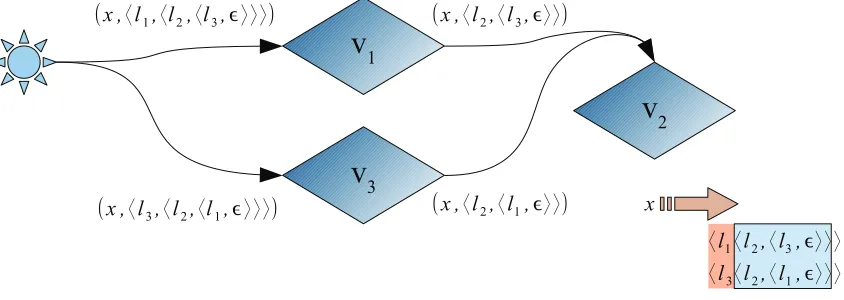
Recall that clauses are introduced to the system in the form (x,hl1,hl2,h...,hlc, iiii).
Let us now introduce a recursive inverse for this same clause so that it traverses variable
assignments in the opposite direction. We simply reverse theconslist so that clausextakes
the form (x,hlc,hlc−1,h...,hl1, iiii) instead. Here, literallc becomes the watch literal for
clausexand, when falsified, issues the remainder tovc−1.
From our previous example, a clause in this form traverses precisely the sequence of
Chapter3. Strategy 24
literals as valid assignments.
Figure 3.4: Two-Watch Unit Under Variable Concurrency
The solution to the requisite two-watch literals pattern, then, is to introduce both clauses
to the system. To detect if clause xis unit atv2, it need only know that both instances of
the clause have been received. This information safely eliminates the possibility that any
other literal might satisfy this clause under the current line of reasoning. Consequently,v2
can immediately take the value which rendersl2 true for this clause. Clause xwill then be
recorded as the reason for its assignment — to be used for calculating resolvents during
any subsequent conflict analysis.
Illustrated in Figure 3.4, it becomes clear that by traversing the clause from both ends,
v2is able to eliminate all preceding and succeeding literals tol2.
3.4.3
Speculative Unit Propagation
An exciting advantage to any parallel design of this type is the possibility of speculative
unit propagation. During the propagation of each unit literal across the clause database,
additional unit literals can be discovered that are within scope of the current assignment.
In this event, it will be possible to concurrently delegate these for continuous propagation
without directly waiting for further instructions from the solver core. This reduces idle
More-Chapter3. Strategy 25
over, a variable-centric design will detect and raise conflicting unit assignments as they
occur since the point of control for a variable’s assignment is safe under concurrency.
3.4.4
Watched Clause Rewriting
In particular, memory usage is an important aspect of this design. Traditional watch
man-agement alters the state of the clause database for all subsequent search without regard to
backtracking. That is, if a watch is moved just prior to a conflict, its change is retained
even after back-jumping has completed. Conventional wisdom regards this as positive,
since watches are cleared along the most-worn path to conflicted areas of the search space.
This fits well with modern heuristics like VSIDS which develop a preference for traversing
highly conflicted literals [6]. The clear opportunity cost, however, is that watches have
been relocated to other literals, which will be encountered as the solver broadens its search.
Moreover, the rapid and flexible changes exhibited by heuristics like Berkmin may further
alter this dynamic [9].
Our proposed design revives aspects of Recursive Clause Rewriting, introduced in
Sec-tion 1.3.4. In particular, the use of immutable data structures offers a compelling, low-cost
restoration of both clauses and watch state on back-jumps. The incremental state
accumu-lated forward of the jump target can be dropped in favor of the target’s prior configuration.
This strategy has several potential advantages in its own right. Watch dispersion
be-comes a function of the ordering for literals in the underlying problem. Dispersion can
remain relatively consistent, even in an environment of rapidly changing assumptions. The
use of immutable types also enables a continuous reduction in the number and size of
clauses as the set of assumptions and consequences grows deeper in search. For systems
with narrow access to memory, such as the Opteron servers discussed previously, the
for-ward reduction in problem size and consistency with regard to the underlying immutable
structure may improve the use of local cache.
Although it might seem that generating watched clause reductions could be costly,
inter-Chapter3. Strategy 26
mediateconscells of the initial clause. Injection of new clauses is similarly trivial: from
the point of insertion, variables exchange the clauses until the watch configuration settles
into place.
3.4.5
Advanced Search Strategies
Another potential advantage of this immutable design is the ease with which it can be
extended to parallel portfolio and guiding path search. Once the initial program structure
has been loaded, the clauses and variables it defines can be shared directly between workers
without additional memory allocation. Subsequent work by competing solvers is retained
in the local state for each competitor. As a consequence, the initial memory allocation is
small, i.e. exactly one instance of the problem. We compare this with the size needed by
mutable solvers, which is linear in the number of competitors. This is because each mutable
solver continuously alters its underlying clause database according to its state of search.
3.4.6
Considerations
At issue is whether this strategy improves memory access, locality and cache behavior.
Moreover, do its benefits outweigh its costs? Some of these aspects can be evaluated in
terms of overall performance whereas others need more focused measurement.
The degree to which this design is sensitive to the number of variables in the underlying
problem is also a consideration. As compared with the clause locus propagation engine, we
suspect a relationship in the ratio of variables to clauses that may influence the effectiveness
Chapter 4
Method
In order to ascertain the strengths and weaknesses of the outlined strategies, several aspects
of the methodology need to be established. In particular, it will be necessary to test the
unit propagation algorithms within their underlying functional environment. It is common
practice in the answer set and logic programming community to use benchmarking as a
technique to measure the effectiveness of solvers and engines. In the following sections,
we outline the benchmarking approach adopted for this research. We discuss aspects of the
unit propagation engines to be benchmarked, including some details of the F# functional
language in which they are written. Selected systemic and search measurements will be
reviewed. Moreover, parameters, both those which are varied and those which are
specifi-cally held constant, will be given special consideration. Finally, the tools used for analysis
of the results will be introduced.
4.1
Benchmarking
Benchmarking will involve running several iterations of a reference problem that is
pub-licly available under a variety of configurations. Since the focus of research is on unit
propagation, a full answer set solving engine is unnecessary. Consequently, the unit
prop-agation engines will be benchmarked with DIMACS format CNF satisfiability problems
Chapter4. Method 28
rather than answer set formats from grounders Lparse or Gringo. In keeping with
bench-marks obtained from Platypus, Claspar and Clasp for a related study, a minimum of five
iterations will be taken per configuration in order to produce results of comparable quality.
The benchmark configurations that follow culminated in thirteen-thousand measured runs
taken over a six month period.
4.1.1
Selections
Suitable DIMACS formatted benchmarks are available from a variety of sources. In
addi-tion to those held in a repository with our colleagues in Potsdam, Germany, SAT
compe-titions publish their benchmarks to the community in order to both maintain transparency
through reproducible measurement but also to help improve the state-of-the-art in logic
problem solvers. In order to maximize the utility of our measurements, we elected to use
problems obtained from SAT competitions in 2002 and 2009 [32].
Detailed profiles of the selected benchmarks appear in Appendix A, including
Ta-ble A.1. Selections were drawn from all three major categories, including application,
crafted and random problems. Generally, the initial problem size among the selected
bench-marks is gradually increasing in terms of both clauses and variables. Outliers were chosen
in order to provide larger initial variable-to-clause and clause-to-variable ratios. The ratio
of initial variables to clauses, which we suspect is an important factor in any comparison
of the variable or clause-centric propagation designs, is illustrated in Figure A.1.
Although the selected benchmarks may seem biased along the diagonal, established
researchers in the field published findings in 1992 regarding the hardness of SAT problems
in terms of over and under specification [33]. They discovered that SAT problems tend
to fall into easy-hard-easy distributions such that either over or under specification of the
boolean constraints imposed by clauses on their variables produce problems which are
easily solved. In specific terms, too many variables and too few clauses constituted
under-constrained problems for which variable assignment is comparatively easy. In contrast,
Chapter4. Method 29
that can be equally easy, but often unsatisfiable. Challenging problems tend to fall in the
middle, and the selected benchmarks cover a range within that space.
4.1.2
Platform
The proposed designs call for measurements of scalability and performance on the F#
run-time environment. Implementations of the F# runrun-time exist on both its native Microsoft
Windows, as the .NET Framework, and Unix, as mono. Unfortunately, 64-bit mono 2.10.2
as installed on Western’s forty-eight-way Rocks 5.4 cluster exhibited reliability problems
and was unsuitable for the sheer number of measurements to be taken. These failures
oc-curred in mono’s memory subsystem, primarily its memory allocator, regardless of which
benchmark or engine was being run. In particular, highly concurrent execution with small
units of work as required by the clause-centric design was the most problematic. The
immutable variable-centric design, however, did produce some very compelling
measure-ments which will be discussed in the final results.
For the majority of measurements, a custom multi-CPU system was purchased and
as-sembled in order to demonstrate F# on the platform for which it is designed and optimized.
This machine runs twin eight-core AMD Opteron Mangy-Cours 6128 processors operating
at a peak frequency of 2.0GHz. These sixteen processor cores make use of 128KB Level-1,
512KB Level-2 and 12MB Level-3 cache to improve access to memory. Each core has its
own Level-1 and Level-2 cache, whereas each processor has a shared Level-3 cache. On
the Asus KGPE-D16 motherboard, these processors access four distinct channels to main
memory. The 32GB of installed memory consists of eight 4GB server-grade Kingston
registered ECC DDR3 1333 memory modules. Data between runs is backed by 2TB of
primary storage. To obtain reproducible results, advanced power saving features were
dis-abled and the clock speed of all sixteen cores was locked to the factory-rated 2.0GHz.
The 64-bit version of Windows 7 Ultimate Edition is installed with version 4.0.30319
of the .NET Framework. This edition of Windows supports two CPUs with up to 32 cores
Chapter4. Method 30
including background update and security software. A Windows PowerShell script was
written to automate sequential execution of the benchmark runs and collect results over the
extended measurement period with several minor revisions over its lifetime.
This highly customized platform remains unchanged during the benchmarking in order
to guarantee consistent results. Having examined the operating platform, we will now
review salient aspects of the F# language employed in this work.
4.2
F
#
Language
As previous discussed, the F# language is a modern descendant of the ML family of
lan-guages, most closely related to Objective Caml — also called OCaml. OCaml added
object-oriented capabilities in 1996 to the Caml language which debuted a decade earlier. Both
are dialects of ML maintained at theInstitut national de recherche en informatique et en
automatiqueor INRIA [34]. Developed at Microsoft Research starting in 2002, F# inherits
many important features from these languages. As Don Syme describes it, ”F# is a
scal-able, succinct, type-safe, type-inferred, efficiently executing functional/imperative/
object-oriented programming language.” Moreover, it is ”both a parallel and a reactive language.”
[22] It also shares certain features such as sequence expressions and workflows withHaskell
which form the basis of its asynchronous processing. He goes on to say that ”its approach
to type inference, object-oriented programming and dynamic language techniques is
sub-stantially different from all other mainstream functional languages.” [35]
Many of the crucial language features used in the following work will be briefly
intro-duced in order to provide useful background.
4.2.1
Immutable Types
One of the most important aspects of F# as it pertains to this research is its support for
immutable data types. In particular, immutable lists and tuples are used extensively by the
Chapter4. Method 31
The most common immutable type in modern languages, such as Java and C#, is the
string. Its contents cannot be directly altered, however, operations on it create new
in-stances which carry the consequences of those operations. In F#, this pattern is extended
to both common collections and end-user classes. Although mutable versions are still
available and supported, immutable types have several important advantages. Most useful
among these is the coherency of concurrent reads. That is, if two threads have references
to an immutable structure, changes derived from that structure result in new instances held
locally to those threads, rather than to any shared state between them. This added safety
eases development of certain types of asynchronous procedures and will be demonstrated
in our implementation of the variable-locus design.
The theoretical model for immutable lists used in our discussion of the variable locus
can be easily translated into F# syntax. Consider the remainder hl1,hl2,h...,hlc, iiii. F#
replaces with the empty list []. Consoperations simply apply the :: operator to join an
element to the front of an existing list — possibly an empty one. For example, the syntax
lc :: [] replaces hlc, iin the previous example. This procedure can be repeated until the
remainder is fully constructed, for examplel1 :: [l2;...;lc]. In its final form, the language
would represent the remainder as [l1;l2;...;lc], however, the underlying linked-list structure
ofconscells remains [35].
The language syntax and representation of the Tuple data-type is exactly the same as
presented in the variable-centric design. The intermediate clause (77,hl1,hl2,h...,hlc, iiii)
can thus be represented as simply (77,[l1;l2;...;lc]) in F#.
4.2.2
Map and Reduce
Operations on immutable data, then, are as simple as applying a function to some reference
and obtaining the result. A useful example could be the mapping and reduction of clauses
on a watch list as part of unit propagation. For example, the following syntax takes watches
from a watch list andmapsthem into a collection of results.
Chapter4. Method 32
A functionvisitWatchdefines how a single watch would be processed. List.mapsimply
applies thevisitWatchfunction to each element in a list ofwatchesto produce a new list of
results. Once all watches have been visited, the collection of results is returned.
If, hypothetically, the results were a count of clauses to be moved - either 1 or 0 for a
single watch - then a simple sum of all movable clauses might be desirable. Similar tomap,
reducecan apply the addition function to merge all elements as follows:
lettotal= (List.reduce(+)counts)
Reduce accepts any binary function which takes two input elements of some type and
returns a single result. It then applies this function repeatedly to the list in order to reduce
it down to a single value.
4.2.3
Recursion and A
ffi
nity
As may have become apparent, the usual techniques for iteration of data are largely
un-necessary in F#, although they do exist. Where iteration is desired as part of a program’s
flow-control, however, F# prefers tail recursive functions to imperative iteration. A function
that is recursive includes the keywordrec.
In F# it is possible to require that the program use only certain CPU cores. A bit map of
the desired core assignment is provided to the framework with 1 enabling use of a core and
0 disabling it. To generate this affinity setting for some number of adjacentcores, consider
the following function:
l e t r e c g e n e r a t e A f f i n i t y ( c o r e s : i n t ) =
i f c o r e s <= 1 t h e n 1
e l s e 1 + 2 ∗ g e n e r a t e A f f i n i t y ( c o r e s − 1 )
The structure of this tail recursive function can be clearly altered by the compiler to
use traditional iteration on the executing machine rather than stack recursion. The result of
this function is used to assign a specific sequential core affinity to the currently executing
Chapter4. Method 33
l e t a f f i n i t y = ( g e n e r a t e A f f i n i t y 8 )
l e t c u r r e n t = ( P r o c e s s . G e t C u r r e n t P r o c e s s ( ) )
c u r r e n t . P r o c e s s o r A f f i n i t y <− n a t i v e i n t a f f i n i t y
In the DPLL and CDCL algorithms, there is a tendency to write tree-recursive
proce-dures which explore one possibility and then its alternative. These cannot be optimized
by the runtime [35]. In our experience, deep search of this type will result in stack
over-flows. An immutable stack can be used explicitly with tail recursion to store alternatives
for subsequent processing which can be easily passed into the next cycle.
4.2.4
Closures and
λ
s
As with other functional languages, F# supports closures, partial application, and lambda
functions. In particular, these are used to construct and return new functions with different
values bound to their enclosing environment. Although F# also supports structured classes
and values, these are a clean, simple method for structured computation. Although their
usage in the experimental implementations is sparse, an application of these structures will
be expanded in the discussion of possible future work, especially Section 6.2 on enclosed
two-watch literal inversion.
4.2.5
Async and MailboxProcessors
When executing map and reduce, the program sequentially visited each watch and produced
a collection of results. These results were then reduced to a single value. Using theasync
keyword defines special asynchronous workflows in the F# language. Effectively, it is
used to define blocks of work that can be computed later. Suppose we wrap the previous
visitWatchfunction withasync:
Chapter4. Method 34
In this example,visitWatchAsyncreturns a task which will visit the watch enclosed within
when executed. Mapping the list of watches to asynchronous tasks builds a body of work
that can be scheduled later:
letasyncWatchT asks= (List.map visitWatchAsync watches)
This collection of tasks enables the environment to run all watch functions simultaneously
when asked to do so. The following example executes all watch tasks concurrently, waiting
until they are completed to obtain the results:
letresults =(Async.RunS ynchronously(Async.Parallel asyncWatchT asks))
This demonstrates the relative ease with which data can be processed concurrently in F#.
Another important language feature, that of agents, is used in the variable-centric
de-sign for concurrent processing on variables. Conceptually, the agent is implemented as
a worker communicating asynchronously with the outside world through the use of
mail-boxes. This is a familiar pattern in high performance computing, including such popular
platforms as the message passing interface, or MPI, used by solvers such as Platypus and
Claspar [13][14]. Agents are implemented with MailboxProcessors — a higher level
fea-ture detailed further in Chapter 13 of Don Syme’s Expert F# 2.0 [35].
4.3
Unit Propagation Experiments
As demonstrated, the F# language offers a variety of powerful and expressive options for
concise concurrent programming which make it a compelling choice for developing and
testing the proposed unit propagation designs.
4.3.1
Development Plan
Experimentation with the propagation control strategies is implemented in three stages.
After studying the idiosyncrasies of MiniSAT, Platypus and Claspar, our first phase of