ISSN 2286-4822 www.euacademic.org
Impact Factor: 3.4546 (UIF) DRJI Value: 5.9 (B+)
Best Practices for Designing Practicum in Special
Education Programs
AJAY SINGH, Ph.D. Early Intervention Program Department of Special Education and Clinical Sciences College of Education, University of Oregon CHIA JUNG YEH, Ph.D. Child Development and Family Relations College of Human Ecology, East Carolina University YASH PAL SINGH, Ph.D. Associate Professor M.J.P. Rohilkhand University, Bareilly, India ANJU AGARWAL, Ph. D.
Associate Professor M.J.P. Rohilkhand University, Bareilly, India ASHWINI TIWARI, Ph.D. Department of Curriculum and Instruction, University of Texas-Pan American
Abstract:
Key words: Best practices, field studies, practicum, special education, teacher education.
Introduction
There is a shortage of special education teachers in the United States. The supply of qualified special education teachers has been especially low for decades (Nichols, Bicard, Bicard, & Casey, 2008). Approximately 98% of the nation‟s school districts report special education teacher shortages (McLeskey, Tyler, & Flippin, 2004). The demand for special educators is expected to increase by 17% from now through 2018; a rate greater than that which is predicted for all other occupations. (Bureau of Labor Statistics, US Department of Labor, 2009). Approximately half of the nation‟s 3.2 million teachers are baby-boomers and one million may retire in the next two years. By 2014, up to a million new teachers will be needed (Duncan, 2009). Such a shortage of teachers is not only a problem in the USA. The organization for Economic Co-operation and Development (OECD, 2009) indicated that finding sufficient numbers of qualified teachers is a problem for all OECD countries. There are several reasons for this shortage, including teacher retirement, teacher attrition, and difficulties in attracting and retaining pre-service teachers (Bruinsma and Jenson, 2010). Teacher education programs that prepare teachers within the context of functioning elementary and secondary schools are widely discussed and debated (Lapan & Minner, 1997). Research studies show that effective preparation of good teachers includes intensive practical experience with K-12 students under carefully supervised conditions in collaboration with experienced teachers (Darling-Hammond, 2013; Grant & Gibson, 2011).
universities. Field studies/practicum may be integrated into teacher education to greater or lesser extent and even if they overlap, different models can be identified (Mattsson, Eilersttsson, & Rorrison, 2011). These experiences are interspersed between blocks of time devoted to theory-based courses and allow teacher candidates to contextualize their theoretical learning work with real students, teachers, and curriculum in natural settings (Baum, & Korth, 2013; LoCasale-Crouch, Davis, Wiens, & Pianta, 2012). A field studies/practicum is part of the learning sequence that scaffolds the transition to a teaching role and provides the opportunity to link theory and practice (Akhtar, Majeed, & Murtaza, 2013; Retallick, & Miller, 2010). Another researchers stated that constructivist teacher education programs should create field experiences that facilitate the growth of teacher candidates through experiences, reflection, self-examination rather than a positivist program that requires the teacher candidates to assume practices mandated by those in authority and added that field studies/practicum experiences should not only enable teacher candidates to observe teaching as practiced by experienced teachers but also to practice reflectivity (Compton, & Davis, 2010; Craig, 2010; Dangel, 2013; Kunter, Kleickmann, Klusmann, & Richter, 2013).
The special education field studies/practicum is an excellent opportunity for the students to develop and utilize the adult learner model. By taking responsibility for their own professional growth and development in special education practice, the undergraduate students can explore and deepen their knowledge and skills for future practice as professional in the field of special education. This approach empowers them to build on the strengths previously developed through volunteer/community service, coursework, and other educational experiences. Incorporating undergraduate students‟ concepts into their field studies/practicum experience will prepare them for future employment, in which they will have to function autonomously and professionally. Also they will serve as effective and qualified professional in the field of special education.
The Context of this Paper
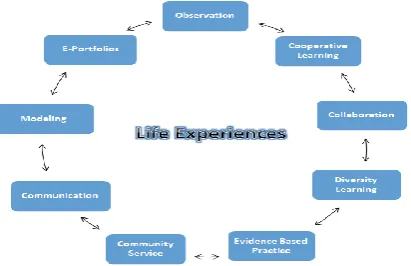
The role of the field studies/practicum in undergraduate and graduate special education programs is very important. What kind of field studies/practicum best prepares prospective special education teachers for classroom practice? Based on real life experience and research, the authors have proposed a reinforced life experience practicum framework (figure 1), which prepares prospective special education teachers for effective classroom practices.
Figure 1: A Reinforced Life Experience Practicum Framework for prospective special education teachers for classroom practices.
Research on training in teacher preparation
Learning to teach
From an early age we are surrounded by teaching, most primarily by parents and educators. These early experiences with authority figures help shape teachers' pedagogical tendencies (Biggs, 2011; Nilsson, & Loughren, 2012; Tigchelaar, Brouwer, & Vermunt, 2010). Teachers are supposed to lay an intellectual and practical foundation for teaching in education courses and field experiences (Darling-Hammond, 2012; Zeichner, 2010). Many teachers reported that their pre-service program did not prepare them for teaching, and a variety of research using both surveys and case methods documents the limited impact of teacher education on prospective teachers' perspectives and beliefs (Gay, 2010; Sang, Valcke, Braak, & Tondeur, 2010; Zeichner, 2010). At the same time, we have some evidence that powerful and innovative teacher preparation can affect the way teachers think about teaching and learning, students and subject matter (Bakkenes, Vermunt, & Wubbels, 2010; Briggs, John, & Tang, 2011). No matter how much students can learn during their teacher preparation program, learning teaching inevitably occurs on the job site. No one learns to teach in their initial year with perfection. Efforts to describe the phases teachers go through in learning to teach through generally posit an initial stage of survival and discovery, a second stage of experimentation and consolidation, and a third stage of mastery and stabilization (Bensalah, Olivier, & Stefaniak, 2012; Eros, 2013; Eros, 2011; Hill, 2013; Miller, 2012; Rumbaugh, King, Beran, Washburn, & Gould, 2012).
Field experience
classroom/field sites. Pre-service programs with the most intense field components (Grieco, 2011; O'Neill, & Stephenson, 2012) required early field experiences, one or two practicum experiences, and a semester- or year-long student teaching placement. Programs with such extensive field experiences recognized the developmental nature of teaching (Nilsson, 2012; Slattery, 2012). Researchers state that practice should be sufficiently extensive and intensive for candidates to demonstrate proficiencies in the professional roles for which they are preparing (Al‐Musawi, Karam; 2011; Papanastasiou, Tatto, & Neophytou, 2012). Following this guideline, most United States teacher education programs require one term/semester of student teaching (Cummings & Bernard, 2010; Rodgers, & Jenkins, 2010; Cuenca, Schmeichel, Butler, Dinkelman, & Nichols 2011: NCTQ, 2011). Dreyer (1998) summarizes this by noting, when initial teacher training students spend more of their training time in schools they get the opportunity to integrate theory of Education with that which they are experiencing at first hand (Quick, & Siebörger, 2005; Reddy, Menkveld, & Bitzer, 2008). At the field studies/practicum sites, the students will be supervised by the certified special education professionals/cooperating teachers and monitored by the University faculty. The faculty mentioned careful supervision as an important feature of their programs (Beck, & Kosnik, 2002; Brownell, Ross, Colón, & McCallum, 2005; Yeh, & Singh, 2014; Singh, Yeh, Das, Heo, Verma, 2014; Zeichner, & McDonald, 2011). Most of the university faculty members continuously incorporate input from cooperating teachers and use their own direct assessments of student performance to determine if students have met expected standards of performance.
Diversity learning
setting and it is imperative that undergraduate programs provide courses and relevant experiences that prepare their pre-service teachers to interact with and have a positive effect on diverse learners (Brown, Barkley, & Higginbotham, 2011; Thomas, Hassaram, Rieth, Raghavan, Kinzer, & Mulloy, 2012). As increased numbers of diverse learners enter the classroom, the need for experiences that educate pre-service teachers on the learning needs of these students is imperative (Anderson, & Stillman, 2013; Doorn, & Schumm, 2013; Gomez, Strage, Knutson-Miller, & Garcia-Nevarez, 2009). Many pre-service teachers enter in the field of special education with fixed philosophies about teaching and learning that may not be correct or applicable to all teaching situations. Researchers in education highly recommend that teacher education institutions/universities offer field experiences, as well as courses focused on teaching diverse learners (Fenwick, & Cooper, 2013; Ryan, Carrington, Selva, & Healy, 2009; Scott, 2011).
Promising practices in field studies/practicum
Across several studies in few decades, one theme that emerges is that field experiences lead to more significant learning when activities are focused and well structured (Biggs, & Tang, 2011; Brophy, 2010; Paechter, Maier, & Macher, 2010). Cooperating teachers have a powerful influence on the nature of the student teaching experience (Chen, 2010; Kopcha, & Alger, 2014). So cooperative learning (CL) is the crucial factor. CL is instruction that involves students working in teams to accomplish a common goal, under conditions that include the following five essential elements (Gillies, & Boyle, 2010; Slavin, 2011):
I. Positive interdependence. Team members are obliged
II. Individual accountability. All students in a group are held accountable for doing their share of the work and for mastery of all of the material to be learned (Dyson, Linehan, & Hastie, 2010; Verma, & Singh, 2014).
III. Face-to-face promote interaction. Although some of
the group work may be distributed out and done individually, some must be done interactively, with group members providing one another with feedback, challenging one another's conclusions and reasoning, and perhaps most importantly, teaching and encouraging one another (AbuSeileek, 2012; Kyndt, Raes, Lismont, Timmers, Cascallar, & Dochy, 2013).
IV. Appropriate use of collaborative skills. Students are
encouraged and helped to develop and practice trust-building, leadership, decision-making, communication, and conflict management skills (McLeskey, Rosenberg, & Westling, 2012; Palloff, & Pratt, 2010).
V. Group processing. Team members set group goals,
periodically assess what they are doing well as a team, and identify changes they will make to function more effectively in the future (Bender, 2012; Jonassen, & Grabowski, 2012).
Factors involved in student teaching
related to student teaching. The quality of teaching depends on these two factors.
I. Environmental factors
The environment influences how student teachers evaluate their abilities to teach (Houts, Caspi, Pianta, Arseneault, & Moffitt, 2010; Skaalvik, & Skaalvik, 2010). Shaping the environment may encourage behavior change. This may include providing opportunities for behavioral change, assisting with those changes, and offering social support. It is important to recognize environmental constraints that might deter behavior change (Greenfield, 2011; Stern, 2011; Timberlake, 2012).
II. Student teacher efficacy
Shapka, & Perry, 2012; Ghanizadeh, & Moafian, 2011; Tschannen-Moran, & Johnson, 2011; Yeh, & Singh, 2014). Teacher‟s sense of efficacy has been shown to be a powerful construct related to student outcomes such as achievement, motivation, and self-efficacy (Duffin, French, & Patrick, 2012; Tuchman, & Isaacs, 2011). Furthermore, teachers‟ sense of efficacy was related to teachers‟ behavior, effort, goals, aspiration, openness to new ideas, innovation, planning and organization, persistence, resilience, reluctance to use criticism, enthusiasm, willingness to work with difficult students, and commitment to teaching and their careers (Akbari, & Tavassoli, 2011; Ciyer, Nagasawa, Swadener, & Patet, 2010; Tweed, 2013).
E-portfolios
Discussion board
Instructors, authors have included a discussion board for instructional purposes in their classroom. They found that the discussion board incorporates the characteristics of authentic learning tasks, such as student interaction for the purposes of sharing their thoughts, relating their ideas to past experiences, collaborating with their peers, actively constructing their own meaning, and incorporating the diverse perspectives of others (Chartrand, 2012; Woo, Herrington, Agostinho, & Reeves, 2007; Ribbe, & Bezanilla, 2013).
Creating a link between teaching and research
University faculty members can help educators and administrators, districts, and states respond to changing expectations for highly competent, caring educators and systematically monitor school, classroom, and student progress and performance in order to know precisely what works to increase student learning in the classroom and promote evidence based practices. The emphasis on research productivity in the faculty incentive and reward system is often justified by the claim that research enhances teaching (Borrego, Cutler, Froyd, Prince, & Henderson, 2011; Prince, Felder, and Brent, 2007).
but active learning may be integrated into all forms of teaching (Gulliford, & Upton, 2013; Perez, Uline, Johnson, James-Ward, & Basom, 2011; Whalley, & Favis-Mortlock, 2011).
Collaboration
Singh, Prem, & Sai, 1999). NCATE (2002) requires: “The unit and school partners collaboratively design and implement field experiences and clinical practice, including the assessment of candidate performance. The school and the university faculty share the responsibility for candidate learning. The partners share and integrate resources and expertise to create roles and structures that support and create opportunities for candidates to learn”. As relationships between schools and universities grow and become more and more symbiotic, pre-service teachers engage in continuously improving levels of structured, well‐defined, and implemented experiences (Alger, 2006; Bernshausen & McMahan, 2011; Goodlad, 2004; Heath, 2005; Shoffner, 2008). Brownell, et al (2005) emphasized collaboration in different ways that included: (a) knowledge of collaborative skills, (b) faculty-to-faculty collaboration, (c) school-to-faculty collaboration, and (d) use of student cohorts.
Conclusion
The current findings should be considered in light of solitary limitation; in person/phone/survey research and/or discussion might have been conducted. Further research is needed to determine what kind of field studies/practicum best prepares prospective special education teachers for effective classroom practices.
REFERENCES
Abu Seileek, A. F. (2012). The effect of computer-assisted cooperative learning methods and group size on the EFL learners‟ achievement in communication skills. Computers & Education, 58(1), 231-239.
Akbari, R., & Tavassoli, K. (2011). Teacher Efficacy, Burnout, Teaching Style, and Emotional Intelligence: Possible Relationships and Differences. Iranian Journal of Applied Linguistics (IJAL).
Akhtar, R. N., Majeed, A., & Murtaza, A. (2013). The Role of Collaborating Teachers (CTs) in Facilitating Prospective Teachers (PTs) in Lesson Delivery: A Multi-Case Study of Teaching Practicum. Bulletin of Education and Research, 35(2), 107-124.
Alger, C. (2006). „What went well, what didn‟t go so well‟: growth of reflection in pre‐service teachers. Reflective Practice, 7(3), 287-301.
Al‐Musawi, N. M., & Karam, E. M. (2011). Humanistic qualities of the teacher as perceived by undergraduate students in Bahrain and Kuwait. Journal of Education for Teaching, 37(2), 183-197.
Anderson, L. M., & Stillman, J. A. (2013). Student Teaching‟s Contribution to Preservice Teacher Development A Review of Research Focused on the Preparation of Teachers for Urban and High-Needs Contexts. Review of Educational Research, 83(1), 3-69.
Averett, P., Carawan, L., & Burroughs, C. (2012). Getting “Tillerized”: Traits and Outcomes of Students in a Rural Community Field Placement. Journal of Social Work Education, 48(1), 75-91.
Bakkenes, I., Vermunt, J. D., & Wubbels, T. (2010). Teacher learning in the context of educational innovation: Learning activities and learning outcomes of experienced teachers. Learning and Instruction, 20(6), 533-548.
Baum, A. C., & Korth, B. B. (2013). Preparing Classroom Teachers to Be Cooperating Teachers: A Report of Current Efforts, Beliefs, Challenges, and Associated Recommendations. Journal of Early Childhood Teacher Education, 34(2), 171-190.
Baum, N. (2011). The Supervisory Relationship as a Triangle: A Study of Students' Perceptions. Families in Society: The Journal of Contemporary Social Services, 92(3), 262-268. Beck, C., & Kosnik, C. (2002). Professors and the practicum
involvement of university faculty in preservice practicum supervision. Journal of Teacher Education, 53(1), 6-19.
Bender, W. N. (2012). Differentiating Instruction for Students With Learning Disabilities: New Best Practices for General and Special Educators. SAGE.
Bensalah, L., Olivier, M., & Stefaniak, N. (2012). Acquisition of the concept of teaching and its relationship with theory of mind in French 3-to 6-year olds. Teaching and Teacher Education, 28(3), 303-311.
Biggs, J., & Tang, C. (2011). Teaching for quality learning at university. McGraw-Hill International.
Bogo, M. (2010). Achieving competence in social work through field education. University of Toronto Press.
Borrego, M., Cutler, S., Froyd, J., Prince, M., & Henderson, C. (2011). Faculty use of research based instructional strategies. In Australasian Association for Engineering Education Conference, Fremantle, Western Australia. Brophy, J. E. (2010). Motivating students to learn. Routledge. Brown, S., Barkley, R., & Higginbotham, J. A. (2011).
Pre-Service Teacher‟s Attitudes towards Teaching Diverse Learners. The Journal, 1.
Brownell, M. T., Bishop, A. M., & Sindelar, P. T. (2005). NCLB and the Demand for Highly Qualified Teachers: Challenges and Solutions for Rural Schools. Rural Special Education Quarterly, 24(1).
Brownell, M. T., Ross, D. D., Colón, E. P., & McCallum, C. L. (2005). Critical Features of Special Education Teacher Preparation A Comparison With General Teacher Education. The Journal of Special Education, 38(4), 242-252.
Bruinsma, M., & Jenson, E. (2010). Is the Motivation to Become a Teacher Related to Pre-service Teachers‟ Intention to Remain in the Profession? European Journal of Teacher Education, 33(2), 185-200.
Bullough Jr, R. V. (2012). Mentoring and New Teacher Induction in the United States: A Review and Analysis of Current Practices. Mentoring & Tutoring: Partnership in Learning, 20(1), 57-74.
Cakiroglu, J., Capa-Aydin, Y., & Hoy, A. W. (2012). Science Teaching Efficacy Beliefs. In Second International Handbook of Science Education (pp. 449-461). Springer Netherlands.
traits and self‐efficacy beliefs to academic achievement: A longitudinal study. British Journal of Educational Psychology, 81(1), 78-96.
Chartrand, R. (2012). Social networking for language learners: Creating meaningful output with Web 2.0 tools. Knowledge Management & E-Learning: An International Journal (KM&EL), 4(1), 97-101.
Chen, R. J. (2010). Investigating models for preservice teachers‟ use of technology to support student-centered learning. Computers & Education, 55(1), 32-42.
Chien, C. F., & Rad, Z. M. (2013). Blending a Three-Way Technology into A Language Acquisition and Development Course for Pre-service Teachers. Journal of Curriculum & Teaching, 2(2).
Ciyer, A., Nagasawa, M., Swadener, B. B., & Patet, P. (2010). Impacts of the Arizona System Ready/Child Ready Professional Development Project on preschool teachers' self-efficacy. Journal of Early Childhood Teacher Education,31(2), 129-145.
Clark, C. (2013). A Phenomenological Study of The Impact of Pre-Service and In-Service Training regarding the Integration of Twenty-First Century Technologies into Selected Teachers’ Instruction (Doctoral dissertation, Liberty University).
Collie, R. J., Shapka, J. D., & Perry, N. E. (2012). School climate and social–emotional learning: Predicting teacher stress, job satisfaction, and teaching efficacy. Journal of educational psychology, 104(4), 1189. Compton, L., & Davis, N. (2010). The Impact of and the Key
Craig, C. J. (2010). Reflective practice in the professions: Teaching. In Handbook of Reflection and Reflective Inquiry (pp. 189-214). Springer, US.
Crawford, S., O‟Reilly, R., & Flanagan, N. (2012). Examining Current Provision, Practice and Experience of Initial Teacher Training Providers in Ireland Preparing Pre-Service Teachers for the Inclusion of Students with Special Education Needs in Physical Education Classes. European Journal of Adapted Physical Activity, 5(2).
Cruickshank, K., & Westbrook, R. (2013). Local and global– conflicting perspectives? The place of overseas practicum in pre-service teacher education. Asia-Pacific Journal of Teacher Education, 41(1), 55-68.
Cuenca, A., Schmeichel, M., Butler, B. M., Dinkelman, T., & Nichols Jr, J. R. (2011). Creating a “third space” in student teaching: Implications for the university supervisor‟s status as outsider. Teaching and Teacher Education, 27(7), 1068-1077.
Cummings, T., & Bernard, M. (2010). Integrating Web-based Instruction and Classroom Teaching: Case Studies from the Caribbean.
Dangel, J. R. (2013). An Analysis of Research on Constructivist Teacher Education. in education, 17(2).
Darling-Hammond, L. (2013). and Educational Equity. Transforming Curriculum for A Culturally Diverse Society, 245.
Darling-Hammond, L. (2012). Powerful teacher education: Lessons from exemplary programs. John Wiley & Sons. Das, A., & Singh, A. (2013, March). Training Needs of
Secondary Regular Education Teachers to Implement Inclusive Education in Delhi, India. In Society for
Information Technology & Teacher Education
Das, A. K., Gichuru, M. & Singh, A. (2013) „Implementing inclusive education in Delhi, India: regular school teachers‟ preferences for professional development delivery modes.‟ Professional Development in Education. DOI: 10.1080/19415257.2012.747979.
Dent, J., & Harden, R. M. (2013). A practical guide for medical teachers. Churchill Livingstone.
Dreyer, J. (1998). The use of mentors (experienced teachers) as school-based experts to assist student and beginner teachers. South African Journal of Education, 18:109-112.
Doorn, K., & Schumm, J. S. (2013). Attitudes of Pre-Service Teachers Regarding Linguistic Diversity in the General Education Classroom. Journal of Reading Education, 38(3).
Duffin, L. C., French, B. F., & Patrick, H. (2012). The Teachers' Sense of Efficacy Scale: Confirming the factor structure with beginning pre-service teachers. Teaching and teacher Education, 28(6), 827-834.
Duncan, Arne (2009, Oct. 22). “Teacher Preparation: Reforming the Uncertain Profession, Remarks of Secretary Arne Duncan at Teachers College, Columbia University,” Retrieved October 30, 2009 from
http://www.ed.gov/news/speeches/2009-/10/10222009.html
Durlak, J. A., Weissberg, R. P., Dymnicki, A. B., Taylor, R. D., & Schellinger, K. B. (2011). The impact of enhancing students‟ social and emotional learning: A meta‐analysis of school‐based universal interventions. Child development, 82(1), 405-432.
El-Kerdany, L. A. (2012). Graduate School of
Education (Doctoral dissertation, The American
University in Cairo).
Eros, J. (2013). Second-Stage Music Teachers' Perceptions of Career Development and Trajectory. Bulletin of the Council for Research in Music Education, (195), 59-75. Eros, J. (2011). The career cycle and the second stage of
teaching: Implications for policy and professional development. Arts Education Policy Review, 112(2), 65-70.
Falchikov, N. (2013). Improving assessment through student involvement: Practical solutions for aiding learning in higher and further education. Routledge.
Federal Interagency Forum on Child, & Family Statistics (US) (2009). America's children: key national indicators of well-being, 2009. Federal Interagency Forum on Child and Family Statistics.
Fenwick, L., & Cooper, M. (2013). Learning about the Effects of Context on Teaching and Learning in Pre-Service Teacher Education. Australian Journal of Teacher Education, 38(3), 7.
Flynn, C., Kamasua, J., Brydon, K., Lawihin, D., Kornhauser, T., & Grimes, E. (2013). Preparedness for Field Education Placement: Social Work Students' Experiences in Papua New Guinea. Social Work Education, (ahead-of-print), 1-16.
Forlin, C. (2010). Reframing teacher education for inclusion. Teacher education for inclusion: Changing paradigms and innovative approaches, 3-10.
García, E., Arias, M. B., Murri, N. J. H., & Serna, C. (2010). Developing responsive teachers: A challenge for a demographic reality. Journal of Teacher Education, 61(1-2), 132-142.
Gay, G. (2010). Acting on beliefs in teacher education for cultural diversity. Journal of Teacher Education, 61(1-2), 143-152.
Gay, G., & Kirkland, K. (2003). Developing cultural critical consciousness and self-reflection in preservice teacher education. Theory into practice, 42(3), 181-187.
Gelman, C. R. (2012). Transformative Learning: First-Year MSW Students' Reactions to, and Experiences in, Gerontological Field Placements.Educational Gerontology, 38(1), 56-69.
Ghanizadeh, A., & Moafian, F. (2011). The relationship between Iranian EFL teachers' sense of self-efficacy and their pedagogical success in Language Institutes. Asian EFL Journal, 13(2), 249-272.
Gillies, R. M., & Boyle, M. (2010). Teachers' reflections on cooperative learning: Issues of implementation. Teaching and Teacher Education, 26(4), 933-940.
Goodlad, J. I. (2004). A place called school (2nd Ed.). New York: McGraw‐Hill.
Grant, C., & Gibson, M. (2011). Diversity and Teacher Education. Studying Diversity in Teacher Education, 19. Greenfield, E. A. (2011). Developmental Systems Theory as a
Conceptual Anchor for Generalist Curriculum on Human Behavior and the Social Environment. Social Work Education, 30(5), 529-540.
Grieco, A. P. (2011). Exploring the Early Field Experience to Examine the Impact on Pre-Service Teacher Development. Doctoral dissertation, Indiana.
Gulliford, R., & Upton, G. (Eds.). (2013). Special educational needs. Routledge. University of Pennsylvania).
Heath, R. (2005). Developing partnerships between public schoo ls and higher education.
Presentation at the Annual Conference of the South Car olina and North Carolina
Professors of Middle Level Education. Charleston, South Carolina.
Henriksen, L. B. (2011). Getting out there: PBL and the Case of Compulsory Practicum in Engineering Education. PBL across the Disciplines: Research into Best Practice, 282. Hill, V. (2013). Principal Leadership Behaviors Which Teachers
at Different Career Stages Perceive as Affecting Job Satisfaction.
Honigsfeld, A. Giouroukakis, V., Cohan, A., & Walsh, M. (2009). Ten ways to incorporate technology into a TESOL teacher preparation program. Contemporary Issues in Technology and Teacher Education, 9(2), 208-221.
Houts, R. M., Caspi, A., Pianta, R. C., Arseneault, L., & Moffitt, T. E. (2010). The Challenging Pupil in the Classroom The Effect of the Child on the Teacher. Psychological science, 21(12), 1802-1810.
Ibrahim, N., Freeman, S. A., & Shelley, M. C. (2012). Exploring the Impact of Work Experience on Part-Time Students' Academic Success in Malaysian Polytechnics. Career and Technical Education Research, 37(1), 57-74.
Jonassen, D. H., & Grabowski, B. L. (2012). Handbook of individual differences learning and instruction. Routledge.
Knowles, M. S., Holton III, E. F., & Swanson, R. A. (2012). The adult learner. Routledge.
Kopcha, T. J., & Alger, C. (2014). Student teacher communication and performance during a clinical experience supported by a technology-enhanced cognitive apprenticeship. Computers & Education, 72, 48-58.
Kunter, M., Kleickmann, T., Klusmann, U., & Richter, D. (2013). The Development of Teachers‟ Professional Competence. In Cognitive Activation in the Mathematics Classroom and Professional Competence of Teachers (pp. 63-77). Springer US.
Kyndt, E., Raes, E., Lismont, B., Timmers, F., Cascallar, E., & Dochy, F. (2013). A meta-analysis of the effects of face-to-face cooperative learning on performance, attitudes and perceptions. Educational Research Review.
Lakhan, R., & Singh, A. (2014). Early Intervention Tool (EIT) for Children with Developmental Delay in India: A Pilot Study. The European Health Psychologist, 16(1), 18-25. Lapan, S., & Minner, S. (Ed.). (1997). Perspectives:
School-university partnerships. Center For Excellence in Education. Northern Arizona University, Flagstaff, Arizona.
Lent, R. W., Nota, L., Soresi, S., Ginevra, M. C., Duffy, R. D., & Brown, S. D. (2011). Predicting the job and life satisfaction of Italian teachers: Test of a social cognitive model. Journal of Vocational Behavior, 79(1), 91-97. Levin, B. B., He, Y., & Allen, M. H. (2013). Teacher Beliefs in
LoCasale-Crouch, J., Davis, E., Wiens, P., & Pianta, R. (2012). The Role of the Mentor in Supporting New Teachers: Associations with Self-Efficacy, Reflection, and Quality. Mentoring & Tutoring: Partnership in Learning, 20(3), 303-323.
Maddux, J. E. (2011). 31 Self-Efficacy: The Power of Believing You Can. The Oxford Handbook of Positive Psychology, 335.
Martin, S. N., & Siry, C. (2012). Using video in science teacher education: An analysis of the utilization of video-based media by teacher educators and researchers. In Second International Handbook of Science Education (pp. 417-433). Springer Netherlands.
Marzano, R. J., & Toth, M. (2013). Teacher evaluation that makes a difference: A new model for teacher growth and student achievement. ASCD.
Mattsson, M., Eilertsen, T. V., & Rorrison, D. (Eds.). (2011). A practicum turn in teacher education (Vol. 6). Springer. Maynes, N., Allison, J., & Julien-Schultz, L. (2012).
International Practica Experiences as Events of Influence in a Teacher Candidates‟ Development.McGill Journal of Education/Revue des sciences de l'éducation de McGill,47(1), 69-91.
McKerlich, R., Riis, M., Anderson, T., & Eastman, B. (2011). Student perceptions of teaching presence, social presence, and cognitive presence in a virtual world. Journal of Online Learning and Teaching, 7(3).
McLeskey, J. M., Rosenberg, M. S., & Westling, D. L. (2012). Inclusion: Effective practices for all students. Pearson Higher Ed.
Education Teachers. The Journal of Special Education, 38(1), 5-21.
Merriam, S. B., & Bierema, L. L. (2013). Adult Learning: Linking Theory and Practice. John Wiley & Sons.
Miller, M. S. (2012). First-Year Teachers‟ Self Efficacy: The Impact of Mentoring as a Support System.
Minutella, R. M. (2012). Secondary English Teachers and Self-Regulated Learning: A Qualitative Study of Teachers’ attitudes and Practices (Doctoral dissertation, California State University).
Mitchell, S. N., Reilly, R. C., & Logue, M. E. (2009). Benefits of collaborative action research for the beginning teacher. Teaching and Teacher Education, 25(2), 344-349.
Nam, C. W., & Zellner, R. D. (2011). The relative effects of positive interdependence and group processing on student achievement and attitude in online cooperative learning. Computers & Education, 56(3), 680-688.
National Council for Accreditation of Teacher Education (NCATE). (2002). Professional Standards for the Accreditation of Schools, Colleges, and Departments of Education. Washington, DC: Author.
NCTQ (2011). Retrieved from
www.nctq.org/edschoolreports/studentteaching
Nichols, S. M. C., Bicard, S. C., Bicard, D. F., & Casey, L. B. (2008). A field at risk: The teacher shortage in special education. Phi Delta Kappan, 89(8), 597-600.
Nilsson, P. (2012). Recognizing the needs–Student teachers learning to teach from teaching. Nordic Studies in Science Education, 4(1), 92-107.
Nilsen, P., & Ellström, P. E. (2012). Fostering practice-based innovation through reflection at work. In Practice-based
Innovation: Insights, Applications and Policy
Nilsson, P., & Loughran, J. (2012). Exploring the development of pre-service science elementary teachers‟ pedagogical content knowledge. Journal of Science Teacher Education, 23(7), 699-721.
Nolan Jr, J., & Hoover, L. A. (2011). Teacher supervision and evaluation. Wiley. com.
O‟Neill, S., & Stephenson, J. (2012). Exploring Australian pre-service teachers sense of efficacy, its sources, and some possible influences. Teaching and Teacher Education, 28(4), 535-545.
Paechter, M., Maier, B., & Macher, D. (2010). Students‟ expectations of, and experiences in e-learning: Their relation to learning achievements and course satisfaction. Computers & Education, 54(1), 222-229. Palloff, R. M., & Pratt, K. (2010). Collaborating online:
Learning together in community (Vol. 32). John Wiley & Sons.
Papanastasiou, E. C., Tatto, M. T., & Neophytou, L. (2012). Programme theory, programme documents and state standards in evaluating teacher education. Assessment & Evaluation in Higher Education, 37(3), 305-320. Perez, L. G., Uline, C. L., Johnson, J. F., James-Ward, C., &
Basom, M. R. (2011). Foregrounding fieldwork in leadership preparation: The transformative capacity of authentic inquiry. Educational Administration Quarterly, 47(1), 217-257.
Prince, M. J., Felder, R. M., & Brent, R. (2007). Does faculty research improve undergraduate teaching? An analysis of existing and potential synergies. Journal of Engineering Education, 96(4), 283-294.
Quick, G., & Siebörger, R. (2005). What matters in practice teaching? The perceptions of schools and students. South African Journal of Education, 25(1), 1-4.
practices. SARE–A Journal of Comparative Education and History of Education, 14(1-2), 143-163.
Regehr, C., Bogo, M., Donovan, K., Lim, A., & Anstice, S. (2012). Identifying student competencies in macro practice: Articulating the practice wisdom of field instructors. Journal of Social Work Education, 48(2), 307-319.
Retallick, M. S., & Miller, G. (2010). Teacher preparation in career and technical education: A model for developing and researching early field experiences.
Ribbe, E., & Bezanilla, M. J. (2013). Scaffolding learner autonomy in online university courses. Digital Education Review, (24), 98-112.
Richardson, W. (2010). Blogs, wikis, podcasts, and other powerful web tools for classrooms. SAGE.
Roberts, P., Kellough, R. D., & Moore, K. (2006). A resource guide for elementary school teaching: Planning for competence. Pearson/Merrill/Prentice Hall.
Rodgers, A., & Jenkins, D. B. (2010). Redesigning Supervision: Alternative Models for Student Teaching and Field Experiences. Teachers College Press. 1234 Amsterdam Avenue, New York, NY 10027.
Romano, M., & Gibson, P. (2006). Beginning teacher successes and struggles: An elementary teacher‟s reflections on the first year of teaching. The Professional Educator, 2(1), 1-16.
Ronfeldt, M. (2012). Where should student teachers learn to teach? Effects of field placement school characteristics on teacher retention and effectiveness. Educational Evaluation and Policy Analysis, 34(1), 3-26.
Rushton, G. T., Lotter, C., & Singer, J. (2011). Chemistry teachers‟ emerging expertise in inquiry teaching: the effect of a professional development model on beliefs and practice. Journal of Science teacher education, 22(1), 23-52.
Ryan, M., Carrington, S., Selva, G., & Healy, A. (2009). Taking a "reality" check: Expanding pre-service teachers' views on pedagogy and diversity. Asia-Pacific Journal of Teacher Education, 37(2), 155-173. Retrieved from EBSCOhost
Saltzburg, S., Greene, G. J., & Drew, H. (2010). Using live supervision in field education: Preparing social work students for clinical practice. Families in Society: The Journal of Contemporary Social Services, 91(3), 293-299. Sang, G., Valcke, M., Braak, J. V., & Tondeur, J. (2010).
Student teachers‟ thinking processes and ICT integration: Predictors of prospective teaching behaviors with educational technology. Computers & Education, 54(1), 103-112.
Schocker, J., Croft, S., Licwinko, J., Muthersbaugh, P., Rossetti, G., & Yeager, M. (2013). Student Teachers Tackle the Lack of Social Studies in Urban Elementary Schools. A Publication of the Ohio Council for the Social Studies,48(1).
Scott, A. L. (2011). Mapping Preservice Teachers Views on Service Learning Against Professional Teaching Standards. Learning and Teaching, 4(1), 5-26.
Seldin, P., Miller, J. E., & Seldin, C. A. (2010). The teaching portfolio: A practical guide to improved performance and promotion/tenure decisions. Wiley. com.
Shoffner, M. (2008). Informal reflection in pre‐service teacher education. Reflective Practice, 9(2), 123-134.
Questionnaire Interval. (Doctoral Dissertation, University of Oregon).
Singh, A., Prem, G., &Sai, O. (1999). Mood Disorder with Mental Retardation. Organized by the National Institute for the Mentally Handicapped, India.
Singh, A., & Squires, J. (2014). ADHD in Preschool: Approaches and Teacher Training. Journal of the American Academy of Special Education. Spring-Summer, 3, 122-149.
Singh. A., Yeh. Chia., Das, Ajay, Heo. Kay., & Verma. Nidhi., (2014). Develop Research-based Early Childhood Science
Curriculum Model for Diverse Students.
25th International Conference organized by the Society for Information Technology & Teacher Education, Jacksonville, Florida.
Skaalvik, E. M., & Skaalvik, S. (2010). Teacher self-efficacy and teacher burnout: A study of relations. Teaching and Teacher Education, 26(4), 1059-1069.
Slattery, P. (2012). Curriculum Development in the Postmodern Era: Teaching and Learning in an Age of Accountability. Routledge.
Slavin, R. E. (2011). Instruction based on cooperative learning. Handbook of research on learning and instruction, 344-360.
Sleeter, C. E., & Owuor, J. (2011). Research on the impact of teacher preparation to teach diverse students: The research we have and the research we need. Action in Teacher Education, 33(5-6), 524-536.
Stern, P. C. (2011). Contributions of psychology to limiting climate change. American Psychologist, 66(4), 303.
Tigchelaar, A., Brouwer, N., & Vermunt, J. D. (2010). Tailor-made: Towards a pedagogy for educating second-career teachers. Educational Research Review, 5(2), 164-183. Timberlake, W. (2012). Behavior Systems and Learning.
In Encyclopedia of the Sciences of Learning (pp. 424-429). Springer US.
Tuchman, E., & Isaacs, J. (2011). The influence of formal and informal formative pre‐service experiences on teacher self‐efficacy. Educational Psychology, 31(4), 413-433. Tschannen-Moran, M., & Johnson, D. (2011). Exploring literacy
teachers‟ self-efficacy beliefs: Potential sources at play. Teaching and Teacher Education, 27(4), 751-761. Trout, M. (2010). Social skills in action: An ethic of care in
social studies student teaching supervision. In Advancing Social Studies Education through Self-Study Methodology (pp. 119-137). Springer Netherlands. Tweed, S. R. (2013). Technology Implementation: Teacher Age,
Experience, Self-Efficacy, and Professional Development as Related to Classroom Technology Integration.
Van Dinther, M., Dochy, F., & Segers, M. (2011). Factors affecting students‟ self-efficacy in higher education. Educational Research Review, 6(2), 95-108. Von Konsky, B. R., & Oliver, B. (2012). The iPortfolio:
Measuring uptake and effective use of an institutional electronic portfolio in higher education. Australasian Journal of Educational Technology, 28(1), 67-90.
Verma, N., and Singh, A. Stress Management & Coping Embedded in the Bhagwad Gita. Indian Journal of Health & Wellbeing, 5 (4), 517-519.
Whalley, W. B., & Favis-Mortlock, D. (2011). Flexible Personal Learning Environments to enhance learning in fieldwork.
Welikala, A. (2012). Integrating Selected Web 2.0 Tools into the High School Curriculum to Enhance Student Engagement and Promote Learning Among the Millennial Generation.
Woo, Y., Herrington, J., Agostinho, S., & Reeves, T. C. (2007). Implementing authentic tasks in web-based learning environments. Educause Quarterly, 30(3), 36–43.
Yeh, C. J., & Singh, A. (2014). Promote Creative Instruction and Mathematics Thinking for Young Children, Tenth Annual Bill Martin Jr Memorial Symposium, Texas A & M University Commerce.
Yu, Y. (2011). Pre-Service Teachers ‘Motivations for Choosing a Teaching Career and Intention to Teach in Urban Settings: A Multilevel Analysis (Doctoral dissertation, Indiana University of Pennsylvania).
Zeichner, K. (2010). Rethinking the connections between campus courses and field experiences in college-and university-based teacher education. Journal of teacher education, 61(1-2), 89-99.