Scheduling Algorithm of a Hydro - Thermal
Power System Using GAMS
*Amanjot Kaur1 *Miss Supreet Saini2
Research Scholar, Department of Electrical Engineering, Guru Gobind Singh College of Engineering & Technology,
Kharar, India
Asst. Professor, Department of Electrical Engineering, Guru Gobind Singh College of Engineering & Technology,
Kharar, India
ABSTRACT: Hydro generation scheduling is an accomplished nonlinear Scheduling challenge. This particular document exhibits a process of research of numerous studies that have been come out of the closet in most recent years on hydro thermal scheduling difficulties. Even as we understand that the Operation concerning both the hydro as well as thermal plants is much more complicated and is of much more significance within a modern electrical power system. Short-term generation scheduling problem is a crucial task in the economic operation of the power system. This particular paper confides in us an significant summary of a hydro thermal scheduling algorithms with results. The document exhibits a review of assorted algorithms as well as result comparisons applied to hydrothermal scheduling difficulties. All the results prepared and also a brief explanation regarding the solution techniques is actually introduced within the paper. The paper consists of 5 cases having their result set and convenient important information.
KEYWORDS: Scheduling Algorithm, GAMS, Efficient Communication, System Security.
I.INTRODUCTION
Over the last decades, there is an acute shortage of energy and the decision for generating electric power has been getting extensive changes across the time span. There are several aspects considered for the efficient and reliable sources of generation and thus, the focus is being shifted towards the clean sources of energy such as uses of wind energy and hydro energy. A number of wind-electricity generating substations are installed few years ago worldwide, due to their low operational cost and almost negligible emission of harmful gases that affect the climate. But, these resources of energy have some operational difficulties due to their uncertain behaviour; as the wind power depends upon the availability of wind speed and hydroelectricity depends upon the water in the river. Their strength in returns decides the total power generation.
It is a challenging optimization problem because of the complex
interplay amongst many variables
[2].
The objective of this paper is to develop a model where the optimized generation schedule calculated within certain operational constraints. The work is limited to the short term scheduling of the energy with the time span of 24 hours. The paper work proposes an approach which ensures the efficient utilization of the available resources, by means of minimization of the overall operational cost of the utility and maximization of benefits of the electricity utility. In this research work, data used has been taken from the standard IEEE 24 bus system and the hourly schedule of power generation in thermal, hydro plants, load demand, inflows and water discharge rate data for the run of the river have been presented. These predicted data are then utilized to optimize[3] GS. The results that are obtained are efficient in terms of emission cost and overall cost operation of the hybrid system.
These optimization methods can generally be categorized into two main categories [4]. • Deterministic methods
II.RESEARCH METHODOLOGY
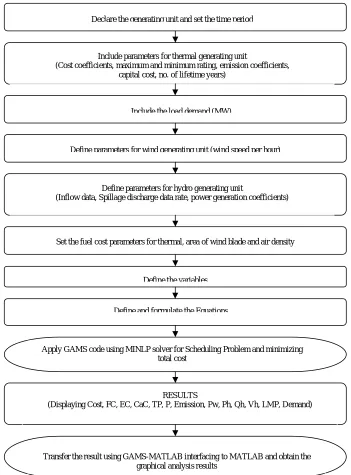
In this research paper, first step is to declare the number of generating units and set the time period for each generating unit as 24 hours comprising of short-term[6] generation scheduling problem. As this is hybrid generation scheduling including thermal, wind and hydro models so the other step is to define the parameters for thermal, wind and hydro generating units respectively. Data for thermal generating unit consists of cost coefficients, maximum and minimum rating of generating units, Emission cost coefficients, capital cost for each generating units and no. of the lifetime years for each of the generating unit respectively. The load demand in MW has been specified for 24 hours. For the wind generating unit, the important parameter that is to define is the total wind speed available hourly. In a hydro generating unit, power generating coefficients, the total inflow data, water spillage discharge rate have to be defined.
Fig. 2.1: General Research Methodology
Declare the generating unit and set the time period
Include parameters for thermal generating unit
(Cost coefficients, maximum and minimum rating, emission coefficients, capital cost, no. of lifetime years)
Include the load demand (MW)
Define parameters for wind generating unit (wind speed per hour)
Define parameters for hydro generating unit
(Inflow data, Spillage discharge data rate, power generation coefficients)
Set the fuel cost parameters for thermal, area of wind blade and air density
Define the variables
Define and formulate the Equations
Apply GAMS code using MINLP solver for Scheduling Problem and minimizing total cost
RESULTS
(Displaying Cost, FC, EC, CaC, TP, P, Emission, Pw, Ph, Qh, Vh, LMP, Demand)
Other miscellaneous parameters defined are fuel cost, sequestration cost parameters for thermal unit and area of wind blade and air density for wind generating unit. After defining all the parameters define variables and formulate the equations that are used to derive the model for scheduling. GAMS code using Mixed-Integer Non Linear programming (MNILP) has been applied for minimizing the total cost [1]. The complete methodology is represented by Fig. 2.1. The unit commitment and scheduling problem has been described in three cases, case 1 when all the units i.e. thermal, wind and hydro units are running. In case-2 there is only thermal and hydro units are running and case three describes when only thermal and wind units are running while hydro unit remains closed. Case 4, 5, and 6 discuss the comparison of total thermal power, emission cost and LMP. The results obtained are then transfer to MATLAB by GAMS-MATLAB interfacing to obtain graphical analysis.
III. SHORT TERM GENRATION SCHEDULING
Short-termgeneration scheduling problem is a crucial task in the economic operation of the power system. A good generation scheduling reduces the production cost, increases the system reliability, and maximizes the profit. The primary objective of the hybrid short-term generation scheduling problem is to minimize the total thermal cost while satisfying all the equality and inequality constraints. The hybrid systems studied here incorporates the wind uncertainties and has water availability in hydro units.
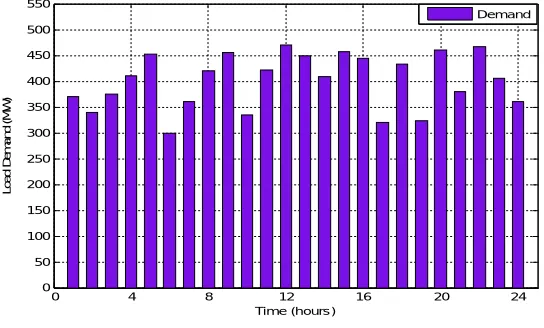
Fig. 3.1: Total Generation Scheduling Load Demand
In fig 3.1, the total load demand has been shown for each hour during generation scheduling of thermal, hydro and wind generating units. The generation is maximum by considering wind and hydro units having less operational and emission cost. Different cases have been studies and carried out as follows.
3.1 CASE 1: GENERATION SCHEDULING OF HYBRID SYSTEM DURING COMBINED
OPERATION
In this case a combination of wind, thermal and hydro units has been used to feed the modified load of IEEE 24 bus system. The thermal unit’s experiences increased number of start-ups and shutdowns, and periods of operation at low load and at high load levels. The fuel cost of generation is generally taken to be a linear, piecewise-linear, or a quadratic function of dispatched generation. The operating cost of thermal plant is very high, though their capital cost is low. On the other hand, the operating cost of hydroelectric plant is low, though their capital cost is high. Wind power is a green power. Moreover, the uncertainty and variability in wind power[7] can result in the reduction of efficiency and affecting generator starting. Thus, the scheduling study forms to be an efficient process to generate power in a hybrid generation system.
In Fig. 3.2, upper part shows the power generation of the 10 thermal generating units and lower part gives the power generation by hydro and wind units for the time span of 24 hours. The effect of hydro power generation and wind power can also be seen in the scheduling of thermal generating units. During operating hours 1 and 2, the hydro unit generates the power to meet the load demand by interconnection with the thermal unit and a small power is also being provided by the wind unit. The water discharge rate during these operating hours is very low such as the water is utilize
0 4 8 12 16 20 24 0
50 100 150 200 250 300 350 400 450 500 550
Time (hours)
L
o
a
d
D
e
m
a
n
d
(
M
W
)
to generate power in the absence of wind that happens in minimizing the operational cost as shown in fig 3.3. As wind power increase from 3h onwards and the hydro unit tend to store water for the future use as shown in lower part of figure 3.2. During the peak operating hours from 8 to 18 the wind availability is less, during this period the hydro units tends to generate power with respect to the thermal unit. It can be seen from the load demand that load is increasing during 8, 9, 12, 15, 16 and 18h and reaches above 450 MW.
3.2: Power Generation during combined operation of Hybrid system
At operating hour 19, the hydro unit remains closed as wind power generation is increasing and it shares the larger load. This shows that when there is no availability of water the interconnected hybrid plant does not generate power. This helps in reducing maintenance cost as well as the operating cost. As wind power increases from 21 to 24 hour, during this operational time period wind power is used to generate power as for the hydro unit is considered to be less corresponding to the thermal generating units and less emission cost. The total emission cost during hybrid generation is 1985.112 $/day.
Fig. 3.3: Total Water Discharge Fig. 3.4: Total Reservoir Volume
The total water discharge and reservoir volume during hybrid generation is as shown in the figure 3.3 and 3.4 respectively. It can be seen from the figure 4.3, that water discharge rate is maximum for the 3, 6, 7, and 21 operating hour and is minimum for the 4, 9, and 19h for which the hydro unit seem to be closed during these operating hours. As in the figure 4.4, the volume is reserved during these hours 4, 8, 9 and 19. The figure shows the maximum volume of water for the operating hours4, 8, 17 and 19th hour.
0 4 8
12 16 20
24 0 2 4 6 8 100 100 200 Time (hours) Generating Units T h e rm a l P o w e r (M W )
0 4 8 12 16 20 24
0 20 40 60 80 100 120 140 Time (hours) H y d ro a n d W in d P o w e r (M w
) PhPw
0 4 8 12 16 20 24
0 5 10 15 20 25 30 35 Time (hours) W a te r D is c h a rg e ( m 3 /s e c ) Qh
0 4 8 12 16 20 24
3.2 CASE 2: GENERATION SCHEDULING OF HYBRID SYSTEM WITHOUT WIND POWER
In this case, the hybrid system is scheduled without wind power. The wind generating unit remains closed and the power is generated through hydro and thermal generating units as shown in the figure 3.5. In this figure, the upper part shows the power generation of the 10 thermal generating units and lower part gives the power generation by hydro unit for the time span of 24 hours. Hydrothermal scheduling is required in order to find the optimum allocation of hydro energy and over the last decades this problem has been studied and discussed by many researchers.
Fig. 3.5: Power Generation without Wind Power
It can be seen from the figure that the generating units 7 and 8 are generating maximum power, the thermal generating unit 6, 3 and 10 also seem to generate more power but less than the 7 no unit. It is due to their low operational cost that these units tend to generate more to reduce overall cost corresponding to the total load demand for the 24 hours as shown in the figure 3.1. The unit no 5remains closed during the operational period as because of its high carbon cost and high operational cost.
As shown in figure 3.6, the hydro generating unit for operating hour 1 to 5h, the water discharge rate is less and during this period the hydro unit is generating the power satisfying the load demand. For the operating hour 5 the hydro unit remains closed and here the thermal unit is used to generate power. This is due to their less operational cost behaviour, results in minimizing the total production cost of the system. There is less of supply of generated power being given by hydro unit during the 19h as thermal unit fills the load demand by generating demandable power as shown in figure 3.1. As water level is increasing from 20h onwards, it helps in generating power by interconnection with thermal unit. Due to the unavailability of wind power, there is increase in the emission cost in comparison to emission cost of case 1
Fig. 3.6: Total Water Discharge Fig. 3.7: Total Reservoir Volume without Wind Power without Wind Power
0 4 8
12 16 20
24 0 2 4 6 8 100 100 200 Time (hours) Generating Units T h e rm a l P o w e r (M W )
0 4 8 12 16 20 24
0 20 40 60 80 100 120 140
Tim e (Hours )
H y d ro P o w e r (M W ) Ph
0 4 8 12 16 20 24
0 5 10 15 20 25 30 35 Time (hours) W a te r D is c h a rg e ( m 3 / s e c ) Qh
0 5 10 15 20 25
The total water discharge and reservoir volume for hydro unit during generation scheduling without wind power are as shown in the figure 3.6 and 3.7 respectively. It can be seen from the figure 3.6 that the water discharge rate is maximum during 2, 6, 7, 8 and 23h operating hour and is minimum for the 9 and 19h for which the hydro unit seem to be closed. As in the figure 3.7 the volume is reserved during these hours 4, 8, 9, 19 and 24. The figure shows the maximum volume of water for the operating hours4, 8, 17, 19and 24th hour.
3.3 CASE 3: GENERATION SCHEDULING OF HYBRID SYSTEM WITHOUT HYDROPOWER
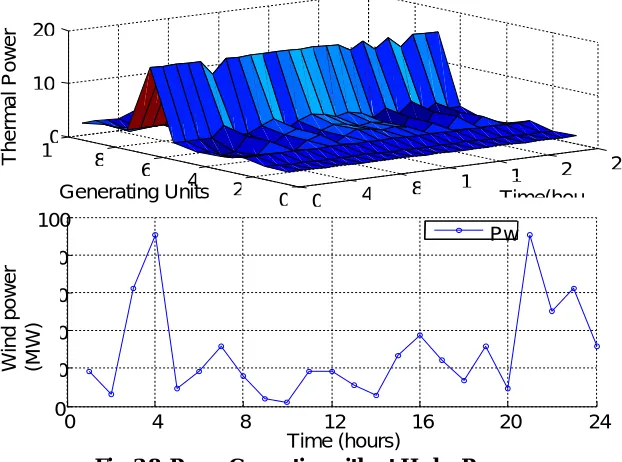
In this case, the hybrid system runs without the hydropower. The hydro unit remains closed during the operation and the power is generated through thermal and wind generating units. The optimal generation scheduling is as shown in figure 3.8, the upper part of the figure shows the thermal power generations and the lower part shows the wind power generation. As we all know the uncertain behaviour of the wind, the power generated by the wind plant depends upon the speed and availability of the wind. During operation all the thermal generating units are working and the 7, 8 and 10 generating unit generates more power due to their less operational cost. As the wind increase for the 3 and 4 h, the wind power uses to generate power and thermal unit seems to be generating less power and or stores fuel for future use as when wind power availability is below estimation or when the demand is high as shown in figure 3.8 lower. It is because during this period the operational cost of the generating units are very less and thus it reduces the overall system operation cost. During the peak load hours, 5-10 and 14-21 the wind availability is less so the thermal units operates in generation mode and satisfy the peak load demand. The optimal scheduling of the wind-thermal plant is as shown in figure 3.8
Fig. 3.8: Power Generation without Hydro Power
The presence of wind and thermal plant in a system reduces the overall system operation cost and also helps in reducing the load demand. The total emission cost during this scheduling period is 2628.328$/day that are much more increasing form the combined operation of thermal, wind and hydro.
3.4 CASE 4: TOTAL THERMAL POWER DURING GENERATION SCHEDULING OF HYBRID
SYSTEM
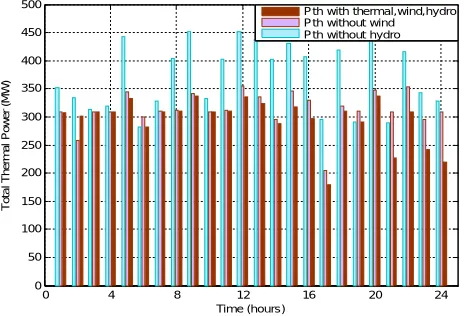
In this case, the comparison of the total thermal power that is generated during combination of thermal, wind and hydro generating units, total thermal power without wind unit and total thermal power without hydro unit for the hybrid system are being presented as shown in figure 3.9. The figure shows that during combined operation the total thermal power is being less as compare to other, that helps in less operational production cost for the system. During the peak hours, 6-11h and 14- 20h the thermal power is less that in turns reduces the peak demand. When there is no hydro unit
0 4 8 1
1 2 2
0 2 4 6 8 10 10 20
Generating Units
0 4 8 12 16 20 24
0 20 40 60 80 100
Time (hours)
Pw Time(hou
T
h
e
rma
l
Po
w
e
r
W
in
d
p
o
w
e
r
(MW
is connected to the system all the generating units operates and there is a huge increase in the thermal power that results in high operational cost and high carbon and emission cost
Fig. 3.9: Comparison of the Total Thermal Power under various Cases
Due to the less use of non-renewable fuel during combined operation in this hybrid system makes this eco-friendly and also being less maintenance and operational cost.
In table 3.1, the comparison data showing the scheduling results of the total thermal power for the time span of 24 hours.It is clear from the table 3.2 that when the proposed hybrid system consisting of thermal, wind and hydro units are interconnected or being scheduled to generate the power, the proposed hybrid generating units contributes less thermal power than the combination of thermal with hydro or thermal with wind individually which in turn reduces the overall operational cost consisting of fuel and emission costs. The efficiency of thermal unit is less since the use of thermal unit leads to much consumption of fuel and it further leads in higher operational cost because of the higher cost of fuel. In addition to this, there are emissions of harmful gases in the environment and which makes the same more polluted.
Table 3.1: Impact of Thermal Power during Hybrid Generation Scheduling for 24 hours
Time Period (hours)
Total Thermal Power (MW) with Thermal, Wind
and Hydro units
Total Thermal Power(MW) without
Wind
Total Thermal Power(MW) without Hydro
1 307.11 309 351.6
2 300.92 258.81 333.69
3 309 309 312.9
4 309 309 319.6
As the system generates less power during combined operation, this implies less emission cost, less wear and tear losses, less LMP and makes the system efficient.
3.5 CASE 5: EFFECT OF EMISSION COST
The overall cost of the power generating plant consists of emission, fuel, maintenance cost and some other miscellaneous cost. Majorly, it depends upon the fuel cost and emission cost. Figure 3.10 shows the comparison of emission cost for one day during hybrid generation. In this the emission cost is low, when all the hydro, thermal and wind generating units are interconnected with each other. In this figure, the emission cost is higher during the operating hours 5, 9, 12, 20 and 22h. It is because the load demand during these hours is high, and this leads to higher emission cost of the hybrid generating system, when the system operates without hydro power.
0 4 8 12 16 20 24 0
50 100 150 200 250 300 350 400 450 500
Time (hours)
T
o
ta
l
T
h
e
rm
a
l
P
o
w
e
r
(M
W
)
Fig. 3.10: Total Emission Cost under various Cases
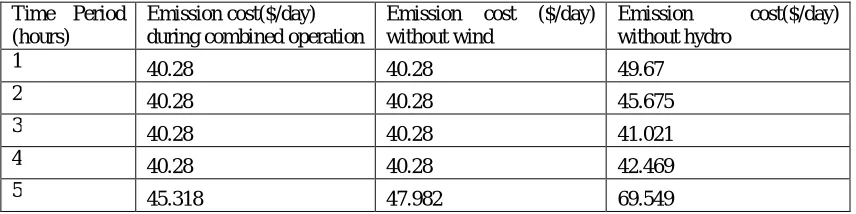
When there is a no hydro unit is connected and only thermal and wind units are operating the value of emission is very high because of the availability of wind is very low during peak hours and all the thermal generating units have to operate and thus the consumption of fuel is very high, this leads to higher emission cost. The emission cost data from the three cases when the entire thermal, hydro and wind units are operating together, when there is no wind generating unit and when there is no hydro generating unit respectively is shown in table 3.2.
Table 3.2: Total Emission Cost during Generation Scheduling of Hybrid System
Time Period (hours)
Emission cost($/day) during combined operation
Emission cost ($/day) without wind
Emission cost($/day) without hydro
1 40.28 40.28 49.67
2 40.28 40.28 45.675
3 40.28 40.28 41.021
4 40.28 40.28 42.469
5 45.318 47.982 69.549
It can be seen from table, when the proposed hybrid system consisting of thermal, wind and hydro generating units operates, the level of emission cost is less as compared to the other operation of hybrid system during combination of thermal with hydro or thermal with wind individually that in turns reduces the overall operational cost. In this hybrid system when the hydro unit remains closed and only thermal and wind generating units operates, the value of emission cost is very much high and leads to higher operational cost. This is because during this operation, all the thermal generating units have to operate due to the less availability of wind speed because of its uncertain behaviour during peak hours. Thus, the proposed hybrid system is efficient for generating power
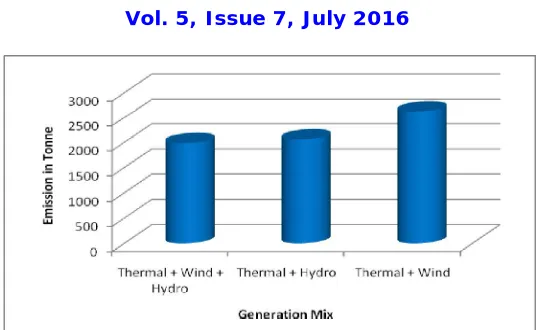
The figure 3.11 shows the total emission cost in tonne during the entire generation mix interconnection of thermal, hydro and wind generating units.
0 4 8 12 16 20 24
0 10 20 30 40 50 60 70
Time (hours)
E
m
is
s
io
n
C
o
s
t
($
/d
a
y
)
Fig. 3.11: Total Emission level for different Combination of Hybrid System
The value of emission is less when the scheduling[5] of thermal, hydro and wind operates and is equals to 1985.112 $/day.The value of emission is increasing when the wind unit remain closed, during this the value of emission is 2057.464 $/day. When there is no hydro unit operates and only thermal and wind power generating units are working the emission cost is much higher and thus increasing the overall cost. The emission cost value is 2628.328$/day.
IV.CONCLUSION
In this Paper, the methodology has been formulated for solving the generation scheduling problem of hybrid system comprising of hydro, thermal and wind. The constraints and parameters for hydro, thermal and wind units are defined according to the data rate and their maximum and minimum ratings. GAMS code corresponding to equations has been implemented to solve the problem. The results that are obtained showing the values of emission factor are less and discussed briefly in.
REFERENCES
[1] A. Brooke, D. Kendrick, A. Meeraus, R. Raman and R.E. Rosenthal, “GAMS: A user’s guide”, GAMS Development Corporation,
Washington, DC, 1998.
[2] K.P. Dahal, C.J. Aldridge, and S.J. Galloway, “Evolutionary hybrid approaches for generation scheduling in power systems”, European
Journal of Operational Research, 2006.
[3] S. Pereira, P. Ferreira, and A.I. Vaz, “Electricity planning in a mixed hydro-thermal-wind power system”, Sustainable Electricity Power
Planning conference, 2011.
[4] I.A. Farhat, “Optimization methods applied for solving the short-term hydrothermal coordination problem”, Electric Power System Research,
vol. 79, pp 1308-1320, 2009.
[5] H. K. Youssef and K. M. EI-Naggar, “Genetic based algorithm for security constrained power system economic dispatch”, Electric Power
System Research, vol. 53, no. 1, pp 47-51, 2000.
[6] A. A. EI Desouky, R. Aggarwal, M.M. Elkateb and F.Li, “Advanced hybrid genetic algorithm for short-term generation scheduling”, IEE
Proceedings – Generation, Transmission and Distribution, vol. 148, no. 6, 2001.
[7] C.L. Chiang, “Optimal economic emission dispatch of hydrothermal power system”, Electric Power and Energy Systems, vol. 29, pp 462-469,