ISSN 2286-4822 www.euacademic.org
Impact Factor: 3.4546 (UIF) DRJI Value: 5.9 (B+)
Rice Estate Development as State Owned
Enterprises (SOEs) to Self Supporting for Food
AMAR MA’RUF
Researcher and Lecturer in Agronomy, University of Asahan
CIK ZULIA
Researcher and Lecturer in Soil Science, University of Asahan
SAFRUDDIN
Researcher and Lecturer in Agribusiness Management University of Asahan
Abstract:
Rice has become the main staple food in Indonesia. In spite of a program for the diversification of food, demand for rice remains difficult unstoppable. The possibility of imports may continue to occur. That’s why programs need to increase rice production to achieve food security without imports. The increase in domestic rice production outline is done in two ways. First, the intensification of improving farming technologies, the extension is to expand agricultural land to increase production. For the creation of food security in a sustainable manner, the need for a special state that manages the cultivation of rice at a time to be partnering with rice farmers in Indonesia. Of course, the establishment of SOEs managers also oriented to the welfare of rice farmers. Therefore, affiliated with the ministry of agriculture as a key. SOEs could be soulution to the domestic demand for rice quota fulfilled even surplus, open a lot of jobs and spur the development of new technologies in the agricultural sector, have an enormous contribution to the clarification groove rice marketing. It took long-term strategy to build a broad-scale rice plantation under the management of SOEs. Provision of land and water resources so the strategy is essential.
INTRODUCTION
Rice has become the main staple food in Indonesia. In spite of a program for the diversification of food, demand for rice remains difficult unstoppable. The latest data show that in 2013 the average Indonesian people consume rice as much as 1,642 kg per week (Statistics Indonesia, 2015). For the average consumption per year, the authors perform calculations in a way 365/7 per week multiplied by consumption, the result is 85.62 kg per year. Although there are different figures from several sources, data from the Agriculture Ministry of Indonesia 124 kg per year. But according to the National Development Planning Agency (2015), household consumption and home meal that comes closest to reality, ie 114 kg per year. Data from Central Bureau of Statistics and the National Development Planning Agency (2015) cit. Anonymous (2014), the projected total population of Indonesia in 2015 reached 255.46 million. Thus, consumption of rice per year throughout Indonesia for this time being about 12.29 million tons.
To meet consumption value is so great, every year the government had to import rice from countries such as Vietnam, Thailand, China, Pakistan, and the United States. The value of imports is dynamic every year. In the last 5 years, the largest rice imports occurred in 2011 amounted to 2.75 million tons. The latest data show that in 2013 Indonesia imported more than 472 thousand tons. (Statistics Indonesia, 2015). The possibility of imports may continue to occur. That’s why programs need to increase rice production to achieve food security without imports.
CONCEPT IDEA
Second, the extension is to expand agricultural land to increase production. Obviously, the government of Indonesia through the Ministry of Agriculture has attempted to do so. Intensification is done through creating new technologies that increase productivity. As Legowo row planting system which is able to increase the yield of approximately 19.9 - 22% (Misran, 2014). But not in line with the extension. Over the years, the land area for rice cultivation even more decreased as a result of land conversion. Wetland converted into housing estates, industrial area, shopping, and so on. In fact, the impact of land conversion tends to be permanent. That is, the problem in the long term despite ongoing land conversion is not done. In contrast to other problems such as pest attack, drought, floods, and falling prices. The problems are only temporary or short periods (Irawan, 2008). Rice field is risky to convert. Most wetland for rice is land S1 class (very appropriate) and S2 (appropriately enough) that tend to have a flat topography so that it matches the function converted into residential, industrial areas, and more.
While still a staple food of Indonesian society, rice continues to act as a social commodity, economic, even political. Rice cultivation is a branch of production which regulates lives of many people. By doing so, management must continue to refer to the Undang-undang 1945 of the Republic Indonesia Article 33, which is in line with religious rules that human association in three things: water, grass (such as agriculture and animal husbandry), and fire (such as energy from fossil fuels ). For example, fuel is a necessity livelihood of many people, it is managed entirely by the state that can not be monopolized. In this case managed by PT Pertamina as the State Owned Enterprises (SOEs).
scientific and technical, construction, water supply and waste management, trading, mining, transportation, and of course agriculture.
For the creation of food security in a sustainable manner, the need for a special state that manages the cultivation of rice at a time to be partnering with rice farmers in Indonesia. Of course, the establishment of SOEs managers also oriented to the welfare of rice farmers. Shaped like PT Perkebunan Nusantara, stretching across Indonesia. This state can not stand alone. There needs to be affiliated with some other SOEs that supports the cultivation of land preparation, processing to marketing. Start SOE seed providers such as PT Sang Hyang Sri, a provider of fertilizers such as PT Pusri, water providers such as PT Perum Jasa Tirta I and II, to Bulog, and some other enterprises that can support the activities of rice cultivation large scale to hundreds of thousands or millions of hectares , Of course, also with several ministries to run synergistically with well-being in other fields.
Already there SOEs with the same style, namely PT Padi Energi Nusantara. The business entity is the result of a consortium of enterprises engaged in the agricultural industry. PT PEN helped make the farmers as partners to form a business entity owned by farmers. As already established, PT Energi Subang Agro Petani in Subang, West Java.
ANALYSIS
Build a rice farm with a large scale would require a long time and a lot of running budget. But it was outweighed by the advantages to be gained if it is already running. Some of these advantages are:
First, the domestic demand for rice quota fulfilled even
minimum of two harvests a year, it produces 8 tons per hectare per year. If the rice SOE managed to build 100 thousand hectares, has produced 800 thousand tons per year. Import 472 thousand tons already covered. 100 thousand hectares across Indonesia is a small number when compared to oil palm plantation area only in one province alone. Citing data from the Agricultural Research Indonesia (2011), in Riau Province vast oil palm plantations reached 1.78 million hectares. That is, the potential for building a rice plantation is more than 100 thousand hectares of very large. If Indonesia does not import rice prices more competitive national production so as to improve the welfare of farmers. The surplus can be exported commodities thus increasing the country's revenue.
Second, open a lot of jobs and spur the development of
new technologies in the agricultural sector. There are still many rice cultivation management is done traditionally. One reason for the knowledge of farmers who are not uniform in every place. If commodity rice is cultivated on an industrial scale under a single management, management and technology would have been the same. New technologies continue to emerge because it encouraged higher productivity. The technology must be transmitted to the local farmers. Assistance to farmers to grow. SOE rice acts as a nucleus, and the farmers in the vicinity is a plasma that deserves attention and assistance.
Third, have an enormous contribution to the
state-owned enterprises have the opportunity to anticipate the rice monopoly price.
The stages are very strategic in building rice SOE is providing the land and water installations. Through Presidential Decree No. 24 in 2010 and the Regulation of the Minister of Agriculture No. 61 / Permentan / OT.140 / 10/2010 form the Directorate General of Agricultural Infrastructures. One task is to expand the area under food crops. In the period 2011-2012, the Director General of Agricultural Infrastructures has scored new fields covering an area of 143 334 hectares or 88% of the target of 162 680 hectares. In 2013 an area of 65,000 hectares. While the target until 2025 required the addition of raw rice fields covering 2.66 million hectares (Subdit Expanding the Area of Food Crops Region, 2013). Of the targeted land area, should be partly managed by SOE rice. SOE is given in the form of land leasehold.
Provision of natural resources on land and irrigation facilities, should be in line with the provision of human resources (HR). During this time the rice is still a lot of traditionally managed. It's a problem. With the increasing need for rice, the traditional workforce even more decreased. Keep in modern technologies. Modern management technologies are certainly easier to implement if the cultivation of rice in the form of plantations. May refer through research results, or appropriate technology that has been applied to other countries. Also must cooperate with educational institutions, in this case the college.
CONCLUSION
essential. Therefore, affiliated with the ministry of agriculture as a key.
Indonesia relies on educational progress. Universities are expected to carry out research function optimally, while others create a master practitioner about the technical. Providing personnel starting at secondary school level, such as through vocational agriculture. The size of the government budget on education in line with the provision of human resources for state-owned rice. For example, the Directorate of Budget Formulation Indonesia, (2014) state for the Ministry of Education and Culture have reached 67.2 trillion rupiah. This figure does not include the institution related to education, such as the Ministry of Religious Affairs. Or ministry that intersect near the SOE rice, namely the Ministry of Agriculture.
REFERENCES
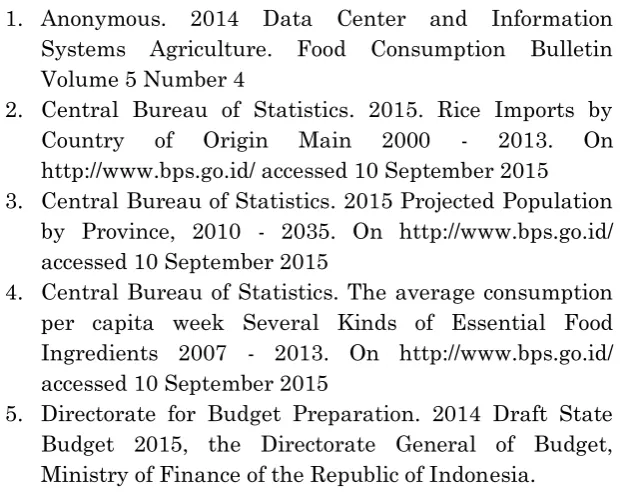
1. Anonymous. 2014 Data Center and Information Systems Agriculture. Food Consumption Bulletin Volume 5 Number 4
2. Central Bureau of Statistics. 2015. Rice Imports by Country of Origin Main 2000 - 2013. On http://www.bps.go.id/ accessed 10 September 2015 3. Central Bureau of Statistics. 2015 Projected Population
by Province, 2010 - 2035. On http://www.bps.go.id/ accessed 10 September 2015
4. Central Bureau of Statistics. The average consumption per capita week Several Kinds of Essential Food Ingredients 2007 - 2013. On http://www.bps.go.id/ accessed 10 September 2015
6. Hadi, P.U and Wiryono, Budi. Policy Impact Protection Against Rice Economy in Indonesia. Centre Socio Economic and Policy. Bogor
7. Irawan, Bambang. Conversion Wetland in West Java: Trends and Effect on Rice Production. Agricultural Research. On www.litbang.pertanian.go.id/ accessed 10 September 2015
8. Agricultural Research. Distribution Map Area of Oil Palm Plantations According Regency / City in the
province of Riau. On
http://perkebunan.litbang.pertanian.go.id/ accessed 10 September 2015
9. Misran. 2014. Study of the System Jajar Legowo against Rice Productivity Improvement. Journal of Applied Agricultural Research Vol 14 (2): 106-110 10.Ritung, Sofyan; Wahyunto; Agus, Fahmuddin; Hidayat,
Hapid. 2007. Land Suitability Evaluation Guide. Soil Research Institute and World Agroforestry Centre 11.Septian Deny. 2015 Minister of Planning: National Rice
consumption is only 28 million tons per year. Coverage 6. On http://bisnis.liputan6.com/ accessed 10 September 2015