Vol. 4, Issue 1, January 2015
Design an Interval Type -2 Fuzzy PI & PID
Controller for Nonlinear System
Indrajit Naskar1, Arabinda Kumar Pal 2
Assistant Professor, Dept. of AEIE, Heritage Institute of Technology, Kolkata, West Bengal, India 1
Associate Professor, Dept. of AEIE, Heritage Institute of Technology, Kolkata, West Bengal, India 2
ABSTRACT: An interval type-2 fuzzy logic controller (T2FLC) for nonlinear dead time process is proposed in this paper. Then PI & PID of T2FLC are applied to dynamic nonlinear system to analysis and comparative study of different performance parameter. Hence to comparative study of T2FLC with conventional T1FLC of different performance parameter such as rise time(tr),peak overshoot(% mp),settling time(ts) integral absolute error (IAE) and
integral-of-time multiplied absolute error(ITAE) are taken . In this work an improved performance of T2FLC is observed. A type-2 fuzzy controller is designed by blurried the membership function based on foot print of uncertaintities (FOU) and embedded four T1FLC.
KEYWORDS: interval type-2 fuzzy controller, IAE, ITAE, blurried the membership function, FOU, embedded four T1FLC
I.INTRODUCTION
Conventional PID controller and fuzzy logic system (FLS) constructed based on type-1 fuzzy logic controller (T1FLC) referred to as T1FLS have shown their ability in many applications, especially for the control of complex nonlinear systems that are difficult to model analytically but they cannot be successfully handled the uncertaintities[1] .We propose a type-2 fuzzy logic controller (T2FLC) to produce better system performance and to handle the uncertaintities more in compared to PID and type-1 FLC. We design an embedded four type-1 FLC to produce type-2 FLC in this paper. With advantages offered by type-2 fuzzy systems (T2FS) in handling uncertainties to control different parameter in nonlinear process applications, one major problem that adverse effects its wide-spread implementation in real-time applications is its high computational cost (Hameed, 2010). In order to reduce the above effects of T2FS, a simplified T2FS based on a hybrid structure [2] of four type-1 fuzzy systems (T1FS) and a fuzzy based linguistic approach is applied in this paper. To check the robustness and reliability of the new implementation type-2 FLC, then it is applied to control different parameter for a nonlinear system equipped with various types of uncertainties. Because of T1FS are certain in the sense that for each input there is a crisp membership grade, but T2FS characterized by membership grades that are themselves fuzzy [3].
Vol. 4, Issue 1, January 2015
behaviors for mobile robotics. Where a T1 FLC is optimized using the Particle Swarm Optimization algorithm to mimic a wall-following behavior performed by an operator. Next, an IT2 FLC is constructed by symmetrically blurring the fuzzy sets of the original T1 FLC (2011).Malik Manceur recently described a new second-order sliding-mode type-2 fuzzy controller for nonlinear uncertain perturbed systems.The control is based on the super-twisting algorithm, which is among second-order sliding-mode controls (SMCs) (2012).Michal Blaho, Martin Urban, Peter Fodrek, Martin Foltin described the network disadvantages as uncertainty and reduced them with type-2 fuzzy logic controller (2012). Yang Chen, Tao Wang investigated the interval type-2 fuzzy PID control under Gaussian and triangular primary membership functions for different nonlinear systems (2012) .Yazmin Maldonado1 and Oscar Castillo1 proposed the design of a Type‐2 Fuzzy Logic Controller (T2‐FLC) using Genetic Algorithms (GAs). The T2‐FLC was tested with different levels of uncertainty to regulate velocity in a Direct Current (DC) motor. (2013).Yang-Yin Lin, Jyh-Yeong Chang, Nikhil R. Pal, and Chin-Teng Lin, In this paper, a mutually recurrent interval type-2 neural fuzzy system (MRIT2NFS) is proposed for the identification of nonlinear and time-varying systems. The MRIT2NFS uses type-2 fuzzy sets in order to enhance noise tolerance of the system. In the MRIT2NFS, the antecedent part of each recurrent fuzzy rule is defined using interval type-2 fuzzy sets, and the consequent part is of the Takagi–Sugeno–Kang type with interval weights (2013).Ahmad M. El-Nagar *, Mohammad El-Bardini proposed an embedded real-time interval type-2 fuzzy proportional –integral – derivative (ITtype-2F-PID) controller which is a parallel combination of the interval type-type-2 fuzzy proportional – integral (IT2F-PI) controller and the interval type-2 fuzzy proportional – derivative (IT2F-PD) controller with uncertaintities The proposed IT2F-PID controller is implemented practically using a low cost PIC microcontroller for controlling the uncertain nonlinear inverted pendulum to minimize the effect of the system uncertainties and found significant improvement result (2014).This paper is organized in this way as follows. Section II describes type-1 FLC method .Section III presents type-2FLC for nonlinear process. Section IV gives the case studies with the proposed T2FLC PID/PI controller. The simulation results are compared between T1FLC and T2FLC .Finally last section presents conclusion and future scope of the works.
II. TYPE-1 FLC
The design of fuzzy controller are based on different step .In the first step fuzzy controller is to determine the inputs and the output of the fuzzy system where the error between reference and actual model output is e (t) and its time derivative are taken as the system input and the controller output is considered as fuzzy system output [6].The linguistic variable which are tabulated in table-1 in below are considered as the size of the input and the output. The shape of the membership function of these rules are a very important factor in the design of a controller .The shapes are trapezoidal ,bell curve function ,triangular function ,out of these shapes last one is taken as the shape of the membership function in this paper because of its simple computation method. The other important factor must be considered for the designs of membership function are the number of curve and their position .The input and output are normalized to vary between -1 to +-1 using the scaling factor of the gain in the simulation block .The linguishistic variable ‘PS’, ‘NS’ and ‘NB’,’PB’ are strongly influence the steady state error of the system and the initial undershoot, overshoot, respectively following disturbances. The magnitude of controller input is strongly influenenced by both error and the deviation error .The values which are commanding the fuzzy system response are shown in table .We select Mamdani method to implement the inference engine to improve the performance of PID & PI controller using min function method [13] .Bisection method is used for the defuzzification to convert the fuzzy output to the crisp output. To improve the robustness of the controller against parameter uncertaintities and external disturbances, the controller must be based on fuzzy logic. Where the error input dominates the output of the fuzzy control indicating that the fuzzy side of the controller has to compensate particularly the proportional gain under deficiency condition.
III. TYPE-2 FLC
Vol. 4, Issue 1, January 2015
handle linguistic uncertainties by modelling and unreliability of information, the amount of uncertaintities in a system could be reduced by T2FLS and now it is in a condition to outperform its T1 counterpart.
As it is known that the MF of a T2FS has a footprint of uncertainty (FOU), which represents the uncertainties in the shape and position of T1FS [16]. The FOU is bounded up by an upper MF (UMF) and by a lower MF (LMF), both of which are T1MF. Since the FOU of T2FS provides an extra mathematical dimension, they are very useful in circumstances where it is difficult to determine an exact membership grade for FS. Therefore, the amount of uncertainty in a system could be reduced by using T2FLS since it offers better capabilities to handle Fuzzy Controllers. Triangular type membership function of type -2 FS is done by (a) blurring the width of type-1 FS (b) blurring the centre of type-1 FS. Ability of T2FLS is to reduce the unwanted oscillation by the control surface of a T2FLS which is smothering than that of T1FLS especially around the origin which is added that of T1 counterpart. Due to small disturbances around steady state, the output of T2FLS will not produce significant control signal .As a result; this will minimize the amount of oscillation. So additional degree of freedom provided by the uncertaintities of T2FLS is used to handle modelling uncertaintities compared to conventional T1FLS.The performance of a designed controller of a model will naturally deteriorate after application to an actual plant due to unable to consider all the characteristics of the plant. Now if a controller T2FLS is designed to handle modelling uncertaintities would be effective [13].
Hence in this work, T2FLS could be obtained by blurring a T1FLS.Now the membership function with uncertaintities width is created by blurring its width and keeping its centre fixed compared to conventional T1FLS. So in this paper, for the sake of simplicity MF with uncertaintities width has been adopted. The performance of a designed controller of a model will naturally deteriorate after application to a actual plant due to unable to consider all the characteristics of the plant. Now if a controller T2FLS is designed to handle modelling uncertaintities would be effective.
A set of an infinite number of T1FS is the basic structure of T2FLS and the defuzzified output of T2FLS could be calculated by aggregating the centroid of the infinite number of embedded T1FLS.When the antecedent membership grade [16] in T2FLS have a continuous domain, the number of embedded T1FLS becomes uncountable. In this paper, for each T2FLS will be represented by its upper and lower bounds which are T1 membership function. Therefore, each two neighbour T2MFS will intersect in four points in compared with T1MFS with one point intersections. The four intersection points are named as upper points ,right points, lower points, left points which are shown in the following block diagram[8] .Membership function for the upper intersection points are constituted by the combination of the right side of the upper band of each T2MF with the left side of the upper bound of it neighbour .Similarly membership function for the lower intersection points are constituted by right side of the lower bounds of each T2MF with left side of the upper bound of each neighbour .In this way membership function of the four intersection points are constructed with each intersection point occurs equally likely to each of the intersection points. So the membership function for upper, right, lower, left intersection points will be used as input and output MF of the upper, right, lower, left fuzzy block respectively. The defuzzified output of T2FLS is then obtained by averaging defuzzified output of the resultant effect of the four embedded T1FLS. When the uncertaintities value equals zero, then four intersection points becomes one and as a result T2MF will behave like T1MF. According to the level of uncertainties detected in this system, T2FLS and T1FLS will vary in between them. Interval type -2 fuzzy systems consist of four stages; they are fuzzification, inference, type reduction, and defuzzification .The fuzzification maps a numeric value x=(x1……xp) T
x1.x2.x3…. xp= x on a type- 2 fuzzy set Ax in X where Ax is a singleton fuzzy set and if µA =1/1at x=x´ and µA at x≠x´
Vol. 4, Issue 1, January 2015
Table 1: 49 rules and 25 rules for seven term and five term type1 FLC and type-2FLC respectively
IV. RESULT
In this section we considered nonlinear processes with dead time to show the simulation results for T1FLC & T2FLC.To get clear comparison between T1FLC & T2FLC ,we measure several performance indices such as peak overshoot(%),rise time(tr),settling time(ts),IAE,ITAE are used. The values of the different performance indices are
listed in the table 2. Peak overshoot and settling is considerably reduced with nearly same rise time for the T2FLC in compared with T1FLC. Hence IAE and ITAE are of two important factor because of they reflect the transient and steady state characteristics of a control system respectively.
To setup the robustness of the proposed scheme for the above processes with different values of dead time we apply the same rule bases for both T1FLC and T2FLC and MF’s with Mamdani method. For the numerical integration we use fourth-order Runge–Kutta method with an interval of 0.01 s for the simulation of the processes.
To performance analysis of PID type both forT1FLC and T2FLC 1) Second order nonlinear process: the process transfer function
ӱ+ẏ+25y2 =u (t-L), using this nonlinear process with different dead time L=0.1, 0.3, and 0.5 with Ge =0.9,G∆e=11 at
t=30s in each case for the design of T1FLC & T2FLC based PID controller and PI controller for the same but with different values of Ge =0.9,G∆e=13.5 . The different values of the performance indices are listed in table 2 and 3 and
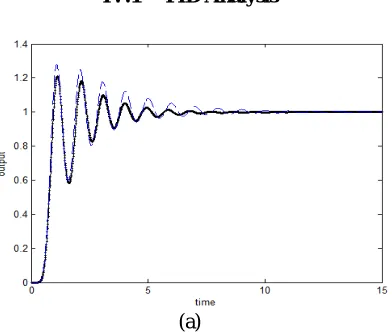
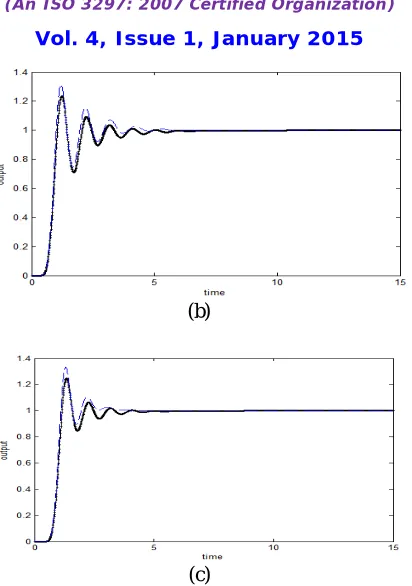
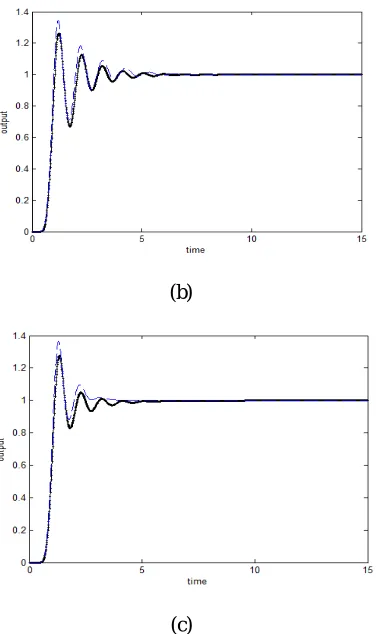
the response are shown in fig 4 and 5 with different dead time L=0.3, 0.4 and 0.5 both for T1FLC (PID&PI) and T2FLC (PID &PI) .It is clear from the comparison table that the T2FLC is shown better result than T1FLC both for PID and PI controller.
IV.1 PID Analysis
(a)
∆
NB NM NS ZE PS PM PBNB NB NB NB NB NM NS ZE
NS NB NM NM NM NS ZE PS
NM NB NM NS NS ZE PS PM
ZE NB NM NS ZE PS PM PB
PS NM NS ZE PS PS PM PB
PM NS ZE PS PM PM PM PB
PB ZE PS PS PB PB PB PB
∆
NB NM ZE PM PBNB NB NB NB MN ZE
NM NB NB NM ZE PM
ZE NB NM ZE PM PB
PM NM ZE PM PB PB
Vol. 4, Issue 1, January 2015
(b)
(c)
Fig 1 : ӱ+ẏ+25y2 =u(t-L) response with delay =0.3,0.4,0.5 in (a),(b),(c) where solid line and dotted line represented for T2FLC (PID)& T1FLC(PID) respectively.
Performance analysis for the nonlinear system (PID)
Table 2: numerical value to compare T1FLC (PID) and T2FLC (PID) with different values of delay 0.3, 0.4, 0.5 respectively
Non linear equation
Delay(L) Type of FLC
Rise time(tr) sec
Settling time(ts) sec
Peak overshoot (%)
IAE ISE ITAE ITSE
ӱ+ẏ+25y2
=u(t-L)
0.3 T2FLC 0.61 5.52 21.042 1.20 1.45 36.211 43.70 T1FLC 0.56 8.08 28.06 1.34 1.80 40.29 43.70 0.4 T2FLC 0.61 4.7 23.59 1.15 1.32 34.55 39.80
T1FLC 0.56 4.3 31.42 1.12 1.27 33.80 39.80 0.5 T2FLC 0.61 3.76 24.61 1.14 1.31 34.39 39.43 T1FLC 0.56 3.25 33.21 1.11 1.23 33.39 39.43
IV.2 PI Analysis
Vol. 4, Issue 1, January 2015
(b)
(c)
Fig 2 : ӱ+ẏ+25y2 =u(t-L) response with delay =0.3,0.4,0.5 in (a),(b),(c) where solid line and dotted line represented for T2FLC (PI)& T1FLC(PI) respectively.
Performance analysis for the nonlinear system (PI)
Table 2: numerical value to compare T1FLC(PI) and T2FLC(PI) with different values of delay
V. CONCLUSION
The proposed controller is designed based on interval type-2 fuzzy logic with footprint uncertaintities which is more effective than type -1. Our proposed type-2 fuzzy PI & PID controller exhibited effective and showed better performance than type-1 fuzzy based controller.
Non linear equation
Delay(L) Type of FLC
Rise time(tr) sec
Settling time(ts) sec
Peak overshoot (%)
IAE ISE ITAE ITSE
ӱ+ẏ+25y2
=u(t-L)
0.3 T2FLC 0.60 6.38 23.99 1.32 1.74 39.62 52.33 T1FLC 0.55 10.10 30.62 1.52 2.31 45.65 52.53 0.4 T2FLC 0.59 4.65 26.45 1.16 1.36 35.07 41.00 T1FLC 0.55 4.48 34.42 1.18 1.39 35.40 41.00 0.5 T2FLC 0.59 3.38 27.63 1.16 1.35 34.91 40.63
Vol. 4, Issue 1, January 2015
REFERENCES
[1] Malik Manceur, Najib Essounbouli, and Abdelaziz Hamzaoui “Second-Order Sliding Fuzzy Interval Type-2 Control for an Uncertain System With Real Application” IEEE transactions on fuzzy systems, vol. 20, no. 2, april 2012, pp-262
[2] Christopher Lynch, Hani Hagras, Victor Callaghan Department of Computer Science, University of Essex Wivenhoe Park, Colchester, CO4 3SQ, UK “ Embedded Type-2 FLC for the Speed Control of Marine and Traction Diesel Engines” Proceedings of the 2005 IEEE International Conference on Fuzzy Systems, Reno, USA, May 2005 © Essex University 2005 pp.347-353
[3] Yazmin Maldonado1 and Oscar Castillo1,* “Genetic Design of an Interval Type-2 Fuzzy Controller for velocity regulation in a DC Motor” International Journal of Advanced Robotic Systems ,jun,2012 DOI: 10.5772/51188
[4] Michal Blaho, Martin Urban, Peter Fodrek, Martin Foltin “Wireless network effect on PI and type-2 fuzzy logic controller” International Journal of Communications Issue 1, Volume 6, 2012
5) Erdal Kayacan, Okyay Kaynak, Rahib Abiyev, Jim Tørresen, Mats Høvin and Kyrre Glette “Design of an Adaptive Interval Type-2 Fuzzy Logic Controller for the Position Control of a Servo System with an Intelligent Sensor” WCCI 2010 IEEE World Congress on Computational Intelligence CCIB, Barcelona, Spain, July, 2010 ,pp18-23,
[6] Yang Chen,Tao Wang Department of mathematics and physics “Interval Type-2 Fuzzy PID Control and Simulation” 2nd International Conference on Electronic & Mechanical Engineering and Information Technology (EMEIT-2012) Liaoning University of Technology,
Jinzhou,121001,China
[7] Philip A.S. Birkin and Jonathan M. Garibald “A Comparison of Type-1 and Type-2 Fuzzy Controllers in a Micro-Robot Contex” ) FUZZ-IEEE 2009, Korea, August 20-24, 2009
[8] Yang Chen,Tao Wang ,Department of mathematics and physics “Interval Type-2 Fuzzy PID Control and Simulation” 2nd International Conference on Electronic & Mechanical Engineering and Information Technology (EMEIT-2012) ,Liaoning University of Technology,Jinzhou,121001,China email:chenyang—[email protected],[email protected]
[9] Ahmad M. El-Nagar *, Mohammad El-Bardini, Department of Industrial Electronics and Control Engineering, Faculty of Electronic Engineering, Menofia University, Menof ,32852, Egypt “Practical Implementation for the interval type-2 fuzzy PID controller using a low cost microcontroller”Ain engineering journal, 23 January ,2014
[10 Erdal Kayacan, Okyay Kaynak, Rahib Abiyev, Jim Tørresen, Mats Høvin and Kyrre Glette] “Design of an Adaptive Interval Type-2 Fuzzy Logic Controller for the Position Control of a Servo System with an Intelligent Sensor”
[11] Mohammad Biglarbegian, Student Member, IEEE, William W. Melek, Senior Member, IEEE, and Jerry M. Mendel, Life Fellow, IEEE “On the Stability of Interval Type-2 TSK ,Fuzzy Logic Control Systems”
[12] Yang-Yin Lin, Jyh-Yeong Chang, Member, IEEE, Nikhil R. Pal, Fellow, IEEE, and Chin-Teng Lin, Fellow, IEEE “A Mutually Recurrent Interval Type-2 Neural Fuzzy System (MRIT2NFS) With Self-Evolving Structure and Parameters” IEEE transactions on fuzzy systems, vol. 21, no. 3, june 2013 [13] Qilian Liang and Jerry M. Mendel, Fellow, IEEE, “ Interval Type-2 Fuzzy Logic Systems:Theory and Design” IEEE transactions on fuzzy systems, vol. 8, no. 5, October 2000,pp 535
[14Mohammad Biglarbegian, Student Member, IEEE, William W. Melek, Senior Member, IEEE, and Jerry M. Mendel, Life Fellow, IEEE “ On the Stability of Interval Type-2 TSK Fuzzy Logic Control Systems”
[15] Ondrej Linda, Student Member, IEEE, Milos Manic, Senior Member, IEEE “Comparative Analysis of Type-1 and Type-2 Fuzzy Control in Context of Learning Behaviors
for Mobile Robotics”,
[16] Leehter Yao and Yuan-Shiu Chen ,National Taipei University of Technology Taiwan “Type-2 Fuzzy Control of an Automatic Guided Vehicle for Wall-Following”
[17] Ibrahim A. Hameed, Claus G. Sorensen and Ole Green,Aarhus University, Foulum Research Centre, Blichers Allé 20, DK-8830, Tjele, Denmark “Building an Intelligent Controller using Simple Genetic Type-2 Fuzzy Logic System”