Available online: http://edupediapublications.org/journals/index.php/IJR/ P a g e | 156
Development of a Stable Dual Machine Transmitting System
using PSS and SVC
1
Vikram
Tewatia,
2Mukesh
Saini,
3Rajeev
Ratan
1M. Tech. student, MVN University, Palwal, Haryana, India
2AssociateProfessor,MVN University, Palwal, Haryana, India
3AssociateProfessor,MVN University, Palwal, Haryana, India
Corresponding Author EMAIL ID : [email protected]
Abstract
In the previous studies the effect of Static Var Compensator (SVC) and Power System Stabilizers (PSS) has not been considered specially for various faults in a three phase system. For improvement in inductive and capacitive power flows Shunt Flexible AC Transmission System (FACTS) devices can be used and when they are placed in the center of transmission line of a electrical power transmission network. We made models with different FACTS devices and also varied their location for reducing fluctuations in voltage and improvement in transient stability.
We have found that, shunt Static Var Compensator are best, so we have continued our research using shunt SVC. Again during our study we have found that if we slightly change the position of FACTS devices towards generator performance of the system improves but it eventually depends on load either local or of overall system. The work described here illustrates modeling of a simple transmission system containing two hydraulic power plants. A static var compensator (SVC) and power system stabilizers (PSS) are used to improve transient stability and power oscillation
damping of the system. The power system illustrated in this thesis is quite simple. However, the phasor simulation method allows the user to simulate more complex power grids. We have used MATLAB for the study of the system.
Key Words:
Displacement; Alienation; Colonial power; White rule
INTRODUCTION
Available online: http://edupediapublications.org/journals/index.php/IJR/ P a g e | 157 improves stability of system but enhanced
steady state flow control also.
Static Var Compensator (SVC) is the FACTS controller, which provides reactive impedance compensation that’s too at very high speed but only for finite length of time but this time is sufficient enough to provide voltage support. Its other advantages are minimization of power fluctuations and reduction in losses
By using MATLAB/SIMULINK I have shown here that Static Var Compensator (SVC) provides reactive compensation dynamically for voltage control fast acting dynamic reactive compensation for voltage support during any sudden change or any unseen event that may reduce voltage quality for a significant time.
Here we have modeled various line faults and effect of SVC and PSS to minimize voltage transient.
A. Introduction to Static Var Compensator:
The Static Var Compensator (SVC) is a shunt device of the Flexible AC Transmission Systems (FACTS) family using power electronics to control power flow and improve transient stability on power grids [1]. The SVC regulates voltage at its terminals by controlling the amount of reactive power injected into or absorbed from the power system. When system voltage is low, the SVC generates reactive power (SVC capacitive). When system voltage is high, it absorbs reactive power (SVC inductive). The variation of reactive power is performed by switching three-phase capacitor banks and inductor banks connected on the secondary side of a coupling transformer. Each capacitor bank is
switched on and off by three thyristor switches (Thyristor Switched Capacitor or TSC). Reactors are either switched on-off (Thyristor Switched Reactor or TSR) or
phase-controlled (Thyristor Controlled
Reactor or TCR).
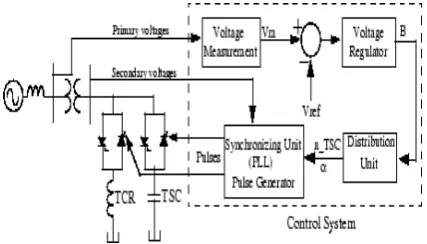
The figure 1 below shows a single-line diagram of a static var compensator and a simplified block diagram of its control system.
The control system consists of a measurement system measuring the positive-sequence voltage to be controlled. A Fourier-based measurement system using a one-cycle running average is used.
Figure 1: Single-line Diagram of an SVC and Its Control System Block Diagram
A voltage regulator that uses the voltage error (difference between the measured voltage Vm and the reference voltage Vref) to determine the SVC susceptance B needed to keep the system voltage constant. A distribution unit that determines the TSCs (and eventually TSRs) that must be switched in and out and computes the firing angle α of TCRs. A synchronizing system using a phase-locked loop (PLL) synchronized on the secondary voltages and a pulse generator that send appropriate pulses to the thyristors.
Available online: http://edupediapublications.org/journals/index.php/IJR/ P a g e | 158 simulation method, activated with the
Powergui block. It can be used in three-phase power systems together with
synchronous generators, motors, and
dynamic loads to perform transient stability studies and observe impact of the SVC on
electromechanical oscillations and
transmission capacity. This model does not include detailed representations of the power electronics, the measurement system, or the synchronization system. These systems are approximated rather by simple transfer functions that yield a correct representation at the system's fundamental frequency.
B. Introduction to the Generic Power System Stabilizer (PSS):
The Generic Power System Stabilizer (PSS) block can be used to add damping to the rotor oscillations of the synchronous machine by controlling its excitation. The disturbances occurring in a power system induce electromechanical oscillations of the electrical generators. These oscillations, also called power swings, must be effectively damped to maintain the system stability. The output signal of the PSS is used as an additional input (vstab) to the Excitation System block. The PSS input signal can be either the machine speed deviation, dw, or its acceleration power, Pa = Pm - Peo (difference between the mechanical power and the electrical power).
The Generic Power System Stabilizer is modeled by the following nonlinear system and is shown in figure 2:
Figure 2: The Generic Power System Stabilizer
To ensure a robust damping, the PSS should provide a moderate phase advance at frequencies of interest in order to compensate for the inherent lag between the field excitation and the electrical torque induced by the PSS action.
The model consists of a low-pass filter, a general gain, a washout high-pass filter, a phase-compensation system, and an output limiter. The general gain K determines the amount of damping produced by the stabilizer. The washout high-pass filter eliminates low frequencies that are present in the dw signal and allows the PSS to
respond only to speed changes. The phase-
compensation system is represented by a cascade of two first-order lead-lag transfer functions used to compensate the phase lag between the excitation voltage and the electrical torque of the synchronous machine.
A. Introduction to Multiband Power System Stabilizer:
The disturbances occurring in a power
system induce electromechanical
oscillations of the electrical generators. These oscillations, also called power swings, must be effectively damped to maintain the
system's stability. Electromechanical
oscillations can be classified in four main categories:
Local oscillations: between a unit and the rest of the generating station and between the latter and the rest of the power system. Their frequencies typically range from 0.8 to 4.0 Hz. Interplant oscillations: between two
electrically close generation plants.
Available online: http://edupediapublications.org/journals/index.php/IJR/ P a g e | 159 Inter area oscillations: between two major
groups of generation plants. Frequencies are typically in a range of 0.2 to 0.8 Hz.
Global oscillation: characterized by a common in-phase oscillation of all generators as found on an isolated system. The frequency of such a global mode is typically under 0.2 Hz.
The need for effective damping of such a wide range, almost two decades, of electromechanical oscillations motivated the concept of the multiband power system stabilizer (MB-PSS).
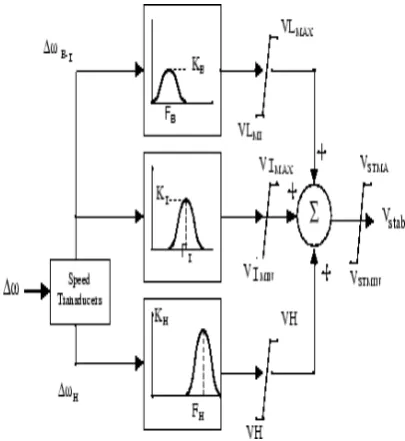
As its name reveals, the MB-PSS structure is based on multiple working bands. Three separate bands are used, respectively dedicated to the low-, intermediate-, and high-frequency modes of oscillations: the low band is typically associated with the power system global mode, the intermediate with the inter area modes, and the high with the local modes.
Each of the three bands is made of a differential bandpass filter, a gain, and a limiter (see the figure 3 called Conceptual Representation). The outputs of the three bands are summed and passed through a final limiter producing the stabilizer output Vstab. This signal then modulates the set point of the generator voltage regulator so as
to improve the damping of the
electromechanical oscillations.
To ensure robust damping, the MB-PSS should include a moderate phase advance at all frequencies of interest to compensate for the inherent lag between the field excitation and the electrical torque induced by the MB-PSS action.
Figure 3: Conceptual Representation
RESULTS & DISCUSSION
A. Circuit Description:
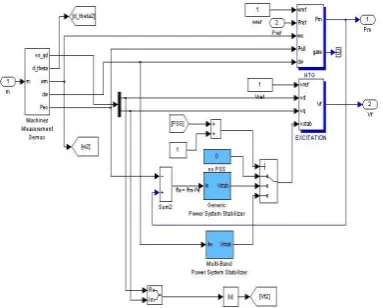
Available online: http://edupediapublications.org/journals/index.php/IJR/ P a g e | 160 subsystems.Two types of stabilizers can be
selected : a generic model using the acceleration power (Pa= difference between mechanical power Pm and output electrical power Peo) and a Multi-band stabilizer using the speed deviation (dw). The stabilizer type can be selected by specifying a value (0=No PSS 1=Pa PSS or 2= dw MB PSS) in the PSS constant block. During this experiment I have applied faults on the 500 kV system and observe the impact of the PSS and SVC on system stability.
B. Fault effect in Three-phase SVC - two PSS system
We will now apply a 3-phase fault and observe the impact of the SVC for stabilizing the network during a severe contingency. Put the two PSS (Pa type) in service (value=1 in the PSS constant block. Reprogram the 'Fault Breaker' block in order to apply a 3-phase-to-ground fault. Verify that the SVC is in fixed susceptance mode with Bref = 0. Start the simulation. By looking at the d_theta1_2 signal, i have observe that the two machines quickly fall out of synchronism after fault clearing. In order not to pursue unnecessary simulation, the Simulink 'Stop' block is used to stop the simulation when the angle difference reaches 3*360degrees. Now open the SVC block menu and change the SVC mode of operation to 'Voltage regulation'. The SVC will now try to support the voltage by injecting reactive power on the line when the voltage is lower than the reference voltage (1.009 pu). The chosen SVC reference voltage corresponds to the bus voltage with the SVC out of service. In steady state the SVC will therefore be
'floating' and waiting for voltage
compensation when voltage departs from its reference set point. Figure 4 shows the 2
machine SVC/PSS system and figure 5 shows the mechanical parts a 3 phase synchronous motor. Figure 6 shows the two machine SVC/PSS turbine regulator system.
Figure 4: A two machine SVC/PSS subsystem
Available online: http://edupediapublications.org/journals/index.php/IJR/ P a g e | 161
Figure 6: 2 machine SVC/PSS turbine regulator subsystem
C. Results
Figure 7 shows the Comparison of results of a 6 cycle 3 phase fault when PSS in service.
Figure 8 shows the sequences of voltages and line power graphs. In this work, the efficiency of shunt FACTS devices such as SVC was studied for improvement of the transient stability of a sample two-machine power system with different studies and investigation. The response of SVC to transients due to various faults in the three phase to ground error were investigated.
Figure8:VoltagesequencesB1‐B2‐B3&LinePowerGraph
Figure 7: Comparison of results of a 6 cycle 3 phase fault when PSS in service
Figure 8: Voltage sequences B1-B2-B3 & Line Power Graph
CONCLUSION
The work described in this work illustrates modeling of a simple transmission system containing two hydraulic power plants. A static var compensator (SVC) and power system stabilizers (PSS) are used to improve transient stability and power oscillation damping of the system. The power system illustrated in this work is quite simple. However, the phasor simulation method allows the user to simulate more complex power grids. The results depict that a system has been developed successfully for the stability of transients in a bi-machine transmission system with PSS and SVC.
References:
[1.] P. Kundur, Power System Stability
Available online: http://edupediapublications.org/journals/index.php/IJR/ P a g e | 162
[2.] Journal of Electrical Systems
Science and Engineering, Vol. 1, No. 1, pp. 1-8,2008.
[3.] N. G. Hingorani, L. Gyugyi,
Understanding FACTS: Concepts and Technology of Flexible AC Transmission Sidhartha Panda and N.P.Padhy, “Robust power system stabilizer design using particle swarm optimization technique”, International Systems, IEEE Press, New York, 2000.
[4.] Y. H Song, T. A. Johns, Flexible
AC Transmission Systems (FACTS), IEE, London, 2000.
[5.] R. M Mathur, R. K. Verma,
Thyristor-based FACTS Controllers for Electrical Transmission Systems, IEEE Press, Piscataway, 2002.
[6.] L. Gyugyi, “Reactive power
generation and control by thyristor circuits” IEEE Trans. Industrial Applications, Vol. IA-15, No.-5, pp.521-532, Sept./Oct. 1979.
[7.] L. Gyugyi, “Power electronics in
electric utilities: static var
compensators,” IEEE Proceedings, vol.76, No. 4, pp. 483-494, April 1988.
[8.] Acha, E., V.G. Agelidis, O.
Anaya-Lara and T.J.E. Miller, 2002. Power Electronic Control in Electrical
Systems, Newnes Power.