Parametric Patterns Inspired by Nature for
Responsive Building Façade
Mohammad Alshami
1,
Dr.Mohammad Atwa
2, Dr.Ahmad Fathy
3, Dr.Ahmad Saleh
4P.G. Student, Dept. of Architecture and Urban Planning, Faculty of Engineering, Suez Canal University, Ismailia, Egypt1
Professor, Dept. of Architecture and Urban Planning,Faculty of Engineering, Suez Canal University, Ismailia, Egypt2 Associated Professor, Dept. of Architecture and Urban Planning,Faculty of Engineering, Suez Canal University,
Ismailia, Egypt3
Assistant Professor, Dept. of Architecture and Urban Planning, Faculty of Engineering, Suez Canal University, Ismailia, Egypt4
ABSTRACT: Architects and designers developed in the past few years various methods of design; specially form generation techniques, inspiration and motivation sources were differed but most of them intended common goals such as achieve sustainability and utilize hi-tech and information technology.
In recent years generative systems in nature have become a source of inspiration for architects. Rather than viewing design as a top-down, linear, and goal-oriented procedure, they seek to understand underlying rules and principles of natural systems, which produce structural order and material organization of high complexity, efficiency, and beauty. This paper investigates how parametrically controlled systems can be applied to architectural design in order to achieve more responsive and adaptive modelling techniques.
KEYWORDS: Biomimicry, Parametric Design, Patterns, Responsive Architecture, Modulation.
I. INTRODUCTION
"Throughout history, architects have used nature for inspiration for their building form designs and approaches of decoration. From this point the emulation process of nature has begun and has been developed in many disciplines and recently recognized as "BIOMIMICRY".
With the innovation in the new architectural trend new methods of design needed to fulfil the complexity of nature geometries, shapes and form generation process, ways could apply the tools which could be used to emulate the algorithms of Nature. The appearance of digital tools applications specially "PARAMETRIC DESIGN TOOLS" and the huge development of computer aided design tools has been the answer to this quest.
Nature as an Inspiration Source: Nature allowed architects through biomimicry to emphasis their buildings with elements which are characterized by nature such as sustainability, survival, interaction, energy efficiency and structures and materials optimization, as well as interaction with the environment.
to adapt with nature, more friendly and more sustainable, better at consumption energy reduction and construction structures and materials optimization.
A. Problem of the Study
Architecture passed in the last years great steps toward new trends in design and form generation methods. Biomimicry Architecture is one of the most emerging trends in the 21st century. Hence there is a need to develop new design methods matches with contemporary architecture and develop a new methodology and design thinking to reduce the complexity of nature form finding.
B. Objectives of the Study
The main aim of this research is to develop an innovative way in which to create new design thinking through a combination of the biomimetic principles of design that relate to and inform the process of digital and parametric design. The desire, in its realization, is to reduce the complexity of both design and construction.
C. Methodology of the Study
In order to achieve the above – mentioned objectives, the researcher adopts two basic methods of research: • A Theoretical Review of the Biomimicry Utilities in Designand an Introduction of Parametric design. • An Analytical Study for Parametric design tools and its applications of biomimicry architecture. • Practical Studies of international and local experiments of biomimicry and parametric applications.
II. THE THEORETICAL ANALYTICAL METHODOLOGY
A. What is Biomimicry?
The term ‗biomimicry‘ first appeared in scientific literature in 1962, and grew in usage particularly amongst materials scientists in the 1980s. There has been an enormous surge of interest during the last ten years, brought about to a large extent by individuals like biological-sciences writer Janine Benyus, Professor of Biology Steven Vogel and Professor of Biomimetics Julian Vincent, who have all written extensively in this subject area. Julian Vincent defines it as ‗the abstraction of good design from nature‘; while for Janine Benyus it is ‗The conscious emulation of nature‘s genius. [1]
B. Nature Strategies and Targets
From wide observation to nature it's clearly obvious that nature concern about main objectives and basis to be achieved in formation, growth and during interaction with context which are:
1. Aesthetics 2.Efficiency 3. Ethics
[1] Aesthetics
Aesthetics have universal and personal appeal. Most people can agree on a beautiful proportion. But at the same time, one group can consider an item or a style to be beautiful while another is repulsed by it
[2] Efficiency
Being efficient is defined by the ratio of time and effort expended for the work being done, and nature is brilliant at balancing need with response. Nature equalizes design solutions that neither gain nor lose energy in the process of change.
[3] Ethics
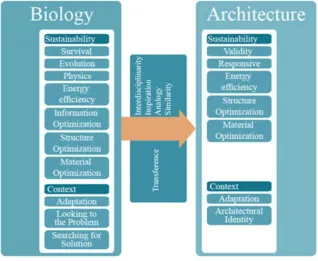
Fig. 1Transference from Nature to Architecture (Source: Researcher)
Fig. 1 showsthe transference methods of Nature Objectives to Architecture and what can architecture mimic from nature in order to solve architectural problems
C. Biomimicry Levels
Three levels of biomimicry that may be applied to a design problem are typically given as form, process and ecosystem. [2]
In studying an organism or ecosystem, form and process are aspects of an organism or ecosystem that could be mimicked. Ecosystem however is what could be studied to look for specific aspects to mimic.
There are three levels of mimicry;
1. Organism Level 2.Behaviour Level 3.Ecosystem Level
The organism level refers to a specific organism like a plant or animal and may involve mimicking part of or the whole organism.
The second level refers to mimicking behaviour, and may include translating an aspect of how an organism behaves, or relates to a larger context.
The third level is the mimicking of whole ecosystems and the common principles that allow them to successfully function.
1. Organism Level
Fig. 3: Matthew Parkes‘ Hydrological Center for the University of Namibia and the stenocara beetle.(Source: Biomimitics in Architecture, Petra Gruber) (Source Biomimcry in Architecture)
Fig. 2Matthew Parkes‘ Hydrological Center for the University of Namibia
2. Behaviour Level
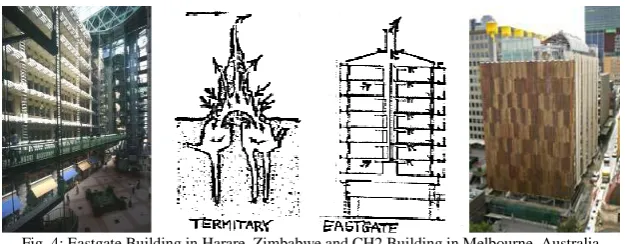
A great number of organisms encounter the same environmental conditions that humans do and need to solve similar issues that humans face. As discussed, these organisms tend to operate within environmental carrying capacity of a specific place and within limits of energy and material availability. These limits as well as pressures that create ecological niche adaptations in ecosystems mean not only adapted organisms continue to evolve, but also well-adapted organism behaviours and relationship patterns between organisms or species.[5]
Fig. 4: Eastgate Building in Harare, Zimbabwe and CH2 Building in Melbourne, Australia
In behaviour level biomimicry, it is not the organism itself that is mimicked, but its behaviour. It may be possible to mimic the relationships between organisms or species in a similar way. An architectural example of process and function biomimicry at the behaviour level is demonstrated by Mick Pearce‘s Eastgate.
D. Digital Architecture
Digital architecture uses computer modeling, programming, simulation and imaging to create both virtual forms and physical structure. It relies on "sets of numbers stored in electromagnetic format" used to create representations and simulations that correspond to material performance and to map out built artifacts
Digital architecture allows complex calculations that delimit architects and allow a diverse range of complex forms to be created with great ease using computer algorithms
What is the parametric design?
Equations are used to represent the relationships between objects. The ability to define, determine and reconfigure geometrical relationships is of particular value.‖[6]
E. Design Principles in Nature
Watching nature and how form in nature is found and the variety in form finding clarify that design in nature rely on principles such as:
1. Shape and Patterns 2. Form generation process
A framework for understanding the application of biomimicry covers Design in nature, parametric potential, grasshopper applications and architectural applications if found. Following; algorithm in nature which related to research subject will be discussed.
1. Form and Unity
a. Voronoi Algorithms
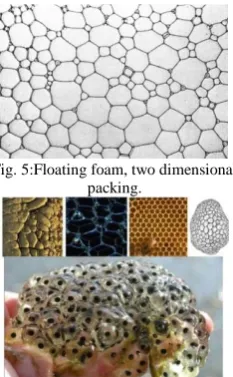
The Voronoi geometry is an organizational phenomena that is sometimes referred to as ―nature‘s rule.‖ It re-occurs at a variety of scales, materials, and life forms. Different examples are found in biology, mineralogy of formation principles geometry, and construction such as foams, sponges, bone structures and crystals.[7]
Fig. 5:Floating foam, two dimensional packing.
b. Parametric Potentials: Voronoi Algorithms
Voronoi diagram [8] is the partitioning of a plane with points into convex polygons such that each polygon contains exactly one generating point and every point in a given polygon is closer to its generating point than to any other. A Voronoi diagram is sometimes also known as a Dirichlet tessellation. The cells are called Dirichlet regions, Thiessenpolytopes, or Voronoi polygons. [9]
Fig 6Voronoi diagrams in biology and mineralogy of formation principles.
c. Patterns
Pattern in Nature
Patterns organize and define relationships in nature and can be integrated into design to substantiate and support visual communication. Because design‘s purpose is to create a relationship with the viewer, the language of pattern helps to frame what that relationship is before the message is read or even consciously processed.
Fig. 7Patterns in living Organisms Tessellation and Tiling in Architecture
Fig. 8 Geometrical studies and extracting the logic of a pattern by simple geometries.(Source: Generative Algorithms, ZubinKhabazi)
2. Responsive Modulation
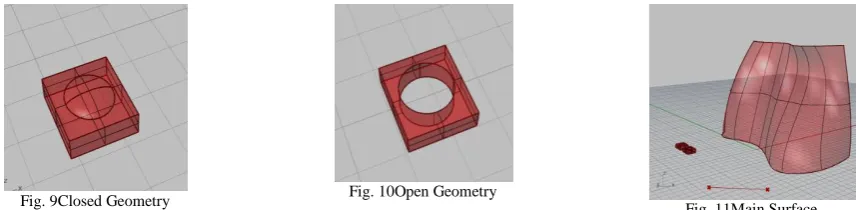
The idea for the next design experiment is to modulate a given surface with control over each module which means any module of this system, has to be responsible for some certain criteria. So even more than regional differentiation of the modules, here I want to have a more specific control over my system by given criteria which could be environmental, functional, visual or any other associative behaviour that we want our module be responsible for.
Fig. 9Closed Geometry Fig. 10Open Geometry Fig. 11Main Surface
Certify Units According to the angle between sun rays and each unit surface
Install the open and the closed geometries according to the Min and the Max angle needed(Source: Generative Algorithms, ZubinKhabazi)
Fig. 12 Divide surface into U, V
Fig. 13 Selected panel distribution Fig. 14 Final result
The final result is separately controlled patterns could be used in architectural applications with deferent geometries and shapes. This concept is more efficient for sustainability targets of natural lighting and ventilation.
III.EXPERIMENTAL RESULTS
Al.Bahar Tower Abu Dhabi
Fig. 15 Al.Bahar Tower Abu Dhabi Architect: Aedas
Location: Abu Dhabi, UAE, 2012
Fig 16responded opened shape Fig 17 responded closed shape
The Design responded with two towers inspired by traditional vernacular architecture, oriented technology, and bio-mimicry.
Fig. 16- 17: The screen was developed following the principles and geometric composition of the ‗mashrabiya‘ – a lattice shading screen common to the sunny regions of the Middle East – combined with the adaptive behaviour of natural organisms to the changing location of the sun and weather conditions
Grasshopper Application
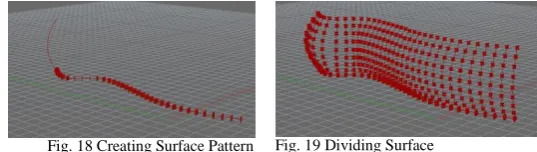
Fig. 18 Creating Surface Pattern Fig. 19 Dividing Surface
Curves Import drawn curve to Grasshopper through Parma categories.
Divide Surface From Surface category divide them with required U&V Direction
Fig. 20 Final result (Source: The researcher)
Design Problem
Construct a huge roof attached with stadium walls which covered with kinetic glass panels
rotating according to the sun ray angle.
Grasshopper Application
Fig. 23 Basic curve
Begin with primary element ( closed shape) drafted in rhino or imported from other CAD software
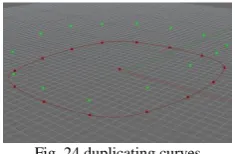
Fig. 24 duplicating curves
Divide curve - Move - Copy
From Curve bar divide the shape to points, then move these points individually in the Z direction according to the desired design to have the other curves
Fig. 25 dividing curves
Copy – Scale - Divide
From Curve category divide curves with constant points number
Fig. 26 creating cross section profiles
Create Lines – Fillet
From Curve category Fillet curves and create polylines in order to create the surface
Fig. 27 creating the surface
Loft
From Surface category loft curves with order
Fig. 28 Creating panels
Divide surface – morph 3D geometry on surface
From surface category divide surface with U & V modules
Fig. 29 Rotating panels with one angle value for each panel
Rotate – Constant angle
From surface category a divided surfaces could be installed according to the U & V modules with fixed axis to achieve the desired rotation angle.
Fig. 30 Solar analysis output in Grasshopper.
With data transference between Grasshopper and Autodesk Ecotectanalyzed values could be used with mathematical operations to calculate rotation angles required according to sun isolation to control day lighting and shades.
Fig. 31 Rotated Panels with different angle values(Source: The researcher)
King Abdullah
Financial District
Hotel Building
Architect: Norman Foster & Partners Location: Riyadh, Saudi Arabia
Fig 32 King Abdullah Financial District Hotel Building
Fig 33 King Abdullah Financial District Hotel Building perforated panel
Design Problem
Construct high rise Building with perforated panel in elevation respond to the environment to control daylight.
Grasshopper Application
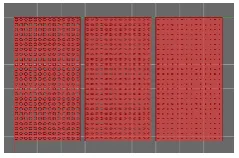
Fig 34 Three Perforated panels
Creating Geometry
In Grasshopper geometries could be created to be base patterns in order to be morphed on the surface.
Fig. 35 Dividing Surface
Divide Surface
From Surface category divide them with required U&V Direction
Fig. 36 Selected Surface panels
Selecting Modules
With a Repeated or random order panels could be selected from the set category with item selection components.
Fig. 37 Distributing panels according rooms use Fig. 38 Final Result (Source: The researcher)
Morphing Geometries
From transform category a divided surfaces could be morphed with geometry according to the U & V modules. Morphing other Geometries
With the same previous technique other geometries could be morphed on the rest of surface panels.
IV.CONCLUSION
pattern helps to frame what that relationship is before the message is read or even consciously processed. be extracted to create a nature mimicked design in art or architecture.
• Responsive Modulation: To modulate a given surface with control over each module which means any module of this system, has to be responsible for some certain criteria.
• Biomimicry problem based approach is more appropriate for architectural applications • Architects usually use all transfer methods between nature and architecture
• All biomimicry level could be used in the architectural process • Local inspiration sources usually emphasis the architectural identity • Local nature is more efficient in solving local problems
• Parametric design tools and mathematical methods in form finding help to get results more aesthetic, efficient, responsive and controllable.
• Parametric tools help to get more acceptable solutions for design problems
REFERENCES
1. Michael Pawlyn, Biomimcry in Architecture, RIBA, (2011), p. 2. 2. Innovation Inspired by Nature Work Book, Biomimicry Guild, April(2007). 3. Ravilious, K. Borrowing from Nature's Best Ideas. The Guardian, (2007) July 31. 4. Knight, W. Beetle fog-catcher inspires engineers. New Scientist, (2001) 13, 38.
5. Reap, J., Baumeister, D. & Bras, B. Holism, Biomimicry and Sustainable Engineering. ASME International Mechanical Engineering Conference and Exposition.Orlando, FL, USA. (2005)
6. Mark Burry, ‗Paramorph‘, (1999)
7. http://www.many.org/index.php?option=com_content&task=view&id=14&Itemid=34
8. In mathematics, a Voronoi diagram, named after Georgy Voronoi, also called a Voronoi tessellation, a Voronoi decomposition, or a Dirichlet tessellation (after Lejeune D irichlet), is a special kind of decomposition of a metric space determined by distances to a specified discrete set of objects in the space, e.g., by a discrete set of points.
9. Aurenhammer, Franz (1991). Voronoi Diagrams - A Survey of a Fundamental Geometric Data Structure. ACM Computing Surveys, 23(3):345-405, 1991.
BIOGRAPHY