Copyright 0 1994 by the Genetics Society of America
The Maize
NCS2 Abnormal Growth Mutant
Has
a Chimeric nad4-nad7
Mitochondrial Gene and Is Associated With Reduced Complex I Function
Joachim R. Marienfeld' and Kathleen J. Newton
Division of Biological Sciences, University of Missouri, Columbia, Missouri 65211
Manuscript received June 6, 1994 Accepted for publication July 18, 1994
ABSTRACT
The molecular basis of the maternally inherited, heteroplasmic NCS2 mutant of maize was investigated. Analysis of the NCS2 mtDNAshowed that it closely resembles the progenitor cmsT mitochondrial genome, except that the mutant genome contains a fused nad4-nad 7gene and is deleted for the small fourth exon of nad4. The rearrangement has occurred at a 16-bp repeat present in the third intron of the nad4 gene and in the second intron of the nad7 gene. Transcripts containing exon 4 of the nad4 gene are greatly reduced in mtRNA preparations from heteroplasmic NCS2 plants; larger transcripts are associated with the first three nad4 exons. Identical 5' ends of the nad4 transcripts have been mapped 396 and 247 bp upstream of the start codon in mtRNAs from both NCS2 and related non-NCS plants. The putative transcription termination signal of nad4 is deleted in mutant DNA, resulting in the production of the unique longer transcripts. The complex transcript pattern associated with nad7 is also altered in the mutant. Both nad4 and nad 7encode subunits of complex I (NADH dehydrogenase) of the mitochondrial electron transfer chain. Oxygen uptake experiments show that the functioning of complex I is specifically reduced in mitochondria isolated from NCS2 mutant plants.
M
ITOCHONDRIAL mutations affecting the oxida- tive phosphorylation pathway have rarely been described in plants, although a number have been ana- lyzed in animal and yeast systems (reviewed by CON-STANZO and Fox 1990; WALLACE 1992). The organization
of the respiratory chain in plant mitochondria differs in important ways from those of animal and yeast mito- chondria (reviewed by DOUCE and NEUBERGER 1989). There is an alternative terminal oxidase and, in addition to the rotenone-sensitive complex I, there are at least two other NADH dehydrogenases.
A genetic approach to the study of mitochondrially coded components of plant mitochondrial function is provided by the nonchromosomal stripe (NCS) mutants of maize. This is a class of maternally transmitted mu- tations (SHUMWAY and BAUMAN 1967; COE 1983) that ex- hibit abnormal characteristics in nearly all tissues throughout the life cycle of the plants. Because the mu- tations are associated with lethality during kernel de- velopment, plants are viable only if they contain normal mitochondria, in addition to mutant mitochondria
(NEWTON and COE 1986). The heteroplasmic NCS plants segregate defective sectors somatically and such sectors can be homoplasmic for the mitochondrial mutations (Gu et al. 1993). We have previously described two in- dependent mutations (NCS5 and NCS6) in the cyto- chrome oxidase subunit 2 ( ~ 0 x 2 ) gene, a component of complex N of the respiratory chain (NEWTON et al. 1990, LAUER et al. 1990). Here we report the molecular basis
' Present address: Institut fiir Genbiologische Forschung, IhnestraBe 63, 14195 Berlin, Federal Republic of Germany.
of NCS2, which we have determined to be a complex I mutation. It has interesting phenotypic and molecular distinctions from the cox2 mutants.
The NCS2 mutant arose spontaneously in maize plants carrying the male sterile Texas type cytoplasm (cmsT) (COE 1983). NCS2 plants are characterized by pale green leaf striping, sectors of aborted kernels on the ears, and by a reduction in overall plant growth (COE 1983; NEWTON and COE 1986, NEWTON et al. 1989). NCS2 differs from NCS5 and NCS6 mutant phenotypes in that the stripes in NCS2 are somewhat greener and the kernels abort at a later stage. The phenotypic differences initially suggested to us the possibility that the NCS2 mutation adversely affects either a different mitochondrial process, or an enzy- matic function other than cytochrome oxidase in oxi- dative phosphorylation.
Earlier molecular characterizations showed that mi- tochondrial DNA (mtDNA) isolated from NCS2 plants has a novel 21-kb XhoI restriction fragment and greatly reduced amounts of a normal 8-kb band (NEWTON and COE 1986). Further investigations showed the novel re- striction fragment to be composed of sequences nor- mally present on the 8- and 15-kb XhoI restriction frag- ments (FEILER and NEWTON 1987). None of the mitochondrially encoded cytochrome oxidase subunits maps to this region of the cmsT genome (FAURON et a2. 1990), and
RNAs
for all of the plant mitochondrial genes identified at the time were found to be present at normal levels in NCS2 mitochondria (FEILER and NEWTON 1987). However,RNAs
that hybridized with probes from the856 J. R. Marienfeld and K J. Newton
rearranged region of the genome were shown to be ab-
normal in NCS2 plants.
In this study, we report that NCS2 is a mutation in components of t h e first complex of the mitochondrial electron transport chain. The molecular basis of the
NCS2 mutation is shown t o be a rearrangement inter-
rupting the coding sequence for the NADH dehydro- genase subunit 4 ( n a d 4 ) , a constituent complex I. T h e rearrangement occurs between intron sequences of the
n a d 4 gene and sequences corresponding to an intron of n a d 7 . Sixteen base pairs of homology are seen at the junction of the rearrangement, suggesting that recom-
bination at a very small repeat leads to t h e rearrange-
ment. The rearrangement replaces the 3' end of the
n a d 4 g e n e with sequences from the n a d 7 gene, result- ing in longer transcripts. We also show that the func- tioning of complex I is abnormal in NCS2 plants, a find- ing that is consistent with the molecular data. This is the first complex I mutation described in a higher plant.
MATERIALS AND METHODS
Plant materials: The NCS2 mutation arose spontaneously in maize plants carrying the cmsT cytoplasm in a WFS-derived nuclear background (COE 1983; NEWTON and COE 1986). Con- trol plants used in this study were descendants of phenotypi- cally normal plants (normal derivatives) arising in NCS fami- lies (FEILER and NEWTON 1987; NEWTON et al. 1989).
Isolation of mtDNA and RNA Mitochondria were isolated from unpollinated ear shoots (at the time of silk emergence) using differential centrifugation and sucrose step gradients as described by NEWTON (1993). mtDNA was obtained from mi- tochondria by Proteinase Kdigestion and subsequent lysiswith sodium dodecyl sulfate (SDS) after DNase I treatment (NEWTON 1993). For isolating maize mtRNA, the protocol of STERN and NEWTON was used (1986).
Sequencing of NCS2 mutant DNA: A partial sequence of the NCS2 mutant DNA was generated from the pMHl clone (FEILER and NEWTON 1987) using the Sequenase I1 kit ( U S Biochemical Corp.) and specific primers. The pMHl clone contains a novel 11-kb HindIII fragment that spans the rear- rangement site. A 554bp region of the pMHl sequence was compared with that of the cmsT normal nad4 region, which was cloned and sequenced as previously described ( W E N -
FELD and NEWTON 1994). A 7.5-kb Psi1 fragment internal to the
15-kb XhoI restriction fragmentwas subcloned from the IIIF,-T cosmid of cmsT mtDNA provided by C. FAURON. It was partially sequenced and was compared with the sequences of pMHl and the wheat nad7 gene (BONEN et al. 1994).
DNA and RNA gel blot analyses: Purified mtDNAs were di- gested with appropriate restriction enzymes according to sup- plier's recommendations and restriction fragments were sepa- rated on 0.7% agarose gels. Gels were blotted onto nylon membrane and hybridized as described earlier (FEILER and NEWTON 1987). RNAs were separated on 1.2% formaldehyde/ agarose gels and blotted onto nylon membranes (STERN and NEWTON 1986). DNA bands to be used as probes were excised from agarose gels and radioactive probes were generated using the random priming technique (Oligolabeling kit, Pharmacia Biotech Inc.). Probes were separated from unincorporated nucleotides utilizing Elutipd columns (Schleicher & Schuell) prior to hybridization.
Oligonucleotides used for DNA and RNA gel blot hybrid- izations were end-labeled with [y3'P]ATP (Amersham Corp.,
Arlington Heights, Illinois) using standard techniques (SAMBROOK et al. 1989). Unincorporated nucleotides were removed by one round of ethanol precipitation.
The following genomic clones were used as probes in hy- bridizations with gel blots: nadl (Oenothera, WISSINGER et al. 1991); nad.5 (Oenothera, WISSINGER et al. 1988); nad7 (wheat, BONEN et al. 1994). An exon 3 probe from the wheat nad 7gene was generated by isolating a 150-bp KpnI/EcoRI fragment from the H221 clone provided by L. BONEN. An exon 1 probe from the maize nad4 gene was isolated as a 600-bp PvuII/
HindIII fragment from the &kb XhoI clone (WENFELD and NEWTON 1994).
Oligonucleotides used as probes and primers: PRnad4-1:
CACGGGACAGAGAATAGGACACTTAGATC; PRnad4-3
CTCCGATCTAAATGGCAG; PRnad4-4: TACGGATGTATG CATGCAGTCCGGGAACAC; PRl : CCATAGTTCTTCCGT- GCGTC; PR2: TGATCGTGTCATGTGCAACG; PR3: TTA- ATCGGCCCTAAGGGAG; PR4: TCCATGGCGAAGCATC; PRlink: GACTCGAGTCGACATCG; PRlink(dT): GACTC-
GAGTCGACATCGTTTTTTTTTTTTTTTTT.
Anchored polymerase chain reaction (PCR): The 3' end of nad4 transcripts was characterized by anchored PCR (FROHMAN et al. 1988; WISSINGER et al. 1991) with modifications. Approximately 10 pg of mtRNA were incubated in a tailing reaction with 50 mM Tris-CI, pH 7.9, 10 mM MgCI,, 2.5 mM MnCI,, 250 mM NaC1,50 pg/ml bovine serum albumin (BSA), 5 mM dithiothreitol (DTT), 250 ~ M A T P , 100 units RNasin, and
0.5 units Escherichia coli poly(A)-polymerase at 37". Aliquots were taken after 15, 30 and 60 min, and the reaction was ter- minated by bringing the reaction mix to 20 mM EDTA. Samples were pooled, extracted with phenol/chloroform/isoamyl al- cohol 25:24:1 (PCI), and ethanol-precipitated. The poly(A)- tailed mtRNA was incubated with 500 ng of a oligo(dT),, primer for 10 min at 70" and then chilled on ice. The reverse transcription reaction contained 20 mM DTT, 0.5 mM dNTP, 20 units RNasin in reverse transcriptase buffer (50 mM Tris-Cl, pH 8.3,75 mM KC1,3 mM MgC1,). After incubating the mix for
2 min at 37", 200 units of reverse transcriptase were added and the reaction proceeded for 60 min at 37". After extraction with PC1 and ethanol precipitation, the cDNA was resuspended in 50 pl ultrapure water. The PCR reaction contained one-tenth of the single-stranded cDNA in 50 mM KCl, 10 mM Tris-C1, pH 8.3, 1 mM dNTP, 2 mM DTT, 5 mM MgC1, and 2.5 units of AmpliTaq DNA polymerase (Perkin-Elmer)
.
Primers used in the reaction were 50 pmol PRlink, 20 pmol PRlink(dT) and 50 pmol PRnad4-3). PCR was carried out for 40 cycles with 1 min at 94", 2 min at 40", and 3 min at 72". Following polishing ofthe ends with T4 DNA polymerase (5 units, 15 min) and ex- traction with PCI, the PCRproducts were ethanol-precipitated. Ends were phosphorylated in 50 mM Tris-C1, pH 7.6, 10 mM MgCI,, 5 mM DTT, 0.1 mM spermidine, 0.1 mM EDTA, 50 pg/ml BSA, 400 FM ATP, and 5 units of T4 polynucleotide kinase (30 min, 37"). The enzyme was inactivated (20 mM EDTA, 65" 10 min) and the sample was ethanol precipitated. Products were ligated into bluntended pBluescript vector (Stratagene) and transformed into E . coli cells. Positive clones were identified by colony screening using PRnad4-4 as a probe.
mtDNA Mutation Mecting Complex I
the 8-kb XhoI clone as template and (ii) using M13 forward primer on Bluescript KS- vector (Stratagene) were run on the same gel.
Reverse transcription-PCR For the detection of NCS2- specific transcripts highly purified mtRNA from normal and NCSZ plants was reverse transcribed with Superscript Reverse Transcriptase (Life Technologies, Inc.) using random primer hexamers as described in MARIENFELD et al. (1993). The re- sulting single-stranded cDNA was used as a template for PCR amplification of specific fragments representing the nad4
transcript, the NCS2 specific transcript, and the transcript of the gene localized on the 15kb XhoI restriction fragment.
Oxygen consumption experiments Oxygen uptake mea-
surements for analyzingcomplex I (EC 1.6.19.3) function were performed at 25" utilizing a Rank oxygen electrode with cham- ber (Rank Brothers, Cambridge, United Kingdom) following standard procedures (RICKWOOD et al. 1987). Oxygen concen- tration in air-saturated medium was assumed to be 240 p ~ .
Gradient-purified mitochondria were resuspended in 2 ml me- dium A (0.4 M mannitol; 10 mM N+HPO,/NaH,PO,, pH 7.2;
Oxygen uptake was induced by adding different substrates fol-
lowed by addition of 1 mM ADP to maintain state 3 conditions.
All substrates were used in a final concentration of 10 mM,
except for NADH, which was 1.0 mM. An analysis of variance was performed using the general linear models (GLM) pro- gram from the Statistical Analysis System (SAS, 1985). Num-
bers of samples for normal mitochondria were n = 16 for malate, n = 7 for succinate, n = 6 for NADH. Numbers of samples for NCSZ mitochondria were n = 11 for malate, n = 6 for succinate, n = 6 for NADH.
5 mM MgCI,; 5 mM KCI; 1 mM EDTA, 25 mM HEPES, pH 7.2).
RESULTS
Identification of the genes altered by the NCS2 mu-
tation: Correlated with the appearance of the novel
21-kb XhoI restriction fragment in NCS2 mitochondrial DNA is the specific reduction in the amount of the nor- mal 8-kb XhoI restriction fragment (NEWTON and COE 1986). The 8-kb XhoI restriction fragment was cloned and sequenced, as was the 5.5kb HzndIII/PstI frag- ment, which overlaps its 3' end. Comparison of the nucleotide and deduced amino acid sequences to the GenBank database identified this region of the cmsT genome as the maize gene for the subunit four of the complex I NADH dehydrogenase (nadl; MARIENFELD
and NEWTON 1994).
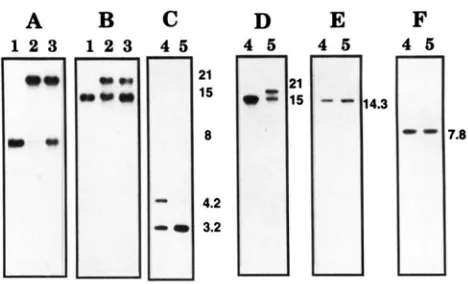
A specific probe for the exon 1 of the maize nad4 gene hybridizes to the novel 21-kb XhoI fragment in mtDNA preparations from NCS2 plants. Reduced levels of hy- bridization with the 8-kb XhoI fragment, carrying the first three exons of the normal nad4 gene, are also seen (Figure 1A). The level of this reduction correlates with the extent of the phenotypic defectiveness of the plant from which the mtDNA was extracted. The novel 21-kb XhoI restriction fragment is composed of sequences nor- mally present on a 15kb, as well as on the 8-kb XhoI fragment (FEILER and NEWTON 1987 and Figure 1B). However, the reduction in the 15-kb XhoI restriction fragment is never as great as the reduction in the 8-kb XhoI restriction fragment (cf. Figure 1, A and B). A 30- nucleotide probe specific for exon 4 of the maize nad4
A
B
C
D
E
1
857
F
FIGURE 1.-XhoI restriction fragment differences in mtDNA isolated from NCS2 and related non-mutant plants. ( A X ) DNA blots probed with regions of maize mtDNA involved in
the NCSP rearrangement: (A) the 8-kb XhoI fragment con-
taining nad4 exons 1-3; (B) a 7.5-kb PstI fragment internal to the 15kb XhoI band-reprobing blot& (C) a maize nad4 exon
4-specific primer (PRnad4-4). (D-F) Probed with other NADH dehydrogenase genes: (D) genomic wheat nad7; (E) Oeno-
thera nad5; (F) Oenothera n a d l . Lanes 1 and 4, mtDNA from "normal" (cmsT) relatives; lanes 2 and 5, mtDNA from very affected NCS2 plants. Lanes 3, mtDNA from moderately af- fected NCSZ plants. Fragment sizes in kilobases were calcu-
lated by comparison to marker fragments (not shown).
gene (PRnad4-4), hybridized to the 4.2-kb XhoI restric- tion fragment that is adjacent to the 8 k b XhoI fragment (see FAURON et al. 1989). The 4.2-kb XhoI fragment is specifically reduced in the mtDNA from NCS2 plants and is not included on the 21-kb novel XhoI fragment (Figure 1C). Thus, the last exon of nad4, that is con- tiguous with the first three exons, appears to be missing from the mutant genome. Residual levels of hybridiza- tion to the normal 8- and 4.2-kb XhoI fragments in NCS2 mtDNA is due to the heteroplasmic nature of the NCS2 plants. The exon 4 oligonucleotide probe also hybrid- izes with a 3.2-kb XhoI fragment that is not reduced in mutant samples (Figure 1C). This indicates that se- quences homologous to exon 4 of nad4 are repeated elsewhere in the mitochondrial genome and that they are not involved in the NCS2 mutation.
After determining that the NCS2 mutant mitochon- drial genome has a rearranged nad4 gene, it was of in- terest to investigate whether other mitochondrially en- coded subunits of the NADH dehydrogenase complex were also altered. Therefore, DNA blot analyses utilizing mitochondrial genomic probes for nadl (Oenothera, WISINCER et al. 1991) nad5, (Oenothera, WISSINGER et al.
1988), and nad7 (wheat, BONEN et al. 1994) were per- formed. The probes for nad5 and nadl did not detect any differences in the digest patterns for the restriction enzymes used (Figure 1, E and F, and unpublished data).
858 J. R. Marienfeld and K J. Newton
NCS2 plants, the 21-kb NCS2-specific XhoI fragment also hybridized with the n a d 7 probe and there was a reduction in the relative amount of hybridization with the 15-kb XhoI band (Figure 1D).
The results of these analyses suggest that the mutation in NCS2 mitochondrial DNA is due to a rearrangement between n a d 4 sequences present on the normal 8-kb and n a d 7 sequences present on a 15-kb XhoI fragment, giving rise to a new XhoI fragment of 21 kb. No other detectable changes between the progenitor (cmsT) and mutant NCS2 mtDNA have been found (FEILER and NEWON 1987; our unpublished data), despite the large distance between the 8- and 15-kb XhoI restriction frag- ments (at least 130 kb) on the published map of the cmsT mitochondrial genome (FAURON et al. 1989).
Sequence around the rearrangement junction: It is
clear that portions of the 8- and 15-kb XhoI fragments have been fused to give rise to the 21-kb NCS2-specific fragment. However, the 8- and 15-kb fragments normally do not share large stretches of homology, and there is no detectable cross-hybridization between the cloned re- striction fragments (Figure 1 and data not shown). In the other NCS mutants that have been analyzed, very short homologous regions were found at the junctions of the rearrangements (NEWON et al. 1990; LAUER et al.
1990; HUNT and NEWTON 1991). To obtain detailed information about the rearrangement site in NCS2 mtDNA, genomic clones covering the junction region in the mutant 21-kb and the normal 15-kb XhoI regions were partially sequenced and compared with the previ- ously sequenced maize n a d 4 gene, present on the 8- and 4.2-kb XhoI fragments (MARIENFELD and NEWTON 1994).
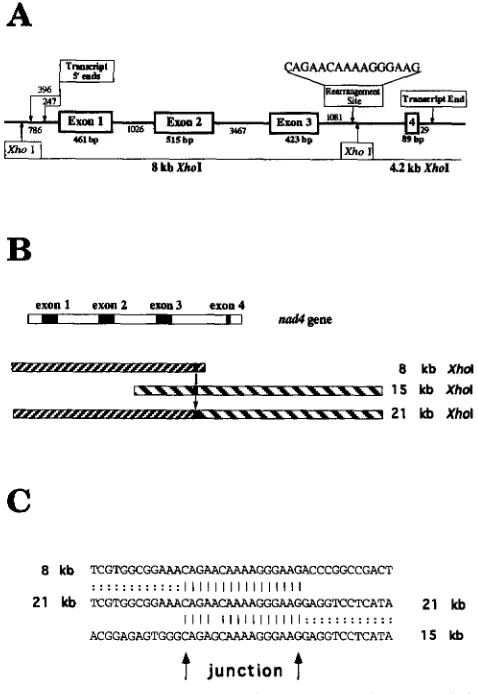
The site of divergence between the normal 8-kb and the NCS2 mutant 21-kb XhoI fragments was found near the end of the 8-kb XhoI fragment, within the third in- tron of the normal n a d 4 gene (Figure 2A). After this point, the 21-kb XhoI fragment had nucleotide identity with sequences carried on the 15-kb XhoI restriction fragment. A model for the generation of the NCS2- specific 21-kb fragment is shown in Figure 2B. Five hun- dred and thirty nucleotides sequenced around the junc- tion in the normal 15-kb XhoI fragment were found to have 93.5% nucleotide identity with sequences of the second intron of the wheat n a d 7 gene (sequenced by BONEN et al. 1994). Strong sequence homology with the wheat n a d 7 intron 2 was found to continue downstream of the rearrangementjunction in both the normal 15-kb and in the mutant 21-kb XhoI fragments (data not shown).
If recombination between sequences present on the 8- and 15-kb restriction fragments had given rise to the 21-kb XhoI fragment, short homologous sequences at the junction of the rearrangement were expected to be found. Indeed, sequence comparisons revealed that a 16nucleotide junction region was present on all three restriction fragments (Figure 2C). With the exception of
exon 1 exon2 ex0113 exon4
I I I I I I d p n e
C
8 kb T C G T G G C G C C G G C C G A C T
21 kb TCGTGGCGGAAACAGAACAAAAGGGAAGGAGGTCCTCATA 21 kb
A C G G A G A G T G G G C G G A A G G A G G T C C T C A T A 1 5 kb
...
... I I I I I I I I I I I I I I I I
I I I I I I I I I I I I I I I : : : : : : : : : : : :
FIGURE 2.4rganization of the maize nad4 gene and the NCS2 rearrangementjunction. (A) Organization of the maize
mitochondrial nad4 gene. Transcript 5’ ends as determined by
primer extension and the transcript 3’ end as determined
by anchored PCR are indicated. The rearrangement site is
located in intron 3 of the maize nad4 gene. (B) The rear- rangement between the normal 8- and 15-kb XhoI restriction fragments leading to the recovery of a novel 21-kb XhoI re- striction fragment in NCS2 mitochondria. (C) A region of 16 nucleotides shared by the normal 8 and 15 kb, as well as by the
mutant 21-kb XhoI restriction fragments.
a single base-pair mismatch at the fifth position, the ho- mologywas exact. Because the 8- and the 21-kb junctions are the same at this nucleotide, the actual rearrange- ment event between the 8- and 15-kb XhoI fragments apparently occurred in the last 11 nucleotides of the junction sequence. Because the site of rearrangement is located downstream of exon 3 of the n a d 4 gene (Figure 2A), the novel 21-kb NCS2-specific fragment carries a partiallydeletedform of the n a d 4 gene. It lacks the small exon 4 and any 3’ termination signals from n a d 4 . They are replaced with sequences from the n a d 7 gene. How- ever, the 21-kb XhoI fragment does include the pro- moter region and the first three exons of the n a d 4 gene.
Transcript analyses: The NCS2 mutation carries a 3’-
mtDNA Mutation Affecting Complex I 859
A
NCS2 21 Irb 16 bp Junction NCS2 21 lb normal 15 Irb 4 Primer 3
1
I"
-
276
bp
-
235
bp
132
bp
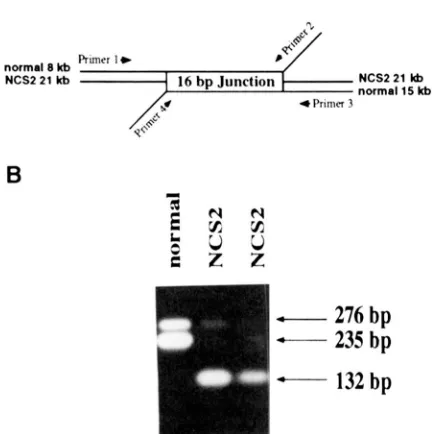
FIGURE 3.-Detection of NCS2 specific transcripts by reverse transcription PCR. (A) A set of four primers designed around
the rearrangement site. (B) Products of the reverse transcrip
tion PCR on mitochondrial RNA isolated from NCSS and re-
lated non-mutant (normal) plants.
plants carrying the NCS2 mutation, reverse transcrip- tion PCR was used (as described in MARIENFELD et al. 1993). A set of four oligonucleotide primers (PRl to PR4 listed in MATERIALS AND METHODS) around the rearrange- ment site in normal and NCS2 mtDNA was designed (Figure 3A). Mitochondrial RNA isolated from normal control plants as well as from severely affected NCS2 plants was reverse transcribed using random hexamer primers. The resulting cDNA was subjected to PCR re- actions using all four primers in the same reaction. The results of the reverse transcription PCR are illustrated in Figure 3B. PCR on cDNA generated from normal mtRNA showed the amplification of two bands: a major 235bp product representing transcripts from the n u d 4 gene and a lower abundance 276-bp product represent- ing transcripts from the nad 7 gene (Figure 3B). When cDNA derived from NCS2 plants was used in the PCR reactions, the amounts of the 2 3 5 and 27Gbp amplifi- cation products were greatly reduced and a new 132-bp band was obtained. The 132-bp PCR product represents an NCSBspecific transcript (Figure 3B). These results suggest that the mutant DNA is expressed and that the amounts of the normal n a d 4 and n a d 7 transcripts are reduced in NCS2 plants.
These results were confirmed using n a d 4 and nad 7 exons as probes on RNA gel blots. A n a d 4 exon 1 probe showed that the amounts of mature transcripts (approxi- mately 1900 nucleotides), as well as partially processed transcripts (approximately 3200 nucleotides) are spe- cifically reduced in the mtRNA from NCSS plants. Unique longer transcripts in the range of 4700 to 7600
A
B
0 "
- @ a
111
D
C
4 7 5 0 0
4 4700
4 1 9 0 0
E
F1~~~~4.-Northern analyses of mtRNA isolated from
NCS2 (lanes 2.3 and 7) and related non-mutant plants (lanes
1, 4, 5 and 6). (A) Transcript pattern after probing with an nad4 exon 1-specific probe. (B) Transcript pattern after prob ingwith a maize nad4 exon 4-specific primer (PRnnd4-4). (C)
Transcript pattern after probing with a wheat nnd7 exon3
probe. (D) and (E) Reprobing of blots A and C with a cloned mitochondrial rRNA gene (loading control). Transcript sizes in nucleotides were calculated by comparison to known mark- ers (RNA ladder, Life Technologies, Inc.).
nucleotides were detected in the NCS2 mtRNA (Figure 4A). These results are similar to those reported previ- ously with cloned restriction fragments corresponding to intron 1 of n a d 4 and to the rearrangement junction as probes (FEILER and NEWON 1987); however, the sizes of the largest transcripts have been revised. The larger
RNAs
in the NCS2 mitochondria are assumed to result from readthrough transcription by the mitochondrial RNA polymerase because the proper termination signals for the n u d 4 gene have been removed as a result of the rearrangement.The fourth exon has been removed from the NCS2 n a d 4 gene. No qualitative differences in the transcript pattern were detectable between normal and NCS2 mtRNA when a specific exon 4specific oligonucleotide (PR n a d 4 - 4 ) was used as a probe; however, large quan- titative differences were readily apparent. The level of mature transcripts (approximately 1900 nucleotides) are very reduced in mtRNA preparations from severely affected NCS2 plants (Figure 4B).
860 J. R. Marienfeld and K J. Newton
A
a + 396 bp
A A G
A A
C A
G A
A A
C-G T - A
A / A \ A
A-T G-C G O T A-T G-C
5 ‘
...
A A A T T T C A T W - T...
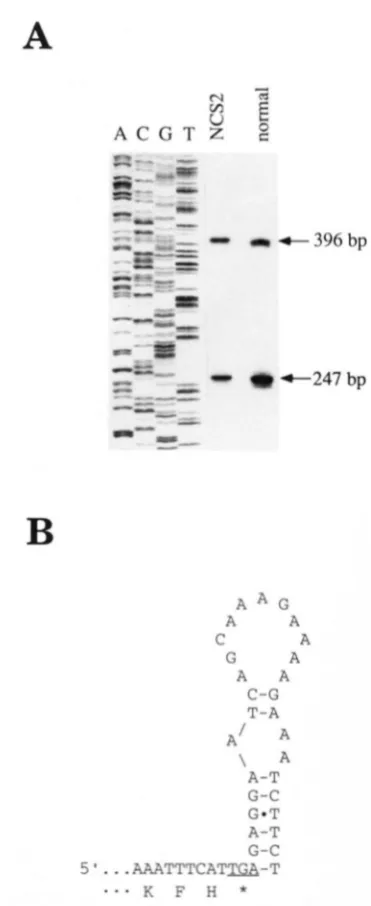
K F H *FIGURE 5.4haracterization of the 5’ end and the 3’ ends of nad4 transcripts. (A) 5’ ends determined by primer exten- sion using an exon lspecific primer (PRnad4-I). (B) The 3’ end of the normal maize nad4 gene determined by sequencing of four independent cDNA clones generated by anchored PCR The AGof the putative secondary structure shown is -6.6 kcal.
Determination of transcript termini: Primer exten- sion analysis was used to identify the 5’ ends of the mu- tant and normal nad4 transcripts. An oligonucleotide homologous to exon 1 of the maize nad4 gene (PRnad4-I) was used to reverse transcribe isolated mtRNA from normal as well as from NCS2 plants. By
comparing the resulting primer extension productswith control sequencing reaction products two 5’ ends were found, 247 and 396 bp upstream of the ATG start codon for the nad4 gene (Figure 5A). Because the rearranged and normal nad4 genes differ only at their 3’ ends, it was not surprising to find that they have similar 5‘ ends (Fig-
ure 5A). The signals for transcript initiation should be identical between the normal and mutant genes.
The 3’ end of the normal nad4 transcripts was de- termined by anchored PCR (FROHMAN et al. 1988; WIS INGER et al. 1991). Four independent cDNA clones were sequenced. A single transcript end was found 29 nucle- otides downstream of the TGA stop codon (Figure 2A). Using the computer program Mulfold (JAEGER et al. 1989a,b; ZUKER 1989), a potential secondary structure was identified in this region (Figure 5B). The calculated AGwas -6.6 kcal for this 3‘ end structure. Putative sec- ondary structures have been found in several mitochon- drial transcripts and they have been discussed as poten- tial transcription termination signals (SCHUSTER et al. 1986; MARIENFELD et al. 1991). In NCS2 transcripts, this potential termination signal has been lost, which may account for the occurrence of some of the longer nad4 chimeric transcripts in the mtRNA isolated from NCS2 plants.
Biochemical investigation of complex I function: Be- cause molecular studies indicated that a subunit of com- plex I, nad4, was defective in NCS2 mitochondria, it was of interest to investigate whether a difference in the functioning of complex I could be shown. The meas- urement of oxygen consumption by isolated mitochon- dria is a standard method to analyze the functioning of the electron transport chain. Use of various substrates can help localize a possible defect to a specific complex within electron transport chain.
Three different substrates were tested (MOORE and
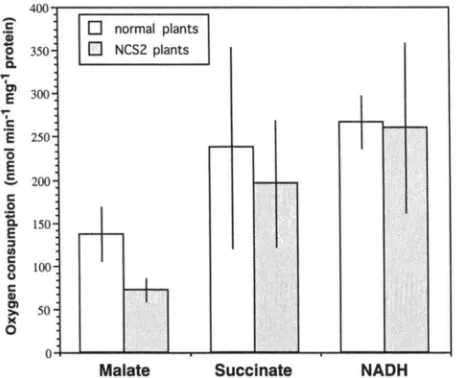
RICH 1985): malate was used to generate NADH as a substrate for complex I, whereas succinate and exog- enous NADH were used to bypass complex I. Mitochon- dria from NCS2 and normal plants utilized succinate and NADH at comparable rates-no statistically signifi- cant differences were found at a confidence level of 95%
(Figure 6). However, mitochondria isolated from the heteroplasmic NCS2 plants utilized malate as a substrate at significantly lower levels than mitochondria from nor- mal plants (Figure 6). These results indicated that the functioning of complex I is specifically impaired in NCS2 mitochondria. Other complexes of the electron transfer chain appear to be unaffected; if complex I is bypassed, the NCS2 mitochondria function normally (Figure 6). These results strongly suggest that mito- chondria from NCS2 plants are deficient in complex I function.
DISCUSSION
mtDNA Mutation Affecting Complex I 861
400,
i i 4 ’ I
I
Malate Succinate
t
-
NADH
4
FIGURE 6.-Results of the oxygen consumption studies of
isolated mitochondria from NCSZ and closely related normal plants. The differences in malate induced oxygen consump- tion between mitochondria isolated from normal and NCS2 plants were statistically significant at a confidence level of 99%.
For both, succinate and NADH, the differences were not sta-
tistically significant at a confidence level of 95%. Numbers of samples for normal mitochondria were n = 16 for malate, n = 7 for succinate, n = 6 for NADH. Sample size for NCS2 mitochondria were n = 11 for malate, n = 6 for succinate,
n = 6 for NADH.
that can function as a termination signal is reached. We have not yet determined whether any of the mutant tran- scripts end at the normal nad7 transcript termination site. The previously reported NCS mutants all have re- arrangements that remove 5’ ends of genes, including the presumptive promoter sequences. The NCS5 and
NCSG rearranged cox2 genes have each lost the proxi-
mal end of the gene, resulting in a lack of transcripts from the mutant genes (LAUER et al. 1990; NEWTON et al. 1990). The NCS3 rearrangement has led to the loss of the 5’ end of the co-transcribed ribosomal protein genes, S3 and L16, and of the corresponding mRNAs
(HUNT and NEWTON 1991). The NCS2 mutation is the
first NCS mutant for which the loss of the 3’ end of a normal mitochondrial gene has been discovered.
The site of divergence between the normal and mu- tant version of nad4 was found to be located within the third intron of the gene. There is 16 bp of homology between the sequence of the second intron of nad 7 and the nad4 intron sequences at this site, suggesting that a very rare recombination event has led to the formation of a chimeric expressed region. A subsequent loss of the expected reciprocal recombination product would ac- count for the deletion of n a d k x o n 4 sequences from
the NCS2 mutant genome. It should be noted, however,
that another fragment (3.2-kb XhoI; Figure lA, lane 2) has homology to an exon 4specific probe and that this homolog is present in both the normal and mutant ge- nomes. No evidence for the transcription or trans- splicing of this exon 4 homolog has been seen.
Very rare recombination events between very small repeats have been implicated in the generation of all the NCS mutants analyzed molecularly to date (NEWTON et al. 1990; LAUER et al. 1990; HUNT and NEWTON 1991). The repeats range in size from 6 bp in NCS5 to 36 bp in NCS6. Thus, our finding of a l 6 b p repeat at the NCS2 junction is consistent with the previous reports.
Al-
though the NCS5 and NCS3 rearrangement sites were found to be located in introns of functional coding se- quences (cox2 and rps3/rpll6, respectively), as is theNCSP site (nad4), this is not necessarily a general rule.
The NCSG rearrangement site is located within the first
exon of the cox2 gene.
It is interesting that the 16bp repeats utilized for the generation of the NCS2 mutation lie within introns in two different coding regions for subunits of complex I, nad4 and nad 7. Because the rearrangement should lead to two partially deleted genes, it is difficult to determine which defect is actually responsible for the mutant phe- notype. Only the reduction of the restriction fragments containing nad4 sequences is strongly correlated with
the NCS2 phenotype, although some reduction of nad 7
sequences is also apparent. For this reason, we favor the hypothesis that the loss of a functional nad4 gene prod- uct is the primary defect in NCS2 mitochondria. The reduction of the major nad4 transcripts is very pro- nounced in the mitochondria from heavily striped NCS2 plants. Some of the transcripts which hybridize with the nad 7probes are also reduced, but to a lesser extent than the nad4 transcripts.
The NAD4 and NAD7 proteins are components of the
multisubunit NADH dehydrogenase (complex I) in the inner mitochondrial membrane (WEISS et al. 1991). The highly defective phenotype associated with NCS2 sug- gests that complex I is the major path of entry for elec- trons into the cyanide-sensitive electron transfer chain in higher plants. At least two other NADH dehydroge- nases have been described in higher plant mitochon- drial membranes (reviewed by DOUCE and NEUBERCER 1989). Their roles have not been completely deter- mined, but their presence certainly does not rescue the mutant NCS2 phenotype.
The phenotype of complex Idefective NCS2 plants is usually not as severe as that of the complex
N ,
~ 0 x 2 -862 J. R. Marienfeld and K. J. Newton
are all heteroplasmic, our oxygen uptake studies cannot distinguish between some level of normal functioning of complex I (from normal mitochondria in the prepara- tions) and low levels of bypass functioning.
Despite the large reduction (usually severalfold) in the levels of mature nad4 mRNA in many of the NCS2 samples, the reductions we have recorded in the func- tioning of complex I are more modest (usually 2-3- fold). There could be a number of explanations for this discrepancy. There are apparently over 27 subunits of complex I (WEISS et al. 1991; LXTERME and BOUTRY 1993) and perhaps neither NAD4 nor NAD7 is absolutely re- quired for function, so that loss of one or both polypep- tides results merely in a reduction of the NADH dehy- drogenase activity. Alternatively, transcripts from the fused nad4-nad 7 gene could be translated into a larger protein product and the chimeric protein might be ca- pable of assembling into a partially functional complex I. In order to determine the biochemical basis of the partial functioning of complex I in the NCS2 samples, extensive immunological analyses will be necessary, using antibodies to NAD4, NAD7 and other complex I constituent proteins.
Previous studies indicated that the synthesis of a mi- tochondrial protein of approximately 24 kD was re- duced in mitochondria from NCS2 plants (FEILER and NEWON 1987). The predicted sizes of the NAD4 and NAD7 proteins are 56 kD (MARIENFELD and NEWTON 1994) and 45 kD (BONEN et al. 1994), respectively. Both proteins are hydrophobic, integral membrane proteins- characteristics which are often associated with aberrant polypeptide migrations on denaturing polyacrylamide protein gels. However, in order to determine (1) if the “24kD polypeptide” corresponds to either the nad4 or the nad 7 gene product and (2) if the nad4-nad7 chi- meric gene in NCS2 is translated to a larger protein product, antibodies to both proteins are needed. The predicted NAD4 protein is highly hydrophobic and our attempts to generate synthetic peptide antibodies to three different regions of the this protein have been unsuccessful (our unpublished data). Therefore, we cannot answer these questions at this time.
Although NCS2 is the first reported complex I mu- tation in higher plants, several complex I mutations have been described in humans (reviewed by WALLACE 1993). In general, patients with mitochondrial mutations are also usually heteroplasmic and the effects on pheno- types can be severe when somatic segregation leads to sorting out of homoplasmic sectors. One type of adult- onset blindness due to death of the optic nerve (Leber’s hereditary optic neuropathy), is caused by a single base- pair change in the nad4 gene (WALLACE et al. 1988; WAL- LACE 1993). In Chlamydomonas, partial deletions of the
nad4 gene are lethal for the cell (RANDOLPH-ANDERSON et aZ. 1993). Considering the drastic effects of nad4 mu-
tations in other organisms, it is not surprising that the maize NCS2 mutation is associated with lethality during
kernel development and defective sectoring in the leaves.
The defective pale-green sectors in the NCS2 leaves contain mitochondria with very reduced cristae (ROUS SELL et al. 1991). Chloroplast ultrastructure and function is also altered in these sectors (ROUSSELL et al. 1991). Thus, the NCS2 mutation has pleiotropic effects on cel- lular metabolism and chloroplast biogenesis. This ap- pears to be a general effect of maize mitochondrial mu- tations affecting oxidative phosphorylation (cf. cox2 mutants; Gu et aZ. 1993). Therefore, not all maternally inherited chloroplast defects can be assumed to be due to mutations in chloroplast DNA.
We are indebted to TONY MOORE and ANDY WALTERS (University of Sussex, United Kingdom) for their patient instruction in and assis- tance with the oxygen uptake experiments. We thank J W N G Gu, MARY SCHRAMKE and BRIAN WINBERG for providing some of the sequenc- ing and hybridization data. AXEL BRENNICKE (Institut fCir Genbiolo- gische Forschung, Berlin, Federal Republic of Germany) and LINDA BONEN (University of Ottawa, Ontario, Canada) are gratefully acknowl- edged for making the probes for nadl, nad5 and nad 7available to us.
We thank LINDA BONEN for communicating results prior to publication and B. WINBERG, J. Gu, FRANKBAKER, ROBERT SMITH and MIKE LuEmfor critical reading and helpful comments on the manuscript. Supported by National Science Foundation grant DMB9019249. Support for J.R.M. was also provided by a Postdoctoral Fellowship from the Deut-
sche Forschungsgemeinschdt (Ma 1433/1-1).
LITERATURE CITED
BONEN, L., K. WILLIAMS, S. BIRD and C. WOOD, 1994 The NADH dehy- drogenase subunit 7 gene is interrupted by four group II introns in the wheat mitochondrial genome. Mol. Gen. Genet. 244: 81-89. COE, E., 1983 Maternally inherited abnormal plant types in maize.
Maydica 2 8 151-167.
CONSTANZO, M. C., and T. D. Fox, 1990 Control of mitochondrial gene expression in Saccharomyces cerevisiae. Annu. Rev. Genet. 24: 91-113.
DOUCE, R., and M. NEUBERGER, 1989 The uniqueness of plant mitc- chondria. Annu. Rev. Plant Physiol. Mol. Biol. 40: 371-414. FAURON, C., M. HAWK, D. LONSDALE and L. NICOLS, 1989 Mitochon-
drial genome organization of the maize cytoplasmic male sterile type T. Mol. Gen. Genet. 216 395-401.
FAURON, C., M. H A W K and R. BRETTELL, 1990 The mitochondrial ge-
nome organization of a maize fertile cmsT revertant line is gen- erated through recombination between two sets of repeats. Genetics 124: 423-428.
FEILER, H., and K. NEWTON, 1987 Altered mitochondrial gene expres- sion in the nonchromosomal stripe 2 mutant of maize. EMBO J.
FROHMAN, M. A., M. K. DUSH and G. R. MARTIN, 1988 Rapid produc- tion of full-length cDNAs from rare transcripts: amplification using a single gene-specific oligonucleotide primer. Proc. Natl. Acad. Sci. USA 85: 8998-9002.
Gu, J., D. MILES and K. J. NEWTON, 1993 Analysis of leaf sectors in the NCSG mutant of maize. Plant Cell 5 963-971.
HUNT, M., and K. NEWTON, 1991 The NCS3 mutation: genetic evi- dence for the expression of ribosomal protein genes in Zea mays
mitochondria. EMBO J.10 1045-1052.
JAEGER, J. A., D. H. TURNER and M. ZUKER, 1989a Improved predic- tions of secondary structures for RNA. Proc. Natl. Acad. Sci. USA
JAEGER, J. A,, D. H. TURNER and M. ZUKER, 1989b Predicting optimal and suboptimal secondary structure for RNA. Methods Enzymol.
183: 281-306.
L U E R , M., C. KNUDSEN, K. J. NEWTON, S. GABAY-LUGHNAN and J. R. LAUGHNAN, 1990 A partially deleted mitochondrial cytochrome oxidase gene in the NCSG abnormal growth mutant of maize. New Biol. 2: 179-186.
6 1535-1539.
mtDNA Mutation Affecting Complex I 863
LETERME, S., and M. BOUTRY, 1993 Purification and preliminary char- acterization of mitochondrial complex I (NADHmbiquinone re- ductase) from broad bean (Vicia faba L). Plant Physiol. 1 0 2
435-443.
MARIENFELD, J. R., and K. J. NEWTON, 1994 The nad4 gene of maize mitochondria is highly conserved. Plant Physiol. 104: 301-302.
MARIENFELD, J. R., R. REsm and W. 0. ABEL, 1991 The first analyzed archegoniate mitochondrial gene ( ~ 0 x 3 ) exhibits extraordinary features. Curr. Genet. 2 0 319-329.
MARIENFELD, J. R , J. Gu and K. J. NEWTON, 1993 PCR-mediated de- tection of heteroplasmy in maize mitochondrial mutants. PCR Methods Appl. 3: 205-207.
MOORE, A. L., and P. R. RICH, 1985 Organization of the respiratory chain and oxidative phosphorylation, pp. 134-172 in Higher Plant Cell Respiration, edited by R. DOUCE and D. A. DAY. Springer-Verlag, New York.
NEWTON, K. J., 1993 Procedures for isolating mitochondria and mi- tochondrial DNA and RNA, pp. 549-556 in The Maixe Handbook
edited by M. FREELINC and V. WALBOT. Springer-Verlag, New York. NEWTON, K. J., and E. H. COE, 1986 Mitochondrial DNA changes in abnormal growth mutants of maize. Proc. Natl. Acad. Sci. USA 8 3 7363-7366.
NEWTON, K. J., E. H. COE, S. GABAY-LAUGHNAN and J. R. LAUGHNAN,
1989 Abnormal growth phenotypes and mitochondrial mutants in maize. Maydica 34: 291-296.
NEWTON, K. J., C. KNUDSEN, S. GABAY-LAUGHNAN and J. R. LAUGHNAN,
1990 An abnormal growth mutant in maize has a defective mi- tochondrial cytochrome oxidase gene. Plant Cell 2 107-113. RANDOLPH-ANDERSON, B. L., J. E. BOYNTON, N. W. GILLHAM, E. H. tIARRIs,
A. M. JOHNSON et al., 1993 Further characterization of the res- piratory deficient dum-1 mutation of Chlamydomonas rednhardtii
and its use as a recipient for mitochondrial transformation. Mol. Gen. Genet. 236: 235-244.
RICKWOOD, D., M. T. WILSON and V. M. DARLEFUSMAR, 1987 Isolation and characteristics of intact mitochondria, pp. 1-16 in Mito- chondria, A Practical Approach edited by V. M. DARLEY-USMAR, D. RICKWOOD and M. T. WILSON. IRL Press, Oxford.
ROUSSELL, D. L., D. L. THOMPSON, S. G. PALLARDY, D. MILES and K. J.
NEWTON, 1991 Chloroplast structure and function is altered in the NCS2 maize mitochondrial mutant. Plant Physiol. 9 6
SAMBROOK, J., E. F. FRITXH and T. MANIATIS, 1989 Molecular Cloning: A Laboratory Manual. Cold Spring Harbor Laboratory, Cold Spring Harbor, N.Y.
SAS Institute, Inc., 1985 SAS User’s Guide: Basics and Statistics. SAS Institute, Cary, N.C.
SCHUSTER, W., R. HIESEL, P. G . ISAAC, C. J. LEAVER and A. BRENNICKE,
1986 Transcript termini of messenger RNAs in higher plants. Nucleic Acids Res. 14: 5943-5954.
SHUMWAY, L. I C , and L. F. BAUMAN, 1967 Nonchromosomal stripe of maize. Genetics 5 5 33-38.
STERN, D. B., and K. J. NEWTON, 1986 Isolation of plant mitochondrial
RNA. Methods Enzymol. 118: 488-496.
WALLACE, D. C., 1992 Diseases of the mitochondrial DNA. Annu. Rev. Biochem. 61: 1175-1212.
WALLACE, D. C., 1993 Mitochondrial diseases: genotype versus phe- notype. Trends Genet. 9: 128-133.
WALLACE, D. C., G. SINGH, M. T. L o n , J. A. HODGE, T. G . SCHURR et a l . , 1988 Mitochondrial DNA mutation associated with Leber’s he- reditary optic neuropathy. Science 2 4 2 1427-1430.
WEISS, H., T. FRIEDRICH, G . H o m u s and D. PREIS, 1991 The respi- ratory chain NADH dehydrogenase (complex I ) of mitochondria. Eur. J. Biochem. 197: 563-567.
WISSINGER, B., R. HIFSEL, W. SCHUSTER and A. BRENNICKE, 1988 The NADHdehydrogenase subunit 5 gene in Oenothera mitochon- dria contains two introns and is cc-transcribed with the 5 S rRNA gene. Mol. Gen. Genet. 2 1 2 56-65.
WISSINGER, B., W. SCHUSTER and A. BRENNICKE, 1991 Trans splicing in Oenothera mitochondria: n a d l mRNAs are edited in exon and trans-splicing group I1 intron sequences. Cell 65: 473-482.
ZUKER, M., 1989 On finding all suboptimal foldings of an RNA mol- ecule. Science 244: 48-52.
232-238.