Content based Intelligent Image Retrieval
Based on Super Pixel with Wavelet Transform
S. Sathiamoorthy1, M. Kamarasan 2 *
Computer Science and Engineering Wing, Directorate of Distance Education, Annamalai University, Annamalainagar, Tamilnadu, India1
Department of Computer Science and Engineering, Annamalai University, Annamalainagar, Tamilnadu, India 2 * Corresponding Author
ABSTRACT: In this paper we proposes Intelligent Content-Based Image Retrieval (ICBIR) based on super pixel with multi-resolution image. Super pixel plays an important role in image retrieval since instead single pixels a group of pixel in an image called super pixel. Super pixel has computationally efficient, representational effective and near-complete future and near-completely meaningful. The super pixel formed in multiresolution environment. Based on super pixel color and texture features are extracted and the formed feature vector. We constructed image database based on feature vector. Cosine distance method is incorporated to find the distance between query image and target image in image database. The proposed method is very efficient since we proposed super pixel concept which provide fast and memory efficient because of feature are extracted in multiresolution environment. The proposed method is implemented in Vistex and corel database images. The precision and recall performance method are incorporated to measure accuracy of proposed methods. The proposed method obtains better result when compared to that of the existing techniques.
KEYWORDS: Super pixel, CBIR, multi-resolution, Cosine distance, distance method
I. INTRODUCTION
a method based techniques: Feature Extraction (FE) and Similarity Measurement(SM). The first, FE step becomes a Maximum Likelihood (ML) estimator for the model parameters of image data and SM step amounts for computing the Kullback–Leibler distances between model parameters. But this system suffers due to the number of parameters [22]. Recently, Kokare et al. [23] developed a method which is based on Dual-Tree Rotated Complex Wavelet Filter (DT-RCWF) and Dual-Tree Complex Wavelet Transform (DT-(DT-RCWF) which used improves retrieval accuracy and reduces time. Same author [2] have developed a technique , which considers both 2-D Rotational Wavelet Filter(RWF) and Discrete Wavelet Transform to improve the performance of previous method. The new method improves characterization of diagonally oriented texture. Recently, Young, and Nam [1] proposed a CBIR methods, which consider color autocorrelograms in HSV color space and BDIP(Block Difference of Inverse Probabilities)-BVLC(Bock Variation of Local Correlation coefficients) moments extracted for Value(V) in multiresolution domain.
Most of the literature proposed methods to improve retrieval accuracy and time complexity, but still gap between semantic features and low-level features and also suffer accuracy of time and space complexity. To cover come above said problems we proposed a technique which based super pixel in multiresolution environment [34]. The proposed method extracts color and texture features in super pixel based multiresolution domain The proposed novel technique consider dominant features as color distribution and texture characteristics at low-level of the images.
The rest of the paper is organized as follows: Section –II, describes multiresolution based decomposition and Feature Extraction (FE) methods. The distance method is discussed in section III. Experimental results are discussed in section-IV and section-V concludes with conclusion.
II. PROPOSED IMAGE RETRIEVAL METHODS
The proposed method extract color and texture based on super pixel in multiresolution domain which is conceptual simple since wavelet transform play an important role, it is tools to decompose an image into various forms sub image. The proposed methods extracts color and texture features in and HSV color space since H and V component represent color dominants and texture characteristics contain in V component. Based on both color and texture features, feature vector is formed and stored as a database, which is called as feature database.
Fig.1. Black diagram of retrieval method.
The Cosine Measure is employed to measure the distance between the feature vectors of the query and target images. Furthermore cosine distance is used to measure divergence of feature vectors. The overall concept of the proposed work is illustrated in Figure-1.
Feature Extraction (Color & Texture)
Feature Extraction (Color & Texture)
HSV Query Image
Wavelet Decompositio
Similarity measurement
Image DB Wavelet
Decompositio
Feature DB
III. MULTIRESOLUTION BASED IMAGE FEATURE EXTRACTION
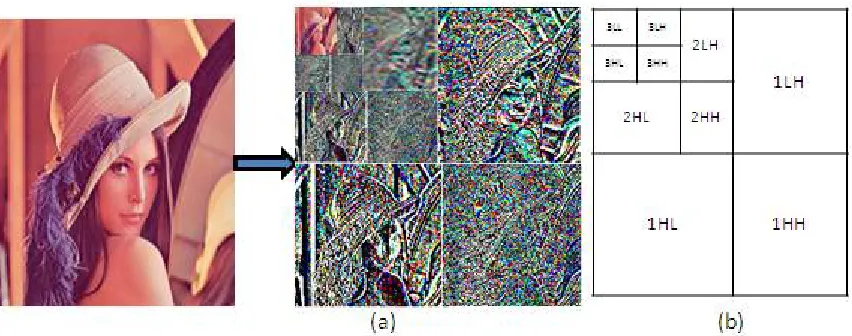
Wavelet is a mathematical tool which is used to decompose the images into various multiresolution levels is called sub bands [24]-[26], is multi-scale oriented. For convenience of computation, input image size with NχN is converted to a sequence X(n) where n = N*N. Here Debau-4 wavelet transform is incorporated to decompose the input image into approximations and details components, results are the low-pass and high-pass filters as shown in Fig.2. The proposed method decompose the images until obtain optimum level. The optimum level not losing the dominant color and texture characteristics in the image. The concepts of the decomposition process are depicted in fig.3.
Fig. 2. Decomposition structure at three levels
Fig. 3 Decomposition structure (a). Deabu-4 Wavelet transform of an image – pyramid at three level decomposition (b) wavelet decomposition structure.
LL – subband denotes the approximation of the image.
LH – subband is representing the discrimination along with horizontal directions. HL – subband denotes the discrimination along with vertical directions.
Super pixel as energy features
In this section, the proposed method decompose the image into various subimage based on multiresolution. The energy of each multiresolution considered as super pixel then we extract the energy or entropy from each super pixel based energy. Let N be the number of pixels in the image, and K the number of super pixels that we want to obtain. We represent a partitioning of the image into super pixels with the mapping s
: {1 … }→{1 … } (1)
where s represent super pixel which belong to i, the statistical features such as spectrum of energy (µ) is computed in given eq.
1 1
1
M N ij i jSpectrum of energy
X
MN
(2)Color feature extraction
The color features are extracted from H subband image which show in section-II. Here color correlogram color features incorporated in the proposed work. Let be an × image with pixels p(x, y). Let [C] a set of C colors c1,...,cc that can denotes in the image I. Pick a pixel = ( , ) and pixel = ( , ) randomly form the image I.
Let random variables denotes the color values of respectively. Color correlogram can be represented as in the given eq 3.
=
,
=
, |
−
| =
=
Ґ ,( )
(Ι)
×
(3)
In the proposed work, advantages of using color correlogram are taking into consideration the spatial correlation of colors, being easy to implement, and producing fairly a small size index. Based on the features a feature vector is formed which is shown in equation (4)
= [ ,Σ] (4) where f is feature vector. The entire process of the proposed system is presented in the algorithmic form:
Step0: Start
Step1: Read image and convert into HSV color space.
Step2: Use Deab-4 wavelet decomposes an image and constructs optimum level Step3: Compute color and texture characteristics at the optimum level.
Step4: Construct feature vector using features and placed them in feature database.
Step5: Find the similarity between query image and target image using and Cosine divergence methods. Step6: Adopt the recall-precision method to test the performance of proposed system and existing system. Step7: Stop.
Algorithm-1. The overall process of the proposed system.
=
→ →
| | || ||
(5)
and
=
| |→→| |
(6)
Table-1
Angle, degree and radian between query and target images
Image Cos( ) θ
Title0002 vs. Title0002 0.9176 21.4954
Wood vs. Wood 1.0000 0
Titles0004 vs. titles0005 0.9482 13.8830
Flower vs. squirrel 0.9871 7.2372
Decose0007 vs. Brickpaint001 0.2712 11.9538
Lena vs. Lena 1.0000 0
Prisonwindow.001 vs. Sand.004 0.9561 23.4839
Valleywater.003 Vs. Groundwatercity.01
0.9888 15.7641
IV. EXPERIMENTAL RESULTS
The proposed method implement in proposed image database which is constructed from both VisTex[31] and Corel[33] databases. The images considered more than 3500 images sizes such as 512x512, 256x256, 128 x 128 with various categories. For sample, 30% of the images considered for the experiment and few image presented in the sample. In the first column, the query images are presented subsequence column represent the relevant images according distance Minkowski-form distance [16]. The distance values are obtained from table 2.
(a)terrain1000
Terrain1001 Terrain1001 Terrain1003 Terrain1004 Terrain1005 Terrain1006 Terrain1007 Terrain1008 (b)
(a)Building000
Building001 Building002 Building003 Building003 Building004 Building005 Building006 Building007 (b)
Fig.5 (a) Query image (b) retrieved relevant image by proposed system from Corel
Table-2
Distance values between query and relevant images in indexed order.
Terrain1
0.0561 0.0949 0.0951 0.4388 0.6458 0.6615 0.0676 0.7628 0.7526
Title001 0.0437 0.3004 0.3338 0.5457 0.5966 0.6302 0.7916 0.8168 0.9163
Fabric002 0.2488 0.3284 0.3956 0.4103 0.4781 0.5085 0.5512 0.7878 1.2610
prison window01 0.6737 0.4397 0.4651 0.5234 0.6425 0.8800 0.9256 0.9395 1.0398
Food001 0.1234 0.3049 0.4672 0.8213 0.8878 1.5657 2.2153 2.2477 2.3576
Wood002 0.3623 0.3822 0.3973 0.4597 0.4973 0.5232 0.5924 0.6913 0.7334
Building02 0.1029 0.2599 0.2649 0.2738 0.3245 0.4850 0.6573 0.9698 1.4163
To evaluate the performance of the proposed system by making comparison with two existing methods such as Wavelet moment, BDIP+BVLC and the obtained results are presented in the table-3. The proposed method is consider uniformly quantizing color pixel values with minimum storage space when compared to that of existing methods.
Table-3
Feature vector dimension and color space of the retrieval methods
Specification
Methods
Color
space
Dimension Remarks
Wavelet moment RGB 96 number of decomposition levels: 8
BDIP-BVLC RGB,V 96 -
Multi-resolution with BDIP+BVLC
HSV 92(60+32) number of decomposition levels: 2
CSD HMMD 128 -
Table-4
Performance measure of proposed work with existing methods
Databases Proposed method BDIP-BVLC Wavelet moment CSD method
Precision Recall Precision Recall Precision Recall Precision Recall
Vistex 0.876 0.721 0.821 0.713 0.841 0.691 0.831 0.701
Corel 0.791 0.712 0.761 0.703 0.751 0.691 0.741 0.681
In order to test proposed worth we used precision and recall methods [32] are mentioned in equations (7) and (8) are employed to measure the retrieval performance of the proposed system.
P(q)=| ( )| ∩ ( )|
( )| (7)
R(q) =| ( )| ∩ ( )|
( )| (8)
where |.| returns the size of the set, precision P(q) represents the ratio of the number of images relevant to the query q
among retrieved images to the number of retrieved images; recall R(q) represents the ratio of the number of images relevant to the query q among retrieved images to the number of images relevant to the query in a image database
V. CONCLUSION
In the proposed method, we used super pixel with multi-resolution image for content based image retrieval. The super pixel based images are used extract features such as color correlogram and energy features in subband of decomposed image. The color features are extracted from H and S components and energy features are extracted V component. Super pixel plays an important role in image retrieval since instead single pixels a group of pixel in an image called super pixel. Super pixel has computationally efficient, representational effective and near-complete future and completely meaningful. Based on super pixel color and texture features are extracted and the formed feature vector. Cosine similarity method is incorporated to find the distance between query image and target image in image database. The proposed method is very efficient since we proposed super pixel concept which provide fast and memory efficient because of feature are extracted in multiresolution environment. The proposed method is implemented in standard databases. In order to implement proposed method, the precision and recall performance method are incorporated to measure accuracy system. The proposed method obtains better result when compared to that of the existing techniques.
REFERENCES
[1] Young Deok Chun, Nam Chul Kim,” Content-Based Image Retrieval using Multiresolution color and Texture Features,” IEEE Trans. on Multimedia, Vol.10.No.6, pp. 1073-1084 October 2008.
[2] Manesh Kokare, P. K. Biswas, and B. N. Chatterji, “Texture Image Retrieval Using Rotated Wavelet Filters,” JOURNAL of Pattern Recognition letters, pp.1240-1249, 2007.
[3] Wei Jiang, Guihua Er, Qionghai Dai, Jinwei Gu, “Similarity-Based Online Feature Selection in Content-Based Image Retrieval,” IEEE Transactions on image processing, vol. 15, no. 3, march 2006.
[4] Kokare, M., Chatterji. B.N., Biswas. P.K, “A Survey on current content based image retrieval methods,” IETE J.Res. 48, 261-271. 2000a.
[5] Arnold W.M. Smeulders, Simone Santini, Amarnath Gupta, Ramesh Jain, ” Content-Based Image Retrieval at the End of the Early Years,” IEEE Transactions on Pattern Analysis and Machine Intelligence, Vol. 22, No. 12, pp. 1349-1380, December 2000.
[6] Nidhi Singhai, Shishir K. Shandilya, “A Survey On: Content Based Image Retrieval Systems”, Journal of Computer Applications vol. 4, No 2, July 2010.
[7] Ritendra Datta, Dhiraj Joshi, Jia Li and James Z. Wang, “ Image Retrieval:Ideas, Influences, and Trends of the New Age”, ACM Computing Survey, vol.40, No.2, April 2008.
[8] Ying Liy, Dengsheng Zhang, Guojun Lu and Wei_Ying Ma,” A Survey of Content-based image retrieval with high-level semantics”, Journal of the pattern recognition,Vol.40.pp 262-282, April 2006.
[10] Young Rui and Thomas S. Huang, “Image Retrieval: Current Techniques, promising Directions, and Open Issues,” Journal of Visual Communication and Image Representation. 10, 30-62. 1999.
[11] B.S Manjunath, J.R. Ohm, V.V Vasudevan and A. Yamada, ”Color and texture descriptors” IEEE Trans. Circuit Syst. Video technol. Vol 11, pp. 703-715, Jun. 2001.
[12] Elif Albuz, Erturk Kocalar, and Ashfaq A. Khokhar, “Scalable Color Image Indexing and Retrieval Using Vector Wavelets,” IEEE Transactions on Knowledge and Data Engineering, Vol. 13, No. 5, September/October 2001.
[13] X.S. Zhou, T.S. Huang, CBIR: from low-level features to high-level semantics, Proceedings of the SPIE, Image and Video Communication and Processing, San Jose, CA, vol. 3974, pp. 426–431, January 2000.
[14] D. Feng, W. C. Siu, and H. J. Zhang, “Fundamentals of Content-Based Image Retrieval, in Multimedia Information Retrieval and Management Technological Fundamentals and Applications”, New York: Springer, 2003.
[15] J. Huang, S. R. Kumar, M. Mitra, W. J. Zhu, and R. Zabih, “Image indexing using color correlograms,” in Proc. IEEE Int. Conf. Computer Vision and Pattern Recognition, San Juan, Puerto Rico, , pp.762–768, Jun. 1997.
[16] . D. Androutsos, K. Plataniotiss, and A. Venetsanopoulos, “Distance measures for color image retrieval,” in Proc. IEEE Int. Conf. Image Processing, Chicago, IL, vol. 2, pp. 770–774, 1998.
[17] ISO/IEC 15938-3/FDIS Information Technology—Multimedia Content Description Interface—Part 3 Visual Jul. 2001, ISO/IEC/JTC1/SC29/WG11 Doc. N4358.
[18] R. M. Haralick, K. Shanmugam, and I. Dinstein, “Texture features for image classification,” IEEE Trans. Syst. Man Cybern, vol. SMC-8, pp.610– 621, Nov. 1973.
[19] B.S Manjunath, and W.Y. Ma, “Texture feature for browsing and retrieval of image data,” IEEE Trans. On Pattern analysis and Machine intelligence, Vol 18, No 8, pp.837-842, Aug. 1996.
[20] M. Kokare, B. N. Chatterji, and P. K. Biswas, “M-band wavelet basedtexture features for content based image retrieval,” in Proc. Indian Conf.Vision, Graphics, and Image Processing. Ahemadabad, Gujarat, India,Dec. 2002, pp. 173–178.
[21] Minh N. Doand Martin Vetterli, “Wavelet-Based Texture Retrieval Using Generalized Gaussian Density and Kullback–Leibler Distance,” IEEE Transactions on Image Processing, Vol. 11, No. 2, pp.146-158, February 2002.
[22] Manesh Kokare, P. K. Biswas, and B. N. Chatterji, “Texture Image Retrieval Using Rotated Wavelet Filters,” Journal of Pattern Recognition letters. pp.1240-1249,2007.
[23] Manesh Kokare, P. K. Biswas, and B. N. Chatterji, “Texture Image Retrieval Using New Rotated Complex Wavelet Filters,” IEEE Trans. on Systems, Man, And Cybernetics—Part B: Cybernetics, Vol. 35, No. 6, pp. 1168-1177 December 2005.
[24] I.Daubechies, “Ten Lectures on Wavelets. Philadelphia,” PA: SIAM, 1992.
[25] I.Daubechies, “The wavelet Transform, time-frequency localization and signal analysis,” IEEE Trans. on Information Theory, Vol.36, pp. 961-1005, Sept. 1990.
[26] S.Mallat, “A theory for multiresolution signal decomposition: the wavelet representation,” IEEE Trans. Pattern Recognition. Machine Intell., vol.11, pp.674-693, July 1989.
[27] Battacharyya, “ On a measure of Divergence Between Two Statistical Populations Defined by their probability Distributions,” Bullettin of Calcutta "Mathematical Society, 35, 99-110, 1943.
[28] N.A Thacker, F.J Aherne and P.I Rockett, “The Battacharyya metric as an absolute similarity measure for frequency coded data”, TIPR’97 Prague 9-11 June, 1997.
[29] K. Seetharaman and R. Krishnamoorthi “ A statistical frame work based on a family of full range autoregressive model for edge extraction”,
Journal of Pattern Recognition letters. pp.759-770, 2007.
[30] K. Seetharaman and R. Krishnamoorthi, “ Image compression based on a family of stochastic models”, Journal of Signal processing.Volume 87. Isuue 3. pp.408-416, 2007.
[31] MIT Media Laboratory. Vistex: Texture image database http://www.white.media.mit.edu/vismod/imagery/vision Texture/vistex.html.
[32] S. F Chang, W. Chen, H. J Meng. H Sundaram, and D Zhong, “a fully automated content-based image video search supporting spatiotemporal queries,” IEEE Trans. on Circuits Syst. Video technol. Vol.8, pp. 602-615, Sept. 1998.
[33] Corel Draw Photo DB [online] available: http//dlp.cs.berkeley.edu/photos/coral/.
[34] E.H. Adelson, C.H. Anderson, J.R Bergen, P.J. Burt, J.M. Ogden,” Pyramid methods in Image processing,” RCA Loboratories 29-6. Nov/Dec. 1984.