Copyright2001 by the Genetics Society of America
Tof1p Regulates DNA Damage Responses During S Phase
in
Saccharomyces cerevisiae
Eric J. Foss
Division of Basic Sciences, Fred Hutchinson Cancer Research Center, Seattle, Washington 98109-1024
Manuscript received August 7, 2000 Accepted for publication November 10, 2000
ABSTRACT
Atof1mutant was recovered in a screen aimed at identifying genes involved specifically in the S phase branch of theMEC1-dependent DNA damage response pathway. The screen was based on the observation that mutants missing this branch are particularly dependent on the cell cycle-wide branch and, therefore, onRAD9, for surviving DNA damage.tof1andrad9conferred synergistic sensitivity to MMS, UV, and HU, and the double mutant was incapable of slowing S phase in response to MMS, inducingRNR3transcription in response to UV, and phosphorylating Rad53p in response to HU.TOF1’s contribution to DNA damage response appeared to be restricted to S phase, sinceTOF1did not contribute to UV-induced transcription during G1 or to the cdc13-1-induced block to anaphase in G2/M. I suggest a model in which Tof1p functions to link Mec1p with Rad53p.
W
HEN yeast cells are treated with agents that dam- way to identify genes involved in that pathway. Such a screen is described in this article. It was based on the age DNA or block DNA replication, they delaybud emergence (Siedeet al.1993, 1994), delay anaphase observation that cells missing only the cell cycle-wide pathway or only the S phase pathway are more proficient (WeinertandHartwell1988), slow DNA replication
(PaulovichandHartwell1995), phosphorylate spe- thanmec1mutants in DNA damage responses, while cells missing both pathways are approximately as deficient as cific proteins (Sanchez et al. 1996; Sun et al. 1996;
Longheseet al. 1997;Emili1998), and increase tran- mec1mutants (Navaset al.1996). Thus, in a strain car-rying a temperature-sensitive allele of RAD9, mutants scription of specific genes (Zhou andElledge 1993;
were isolated that, specifically at the restrictive tempera-Aboussekhra et al. 1996; Kiser and Weinert 1996).
ture, showed not the moderate MMS sensitivity of arad9
These responses are frequently called “checkpoint”
re-mutant but instead the extreme MMS sensitivity of a sponses. The pathway that regulates these responses
mec1 mutant. A secondary screen, requiring that the contains two branches, one of which functions
through-rad9 geneXdouble mutant be unable to slow replication out the cell cycle (referred to here as the cell cycle-wide
in response to MMS at the restrictive temperature, was pathway) and one of which functions specifically during
included to ensure that mutants were defective in a S phase (referred to here as the S phase pathway). The
response that must occur during S phase. The screen former pathway depends on, among other genes,RAD9;
yielded a mutant in a gene called TOF1.
the latter pathway depends on several genes involved
TOF1(TOpoisomerase 1-associatedFactor1) was pre-in DNA replication; and both of these pathways depend
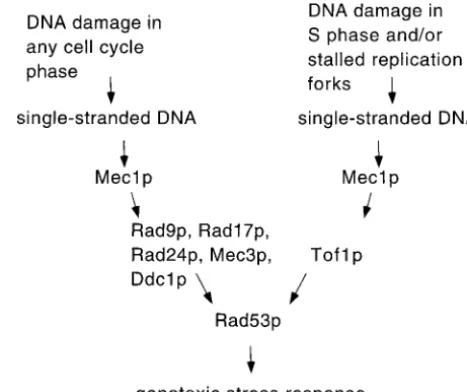
viously identified in a two-hybrid screen for proteins onMEC1(Figure 1). This article describes the
identifi-that interact with the topoisomerase Top1p; the two cation of another gene involved in the S phase pathway.
proteins also interact in vitro(Parkand Sternglanz The mutations known to affect specifically the S phase
1999). Deletion ofTOF1causes no obvious phenotype pathway were identified by examining mutant alleles of
(ParkandSternglanz1999).TOF1is 3.7 kb in length genes known to be involved in replication or metabolism
and its transcript peaks just before S phase (Cho et
of DNA and by carrying out genetic screens. The designs
al.1998;Spellmanet al.1998). TheSchizosaccharomyces
of these screens, given current understanding of this
pombe TOF1homolog,swi1⫹, is involved in mating-type field, are not expected to limit the genes thus identified
switching (Egel et al. 1984); the other known TOF1
to components of the S phase pathway. A more
restric-homologs, which are found inAspergillus nidulans and tive screen,i.e., a screen for mutants defective
specifi-Candida albicans, have not been characterized. cally in the S phase pathway, should be a more efficient
In this article, cellular responses to abuse to DNA [by agents such as those used here, namely methyl methane-sulfonate (MMS), UV, the cdc13-1 mutation, and hy-Address for correspondence:Eric J. Foss, Division of Basic Sciences,
droxyurea (HU)] are referred to as genotoxic stress
A3-023, Fred Hutchinson Cancer Research Center, 1100 Fairview
Ave. N., Seattle, WA 98109-1024. E-mail: [email protected] responses. A subset of these responses fit the original
MATERIALS AND METHODS
definition of checkpoint responses (Hartwell and
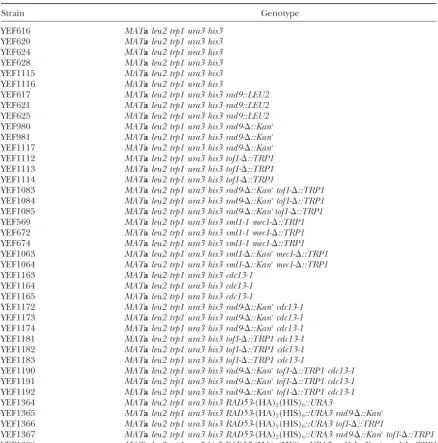
Weinert 1989). MMS alkylates DNA (reviewed in Yeast strains: All strains are in the A364a genetic back-Friedberget al.1995), resulting in DNA double-strand ground. Genotypes are listed in Table 1.
breaks (Chlebowicz and Jachymczyk 1979). UV in- Mutant screen:A strain carrying a temperature-sensitive al-lele ofRAD9(isolated by Mandy Paulovich; Whitehead
Insti-duces pyrimidine dimers (reviewed inFriedberget al.
tute, Massachusetts Institute of Technology, Cambridge, MA)
1995). Cdc13p maintains telomeres both by protecting
was EMS-mutagenized to 30% survival, and mutagenized cells
chromosome ends and by loading telomerase onto were allowed to grow up into colonies on rich medium at those ends (Nugent et al. 1996). cdc13-1 mutants at restrictive temperature (37⬚). A total of 10,000 colonies were restrictive temperature accumulate single-stranded patched out on rich plates and replica plated to 0.008% MMS, which allows growth ofrad9mutants but notmec1 sml1mutants.
DNA at their telomeres (Garviket al.1995). All lesions
Duplicate MMS plates were incubated for three days at
permis-induced by the above three treatments are referred to as
sive (23⬚) and nonpermissive temperatures and scored for
“DNA damage.” HU inhibits ribonucleotide reductase,
temperature-sensitive MMS sensitivity. Theⵑ200 candidates
slowing or stopping DNA synthesis. Since HU is not scored as sensitive in two separate experiments were trans-known to directly damage DNA, this treatment is de- formed with wild-typeRAD9on a plasmid and with the vector
alone. In 26 cases, wild-typeRAD9suppressed the MMS
sensi-scribed here simply as “HU-induced stress.”
TABLE 1
Yeast strains
Strain Genotype
YEF616 MATaleu2 trp1 ura3 his3
YEF620 MATaleu2 trp1 ura3 his3
YEF624 MATaleu2 trp1 ura3 his3
YEF628 MATaleu2 trp1 ura3 his3
YEF1115 MATaleu2 trp1 ura3 his3
YEF1116 MATaleu2 trp1 ura3 his3
YEF617 MATaleu2 trp1 ura3 his3 rad9::LEU2
YEF621 MATaleu2 trp1 ura3 his3 rad9::LEU2
YEF625 MATaleu2 trp1 ura3 his3 rad9::LEU2
YEF980 MATaleu2 trp1 ura3 his3 rad9-⌬::Kanr
YEF981 MATaleu2 trp1 ura3 his3 rad9-⌬::Kanr
YEF1117 MATaleu2 trp1 ura3 his3 rad9-⌬::Kanr
YEF1112 MATaleu2 trp1 ura3 his3 tof1-⌬::TRP1
YEF1113 MATaleu2 trp1 ura3 his3 tof1-⌬::TRP1
YEF1114 MATaleu2 trp1 ura3 his3 tof1-⌬::TRP1
YEF1083 MATaleu2 trp1 ura3 his3 rad9-⌬::Kanrtof1-⌬::TRP1
YEF1084 MATaleu2 trp1 ura3 his3 rad9-⌬::Kanrtof1-⌬::TRP1
YEF1085 MATaleu2 trp1 ura3 his3 rad9-⌬::Kanrtof1-⌬::TRP1
YEF569 MATaleu2 trp1 ura3 his3 sml1-1 mec1-⌬::TRP1
YEF672 MATaleu2 trp1 ura3 his3 sml1-1 mec1-⌬::TRP1
YEF674 MATaleu2 trp1 ura3 his3 sml1-1 mec1-⌬::TRP1
YEF1063 MATaleu2 trp1 ura3 his3 sml1-⌬::Kanrmec1-⌬::TRP1
YEF1064 MATaleu2 trp1 ura3 his3 sml1-⌬::Kanrmec1-⌬::TRP1
YEF1163 MATaleu2 trp1 ura3 his3 cdc13-1
YEF1164 MATaleu2 trp1 ura3 his3 cdc13-1
YEF1165 MATaleu2 trp1 ura3 his3 cdc13-1
YEF1172 MATaleu2 trp1 ura3 his3 rad9-⌬::Kanrcdc13-1
YEF1173 MATaleu2 trp1 ura3 his3 rad9-⌬::Kanrcdc13-1
YEF1174 MATaleu2 trp1 ura3 his3 rad9-⌬::Kanrcdc13-1
YEF1181 MATaleu2 trp1 ura3 his3 tof1-⌬::TRP1 cdc13-1
YEF1182 MATaleu2 trp1 ura3 his3 tof1-⌬::TRP1 cdc13-1
YEF1183 MATaleu2 trp1 ura3 his3 tof1-⌬::TRP1 cdc13-1
YEF1190 MATaleu2 trp1 ura3 his3 rad9-⌬::Kanrtof1-⌬::TRP1 cdc13-1
YEF1191 MATaleu2 trp1 ura3 his3 rad9-⌬::Kanrtof1-⌬::TRP1 cdc13-1
YEF1192 MATaleu2 trp1 ura3 his3 rad9-⌬::Kanrtof1-⌬::TRP1 cdc13-1
YEF1364 MATaleu2 trp1 ura3 his3 RAD53-(HA)2(HIS)6::URA3
YEF1365 MATaleu2 trp1 ura3 his3 RAD53-(HA)2(HIS)6::URA3 rad9-⌬::Kanr
YEF1366 MATaleu2 trp1 ura3 his3 RAD53-(HA)2(HIS)6::URA3 tof1-⌬::TRP1
YEF1367 MATaleu2 trp1 ura3 his3 RAD53-(HA)2(HIS)6::URA3 rad9-⌬::Kanrtof1-⌬::TRP1
tivity of the candidate (geneX) at restrictive temperature. One of peak definition) are better for cells stained with Sytox than for cells stained with propidium iodide; consequently Sytox of the 26rad9 geneXdouble mutants was completely unable
to slow S phase in MMS, as determined by flow cytometric has been used in flow cytometric analysis of mammalian (Mo-lecular Probes web site http://www.probes.com/handbook/ analysis of cells grown in 0.033% MMS at 37⬚.
Identifying the gene:Attempts to clone geneX by comple- figures/1512.html) and fission yeast cells (RhindandRussell 1998). Conditions for using Sytox in flow cytometric analysis menting the HU sensitivity ofrad9 geneXdouble mutants and
rad9 rad17 geneX triple mutants by transformation with six of Saccharomyces cerevisiae were determined by S. B. Haase (The Scripps Research Institute, La Jolla, California; personal different genomic libraries yielded only plasmids that carried
RAD9 as a strong suppressor of the HU sensitivity (in the communication). For a general discussion of flow cytometry former case) andRAD24as a weak high copy suppressor of inS. cerevisiae, seeHaaseandLew(1997).
the HU sensitivity (data not shown). The failure to recover a Viability curves:For the MMS and HU viability curves, cul-plasmid containingTOF1is probably due to the fact thatTOF1 tures were grown overnight at 30⬚ to mid-log phase (1.0 ⫻ is toxic toEscherichia coli (see below). Deletion ofRAD9 in 106–1.0 ⫻ 107 cells/ml), sonicated, counted in a Coulter
variously marked strains allowed assembly of a collection of Counter, spun down, and resuspended in fresh medium
con-rad9-homozygousgeneX-heterozygous diploids. These diploids taining either 0.033% MMS or 200 mmHU. Aliquots were were sporulated and dissected with hopes of detecting linkage withdrawn at 0, 1, 2, 3, and 4 hr, sonicated, counted, diluted, between a marker andgeneX, whose location was inferred from and plated on synthetic complete medium. For the UV survival HU sensitivity that segregated 2:2. In one experiment, 29 curve, cultures were grown, sonicated, and counted as above. out of 30 tetrads showed parental ditype segregation of HU Cells were then plated on synthetic complete medium and sensitivity andMET2.Among the nearby genes,TOF1 stood exposed to various UV doses (ⵑ260 nm; UVP model UVS-28; out because of its pre-S phase transcription induction (Cho Upland, CA) on a rotating platform. The UV source was always
et al.1998;Spellmanet al.1998) and its association with Top1p turned on at least 30 min before use, and UV fluence was (ParkandSternglanz1999). Transformation ofrad9 geneX measured immediately before each experiment. In all three double mutants with a PCR fragment containing only wild- cases, plates were incubated at 30⬚for 3 days and every macro-typeTOF1, followed by a long (overnight) outgrowth in rich scopic colony was counted. Graphs show the percentage of medium to allow time for integration of the fragment (presum- cells that formed macroscopic colonies. Each data point repre-ably at tof1) and expression of the wild-type protein, sup- sents the average of three different strains. Horizontal lines pressed the HU sensitivity of the double mutant. Sequencing showing standard deviations are included in each case, except both strands of a PCR fragment containing “tof1-1” revealed when their inclusion would obscure the data point to which a stop codon ⬍6% from the translation start site that was they are relevant.
absent in the wild-type control (amino acid 72, TRP, TGG Staining spindles and DNA:Cultures were grown overnight
changed to stop, TAG). at 30⬚to mid-log phase (1.0⫻106–1.0⫻107cells/ml),
soni-Efforts to subclone PCR fragments containingTOF1into a cated, counted in a Coulter Counter, spun down, and resus-vector marked withURA3were unsuccessful, suggesting that pended in fresh medium containing 5m␣-factor. After 2.5
TOF1is toxic to E. coli.To test this idea, equal amounts of hr at 30⬚, cells were spun down and resuspended in fresh this subcloning ligation mix were transformed into E. coli, medium containing 200 mmHU and 1 mg/ml pronase. After selecting for-lactamase (amp), and intorad9, “tof1-1,”ura3 3 more hours at 30⬚, cells were fixed with a 1:6 dilution of
yeast cells, selecting for URA3. The E. coli transformations 37% formaldehyde, treated with Zymolyase and then with yielded few colonies, none of which contained plasmids
car-ryingTOF1.The yeast transformations yielded large numbers of colonies, most of which carried plasmids containingTOF1, as inferred from the transformants’ loss of HU sensitivity. Furthermore, the HU resistance was plasmid dependent, as demonstrated by forcing loss of the plasmid on 5-fluoroorotic acid, which selects againstURA3.Attempts to transfer these plasmids back intoE. coliwere unsuccessful, again suggesting thatTOF1is toxic toE. coli.To further test this idea, equal amounts of DNA from yeast strains with plasmid-borneTOF1
were cut separately withHindIII andKpnI. Both of these en-zymes cut within and outside of theTOF1open reading frame, thereby removing most ofTOF1.The cut DNAs were ligated at low concentrations, to encourage intramolecular ligation reactions. An equal aliquot was mock treated. All three reac-tion mixes were transformed into the same preparareac-tion of competentE. coli alluded to five sentences earlier. The two reaction mixes in which most of theTOF1open reading frame had been removed from the plasmid yielded confluent lawns of bacterial transformants, while the uncut control yielded none. All plasmids checked contained the expected structure. These plasmids were then used to make a plasmid (pEF380) that was used to delete 77% of theTOF1open reading frame.
Flow cytometry:Three-milliliter samples for flow cytometry were pelleted, resuspended in 70% ethanol, washed with wa-ter, treated with 500l of 2 mg/ml RNaseA in 50 mmTris,
pH 7.5 for 1 hr at 37⬚, pelleted, treated with 500l of 2 mg/ Figure1.—A model for two parallel sensory pathways. The ml proteinase K in 50 mmTris, pH 7.5 for 1 hr at 50⬚, pelleted, RAD9-dependent pathway functions throughout the cell cycle and stained with 1mSytox green (Molecular Probes, Eugene, and detects DNA damage. The S phase-specific pathway
rat anti-tubulin antibody (YOL1/34), and stained with FITC- Cell body counts incdc13-1 strains:Cultures were grown overnight to mid-log phase (2⫻106–1⫻107) at 23⬚, sonicated,
conjugated goat anti-rat IgG and 4⬘
,6-diamidino-2-phenylin-dole (DAPI). Samples were viewed with a Delta Vision micro- placed on a thin slab of rich agar on a microscope slide, covered with a slip and sealed with Vaseline. Cell proliferation scope. All photos are shown at the same magnification.
RNR3transcription:Cultures (25 ml) were grown overnight at 37⬚was monitored by time-lapse video microscopy. Video-tapes were later viewed to count the number of cell bodies at at 30⬚to mid-log phase (1.0⫻106–1.0⫻107cells/ml),
soni-cated, and counted in a Coulter Counter; 1.5 ml was then 0 and 6 hr. The graph in Figure 3B shows (number of cell bodies at 6 hr)/(number of cell bodies at 0 hr). Each bar removed and processed for flow cytometric analysis. The
re-mainder of the culture was divided in two and spun down; represents the average from three different strains. Horizontal lines showing standard deviations are included in each case, one half (“G1” half) was resuspended in 10 ml of fresh medium
containing 5m␣-factor and incubated for 2 hr at 30⬚while but are indistinguishable from the top of the bar in the case oftof1.
the other half (“log phase” half) was resuspended in 10 ml
of water. One-half of the log phase half (log phase-UV quarter) Budding measurements: Cultures were grown to mid-log phase (1.0⫻106–1.0⫻107cells per milliliter), pelleted,
soni-was transferred to an empty plastic petri dish and exposed to
cated, and resuspended in medium with␣-factor. After 2.5 hr 50 J/m2 UV (ⵑ260 nm; UVP model UVS-28) on a shaking
in␣-factor, cells were pelleted, sonicated, resuspended in wa-platform. The UV source was always turned on at least 30 min
ter, and half of the culture was exposed to 50 J/m2 UV, as
before use, and UV fluence was measured immediately before
described above. Cells were then pelleted and resuspended each experiment. The log UV quarter and the log
phase-in fresh medium contaphase-inphase-ing 1 mg/ml pronase. Samples were no UV quarter were then spun down, resuspended in 10 ml
removed every 15 min, and multiple fields of cells were video-of fresh medium, and incubated for 30 min at 30⬚ to allow
taped through a microscope. Videotapes were later viewed to time for induction ofRNR3transcription (Navaset al.1996).
quantify bud emergence. Horizontal lines showing standard Cells were then transferred to 40-ml tubes containing crushed
deviations were deleted from this graph for clarity. ice, pelleted at 4⬚, washed with 1 ml of cold TE, pelleted,
Protein preparation and Western blot analysis (Tyerset al.
frozen on dry ice, and stored at⫺70⬚. After the 2-hr incubation
1992;Emiliet al.1998) was performed as described previously. in␣-factor, a 1.5-ml sample of the ␣-factor-arrested culture
was removed for flow cytometric analysis and the remainder was treated as was the first half of the culture, except that the
final 30-min outgrowth was in fresh medium that contained RESULTS
5m␣-factor. RNA was isolated and analyzed on a Northern
Screen for mutants in the S phase pathway:A mutant
blot. The probes used were thePvuII (179) toHindIII (2585)
fragment ofRNR3and the entire open reading frame (though screen to identify components of the S phase pathway
no more) ofPDA1. The blot was stripped between the two was based on the assumption that mutants missing this probings.PDA1, which encodes pyruvate dehydrogenase, was pathway would be particularly dependent on the cell used as a loading control becausePDA1transcript levels are
cycle-wide pathway, and therefore onRAD9, for
surviv-unaffected by a wide variety of treatments (Wenzelet al.1995).
ing DNA damage (see Introduction and Figure 1). Thus,
Radioactive blots were quantified using a PhosphorImager.
Data points represent levels of [(postirradiationRNR3tran- a strain carrying a temperature-sensitive allele ofRAD9 script/postirradiationPDA1transcript)/(preirradiationRNR3 was EMS-mutagenized, 10,000 colonies were patched
transcript/preirradiationPDA1transcript)]. Each bar repre- out, and mutants were isolated that showed extreme sents the average value for three different strains. Horizontal
(mec1-like) MMS sensitivity specifically at the restrictive
lines showing standard deviations are included in each case,
temperature. One of theserad9 geneXdouble mutants
but are indistinguishable from the top of the bar in the case
of log phasemec1 sml1. was completely unable to slow S phase in response to
MMS. ThegeneXphenotype was traced to a null muta- of UV-induced transcription.) Figure 3A shows RNR3
transcript levels 30 min after cells were exposed to 50 tion inTOF1(seematerials and methods). A deletion
allele ofTOF1was constructed for the experiments de- J/m2 UV irradiation. Consistent with previous results
(Navaset al.1996), wild-type cells showed higherRNR3
scribed below (see materials and methods).
TOF1 and RAD9 have overlapping functions in re- transcript levels after UV-irradiation of both log phase and G1-arrested cultures,rad9mutants displayed higher
sponse to MMS- and UV-induced damage:Phenotypes
exploited in the isolation of atof1mutant are illustrated RNR3 transcript levels in log phase, but not G1, and
mec1 sml1mutants did so in neither log phase nor G1 in Figure 2, A–C. Viability as a function of incubation
time in 0.033% MMS is shown forrad9andtof1single (Figure 3A). Consistent with TOF1 function being re-stricted to S phase,TOF1’s contribution to UV-induced mutants and for rad9 tof1 double mutants, with
wild-type and mec1 sml1 strains serving as controls (Figure RNR3transcript levels was apparent in log phase cultures (comparerad9andrad9 tof1) but not in G1-arrested cul-2A). [All mec1strains used here carry asml1 mutation
to suppress the lethality of themec1mutation (Zhaoet tures (Figure 3A).
The cdc13-1 mutation causes regions of
single-al.1998).] While the viabilities ofrad9and tof1single
mutants in MMS were only slightly lower than the viabil- stranded DNA to remain at telomeres in G2/M (Garvik et al.1995), and this induces a block to anaphase, which ity of wild type, therad9 tof1double mutant was as MMS
sensitive asmec1 sml1(Figure 2A). Therad9 tof1double is reflected in a block to cytokinesis after S phase is complete (Weinert and Hartwell 1993). Thus, if mutant also resembled themec1 sml1mutant in being
incapable of retarding S phase in response to MMS. TOF1 function is restricted to S phase, it should not contribute to the block to cytokinesis. Figure 3B shows This defect was apparent when log phase cultures were
transferred into medium containing MMS (Figure 2B) thattof1mutants were as proficient as wild-type cells in this response, while rad9 mutants were deficient (as as well as when cultures arrested in G1 with␣-factor were
allowed to resume proliferation in medium containing previously demonstrated; Weinert and Hartwell 1993). Instead of exacerbating the deficiency, deletion MMS (Figure 2C). The effect is easier to see in Figure
2B because all profiles contain cells in G1 and in G2/M, ofTOF1in arad9mutant appeared to partially restore the block to anaphase, but this result is likely to be an providing internal reference points, and because the
time before the entire population has completed S artifact of the low viability of rad9 tof1 cdc13-1 triple mutants: even at 23⬚, viability, as measured by colony-phase is longer. (Cultures arrested in G1 acquire a G2
DNA content upon resumption of proliferation in less forming units per cell, was only 49%, as opposed to about 75% for the other strains tested (Figure 3B). time than do log phase cultures; during a 2.5-hr␣-factor
block, newly formed daughter cells grow to the cell TOF1 and RAD9 have overlapping functions in re-sponse to HU-induced stress:As with MMS and UV,tof1
volume required for entrance into S phase.) Figure 2C
is included to show that rad9 tof1 double mutants do and rad9 caused synergistic sensitivity to HU (Figure 4A). [Althoughtof1mutants were highly viable in HU, not simply arrest all cell cycle progression when shifted
to MMS. they had a growth deficiency when streaked out on HU
plates (data not shown).] Strains missing bothtof1and As shown in Figure 2D, deletion of TOF1increases
the UV sensitivity ofrad9mutants. For survival of wild- rad17, rad24, or mec3 were also HU sensitive, even though none of these single mutants appears more sen-type cells in both MMS and UV, the data point to a
greater role forRAD9than forTOF1, consistent with a sitive than wild-type when patches of cells are replica plated to 100 mmHU (data not shown). (ddc1was not cell cycle-wide function forRAD9and an S phase-specific
function forTOF1. tested.)
Cells exposed to HU phosphorylate Rad53p. This Siede and colleagues reported that UV irradiation
delays bud emergence and that this response is depen- phosphorylation is controlled byMEC1and, to a lesser degree, TEL1(Sanchez et al. 1996). RAD9 andTOF1
dent onRAD9andMEC1(Siedeet al.1993, 1994, 1996).
However, in the experiments reported here, mutation were necessary and largely redundant for HU-induced phosphorylation of Rad53p (Figure 4B). The level of of neitherTOF1nor any other genes tested affected this
response (Figure 2E). This discrepancy may be due to HU-induced phosphorylation in the rad9 tof1 mutant was at least as low as in themec1 sml1mutant and may strain background differences.
TOF1 does not respond to UV- or cdc13-1-induced be completely absent. Perhaps either Rad9p or Tof1p
is absolutely required for a physical association of either
DNA damage outside of S phase: If Tof1p functions
specifically in the S phase pathway, its contribution to Mec1p or Tel1p with Rad53p (seediscussion). As seen previously (Sanchezet al.1996;Sunet al.1996), Rad53p DNA damage response should be restricted to S phase.
Thus,TOF1should contribute to UV-induced transcrip- protein accumulates in response to HU. This increase is only partially dependent onMEC1,RAD9, andTOF1
tion ofRNR3in log phase cultures, where a portion of
the culture is in S phase, but not in cultures arrested (Figure 4B). The part of the increase not dependent on these genes may be a reflection of the MCB regulation of in G1 with␣-factor. (RNR3encodes a subunit of
Figure3.—UV-induced transcription andcdc13-1-induced anaphase delay. (A) UV-induced transcription ofRNR3.Overnight mid-log phase cultures were split in two, half was exposed to 50 J/m2UV irradiation. The other half of the original culture was
arrested in G1 (by incubation for 2 hr in␣-factor) and then treated as was the first half of the original culture. Cells were then incubated for 30 min at 30⬚to allow time for induction ofRNR3transcription.PDA1transcript levels were used as a loading control (Wenzel et al. 1995). Each bar represents the average (postirradiation RNR3 transcript level/postirradiation PDA1
transcript level)/(preirradiationRNR3transcript level/preirradiationPDA1transcript level) for three different strains. Aliquots were removed at each stage and processed for flow cytometry (data not shown). Representative RNAs are shown at the bottom. (B)cdc13-1-induced anaphase delay, as determined by measuring the delay in cytokinesis. Cultures were grown overnight at 23⬚ to mid-log phase, sonicated, and spotted onto a thin slab of agarose on a microscope slide. Cell proliferation at 37⬚was followed using time-lapse video microscopy. Graph shows the number of cell bodies after 6 hr at 37⬚divided by the number of cell bodies att⫽0. Each genotype represents three different strains.
that cause transcription to peak in or just prior to S pendent role forMEC1in maintaining viability in HU is consistent with results reported by Desany et al.
phase, and HU blocks cells in S phase.)
tof1mutants undergo concurrent S phase and spindle (1998) that demonstrate a role forMEC1in maintaining viability in HU even when spindle elongation is
chemi-elongation in HU:Weinertet al.(1994) raised the
possi-bility that the HU sensitivity ofmec1 mutants was due cally blocked. DAPI staining of the DNA in mec1 sml1
andrad9 tof1mutants was uneven, suggesting DNA frag-to their entry infrag-to anaphase, as inferred from spindle
elongation, before DNA replication is complete. (Note, mentation, though this phenotype was subtle (data not shown). In contrast, the DNA intof1mutants was indis-however, that spindle elongation need not reflect
ana-phase;Skibbenset al.1999.) Consistent both with this tinguishable from that inrad9mutants or wild-type cells (data not shown). The percentage of cells that showed idea and with the extreme HU sensitivity of rad9 tof1
double mutants, rad9 tof1 double mutants displayed obvious stretching of the DNA toward the spindle poles (⬍5%) was approximately the same in strains of all five elongated spindles in HU (Figure 4C). However,tof1
single mutants also displayed some spindle elongation genotypes (data not shown). I know of no simple model to explain why, despite numerous overlapping func-in HU (Figure 4C) prior to completion of S phase
(Fig-ure 4D). These data are consistent with the possibility tions,TOF1andRAD9do not appear to overlap in their ability to block spindle elongation in HU.
that spindle elongation accounts for a small fraction of the HU-induced lethality of rad9 tof1 and mec1 sml1
mutants, but accounts for a large fraction of the
HU-DISCUSSION
induced lethality oftof1mutants. Alternatively, the data
elongation-inde-Figure4.—Cellular responses to HU. (A) Viability in HU. Mid-log phase overnight cultures were spun down and resuspended in fresh medium containing 200 mmHU. Aliquots were withdrawn at 0, 1, 2, 3, and 4 hr and, for wild-type,tof1, andrad9strains, also at 6, 8, 10, and 12 hr, sonicated, counted, and plated on synthetic complete medium. Graph shows percentage of cells that could form macroscopic colonies after 3 days of incubation at 30⬚. In therad9 tof1strains, HU treatment caused heterogeneous colony sizes, and many of the colonies were barely visible. Each genotype represents three different strains. (B) Phosphorylation of Rad53p in response to HU. Mobility of immunoprecipitated Rad53p tagged with HA was examined after late log phase cells were resuspended in fresh medium with or without 200 mmHU and grown for an additional 2 hr at 30⬚. (C) Spindle elongation in HU. Overnight mid-log phase cultures were␣-factor-arrested, pelleted, and resuspended in fresh medium containing 200 mm HU and 1 mg/ml pronase. Aliquots were removed after 3 hr of incubation at 30⬚, fixed with formaldehyde, stained for DNA and spindles, and viewed under a Delta Vision microscope. All samples are shown at the same magnification, with spindles in green and DNA in blue. (D) Cell cycle position of strains 3 hr after release from an␣-factor block into medium containing 200 mmHU. Shaded profiles of log phase cultures are shown for reference.
pathway that functions specifically within S phase:tof1 lently links Top1p to Top1p-cleaved DNA, causes strand breaks preferentially at replication forks in SV40, even andrad9showed synergistic sensitivity to MMS, UV, and
HU, and the double mutant was unable to slow S phase when added after replication fork progression has been blocked by aphidicolin (Avemannet al.1988), suggest in response to MMS and to phosphorylate Rad53p in
response to HU. In log phase cultures, tof1 and rad9 that Top1p, and by implication Tof1p, functions at the replication fork. Thus the S phase specificity ofTOF1
showed synergistic inability to increaseRNR3transcript
levels in response to UV, but during G1 TOF1did not function demonstrated in this article may reflect an association of Tof1p with the replication apparatus. appear to contribute to this response. Mutation ofTOF1
did not impair thecdc13-1-induced delay in cytokinesis, Previous work led to the belief that, while both the cell cycle-wide pathway and the S phase pathway were which occurs in response to DNA damage present after
S phase is complete. important for surviving DNA damage, only the S phase pathway was important for surviving replication blocks. The observations (1) that Top1p is the topoisomerase
cova-demonstrated a role forRAD9in allowing colony forma-tion in the continuous presence of HU (Navas et al.
1996); however, blocking cell proliferation in the con-tinuous presence of HU is not equivalent to HU-induced lethality (Allenet al.1994).] If both pathways are capa-ble of responding to DNA damage and to replication blocks, one is free to suppose both that they detect a common stress signal and that they use the same sensor protein to detect this signal.
Single-stranded DNA is a good candidate for a signal generated both by DNA damage and by stalled replica-tion forks: The cell cycle-wide pathway responds to sin-gle-stranded DNA (Garvik et al. 1995). DNA lesions, such as double-strand breaks or thymine dimers, elicit a response from this pathway only if the lesions are processed to produce single-stranded DNA (Siedeet al.
1994; Lydall et al. 1996). And aphidicolin, an agent
that blocks DNA replication, generates single-stranded Figure 5.—Model in which Mec1p functions as a single-DNA in the SV40 replication system (Drogeet al.1985) stranded DNA-dependent protein kinase at the top of both
sensory pathways.
and in melanoma cells (LonnandLonn1988). Mec1p is the obvious candidate for a protein that senses this single-stranded DNA: The mammalianMEC1
is capable of fulfilling Top1p’s role as a topoisomerase homolog, DNA-PK, is a protein kinase that is activated
during DNA replication (KimandWang1989). An obvi-by DNA double-strand ends (SmithandJackson1999).
ous possibility for the function of a topoisomerase-Tof1p And the closest mammalianMEC1homolog, ATR, is a
interaction is to link Tof1p to the replication apparatus. protein kinase whose activity can be stimulated by
single-The phenotypes of rad9 tof1mutants are not always stranded DNA (Hall-Jackson et al. 1999). Thus, it is
quantitatively equivalent to the phenotypes ofmec1 sml1
logical to suppose that single-stranded DNA constitutes
mutants. There are at least four reasons for expecting a universal signal of genotoxic stress, and that Mec1p
differences between strains of these two genotypes: is a single-stranded DNA-dependent protein kinase that
functions to detect this single-stranded DNA. 1. Deletion ofRAD9does not eliminate the cell cycle-wide branch of the DNA damage response pathway; The functional redundancy between Rad9p and
Tof1p demonstrated in this article may be an indication other genes in the pathway can make small contribu-tions to DNA damage response in the absence of that these proteins have a common molecular activity.
A function for Rad9p is suggested by the observation RAD9and vice versa (de la Torre Ruizet al.1998). 2. RAD9 must have functions independent of MEC1, that DNA damage inducesMEC1-dependent
phosphory-lation of Rad9p and that this allows Rad9p to bind since deletion of RAD9 in a mec1 mutant leads to increased MMS sensitivity (Paulovichet al.1997). Rad53p (Emili1998;Sunet al.1998); specifically, Rad9p
may allow a lesion-dependent complex to form between 3. MEC1must have functions independent ofRAD9and
TOF1, since MEC1 is an essential gene, while rad9
Mec1p, Rad9p, and Rad53p. By analogy, Tof1p may
allow a lesion-dependent complex to form between tof1mutants (andrad9 rad24 tof1mutants; data not shown) are viable.
Mec1p, Tof1p, and Rad53p. As suggested above, Tof1p’s
S phase specificity may come from an association with 4. TheMEC1homologTEL1can partially substitute for
MEC1. [Deletion of SML1 in a rad9 tof1 mutant is the replication apparatus; thus, only when
single-stranded DNA is generated at the replication fork (ei- not expected to eliminate differences in UV and HU sensitivity betweenrad9 tof1andmec1 sml1strains. If ther from DNA damage or from a stalled DNA
polymer-ase) would Mec1p act on Tof1p instead of on Rad9p to anything, it may slightly magnify the differences, since deletion ofSML1causes a very slight decrease transmit the signal to Rad53p. The arguments in these
last four paragraphs lead me to favor the model in in UV, HU, and MMS sensitivity (Zhaoet al.1998).] Figure 5 over the more widely accepted model in Figure
Four observations suggest that deletion ofTOF1leads 1. These ideas are discussed extensively inFoss(2000).
to increased endogenous DNA damage (three of which An interaction between Tof1p and Top1p is not
re-also suggest that the absence ofRAD9leads to increased quired for Tof1p function, sincetop1deletion mutants,
endogenous damage): unliketof1deletion mutants, do not show synergistic HU
sensitivity withrad9(data not shown). If the interaction 1. There was low-level phosphorylation of Rad53p in the absence of HU (Figure 4B).
between Tof1p and Top1p is functionally relevant,
0.14) was lower than that ofrad9 mutants (0.82 ⫾ LITERATURE CITED
0.09; though the viability oftof1mutants was similar Aboussekhra, A., J. E. Vialard, D. E. Morrison, M. A. de la
Torre-Ruiz, L. Cernakovaet al., 1996 A novel role for the budding
to that of wild-type cells).
yeastRAD9checkpoint gene in DNA damage-dependent
tran-3. The viability of rad9 tof1 cdc13-1 mutants (0.49 ⫾
scription. EMBO J.15:3912–3922.
0.02) was lower than that of rad9 cdc13-1 mutants Allen, J. B., Z. Zhou, W. Siede, E. C. FriedbergandS. J. Elledge,
1994 TheSAD1/RAD53protein kinase controls multiple
check-(0.75⫾0.02; though viability ofcdc13-1 tof1mutants
points and DNA damage-induced transcription in yeast. Genes
(0.74⫾ 0.03) was similar to the viability ofcdc13-1
Dev.8:2401–2415.
mutants (0.78⫾0.06). Avemann, K., R. Knippers, T. KollerandJ. M. Sogo,1988
Campto-thecin, a specific inhibitor of type I DNA topoisomerase, induces
4. In the absence of any exogenous DNA-damaging
DNA breakage at replication forks. Mol. Cell. Biol.8:3026–3034.
agents, the flow cytometry profiles of log phase
cul-Chlebowicz, E., and W. J. Jachymczyk, 1979 Repair of
MMS-tures ofrad9 tof1 mutants were wider than those of induced DNA double strand breaks in haploid cells of Saccharo-myces cerevisiae, which requires the presence of a duplicate ge-rad9mutants (though the profiles of wild-type cells
nome. Mol. Gen. Genet.167:279–286.
andtof1 mutants were similar).
Cho, R. J., M. J. Campbell, E. A. Winzeler, L. Steinmetz, A. Conway
et al., 1998 A genome-wide transcriptional analysis of the mitotic
Why might deletion of TOF1 increase endogenous cell cycle. Mol. Cell2:65–73.
damage? Perhaps the replication fork is less stable in de la Torre-Ruiz, M. A., C. M. GreenandN. F. Lowndes,1998
RAD9andRAD24define two additive, interacting branches of tof1 mutants than in wild-type cells in the absence of
the DNA damage checkpoint pathway in budding yeast normally
exogenous genotoxic agents (an effect that need not required for Rad53 modification and activation. EMBO J.17:
2687–2698.
be exaggerated by the presence of exogenous genotoxic
Desany, B. A., A. A. Alcasabas, J. B. BachantandS. J. Elledge,
agents). Clearly, other components of this pathway have
1998 Recovery from DNA replicational stress is the essential
functions besides detecting DNA structures generated function of the S-phase checkpoint pathway. Genes Dev.12:2956–
2970.
by exogenous genotoxic agents, since both MEC1and
Droge, P., J. M. SogoandH. Stahl,1985 Inhibition of DNA synthe-RAD53are required for viability. Perhaps the presence
sis by aphidicolin induces supercoiling in simian virus 40
replica-of Mec1p, Rad53p, and Treplica-of1p at replication forks helps tive intermediates. EMBO J.4:3241–3246.
Egel, R., D. H. BeachandA. J. Klar,1984 Genes required for
to stabilize those forks when they stall during
unper-initiation and resolution steps of mating-type switching in fission
turbed S phases.
yeast. Proc. Natl. Acad. Sci. USA81:3481–3485.
Does the observation that deletion ofTOF1can cause Emili, A.,1998 MEC1-dependent phosphorylation of Rad9p in
re-sponse to DNA damage. Mol. Cell2:183–189.
endogenous DNA damage negate the idea that TOF1
Foss, E. J.,2000 Is Rad9p upstream or downstream of Mec1p? Cold
plays an active role in DNA damage response during S
Spring Harbor Symp. Quant. Biol.65:(in press).
phase? No. The observation does not provide an expla- Friedberg, E. C., G. C. WalkerandW. Siede, 1995 DNA Repair and Mutagenesis.ASM Press, Washington, DC.
nation forTOF1’s role in UV-induced transcription of
Garvik, B., M. Carson andL. Hartwell, 1995 Single-stranded RNR3 and in HU-induced phosphorylation of Rad53p DNA arising at telomeres incdc13mutants may constitute a spe-(compare log phase rad9 with log phase rad9 tof1 in cific signal for theRAD9checkpoint. Mol. Cell. Biol.15:6128–
6138.
Figure 3A and comparerad9withrad9 tof1in Figure 4B).
Haase, S. B.,andD. J. Lew,1997 Flow cytometric analysis of DNA
Furthermore, if deletion ofTOF1was simply causing a content in budding yeast. Methods Enzymol.283:322–332. higher level of endogenous damage, then the MMS, Hall-Jackson, C. A., D. A. Cross, N. MorriceandC. Smythe,1999
ATR is a caffeine-sensitive, DNA-activated protein kinase with a
UV, and HU sensitivities of rad9 tof1 double mutants
substrate specificity distinct from DNA-PK. Oncogene18:6707–
should be approximately the same as that ofrad9mu- 6713.
tants; the absence of TOF1 would just add a slightly Hartwell, L. H.,andT. A. Weinert,1989 Checkpoints: controls that ensure the order of cell cycle events. Science246:629–634.
higher baseline level of damage. This is not the case
Kim, R. A.,andJ. C. Wang,1989 Function of DNA topoisomerases
(Figures 2, A and D and 4A). Thus, as is likely the case as replication swivels inSaccharomyces cerevisiae.J. Mol. Biol.208: with removal of MEC1 or of RAD53, removal of TOF1 257–267.
Kiser, G. L.,andT. A. Weinert,1996 Distinct roles of yeastMEC creates endogenous damage; however, this does not
be-andRADcheckpoint genes in transcriptional induction after DNA
lie its active role in genotoxic stress response. damage and implications for function. Mol. Biol. Cell7:703–718.
Longhese, M. P., V. Paciotti, R. Fraschini, R. Zaccarini, P.
Plev-I am enormously grateful to Jette Foss for many discussions critical
aniet al., 1997 The novel DNA damage checkpoint protein to the intellectual development of this work and for extensive
com-Ddc1p is phosphorylated periodically during the cell cycle and ments on this manuscript. In this regard, I also thank Toni Bedalov, in response to DNA damage in budding yeast. EMBO J.16: Linda Breeden, Aida de la Cruz, Leon Dirick, Andrew Emili, Christian 5216–5226.
Frei, Barbara Garvik, Jim Haber, Lee Hartwell, Joe Horecka, Doug Lonn, U.,andS. Lonn,1988 Extensive regions of single-stranded Koshland, Charles Laird, Andrew Murray, Patrick Paddison, Dina DNA in aphidicolin-treated melanoma cells. Biochemistry27:
566–570. Raveh, Nick Rhind, Jim Roberts, Julia Sidorova, Frank Stahl, and
Lydall, D., Y. Nikolsky, D. K. BishopandT. Weinert,1996 A David Toczyski. I thank Jeff Bachant, Andrew Emili, Elizabeth Greene,
meiotic recombination checkpoint controlled by mitotic check-Steve Haase, Joe Horecka, and Tim Knight for advice on spindle
point genes. Nature383:840–843. staining, Western blots, sequence analysis, flow cytometry, Northern
Navas, T. A., Y. SanchezandS. J. Elledge,1996 RAD9and DNA blots, and image analysis, respectively. I thank Scott Diede, Andrew
polymerase epsilon form parallel sensory branches for transduc-Emili, and Mandy Paulovich for plasmids and strains. This work was ing the DNA damage checkpoint signal inSaccharomyces cerevisiae. supported by my fellowship from the Damon Runyon/Walter Winchell Genes Dev.10:2632–2643.
foundation and by Lee Hartwell’s National Institutes of Health grant Nugent, C. I., T. R. Hughes, N. F. Lue and V. Lundblad,
with a dual role in yeast telomere maintenance. Science 274: Spellman, P. T., G. Sherlock, M. Q. Zhang, V. R. Iyer, K. Anders
249–252. et al., 1998 Comprehensive identification of cell cycle-regulated
Park, H.,andR. Sternglanz,1999 Identification and characteriza- genes of the yeastSaccharomyces cerevisiaeby microarray hybridiza-tion of the genes for two topoisomerase I-interacting proteins tion. Mol. Biol. Cell9:3273–3297.
fromSaccharomyces cerevisiae.Yeast15:35–41. Sun, Z., D. S. Fay, F. Marini, M. FoianiandD. F. Stern,1996 Spk1/
Paulovich, A. G.,andL. H. Hartwell,1995 A checkpoint regu- Rad53 is regulated by Mec1-dependent protein phosphorylation lates the rate of progression through S phase inS. cerevisiaein in DNA replication and damage checkpoint pathways. Genes Dev.
response to DNA damage. Cell82:841–847. 10:395–406.
Paulovich, A. G., R. U. Margulies, B. M. GarvikandL. H. Hart- Sun, Z., J. Hsiao, D. S. Fay and D. F. Stern,1998 Rad53 FHA well,1997 RAD9,RAD17, andRAD24are required for S phase domain associated with phosphorylated Rad9 in the DNA damage regulation inSaccharomyces cerevisiaein response to DNA damage. checkpoint. Science281:272–274.
Genetics145:45–62. Tyers, M., G. Tokiwa, R. NashandB. Futcher,1992 The
Cln3-Rhind, N., and P. Russell, 1998 The Schizosaccharomyces pombe Cdc28 kinase complex ofS. cerevisiaeis regulated by proteolysis
S-phase checkpoint differentiates between different types of DNA and phosphorylation. EMBO J.11:1773–1784. damage. Genetics149:1729–1737.
Weinert, T. A.,andL. H. Hartwell,1988 TheRAD9gene controls
Sanchez, Y., B. A. Desany, W. J. Jones, Q. Liu, B. Wanget al., 1996 the cell cycle response to DNA damage inSaccharomyces cerevisiae. Regulation ofRAD53by the ATM-like kinasesMEC1andTEL1
Science241:317–322. in yeast cell cycle checkpoint pathways. Science271:357–360.
Weinert, T. A.,andL. H. Hartwell,1993 Cell cycle arrest ofcdc
Siede, W., A. S. FriedbergandE. C. Friedberg,1993 RAD9
-depen-mutants and specificity of theRAD9checkpoint. Genetics134: dent G1 arrest defines a second checkpoint for damaged DNA
63–80. in the cell cycle ofSaccharomyces cerevisiae.Proc. Natl. Acad. Sci.
Weinert, T. A., G. L. Kiser andL. H. Hartwell, 1994 Mitotic USA90:7985–7989.
checkpoint genes in budding yeast and the dependence of mitosis
Siede, W., A. S. Friedberg, I. DianovaandE. C. Friedberg,1994
on DNA replication and repair. Genes Dev.8:652–665. Characterization of G1 checkpoint control in the yeast
Saccharo-Wenzel, T. J., A. W. R. H. TeunissenandH. Y. Steensma,1995 PDA1 myces cerevisiaefollowing exposure to DNA-damaging agents.
Ge-mRNA: a standard for quantitation of mRNA in Saccharomyces
netics138:271–281.
cerevisiaesuperior toACT1mRNA. Nucleic Acids Res.23:883–884.
Siede, W., J. B. Allen, S. J. ElledgeandE. C. Friedberg,1996 The
Zhao, X., E. G. D. MullerandR. Rothstein,1998 A suppressor
Saccharomyces cerevisiae MEC1gene, which encodes a homolog of
of two essential checkpoint genes identifies a novel protein that the human ATM gene product, is required for G1 arrest following
negatively affects dNTP pools. Mol. Cell2:1–20. radiation treatment. J. Bacteriol.178:5841–5843.
Zhou, Z.,andS. J. Elledge,1993 DUN1encodes a protein kinase
Skibbens, R. V., L. B. Corson, D. KoshlandandP. Hieter,1999
Ctf7p is essential for sister chromatid cohesion and links mitotic that controls the DNA damage response in yeast. Cell75:1119– chromosome structure to the DNA replication machinery. Genes 1127.
Dev.13:307–319.
Communicating editor:J. Rine Smith, G. C.,andS. P. Jackson,1999 The DNA-dependent protein