M U T A T I O N (t3> A T -4 MUTABLE LOCUS I N THE MOUSE L. C. DUNN A N D S. GLUECKSOHN-WAELSCH
Colulrzhia University, .Vex1 York
Received April 3, 1950
T has been pointed out recently ( D U N N and GLCECKSOHN-SCHOEN-
I
H E I M E R 1950) that the locus in chromosome I X of the house mouse which is marked by the mutation T (Brachyury or short tail) is relatively unstable. In balanced lines containing two lethals at this locus (such as T / t o or T / t l tailless) exceptions are occasionally found which are normal-tailed instead of tailless. Tests of exceptions of this sort which occurred in our balanced stocks have shown that in each case the exception has a t type mutation which resembles that in the parents in interacting specifically with T to produce taillessness, but differs from the parental mutant in forming a viable normal individual, such as tO/tn instead of an inviable, abnormal one, such as to/to. I n the case of each exception the questions arise (1) whether the new t type mutation is an allele of the parental type and if so whether it represents a novel change at this locus or the recurrence of one which has already been recorded; (2) whether the new mutation retains the peculiarity of the pa- rental t chromosome in preventing recombination in the immediate neighbor- hood of T ( D U N N and CASPARI 1945) due probably to an inverted section; ( 3 ) whether it shares also some of the other peculiarities of t type mutations in lethal effect, production of non-random segregation in the male, sterility of male compounds tO/ta and other effects ( D U N N and GLUECKSOHN-SCHOEN- HEIMER 1943). The questions primarily at issue in such analyses concern the mode of origin and degree of resemblance of mutations which are apparently unilocal, yet show complementary effects with each other, indicating com- plexity of the locus within which qualitatively different processes are deter- mined. I n the present paper, the questions are examined as they pertain to the first of the new exceptions at this locus to be extensively analyzed.T H E OCCURRENCE O F MUTATION t3
The inbred Line 29 originally obtained from PROF. DOBROVOLSKAIA- ZAVADSKAIA in 1933 and described by her pupil KOROZIEFF (1935) normally breeds true and produces only tailless offspring. I t is known to produce three classes of offspring, T / T which die as embryos at 10% days, tl/tl which die before implantation, and T / t l which survive. Line 29 animals are there- fore T / t l and recombination between T and tl does not occur. However, from one mating of T / t l x T / t l , a litter was born which consisted of three tailless and one normal offspring, a female. Continued breeding of this pair
1 This work was aided by a grant from the AMERICAN CANCER SOCIETY, recommended by the COMMITTEE ON GROWTH.
MUTABLE LOCUS I N THE MOUSE 5
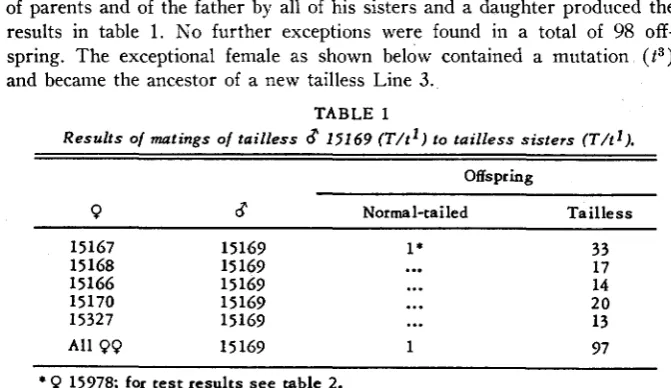
of parents and of the father by all of his sisters and a daughter produced the results in table 1. No further exceptions were found in a total of 98 off- spring. The exceptional female as shown below contained a mutation ( t 3 ) and became the ancestor of a new tailless Line 3.
T A B L E 1
Results of matings of tailless
6
15169 ( T / t ' ) to tailless sisters ( T / t l ) .Offspring
Q
d
Normal-tailed T a i l l e s s15167 15169 1* 33
15168 15169
...
1715166 15169
...
1415170 15169
...
2015327 15169
...
13A l l QQ 15169 1 97
* Q 15978; for test r e s u l t s see table 2.
The tailless parents which gave rise to the exception had been derived from the progeny of an outcross of Line 29 tailless to a normal mouse, made in order to save the tailless line from extinction. The immediate parents of the tailless animals which produced the exception were thus +/tl x T / + 8
.
It is unlikely, however, that the mutation t3 was introduced from the normal stock since both parents of the exception bred as though they were T / t l(table 1, line 1 ) . It is more likely that a mutation t' to t3 occurred in a cell ancestral to at least one gamete of one of the parents of the exception.
Breeding tests of the exceptional normal-tailed female showed that it was neither a recombination ( + t / + t l ) nor a phenotypic deviant of genotype T / t l since when crossed to Brachy T/+ it produced only normal-tailed and tail- less progeny (table 2) ; and the tailless progeny were shown to consist
TABLE 2
Results of mating t e s t s of exceptional normal-tailed female (15978) t 1 / t 3 .
of
OfIspring
Q
d
Normal-tailed Tailless Total15978 normal T / t 5 1 6
15978 normal T/ + 20 18 38
two genotypes T / t l and T/t3. This was deduced from the results of test crossing one of these tailless progeny by the parent stock ( T / t l ) ; it produced six tailless and three normal. The same animal tested by tailless Line A
( T / t o ) produced 3 tailless and 2 normal, showing that it must contain a mutation different from either to or t l . Its genotype was assumed to be T / t a
T / t l . These tests are summarized in table 3 . Of the 18 animals tested in mat-
ings with each other, one gave both tailless and normal offspring; and this
female ( 9 16102) produced some normal progeny both by her tailless brother
and by a Line 29 male ( T / t l ) . This proved her to carry a mutation different
from tl since in combination with t' it produced a normal tail. Of the 18 tail-
less offspring of 15169, 17 were probably T / t l while one ( 9 16102) was
T/t". This new t mutation also behaved like t3, so that it is probable that
8 15169 transmitted t3 to two of his 116 affspring ( 0 15978 t 1 / t 3 ; 9 16102
T / t 3 ) . Thus, at least two of the 58 t gametes from him which were tested
were not tl but f3. Either t3 was subject to a high mutation rate in the sperm
of 8 15169, or else the mutation to t3 occurred before the last meiotic division
resulting in a mosaic gonad, and was thus included in more than one sperm.
TABLE 3
T e s t s o/ tailless offspring of
8
1.51 69 tailless Line 29 ( T / t ' ) x tailless t e s t mates.Offspring
F , tailless x T a i l l e s s test mates Noma I-tailed Tailless Genotype
Q 16099 x
6
16101 ( T / t l )Q 16099 x
6
Line 29(T/t1)Q 16102 x
6
16101 ( T / t l )Q 16102 x
6
Line 29 ( T / t l )Q 15822 x
d
16101 ( T / t l )6
16101 x QQ Line 29 ( T / t l )6
15979 x QQ Line 29(Tit')
6
16130 X 4 QQ (daughters)6
16152 X 2 QQ (daughters)6
16491 x 2 QQ (daughters)6
16724 X 2 QQ (daughters)...
...
8 5...
...
...
...
...
...
...
27* 2 3 8 11 27 13 20 36 22 7Total: 18 tailless offspring of
6
15169. 17 = T / t 1 ; 1 = T / t 3T / t
T / t 3
T / t T / t l
5 T / t l 3 T / t 1 3 T / t l 3 T / t l T / t I
* One of these,
d
17178, proved to be T / t 3 since when tested by T / t l he gave 3t Daughters of
6
15169.tailless and 1 normal-tailed offspring.
It is not possible on the basis of our data to decide between these alterna- tives. However, it is interesting to note that the same phenomenon repeated
itself with some tailless offspring of 8 15169 which although genetically
proved to be T / t l , transmitted t 3 as well.
The mating of 8 16101 and 0 16099 (both tailless offspring of 8 15169)
produced 27 tailless offspring (table 3 ) . One of these ( 8 17178) turned out
to be T/t3. H e gave one normal and three tailless offspring by a tailless
female T/t', and three normal and eight tailless offspring by tailless females
T/t3. The tests of the father of 8 17178 ( 8 16101) had shown him to be
T / t l (table 3 ) . The mother (16099) did not have an adequate test by Line
29 T / t l (only 2 tailless offspring) ; however, in niatings to 8 16101 ( T / t l
by test) she behaved as T / t l giving 27 tailless offspring. Thus, 8 17178
owes its genotype T / t 3 either to a mutant gamete from one of the parents or
MUTABLE LOCUS I N THE MOUSE 7
to decide between these alternatives, one of which supposes an unusually high mutation rate, the other one hereditary transmission of gonadal mosaicism. I n any case, the new mutations derived from 8 15169 (through his daughters 15978 and 16102) appear to be the same. The description of the breeding behavior of the new mutation, as given below, is based upon experiments with stock derived from outcrosses of 15978, 16102 and 17178 by T/+.
BREEDING BEHAVIOR OF T H E NEW TAILLESS LINE 3, T / t 3
Tailless animals which had been proved, in test crosses with T / t l , to be T / t 3 were bred together and tested by Brachy ( T / + ) and normal (+/+). The results are shown in table 4. The inter se matings of " tailless " (row 1)
comprise approximately the first three generations of inbreeding, usually brother x sister, following extraction of T/t3. Included under " tailless " are
occasional animals with a short bony stump or, rarely, a tail up to of the normal length. These, as in the case of similar exceptions found in tailless Lines A and 29, are apparently phenotypic variants of the genotype T/t3.
I n Line 3, matings of tailless by tailless produced 270 tailless and 10s normal-tailed offspring. If the parents are T/t", and if t3, like to, t l , and t2,
shows no recombination with T , then three classes of progeny should be pro- duced: T / T (known to die as 10-11-day embryos), T / t 3 tailless, and t3/t3. This would mean that t3/p3, unlike previous t-alleles, is viable when homozy- gous. These assumptions are readily tested by mating such normal-tailed animals with Brachys (table 4, rows 7 and 8). Both males and females are fertile and produce in such tests only normal ( + / t 3 ) and T / t 3 offspring. The four exceptions were animals with short tails like the occasional exceptions found in T / t 3 and were probably phenotypic variants of T / t 3 and not recom- binations. Extracted t3/t3 bred true when inbred (row 6 ) . I n general, the tails of these were normal or nearly so but many of them were blunter than normal, and there were occasional kinks and other irregularities. Although no special studies of this point have yet been made, it is our impression that t3/t3, especially in certain combinations, does have a slight effect on tail length and is perhaps more subject to the irregularities which are seen with greater rarity in " normal-tailed " stocks.
The ratio in which t3 segregates from
+
or from T is less easy to test due to unknown viability effects of t3 and lack of stocks segregating for t3 but otherwise isogenic. However, it is evident that T / t 3 females when tested by normal males (row 3 ) produce about equal numbers of normal ( + / t 3 ) and Brachy ( T / + ) offspring, indicating normal segregation of T and t3. The one exceptional tailless offspring was a phenotypic variant of T/+. When T / t 3males are tested by normal females, again normal ( + / t 3 ) and Brachy ( + / T ) offspring (including one tailless) are produced but now there is an excess of Brachy. The excess is barely significant ( p = .04), yet what is interesting is
VI
3
YC M d
Y
5
a
MUTABLE LOCUS IN THE MOUSE 9
been found that the ratio of T to tn in sperms (but not in eggs) is subject to non-random fluctuation (cluster phenomenon of DUNN 1939) in T / t 3 as well as in T/tO, T / t l , T / t 2 and a special study is being made of this.
As for further tests, the results of matings of Line 3 tailless by Brachy (table
4,
rows4
and5 )
conform to expectation qualitatively, but the numbers are too low to serve as tests of ratios.As a whole, the data support the assumptions that the new mutation t3 reacts with T to form a tailless phenotype, is recessive to
+
in its effect on the tail, and ,shows no recombination with T . In these respects it resembles to, ti, and t2. Unlike the earlier mutations, however, it is viable when homozy- gous, and does not appear in more than half of the sperms from T/t3.RELATION OF t3 TO EARLIER t ALLELES
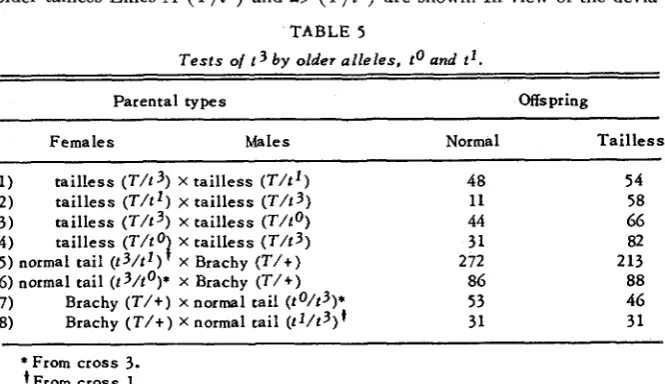
In table
5
the results of crosses of animals of tailless Line 3 ( T / t 3 ) by the older tailless Lines A ( T / t o ) and 29 ( T / t l ) are shown. In view of the devia-TABLE 5
Tests of 13 b y older alleles. t o and t l .
Parental types "spring
Females Ma le s Normal T a i l l e s s
I) tailless ( ~ / t 3 ) x tailless ( T / t l ) 48 54
2) tailless ( T / t ' ) x tailless ( T / t 3 ) 11 58
3 ) tailless ( ~ / t 3 ) x tailless 44 66
5 ) normal tail ( t 3 / t 1 ) X Brachy ( T I + ) 2 72 213 7) Brachy ( T / + ) X normal tail ( t 0 / t 3 ) * 53 46 8 ) Brachy ( T / + ) X normal tail ( t I / t 3 ) ' 31 31
4) tailless ( T / t O f x tailless ( T / t 3 ) 31 82
6) normal tail ( t 3 / t o ) * x Brachy ( T I + ) 86 88
* From cross 3. tFrom cross 1.
tions of gametic segregation from the 1 : 1 ratio, it is difficult, if not impos- sible, to predict the ratios of normal-tailed to tailless offspring. I n the crosses of females of tailless Line 3 ( T / t 3 ) by males of either Line A ( T / t o ) or 29
( T / t l ) , there is an apparent deficiency of tailless offspring; with normal segregation, ratios of two tailless to one normal are expected while actually the numbers formed are 54 tailless and 48 normal in the cross of Line 2 9 x
Line 3, and 66 tailless to
44
normal in the cross by Line A x Line 3. I n tne reciprocal crosses there is a definite deficiency of normal-tailed progeny in the matings of females of Line 29 by males of Line 3, that is, a deviation in the opposite direction. There is no deviation in the ratio of tailless to normal- tailed offspring in the matings of females of Line A by males of Line 3.less to normal-tailed offspring expected. The absence of Brachyury offspring from these matings shows the failure of recombination in t0/t3 and t1/t3 females, and indicates that t3 behaves as an allele of to and tl which had been shown to act as alleles of each other (DUNN and GLUECKSOHN-SCHOEN-
HEIMER 1943). The deficiency of tailless females in row 5 is significant and
is probably due to lowered viability, but no further study of this has been made.
Males of the genotypes t1/t3 and to/t3 are sterile or quasi-sterile and studies of these will be published separately. It can be stated here, however, that when offspring are obtained from matings of t0/t3 and t1/t3 by Brachy females, no evidence of recombination of to or tl with t3 is found (table
5,
rows 7 and 8). Thus males, in which the t alleles show cumulative rather than complementary action in respect to sterility behave like the females in respect to recombination.
The total amount of information on recombination of t3 with
T,
toJ tl is summarized in table 6. In these tests half of the recombinants, those withoutTABLE G
Summary of recombination d a t a on t e s t s involving t 3 .
Test cross Non-recombinants Reference
Q t l / t 3 x T / + Q t 3 / t 3 x T / +
6
t 3 / t 3 x T / +Q t 1 / t 3 x T / +
d t l / t 3 x T / + Q t o / t 3 x T / +
6 t O / t 3 x T / +
Q T / t 3 Y T i t 3
38 336: 46 485 G2 174
99
378
table 1
” 4 ” 4 ” 5 ” 5 ” 5 ” 5 ” 4
Total 1,618
* Includes 4 phenotypic overlaps of recombinant type.
a mutant at T locus, could be detected as short-tailed (Brachy) individuals in the upper 7 test crosses in table 6 or as Brachy or normal exceptions in the lowest test cross. The frequency of recombination can thus be stated as none in 809 tested gametes. This number is sufficient to give a likelihood of
.05
to a recombination value of .5 percent, consequently is competent to detect such a recombination value but not lower values. Taken together with its interaction with T , this indicates it is probably unilocal with T and other t alleles.
Experiments are in progress to determine whether t3, like to, t l , and t2 pre- vents recombination at loci near to T (DUNN and CASPARI 1945).
DISCUSSION
MUTABLE LOCUS I N THE MOUSE 11 information as to the kind and degree of differentiation of which the locus is capable. In the present instance the evidence seems good that the mutation reported is actually new and not due to recombination of nearby elements. The fact that the new mutation is viable and fertile when homozygous serves to distinguish it from previous mutations to, t l , t2, with which it has several other effects in common. Its allelism with T , to, and tl is not conclusively proved, since very small percentages of recombination of t3 with these have not been excluded; but because of its origin, and its similarity with to and t l , it is most reasonable to treat it as an allelic alteration of the same locus, as- suming that the locus is a complex one ( D U N N and GLUECKSOHN-SCHOEN- HEIMER 1950).
The mode of origin of t3 is not entirely clear since it .appears to have arisen a t least twice in premeiotic cells of related individuals. I t is very difficult to rule out the possibility that because of irregularities in segregation and via- bility effects of such mutations, it may have been present in some individuals which failed to reveal it by the usual tests so that the negative result of a test, such as those reported in table 3 may not be conclusive. This means that while the presence of a new mutation of this sort can be proved, its absence cannot be, and consequently one cannot demonstrate the independence of mutations to the same allele which occur in the same pedigree.
It is quite clear, however, that the mutation arose in a chromosome which previously contained either T or t l , and since a number of other mutations have been found in stock containing t', but none has yet been found in stock containing T only, it seems most reasonable to assume that tl mutated to t3 in a chromosome which retained the t l chromosomal aberration. This leads to the prediction that t3 should prevent recombination in the T-Ki area and this is being tested. I t has been assumed that the instability evidenced by re- peated mutations is probably connected with the inclusion of locus t in an inverted section ( D U N N and GLUECKSOHN-SCHOENHEIMER 1950).
The quasi-sterility of the compound males t0/t3 and t 1 / t 3 is apparently due to interaction of these alleles on the male zygote rather than to direct effects of single alleles on the sperm since in other combinations to, t l , and t3 sperm function normally. This indicates a cumulative effect of these alleles on sper- matogenesis, suggesting alteration of the same or similar processes, as con- trasted with complementary action on viability, and tail development, and on fertility in female compounds. The fact that t 3 / t 3 males appear to be fertile and that t 3 / t 3 stock has been carried through six generations of inbreeding, indicates that homozygosis for a chromosomal aberration is not primarily responsible for sterility in t0/t3 or t 1 / t 3 since this condition would obtain also in t3/t3. Further discussion will be found in connection with the description of the sterility effects ( D U N N and GLUECKSOHN-SCHOENHEIMER, in press).
SUMMARY
(short-tail), nor with previous mutations at this locus ( t o , t ' ) . I t interacts with T to produce taillessness ; shows complementary interaction with to and t1 with respect to tail length, viability, and female fertility, but shows cumula- tive interaction with to and t l with respect to male fertility, t0/t3 and t 1 / t 3 males being quasi-sterile. I t is recessive to its wild type allele in respect to tail length and is viable and fertile in both sexes when homozygous.
I t appears to have originated by mutation of an earlier allele, tl, and ap- peared twice in related individuals, in one of which the mutation probably occurred before the last meiotic division.
L I T E R A T U R E C I T E D
BRYSON, V., 1944 Spermatogenesis and fertility in Mus musculus, affected by factors DUNN, L. C., 1939 The inheritance of taillessness (anury) in the house mouse. 111.
DUNN, L. C., and E. CASPARI, 1945 A case of neighboring loci with sinYilar effects.
DUNN, L. C., and S. GLUECKSOHN-SCHOENHEIMER, 1943 Tests for recombination
DUNN, L. C., and S. GLUECKSOHN-SCHOENHEIMER, 1950 Repeated mutations in one
KOBOZIEFF, N., 1935 RCcherches morphologiques et gCn4tiques sur l'anourie chez la at the T locus. J. Morph. 74: 131-187.
Taillessness in the balanced lethal line 19. Genetics 24: 728-731.
Genetics 30: 543-568.
amongst three lethal mutations in the house mouse. Genetics 28: 29-40.
area of a mouse chromosome. Proc. nat. Acad. Sci. 36: 233-237.