Vol. 4, Issue 2, February 2015
Emendation of Undesirable Attack on
Multiparty Data Sharing With Anonymous Id
Assignment Using AIDA Algorithm
Rene Thomas
1, Sushitha Susan Joseph
2Student, Department of CSE, Mar Baselios Christian College of Engineering and Technology, Kerala, India1 Assistant Professor, Department of CSE, Mar Baselios Christian College of Engineering and Technology, kerala, india2
ABSTRACT: Security is a state of being free from danger or threat. When someone finds the vulnerabilities and loopholes in a system without permission means the system lacks its security. Wherever a secure data sharing occurs between multiparty there would be the possibility for undesirable attacks. In a variety of application domains such as patient medical records, military applications, social networking, electronic voting, business and personal applications there is a great significance of anonymity. Using this system we can store our data as groups and also encrypt it with encryption key. Only the privileged person can see the data. The secure computation function widely used is secure sum that allows parties to compute the sum of their individual inputs without mentioning the inputs to one another. This function helps to characterize the complexities of the secure multiparty computation. Another algorithm for sharing simple integer data on top of secure sum is built. The sharing algorithm will be used at each iteration of this algorithm for anonymous ID assignment (AIDA). By this algorithm and certain security measures it is possible to have a system which is free from undesirable attacks.
KEYWORDS: Vulnerability, anonymity, encryption key, secure multiparty computation, AIDA
I. INTRODUCTION
Nowadays security in multiparty data sharing is one of the most inevitable element. The emendation of undesirable attacks with AIDA algorithm and privacy preserving communications etc. are based on an assumption that each party is semi-honest. Internet involves and enables sharing of data but identity of the shared data owner is to be preserved. This is called maintaining anonymity that is quite difficult with increasing server storages like cloud, a problem area. Researchers have also investigated the relevance of anonymity and/or privacy in various application domains: patient medical records [1], electronic voting [2], e-mail [3], social networking [4], etc.
Defining privacy-preserving data access turns out to be harder than you might expect, because many superficially attractive definitions break down. Some definitions work if the analyst can ask only one question, but get into trouble if the analyst can ask multiple questions the analyst might be able to ask two harmless questions whose answers, taken together, reveal everything about an individual. Some definitions break down if the analyst has any access to outside information about the world, even basic information like the fact that the average human is less than ten feet tall. Some definitions turn out to be impossible to achieve in this universe. Differential privacy avoids all of these pitfalls.
Vol. 4, Issue 2, February 2015
The main algorithm is based on a method for anonymously sharing simple data and results in methods for efficient sharing of complex data. a. There are many applications that require dynamic unique IDs for network nodes [5]. The IDs are needed in networks for security or for administrative tasks requiring reliability, such as configuration and monitoring of individual nodes, and download of binary code or data aggregation descriptions to these nodes. It further explores the connection between sharing secrets in an anonymous manner, distributed secure computation and random ID assignment. The network is not anonymous and the participants are identifiable in that they are known to and can be addressed by the others. This paper builds an algorithm for sharing simple integer data on top of secure sum.
II. RELATED WORK
The existing system has many advantages and disadvantages. Existing and new algorithms for assigning anonymous IDs are examined with respect to trade-offs between communication and computational requirements. Also, suppose that access to the database is strictly controlled, because data are used for certain experiments that need to be maintained confidential. Clearly, allowing one person to directly read the contents of the tuple breaks the privacy of another; on the other hand, the confidentiality of the database managed by first is violated once second has access to the contents of the database. Thus, the problem is to check whether the database inserted with the tuple is still k-anonymous, without letting one‟s and second know the contents of the tuple and the database respectively. The current system has certain algorithms the secure sum allows us to share simple data anonymously even if it does not have enough security measures we are adding the anonymous data sharing power sums algorithm and finally we got a system which can send complex data but as it names signifies itself it is difficult to find the ways in which how it is arranged and further modification are also not possible. For the convenience of the system we are adding AIDA algorithm it is easy to send complex data but the data are not all secure and even a hacker can easily read the data and a cracker can easily change the contents.
Consider, group of hospitals (or any system which you want to share details) desire to share the average of data items by means of individual databases. Nodes contain data items and workout and allocate only the total value. Along with some assurances of anonymity, a secure sum algorithm permits the sum to be collected. To allocate the nodes identifiers, numbers ranging from 1 to N, was applied in the technique and the identities received are unidentified to the other members of the group and in that this assignment is anonymous. The semi-honest model of privacy preserving data mining was assumed, in which each node will go after the rules of the protocol, however may possibly use the information it spots during the implementation of the protocol to compromise security.To solve this problem, we use the secure um algorithm which is as follows:
Algorithm 1:Secure Sum [6][7]
Given nodes n1,…,nN each holding an data item di from a finitely representable abelian group, share the value
T=∑di among the nodes without revealing the values di.
Each node ni, i=1,..,N chooses random values ri,1 ,….,ri,Nsuch that
ri,1 + ……+ ri,N= di
1) Each “random” value ri,j is transmitted from node ni to node nj. The sum of all these random numbers ri,j is,
of course, the desired total T.
2) Each node njtotals all the random values received as:
sj =r1,j +…+ rN,j
3) Now each node nisimply broadcasts si to all other nodes so that eachnode can compute:
T = s1 + …+ sN
Algorithm 2: Anonymous Data Sharing With Power Sum [6]
Given nodes n1…nN each holding a data item di from a finitely representable field , make their data items
public to all nodes without revealing their sources. 1) Each node ni computes di
n
Vol. 4, Issue 2, February 2015
2) The power sums P1….PN are used to generate a polynomial which has d1…dN as its roots using Newton‟s
Identities as developed. Representing the Newton polynomial as :
p(x) = cNxN + … + c1x + c0 (1)
The values c0….cN are obtained from the equations:
CN = -1
CN -1 = -1/1(CNP1)
CN-2 = -1/2(CN-1P1+CNP2)
C
N-3 = -1/2(C
N-2P1 +C
N-1P2+ C
NP3)………
m
C
N-m = -1/m
Σ
CN-m+kPk (2)k=1
3) The polynomial p(x) is solved by each node, or by a computation distributed among the nodes, to determine the roots d1….dN.
The power sums Pi can be collected and shared using a single round of secure sum by sending them as an
array and applying the method to the vectors transmitted and received. The power sums are symmetric functions, and thus no association is made between ni and the value of di. However, nonetheless, the information contained in these
sums can be used to find the values of the data items d1….dN .The choice cN= -1 may be replaced by cN= 1 or any other
nonzero value. Also, note that in the typical F=GF(P) case, the solution for the ci requires finding the multiplicative
inverse of the coefficients 2,3,..N modulo P. While the Euclidean algorithm could be used, the inverses 1/x can easily be computed in the order x=1,2…N by the formulae:
After the integer division with remainder r, 1/r will already be known, since r< x.
Algorithm 3: Find AIDA [6]
Given nodes n1..nn, use distributed computation (without central authority) to find an anonymous indexing
permutation s: {1..N} ->.{ 1…N}) 1) Set the number of assigned nodes A=0.
2) Each unassigned node ni chooses a random number ri in the range 1 to S. A node assigned in a previous round
chooses ri=0.
3) The random numbers are shared anonymously. One method for doing this was given. Denote the shared values by q1….qN.
4) Let q1….qk denote a revised list of shared values with duplicated and zero values entirely removed where k is the
number of unique random values. The nodes ni which drew unique random numbers then determine their index si from
the position of the random number in the revised list as it would appear after being sorted: si= A+ card{ qj: qj<= ri}
5) Update the number of nodes assigned : A =A+k;. 6) If A<N then return to step (2).
Each algorithm compared can be reasonably implemented and each has its advantages. Our use of the Newton identities greatly decreases communication overhead.This can enable the use of a larger number of “slots” with a consequent reduction in the number of rounds required. The solution of a polynomial can be avoided at some expense byusing Sturm‟s theorem. All of the non-cryptographic algorithms have been extensively simulated, and we can say
P1 = di1 𝑁
𝑖=1 P1 = di2
𝑁
𝑖=1 … PN= diN
Vol. 4, Issue 2, February 2015
requirements of the algorithms depend heavily on the underlying implementation of the chosen secure sum algorithm. In some cases, merging the two layers could result in reduced overhead.
III. EXPERIMENTAL RESULTS
The system using AIDA algorithm, it is easy to transfer complex data anonymously without any interference. For this we are having an admin or someone who can add the members and those want to participate in the data sharing. The system mainly deals with the efficient algorithms for assigning identifiers (IDs) [6] to the nodes of a network in such a way that the IDs are anonymous using a distributed computation with no central authority.
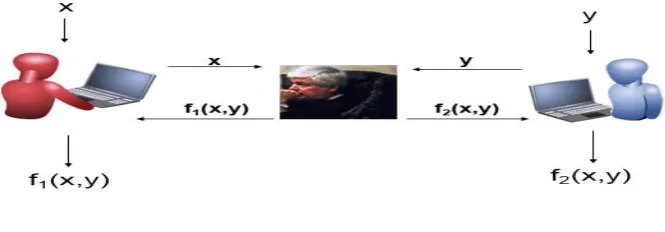
The Fig 1 of ideal system builds an algorithm for sharing simple integer data on top of secure sum. The sharing algorithm will be used at each iteration of the algorithm for anonymous ID assignment (AIDA). This AIDA algorithm, and the variants that we discuss, can require a variable and unbounded number of iterations. With the help of this system explores the connection between sharing secrets in an anonymous manner, distributed secure multiparty computation and anonymous ID assignment.
Fig. 1 Ideal System
The use of the term “anonymous” means the external data authentication purposes in real v/s ideal system in Fig 2 differs from its meaning in research dealing with symmetry breaking and leader election in anonymous networks.
Fig 2 Real V/S Ideal Systems
Vol. 4, Issue 2, February 2015
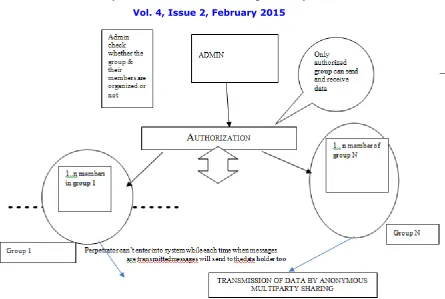
Fig 3. Architecture of data sharing
Fig 3 explains that increasing a parameter in the algorithm will reduce the number of expected rounds.Every members have anonymous id and they are known to the trusted third party. Suppose trusted third party say T, and admin say Main (M). If the group A need to send information to some members in „i‟ groups. Each group have separate authentication, where the admin whether the group‟s authorized or not. Just like an authorization module for checking the password invalid or not. If it is an authorized group the One Time Password (OTP) will be generated and that generate did will be given to the group which we need to send, if these groups are also authorized. Then they were able to send information between them.After accessing the group id using OTP the message code will be generated. Then these message code will reached their appropriate destination. So that the message received by each member will be transferring required data as far as possible. Since each of the group can be send message only if they are authorized and for receiving message also it would be an authorized group. This is how the proposed system improves its security. Simultaneously the messages will received by multiple members. Even though every members in the group does not need the entire information the id will provide the appropriate message if those id‟s are matching. This is how the anonymous id generated and adding some additional security measures and all the undesirable attacks in the multiparty data sharing with AIDA algorithm will be possible.
IV. CONCLUSION
Vol. 4, Issue 2, February 2015
interest for future extensions to AIDA.Using this system we can ensure high security in all its aspects and many future enhancements can be done with the help of it.
REFERENCES
[1] A. Friedman, R. Wolff, and A. Schuster, “Providing k-anonymity in data mining,” VLDB Journal, vol. 17, no. 4, pp. 789–804, Jul. 2008. [2] F. Baiardi, A. Falleni, R. Granchi, F. Martinelli, M. Petrocchi, and A. Vaccarelli, “Seas, a secure e-voting protocol: Design and implementation,”
Comput. Security, vol. 24, no. 8, pp. 642–652, Nov. 2005.
[3] D. Chaum, “Untraceable electronic mail, return address and digital pseudonyms,” Commun. ACM, vol. 24, no. 2, pp. 84–88, Feb. 1981. [4] Q. Xie and U. Hengartner, “Privacy-preserving matchmaking for mobile social networking secure against malicious users,” in Proc. 9th Ann.
IEEE Conf. Privacy, Security and Trust, Jul. 2011, pp. 252–259.
[5] J. Smith, “Distributing identity [symmetry breaking distributed access protocols],” IEEE Robot. Autom. Mag., vol. 6, no. 1, pp. 49–56, Mar. 1999
[6] Larry A. Dunning, Member, IEEE, and Ray Kresman “Privacy Preserving Data Sharing With Anonymous ID Assignment” in IEEE transaction on information and forensics and security, vol 8, no. 2 february 2013
[7] Benjamin C.M. Fung, Member, IEEE, Thomas Trojer, Member, IEEE, Patrick C.K. Hung, Member, IEEE, Li Xiong, Member, IEEE,
Khalil Al-Hussaeni, Member, IEEE, and RachidaDssouli, Member, IEEE, “Service-Oriented Architecture for High-Dimensional Private Data Mashup” IEEE transactions on services computing,vol. 5, no. 3, july-september 2012
BIOGRAPHY
Name: Rene Thomas
Affiliation: B.tech Student atDepartment of CSE, Mar Baselios Christian College of Engineering and Technology, Kerala, India
Specialization / Interest Area : Network Security, Gaming, Ethical Hacking
Name :Sushitha Susan Joseph
Affiliation: Assistant professor in the Departmentof Computer Science and Engineering, MBCCET, Peermade,Kerala.