Copyright1998 by the Genetics Society of America
One-Locus Two-Allele Models With Maternal (Parental) Selection
Sergey Gavrilets
Department of Ecology and Evolutionary Biology and Department of Mathematics, University of Tennessee, Knoxville, Tennessee 37996-1610 Manuscript received March 17, 1997
Accepted for publication February 23, 1998
ABSTRACT
I formulate and study a series of simple one-locus two-allele models for maternal (parental) selection. I show that maternal (parental) selection can result in simultaneous stability of equilibria of different types. Thus, in the presence of maternal (parental) selection the outcome of population evolution can significantly depend on initial conditions. With maternal selection, genetic variability can be maintained in the population even if none of the offspring of heterozygous mothers survive. I demonstrate that interactions of maternal and paternal selection can result in stable oscillations of genotype frequencies. A necessary condition for cycling is strong selection.
M
ATERNAL effects refer to situations in which an effects. An extreme case of fitness that depends entirely on the mother’s genotype at a single diallelic locus was individual’s phenotype depends (besides otherfactors) on the phenotype of its mother. Well known considered byWright(1969, pp. 57–59) andNagylaki
(1992). Wright (1969, pp. 148–149) and Wade and
to biologists for decades, maternal effects have been
considered as a nuisance that makes interpretation of Beeman(1994) studied single-locus two-allele models
in which offspring of a specific genotype with a parent biological data more difficult and that should be
re-moved from experiments if possible (Falconer1989). of a specific genotype has a reduced fitness.
Here I consider the dynamics of a series of simple Recent years, however, have been characterized by a
growing realization that maternal effects may actually one-locus two-allele models for maternal (and paternal) selection. These models are closely related to those in-be very important in evolution (e.g., Cheverud and
Moore1994;Wade andBeeman 1994;Foxand Mous- troduced and discussed byWade(1996) who, however, seau 1996; Roosenburg 1996; Rossiter 1995, 1996; did not consider the dynamic behavior. Although the Sinervo and Doughty1996;Wade 1996; Wolfet al. models studied in this article probably oversimplify real
1997). This realization is coming partially from theoreti- situations, they may be useful in identifying different cal models that have shown that maternal effects can dynamic possibilities and important parameters and in result in very interesting and sometimes counterintu- training our intuition about more complex (and realis-itive evolutionary dynamics (Cheverud1984;Kirkpat- tic) systems.
rick andLande1989; Lande andKirkpatrick1990; Orr1991;GinzburgandTaneyhill1994;Wadeand
Beeman1994). The concept of maternal effects can be A MODEL FOR MATERNAL SELECTION
generalized to the concept of “kin effects” (Cheverud
I consider a single randomly mating diploid popula-1984; Cheverud andMoore1994) incorporating the
tion with nonoverlapping generations. I assume that effects of any relatives on an invidivual’s phenotype.
fitness (viability) of an individual depends on its geno-“Maternal selection” is one of various maternal effects.
type at a single diallelic locus as well as on the genotype This notion describes situations in which an individual’s
of its mother at this locus. Let i5 1, 2, 3 correspond fitness depends (besides other factors) on the
pheno-to genotypes AA, Aa and aa, respectively, and let wi,jbe
type of its mother (KirkpatrickandLande1989). Most
the fitness of an individual with genotype i raised by a of the theoretical work on the evolutionary
conse-mother with genotype j. Genotype frequencies are equal quences of maternal selection has been done within a
in both sexes after one generation of selection and quantitative genetics framework (e.g.,Dickerson1947;
segregation. Let x, y and z be the frequencies of adults
Villham1963, 1972;Falconer1965;Cheverud1984;
with genotypes AA, Aa and aa, respectively. The nine
KirkpatrickandLande1989;LandeandPrice1989;
mating types and the frequencies of the corresponding
LandeandKirkpatrick1990). There have been only
matings and offspring are given in Table 1. Using this a handful of theoretical studies considering major locus
table, the adult frequencies x9, y9and z9in the next generation are defined by
Address for correspondence: Department of Ecology and Evolutionary
Biology, University of Tennessee, Knoxville, TN 37996-1610. wx9 5w1,1x211
2(w1,11w1,2)x y1 1 4w1,2y
2, (1a)
E-mail: [email protected]
TABLE 1 than the average of the fitnesses of heterozygotes having a heterozygous mother and a homozygous mother.
Re-Mating types and offspring
versing both inequalities results in the conditions for pro-tecting polymorphism in this model. Analysis of attractors
Mating types Offspring
Frequency of (1) other than the monomorphic equilibria requires Female Male of mating AA Aa aa
additional simplifying assumptions about fitnesses wij.
Some special simplifying cases are examined below.
AA AA x2 1 0 0
Aa xy 1/2 1/2 0
aa xz 0 1 0
Symmetric model for maternal selection
Aa AA xy 1/2 1/2 0
A standard approach for simplifying analysis of
popu-Aa y2 1/4 1/2 1/4
aa yz 0 1/2 1/2 lation genetic models is to introduce some symmetry in the model. In this section, I will assume that fitnesses
aa AA xz 0 1 0
wi,j are symmetric in the sense that w1,15 w3,3, w1,2 5
Aa yz 0 1/2 1/2
w3,2, w2,1 5w2,3. This symmetric case can be described
aa z2 0 0 1
by the following fitness matrix:
Maternal genotype
Individual genotype AA Aa aa
wy9 51
2(w2,11 w2,2)x y1 1
2(w2,21w2,3)yz
AA a b —
Aa g d g
1 (w2,11w2,3)x z1
1 2w2,2y
2, (1b)
aa — b a
wherea,b,ganddare nonnegative. Note that neither
wz9 5w3,3z21
1
2(w3,31 w3,2)yz1 1 4w3,2y
2, (1c)
genotype AA can have a mother with genotype aa, nor can genotype aa have a mother with genotype AA. This where the mean fitness of the population w is such that symmetric model implies that fitnesses of homozygotes
x9 1 y9 1 z9 5 1. If wi,j 5 wi for all i ,j, that is, if the raised by homozygous mothers are identical, fitnesses
fitness of an individual depends only on its own geno- of homozygotes raised by heterozygous mothers are type, one has a classical model of “pure” viability selec- identical and fitnesses of heterozygotes raised by homo-tion. If wij 5 wj for all i ,j, that is, if the fitness of an zygous mothers are identical. The dynamic equations
individual depends only on the genotype of its mother, (1) become one has a model of “pure” maternal selection
consid-ered byWright(1969) andNagylaki(1992). In both
wx9 5 ax211
2(a 1 b)x y1 1 4by
2, (3a)
models, the system evolves to a single polymorphic equi-librium if there is overdominance (w2.w1, w3) and to
a monomorphic state otherwise. I will be interested in wy9 51
2(g 1 d)(x1z)y12gx z1 1 2dy
2, (3b)
the model dynamics when both individual and maternal genotypes affect individual fitness.
wz9 5 az21 1
2(a 1 b)y z1 1 4by
2. (3c)
The dynamic system (1) has two monomorphic equi-libria (1, 0, 0) and (0, 0, 1) corresponding to the fixation
of genotype AA and aa, respectively. Conditions for sta- In this symmetric model, the conditions for stability of bility of these equilibria, which can be found in a monomorphic equilibria, which have been given above, straightforward manner, are given in simplify.
Result 1 (stability of monomorphic equilibria):Mono- Result 1a (stability of monomorphic equilibria): Mono-morphic equilibrium (1, 0, 0) is locally stable if morphic equilibria (1, 0, 0) and (0, 0, 1) are
(simultane-ously) locally stable if
w1,1.
1
2(w2,11w2,2) , (2a) a .(g 1 d)/2 (4)
and is unstable if the latter inequality is reversed. Mono- and are (simultaneously) unstable if the latter inequality morphic equilibrium (0, 0, 1) is locally stable if is reversed.
Let us consider polymorphic equilibria of Equation 3.
w3,3.
1
2(w2,31 w2,2) , (2b) Results 2 (existence of a symmetric polymorphic equi-librium):There always exists a symmetric polymorphic equilibrium with xsym5zsym. The genotype frequencies
and is unstable if the latter inequality is reversed.
at this equilibrium are xsym5u/(2u12), ysym51/(u1
Thus, a monomorphic equilibrium is stable if fitness
Result 5: Ifb 5 d 5 0, the necessary and sufficient
u5 a 2 d
2g 1
!1
a 2 d2g
2
2
1 b
g. (5) condition for both existence and simultaneously stabil-ity of a pair of asymmetric polymorphic equilibria is A symmetric polymorphic equilibrium exists always but g .2a.
is not always stable. This somewhat conterintuitive result means that
ge-Results 3 (stability of the symmetric polymorphic equi- netic variability can be maintained in the population librium):The symmetric polymorphic equilibrium is lo- even if none of the offspring of heterozygous mothers
cally stable if survive. This is a general feature of models where there
is competition between sibs within a family and a feature
(a 2 g)u, (d 2 a) . (6)
of the maternal-effect selfish gene model ofWadeand Beeman(1994).
A symmetric polymorphic equilibrium is never stable if a . g,d and is always stable if a , g,d. Note that
the former (latter) inequality guarantees the stability Multiplicative model for maternal selection (instability) of the monomorphic equilibria. Ifd . a .
Let an individual’s fitness, w, be a product of two g, then a symmetric equilibrium is stable for sufficiently
parameters, one of which, v, depends on an individual’s small band is unstable for sufficiently largeb. Ifd ,
own genotype, whereas another one, m, depends on its a , g, then it is stable for sufficiently large b and is
mother’s genotype unstable for sufficiently smallb. It is possible that both
monomorphic equilibria and a symmetric equilibrium w
ij 5vimj, i,j51, 2, 3 . (8)
are stable simultaneously. In this case, initial conditions
This is a plausible assumption if different components determine whether polymorphism is or is not
main-of fitness are important at different stages main-of the life tained in the system under consideration. On the other
cycle. In this case, the dynamic system (1) reduces to hand, it is possible that none of the equilibria we have
considered so far are stable.
wx9 5v1
3
F11x2 1F12xy11 4F22y
2
4
, (9a)Results 4 (existence of a pair of unsymmetric polymor-phic equilibria): A pair of unsymmetric polymorphic equilibria with genotype frequencies (x *, y *, z *) and
wy9 5v2
3
F12xy 1F23yz1 2F13x z11 2F22y
2
4
, (9b)(z *, y *, x*) exists if
d 2 a 1 b/a(g 2 a)
a 2(g 1 d)/2 .2
√b
/a. (7) wz9 5v33
F33z2 1F 23yz1
1 4F22y
2
4
, (9c)Here where
Fij5 (mi1 mj)/2 (10)
y* 5 2a 2 g 2 d
(a 2 g)(12 b/a),
for all i ,j. Equations (9) are equivalent to those describ-ing a general one-locus two-allele model with both viabil-and x* viabil-and z* are positive real solutions X to quadratic
ity selection (characterized by vi) and fertility differ-X22(1 2y *)X1(b/4a)y*25 0 .
ences (characterized by Fij) introduced by Bodmer
(1965). Equations 9 and 10 with vi 5 1 (no viability
Ifa . g,dora , g,d, the unsymmetric polymorphic
differences) define a model with additive fertilities, as equilibria do not exist. Ifais closer todthan tog(that
studied byPenrose(1949). The general system (9, 10)
is,D1;|a 2 d|,D2;|a 2 g|), then the unsymmetric
represents a partial case of a multiplicative fertility selec-polymorphic equilibria exist for sufficiently smallb/a
tion model studied byBodmer(1965). For some
param-(forb/a ,D1/D2). Ifais closer todthan tog(i.e.,D1.
eter values this system admits two simultaneously stable D2), then the unsymmetric polymorphic equilibria exist
polymorphic equilibria. for sufficiently large b/a(forb/a .D1/D2).
Can these equilibria be stable? Conditions for stability
of these equilibria can be found in a straightforward Symmetric model for parental selection manner but are rather cumbersome. These conditions
In this section, I assume that both parents contribute simplify ifb 5 d 50, that is, if offspring of heterozygous
to an offspring’s fitness. Let wi,jk be the fitness of an
mothers are inviable. In this case, the genotype
frequen-individual with genotype i raised by a mother with geno-cies at unsymmetric equilibria are
type j and a father with genotype k (i, j, k5 1, 2, 3). Using Table 1, the adult frequencies x9, y9and z9in the
1
0, a g 2 a, 12a
g 2 a
2
and1
12 a g 2 a,a
g 2 a, 0
2
; next generation are defined byat the former, genotype AA has zero frequency, whereas wx9 5w
1,11x21
1
2(w1,121 w1,21)xy1 1 4w1,22y
2, (11a)
wy9 51
2(w2,121w2,21)x y1 1
2(w2,231 w2,32)yz
1(w2,131w2,31)x z1
1 2w2,22y
2, (11b)
wz9 5w3,33z21
1
2(w3,321w3,23)yz1 1 4w3,22y
2. (11c)
Let us assume that wi,jk5wjk, that is, the fitness of an
individual depends only on the genotypes of its parents and does not depend on its own genotype. This is a two-parent generalization of the model introduced by
Wright(1969, pp. 57–59). Let us further assume that
the fitness matrix wjkis symmetric and has the following
form:
Paternal genotype
Maternal genotype AA Aa aa
AA a b g
Aa b d b
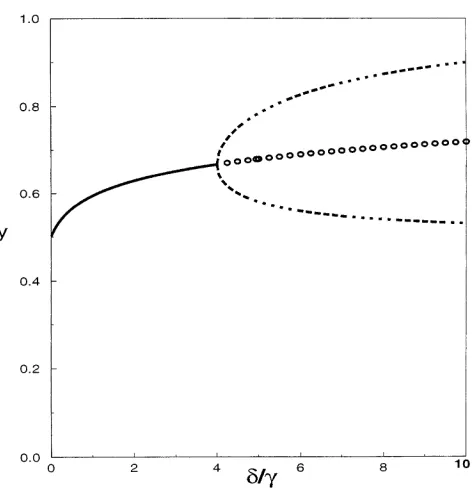
Figure1.—The bifurcation diagram for the heterozygote
fre-aa g b a
quency y in the symmetric model of parental selection (12) with a 5 b 50. The symmetric polymorphic is stable ford/g ,4 wherea,d,gandd are nonnegative parameters. Note
(solid line) and is unstable ford/g .4 (circles). Atd/g 54, that the meaning of these parameters in the model
a stable two-cycle bifurcates from the equilibrium point (dashed considered here is completely independent of that in
line). The homozygote frequencies x5z5(12z)/2. the previous sections. With fitnesses as above, the
dy-namic equations (11) can be rewritten as
CONCLUSIONS
wx9 5 ax21 bx y11
4dy
2, (12a)
Here I have studied a series of simple one-locus two-allele models for maternal (parental) selection.Srbet al.
(1965, Chapter 11) give several examples for maternal
wy9 5 bxy1 by z12gxz1 1
2dy
2, (12b)
effects that can be attributed to a single diallelic locus; seeWade (1996) for more discussion of the relevance
wz9 5 az21 byz 11
4dy
2. (12c)
of maternal effects controlled by a small number of loci with large effects. My results indicate similarity between dynamic behaviors under maternal selection and fertil-These equations are exactly the same as those analyzed
by Hadeler and Liberman (1975) in the context of ity selection. The latter is well-known to be much more
complicated than the dynamics resulting from viability fertility selection models. Numerous results by these
authors are applicable here. In particular, the dynamic selection (e.g.,Owen1953;Bodmer1965;Hadelerand Liberman1975). I have shown that maternal selection
system (12) can have two simultaneously stable
polymor-phic equilibria or a stable limit cycle with period two! can result in a simultaneous stability of equilibria of different types. Thus, in the presence of maternal (pa-To illustrate this, let us assume that only offspring
of heterozygous parents and of different homozygous rental) selection, the outcome of population evolution can significantly depend on initial conditions. With ma-parents are viable, and offspring of all other pairs of
parents are inviable. In this case the following is true. ternal selection, genetic variability can be maintained in a population even if none of the offspring of heterozy-Result 6: Let a 5 b 50,d, g .0. Then if 4g . d,
the only stable equilibrium of (12) is a symmetric poly- gous mothers survive. I have demonstrated that interac-tions of maternal and paternal selection can result in morphic equilibrium (with x* 5 z *). If 4g , d, the
system does not have any stable equilibria. stable oscillations of genotype frequencies. A possibility for cycling and even chaos in theoretical models incor-In the latter case, the system cycles with period two (see
Figure 1). In general, a dynamic system (12) cycles if the porating maternal effects has been already demonstrated byGinzburgandTaneyhill(1994). InGinzburgand
fitnessdof individuals with both parents heterozygous is
sufficiently large relative to the fitnessg of individuals Taneyhill’s model, cycling resulted from ecological
factors. In contrast, in the model considered here cy-with different homozygous parents, which in turn is
sufficiently larger than fitnessesaandbof other individ- cling is brought about by genetic factors and maternal selection.
Evolution, edited by C. R. B.Boake. University of Chicago Press, The counterintuitive results about the maintenance
Chicago.
of variability and cycling require selection to be strong. Dickerson, G. E., 1947 Composition of hog carcasses as influenced by heritable differences in rate in economy of gain. Iowa Agr. The following two examples of very strong maternal
Exp. Sta. Res. Bull. 354: 492–524. selection are interesting in this respect. The first
exam-Falconer, D. S., 1965 Maternal effects and selection response, pp. ple (Srbet al. 1965, pp. 319–320) concerns Drosophila
763–774 in Proceedings of the XI International Congress on Genet-ics, Vol. 3,S. J. Geerts, editor. Pergamon Press, Oxford. where the sex-linked recessive gene fused causes partial
Falconer, D. S., 1989 Introduction to Quantitative Genetics. John sterility as well as fusion of two longitudinal wings’ veins.
Wiley & Sons, New York.
At least one wild-type allele of the fused locus must be Fox, C. W., and T. A. Mousseau, 1996 Larval host plant affects fitness consequences of egg size variation in the seed beetle Stator present in either the mother or in the progeny in order
Limbatus. Oecologia 107: 541–548. for embryogenesis to proceed normally. As a result,
Ginzburg, L. R., andD. E. Taneyhill, 1994 Population cycles of offspring with identical genotypes may die or develop forest Lepidoptera: a maternal effect hypothesis. J. Anim. Ecol.
63:79–92. to maturity, depending on the genotype of their mother.
Hadeler, K. P., andU. Liberman, 1975 Selection models with fertil-The second example is a class of dominant lethal genetic
ity differences. J. Theor. Biol. 2: 19–32.
factors called Medea that is widespread in natural popula- Kirkpatrick, M., andR. Lande, 1989 The evolution of maternal characters. Evolution 43: 485–503.
tions of the flour beetle, Tribolium castaneum (Beeman
Lande, R., andT. Price, 1989 Genetic correlations and maternal
et al. 1992). These factors cause maternal-effect lethality effect coefficients obtained from offspring-parent regression.
Ge-of all Ge-offpring not inheriting a copy Ge-of the factor [see netics 122: 915–922.
Lande, R., andM. Kirkpatrick, 1990 Selection response in traits
WadeandBeeman(1994) for a theoretical study of the
with maternal inheritance. Genet. Res. 55: 189–197. evolutionary dynamics of these factors]. These examples
Nagylaki, T., 1992 Introduction to Theoretical Population Genetics. suggest that conditions necessary for complex dynamics Springer-Verlag, Berlin.
Orr, H. A., 1991 Is single-gene speciation possible? Evolution 45: might be satisfied at least for some biological systems.
764–769. Results and findings reported here are
complemen-Owen, A. R. G., 1953 A genetic system admitting of two distinct tary to those obtained within the quantitative genetic stable equilibria under natural selection. Heredity 7: 97–102.
Penrose, L. S., 1949 The meaning of “fitness” in human populations. framework (e.g.,Dickerson1947;Villham1963, 1972;
Ann. Eugenics 14: 301–304.
Falconer 1965; Cheverud 1984; Kirkpatrick and
Roosenburg, W. M., 1996 Maternal condition and nest site
Lande1989;LandeandPrice1989;LandeandKirk- choice—an alternative for the maintenance of environmental sex determination. American Zoologist 36: 157–168.
patrick1990). The latter typically considers an additive
Rossiter, M., 1995 Impact of life-history evolution on population quantitative trait that is controlled by both direct genetic dynamics: predicting the presence of maternal effects, pp. 251– and maternal factors and that is subject to phenotypic 275 in Population Dynamics, edited byN. CappuccinoandP. W.
Price. Academic Press, San Diego. selection. The main focus is usually on the dynamics of
Rossiter, M., 1996 Incidence and consequences of inherited envi-the mean value of envi-the trait, whereas (constant) genetic
ronmental effects. Ann. Rev. Ecol. Syst. 27: 451–476.
variability is tacitly assumed to be maintained by some Sinervo, B., andP. Doughty, 1996 Interactive effects of offspring size and timing of reproduction on offspring reproduction— factors that are not considered explicitly. The major
experimental, maternal, and quantitative genetic aspects. Evolu-locus framework utilized here and in Wright(1969),
tion 50: 1314–1327.
Nagylaki (1992), and Wade and Beeman(1994) fo- Srb, A. M., R. D. OwenandR. S. Edgar, 1965 General Genetics, Ed. 2. W. H. Freeman, San Francisco.
cuses on maternal effects contributing directly to fitness.
Villham, R. L., 1963 The covariance between relatives for characters This framework allows for analyzing conditions for the
composed of components contributed by related individuals. Bio-maintenance and dynamics of genetic variability and the metrics 19: 18–27.
Villham, R. L., 1972 The role of maternal effects in animal breed-existence of multiple stable equilibria. Generalization of
ing. III. Biometrial aspects of maternal effects in animals. J. Anim. this approach for the case of multiple alleles and loci
Sci. 35: 1288–1293.
would be very desirable. Wade, M. J., 1996 The evolutionary genetics of maternal effects. (in press)
I am grateful toMaryCarol Rossiter andMichaelWadefor
Wade, M. J., andR. W. Beeman, 1994 The population dynamics of sharing manuscripts before publication and to reviewers for valuable maternal-effect selfish genes. Genetics 138: 1309–1314. comments and suggestions. This work was partially supported by Na- Wolf, J. B., E.D. Brodie III, J. M. Cheverud, A. J. Moore and tional Institutes of Health grant GM-56693. M. J. Wade, 1997 Evolutionary consequences of indirect genetic
effects. Trends Ecol. Evol. 13: 64–69.
Wright, S., 1969 Evolution and the Genetics of Populations, Vol. II. The
Theory of Gene Frequencies. The University of Chicago Press, Chicago.
LITERATURE CITED Communicating editor:W. H. Li
Beeman, R. W., K. S. FriesenandR. E. Denell, 1992 Maternal-effect selfish genes in flour beetles. Science 256: 89–92. Bodmer, W.F., 1965 Differential fertility in population genetics
models. Genetics 51: 411–424.
Cheverud, J. M., 1984 Evolution by kin selection: a quantitative
APPENDIX genetic model illustrated by maternal performance in mice.
Evo-lution 38: 766–777. In analyzing the dynamics of Equation 3 it is convenient Cheverud, J. M., andA. J. Moore, 1994 Quantitative genetics and
to use new variables u 5 2x/y and v 5 2z/y, which are the role of the environment provided by relatives in behavioral
to the equilibrium value defined by Equation A4, one
u9 5 au
21 (a 1 b)u 1 b
guv11/2(g 1 d)(u 1v)1 d, (A1a) finds Equation 6, which completes the proof of Result 3. Combining Equation A3 with Equation A2 at equilib-rium, one finds that at asymmetric equilibria
v9 5 av
21 (a 1 b)v1 b
guv11/2(g 1 d)(u 1v)1 d. (A1b)
uv5 b/a, (A5a)
Subtracting Equation A1a from Equation A1b,
u1v5d 2 a 1 b/a(g 2 a)
a 2(g 1 d)/2 ;T. (A5b)
u9 2v9 5 a 1 b 1 a(u1v)
guv11/2(g 1 d)(u1v)1 d(u2v). (A2)
Eliminating v, one finds that equilibrium values of u satisfy The last equality means that at equilibrium either u5v, to a quadratic u22Tu1 b/a 50, which has both roots
or positive and real if T.2
√b
/a. The latter is the conditionof existence of unsymmetric polymorphic equilibria stated a 1 b 1 a(u1v)
guv1 1/2(g 1 d)(u1v)1 d51. (A3) in Result 4. Equilibrium values of genotype frequenciescan be found by using the inverse transformation x5u/
(21u1v), y52/(21u1v), z 5v/(21u1v).
if v5u, Equation A1b takes the form
Ifb 5 d 50, the values of u and v at the unsymmetric equilibria are (0,a/(g/2 2 a)) and (a/(g/2 2 a), 0).
u9 5au1 b
gu1 d ;F (u). (A4) Thus, these equilibria are feasible ifa , g/2. The
eigen-values of the stability matrix at these equilibria are 2a/g It is easy to see that F(u) is a monotonic function of u
and 122a/g. For the unsymmetric equilibria to be stable with no inflection points. Thus, the equation u 5F (u)
these eigenvalues should lie between21 and 1, which is has a single positive solution, which defines the value of
obviously the case given that the equilibria exist. This
u at the symmetric polymorphic equilibrium and is given
completes the proof of Result 5. in Result 2.
Using Equations 4 and 6 fromHadelerandLiberman
The symmetric equilibrium is stable with respect to
sym-(1975), one finds that ifa 5 b 50, the only equilibrium metric perturbations (such that perturbed values of u and
of Equation 12 satisfies to the cubic
v are equal), if at this equilibrium
εw31w2 150, (A6)
21,dF(u)
du , 1. whereε5 d/g. The eigenvalue that determines stability
of this equilibrium is equal to22εw3. One can easily show
The latter inequality follows from the fact that the graph that ifε,4, thenεw3, 1/2 and hence the symmetric
of Y5F(u) crosses the line Y5u from left to right. The polymorphic equilibrium is stable. On the other hand, if
former inequality can be proven after calculating dF/du ε.4, thenεw3.1/2 and hence the symmetric
polymor-and plugging in the equilibrium value of u. Thus, the phic equilibrium is unstable. This completes the proof of symmetric equilibrium is always stable to symmetric pertur- Result 6. Note that iterating Equation 4 fromHadelerand
bations. To analyze the stability of this equilibrium to asym- Liberman(1975) twice one can easily find the genotype
metric perturbations (such that perturbed values u?v), frequencies corresponding to the two-cycle symmetric so-one needs to analyze Equation A2. This equation tells lution of Equation 12. The fact that the right-hand side us that the equilibrium is stable if the expression in the of Equation 4 fromHadelerandLiberman(1975) is a
left-hand side of Equation A3 is,1. Rewriting this condi- monotonically decreasing function implies that this equa-tion does not have any other periodic soluequa-tions.