A
New
Generalizable Test for Detection
of
Mutations Affecting TnlO
Transposition
Olivier Huisman’ and Nancy Kleckner
Department of Biochemistry and Molecular Biology, Harvard University, Cambridge, Massachusetts U2138
Manuscript received December 23, 1986 Accepted March 2, 1987
ABSTRACT
We describe here a new rapid screen that allows easy detection of transposon or host mutations that affect TnlU transposition in Escherichia coli. This test involves a new TnlU derivative called the “mini-lacZ-kanR fusion hopper” or mini-TnlU-LK for short. This element does not direct expression of /3-galactosidase when present at its original starting location on a suitably engineered plasmid or phage genome because it lacks appropriate transcription and translation start signals. However, transposition of this element into the chromosome of E. coli l a d - bacteria leads to productive fusions in which the lacZ gene within the transposon is expressed from external chromosomal signals. Such fusions are readily detectable on Macconkey lactose indicator plates as red (Lac+) papillae inside of white (LacZ-) colonies. The length of time required to see red papillae appearing in a white colony sensitively and accurately reflects the transposition frequency of the mini-transposon within the colonies. Differences in times for color formation are sensitive enough that 10-fold differences in transposition frequency can readily be detected. This papillation assay can be used to identify mutant clones in which the frequency of TnlU transposition is either increased or decreased. We have successfully used the assay to identify mutations in the terminal sequences of Tn 10; mutations in the TnlU transposase gene or the bacterial host can be isolatedjust as easily. This screen should be readily adaptable to transposable elements other than Tn 10.
OBILE elements a r e involved in many types of
M
DNA rearrangements in bacteria, Because of their importance, they have been extensively studied (for reviews, see KLECKNER (1 9 8 1) a n d GRINDLEY a n dREED (1985)l. In Escherichia coli, several transposons a n d insertion sequences have been completely se- quenced, a n d molecular a n d genetic analysis has dis- closed the existence a n d the role of element-encoded transposase genes a n d of essential sequences a t the ends of each element. Biochemical approaches, al- though only a t their beginning, have begun to reveal host factor requirements (D. MORISATO a n d N .
KLECKNER, personal communication) a n d other as- pects of the transposition reaction.
Despite the importance of the transposition process, very few direct searches for mutations affecting trans- position have yet been conducted, although this ap- proach has turned o u t t o be very successful when it has been used. Recently, for example, mutant isolation has led to the discovery of a role for DNA adenine methylation in regulation of T n l O a n d IS10 transpo- sition (ROBERTS et al. 1985). Further isolation of host mutations should allow identification of host factors that participate directly in transposition, a n d muta- tions affecting the transposase or the essential terminal sequences should help t o improve o u r understanding
’
Present address: Departement de Biotechnologie, Institut Pasteur, 29 rue du Docteur Roux, 75015 Paris, France.Genetics 116: 185-189 (June, 1987)
of the functions of these two types of determinants a n d of their interaction. Despite the obvious advan- tages of such a genetic approach, it has not yet been widely used, probably in large part because it has been difficult to identify the desired mutants. We present here a new strategy that allows efficient a n d easy detection of all types of mutations affecting the activ- ity of transposon T n l O in E. coli a n d the successful application of this strategy for isolation of mutations in the T n 10 terminal sequences. O u r approach could, with appropriate engineering of mini-transposon de-
rivatives, be extended to analysis of other transposable elements. T h e new mini-Tn10 transposon we present here as part of this strategy can also be used as a new useful transposon tool for genetic analysis in vivo
(HUISMAN et a l . 1987).
MATERIALS AND METHODS
Bacterial strains: NK7800 is a recA56 transductant of NK7254 ( t r p l l , his], argG6, rpsLlU4, tonA2, laddel-rl, supE44, x y 1 7 , mt12, metB1, tsx, leu6). The F’lacIqL8pro episome (FOSTER et al. 1981) has been introduced in this strain by standard conjugation assay (MILLER 1972). The strain NK6641 which is used as recipient in the mating out assay is lac-ProXIII, recA56, malR, strA (FOSTER et al. 1981).
186
leaving only the 70 outermost basepairs (bp) at the ends of the element at the two extremities of the backbone. The BamHI digest of pMC1871 generated a truncated 1acZ fragment starting at bp 22 of the lacZ coding sequence; in pNKl206, the amino-terminal end of lac2 is adjacent to the terminal sequences at the IS IO-Right end of TnlU, and the kanR segment is located between the distal end of lacZ and the terminal sequences at the ISIU-Left end of TnlU. pNK1207 has been made by substitution of the BglII-PstI
segment of pNK1206, which lies upstream of the I S I U -
Right end of TnlO, by a BamHI-PstI piece of pRS391 (SIMONS, HOUMAN and KLECKNER 1987), containing re- peated copies of the rrnB transcriptional terminator se- quence. In pNK 1207, the terminator sequences prevent nonspecific transcription of the lac2 gene. pNKl2 14 was used for isolation of the mutations in the terminal sequences of TnlU. It derives from pNK1207 by several steps. First the BamHI site at the lacZ/kanRjunction has been destroyed by filling in with the Klenow fragment of DNA polymerase. The left outside end of TnlO, adjacent to the h n R deter- minant, has then been replaced by the right outside end of TnlO extended to the AccI site [for restriction map of TnlO, see WAY et al. ( 1 984)]. Finally, a SalI linker has been inserted in the Nrul site of this new end. pNK1215 is a BglII-BclI
deletion of the TnlO outside end adjacent to the kanR segment in pNK1214.
Bacteriophages: XNK1039 is a derivative of XRP167 (MAURER, MEYER and PTASHNE 1980), containing the EcoRI his fragment of pNK75 (FOSTER et al. 198 1). XNKl205 has been obtained by homologous recombination between the homologous histidine regions contained in pNKl207 and XNK1039. The phage recombinant has been selected as prophage able to render lysogenic bacteria resistant to kan- amycin and contains the mini-Tn insert within this segment.
Media, enzymes and chemicals: Biological media were prepared as described by MILLER (1972). When used, sup- plements were added at the following concentrations: amino acids, 100 pg/ml; ampicillin, 100 pg/ml; kanamycin, 50 pg/ ml; streptomycin, 200 pg/ml; tetracycline, 10 pg/ml; isopro- pyl- 1 -thio-P-D-galactopyranoside (IPTG), 1 mM. Bacterio- logical supplies were purchased from Difco. The Mac- Conkey lactose medium was made fresh each time and prepared according to the instructions. Enzymes for in vitro DNA work were purchased from New England Biolabs.
Procedure for the "papillation test": Competent bacteria were transformed by the required plasmids according to MANIATIS, FRITSCH and SAMBROOK (1982). They were then diluted 20-fold in LB medium and incubated at 37" for 90 min with good aeration. Appropriate dilutions were spread on freshly poured Macconkey lactose plates and incubated at 37" for the appropriate time. Since the incubation was sometimes very long, the plates were protected against light and evaporation.
Mutagenesis procedure: T h e BclI SalI fragment from the pNK1214 that contains the outermost 70 bp of T n l O has been mutagenized following the procedure described by MEYERS and MANIATIS (1985). The mutagenized fragment preparation was then subcloned back into plasmid pNK1214. After overnight ligation at 16", the ligation mixture was transformed directly into NK7800/
FlacZqL8pro; after 30 min expression in LB medium, trans- formants were selected on Macconkey lactose plates con- taining ampicillin. Further details will be published else- where (0. HUISMAN, P. ERRADA and N. KLECKNER, unpub- lished results).
Conjugational "mating out" assay for transposition: For each strain to be tested, three single colonies were chosen, individually inoculated into LB broth containing IPTG and
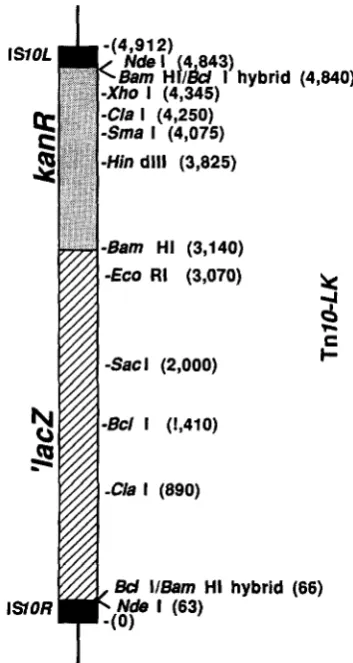
-Hin dlll (3,825)
-Bam HI (3,140)
-€CO RI (3,070)
Bd ll6am HI hybrid (66)
ISOR Ndre I (63)
FIGURE 1 .-Structure of the mini-lacZ-kanR transposon (TnZU- LK). Numbers represent the distance in nucleotides of each restric- tion enzyme cut site from the left-most end of the element. Lac2 transcription is from left to right. The sequence of the TnlU across the junction to the truncated lacZ gene, beginning with bpl of the
IS10 sequence, is CTG ATG AAT CCC CTA ATG A T T TTG
G T A A A A A T C A T T A A G T T A A G G T G G A T A C A C A T C T T G TCA T A T GAT CCC GTC, etc. GAT is the first codon of the lac2 coding sequence.
grown to about 1 X lo8 bacterial/ml with good aeration. One milliliter of each such culture was mixed with 2.5 ml of a culture of the recipient strain grown to a concentration of 4 X 10' cells/ml in LB broth. After 60 min of incubation with good aeration, the mating mixture was vortexed vig- orously, placed on ice, and aliquots were plated. The total frequency of exconjugants was determined by direct selec- tion of Pro+SmR clones emerging from the mating. The frequency of transposition exconjugants was determined by selection of Pro+KmRSmR clones. Transposition frequencies in such ex eriments are expressed as the ratio of Pro+KmRSm
B
to Pro+SmR exconjugants.RESULTS AND DISCUSSION
Basis of the screening assay: To facilitate t h e iso-
lation of mutants affected for transposition, we wished t o develop an assay by which differences in transposi- tion frequency a m o n g different bacterial clones could
be recognized by simple visual inspection of isolated single colonies.
lac2-kanR element, T n IU-LK, has the appropriate terminal sequences of TnlO flanking the E. coli lac2
gene and the kanR determinant of Tn903. The lac2 gene was truncated so that it lacks both transcriptional and translational initiation signals, and a series of transcription terminators is present upstream of the lacZ gene, but outside of the transposon, to eliminate fortuitous readthrough transcription. As a result of these features, the mini-lacZ-kanR element produces only a very low level of &galactosidase. This level is insufficient to render a LacZ- bacterial strain LacZ+, even when the transposon construct is present on a multicopy plasmid. However, the lac2 coding se- quence has been connected to one of the terminal sequences of TnlO in such a way that a correct open reading frame extends from the very end of the element, across the terminal sequences, and into the lacZ gene. Thus, insertion of this mini-transposon in the correct orientation and reading frame into an efficiently expressed E. coli gene can lead to high level expression of &galactosidase and a LacZ+ phenotype. The exact sequence across the T n 10 terminus and the start of the lacZ gene are given in the legend to Figure
1.
We have used the T n 10 mini-lacZ-kunR transposon to detect transposition mutants by taking advantage of the fact that Lac+ and Lac- bacteria can easily be discriminated on Macconkey lactose indicator plates, where they form red and white colonies respectively. A LacZ- strain containing a non-transposing mini- lacZ-kanR element forms white colonies on such plates. In contrast, a LacZ- strain carrying a transpo- sition-proficient mini-element forms colonies that are initially white but eventually develop red papillae or, at higher transposition rates, turn completely red due to the occurrence of multiple Lac’ insertion events within the colony. In fact, the rate at which the colonies develop red papillae is directly and sensitively related to the frequency of transposition within the colony. (Note: for simplicity, we will describe all col- ony morphologies with the terms “papillae” or “papillation” even though the colonies that turn com- pletely red do not actually exhibit discrete fast-grow- ing outgrowths.)
Fidelity and sensitivity of the assay: This method was first tested using a lacZ- recA- strain, NK7800, carrying two compatible plasmids: pNKl207 that con- tains the mini-lac2-kanR transposon, and pNK629 that provides high levels of the essential T n I O transposase function that is lacking from the mini-element con- struct. Transformants containing both plasmids were plated on Macconkey lactose plates supplemented with appropriate selective drugs and incubated at 37 O
.
All of the resulting colonies were initially white but had turned red by 48 hr of incubation. Occurrence of red colonies exhibits the same requirements as
TnlO transposition: presence of transposase and in- tegrity of the transposon termini. Transformants of the lacZ- recA- strain carrying only the mini-transpo- son plasmid pNKl207, or transformants carrying the transposase plasmid plus pNK 12 1 5 , a mini-transposon plasmid lacking the terminal T n I O sequences adjacent to the kanR gene, both give rise exclusively to uniform white colonies after 48 hr of incubation at 37 O
.
The Lac+ character of the red papillae is not the result of internal rearrangements within the mini transposon contained in the plasmid molecule. In- deed, we analyzed ten independent Lac+ clones iso- lated from ten different colonies exhibiting red pa- pillae. Each of the ten were shown by physical char- acterization and genetic analysis to contain the two original wild type plasmids (data not shown). We thus conclude that the formation of red colonies primarily reflects transposition of the mini-lacZ-kanR element from the plasmid into appropriate locations in the bacterial chromosome.
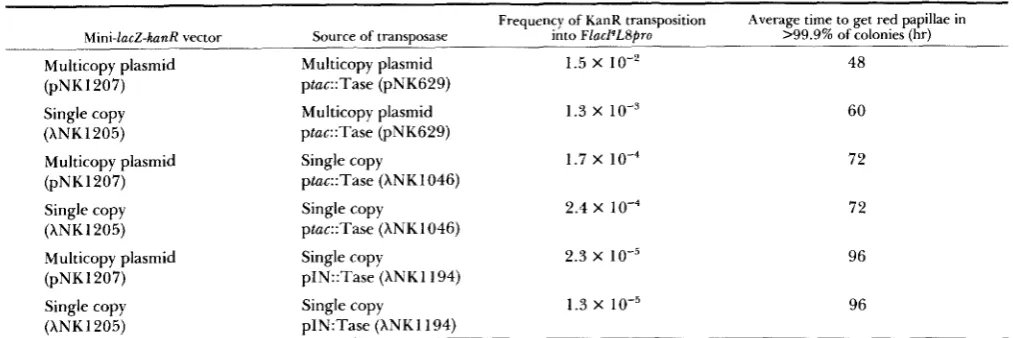
The fidelity and sensitivity of the papillation assay were further assessed by genetically varying the trans- position frequency of the mini-lacZ-kanR element and comparing in a single set of strains the rate of red papillae-containing colony formation on Macconkey lactose plates and the quantitative transposition fre- quency as measured in a standard “mating-out” assay (see MATERIALS AND METHODS for further description). This analysis, described in Table 1 and below, shows that the rate at which colonies turn red decreases from 48 to 96 hr as the relative frequency of trans- position drops 1000-fold. Most important, it reveals that transposition frequencies differing by as little as a factor of 10 should be distinguishable by this test.
Finally, these reconstruction experiments provide background information that allows one to select ex- actly the appropriate conditions needed to identify mutants having the desired increase or decrease in transposition.
A 1000-fold range in transposition frequencies was achieved by combining different levels of transposase with high or low transposon copy numbers. The fre- quency of T n I O transposition is known to be roughly proportional to the level of transposase present in the cell (MORISATO et al. 1983). In our first experiments, described above, the transposase was provided from a multicopy plasmid and its synthesis was under control of a very strong heterologous ptac promoter. Lower transposase levels were achieved by using a single copy prophage vector and/or by using normal T n I O transposase promoter PIN which is much weaker than ptac (SIMONS et al. 1983); transposon copy numbers were reduced from the original multicopy level by placing the mini-lac-kan element in the cell on a single copy X prophage.
188 N.
TABLE 1
Length of time for papillation as a function of tranposition frequency
Frequency o f KanR transposition Average time to get red papillae in Mini-lad-kanR vector Source of transposase into Flacl‘LXpro >99.9% of colonies (hr)
Multicopy plasmid Multicopy plasmid 1.5 X lo-‘ 48
(pNK1207) ptac::Tase (pNK629)
Single copy (XNK1205)
Multicopy plasmid 1.3 X lo-’ ptac::Tase (pNK629)
Multicopy plasmid Single copy 1.7 x 1 0 - ~
(pNK1207) ptac::Tase (XNK1046)
Single copy (XNKI 205)
Single copy 2.4 x 1 0 - ~
ptac::Tase (XNKl046)
Multicopy plasmid Single copy 2.3 x 1 0 - ~
(pNK1207) p1N::Tase (hNKl194)
60
72
72
96
Single copy Single copy 1.3 x 1 0 - ~ 96
(XNKl205) p1N:Tase (XNKll94)
“ptac::Tase” means that the synthesis of the transposase is controlled by the heterologous ptac promoter (AMANN, BROSIUS and PTASHNE 1983; ROBERTS, KACICH and PTASHNE 1979). The p1N::Tase expression means that on those vectors the synthesis of the transposase is controlled by the wild type T n l O transposase promoter (SIMONS et al. 1983). The “frequency of KanR transposition” has been measured by the standard mating o u t transposition assay (see MATERIALS A N D METHODS). The “average time to get red papillae” represents the time necessary for all of the 2000 colonies examined to exhibit red papillae. Additional controls have shown that, after prolonged time of incubation, colonies containing the Lac-Kan transposon but no transposase will eventually turn red (data not shown). However, this happens only after the incubation times of around 96 hr in the case where the element is carried on a multicopy plasmid and around 120 hr in the case where the element is present in a single copy. In the case of the multicopy plasmid, the appearance of Lac’ bacteria was due to transposase-independent rearrangements on the plasmid rather than to any real transposition event (data not shown).
frequency of transposition is correlated with the length of incubation required for every colony to exhibit red papillae. For example, if the frequency of transposition is 1.5 X lo-*, all colonies exhibit red papillae after 48 hr of incubation at 37”; when the transposition frequency drops to 1.3 X 1 0 - 3 , the col- onies remain white after 48 hr, but all have red papillae after 60 hr; even at a transposition frequency of 1.3 x all colonies have red papillae by 96 hr, while colonies of transposition-negative control strains are still all uniformly white. In some cases, the trans- position frequency remains constant despite a varia- tion in transposon copy number (compare lines 3 and 4, and lines 5 and 6). One possible explanation is that the level of transposase in these cases is so low as to be the limiting factor for transposition. The important point for the analysis here is that even in these unusual situations, the time necessary to observe the formation of red papillae or colonies is still correlated with transposition frequency.
Use of assay to isolate transposition mutants: We have successfully used the mini-lacZ-kanR red papillae screen to isolate mutations in the terminal sequence of TnlU that decrease the level of transposition. After an efficient mutagenesis targeted to one terminal se- quence of a plasmid-born mini-transposon (see MATE- RIALS AND METHODS), plasmid molecules were intro- duced into an appropriate lacZ- recA- strain contain- ing the compatible transposase overproducer plasmid pNK629. The resulting transformants were plated on Macconkey lactose plates and incubated at 37”. After
48 hr, 13 of the 5200 colonies observed remained white, while all others presented red papillae. Further analysis of the mutant candidates by mating-out trans- position assays revealed that 8 of the 13 did in fact exhibit reduced transposition frequencies. DNA se- quence analysis of these mutants confirms that 5 of them had suffered a single base change within the T n l 0 terminal sequence (the 3 others were deletions at the end of the transposon). The changes identified in this experiment were: a G to T transversion at bp
6, a T to C transition at bp 9, and a C to T transition at bp 11. One of the point mutations identified at bp 9 was in fact identical to a mutation previously iden- tified by more laborious methods (WAY and KLECK- NER 1984). Further characterization of those single mutations and their effects on T n 10 transposition will be described elsewhere. The five white colonies ex- hibiting normal transposition phenotype are pre- sumed to have suffered alterations in the EacZ deter- minant that did not affect transposition. Three other independent mutageneses of the mini-lad-kanR ele- ment followed by mating-out assays on mutant candi- dates have confirmed the conclusions from the first analysis: this screen allows the easy detection of trans- posons harboring mutations in the terminal transpo- son sequences.
straightforward to search specifically for mutations in only one of these determinants, because the terminal sequences, the transposase gene and the host genome can each be mutagenized and manipulated separately. Also, the papillation assay allows detection of muta- tions that either increase or decrease the efficiency of transposition.
We expect that this method will greatly facilitate the genetic dissection of T n
IO
transposition. This approach should be also generally adaptable to genetic analysis of elements other than TnZO. Other trans- posons that can promote formation of lac2 fusions have already been described in some cases (CASADA-BAN and CHOU 1984; KROOS and KAISER 1984) and can be readily engineered in most others.
Application to genetic analysis in vivo: The mini lad-kanR element transposon described here also pre- sents several advantages for transposon analysis. Like other mini-Tn 10 elements described previously (WAY et al. 1984), it can transpose at a high frequency, but the resulting insertions are stable because the transpo- sase gene is not present within the element itself. Most important, the presence of the truncated lacZ gene in an open reading frame through the end of the TnlO terminus allows one to obtain protein fusions if inser- tion occurs in the correct orientation and open read-
ing frame. Isolation and analysis of insertions and protein fusions are described in HUISMAN et al. (1 987).
We are very grateful to all the members of the laboratory for their warm interest in red papillae, and especially to DENISE ROE
ERTS and D ~ N A L D MORISATO for fruitful discussions throughout this work. O.H. was supported by a European Molecular Biology Organization fellowship. This research was supported by grants to N.K. from the National Institutes of Health and the National Science Foundation.
LITERATURE CITED
AMANN, E., J. BROWS and M. PTASHNE, 1983 Vectors bearing a hybrid trp-lac promoter useful for regulated expression of cloned genes in Escherichia coli. Gene 25: 167-178.
CASADABAN, M. J. and J. CHOU, 1984 In vivo formation of gene fusions encoding hybrid @-galactosidase proteins in one step with a transposable Mu-lac transducing phage. Proc. Natl. Acad. Sci. USA 81: 535-539.
CASADABAN, M. J., A. MARTINEZ-ARIAS, S. K. SHAPIRAandJ. CHOU,
1983 Galactosidase gene fusions for analyzing gene expres- sions in Escherichia coli and yeast. Methods Enzymol. 1 0 0 293- 307.
FOSTER, T. J., M. A. DAVIS, D. E. ROBERTS and N. KLECKNER, 1981 Genetic organization of transposon TnlO. Cell 23: 201- 213.
Transpositional recom- bination in procaryotes. Annu. Rev. Biochem. 5 4 863-896.
KLECKNER, D. BOTSTEIN and M. A. HOYT, 1987 A TnlO-
lacZ-kanR-URA3 gene fusion transposon for insertion mutagen- esis and fusion analysis of yeast and bacterial genes. Genetics
KLECKNER, N., 198 1 Transposable elements in prokaryotes. Annu. Rev. Genet. 1 5 341-404.
KROOS, L., and D. KAISER, 1984 Construction of a T n 5 lac, a transposon that fuses lacZ expression to exogenous promoters, and its introduction into Myxococcus xanthus. Proc. Natl. Acad. Sci. USA 81: 5816-5820.
MANIATIS, T., E. F. FRITSCH and J. SAMBROOK, 1982 Molecular Cloning. Cold Spring Harbor Laboratory, Cold Spring Harbor, New York.
Gene regulation at the right operator (OR) of bacteriophage A. I. OR3 and autogenous negative control by repressor. J. Mol. Biol. 1 3 9
MEYERS, R. M. and T. MANIATIS, 1985 A new method for satu- rated mutagenesis. Science 429: 242-245.
MILLER, J. H., 1972 Experiments in Molecular Genetics. Cold Spring Harbor Laboratory, Cold Spring Harbor, New York.
MORISATO, D., J. C. WAY, H.-J. KIM and N. KLECKNER, 1983 TnlO transposase acts preferentially on nearby trans- poson ends in Y~ZJO. Cell 32: 799-803.
ROBERTS, D., B. C. HOOPES, W. R. MCCLURE and N. KLECKNER, 1985 IS1 10 transposition is regulated by DNA adenine meth- ylation. Cell 43: 1 17-1 30.
ROBERTS, T. M., KACICH, R. and M. PTASHNE, 1979 A general method for maximizing the expression of a cloned gene. Proc. Natl. Acad. Sci. USA 7 6 760-764.
Improved single and multicopy lac-based cloning vectors for protein and operon fusions. Gene 53: 85-96.
SIMONS, R. W., B. C. HOOPES, W. R. MCCLURE and N. KLECKNER, 1983 Three promoters near the termini of ISIO: plN, POUT and pIII. Cell 3 4 673-682.
WAY, J. C. and N. KLECKNER, 1984 Essential sites at transposon TnlO termini. Proc. Natl. Acad. Sci. USA 81: 3452-3456.
WAY, J. C., M. A. DAVIS, D. MORISATO, D. E. ROBERTS and N. KLECKNER, 1984 New TnlO derivatives for transposon mu- tagenesis and for construction of lacZ operon fusions by trans- position. Gene 32: 369-379.
Communicating editor: E. W. JONES GRINDLEY, N. D. F. and R. R. REED, 1985
HUISMAN, O., W. RAYMOND, K.-E. FROEHLICH, P. ERRADA, N.
116: 191-199.
MAURER, R., B. J. MEYER and M. PTASHNE, 1980
147-161.