Perspectives
Anecdotal, Historical and Critical Commentaries
on
Genetics
Edited
by James F.
Crow
and William F. Dove
REGULATING
TNIO
ANDIS10 TRANSPOSITION
T
RANSPOSABLE elements are ubiquitous inhab- itants of both prokaryotic and eukaryotic ge- nomes. They may be molecular parasites, surviving only because they replicate faster than their hosts; alternatively, they may survive because they confer a selective evolutionary advantage to an individual host, to a host population, or to a particular favorable gene such as antibiotic resistance (for interesting reading see CAMPBELL 1981a, b; ORCEL and CRICK 1980; SAPIENZA and DOOLITTLE 198 1; SYVANEN 1984). For bacterial transposons, at least, this final possibility seems particularly simple and attractive. T h e ability of a gene to spread through a population is greatly enhanced if it can transpose onto and off of transmit- ting DNA molecules (viruses, plasmids or transform- ing DNA); transposition of genetic segments in the absence of any element is exceedingly rare. Further- more, because the transposon remains tightly linked to the favorable gene, selection for and dissemination of that gene necessarily disseminates the transposable element as well.Regardless of the evolutionary forces involved, sta-
ble coexistence of a transposable element with its host requires that a balance be struck between too little transposition and too much. If the element transposes too much, or in an inappropriate way, deleterious effects on the host will counterbalance the advantage conferred by transposition and may cause the host to evolve specific defenses. On the other hand, if the element does not transpose at some minimal level, it cannot maintain itself as an evolutionarily successful unit.
TnlO and ISIO: TnIO is a bacterial tetracycline- resistance transposon. It is a composite element be- cause its two ends are inverted repeats of an insertion sequence, in this case ISIO. While either ISIO element can transpose individually, ISIO-Right is fully func- tional and ISIO-Left is defective, relying primarily on transposition functions provided by ISIO-Right. T h e two ISIO elements can also cooperate to effect trans- position of the entire TnIO unit or to generate certain TnIO-promoted rearrangements. All of these events
Genetics 1 2 4 449-454 (March, 1990)
are rare, approximately 1 per IO’ cell generations for ISIO, 1 per IO’ for TnIO, and 1 per lo5 for the rearrangements. All of these events require ISIO-
encoded transposase, which interacts with different pairs of outside and inside IS20 ends to promote the various events. In vitro, TnIO and IS10 transposition also requires a host protein which may be either IHF or HU and which plays an accessory role in the reac- tion, probably by altering DNA structure. IHF is likely to be the most important host factor in vivo.
TnIO and IS20 transpose by a nonreplicative mech- anism in which the element is excised from the donor site and inserted at a new target location without any replication of the element except for a small amount of repair synthesis at the very ends. T h e fate of the donor molecule is not firmly established, but is likely to involve chromosome loss and/or repair of the re- maining double-strand gap against another copy of the donor region present on another molecule in the same cell. Loss of a chromosome need not be a lethal event, because bacteria contain more than a single chromosome under most growth conditions.
We describe below the mechanisms by which ISIO-
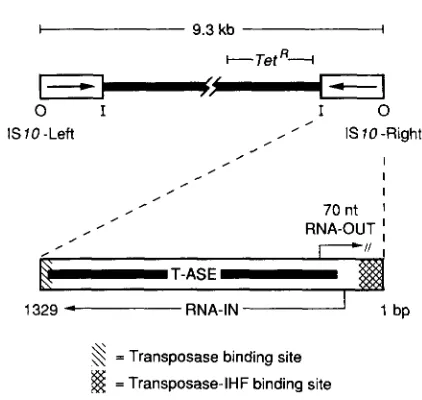
Right (hereafter called ISIO) and TnIO modulate their transposition activities (Figure 1). Some of these mechanisms are intrinsic to the transposon or inser- tion sequence itself, while others involve interplay between the transposon and its host. They can all be rationalized as stratagems ensuring that transposition occurs at an appropriate rate and under appropriate circumstances. T h e existence of these many mecha- nisms, some of which are quite sophisticated, makes it clear that ISIO and TnIO are evolutionarily successful creatures and that ISIO, at least, has been with us for a long time. Many of these mechanisms are known or suspected to operate for other IS elements and similar general regulatory strategies are found in many types of transposons. T h e reader should consult Mobile DNA
for descriptions of other elements and for a fuller review of TnIO and ISIO with references to the pri- mary literature (KLECKNER 1988).
9.3 kb I t- Tet ’?-+
”
0 I I 0
IS 10 -Left , ’ , IS70 -Right
, ,
, I
, I
, I
, , ,
r
, 70 nt I
, ,
, RNA-OUT
I
,
1 bP
= Transposase binding site
$$
= Transposase-IHF binding siteFIGURE 1 .-The structure of’ TnlU.
protein is never very high (RALEIGH and KLECKNER 1986). A single copy of IS10 in the bacterial chro- mosome generates fewer than 0.2 molecule per cell per generation as estimated from the level of P-galac- tosidase in a strain bearing a single-copy transposase/ &galactosidase fusion gene. So little protein is made that polypeptide chains can be detected in enzyme assays only if the cells are broken open so that unas- sociated fusion-protein monomers can reassemble into active tetramers in vitro.
This low level of protein is achieved by a combina- tion of infrequent transcription (0.25 transcript per element per cell generation) and inefficient translation (fewer than 60% of transcripts being translated even once). Transcription is infrequent in part because the transposase gene promoter, PIN, is relatively weak (SIMONS et al. 1983), and in part because transcription is confined to a small fraction of the cell cycle (see below). Translation is inefficient primarily because there is no obvious Shine-Dalgarno ribosome binding site consensus sequence; most mutations that increase transposase gene translation bring the sequence closer to consensus (C. JAIN and N. KLECKNER, unpublished results).
Two subtler mechanisms may also contribute to inefficient translation by confining translation initia- tion on a nascent 5’ mRNA to the first few seconds after transcription is initiated. First, translation is re- duced severalfold by fold-back inhibition, in which a region of transposase mRNA about 300 nucleotides (nt) from the 5‘ end pairs with and sequesters the ribosome binding site near the start of the message (KITTLE and KLECKNER 1988; J. E. GONZALEZ and R.
W. SIMONS, unpublished results). Second, preliminary experiments suggest that failure to initiate translation at the transposase AUG start codon may reduce the stability of the 5’ end of the mRNA (C. JAIN and N.
KLECKNER, unpublished results).
Transposition of a single-copy element regulated
by dum methylation: T h e most important regulatory
mechanism for an ISZO element present in single copy involves DNA adenine methylation at specific sites in
IS20 (ROBERTS et al. 1985; additional discussion in
KLECKNER 1988). This mechanism not only reduces
the basal level of transposition but also ensures that it occurs specifically in the most appropriate situations.
Escherichia coli mutants exhibiting increased levels of
TnIO-promoted rearrangements were isolated and subsequently shown to increase ISZO transposition more than 100-fold. All of these mutations turn out to be alleles of the dam gene whose product, DNA adenine methylase, methylates the N-6 positions of the symmetrical adenines in the sequence 5’GATC. T h e effects of dam mutations are a direct consequence of the absence of methylation at two strategically located GATC sites in ISIO, one of which overlaps the -10 region of the transposase promoter near the outside end of the element and the second of v, hich occurs within the transposase binding site at the op- posite (inside) end of ISZO.
Because there is normally no fully unmethylated DNA in wild-type E. coli strains, and because hemi- methylated DNA is generated only transiently upon replication of the transposon, we reasoned that the effects of dam mutations must reflect a normal process in which IS10 is activated by hemimethylation. Addi- tional analysis revealed this to be the case. Further- more, passage of the replication fork generates two chemically distinguishable hemimethylated IS10 spe- cies, and we found that only one of these is substan- tially activated for transposition. T h e ratios of approx- imate transposition rates for the fully methylated and the two hemimethylated species are 1 : 12:2,400 (min- imum) to 1: 12:60,000 (possible). These conclusions were reached largely by direct examination of IS10
transposition from hemimethylated DNA in vivo.
Hemimethylated elements were generated in vivo by transferring ISZO from a Dam+ host to a Dam- host in an Hfr cross, where one specific strand of the transferred DNA is synthesized in the donor while the complementary strand is synthesized de novo in the recipient.
Appropriate variations in the Hfr transfer experi- ment revealed the basis for these differences. Each of
Perspectives 1
ing hemimethylated just as the replication fork passes.
In the coupled situation, transposase protein is used more efficiently than it would be were the terminus and promoter activated at independent times.
One important prediction of dum regulation is that
I S 1 0 transposition will occur only during a limited
period of the cell cycle, immediately after the repli- cation fork passes. Although the I S l O GATC sites have not yet been examined, recent experiments sug- gest that a typical GATC site in the E. coli chromo- some remains hemimethylated for 0.5-4 min, 1-10% of a generation
(J.
CAMPBELL and N. KLECKNER, un- published results). Furthermore, during this interval, only one of the two sister chromosomes can generatean I S 1 0 transposition. This type of regulation should
be specifically advantageous to an element like ISlO
that transposes by a nonreplicative mechanism and leaves a hole in the donor chromosome. dum regula- tion should ensure that transposition will never occur unless a second copy of the donor region is present,
i.e., on the sister chromatid. Thus, a cell will never
die because a donor molecule is not repaired. Fur- thermore, the likelihood of repair may be increased because a homologous sister-chromatid region is al- ways in the general vicinity of the donor molecule at the time of transposition.
Activation by hemimethylation should also mean that transposition will be transiently induced when
IS10 enters a new host by any mechanism that involves transfer of single-stranded DNA followed by synthesis of the complementary strand in the recipient cell (i.e.,
conjugal transfer, some types of transformation, or infection by single-stranded DNA phages). This may be particularly important for expediting the dissemi- nation of I S 1 0 in bacterial populations.
Mechanisms slowing the accumulation of multi- ple transposon copies: Although I S l O transposes by a nonreplicative mechanism, the average number of transposons per cell in the population should increase with almost every cycle of transposition. If the gap left behind at the donor site is repaired by interaction with another chromosome, a second copy of the tran- sposon is generated by the restoration process. If the gap is not repaired and the donor chromosome is lost, the average number of transposons per bacterial ge- nome can still increase: if the transposon inserts into a chromosome other than the one that is lost, the number of transposons remains constant while the total number of chromosomes decreases. In either case, the transposon frequency further increases if the moving element inserts ahead of the replication fork in the target chromosome.
If transposition were left unchecked, the average number of transposons per cell would continue to accumulate, and at ever-increasing rates. With more copies, there would be more potential donor elements
and, in addition, the transposase concentration would increase. T h e cell would eventually explode. For I S l 0 ,
these risks are greatly reduced by diverse mechanisms.
I S l O transposase acts preferentially in cis: cis action is
observable in complementation tests: the transposition frequency of an element making its own transposase is much greater than that of an equivalent element provided with the same level of transposase in trans
(FOSTER et ul. 1981; N. KLECKNER, unpublished re- sults). As a consequence, increasing the numbers of
IS10 copies no longer increases the effective transpos- ase concentration; each ISlO element sees only its own transposase.
Formally, failure to observe complementation could result either from an intrinsic failure of the protein to move freely through the cell and/or from coupling of transposase action to transposase expression. In the first case, transposase made by one element would never reach a distant element. In the second case, transposase which reaches an element in trans could never act because silent transposons are poor sub- strates for transposase action. In fact, IS10 uses both of these mechanisms.
Transposase is indeed intrinsically cis-acting. Even when all regulatory mechanisms are experimentally eliminated, transposase made in one location acts pref- erentially on transposon ends that are located nearby (MORISATO et al. 1983). T h e physical basis for this property is not understood. Perhaps some combina- tion of high nonspecific DNA binding and a finite functional half-life prevents transposase from migrat- ing very far from the site where it first contacts DNA.
cis action of this type also requires that the transposase mRNA never diffuse very far from the template ele- ment. Because the mRNA cannot be separated from the template element until transcription is complete, mRNA localization might be facilitated by transla- tional polarity and/or fold-back inhibition.
In addition, transposase should be effectively cis-
acting because its action is coupled to its transcription by dum regulation. IS10 elements at different loca- tions in the genome become hemimethylated at dif- ferent times. Any particular element will be immune to transposase that is made by elements elsewhere in the genome because its inside end will be fully meth- ylated when those transposases are made.
I S l O multicopy inhibition: I S l O has evolved an entire
regulatory process whose sole function is to reduce transposition when the element is present in more than a single copy. I S l O encodes a trans-acting nega-
tive regulator of transposase expression whose effec- tiveness increases with increasing concentration, i e . ,
with increasing transposon cop'] number (SIMONS and KLECKNER 1983). T h e level of this regulator is ad- justed so that transposase expression from an element
KLECKNER 1983); however, the presence of even two copies results in a threefold inhibition, and 30 copies can inhibit as much as 50-fold
(J.
MATSUNACA and R. W. SIMONS, unpublished results). Because transposase is cis-acting, any decrease in the level made per copy reduces the frequency of transposition of each copy. Thus, the combination of a trans-acting negative reg- ulator and a cis-acting transposase means that as the number of IS10 copies increases, the frequency of transposition per copy decreases. In fact, the overall rate of IS20 transposition by the ensemble of copies in the cell probably remains essentially constant re- gardless of the copy number.This ISIO-encoded trans-acting negative regulator is a 70-nt antisense RNA, RNA-OUT. Its existence was discovered in the course of complementation ex- periments in which multicopy IS10 plasmids were tested against transposase-defective TnlO derivatives introduced on X phages. Mysteriously, control exper- iments demonstrated that wild-type TnlO transposed less frequently into cells containing a multicopy ISIO plasmid than into cells lacking any plasmid. Deletion analysis then demonstrated that this multicopy inhi- bition was not due to transposase itself. T h e RNA nature of the inhibitor was revealed by genetic analysis coupled with in vitro identification of the responsible promoter, POUT, located internal to and opposing the transposase gene promoter PIN. T h e template sequences for RNA-OUT and the transposase mRNA (RNA-IN) overlap for 36 bp. T h e key evidence that inhibition results from pairing of the two RNAs was the genetic observation that the inhibitory effect con- ferred by a wild-type plasmid could be titrated by an additional, truncated transposase gene, present in cis
or in trans, expressing the 5’ end of RNA-IN at high levels.
I S I O antisense control works in a simple and direct
way. The region of RNA-IN that is complementary to RNA-OUT includes the ribosome binding site for the transposase gene, and RNA-OUT exerts its effect by preventing ribosome binding to RNA-IN (C. MA and R. W. SIMONS, unpublished results). T h e paired species is also cleaved by the double-strand-specific RNaseIII, but this cleavage is not required for anti- sense control (C. c . CASE, E. SIMONS and R. W.
SIMONS, unpublished results; see SIMONS and KLECK-
Specific features of the antisense system are impor- tant for its function. RNA-OUT forms a stem-loop structure, and the 5‘ end of the transposase message, RNA-IN, is complementary to the top of the loop. Pairing initiates by interaction at the 5’ terminal se- quence GCG, extends through the rest of the loop, and then proceeds by displacement of one strand of the RNA-OUT stem throughout the remaining re- gion of complementarity to the 3’ end of RNA-OUT
NER 1988).
(KITTLE et al. 1989). T h e three initial G C pairs are probably important for nucleation of stable pairing, and initiation at the terminus of RNA-IN permits free rotation of the nascent duplex around the RNA-OUT chain, thus permitting pairing over more than a single turn of the helix. Also, the stem domain of RNA- O U T has several base-pair mismatches while the RNA-IN/RNA-OUT hybrid has perfect complemen- tarity; replacing imperfect matches with perfect ones during pairing may help to drive the strand-displace- ment reaction in the forward direction.
Biologically, the stem-loop structure of RNA-OUT allows presentation of an exposed single-stranded re- gion (the loop) for pairing initiation in a structure where it is protected from nucleolytic degradation by the stem domain. Mutations in the loop domain alter the rate of antisense pairing in vitro but have little effect on stability in vivo. In contrast, mutations that reduce intramolecular pairing in the stem domain have little effect on the rate of pairing but drastically reduce the half-life of RNA-OUT inside the cell and are suppressed by compensatory mutations that re- store stem pairing (CASE et d . 1989). T h e stem region probably acts to block the progress of exonucleolytic single-strand RNases, which are a major source of single-strand nucleolytic activity in E . coli. However, the duplex stem domain is also specifically arranged
so as not to be a substrate for RNaseIII: a single-base mutation in RNA-OUT that extends the stem domain pairing up into the loop domain renders the molecule sensitive to that RNase.
As a consequence of these features, RNA-OUT is exceptionally stable; its half-life is more than 40 min as compared with a typical bacterial mRNA half-life of 1-2 min (CASE et aZ. 1989). This stability allows the cell to achieve a high steady-state level of the RNA with a promoter that is only moderately active. Such a mechanism does not permit the level of RNA-OUT
to change rapidly, but rapid changes are not necessary for a regulatory process whose role is to reduce risks whose consequences are manifested on an evolution- ary time scale. For a contrasting case, read about ColEI in SIMONS and KLECKNER (1 988).
Perspectives
RNA-IN
I\’
G - C U - A A A A A u .A :
U - A i RIBOSOME G - C A - U [ [BINDING
U - A ;SITE A G i U A / A C C A U - A G - C U - A G U
G A U - A U - A U - A U - A
BP 1 IS 10
A - U G - C U - A
I A - U
C - G U - A
ITRANSPOSASE
C - G START CODON
I A - U A - U
v
... CUGAUGAAUCCCC AGUUAAGGUGGAUA CGAACUCGAUAUUUUACA U - A
C - G
I
EXTERNAL PROMOTOR
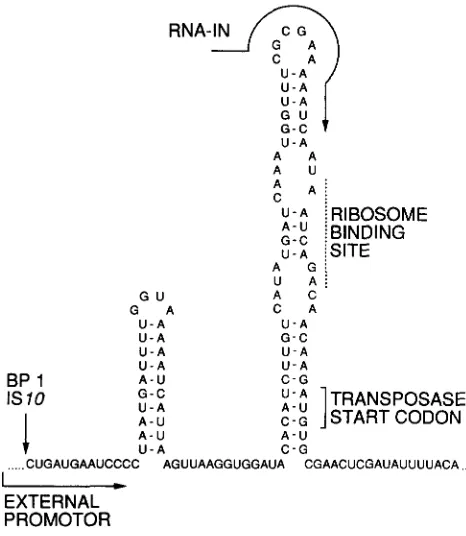
FIGURE 2 , ” I S I U transposase expression from readthrough tran- scripts is blocked by sequestration of translation start signals in a region of secondary structure.
molecules having the precise 5’ end found in wild- type RNA-IN.
T h e most important ISlO protection mechanism acts at the level of transposase translation: externally initiated transcripts yield less than 1% as much trans- posase protein per transcript as do transcripts initiated from PIN (DAVIS, SIMONS and KLECKNER 1985). A portion of this effect is probably due to premature termination of readthrough transcripts before they transverse the transposase gene. However, most inhi- bition occurs post-transcriptionally. T h e sequence be- tween the end of IS20 and the transposase ribosome binding site is such that readthrough transcripts form a strong stem-loop structure, essentially the comple- ment to the RNA-OUT stem-loop, that sequesters the translation-initiation signals (Figure
2).
T h e 5’ end of RNA-IN is at a position corresponding to the top of this loop, and RNA-1 N therefore lacks the inhibitory structure.A second protection mechanism is provided by the fact that transcription initiated outside of the element and across the outside terminus of IS10 inhibits trans- position, even when transposase is provided in trans (DAVIS, SIMONS and KLECKNER 1985). This direct inhibition in cis is severalfold when transcription is promoted by a fully induced lac promoter and is more than sufficient to counteract any small increase in the level of transposase from readthrough transcripts that escape other protection mechanisms.
A third level of protection is provided once again by dam methylation. Readthrough transcripts are ex-
pressed throughout the cell cycle. However, any resid- ual transposase made from such transcripts will be effective only during that small fraction of the cell cycle when the inside end is activated. T h e importance of dam methylation in this regard is directly observa- ble in ISlO mutants where the contribution of read- through transcription is elevated due to reduced translational protection (HUISMAN et al. 1989).
A fourth level of protection comes in the form of prevention: insertion of TnlO (and thus presumably of ISIO) is inhibited by transcription of the target region. Transposition into the E . coli lactose operon assayed in Salmonella typhimurium is tenfold more frequent in the absence of inducer than in its presence; similar effects have been observed in the Salmonella histidine operon (CASADESUS and ROTH 1989). Thus, the probability of risk from external transcription is reduced by the transposon’s choice of target sites. This situation should also reduce the probability that TnlO or ISIO will insert into absolutely essential genes or genes that are required for growth at the time of transposition, because both kinds of genes are likely to be actively transcribed.
TnlO-specific regulation: TnlO poses the same threats to the cell as does ISIO, although its much lower transposition frequency reduces their extent. T h e low frequency of transposition is a consequence of the length of the transposon; deletion analysis shows that the rate of TnlO transposition increases approx- imately 40% for every kilobase decrease in transposon length (MORISATO et al. 1983). T h e mechanism for transposition length dependence is not known, but is generally presumed to reflect some aspect of the way in which transposon ends find one another. For ex- ample, a complex of transposase protomers might initially bind at one end of the element and then initiate a one-dimensional search for the other end; in this case, length dependence might arise because the complex has a significant chance of getting stuck or otherwise decaying during the search (e.g., WAY and KLECKNER 1985). It could be argued that this trans- position length dependence is itself a device for re- ducing the deleterious effects of the transposon. Per- haps the level of transposition required for TnlO to be an evolutionarily successful creature is lower than that required by ISIO: TnlO is presumably maintained because of its linkage to tetracycline resistance, whereas IS20 maintenance may require the capacity to efficiently generate new types of composite trans- posable elements by transposition to new locations.
TnlO when the replication fork passes or upon single- stranded entry into a new host should be less dramatic than for ISIO; furthermore, T n l O ends are not pro- tected from outlaw transposase molecules generated by readthrough transcription or by other IS10 ele- tnents.
Questions for the future: Additional features of IS10 and TnlO remain to be discovered. T h e most important involve the roles of transposition host fac- tors IHF and HU. T h e bacterial host may use these proteins to communicate with IS10 regarding the desirability of transposition (HUISMAN et al. 1989 and unpublished results; J. KRULL-SUSSMAN and R. W. SIMONS, unpublished results). T h e outstanding ques- tion is: what is the cell trying to say?
A second question is: how does ISlO manage to tnake enough transposase molecules to carry out a transposition? Analogies with other systems suggest that numerous molecules (as many as 12) might be needed (GRINDLEY et al. 1982; ABDEL-MEGUID et al.
1984). Perhaps many cells make some transposase but only a few make enough to produce a transposition. Alternatively, specific mechanisms might ensure that transposase is made in small bursts. In this case, most cells would make no transposase protein, but occasion- ally a cell would make all of the necessary molecules and would have a very high probability of undergoing transposition. Bursts would be economical and might also minimize potentially damaging abortive events.
Third, is there regulation at the level of transposase itself? IS10 transposase appears to be rather stable, but is its effective level reduced, or its action modified, by virtue of some functional instability? Furthermore, how are the DNA cleavage activities of the transposon controlled? Interaction with the target site involves cleavage of relatively nonspecific sequences by a pair of staggered nicks located 9 bp apart; what features of the transposition reaction ensure that transposase does not act as a restriction enzyme?
NANCY KLECKNER
Harvard University
Department of Biochemistry and
7
Divinity AvenueCambridge, Massachusetts 02 138 Molecular Biology
L I T E R A T U R E C I T E D
ABDEL-MEGUID, S . S . , N. D. F. GRINDLEY, N. S. TEMPLETON and T. A . STEITZ, 1984 Cleavage of the site-specific recombina- tion protein y6 resolvase: the smaller of two fragments binds D N A bpecifically. Proc. Natl. Acad. Sci. USA 81: 2001-2005.
CAMPBELL, A., 1981a Evolutionary significance ofaccessory DNA
CAMPBELL, A., 1981b Some general questions about movable elements and their implications. Cold Spring Harbor Symp. Quant. Biol. 45: 1-10,
CASADESUS, J., and J. R. ROTH, 1989 Transcriptional occlusion of
transposon targets. Mol. Gen. Genet. 216: 204-209.
CASE, C. C . , S. M. ROELS, P. D. JENSEN, J. LEE, N. KLECKNER and R. W. SIMON, 1989 The unusual stability of the ISlO anti- sense RNA is critical for its function and is determined by the structure of its stem-domain. EMBO J. 8: 4297-4305. DAVIS, M. A , , R. W. SIMONS and N. KLECKNER, 1985 TnlO
protects itself at two levels against fortuitous activation by external promoters. Cell 43: 379-387.
FOSTER, T . , M. A . DAVIS, K. TAKESHITA, D. E. ROBERTS and N. KLECKNER, 1981 Genetic organization of transposon T n l O . Cell 23: 201-213.
GRINDLEY, N. 1). F., M. R. LAUTH, R. G. WELLS, R. J. WITYK, J. J . SALVO and R. R. REED, 1982 Transposon-mediated site-spe- cific recombination: identification of three binding sites for resolvase at the res sites of yS and Tn3. Cell 30: 19-27.
HUISMAN, O., P . R. ERRADA, L. SICNON and N. KLECKNER, 1989 Mutational analysis of ISlO’s outside end. EMBO J. 8: 2101-2109.
KITTLE, J. D., and N . KLECKNER, 1988 Mechanism of IS10 anti- sense RNA pairing in vitro and in vivo, pp. 1-7 in Antisense
R N A and DNA, edited by D. A. MELTON. Cold Spring Harbor
Laboratories, Cold Spring Harbor, N.Y.
KITTLE, J. D., R. W. SIMONS, J. LEE and N. KLECKNER, 1989 Insertion sequence IS10 anti-sense pairing initiates by an interaction between the 5’ end of the target RNA and a loop in the anti-sense RNA. J. Mol. Biol. 210: 561-572. KLECKNER, N., 1988 Transposon TnlO, pp. 225-267 in Mobile
D N A , edited by D. E. BERG and M. M. HOWE. American Society
for Microbiology, Washington, D.C.
MORISATO, D., J . C. WAY, H,-J. KIM and N. KLECKNER, 1983 TnlO transposase acts preferentially on nearby transpo- son ends in vivo. Cell 32: 799-807.
ORGEL, L. E., and F. H. C. CRICK, 1980 Selfish DNA: the ultimate parasite. Nature 284: 604-606.
RALEIGH, E. A , , and N. KLECKNER, 1986 Quantitation of insertion sequence IS10 transposase gene expression by a method gen- erally applicable to any rarely expressed gene. Proc. Natl. Acad. Sci. USA 83: 1787-1791.
ROBERTS, D. E., B. C. HOOPES, W. R. MCCLURE and N. KLECKNER, 1985 IS1 0 transposition is regulated by DNA adenine meth- ylation. Cell 43: 1 17-1 30.
SAPIENZA, C., and W. F. DOOLITTLE, 1981 Genes are things you have whether you want them or not. Cold Spring Harbor Symp. Quant. Biol. 45: 1’7’7-182.
SIMONS, R. W., and N. KLECKNER, 1983 Translational control of ISlO transposition. Cell 3 4 683-691.
SIMONS, R. W., and N. KLECKNER, 1988 Biological regulation by anti-sense RNA in prokaryotes. Annu. Rev. Genet. 22: 567-
600.
SIMONS, R. W., B. HOOPES, W. MCCLURE and N. KLECKNER, 1983 Three promoters near the ends of ISIO: p-IN, p-OUT and p-111. Cell 3 4 673-682.
SYVANEN, M., 1984 T h e evolutionary implication of mobile ge- netic elements. Annu. Rev. Genet. 18: 271-293.
WAY, J., and N. KLECKNER, 1985 Transposition of plasmid-borne T n l O elements does not exhibit simple length-dependence. Genetics 111: 705-71 3.