Copyright 0 1994 by the Genetics Society of America
Does
Diploidy
Increase
the Rate
of
Adaptation?
H. Men Om*
and
Sarah
P. Ottot
*Department of Biology, University of Rochester, Rochester, New York 14627, and tDepartment of Integrative Biology, University of California, Berkeley, California 94720
Manuscript received August 20, 1993 Accepted for publication December 27, 1993
ABSTRACT
Explanations of the evolution of diploidy have focused on the advantages gained from masking del- eterious alleles. Recent theory has shown, however, that masking does not always provide an advantage to diploidy and would never favor diploidy in predominantly asexual organisms. We explore a neglected alternative theory which posits that, by doubling the genome size, diploids double the rate at which favorable mutations arise. Consequently, the rate of adaptation in diploids is presumed to be faster than in haploids. The rate of adaptation, however, depends not only on the rate of appearance of new favorable mutations but also on the rate at which these mutations are incorporated (which depends on the popu- lation size and on the dominance of favorable mutations). We show that, in both asexuals and sexuals, doubling the mutation rate - via diploidy often does not accelerate the rate of adaptation. Indeed, under many conditions, diploidy slows adaptation.
T
HERE has been a great deal of interest recently inthe evolutionary advantages of diploidy (KONDRA-
SHOV and CROW 1991; PERROT et al. 1991; CHARLESWORTH
1991; VALERO et al. 1992; OTTO and GOLDSTEIN 1992; BENGTSSON 1992; GOLDSTEIN 1992). Several genetic theo- ries have been offered.
Perhaps the most popular emphasizes that diploids enjoy an advantage due to masking the deleterious ef- fects of recessive mutations. This advantage does not, however, confer a higher mean fitness upon diploids at equilibrium since diploids suffer from the load of twice as many deleterious mutations (CROW and
KIMURA 1965). Two recent variations on the masking
hypothesis appear more promising. First, KONDRASHOV
and CROW (1991) have shown that, with truncation se- lection, the mean fitness of a diploid population can exceed that of a haploid population. Further, PERROT
et al. (1991), considering individual-level selection among interbreeding haploids and diploids, showed that an allele increasing the proportion of time spent as a diploid can invade despite a subsequent decrease in mean fitness at equilibrium.
Unfortunately, the latter result depends critically on the assumptions of random mating and free recombi- nation between the locus controlling ploidy and the lo- cus under selection. When asexuality, assortative mat- ing, or selfing are common or when recombination is rare, alleles increasing the diploid phase of a life cycle do not invade while those increasing the haploid phase do invade (BENGTSSON 1992; OTTO and GOLDSTEIN 1992; S. P. OTTO and J. MARKS, unpublished results). Thus, in those many organisms having low rates of either recom- bination or outcrossing [ e . q., many taxa in the chloro- phyta (BELL 1982), rhodophyta (HAWKES 1990), and ba-
Genetics 136 1475-1480 (April, 1994)
cillariophyta (WETZEL 1983)], the prevalence of diploidy is not satisfactorily explained by the masking hypothesis. Moreover, it is unclear whether diploidy evolved before or after high rates of recombination in the lineage lead- ing to metazoans; if before, the masking hypothesis would also fail to explain diploidy among the higher animals.
A second hypothesis for the advantage of diploidy pos- its that diploids, who can produce heterozygotes, benefit from overdominance. However, in organisms having a brief diploid phase, overdominance cannot maintain a polymorphism (GOLDSTEIN 1992) ; without such a poly- morphism, there is, of course, no benefit to diploidy. Thus this hypothesis fails to explain the initial expansion of the diploid phase.
1476 H. A. Orr and S. P. Otto
have investigated this theory mathematically. At issue is whether a doubling of the genome generally accel- erates the rate of adaptive evolution. We examine this question by first comparing rates of adaptive evolution in asexually reproducing haploids and diploids. Sec- ond, we examine adaptive evolution in a sexual popu-
lation that undergoes an alternation of generations
between haploid and diploid phases; here, the propor- tion of time spent in each phase is allowed to evolve.
RESULTS
The rate of adaptation in asexuals: Without mixis, two or more mutations can be incorporated into the same line only if subsequent mutations occur among the de-
scendants of earlier mutations (MULLER 1932). This
complicates calculation of the rate of adaptive substitu-
tion in asexual organisms (MULLER 1964; CROW and
KIMURA 1965; MAWARD SMITH 1971, 1978; KIMURA and OHTA 1971).
Fortunately, we can find the conditions under which diploid asexuals evolve faster than haploids by slightly
modifying the approach of MULLER (1964). This ap-
proach [and its refinements by CROW and KIMURA (1965)
and KIMURA and OHTA (1971)] allows one to estimate the
adaptive substitution rate by calculating the waiting
time, g, between the appearance of afavorable mutation
and the appearance of another favorable mutation
among the descendants of the first mutant. The rate of
adaptive evolution is inversely proportional to g.
The calculations below involve trivial modifications of
the approach taken by KIMURA and OHTA (1971).
As
inthat model, we assume that adaptation is due to fixation
of newly arising (or at least very rare) mutations that are definitely favorable. Only those favorable mutations that
escape accidental loss when rare are considered. For
simplicity, we assume that the effective population size
is N for both haploids and diploids (Ndip = Nh,)
.
If U is the rate of occurrence per individual per gen-
eration of lucky favorable mutations (i. e., those that
escape stochastic loss when rare), the number of indi-
viduals who must on average be produced before a
second favorable mutation arises among the descen-
dants of the first is just 1/ U. We wish to find the aver-
age number of generations, g, that elapse before these
1/ U individuals are produced. If
p ,
is the frequency ofthe original favorable mutation in the tth generation, then
1 / u =
pp,
dt. ( 1 )We assume that the increase in frequency of an ad-
vantageous mutation takes the form of the logistic equa-
tion:
p ,
=p,/
(p ,
+
[ l -p,]
e?'), where u is the selectiveadvantage of the mutant asexual type ( s in haploids and
hs in diploids). Setting
p,
= 1/N ( i e . , the mutationarose in one individual), and integrating ( 1 ) , g may be
found (CROW and KIMURA 1965):
In haploids, the rate of occurrence of lucky favor-
able mutations, U, is simply the product of the rate at
which favorable alleles appear by mutation per hap-
loid genome ( v ) and the probability that such a mu-
tant escapes accidental loss, which is roughly 2s for
weak selection (MORAN 1962, p. 116). Thus U = 2vs
and we can rewrite (2)
In diploids, the rate of favorable mutations will equal the product of the mutation rate per diploid genome
(271)
and the probability that such mutations escape loss( 2 h s ) , where h is the mean dominance coeffkient for
favorable mutations (mutations remain permanently
heterozygous in asexual diploids). Now U = 4vhs so that
(2) becomes
Because the rate of adaptive evolution, K, is inversely
proportional to g, the relative rate of adaptive evolution
in diploids us. haploids is just
which is independent of the strength of selection, s.
Equation 5 shows that, if populations are small
enough that favorable mutations arise very rarely
( N v
<<
1) , Kdip/ Khap-
2h. In this case, diploidy is favored if advantageous mutations are, on average, partialiydominant ( h
>
1/2). If, on the other hand, populationsare iarge enough that advantageous mutations appear
fairly often somewhere in the population ( N v 2 l ) ,
KdiP/Khap
-
h (In 2v/ln 471)-
h, where the last approxi-mation assumes that v is small. Thus, in large popula-
tions, diploids actually evolve slower than haploids (as
long as h < 1 ) even though twice as many favorable mu-
tations appear in the diploid population.
Figure 1 shows how the dominance of favorable mu-
tations and the product Nu interact to determine the
ratio Kdip/Khap. Obviously, over much of the parameter
space, asexual diploids do not evolve faster than haploids.
The logistic equation used in the above theory naively assumes that only one favorable mutation segregates in a population at any given time; this clearly becomes less
realistic as N v increases. To check the accuracy of Equa-
tion 5 under more realistic assumptions, we performed
Ploidy Levels and Adaptation Rates 1477
F ~ C U R E 1.-Rate of adaptation in diploid us. haploid asexu-
als. The ratio, Kaip/Khap, of adaptive substitution rates (from
Equation 5 ) in diploids us. haploids plotted as a function of both the dominance coefficient, h, and the product of popu-
lation size and genomic mutation rate to favorable alleles (ex-
pressed as log,, ( N u ) ) . v = although other small values
yield nearly identical results. Diploidy is favored only when h is large and Nu is small.
vs. haploids when several favorable mutants were al-
lowed to segregate simultaneously. The mechanics of
the simulations were similar to those in MAWARD SMITH
(1971). Mutations were introduced at a frequency of 1/N, where the effective mutation rate to “lucky” favor-
able alleles was 2vs for haploids and 4vhs for diploids.
The change in frequency of asexual types was determin-
istic, where the fitness of an individual was a multipli- cative function of the number of favorable mutations ( n ) that the individual carried compared to the least fit
individuals currently in the population. When the class
of least fit individuals ( n = 0) reached a frequency of
they were pooled with the class carrying only one
additional favorable mutation ( n = 1 ) . This pooled class
was then considered the wild type.
The results showed that our approximate analytic re-
sults are quite robust; indeed the plot of Kdi,/Kh,, us. h
and log,, ( N v ) obtained from the simulations is almost
identical to that given in Figure 1 (not shown). The above theory also assumes separate populations of haploids and diploids that are equal in size and that
do not directly compete ( L e . , Ndip always equals Nhap and
both are constant). Since diploid cells are often larger and require more nutrients, one might wish instead to
assume that Ndip is less than Nhap, an assumption that
restricts the advantage of diploidy even further than de-
scribed above (proof not shown). Alternatively, one
might consider the case where diploids and haploids
compete against one another for limited resources.
Imagine a single asexual population of constant size Nwith a variable fraction,J of diploids and a fraction,
(1
-f),
of haploids. If mutations are very rare, whicheverploidy-type happens to carry a single new advantageous mutation will sweep to fixation. The fraction of rare mu- tations that appear within a diploid individual, survive
random sampling, and hence spread to fixation
together with diploidy is
2Nf(2hs)
2 N f ( 2 h )
+
N(1 - f ) ( 2 s ) ’ (6)while the analogous fraction for haploids is
N(1
- j W )
2 N f ( 2 h )
+
N( 1 -fl(2s) * (7)Thus, Equations 6 and 7 show that, when h > 1 / 2 ,
mutations are more likely to fix the diploidy-type than
expected given their initial frequency in the population.
Avery different result obtains, however, if mutations are
common enough (or the population is large enough)
that mutations appear in both haploid and diploid in- dividuals. In this case, haploid mutants will have the
highest fitness (when h
<
1) and will generally displacethe diploids, since mean fitness is maximized in asexual populations.
Qualitatively, then, one obtains the same result
whether considering separate populations of haploids
and diploids or a single population in which the two
types compete: diploidy is favored if favorable mutations
are both dominant and rare (e.g., when populations are
small). Haploidy, however, is favored whenever muta-
tions are fairly common ( e . g . , when populations are
large).
The rate of adaptation in sex& Because diploids produce more favorable mutations than haploids, we might expect the diploid phase of a sexual organism to increase over evolutionary time. This advantage of d i p loidy, however, may be offset by the incomplete domi- nance of favorable mutations in diploids. To see how
these two effects balance, we can begin by taking an
optimality approach and determining how mean fitness
depends on the life cycle. We calculate a measure of mean fitness for a sexual population having both a h a p
loid and a diploid phase: let
p
equal the frequency of abeneficial allele with selective advantage of s when h a p
loid or homozygous and an advantage of hs when het-
erozygous. Let selection occur among diploids after
syngamy for a proportion of time, t , followed by meiosis
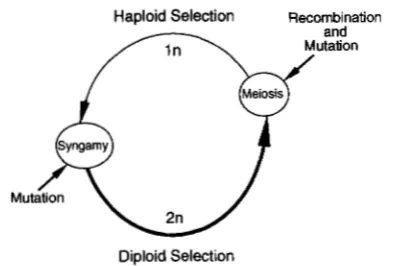
and selection in haploids (Figure 2 ) . Multiplying the
mean fitness in the diploid phase by that in the haploid phase, we get
w =
( l + s )p‘
+
(1+
h)*[(l+
s)(””+
13* p U
-
p )
+
( 1-
p)’.
(8)
For weak selection, mean fitness increases with the time spent in the diploid phase for dominant beneficial mu-
tations ( h
>
1 / 2 ) , but decreases for recessive mutations( h
<
1 / 2 ) . We might expect, therefore, that selectionwould favor increases in t for dominant mutations and
1478 H. A. Orr and S. P. Otto
Hadoid Selection Recombination
t
Diploid Selection
FIGURE 2.-The life cycle of the sexual species considered. Mating of haploid gametes occurs randomly to produce d i p loid zygotes. These diploids experience selection according to the amount of time spent in this phase, which is under the control of the ploidy locus. Once meiosis occurs, the haploids produced experience selection for the remainder of the cycle. These haploids then produce gametes and the cycle repeats.
this simple argument ignores potentially important as- sociations between fitness loci and genes controlling ploidy levels.
To assess the effects of these associations, we per- formed simulations with one to three fitness loci and one "ploidy" locus governing the timing of meiosis (Fig- ure 2; for more details see O n 0 1994). A population began with variation at the ploidy locus such that some genotypes had a longer and others a shorter diploid phase. Favorable mutations were introduced at the fit- ness loci and were assumed to be in linkage equilibrium with alleles at the ploidy locus. This assumption is more likely to be met when the product Nu is fairly large and when the timing of meiosis does not vary dramatically between alleles. Mutations were allowed to increase in frequency deterministically. A particular ploidy level was said to be favored when alleles causing individuals to spend more time in that phase increased in frequency during the sweeps of beneficial mutations.
These simulations were repeated with different rates of recombination between the ploidy and fitness loci. For a given rate of recombination, the critical level of dominance for beneficial mutations, h*, was found above which increases in the diploid phase occurred and below which increases in the haploid phase occurred. The results (Figure 3) clearly show that partial domi- nance of favorable mutations ( h > 1/2) is not sufficient to ensure that diploidy will be favored. As expected, dominance is less of a guarantee of the advantage of diploidy as the recombination rate falls. Indeed-just as with deleterious mutations (OTTO and GOLDSTEIN
1992)-haploidy is almost always favored when there is little recombination between the fitness and ploidy loci. Last, it is worth noting that, in a sexual population, favorable mutations are likely to arise in linkage disequi- librium with the ploidy locus, especially when mutations are rare. Whichever ploidy allele happens to be coupled
r=O.OO
r=0.01 r=0.10 r=0.25
r=o.so
0.4 .
Increased diploidy above curve
0.2 . Increased haploidy below curve
1.4 1 .a 2.2 2.6 3
Mutant fitness (l+s)
FIGURE 3.-Conditions favoring haploid vs. diploid sexu- als. Simulations were run with one ploidy locus and one vi- ability locus to find the critical value of dominance ( h * ) above which ploidy alleles extending the diploid phase in- crease in frequency and below which alleles extending the haploid phase are favored. The population began with two
alleles at the ploidy locus (in equal frequencies) and a favor- able mutation at a frequency of 0.002 (in linkage equilib rium). Depending on the diploid genotype at the ploidy lo- cus, an individual spent 49.9, 50 or 50.1% of the generation in the diploid phase. h* clearly depends on s and r, but is fairly insensitive to the exact ploidy alleles compared, to the starting conditions when in linkage equilibrium, and to the co-segregation of favorable alleles at more than one viability locus (results not shown). However, the curves are quite sen- sitive to the initial linkage disequilibrium between the viabil- ity and ploidy loci: if the population starts with disequilib rium coupling the more haploid allele with the beneficial allele, all the curves are shifted up (haploidy more favored) and vice versa (see Orro 1994). The size of this shift is greatest with low rates of recombination and smallest with high rates.
with a new mutation enjoys an obvious advantage. Be- cause the probability that a mutation escapes stochastic l o s s ( = 2 [ ( 1 + h s ) t ( 1 + s ) ( " ' ) - 1 ] ) d e c r e a s e s w i t h t h e amount of time spent in the diploid phase, the number of mutations that survive random sampling will be larger per gene for more haploid individuals. This suggests that any initial linkage disequilibria should, on average, favor haploidy.
DISCUSSION
Because diploidy doubles the rate at which favorable mutations appear, one might intuitively expect diploids to enjoy a faster rate of adaptation than haploids. This could, in turn, explain the prevalence of diploidy (PAQUIN a n d h w s 1983). The presentwork shows, how- ever, that under many conditions this verbal argument fails: among both asexuals and sexuals, diploidy often does not increase the rate of adaptive evolution.
Ploidy Levels and Adaptation Rates 1479
on the number of favorable mutations that appear per generation ( N u ) . The effect of dominance enters in two
ways. First, the fact that not all mutations act as complete dominants among diploids increases the chances that favorable mutations will be accidentally lost when rare in diploids. Second, even if a mutant does escape ran- dom loss, its rate of increase is slower among asexual diploids than haploids (unless h = 1 ) , since the selective advantage of the mutation would be smaller ( h s com- pared to s)
.
This, in turn, means that a smaller propor- tion of subsequent favorable mutations arise among the descendants of previous ones, lowering the rate of in- corporation of mutations in diploid asexuals.Perhaps more importantly, diploidy is favored in asexuals only when the product N v is small. This effect has a straightforward explanation. If advantageous mu- tations appear very rarely, a mutation will almost always be fixed long before a second appears. Thus almost all favorable mutations arise among descendants of previ- ous ones and so almost all mutants that escape stochastic loss when rare ultimately become incorporated. In this case, the speed of adaptation is limited by the advanta- geous mutation rate and doubling this rate ( e . g . , by dip- loidy) can speed adaptation (when h > 1/2). If, however, haploid populations are large enough that, on average, at least one favorable mutation appears each generation
( N u 2 l ) , many advantageous mutations fail to get in- corporated because they arise before the fixation of pre- vious mutants. In this case, the rate of adaptation is not
limited by the rate of appearance of favorable mutants, but by their rate of spread, and so doubling the mutation rate (by diploidy) does little or nothing to help. In fact,
if h
<
1 in a large population, diploidy actually slows the rate of adaptation below that in haploids because dip- loids merely suffer the disadvantages of incomplete dominance (lower probabilities of fixation and slower increases in allele frequency).Although there are some metabolic reasons for ex- pecting that h > 1 /2 for favorable mutations (KACSER and
BURNS 1981; but see CHARLESWORTH et al. 1987), we have
very little direct evidence on this point. Even less, of course, is known about the magnitude of Nv. It would certainly seem, however, that population sizes are ex- tremely large in many of the taxa in which diploid asexu- ality is common ( e . g . , diatoms). The doubling-of- mutation-rate hypothesis would not, therefore, seem to offer a very satisfactory explanation of diploidy in such groups.
The situation in sexuals is somewhat more favorable to diploidy. As Figure 3 shows, diploidy can be favored if advantageous mutations are quite dominant and if
recombination is frequent. However, as Figure 3 also shows, diploidy is not invariably favored whenever h > 1/2 as mean fitness arguments (Equation 8) would sug- gest. Instead, the critical level of dominance above which diploidy is favored rises far above h = 1/2 as re-
combination rates decrease. The reason is that, as ben- eficial mutations sweep through a population, associa- tions develop coupling these mutations with alleles extending the haploid phase. This occurs because the efficiency of selection increases with the extent of the haploid phase, such that less fit alleles are more often removed and beneficial mutations are more often pre- served during haploid selection. The net result is that organisms with longer haploid phases tend to have more beneficial alleles than expected and are thus favored more often than expected from mean fitness arguments that ignore these associations. Mechanisms that main- tain genetic associations (such as linkage) strengthen this coupling and hence favor the evolution of haploidy. In sum, despite its intuitive appeal, a doubling of the favorable mutation rate often confers no advantage on diploidy. Unfortunately, this hypothesis fails under roughly the same conditions as the masking of delete- rious recessives hypothesis; whenever recombination rates are low (either due to asexuality per se or to re- stricted recombination in sexual diploids), diploidy is typically not favored. Thus, in those taxa showing little sex or in which diploidy evolved before frequent recom- bination, we are left with no clear explanation of the prevalence of diploidy.
We thank BENCT BENGTSSON, ANDREW CLARK, JAMES CROW and DAVID GOLDSTEIN for helpful comments on the manuscript. H.A.O. was sup- ported during part of this work by the Alfred P. Sloan Foundation and by the Center for Population Biology, University of California, Davis. S.P.O. was supported by a Miller Post-Doctoral Fellowship and by Na- tional Institutes of Health grant number GM40282 to MONTGOMERY SLATKIN.
LITERATURE CITED
BELL, G., 1982 The Masterpiece of Nature: The Evolution and
BENGTSSON, B., 1992 Deleterious mutations and the origin of the mei- CHARLESWORTH, B., 1983 Adaptive evolution in the laboratory. Nature CHARLESWORTH, B., 1991 When to be diploid. Nature 351: 273-274. CHARLESWORTH, B., J. A. COYNE and N. H. BARTON, 1987 The relative
rates of evolution of sex chromosomes and autosomes. Am. Nat. CROW, J. F., and M. KIML'RA, 1965 Evolution in sexual and asexual
populations. Am. Nat. 99: 439-450.
GOLDSTEIN, D. B., 1992 Heterozygote advantage and the evolution of
a dominant diploid phase. Genetics 132: 1195-1198.
HAWS, M. W., 1990 Reproductive strategies, pp. 455-476, in Biology
of the Red Algae, edited by K. M. COLE and R. G. SHEATH. Cam- bridge University Press, Cambridge.
KACSER, H., and J. A. BURNS, 1981 The molecular basis of dominance.
Genetics 97: 639-666.
KIMURA, M., and T. OHTA, 1971 Theoretical Aspects of Population
Genetics. Princeton University Press, Princeton, N.J.
KONDRASHOV, A. S., and J. CROW, 1991 Haploidy or diploidy: which is better? Nature 351: 314-315.
MAYNARD SMITH, J., 1971 What use is sex? J. Theor. Biol. 30: 319-335. MAYNARD SMITH, J., 1978 TheEuolution of Sex. Cambridge University
MORAN, P. A. P., 1962 The Statistical Processes of Evolutionary
MULLER, H. J., 1932 Some genetic aspects of sex. Am. Nat. 64:
Genetics of Sexuality. University of California Press, Berkeley.
otic ploidy cycle. Genetics 131: 741-744. 302: 479-480.
130: 113-146.
Press, New York.
Theory. Oxford University Press, Oxford.
1480 H. A. Orr and S. P. Otto
MULLER, H. J., 1964 The relation of recombination to mutational advance. Mutat. Res. 1: 2-9.
OTTO, S. P., and D. B. GOLDSTEIN, 1992 Recombination and the evc- lution of diploidy. Genetics 131: 745-751.
OTTO, S. P., 1994 The role of deleterious and beneficial mutations in the evolution of ploidy levels, in press, in Theories f o r the Evo- lution of Haploid-diploid Life Cycles, edited by M. KIRKPATRICK.
American Mathematical Society.
PAQUIN, C., and J. ADAMS, 1983 Frequency of fixation of adaptive mu- tations is higher in evolving diploid than haploid yeast popula-
tions. Nature 302: 495-500.
PER ROT,^., S. RICHERD and M. VALERO, 1991 Transition from haploidy to diploidy. Nature 351: 315-317.
VALERO, M., S. RICHERD, V. PERROT and C. DESTOMBE, 1992 Evolution of alternation of haploid and diploid phases in life cycles. Trends
WETZEL, R. G., 1983 Limnology, Ed. 2. Saunders College Publishing, Ecol. Evo~. 7: 25-29.
Philadelphia.