SENSITIVITY STUDY ON SEVERE ACCIDENT CORE MELT
PROGRESSION OF ADVANCED PWR USING MELCOR CODE
Tae-Woon Kim1*, Jinho Song1, Vo Thi Huong1, Douglas A. Fynan2, Joon-Eon Yang1
1Korea Atomic Energy Research Institute,1045 Daedeokdaero, Yusong,, Daejeon 305-353, Korea 2Department of Nuclear Engineering and Radiological Sciences, University of Michigan, USA
* E-mail of Corresponding Author: [email protected]
ABSTRACT
A LBLOCA scenario for an advanced pressurized water reactor, call APR1400, developed in Korea is analyzed in order to obtain an overall insight into a severe accident progression from an initiating event to the reactor vessel failure in detail by using the MELCOR computer code Versions 1.8.5 and 1.8.6. The present results (the amount of molten corium and vessel failure timing) would be used as input for the establishment of severe accident management strategies or for the design of a core catcher for the APR1400. The MELCOR results showed that the lower head instrumentation tube penetration failure model and internal structure in the reactor vessel had influence on the amount of corium ejected and the timing of reactor vessel failure.
INTRODUCTION
The research and development for identify the bottom head failure mechanisms [1] is one of the long term issues for the establishment of severe accident management strategies for light water reactors after TMI 2 (1979), Chernobyl (1986) and Fukushima (March 11, 2011) accidents .
In Korea the 1000 MWe Optimized Power Reactor (OPR1000) [2] and 1400 MWe Advanced Power Reactor (APR1400) [3] are designed. The thermal power of APR1400 is 3,983 MW. It has two steam generators and four reactor coolant pumps. It has the in-containment refueling water storage tank (IRWST), the hold-up volume tank (HVT) and the cavity flooding system (CFS) inside the containment. MELCOR computer code has been developed over 25 years by Sandia National Laboratories for Nuclear Regulatory Commission of USA for the analysis of severe accident phenomena in Light Water Reactor (LWR) nuclear power plant. In these analysis MELCOR versions 1.8.5 and 1.8.6 are used [4,5]. The governing equations for thermal-hydraulic behavior in MELCOR are the equations of conservation of mass, momentum, and energy. A semi-implicit formulation of the governing equations is used to permit the time steps greater the acoustic Courant limit. Also, MELCOR uses a full two-fluid treatment rather than a drift-flux formulation and the resulting equations are iterated when necessary so that the result is fully implicit with respect to pressures used in the momentum equation.
The MELCOR Core (COR) package calculates the thermal response of the core and lower plenum internal structures, including the portion of the lower head directly below the core. The package also models the relocation of core and lower plenum structural materials during melting, slumping, and formation of molten pool and debris, including the failure of the reactor vessel and ejection of debris into the rector cavity. Energy transfer to and from the Control Volume Hydrodynamics (CVH) package and Heat Structure (HS) package is calculated. It treats also the lower head failure mechanisms such as the penetration failure, creep rupture models, etc, in the lower head. In MELCOR 1.8.6 many new modeling enhancements has been made compared to the MELCOR 1.8.5. These new models include hemispherical lower head geometry, models for simulating the formation of molten pools both in the lower plenum and the upper core, crust formation, convection in molten pools, stratification of molten pools into metallic and oxide layers, and partitioning of radio nuclides between stratified molten pools. Fuel pellets, cladding, grid spacers, core baffles, formers, molten pools, and particulate debris are modeled separately within individual cells which is the basic nodalization unit in the COR Package.
Figure 1. MELCOR Nodalization for Reactor Coolant System of APR1400
ANALYSIS OF A LOCA SCENARIO
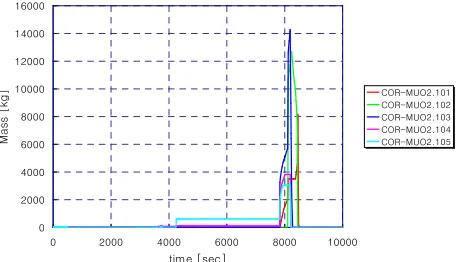
A double ended break, the size of which is 0.5 ft2 (0.0465 m2), is occurred at time 0 second at a cold leg which is connected to the pressurizer. Table 1 shows the chronology of this event analyzed by MELCOR version 1.8.5. If LOCA occurs, the reactor and turbine trip by the high containment pressure signal. The decay heat is assumed to be generated according to the ANS 79-3 curve. The main feedwater and auxiliary feedwater is assumed to be tripped. The safety injection system is assumed to be not working. It is assumed that the four safety injection tanks (SITs) are only working to make up the inventory of reactor coolant system which is lost by the break.
Table 1. Chronology of Event (0.5 ft2 LOCA)
Time (sec) Event Description
0.0 LOCA occurs
7.25 STOP TO SUPPLY MFW. REACTOR TRIP.
30.4 RCP Trip
176.8 START CORE UNCOVERY
177.1 START TO INJECTION SAFETY INJECTION TANKS
987.2 SAFETY INJECTION TANKS INVENTORY EXHAUSTED
2,848 CORE SUPPORT PLATE HAS FAILED IN CELL 113
3,066 START TO MELT FUEL
3,499 UO2 RELOCATED TO LOWER HEAD
7,830 - 8,568 START OF DEBRIS QUENCH IN RADIAL RINGS 1 to 5
8,156 - 10,740 LOWER HEAD PENETRATIONS IN RADIAL RINGS 1 to 5 FAILED.
8,156 BEGINNING OF DEBRIS EJECTION TO CAVITY
9,600 - 10,267 END OF DEBRIS QUENCH IN RADIAL RINGS 1 to 5
0 2 4 6 8 10 12 14 16 18
-5000 0 5000 10000 15000 20000 25000
time [sec] P re s s u re [M P a ] CVH-P.170 CVH-P.600 CVH-P.700
Figure 2. Pressure of RCS (CV170) and SG secondary side (CV600 & CV700)
-9 -8 -7 -6 -5 -4 -3 -2 -1 0
-5000 0 5000 10000 15000 20000 25000
time [sec] W A T E R L E V E L [m ] CVH-LIQLEV.150 CVH-LIQLEV.170
Figure 3. Water Levels of Active Core (CV170) and Lower Plenum (CV150)
0 500 1000 1500 2000 2500 3000 3500 4000
-5000 0 5000 10000 15000 20000 25000
time (sec) T e m p e ra tu re [K ]
Max. Fuel Temp. Max. Clad Temp. Max. Particulate Temp.
0 1000 2000 3000 4000 5000 6000
0 2000 4000 6000 8000 10000
time [sec]
M
a
s
s
[k
g
] COR-MUO2.111
COR-MUO2.112 COR-MUO2.113 COR-MUO2.114 COR-MUO2.115
Figure 5. Mass of Melted UO2 in Axial nodes 11 to 15 in Radial ring 1
0 1000 2000 3000 4000 5000 6000 7000 8000 9000
0 2000 4000 6000 8000 10000
time [sec]
M
a
s
s
[k
g
] COR-MUO2.106
COR-MUO2.107 COR-MUO2.108 COR-MUO2.109 COR-MUO2.110
Figure 6. Mass of Melted UO2 in Axial nodes 6 to 10 in Radial ring 1
0 2000 4000 6000 8000 10000 12000 14000 16000
0 2000 4000 6000 8000 10000
time [sec]
M
a
s
s
[k
g
] COR-MUO2.101
COR-MUO2.102 COR-MUO2.103 COR-MUO2.104 COR-MUO2.105
CVH-TLIQ.150 0 100 200 300 400 500 600 700 800 900 1000
-5000 0 5000 10000 15000 20000 25000
time [sec] T e m p e ra tu re [K ] CVH-TLIQ.150
Figure 8. Temperature of Liquid in Lower Head Volume (CV150)
0 1000 2000 3000 4000 5000 6000 7000 8000 9000
0 5000 10000 15000 20000
time [sec] M a ss [k g ] COR-MUO2.101 COR-MUO2.201 COR-MUO2.301 COR-MUO2.401 COR-MUO2.501
Figure 9. Mass of Melted UO2 in Lowest Axial Node 1 in Radial Rings 1 to 5
0 20 40 60 80 100 120 140
-5000 0 5000 10000 15000 20000 25000 time [sec] M a ss [M T ] COR-MINC-TOT COR-MSS-TOT COR-MSX-TOT COR-MUO2-TOT COR-MZR-TOT COR-MZX-TOT
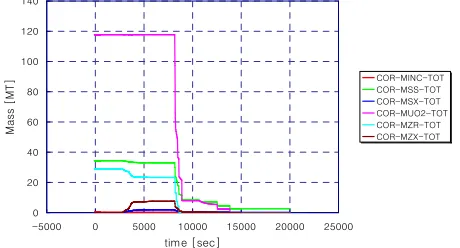
Figure 10. Total Mass of Core Materials melted and relocated into the Core and Lower plenum MSS : Mass of Stainless Steel,
MSX : Mass of Stainless Steel oxidized MZR : Mass of Zircaloy, MZX : Mass of Zircaloy oxidized
FDI-FMRELT.1
0 20 40 60 80 100 120 140 160 180 200
-5000 0 5000 10000 15000 20000 25000
time [sec]
M
a
s
s
[M
T
]
FDI-FMRELT.1
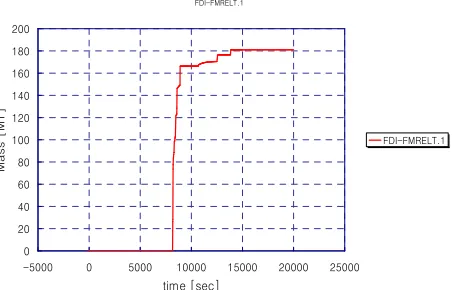
Figure 11. Total Mass of Core Materials ejected from the Lower plenum into the Cavity Region
COMPARISON BETWEEN MELCOR VERSIONS 1.8.5 AND 1.8.6
The comparison is made between MELCOR versions 1.8.5 and 1.8.6 for the 20 inches inside diameter LBLOCA scenario for APR1400. The following four cases are compared:
- The penetration failure temperature of 1300K with MELCOR version 1.8.5 - The penetration failure temperature of 2500K with MELCOR version 1.8.5 - The penetration failure temperature of 1300K with MELCOR version 1.8.6 - The penetration failure temperature of 2500K with MELCOR version 1.8.6
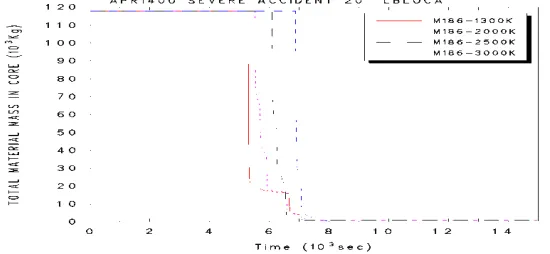
The figures 12 to 14 show the results. Figure 12 shows the maximum fuel and particulate debris temperature in the active core regions. The accident progression in MELCOR 1.8.5 is faster than the case of MELCOR 1.8.6. This is because the water mass of lower plenum in MELCOR 1.8.5 is smaller than the case of MELCOR 1.8.6 as shown in figure 13. Figure 14 shows the maximum penetration temperature among 5 rings in the lower head. According to the penetration temperature the lower head failure occurs. Figure 15 shows the total cumulative hydrogen production rate in the active core region and the lower plenum region. In MELCOR 1.8.5 analysis, the metal of zirconium and steel are not fully oxidized with water due to the less amount of water in MELCOR 1.8.5 compared to the MELCOR 1.8.6. The same trends can be shown in figures 16 and 17. Figures 16 and 17 show the results analyzed using MELCOR 1.8.5 and 1.8.6, respectively, with increasing the penetration failure temperatures from 1300, 2000, 2500, to 3000K. As increasing the penetration failure temperatures, the lower head failure time is delayed.
Figure 13. Lower Plenum Water Mass
Figure 14. Maximum Penetration Temperature
Figure 16. Total Corium Mass in Core and Lower Plenum Region depending on the Penetration Failure Temperature
Figure 17. Total Corium Mass in Core and Lower Plenum Region depending on the Penetration Failure Temperature
CONCLUSIONS AND FUTURE STUDY
Using MELCOR versions 1.8.5 and 1.8.6, the corium relocation models and lower head penetration models are tested for a LBLOCA scenario for the APR1400 developed in Korea for the establishment of severe accident management strategies. The primary difference in the analysis results between MELCOR versions 1.8.5 and 1.8.6 is the lower head failure timing. The failure timing in the case of MELCOR 1.8.5 is a little faster than that of the case of MELCOR 1.8.6. This is due to the less amount of water in lower plenum in case of MELCOR 1.8.5 compared to the case of MELCOR 1.8.6. In the cases of the lower penetration failure temperatures such as 1300K and 2000K, the multiple pours are expected. This is maybe because the structural steel is remaining in the lower plenum. In the near future the IVR/ERVC (In-Vessel Retention with Ex-Reactor Vessel Cooling) capability is planned to be tested by MELCOR and /or other severe accident simulation codes such as MAAP and SCDAP/RELAP5. By comparing the results among various codes the appropriateness of models will be checked and some experiment plans will be established for the design of core catcher if needed.
REFERENCES
[1] “Light Water Reactor Lower Head Failure Analysis”, NUREG/CR-5642, EGG-2618, Idaho National Engineering Laboratory, [1993]
[2] Korea Electric Power Company, “Optimized Power Reactor OPR-1000, Standard Safety Analysis Report” [3] Korea Electric Power Company, “Advanced Power Reactor 1400, Standard Safety Analysis Report”
[4] “MELCOR Computer Code Manuals,” Ver. 1.8.5. Rev.2 of NUREG/CR-6119, SAND2000-2417, Sandia National Laboratories, [2000]