N A T U R A L S E L E C T I O N I N C E P A E A
A. J. CAIN
Department of Zoology and Comparative Anatomy, University of Oxford P . M . S H E P P A R D
Genetics Laboratory, Department of Zoology, University of Oxford Received May 29, 1953
HE remarkable variation in colour and ornamentation of the shell which
T
is shown by certain gastropods has attracted the attention of collectors for many years. Recently, several studies of this variation have appeared, which unfortunately lead to very diverse conclusions on its mechanism of mainte- tenance and its significance in evolution. One of the commonest and most strikingly variable snails of Europe is Cepaea nemoralis, which has been studied in considerable detail by several workers, mainly in Europe but also in the U.S.A. where it has been successfully introduced. DIVER (1940) has concluded that its range of variation is wholly random, BOETTGER (1931) that on the contrary it is determined by natural selection, while LAMOTTE (1951) believes that for banding, at least, it is maintained in each colony primarily by mutation, and SCHILDER (1950) by gene flow.Our own investigations (CAIN and SHEPPARD 1950, 1952 ; SHEPPARD 1951, 1952) lead u s to the conclusion that variation is maintained by balanced poly- morphism ( FISHER 1930a ; FORD 1940), but the proportions of different varie- ties in each colony are strongly affected by selective visual predation. In this paper the principal studies on Cepaea nemoralis are examined, and further evidence for the importance of natural selection is presented.
SYSTEMATICS
The genus Cepaea Held 1837, proposed and still often ranked as a subgenus of Helix L., contains four very closely allied species, reviewed by PERROT and PERROT (1938). C. vindobonensis is confined to southeastern Europe and the Caucasus, C. sylvatica to the western Alps. C. hortensis ranges through north, central and western Europe from Finland to the Pyrenees, and the British archipelago, and as far as Iceland and northeastern North America. C. nemo-
90 ,4. J. CAIN AND P. M. SHEPPARD
well reviewed by LAMOTTE (1951). It is extremely rare in the wild. Hybrids have been produced with some difficulty in the laboratory ( L A N G 1904, 1912; KLEINER 1912). DIVER (1940) observed courtship between individuals of
horteizsis and nenzoralis and concluded that specific differences in courtship behaviour probably formed a n efficient barrier to fertilization.
P O L Y M O R P H I S M
Although all the species of Cepaea are variable in shell characters, C. nemo- ralis is particularly so. The lip is normally black or dark brown, rarely pink o r white. The rest of the shell may be yellow, brown or any shade from very pale fawn through pink and orange to red. U p to five black or dark brown (seldom transparent) longitudinal bands may be present, very rarely more. All possible combinations of presence or absence and of fusion of adjacent bands have been recorded (TAYLOR 1914), but their frequencies vary con- siderably ; particularly common are five-banded, and unbanded shells and those with only the middle band. For recording, the bands are numbered 1 to
5,
the uppermost being 1. Fusions are indicated by bracketing the numbers repre- senting the fused bands, absence by 0. This system is slightly simplified from that proposed by VON MARTENS (see LAMOTTE 1951). The bands may vary greatly in width, and also in their point of origin along the shell. A band may be absent or nearly absent either because it has been reduced in width to the vanishing point, or because its formation has been postponed until the animal has nearly or quite stopped growing. Fusions also may occur at any time after the appearance of the bands affected. In his monographic study of variation in C. nemoralis, LAMOTTE (1951) classifies the banding varieties by the pres- ence or absence of bands, ignoring fusions. Apparently, a band is counted as present even if reduced to a mere trace near the lip. In our papers, these traces if appearing only for one-fourth inch or less and only close to the lip, are not recorded as present, since they are phenotypically almost insignificant. Fusions are recorded only if they occupy a large part of the largest whorl of the shell(CAIN and SHEPPARD 1950).
Although most of the various banding-varieties grade into each other because of variation in the development and fusion of bands, some appear clear-cut. The unbanded form 00000, and that with only the median band, 00300, are usually distinct from the five-banded ones (12345 with or without fusion), intermediates with more than the slightest traces being very rare. O n the other hand, every intermediate due to reduction in width of bands between 12345,02345, 10345, 00345 and 00045 may occur in the same colony. In some colonies, however, certain of these combinations may occur without inter- mediates. The intensity of pigmentation of the bands varies somewhat ; rarely there occurs a very distinctive variety in which there is no dark pigmentation. Although the ground colour is present, these individuals are referred to in the literature as albinos. The bands are transparent and tinged with the ground colour of the shell, and the lip is white or pink.
NATURAL SELECTION IN CEPAEA 91 suffused with yellow, pink, or dull violet which in combination with the yellow proteinous periostracum produce respectively yellow, a range of colours from fawn to red, and dull brown. LAMOTTE (1951) appears not to have found examples of the last class.
In almost every colony, at least two colour and banding classes are repre- sented, and frequently many more. The compositions of many French colonies are given by LAMOTTE (1951) and of some English ones by us (1950, 1952).
GENETICS
The earlier work on Cepaea has been admirably reviewed by LAMOTTE (1951) who has added considerably to the available information. I t is certain that yellow ground colour is recessive to pink. The genetics of brown are not known. In our experience it is a clear-cut character almost certainly controlled by a single factor (see p. 96). The unbanded form OoooO is dominant to both 12345 and to 00300 which itself is dominant to 12345. I t is highly probable, although not proved, that 00300 is not an allelomorph of 12345. LANG (1912) for C. nemoralis and BOETTCER (1950a) for C. hortensis have suggested domi- nance relations for 00345 and 00045, but do not give the necessary data. The character “ pale o r interrupted bands ” as against the normal darkly pigmented
and continuous ones has been studied by LANC (1908, 1912) and by L.AMOTTE (1951) whose data support LANG’S suggestion that it is controlled by a domi- nant gene, which is not an allele of colour or the various banding patterns. The character albino is recessive to normal pigmentation (of the lip and of bands when present). W e can find no data to show whether it is an allele of
“ pale bands ” or not : it is certainly not allelic with colour or banding patterns.
FISHER and DIVER (1934) have shown linkage between colour and banding with a crossover value of approximately 2070. STELFOX (unpublished data quoted by them) found the same linkage but with a crossover value signifi- cantly less than FISHER and DIVER’S : in fact, in his experiment he observed no crossing over. Pink and yellow, and unbanded and some unspecified banding variety were investigated. FISHER and DIVER suggest that either the factors for pink were not the same in their and STELFOX’S experiments, or that the closeness of linkage varies ; presumably they and STELFOX used the same band- ing variety, otherwise this also could have differed. PROFESSOR J. B.
S.
HAL-DANE has suggested to us that t differences in crossover value may be associ-
ated with inversions.
WO
2
nately the chromosomes (figured by PERROT and PERROT 1938) are not good material for investigating this cytologically.92 A. J. CAIN AND P. M. SHEPPARD
TABLE I Albinos
Yellow Pink Brown
00000 00300 Other? 00000 00300 Others 00000 00300 Others
Locality Totals Total
6t
72h l l y n c s s Normal 35 0 29 0 0 0
Thnuton Normal 0 0 0 2 86 10 24 5 0 127 156
Bay Albino 0 0 8 0 0 0 0 0
Albino 0 0 0 0 29 0 0 0 0 29
0 0 0
Pentridge Normal 0 63 196 1 34 93
I Albino 0 3 12 0 0 0
Pentridge Normal 0 24 43 2 17 46 1 3 5 141
I1 Albino 0 3 6 0 0 0 0 0 0 9 l W
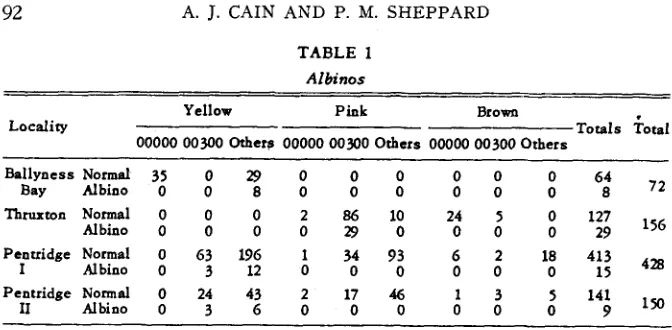
pointed out that linkage can be observed in wild populations of C. nenzoralis and states (unfortunately without giving data) that all the she11 characters investigated by him are linked. Our data tend to support this view, as will be seen from tables 1 4 .
TABLE 2
m
Beechwoods
Ashbury 0 0 3 5 1 5 1 7 0 0 31 0
....
Great Beech Wood 1 1 0 34 23 22 19 0 0 100 2 0
Wood
o
o
5 31 o 16 7 0 0 59o
1Great Bear Wood 0 1 1 4 5 7 3 0 0 2 1 0
....
Pulpit Hill (top) 0 0 2 2 9 0 4 0 0 0 3 5
o
....
Rockley 1 1 5 0 4 1 0 8 1 1 2 1 0
....
Rockley 2 18 16 0 51 7 0 45 2 0 139 0 0
Rockley 6 9 4 0 , 8 17 0 4 3 0 0 83 0 0
Rockley 8 2 4 0 6 4 1 1 2 1 0 3 0 0
....
Rockley 9 1 3 0 2 6 1 9 3 0 2 5 1
....
Hackpen 15 24 0 78 39 0 1 1 0 158 0 18
Aston Rowant 0 0 0 2 3 0 7 0 0 0 3 0 1
..
..Oakwoods Beechgrove Farm
Great Bedwyn Wood P u t a l l Gate Boarstall Wood Qakley Wood
Tackley Heath Wood Stanton St. John
Gt. Wood Hell Coppice Cobham Frith Btoomsgrove
1 2 0 3 1 3 0 2 0 0 2 1 0
9 7 8 146 188 211 62 0 1 632 7 0 0 0 54 28 51 0 0 0 133 0 0 2 4 8 41 72 0 0 0 1 2 7 3
0 28 32 79 5 1 60 0 0 0 250 4
0 0 0 5 7 1 0 0 0 0 2 2 0
0 2 0 10 27 16 3 0 0 58 0
0 25 1 54 88 25 0 4 2 199 0
1 4 5 5 30 5 3 0 1 5 2 77 0
../.
516
7 0
NATURAL SELECTION IN CEPAEA 93
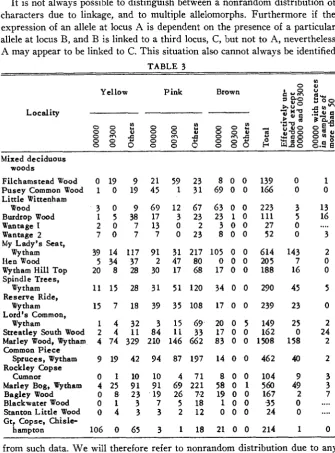
It is not always possible to distinguish between a nonrandom distribution of characters due to linkage, and to multiple allelomorphs. Furthermore if the expression of an allele at locus A is dependent on the presence of a particular allele at locus B, and B is linked to a third locus, C, but not to A, nevertheless
A may appear to be linked to C. This situation also cannot always be identified
TABLE 3
Mixed deciduous
Filchamstead Wood 0 19 9 21 59 23 8 0 0 Pusey Common Wood 1 0 19 45 1 3 1 69 0 0 Little Wittenham
Burdrop Wood 1 5 38 17 3 23 23 1 0
Wantage I 2 0 7 13 0 2 3 0 0
Wantage 2 7 0 7 7 0 23 8 0 0
My Lady's Seat,
Wytham 39 14 117 91 31 217 105 0 0
Iien Wood 5 34 37 2 47 80 0 0 0 Wytham Hill Top 20 8 28 30 17 68 17 0 0 Spindle Trees,
Wytham 1 1 15 28 31 51 120 34 0 0
Reserve Ride,
Wytham 15 7 18 39 35 108 17 0 0
Lord's Common,
Wytham 1 4 32 3 15 69 20 0 5
Streatley South Wood 2 4 11 84 1 1 33 17 0 0 Marley Wood, Wytham 4 74 329 210 146 662 83 0 0
Common Piece
Spruces, Wytham 9 19 42 94 87 197 14 0 0 Rockley Copse
Cumnor 0 1 1 0 10 4 71 8 0 0
Marley Bog, Wytham 4 25 91 91 69 221 58 0 1
Blackwater Wood 0 1 3 7 5 18 1 0 0
StantonLittle Wood 0 4 3 3 2 12 0 0 0 Gr, Copse, Chisle-
hampton 106 0 65 3 1 18 21 0 0
woods
Wood 3 0 9 69 12 67 63 0 0
Bagley Wood 0 8 23 19 26 7-2 19 0 0
139 166 223 111 27 52 614 20 5
188 290 239 149
16 2 1508 46 2 104 560 167
.3 5
24 2 14
0 0 3 5 0 0 143 7 16 45 23 25 0 158 40 9 49 2 0 0 1 1 0 13 16 3 2 0 0
....
5 0 2 24 2 2 3 3 7....
....
0from such data. We will therefore refer to nonrandom distribution due to any of these situations as associations between the characters concerned.
In table 1 are shown the only colonies we have found in which albinism is sufficiently frequent for association to be investigated. No unbanded albinos appear in it, but they have been found by us, and are reported by BOETTGER
94 A. J. CAIN A N D P. M. SHEPPARU
T A B L E 4
Yellow Pink Brown Locality
O 0
4
g g
2
0 0 0
8
8
0 a 0 8 0Hedgerows L i t t l e Wittenham University Farm Bletchingdon Road Shrivenham
West Adderbury Turn Culham Hedge T a c k l e y Turn Ban bury-Warmington T a c k l e y Heath Hedge nt. Tackley
Turn Eynsham Road Easington Near Wroxton Edge Hill F y f i e l d Faringdon Road E a s t of P u s e y
Common Wood Golden Butts
West of P u s e y Common Wood Oak Holt CumnocFarmoor Eotley
Stretham Kingston Hill Parks Hedge Canal Bank Hinksey Hedge Wytham Lane 1
Wytham L a n e 2
Standlake Woodstock Road Hedge S . of I s l i p Woodstock Rd. l e v e l
c r o s s i n g
11 1 43 31 16 92
2 2 8
0 1 93 33 24 68 0 22 18
0 4 224 13 28 33 1 13 67
1 8 139 36 5 81 1 2 1 2
2 4 6
4 2 10
29 4 26 3 21 61
2 0 6
0 5 12
23 2 34 0 15 38 2 5 72 1 0 37
0 2 26 10 4 58
1 1 1 2 17 25 72 5 2 11
2 1 13
3 0 23 3 7 42
1 2 17 3 12 33 8 6 14
U)
6 0
18 0
3 0
1 0
37 25 0 9
0 8
7 23 0 11
0 4
2 4
1 1
3 3
0 0
22 11
0 4
2 0
0 1
11 5
3 9 0 1 0 0 0 0 8 2 0 1
7 27
4 2
1 0
0 0
14 1
1 3 4 9 54 33 22 16 44 40 82 29 67 43 22 8 19 1 59 23 8 4 93 34 32 4 3 18 61 120 10 5 17 5 5 22
17 0 1
5 0 0
1 0 0
9 0 0 10 0 0 20 0 0
0 0 0
0 0 0
0 0 0
5 0 0
2 0 0
0 0 0
0 0 0
0 0 0
0 0 0
0 0 0
0 0 0
0 0 0
4 0 0
0 0 0
22 0 0 I 5 0 0
0 0 0
0 0 0
0 0 0
9 1 1
0 0 0
0 0 1
11 0 0
8 0 0
0 0 0
4 0 0
0 c 0 0 0 0
133 195 38 120 241 109 318 133 159 200 152 25 37 17 151 112 18 22 172 99 134 57 31 100 76 279 34 23 54 80 29 87 28 2 2 1 3 1 1 0 10 1 5 52 3 0 0 0 3 7 0 0 1 0 2 6 2 1 0 10 1 1 7 2 3 1 0 0 0 0 0 0 0 0 0
....
1 0 .. .. .... .... 0 0 .... .... 0 0 2 0 0 0 0....
.... .... 0 0 0....
....N A T U R A L S E L E C T I O N I N C E P A E A 95
But this preference merely raised the proportion of pink shells taken and therefore increased the probability of obtaining albino pinks if they were pres- ent. I n fact, no albino pinks were found at all at this locality.
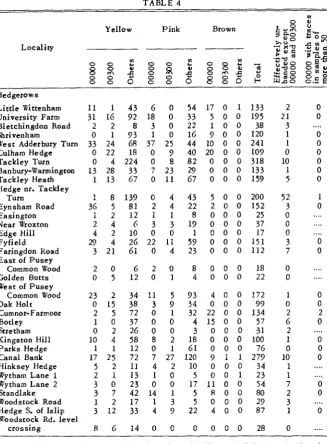
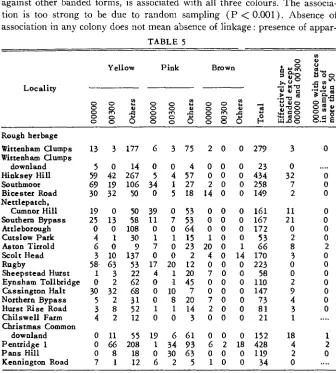
I t appears from tables 2-6 that 00000 as against banding, but not 00300 as against other banded forms, is associated with all three colours. The associa- tion is too strong to be due to random sampling ( P
<
0.001). Absence of association in any colony does not mean absence of linkage : presence of appar-TABLE 5
v)
o w
Yellow Pink Brown
Locality
Rough herbage Wittenham Clumps Wittenham Clumps
downland Hinksey Hill Southmoor Bicester Road Nettlepatch,
Cumnor Hill Southern Bypass Attleborough Cutslow Park Aston Tirrold Scolt Head Rugby
Sheepstead Hurst Eynsham Tollbridge Csssington Halt Northern Bypass Hurst Rise Road Chilswell Farm Christmas Common
downland Pentridge 1 Pans Hill Kennington Road
13 3
5 0
59 42 69 19 30 32
19 0 25 13
0 0
4 1
6 0
3 10 58- 63
1 3
0 2
30 32
5 2
3 8
4 2
0 11
0 6 6
0 8 7 1 177 14 267 106 50 50 58 108 30 9 137 53 22 62 68 31 52 12 55 208 18 12
6 3 75 2 0 0 279
0 0 4 0 0 0 23
5 4 57 0 0 0 434
34 1 27 2 0 0 258
0 5 18 14 0 0 149
39 0 1 1 7
0 0
1 1
7 0
0 0
17 20
4 1
0 - 1 0 10
0 8 1 1 0 0 53 53 64 15 23 2 12 20 45 7 20 14 3
0 0 0 161 0 0 0 167 0 0 0 172
1 0 0 53
20 0 1 66
4 0 14 170 0 0 0 223
7 0 0 58
0 0 0 110 0 0 0 147
7 0 0 73
2 0 0 81
0 0 0 21
19 6 61 0 0 0 152
1 34 93 6 2 18 428 0 30 63 0 0 0 119
6 2 5 1 0 0 34
3 0 32 7 2 11 21 0 2 8 3 0 0 2 9 4 3 1 18 4 2 0 0
....
0 0 0 0 0 0 0 2 0 0 0 0 0 0 0....
1 2 0....
96
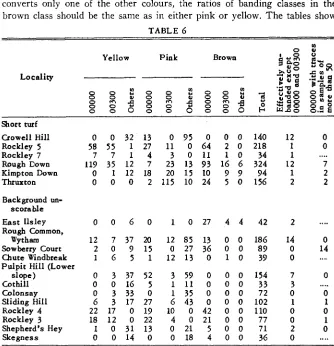
A. J. CAIN AND P. M. S H E P P A R Dis clearly not an allelomorph of colour or banding ; it is linked to banding and to colour. 00000 is associated with all three colours and has been shown by FISHER and DIVER (1934) to be linked with the pink-yellow locus. Brown could be an allelomorph of yellow and pink or a different gene converting either or both of the other colours to brown. If it be a separate gene, it is cer- tainly linked with 00000, which itself is linked with the pink-yellow locus. If it converts only one of the other colours, the ratios of banding classes in the brown class should be the same as in either pink or yellow. The tables show
TABLE 6
Short turf G o w e l l Hill Rockley 5
Rockley 7
Rough Cown
Kimpton Down Thruxton Background un-
scorable East Ilsley Rough Common,
Wytham Sowberry Court Chute Windbreak Pulpit Hill (Lower
slope) Cothill Colonsay Sliding Hill Rockley 4
Rockley 3
Shepherd's Hey Skegness
0 0 32 13 0 95 0 0 0 140
58 5 5 1 27 11 0 64 2 0 218
7 7 1 4 3 0 1 1 1 0 34
t i 9 35 12 7 23 13 93 16 6 324 0 1 12 18 20 15 10 9 9 94 0 0 0 2 115 10 24 5 0 156
0 0 6
12 7 37
2 0 9
1 6 5
0 3 37 0 0 16 0 3 33 6 3 17 22 17 0 18 1 2 0 1 0 31 0 0 14
0 20 15 1 52 5 0 27 19 2-2 13 0
1 0 2 7 4 4 42
12 85 13 0 0 186 0 27 36 0 0 89 1 2 13 0 1 0 39
3 59 0 0 0 154
1 1 1 0 0 0 33
1 3 5 0 0 0 72
6 43 0 0 0 102 10 0 42 0 0 110
4 0 2 1 0 0 77
0 2 1 5 0 0 71
0 1 8 4 0 0 36
1 2 0
1 0
1
....
12 7
1 2
2 2
2
....
14 0
0 14
0
....
7 0
3
....
0 0
1 1
0 0
0 1
2 0 0
..
..
~ ~~ ~ ~ ~ ~ ~ ~~~ ~~
clearly that this is not so. Brown must therefore be either an allelomorph at the pink-yellow locus or linked with it.
There is evidence that 00300 is at a different locus from ooOo0 (LAMOTTE 1951) and our data do not show that 00300 is associated with colour. Some of LAMOTTE'S data for French colonies suggest linkage at the other loci.
NATURAL SELECTION IN CEPAEA 97
SELECTION
Several authors ( HALDANE 1932 ; ROBSON and RICHARDS 1936 ; DIVER
1940; DOBZHANSKY 1941 but not 1951; HUXLEY 1942; MAYR 1942; CARTER
1951) have stated that variation in C. nemoralis is random; some have sug- gested that the differences between colonies or parts of colonies are very proba- bly due to genetic drift. These conclusions rest upon an error of procedure
(CAIN 1951a, b). Because a worker has been unable to correlate variation with any environmental or other factors, it does not follow that no correlations exist. In fact, the distribution of varieties in this species is controlled pri- marily by natural selection.
Selection b y visual predation
Selection for both colour and banding has been directly demonstrated. SHEP- PARD (1951) has shown that in Wytham Woods thrushes (Turdus ericeto-
rum) do exert a visual selection while preying on these snails, and that the selection varies with seasonal changes in the background on which the snails live. When the woodland floor is brown with leaf-litter and exposed earth in early spring, yellow shells are at a disadvantage to brown o r pink ones, but when in late spring the background becomes green, they are at an advantage.
LAMOTTE (1951) has shown by the comparison of intact shells with shells broken by thrushes that in certain localities unbanded shells were at a dis- advantage to five-banded ones. According to him, shells with 00300 or 00345 were intermediate in selective value but closer to the unbanded. W e have in- vestigated a colony of C. nemoralis in Marley Bog, a small hill-side fen, main- tained by spring water, in Wytham Woods. The colony is predated by thrushes which are forced to carry the snails a few yards on to a bank above the fen where there are stones, in order to crack them. The thrushes were watched every day from July 4 to 20, 1951 by MR. J. A. GIBB, who very kindly col- lected the broken shells for us. Collections of live snails were made by us,
taking all the snails discovered in an intensive search of a series of small patches of herbage: the composition of these is given in table
7.
There was noTABLE 7
Ocher effectively Effectively Totals unbanded shells banded shells
Living snails 153
Predated snails 204
143 264 560
173 486 863
evidence of selection for colour, which is accordingly disregarded in this table, from which a comparison of live and predated snails can be made. There is good evidence ( P
<
0.02) that unbanded shells00000
are at a selective ad- vantage to effectively banded ones. In previous papers (CAIN and SHEPPARD1950; SHEPPARD 1952) we have suggested that since the lower bands are nor- mally partially or completely hidden in the living snail, shells with bands 1 and
A. J. CAIN A N D P. M. S H E P P A R D 98
MOTTE’S data suggest that the varieties 00300 and 00345 may be intermediate in selective value between 00000 and 12345, as might be expected. At Marley Bog, the selective value of 00300 and 00345 (which with 00000 make up the class of effectively unbanded shells there) is so close to that of 00000 that the figures give no indication whatever of any difference, but do show a significant difference of these two combined from effectively banded shells ( P
<
0.001). Consequently these forms at Marley Bog are effectively unbanded. Since in both LAMOTTE’S and our data these intermediate forms tend to resemble 00000in selective value, it is justifiable to combine them with 00000 in a class of effectively unbanded as against effectively banded shells, a useful simplification. Direct evidence of selection thus supports a classification originally based on the appearance of the shells judged by the human eye.
Direct evidence of selection has so far been obtained in a few localities only, but is amply supported by indirect evidence drawn from a large number of colonies. W e have investigated all the colonies we have found, and our sample of them is biased only in so far as we have looked for these snails in localities where the background could be classified (as beechwoods, downland, hedge- rows etc.), avoiding those where there is a mixture of types of vegetable for- mations. The few colonies on mixed background that have been found are listed separately in table 6.
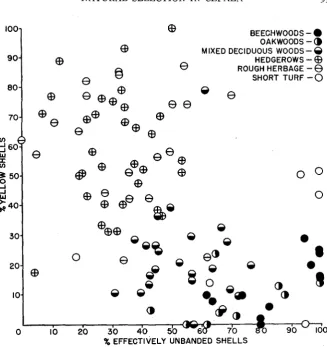
It was shown (CAIN and SHEPPARD 1950) that there is a strong correlation between the proportions of varieties in each colony and the characteristics of the exact background on which the snails are living. O n the greener back- grounds there is a high proportion of yellow shells, on the more uniform a high proportion of effectively unbanded ones. This result is completely confirmed by more extensive collecting. The data for all our samples (except a few very small ones listed in CAIN and SHEPPARD 1950) are set out in tables 2-6 and a correlation diagram for percentage yellow shells, percentage effectively un- banded, and habitat is given in figure 1. The samples from the Pentridge, Scolt Head, Skegness, Ballyness Bay and Colonsay are omitted from the diagram, since we have not collected them personally nor seen their localities. In general, the classification by habitat gives a measure of the smoothness and greenness of the background (CAIN and SHEPPARD 1950). I t will be seen that colonies in the same habitat-class tend to group together in the diagram (most closely in the least variable habitats). But it should also be noticed that even when the habitat classification is disregarded, there is an extremely good correlation between percent yellow and percent effectively unbanded. Because colour and banding are known to be genetically distinct, and there is no constant. associa- tion of yellow with any particular banding-formula in individuals, this in itself can only mean that selection is operating. W e have shown that this correlation is chiefly due to an association of colour and uniformity in the backgrounds we have studied, the browner ones being usually the more uniform.
NATURAL SELECTION I N CEPAEA 99
100-
90-
80-
70-
v)
w60f3 e
I
U)
50-
-I -1
2
40-30-
20-
IO.
0
BEECHWOODS
-
0 OAKWOODS-
Q)e
MIXED DECIDUOUS WOODS- 8HEDGEROWS
-
@e
f3
SHORT TURF -0@
e
ROUGH HERBAGE-e
@
@
@
e
@ Q @ @ @
e e
@
@ @
@
0 %
@
a3 @@ & e e
%Be
e
@@@
e
63
43
8
0
a
@e@
8 0
Q @
0
e
8@8
eQ
8
IO 20 30 40 5'0 7b
RI
90 -008
8 0
8
9
0.@a
0
@ Q
*
@
8
0
0 0
0
FIGURE 1.-Correlation-diagram, for % yellow shells, % effectively unhanded shells, and habitat, of all colonies of Cepaea nemoralis seen by us, except those with background unscorable.
\
100 A. J. CAIN A N D P. M. S H E P P A R D
Six colonies appear to have characteristics exceptional for the habitat class. Two, at Pan’s Hill and Great Copse, Chislehampton, are in complete agreement with the backgrounds, which are exceptional in their habitat-classes. The colony at Pan’s Hill is in a large thicket of rosebay willowherb merging with dense brambles. Although the habitat must be classified as rough herbage, the background at and just above ground level is brown, not green: correspond- ingly, the proportion of yellows is very low. Great Copse is an open elm wood on a hillside, with several springs, and the background at ground-level is of brilliant green short grass. The proportion of yellow is very high. Out of a total of 104 localities investigated by us personally, only four are really excep- tional ; these are at Crowell Hill, Aston Tirrold, Thruxton, and Kimpton Down, and, remarkably enough, they have many characters in common. All are on steep downland slopes with much grass, and a few bushes. All are infested by rabbits, and most of the shells collected were rabbit-predated. All have an unexpectedly low proportion of yellows, considering the greenness of the back- ground, and at Crowell Hill, there is an unexpectedly high proportion of banded shells, much of the turf there being smooth and rabbit-grazed. All have a high population-density of C. rzenaoralk. The strong similarity of these four exceptional colonies indicates that there is some definite reason for their peculi- arities other than mere random variation. It is possible (CAIN, in press) that rabbit predation by tone only, not colour and tone, is of particular importance in these four localities.
The similarity between colonies in similar habitats cannot possibly be due either to migration between adjacent colonies, o r to geographical variation correlated with broad features of the environment such as climate. The colo- nies in each habitat-class are widely scattered in the region investigated, and their similarities are correlated only with the background, not at all with prox- imity. Figure 2 is a map of the Oxford district showing all the localities where colonies have been found. These colonies are isolated from one another by unsuitable habitats. I t is obvious that colonies from mixed deciduous woodland agree in composition, although often separated and surrounded by colonies in rough herbage or hedgerows, which themselves agree within their habitat class, not according to their relative geographical positions. Geographical variation in the proportions of the shell-types tends to follow variation in the back- ground very faithfully. At Rorkley ( SHEPPARD 1952) a single widespread colony occurs in downland and in three isolated beechwoods, separated by the downland. The different parts of the colony show a remarkable correlation with their backgrounds. A similar situation has been found at Tackley, north of Oxford, and Pusey Common Wood, ten miles west, where hedgerow colo- nies approach within a few feet of colonies in woodland without losing their distinctive characters (Pusey Common Wood and contiguous hedgerows on Oxford side and further side; Tackley Heath Wood, and Tackley Heath in tables 2, 3 and 4). That such situations can be found is the strongest possible evidence both for selection and for a very low degree of migration. LAMOTTE
NATURAL SELECTION I N CEPAEA 101
F 1 ~ ~ ~ ~ 2 - S k e t c h - m a p of the Oxford district showing for each colony found 70 yellow shells (left hand column) and "/o effectively banded shells. Woodlands stippled; all colonies outside them are in hedgerows or rough herbage.
indeed very restricted. O n the basis of his experiments, LAMOTTE concluded that no colony
d
more than 30 metres radius can be considered a panmictic unit, nor can linear colonies longer than 52.5 m. Both LAMOTTE, and SCHNET-TER who obtained a rather higher value for the panmictic unit, used marked
102 A. J. CAIN AND P. M. SHEPPARD
I t has been shown (CAIN and SHEPPARD 1952) that not only the proportion of pinks and browns in a colony but also the shade of the pink shells is deter- mined by selection, rich reds being found on beech leaf litter for example, but pale pinks and fawns on oak litter, which is a much paler brown. Selection also appears to act on the character vestigid bands, o r traces. These appear only as small dark marks close to the lip in the normal band-position in the adult shell (p. 90). A shell with five traces may be genetically 12345, but phenotypically it is 00000. DR. LAMOTTE has very kindly informed us that in scoring his samples he counted all traces as full bands. W e have ignored them as pheno- typically of little importance. W e find that the use of his system makes no important difference in the proportions of unbanded shells in our colonies; however, the data suggest that the unbanded individuals with traces are more abundant in woodlands than in hedgerows and rough herbage. This is to be expected, since the proportions of unbanded shells are low in these last two habitat classes, and banding is at an advantage. Consequently there will be selection against any modifiers causing banded shells to appear even partially unbanded. In woodlands, on the other hand, where unbanding appears to be at an advantage, such modifiers will be favoured. W e have also noticed that in woodland colonies uninterrupted bands are often rather pale and narrow, while in hedgerows, even those contiguous with woodlands, the banding is usually more emphatic. These variations in breadth and intensity are difficult to score quantitatively.
Selection acts differently upon different combinations of shell characters. As already shown, the effects will be appreciable by examining wild popula- tions only when there is strong linkage. Linkage between colour and unband- ing, 0o000, is sufficiently strong (p. 91) fur these effects to be observed, and in fact it can be seen from tables 2-6 that yellow unbanded shells tend to be deficient in woodlands ( P
<
0.01 ) and to be in excess in some other habitats. An interesting exception is at Great Copse, Chislehampton where yellow 00000 is in excess, but the background here is, for a woodland, excessively green (p. 100). This variation in frequency of yellow unbanded shells is exactly what would be expected, as a result of visual selection in relation to the background, since when yellow is conspicuous as on brown backgrounds the plain yellow unbanded shells will be more obvious than those partly obliterated by banding. BOETTGER (1931) has already stated that unbanded yellow shells are never found in dense woodlands, and are common in open sunny places, but unfortu- nately does not give the necessary data. Our results support his view, although we do not usually find a complete absence of yellow unbanded shells in wood- lands.NATURAL SELECTION I N CEPAEA 103 SHEPPARD 1952). The darker bodies, as might be expected, predominate on the darker backgrounds, and selection acts upon body colour although the body of the snail is far less often seen than the shell.
Non-visual selection
BOETTGER (1931) states, without giving details, that the degree of diversity in a colony is proportional to the diversity of its background. All our results agree entirely with this statement. O n smooth uniform backgrounds such as beechwoods and short turf, the colonies are far less variable than in hedge- rows, rough herbage, or even mixed deciduous woodland. Full details for some of the colonies investigated are given by CAIN and SHEPPARD (1950).
O n uniform backgrounds, visual selection reduces the frequency of most of the varieties, and would be expected to remove them if the background remains constant. SHEPPARD (1951) has found that in Reserve Ride (Wytham Woods) of 1358 marked snails released on April 26th, 1950, 46 predated shells were actually found at thrush stones in the short period between 28th April and 5th June 1950. This indicates that about 3% of the population was predated in this period. At the beginning of the period, when the background was brown, yel- low shells were at a disadvantage. His figures for selective destruction of yellows at the beginning of the period for three independent groups of shells are consistent and suggest that on the thrush-stones about 1.5 times as many yellows appeared as would be expected if predation was random. If the back- ground were to remain constant (as it does in beechwoods and in many grassy places) then even with no more selective predation per year than that found in Reserve Ride between 26th April and 5th June 1950, it is clear that there would be selection against yellow shells on a brown background (or for them on a green one) of the order of 1% or more. This would remove either the yellows or the other colours from the colony relatively rapidly. A tentative estimate of population size at Marley Bog made by recapturing marked snails, gives about 10,000 adults present. From the degree of predation shown in table
7 between 4th July 1951 and 20th July 1951, it is obvious that selection for unbanded shells at this locality, with a constant background would be of at least the same intensity.
BOETTGER (1950b) and DIVER (1929) have pointed out that C. nemoralis
has been polymorphic for banding at least since Neolithic times, and probably much longer. All its close relatives are polymorphic for banding and colour. Polymorphism in C. nemoralis must therefore be regarded as normal and stable. But it might be maintained either by selection for different varieties in different places, combined with gene-flow, o r by mechanisms tending to main- tain variability independent of the locality, such as that described by FISHER
104 A. J. CAIN AND P. M. S H E P P A R D
which are well isolated geographically, migration must be frequent and wide- spread, unless visual selection is very low.
The remarkable correspondence found by us, of parts of colonies with their different backgrounds and the extensive experiments of LAMOTTE (1951) show that migration in C. nemoralis is very slight (except possibly by human aid in urban districts), and cannot maintain polymorphism in face of the high visual selection demonstrated by us. Therefore there must be some nonvisual selective pressure, of the type discussed by FISHER (1930a), which is stabi- lising the polymorphism.
There is good indirect evidence for nonvisual selection within the class of brown shells. W e formerly considered (CAIN and SHEPPARD 1950) that there was some interference between brown and the expression of banding. Further experience in collecting shows that the faint fluctuations of ground colour simulating very weak banding in browns occur also in pinks and yellows, and that banding when it does occur in browns is as clear as in banded shells in the other colour classes in the same colony. As tables 2-6 show, banded browns are always far less common than unbanded ones. There is an excess over ex- pectation of unbanded brown shells even if it be assumed that brown is a n allelomorph of banding, not colour, and that the brown heterozygotes are un- banded and only the brown homozygotes are banded. This unlikely assumption much reduces the expected frequency for banded browns. Moreover, since the deficit of banded browns is independent of the background of each colony, and therefore of the direction of visual selection of banding, the assumption that brown is an allelomorph of banding leads to the conclusion that there is constant nonvisual selection against banded browns. If brown is not an allelo- morph of banding but is closely linked to it, then again there must be selection constantly against banded browns irrespective of the background. No doubt visual selection will act on banded as against unbanded shells in brown as in the other colour classes. But since brown is by far the darkest of the general shell colours, and most like the bands in hue, it is to be expected that visual selective discrimination between banding classes in brown will be less than in any other colour-class. In fact, in this colour class only, it seems constantly unable to override the effects of nonvisual selection.
Direct evidence of nonvisual selection has not been recorded in C. nemo-
ralis. SCHNETTER (1950) has shown very strong selection to be favouring yellow unbanded C. hortensis in a colony which he observed from 1942 to 1950. H e finds that this variety is more abundant in drier and more open places, and correlates its increase with a drying out and clearing of the locality. However, thrushes feed in this colony, and it is possible that part of the in- crease may be due to visual selection. In Fruticicola lanzi, however, GAUSE and SMARAGDOVA (1940) have shown that there is a considerable difference between dextrals and sinistrals in their capacity to resist starvation.
M A I N T E N 4 N C E O F T H E VARIATION
NATURAL SELECTION I N CEPAEA 105 the extraordinary variability of Cepaea. BOETTGER ( 1931, 1950a) considers that the degree of variation is controlled by the diversity of the background through visual selection, and that on uniform backgrounds the number of varieties will be reduced unless replenished by natural or artificial introduc- tions. As LAMOTTE (1951) points a u t , BOETTGER has not published the data necessary to support his conclusions. DIVER (1940) believes, on the contrary that variation in C. nemoralis is random, and that the difference between colo- nies is due to genetic drift, but his conclusions are equally unsupported by published evidence.
As just stated, SCHNETTER (1950) has found in C. hortensis evidence of strong selection which he correlates with a change in the environment. H e did not investigate the relative importance of visual selection and climatic selection in detail but makes it clear that the nonvisual selection was the more impor- tant. H e was unable to find evidence of similar selection in C. nemoralis living in the same area, but his investigations in the two species were not fully com- parable since they differed very strongly in the proportion of varieties present. O n evidence which, as he himself is careful to point out, is very inadequate, he believes that some geographical variation can be discerned in C. hortensis, not in C. nemoralis, and as widely separated colonies may be much more alike than nearly adjacent ones, he concludes that the overall influence of climatic selection must be very slight, and that a great deal of the variation between colonies is due to random extinction of genes (i.e., to genetic drift). This con- clusion is entirely based on the assumption that the direction and intensity of selection cannot alter profoundly over short distances. Our results show that this assumption is incorrect (e.g., fig. 2 ) .
SCHILDER (1950) has studied in considerable detail the colonies of C. nemo-
rdis and hortensis on a small island off the north German coast. H e mapped the distribution of each species and the occurrence of particular varieties, indi- cating for each collecting station the nature of the habitat (oak copse, culti- vated land, etc.) and listing the principal plants present. H e found that at certain stations, particular varieties were especially abundant, and that their frequencies tended to fall off rather uniformly with distance from these
“ centres.” Both the ranges of the species and their geographical variation were
106 A. J. CAIN AND P. M. S H E P P A R D
environment, and one can draw no conclusions from an apparent absence of selection. But it should be noted that the variation-pattern observed by SCHILDER could be brought a b u t in two ways. There could be either the introduction o r local production of new forms in already colonized areas, o r the introduction of one or a few individuals into unoccupied territories. I n the first case, the new form cannot reach a high frequency at the place of origin in the face of continual gene-flow without a considerable selective advantage, yet that gene-flow is high seems demonstrated by the length and smoothness of the character-gradients claimed by SCHILDER. I n the second case, local homogene- ous populations will be produced. If these reach high population densities, and expand, they will eventually come into contact with other populations, inter- breed, and produce clines, which will gradually disappear. Neither of these hypotheses is incompatible with the control of genes in the colonies primarily by selection.
I n fact, gene-flow in these colonies is only inferred not demonstrated, since demonstration requires observations made at two separate periods, at least. But it is remarkable that all the unbanded nemoralis are pink, although yellows are present in other banding-classes. This can only mean that either there is strong selection (with linkage) against unbanded yellows, o r that the unbanded allelomorph has not been on the island long enough for an appreciable fre- quency of the crossover class to appear. Even if there were absolute linkage (which is unlikely) one would still expect unbanded yellows to appear either by further introduction or by mutation, especially if LAMOTTE’S estimate for this mutation rate in Cepaea can be believed (p. 107).
By far the most important single paper on Cepaea that has yet appeared is LAMOTTE’S study of C. nemoralis (1951). This author’s work on population- size, panmictic units, homogamy, and migration is the best yet produced. H e is also the first to apply quantitatively SEWALL WRIGHT’S equations for the interaction of selection, mutation, migration and population size to an ensemble of actual populations. His conclusions, based on a careful study of over 800 French colonies, are diametrically opposed to ours, since he believes that mu- tation assisted by migration is the prime agent maintaining the variation, that differences between colonies are due to genetic drift, and that selection, al- though present, plays an almost negligible part. I n the colonies investigated by us, selection is the primary factor both in maintaining variation within a
colony and in determining the differences between colonies. This apparent contradiction must be investigated.
LAMOTTE regards selection as unimportant for the following reasons. (1) H e finds no obvious correlation between variation in colonies and the environment.
(2) Although there is some selective predation by thrushes, these birds are only winter-visitors in France, and in winter most of their predation is non- selective.
( 3 ) H e can find no correlation whatever between variation in C. nemoralis
NATURAL SELECTION I N CEPAEA 107
(4)
His data show that small colonies are more variable than larger ones.(5)
H e has been able to fit to his data on the frequency of the gene for bandless in Aquitaine a curve derived from SEWALL WRIGHT’S formulae, which indicates that in these colonies migration plus mutation is important and selection almost negligible. Using additional data from other areas he concludes that the mutation rate of the allelomorph for banding to bandless is 1 x and the reverse rate5
x and that these mutation rates are sufficient to maintain polymorphism. H e supposes therefore, that selection never plays more than an accessory part (1951, p. 230).These reasons, and the conclusions based upon them, seem incorrect, on the following grounds respectively.
( 1 ) Many of the localities investigated by LAMOTTE were, as he points out, in recently disturbed or unstable environments, and in these a correspondence of varietal proportions and the background is not to be expected. Also in many localities there was a mixture of habitats, such as we have avoided (p.
98, above) so that even if the proportions of phenotypes were controlled by visual selection, a correspondence could hardly be observed.
LAMOTTE makes no direct comparison of colonies with backgrounds, for reasons considered below. H e does make comparisons of colonies classified by their broad habitats (1951, p. 135), but using such classes as “bottoms of valleys,” “ dry biotopes ” and “ sunny places ” which are too broad to be use-
ful in considering backgrounds or investigating nonvisual selection if visual selection is effective. However, he does use two classes, oak coppices, and hedges, which seem to be sufficiently homogeneous, and comparable to our classes, although as he gives no description of them it is not certain that several types may not be included. H e considers only the proportion of un- banded to banded shells : a better estimate involves the proportions of effec- tively unbanded shells (p. 98, above) and of the various colour classes. His data indicate that variation between colonies in hedgerows is greater than in oak coppices, as might be expected. The mean frequency of unbanded shells, however, is higher in both classes than in our data, and is not significantly lower in hedgerows than in oak coppices. Since the backgrounds have not been described, no definite conclusion can be reached. It is quite possible that the observed higher frequencies of unbanded shells in his colonies could be due to climatic selection. SCHNETTER (1950) in C. hortensis finds that, largely as a result of nonvisual selection, unbanded shells are more common in open, dry, sunny places. LAMOTTE (p. 136) obtained indications of the same situation in C. nemordis. Moreover, his data on climatic factors suggest that the highest frequency of unbanded shells occurs in regions where the July temperature is highest. As insolation is considerably higher in France than in Great Britain, a higher proportion of unbanded shells might be expected in France especially in the more open habitats such as hedgerows in contrast to woods.
108 A. J. CAIN AND P. M. S H E P P A R D
strated is acting, then grouping the colonies by climatic characters alone will mask more or less completely the effects of climatic selection. Nevertheless his published results (p. 141) do suggest a correlation between the frequency of unbanded shells and temperatures in both July and January, but these two factors may not be independent. It is possible that if the effect of visual selec- tion had been eliminated by considering only colonies on the same background, a significant correlation with climate could have been observed.
(2) In Britain the song thrush is certainly not the only bird that preys upon these snails (WITHERBY et al. 1943), and in Europe many birds are re- corded as eating molluscs (KLEINER 1936, 1937). Half-grown individuals, in which colour and banding are well developed, could be eaten whole by many small birds, including, of course, thrushes, which need to bring only the larger individuals to the anvils. I t is extremely unlikely that a scarcity of song thrushes in any district means the virtual absence of visual predators.
In about 40 of his colonies, LAMOTTE was able to obtain sufficiently large samples of shells broken by predators to make a comparison between them and intact shells. His illustration (p. 183) of shells broken by birds includes at least two which have every appearance of having been attacked not by birds but by mammals. (This conclusion has been very kindly confirmed for us by MR. D. J. MORRIS, who has made a special study of the subject, MORRIS, in press.) It is most unlikely that rodents and birds find the snails in the same way, so that combining all the predated shells in a colony may well obscure the effects of selection. Nevertheless, LAMOTTE has obtained evidence of visual selection in certain cclonies, always against unbanded shells; in others he found no evidence of selection, although the snails were being attacked, and concluded that in these there was only nonselective winter predation by thrushes. H e has not, however, excluded the possibility of important visual selection by other birds. H e compared the proportions of unbanded shells in colonies with the presence or absence of visual selection, and found no cor- relation. But because selection can vary in intensity and direction, the aver- age selective value of unbanded shells should be compared with their fre- quency in each colony. Only those colonies that have lived in the same habitat for a long period should be used, and to reduce the effects of nonvisual selec- tion, comparison should be made only between those in the same sort of habitat and in the same area.
LAMOTTE has compared the diversity in frequency of unbanded shells in colonies known to be attacked by predators and in those he supposes to be exempt, and finds no difference. H e comments on the high degree of diversity in both classes. But in fact, it is extremely likely that all these colonies are attacked by predators (many of which do not leave broken shells as evidence), and the high diversity is to be expected if visual selection is operative against a complicated mosaic of backgrounds, favouring unbanded shells on some and banded on others.
NATURAL SELECTION I N CEPAEA 109 fluence of the environment upon the visible characters of the snail. The two very similar species C. nemoralis and C. hortensis are not infrequently found living together in the same colony. If visual selection is favouring a particular variety in one species in a mixed colony then it should favour it in the other species as well. Consequently there should be a correlation between the fre- quency of unbanded shells in C. nemoralis and C. hortensis in mixed colonies.
LAMOTTE finds no trace of such a correlation (and neither do we).
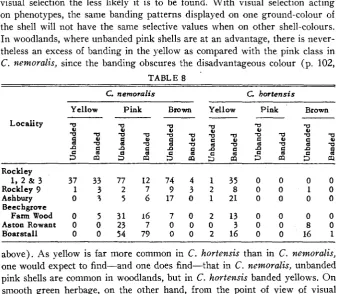
But in fact such a correlation is not to be expected; and the stronger the visual selection the less likely it is to be found. With visual selection acting on phenotypes, the same banding patterns displayed on one ground-colour of the shell will not have the same selective values when on other shell-colours. In woodlands, where unbanded pink shells are at an advantage, there is never- theless an excess of banding in the yellow as compared with the pink class in C. newtoralis, since the banding obscures the disadvantageous colour (p. 102,
T A B L E 8
C. nemoralis C. hortensis
Yellow P i n k Brown Yellow Pink Brown
- - _ _ _
-Locality a a a V
Rockley
1,2&3 37 33 77 12 74 4 1 35 0 0 0 0
Rockley 9 1 3 2 7 9 3 2 8 0 0 1 0
Ashbury 0 3 5 6 1 7 0 1 2 1 0 0 0 0
Beechgrove
FarmWood 0 5 31 16 7 0 2 13 0 0 0 0
Aston Rowant 0 0 23 7 0 0 0 3 0 0 8 0
Hoar stall 0 0 5 4 7 9 0 0 2 1 6 0 0 16 1
above). As yellow is far more common in C. hortensis than in C. nemoralis,
one would expect to find-and one does find-that in C. nemoralis, unbanded pink shells are common in woodlands, but in C. hortensis banded yellows. On smooth green herbage, on the other hand, from the point of view of visual selection, a high proportion of unbanded shells would be expected in both species, so that there will not be a simple negative correlation.
Table 8 gives the proportions of banded and unbanded shells in both species in four mixed colonies investigated by us. Although there is a very striking correspndence between the background and the C. nemoralis population (see
CAIN and SHEPPARD 1952; SHEPPARD 1952; and tables 2-6 in the present paper) there is little resemblance between the proportion of banded shells in the two species.
Furthermore, for a correlation to be apparent, the nonvisual selective values of the various allelomorphs (which SCHNETTER 1950 for unbanded C. hor-
110 A. J. CAIN A N D P. M. SHEPPARD
correlation might be very feeble unless the two species were intermixed either on a uniform background, or at uniform density in each distinct area of an irregular background, and were predated in the same way and to approxi- mately the same degree. SCHILDER (1950) finds that C. hortensis is much more addicted to sitting on stems and in bushes, while C. nemoralis is more usually found on the ground. This is in agreement with our own observations. DR. P. H. T. HARTLEY informs us that in his experience thrushes cannot effec- tively predate snails resting more than a few inches above the ground. Con- sequently even in the same habitat, the incidence of predation by thrushes on the two species is likely to be different.
(4) Recently LAMOTTE (1952) has claimed that the differences between small colonies of C. nemoralis are considerably greater than between large ones in respect of the frequency of the genes for pink, and especially for absence of bands. H e considers that since the effects of selection are inde- pendent of population size, any difference in variance between large and small colonies must be due to random fluctuations (genetic drift). According to his data, within a limited region, drift is responsible for one half the variance between large colonies (3,OOO-10,000 individuals) and five sixths that of small ones (500-1000). This conclusion is unacceptable for two reasons.
( a ) Because backgrounds vary considerably over small distances, and the larger colonies will tend to be spread over larger areas and therefore over more types of background than the smaller ones, it is to be expected that large colonies will tend to be more alike, since the diverse effects of selection in different parts of each colony will tend to cancel out when the colony is considered as a whole, and in any case will be reduced to a certain extent by gene flow. Small colonies will tend to be on more homogeneous backgrounds, and will therefore become more diverse by selection. If selection is acting in different directions in different habitats, as we have shown, then when gene frequencies for all the colonies (in many different habitats) within a region are combined and compared with those of other regions, there should be less variance between frequencies for regions than between individual colonies in the same region. LAMOTTE’S figures show that this is so, and therefore fail to provide any distinction between the effects of diverse selection and of genetic drift.
NATURAL SELECTION I N C E P A E A 111 If polymorphism in C. nemoralis is balanced, then the gene-frequencies will depart further from those obtained solely by the action of nonvisual selection in the smaller colonies. One cannot assume without proof that visual selec- tion is independent of population size, especially when birds that hold terri- tories are involved.
I t is clear that before differences in variance between large and small col- onies can be advanced as a proof of the importance of genetic drift, one must compare only colonies each of which lives on a single type of background, and show that the intensity of predation in them is irrespective of size.
( 5 ) In view of his demonstration that selection is unimportant, LAMOTTE considers that the agreement between his data on population-size, migration and the frequency of the allelomorph for bandless, on the one hand, and a curve derived from SEWALL WRIGHT’S equations-on the other, means that in this case the equations present an adequate analysis of the actual situation. Consequently they can be used to determine values for selection and the muta- tion rates, and to show how polymorphism is maintained. But this is so only
:L,
L D G r R ; ; ROUGH HERBAGE A,;L,
IO
5
‘0 20 40 60 00 100
% BANDLESS SHELLS
(a) (b) ( C)
FIGURE 3.-Frequency histograms for ’% totally unbanded shells (as in LAMOTTE’S
diagrams) in colonies with samples of 50 or more. (a) All colonies ; (b) hedgerows and rough herbage only ; (c) woodlands only.
if selection is very feeble, and as we have shown above, his conclusions on this point cannot be sustained. But if selection is important, then it is quite possible that the characteristics of the various backgrounds might be such that exactly the same curve could be produced by strong visual selection. I n our colonies the effect of visual selection is obvious. Yet when a histogram for the frequency of unbanded shells is plotted (fig. 3a) it shows a remarkable resemblance to that obtained by LAMOTTE for the regions he investigated in the Pyrenees (1951, p. 131). However, when values for colonies in rough herbage and in hedgerows, on the one hand, and for all woodland colonies on the other are plotted separately, two obviously different curves are obtained (fig. 3b, c ) , the first of which is almost exactly like Lamotte’s frequency histogram for the Parisian regian (1951, p. 130) and the second resembles that for Aquitaine.