The Military Munitions Response Program: A Case Study of Munitions
Response Site MU732
by
Kevin Michael Limani
A project submitted to the Graduate Faculty of North Carolina State University
in partial fulfillment of the requirements for the degree of
Master of
Environmental Assessment
Raleigh, North Carolina 2013
APPROVED BY:
ABSTRACT
LIMANI, KEVIN. The Military Munitions Response Program – A Case Study of Munitions Response Site MU732 (Under the direction of committee chair Linda R. Taylor, PE)
BIOGRAPHY
First Lieutenant Kevin M. Limani is the Flight Commander of the Fuels Management Flight and is currently assigned to the 99th Logistics Readiness Squadron at Nellis Air Force Base, Nevada. Lieutenant Limani was born in Trenton, New Jersey and grew up in the neighboring suburb of Hamilton, New Jersey. He attended Steinert High School where he excelled at academics and participated in athletics throughout all seasons. Upon graduation in June 2006, he ranked in the top 10 of his graduating class. Lieutenant Limani participated in cross country, winter track, and was a member of the golf team in high school.
After graduating from high school, Lieutenant Limani attended Rutgers – The State University of New Jersey. His undergraduate studies were focused on atmospheric and environmental sciences. One of his key accomplishments was designing a storm water management system that could be used to protect the pristine aquifers of the New Jersey Pine Barrens. The project was chosen by his professor to be presented to the Freeholders of Stafford Township, New Jersey. In his first semester at Rutgers, Lieutenant Limani enrolled in the United States Air Force Reserve Officer Training Corps program. In August 2008, he completed Field Training at Maxwell Air Force Base, Alabama. His four years of officer training culminated in being selected as the Cadet Vice Wing Commander of Detachment 485 which consisted of 70 cadets. In May 2010, Lieutenant Limani was awarded a Bachelors of Science degree and was commissioned as a Second Lieutenant in the United States Air Force.
Upon entering active duty in November 2010, Lieutenant Limani has held multiple positions within the Logistics Readiness Squadron such as the Officer in Charge of the Vehicle Management Flight, Installation Deployment Officer, and assisted in standing up the Logistics Quality Assurance section. He currently leads the most diverse Fuels Flight in the Air Combat Command as the Flight Commander for 116 fuels personnel. Lieutenant Limani has held a council position for the installation Company Grade Officer Council and has participated in several volunteer opportunities such as Junior Achievement and Habitat for Humanity.
Lieutenant Limani graduated from Logistics Readiness Officer Basic Course with Distinguished Graduate honors. Additionally, he is one task shy of being awarded his Masters of Environmental Assessment Degree from North Carolina State University. His long-term goals are to earn a Doctorate Degree in an Environmental Sciences discipline and to become a leader for environmental sustainability in the United States military
TABLE OF CONTENTS
LIST OF TABLES ... vii
LIST OF FIGURES ... viii
INTRODUCTION ... 1
DEPARTMENT OF DEFENSE ENVIRONMENTAL RESORATION INITIATIVES ... 2
THE CERCLA RESTORATION PROCESS ... 3
THE MILITARY MUNITION RESPONSE PROGRAM ... Error! Bookmark not defined. NELLIS AFB AND MRA MU732 ... 7
CSE PHASE I ... 8
REMEDIAL INVESTIGATION ... 14
FEASIBILITY STUDY ... 16
CONCLUSION ... 28
REFERENCES ... 30
LIST OF TABLES
Table 1: Typical PAH Content of Clay Targets... 12
Table 2: PAH Sampling Results ... 13
Table 3: PAHs Exceeding Human Health and Ecological Screening Criteria ... 16
Table 4: General Response Actions ... 19
Table 5: Remedial Technologies and Process Options ... 21
LIST OF FIGURES
INTRODUCTION
The mission of the Department of Defense (DoD) is to provide the military forces needed to deter war and to protect the security of the United States of America (Quadrennial Defense Review, 2010). These aforementioned military forces require certain skillsets to obtain their military objectives. In order to develop these skillsets, the DoD manages an infrastructure of nearly 30 million acres of land that provides the spatial capacity to organize, train and equip their forces (Section 313 Report, 2007). After decades of military training, DoD properties have become riddled with unexploded ordnances# (UXO), discarded military munitions* (DMM), and munitions constituents+ (MC) (Section 313 Report, 2007). In response to the environmental contamination by UXO, DMM, and MC, the DoD established the Military Munitions Response Program (MMRP) in September 2001 to manage the restoration process of military-use grounds (Section 313 Report, 2007).
DEPARTMENT OF DEFENSE ENVIRONMENTAL RESORATION INITIATIVES
The MMRP is part of a larger DoD environmental restoration initiative, the Defense Environmental Restoration Program (DERP). The DERP was established by the Superfund Amendments and Reauthorization Act of 1986 (SARA). This program provides the funding for the cleanup of hazardous substances associated with past DoD activities at operating installations, as well as at Formerly Used Defense SitesX (FUDS) (DERP, 1986). Along with the MMRP, the Installation Restoration Plan (IRP) is captured under the DERP (DERP, 1986). The IRP is designed to identify, investigate, and clean up contamination associated with past DoD activities at active military installations; government-owned, contractor-operated facilities; off-site locations where contamination may have migrated; and sites that the DoD formerly owned or used (AFI 32-7020, 1994). To simplify, the IRP requires each service component to meet its lawful obligations to eliminate threats to public health and restore natural resources for future use (Management Guidance for the Defense
Environmental Restoration Program, 1998). In contrast to the IRP, the MMRP focuses on the potential explosives safety, health, and environmental issues caused by past DoD munitions related activities (Nellis AFB MMRP, 2008).
(#) UXO: Military munitions that (a) have been primed, fuzed, or armed, or otherwise prepared for action; (b) have been fired, dropped, launched, projected, or placed in such a manner as constitute a hazard to operations, installations, personnel, or material and (c) remain unexploded either by malfunction, design, or any other cause.
(*) DMM: Military munitions that have been abandoned without proper disposal or removed from storage in a military magazine or other storage area for the purpose of disposal, but does not include UXO.
(+) MC: Materials originating from UXO, DMM, or other military munitions, including explosive and non-explosives and non-explosive materials, and emission, degradation, or breakdown elements of such ordnance or munitions.
THE CERCLA RESTORATION PROCESS
The MMRP applies the environmental restoration process set forth by the
Comprehensive Environmental Response, Compensation and Liability Act (CERCLA) and its implementing regulation, the National Oil and Hazardous Substances Pollution
Contingency Plan (NCP), and in some instances, the Resources Conservation and Recovery Act (Section 313 Report, 2007). The following section outlines the CERCLA restoration process and highlights significant differences found within the MMRP.
CERCLA, commonly referred to as Superfund, was enacted by congress in December 1980. It gave authority to the federal government to respond directly to releases or threatened releases of hazardous substances that could endanger public health or the environment. The Environmental Protection Agency (EPA) developed standard practices to which investigators could use to evaluate the degree of harm caused by the release of hazardous substances. This restoration process contains several designed phases to assist in defining the problem,
identifying extent of contamination, and developing remedial actions.
The CERCLA restoration process begins with a Preliminary Assessment (PA). This phase involves site discovery and notification to the EPA of a possible release of hazardous substances. The PA is designed to identify possible threats to human and environmental health. Under the MMRP, the program manager at an installation will identify possible sites
to higher headquarters through historical reviews and initial site surveys. If a significant
The main objectives of a Sl include the collection of environmental samples, and identification and analysis of specific contaminants to determine whether they are being released to the environment from the site. The SI can be conducted in multiple stages. Rather than Site Investigations, the MMRP refers to similar multistage investigations as
Comprehensive Site Evaluations (CSE). A CSE Phase I is analogous with the CERCLA PA, while the CSE Phase II includes a majority of the actions that occur during the SI. At the completion of the SI, the EPA decides whether the site qualifies for possible inclusion on the National Priority Listing (NPL). The NPL includes those sites that pose the most serious threats to human and environmental health. The EPA’s Hazard Ranking System (HRS) evaluates the severity of each site and allows the NPL to be prioritized for the purpose of remedial action. In contrast, MMRP sites are added to an MMRP Inventory through the use of the Military Munitions Response Prioritization Protocol (hereafter, Protocol). Once a site is added to the NPL or the MMRP Inventory a remedial investigation/feasibility study
(RI/FS) is performed on the site.
The RI serves as the mechanism for collecting data to characterize site conditions, determine the nature of the contamination, and assess risk to human health and the
The FS is the mechanism for the development and detailed evaluation of alternative
remedial actions. Following the analysis of remedial activities, a Report of Decision is
published which states the restoration technologies that will be used on the site. The majority
of the physical restoration happens during the Remedial Design and Remedial Action steps.
A site is delisted from the NPL once appropriate remedial levels have been achieved. Finally,
the EPA or the military installation will work with the stakeholders to return the site to safe
and productive use without adversely affecting the remedy.
THE MILITARY MUNITIONS RESPONSE PROGRAM
The MMRP ultimately falls under the responsibility of the DoD but is executed and centrally managed by each service component (Air Force MMRP, 2009). For example, each Air Force installation has a MMRP Program Manager who works closely with the Regional-Project Management Office at the Air Force Center for Engineering and the Environment. The MMRP is governed by both federal and state environmental legislation, so the Program Manager also works closely with his or her respective state’s environmental agency (Air Force MMRP, 2009).
of each MRS based on three factors: explosive, chemical and relative risk (Section 313 Report, 2007). For instance, the Protocol considers the following elements of an MRS:
Presence of known or suspected unexploded ordnance, discarded military munitions, or munitions constituents
Types of munitions or munitions constituents Presence/effectiveness of public access controls Potential/evidence of direct human contact Status of any response actions
Date for transfer from military control Extent of documented incidents
Potential for drinking water contamination or release into the air Potential for damage to natural resources
In addition, “Risk-plus” factors, such as regulator and stakeholder concerns, mission-driven requirements, cultural and social factors, economic factors and reasonably anticipated future land use are applied when prioritizing each MRS (MRSPP Review & Update Brief, 2011).
As of 2010, there were 3,783 sites in the DoD MRS Inventory (Defense
ranges, air-to-ground ranges and artillery ranges. The goal of the Air Force is to have 95% of MMRP sites at active installations closed by the end of Fiscal Year 2021 (MRSPP Review & Update Brief, 2011).
NELLIS AFB AND MRA MU732
Nellis AFB is located approximately eight miles northeast of downtown Las Vegas in North Las Vegas, Clark County, Nevada. There are three Munitions Response Areas$
(MRA) on the installation, MU732, XU741 and TM742, totaling 4,400 acres which were derived from multiple historic military ranges (URS, 2006). In 1941, the Flexible Gunnery School (47,000 acres) was established for the use of small arms, air-to-ground, ground-to-air, air-to-air, bombing, rocketry and demolition training. Today, 7,000 acres are still used for small arms training and 36,000 acres have been returned to various state and federal entities (URS, 2006). MRA MU732 has been divided into 4 MRSs: MU732, MU732a, MU732b and MU732c. There are two distinct areas within the 419 acre MRS MU732: a historic shotgun firing range and a training and maneuver range. The training and maneuver range consists of a complex of gravel roads that was used as a training area for small arms mounted onto vehicles. MRA MU732 is expected to remain under the control of the DoD for the
foreseeable future. The geographic location of Nellis AFB and MRA MU732 is depicted in Figure 1.
Figure 1: Nellis AFB and MRA MU732
CSE PHASE I
The first stage of the restoration process at MU732 began in 2006 with a CSE Phase I conducted by URS Group, a contracted organization. The investigators reviewed historical records from on-site and off-site data repositories and conducted interviews with persons knowledgeable about Nellis AFB. The Phase I was capped off by a visual survey of MU732 to identify physical evidence of contamination.
2.75 rocket motors
M23 Igniters with M173 fuzes M23 Igniter without fuze
Miscellaneous small arms up to .50 caliber Small amount of explosives residues
A second range clearance was performed by Nellis AFB EOD in 1995. During the clearance, the team located, identified, and disposed of the following items:
(BDU)-33/B Practice bomb MK 106 practice bomb Practice MK 82 Mod 0 bomb M117 inert bomb
MK 42 Mod 1 rocket motor
M229 2.75 inch High Explosive (HE) rocket warhead MK 1 Mod 3 inert rocket warhead
AN-M14 thermite grenade .50 caliber ball ammunition 20mm HE incendiary projectile
During the visual survey, the investigators identified .30 and .50 caliber projectiles, cartridge casings, 12 gauge shotgun shells and lead shot, clay pigeon debris, berms, concrete firing points, machine-gun mounting poles, shotgun shell burn pits and target debris. The identification of MEC is important to understand the primary composition, or MC, of each item. For instance, the MCs for bombs and bomb fuzes are heavy metals, volatile organic compounds, and semi-volatile organic compounds.
one plant species listed as threatened or endangered by the State or Federal governments have the potential to be present in southern Nevada. Based on the habitat requirements or preferences of the threatened and endangered species, only the desert tortoise is likely to be present at MU732. In addition, one sensitive species, the western burrowing owl, has the potential to inhabit MU732. The burrowing owl has been listed as a sensitive species by the Nevada Bureau of Land Management, but is not legally protected like the desert tortoise (BLM, 2011). The existence of such species, as well as possible human receptors, can affect prioritization of the site and potential remedial actions.
CSE PHASE II
The CSE Phase II was completed by Bay West, Inc. in 2010. The team conducted a site survey to evaluate the extent of MEC and collected surface and subsurface soil samples from areas with significant evidence of MEC for worse-case MC analysis.
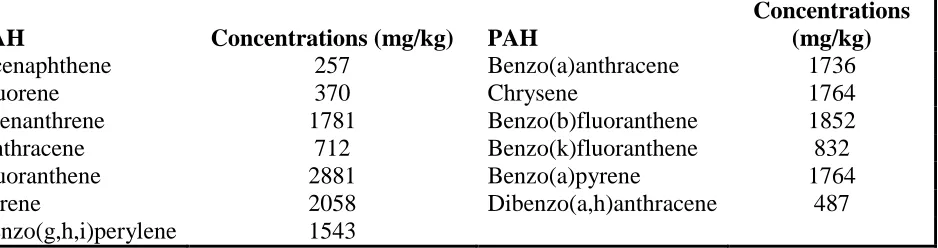
During the site survey, the investigators detected two primary MEC items, spent ammunition cartridges from small arms and clay target debris. The primary MC associated with small arms ammunition are heavy metals, primarily lead. Lead shot, small lead pallets ranging in size from 1 to 15 millimeters, were the original and most common form of shotgun ammunition. The surveyors noted a significant amount of lead shot on the soil surface. Clay targets are typically composed of limestone (70%) and a coal tar binding material (Lobb, 2006). This material can, especially in older manufactured models, contain polycyclic aromatic hydrocarbons (PAHs) at concentrations ranging from 3,000 to 40,000 mg/kg per target (Lobb, 2006). Table 1 illustrates the typical PAH content in clay targets. The Department of Health and Human Services has determined the following PAHs may reasonably be expected to be carcinogens: benzo(a)anthracene, benzo(b)fluoranthene, benzo(k)fluoranthene, benzo(a)pyrene, chrysene, dibenzo(a,h)anthracene and idenol(1,2,3-cd)pyrene. Based on the primary MEC items, the investigators did not anticipate MC associated with explosive hazards to be present. The investigators conducted surface and subsurface soil sampling for analysis of lead and PAHs.
Table 1: Typical PAH Content of Clay Targets (Lobb, 2006)
PAH Concentrations (mg/kg) PAH
Concentrations (mg/kg)
Acenaphthene 257 Benzo(a)anthracene 1736
Fluorene 370 Chrysene 1764
Phenanthrene 1781 Benzo(b)fluoranthene 1852
Anthracene 712 Benzo(k)fluoranthene 832
Fluoranthene 2881 Benzo(a)pyrene 1764
Pyrene 2058 Dibenzo(a,h)anthracene 487
Benzo(g,h,i)perylene 1543
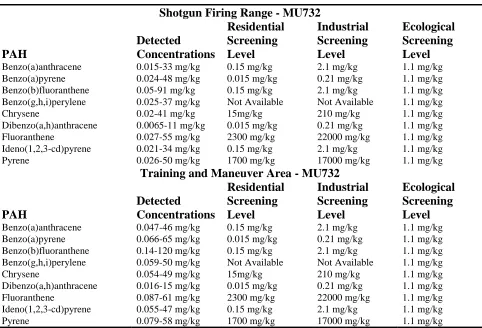
A total of 29 surface soil samples and 24 subsurface soil samples were analyzed for lead by way of off-site laboratory methods. Lead was detected above the background lead levels for a majority of the samples. Additionally, lead was observed above ecological and human health screening criteria in one sample. Forty-three surface soil samples and 14 subsurface soil samples were analyzed for PAHs by way of off-site laboratory methods. Table 2 illustrates the results of the PAH analysis. In summary, 7 PAHs exceeded human health screening criteria and 9 PAHs exceeded ecological screening criteria.
The extent of PAH contamination was of particular interest to the investigators. PAHs were found in areas with significant clay target debris as well as near areas that lacked the presence of clay target debris, sometimes in high concentrations. This was attributed to PAH migration through overland transport, primarily during rain events. However, PAHs extended radially outward from the clay target source, and were not biased to the
column occurred to a limited extent. On average, there was a 65.8% reduction in the concentration of total PAHs from the surface soil samples to the subsurface soil samples, which were collected at 0.5-1.0 feet below ground surface. Based on these results, it was anticipated that the PAHs are limited to the top 1.5-2 feet below ground surface. Future vertical migration of PAHs is unlikely to occur due to the physical properties of PAHs and the dry climate of the region. In conclusion, the team recommended further evaluation of lead and PAHs in surface and subsurface soil at MU732 through a RI.
Table 2: PAH Sampling Results
Shotgun Firing Range - MU732
PAH Detected Concentrations Residential Screening Level Industrial Screening Level Ecological Screening Level
Benzo(a)anthracene 0.015-33 mg/kg 0.15 mg/kg 2.1 mg/kg 1.1 mg/kg
Benzo(a)pyrene 0.024-48 mg/kg 0.015 mg/kg 0.21 mg/kg 1.1 mg/kg
Benzo(b)fluoranthene 0.05-91 mg/kg 0.15 mg/kg 2.1 mg/kg 1.1 mg/kg
Benzo(g,h,i)perylene 0.025-37 mg/kg Not Available Not Available 1.1 mg/kg
Chrysene 0.02-41 mg/kg 15mg/kg 210 mg/kg 1.1 mg/kg
Dibenzo(a,h)anthracene 0.0065-11 mg/kg 0.015 mg/kg 0.21 mg/kg 1.1 mg/kg
Fluoranthene 0.027-55 mg/kg 2300 mg/kg 22000 mg/kg 1.1 mg/kg
Ideno(1,2,3-cd)pyrene 0.021-34 mg/kg 0.15 mg/kg 2.1 mg/kg 1.1 mg/kg
Pyrene 0.026-50 mg/kg 1700 mg/kg 17000 mg/kg 1.1 mg/kg
Training and Maneuver Area - MU732
PAH Detected Concentrations Residential Screening Level Industrial Screening Level Ecological Screening Level
Benzo(a)anthracene 0.047-46 mg/kg 0.15 mg/kg 2.1 mg/kg 1.1 mg/kg
Benzo(a)pyrene 0.066-65 mg/kg 0.015 mg/kg 0.21 mg/kg 1.1 mg/kg
Benzo(b)fluoranthene 0.14-120 mg/kg 0.15 mg/kg 2.1 mg/kg 1.1 mg/kg
Benzo(g,h,i)perylene 0.059-50 mg/kg Not Available Not Available 1.1 mg/kg
Chrysene 0.054-49 mg/kg 15mg/kg 210 mg/kg 1.1 mg/kg
Dibenzo(a,h)anthracene 0.016-15 mg/kg 0.015 mg/kg 0.21 mg/kg 1.1 mg/kg
Fluoranthene 0.087-61 mg/kg 2300 mg/kg 22000 mg/kg 1.1 mg/kg
Ideno(1,2,3-cd)pyrene 0.055-47 mg/kg 0.15 mg/kg 2.1 mg/kg 1.1 mg/kg
REMEDIAL INVESTIGATION
A RI was conducted by URS in 2012. The primary objectives were to refine the boundaries of the site, characterize the nature and extent of contamination, and assess human health and ecological risk. During a site reconnaissance, evidence of on-site OB/OD was observed. As a result, the characterization of the nature and extent of MEC in the form of dioxins and furans was added as an objective of the RI.
Upon completion of the sampling analysis, the investigators completed a human and ecological risk assessment. The purpose of the risk assessments was to characterize the potential for MC exposure to relevant human and ecological receptors at MU732. This was done by creating a Conceptual Site Model to provide a framework for problem definition, identification of exposure pathways, identification of data needed to evaluate potential
exposure pathways, and assist in drafting effective cleanup actions. The most likely potential exposure pathway was determined to be from direct contact with surface soil, resulting in incidental ingestion, dermal absorption of chemicals, or inhalation of particulates from soil by site workers, AF personnel and trespassers. Ecological receptors may be exposed through direct contact with soil, or may be indirectly exposed via food chain exposures and incidental ingestion of soils while foraging. The ecological health assessment determined the
burrowing owl was the only at-risk species at MU732 for exposure to lead and PAHs. The Conceptual Site Model assists in developing Remedial Action Objectives (RAOs) and General Response Actions (GRAs) during the FS portion of the restoration process.
Table 3: PAHs Exceeding Human Health and Ecological Screening Criteria
Exceedance of Human Health Screening Criteria - Surface Soil
Exceedance of Human Health Screening Criteria - Subsurface Soil
PAH Detected Concentrations
(mg/kg) PAH
Detected Concentrations (mg/kg)
Benzo(a)anthracene 0.16 - 520 Benzo(a)anthracene 0.17 - 47
Benzo(a)pyrene 0.041 - 420 Benzo(a)pyrene 0.042 - 43
Benzo(b)fluoranthene 0.16 - 770 Benzo(b)fluoranthene 0.16 - 93
Benzo(k)fluoranthene 1.6 - 880 Benzo(k)fluoranthene 1.6 - 82
Chrysene 16 - 560 Chrysene 18 - 41
Dibenzo(a,h)anthracene 0.016 - 85 Dibenzo(a,h)anthracene 0.016 - 10
Indeno(1,2,3-cd)pyrene 0.16 - 360 Indeno(1,2,3-cd)pyrene 0.17 - 31
Naphthalene 3.8 - 34
Exceedance of Ecological Screening Criteria - Surface Soil
Exceedance of Ecological Screening Criteria - Subsurface Soil
PAH Detected Concentrations
(mg/kg) PAH
Detected Concentrations (mg/kg)
Anthracene 32 - 45 Benzo(a)anthracene 1.2 - 47
Benzo(a)anthracene 1.3 - 520 Benzo(a)pyrene 1.2 - 43
Benzo(a)pyrene 1.2 - 420 Benzo(b)fluoranthene 1.2 - 93
Benzo(b)fluoranthene 1.5 - 770 Benzo(g,h,i)perylene 1.2 - 32
Benzo(g,h,i)perylene 1.3 - 280 Benzo(k)fluoranthene 1.2 - 82
Benzo(k)fluoranthene 1.2 - 880 Chrysene 1.2 - 82
Chrysene 1.2 - 560 Dibenzo(a,h)anthracene 1.6 - 10
Dibenzo(a,h)anthracene 1.2 - 85 Fluoranthene 1.2 - 68
Fluoranthene 1.3 - 570 Indeno(1,2,3-cd)pyrene 1.2 - 31
Indeno(1,2,3-cd)pyrene 1.2 - 360 Phenanthrene 34
Naphthalene 34 Pyrene 1.2 - 58
Phenanthrene 32 - 190
Pyrene 1.2 - 670
FEASIBILITY STUDY
and Appropriate Requirements (ARARs), development of RAOs and GRAs, identification of technologies and process options, screening of technologies and process options and the development of relevant remedial alternatives.
The first step to developing corrective measures is to accurately define the problem. Based on information provided by the CSE Phase I, Phase II and RI, the site exhibits soil concentrations of PAHs and lead that exceed human and ecological health criteria. The contamination is widespread throughout the 400 acre site and there is a potential occurrence of off-site migration. In addition to PAH and lead contamination, MEC have been observed on the site as recently as the RI. The RI identified site workers, Air Force personnel and the burrowing owl as potential receptors.
Future remedial actions and site conditions must comply with federal and state environmental legislation. Since it is unlikely that remedial actions will remove 100 percent of the contamination at a site, CERCLA requires that in order for any hazardous substance or pollutant to remain on a site it must meet certain regulatory standards that have been
identified as ARARs. ARARs include standards, requirements, criteria, or limitations established under federal environmental law or any more stringent standards, requirements, criteria, or limitations promulgated in accordance with a state environmental statute. ARARs are classified into three categories: chemical-specific, location-specific, and action-specific. Based on the chemicals present, locations of future remedies, and the potential remedies themselves, the following are considered to be ARARs for MU732:
Federal
50 CFR 424, Listing Endangered or Threatened Species and Designating Critical Habitat
State
Disposal of Solid Waste Disposal of Hazardous Waste Recycling
Voluntary Cleanup
The next step is to formulate RAOs for future corrective measures. RAOs specify the contaminants and media of interest, exposure pathways, and preliminary remediation goals that permit a range of alternatives to be developed. The following RAOs were developed for MU732:
Remedial Action Objective 1: Reduce or eliminate explosive safety hazards to human and ecological receptors associated with potential MEC.
Remedial Action Objective 2: Prevent human exposure to lead in soil at unacceptable levels of risk.
Remedial Action Objective 3: Prevent human exposure to PAHs in soil at unacceptable levels of risk.
Remedial Action Objective 4: Prevent burrowing owl exposure to lead in soil at unacceptable levels of risk.
Remedial Action Objective 5: Prevent burrowing owl exposure to PAHs in soil at unacceptable levels of risk.
conditions of other Air Force MRSs and information gathered from the Federal Remediation Technologies Roundtable (FRTR).
Table 4: General Response Actions
RAO General Response Action
RAO 1
MEC Removal Demolition Disposal
RAO 2
Land Use Controls (LUCs)
In-Situ Physical/Chemical Treatment
Ex-Situ Physical/Chemical Treatment (assuming excavation) Excavation and Off-Site Disposal
RAO 3
LUCs
In-Situ Biological Treatment
In-Situ Physical/Chemical Treatment
Ex-Situ Physical/Chemical Treatment (assuming excavation) Excavation and Off-Site Disposal
RAO 4
In-Situ Physical/Chemical Treatment
Ex-Situ Physical/Chemical Treatment (assuming excavation and relocation of burrowing owl) Excavation and Off-Site Disposal (assuming relocation of burrowing owl)
Relocation of Burrowing Owl Supplemented by Site Surveys
RAO 5
In-Situ Biological Treatment
In-Situ Physical/Chemical Treatment
Ex-Situ Physical/Chemical Treatment (assuming excavation and relocation of burrowing owl) Excavation and Off-Site Disposal (assuming relocation of burrowing owl)
Relocation of burrowing owl Supplemented by Site Surveys No Action (Required for comparison with other alternatives)
As the FS progresses, the GRAs are further specified by introducing remedial
chosen based on personal knowledge, comparable site conditions to other Air Force MRSs and information gathered from the FRTR.
Each remedial technology represented in Appendix A has the ability to reduce or eliminate explosive hazards, PAHs or lead with a varying degree of effectiveness and ease. For instance, the excavation of one foot of soil from a 400 acre site is costly and
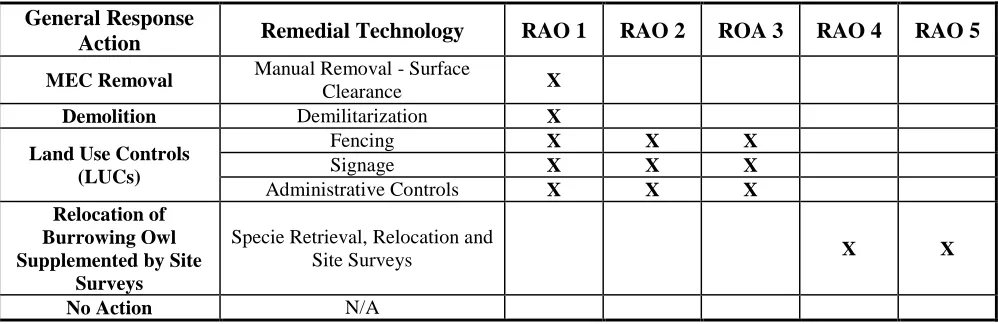
Table 5: Remedial Technologies and Process Options
General Response
Action Remedial Technology RAO 1 RAO 2 ROA 3 RAO 4 RAO 5
MEC Removal Manual Removal - Surface
Clearance X
Demolition Demilitarization X
Land Use Controls (LUCs)
Fencing X X X
Signage X X X
Administrative Controls X X X
Relocation of Burrowing Owl Supplemented by Site
Surveys
Specie Retrieval, Relocation and
Site Surveys X X
No Action N/A
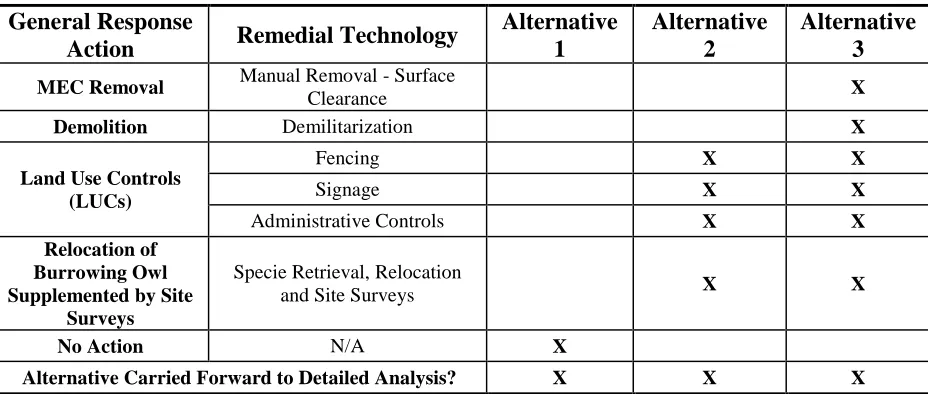
In order to satisfy all RAOs, multiple GRAs were combined to develop a suitable remediation strategy. The retained technologies and process options from the detailed screening process were used to develop remedial alternatives. To address the Remedial Action Objectives developed for MU732, the following alternatives were developed:
Alternative 1 – No Action
The no action alternative assumes that no actions would be taken regarding MEC or MC at MU732. No institutional or engineering LUCs would be implemented. This method requires no implementation and would have no capital or operations and maintenance costs. This alternative is required for baseline comparison purposes.
Alternative 2 – LUCs/Relocation of Burrowing Owl Supplemented by Site
Surveys
LUCs are institutional or engineering controls to protect human health and the
would consist of restrictions on land use and educations programs to inform potential
receptors of the risk. Engineering controls would consist of the installation of signage every 100 feet at access points along the perimeter of the MRS to inform receptors of the potential presence of MEC. Aviary experts would retrieve and relocate burrowing owls to a suitable destination in Southern Nevada. Owl burrows would be destroyed to deter future occupation. Semi-annual site surveys would be conducted to document the occupation by burrowing owls. Any owls found on the site would be relocated.
Alternative 3– MEC Removal/LUCs/ Relocation of Burrowing Owl
Supplemented by Site Surveys
Semi-annual site surveys would be conducted to document the occupation by burrowing owls. Any owls found on the site would be relocated.
Table 6: Remedial Alternatives Development Summary
General Response
Action Remedial Technology
Alternative 1
Alternative 2
Alternative 3
MEC Removal Manual Removal - Surface
Clearance X
Demolition Demilitarization X
Land Use Controls (LUCs)
Fencing X X
Signage X X
Administrative Controls X X
Relocation of Burrowing Owl Supplemented by Site
Surveys
Specie Retrieval, Relocation
and Site Surveys X X
No Action N/A X
Alternative Carried Forward to Detailed Analysis? X X X
This next section presents the analysis of each alternative with respect to the evaluation criteria prescribed by the NCP (40 CFR 300.430) and the US Army MMRP Munitions Response RI/FS Guidance (U.S. Army 2009). The nine criteria identified by the NCP and U.S. Army MMRP guidance are divided into three functional categories: threshold criteria, primary balancing criteria, and modifying criteria. Threshold criteria are
requirements each alternative must meet or have specifically waived to be eligible for selection.
Compliance with ARARs - Addresses whether a remedial alternative meets all selected federal and state environmental statutes and regulations.
Primary balancing criteria are those that, for the basis for comparison among the alternatives, meet the threshold criteria. Primary balancing criteria consist of the following:
Long-Term Effectiveness and Permanence - Addresses the ability of a remedial alternative to maintain reliable protection of human health and the environment over time, and considers the magnitude of residual risk/hazard, the adequacy of the response in limiting the risk/hazard, and whether LUCs and/or long-term management are required.
Reduction of Toxicity, Mobility or Volume (TMV) through Treatment - Addresses the preference for remedial actions that use treatment technologies that
permanently and significantly reduce TMV or any MC-related contaminants or remove any MEC reasonably possible to detect.
Short-Term Effectiveness - Addresses the period of time needed to implement the remedy and any adverse impacts that may be posed to workers, the community and the environment during implementation.
Implementability - Addresses the technical and administrative feasibility of implementing a remedial alternative from design through completion.
Cost - Addresses the total cost of each remedial alternative, including consideration of capital costs, annual O&M costs, periodic costs, and present value (USEPA 2000).
State Acceptance - This criterion addresses state regulatory concerns or issues identified upon review of the FS.
Community Acceptance - This criterion addresses components of an alternative that those in the community identify as presenting a potential issue, concern, or that are simply opposed by the community.
The proposed alternatives were compared based on the NCP and US Army analysis criteria and is summarized below:
Overall Protection of Human Health and the Environment – Potentially
unacceptable risk to potential human and ecological receptors from exposure to MEC or MC in soil would remain under Alternative 1. Under Alternative 2, long-term risk to humans and ecological receptors from MEC and MC would be reduced as long as LUCs are enforced and containment measures are maintained. Under Alternative 3, MEC in soil threatening
ecological receptors would be removed, permanently reducing long-term risk. For all Alternatives, MC in soil would remain requiring a long term, enforced strategy to conduct site surveys to confirm burrowing owls are not present on the site.
Compliance with ARARs – Alternative 1 would not meet ARARs. Alternatives 2 and 3 would meet ARARs. Waivers would not be required for Alternatives 2 or 3.
Alternative 3, residual contamination would pose reduced risk to human
industrial/commercial or ecological receptors, and LUCs would reduce the remaining residual risk to human receptors. Long-term reduction of risk to the burrowing owl depends on semi-annual site surveys.
Reduction of TMV – Alternatives 1 and 2 would not reduce the volume of MEC or
MC. For Alternative 3, surface clearance would permanently reduce the volume of MEC. Alternatives do not address the reduction of PAHs and lead from soil.
Short-Term Effectiveness – Alternative 3 would pose the greatest risk to site workers during LUC installment and MEC surface clearance. Site workers would need to take the appropriate health and safety precautions during the construction activities for Alternatives 2 and 3.
Implementability – Alternative 1 is not administratively feasible and is therefore difficult to implement. Alternatives 2 and 3 require administrative coordination and enforcement. Alternative 3 involves the use of specialized equipment and specially trained personnel for removal of objects.
Cost – No capital, O&M, or periodic costs are associated with Alternative 1. Alternative 3 is likely to cost 20-25 times as much as Alternative 2. Estimated costs for Alternative 3 are likely to be between $6,000,000 and $7,000,000.
The next step in the restoration process is remedy selection. Based on the FS,
more than Alternative 2. Based on the above analysis, Alternative 2 is selected as the preferred alternative, as it protects human and ecological health, complies with ARARs, and provides the best balance of long term and short term effectiveness, implementability and cost.
As a result of the chosen remedial alternative, MC-contaminated soil at MU732 will not be remediated. This decision was based on the site’s remote location, physical and biological properties, and planned future use. With the exception of trespassers, the
community as a whole is not in danger of the PAHs and lead on-site. Additionally, there are no plans to develop the property residentially or commercially in the foreseeable future. The physical and biological properties of the site directly affected the effectiveness and
MC-exposure at MU732, I felt it was necessary to implement a unique remedial process option of relocating the owl away from the site.
CONCLUSION
The MMRP was established to counter the environmental damage caused by the employment of military munitions. Since its establishment in 2001, the DoD has identified 1,674 MRSs at active military installations and has achieved closure of 40 percent of these sites. The program is in full-swing at Nellis AFB where all sites have been identified and initially surveyed. MRS MU732, a small-arms range utilized since the 1940’s, has been extensively surveyed and studied. The CSE Phase I, CSE Phase II and RI at MU732 highlighted the presence of MEC and soil concentrations of PAHs and lead hazardous to humans and the burrowing owl, a species regarded as “sensitive” by the Bureau of Land Management – Nevada.
The objective for this project was to develop a FS to demonstrate my understanding of human and environmental risk assessments, remedial technologies and my ability to make decisions based on available scientific information. Upon review of the official reports and the completion of a FS, the preferred remedial action for MU732 is a combination of installment of LUCs and relocation of the burrowing owl to an optimal location in southern Nevada. The next step of the restoration process would be to present my research and proposed remedial alternatives to community stakeholders and state regulators.
REFERENCES
Comprehensive Site Evaluation Phase I Nellis AFB, Nevada. Omaha, NE: URS Group, 2006.
Comprehensive Site Evaluation Phase II Nellis AFB, Nevada. St. Paul, MN: Bay West, 2010. "Defense Environmental Restoration Program (DERP)." Department of Defense. 1986.
The Environmental Restoration Program. AFI 32-7020. Washington D.C. United States Air Force, 1994.
Federally Listed Endangered and Threatened Species and BLM Sensitive Species. Nevada: Bureau of Land Management, 2007.
Gates, Robert M. Quadrennial Defense Review. Washington D.C: Department of Defense, 2010.
Krieg, Kenneth J. Military Munitions Response Program Fiscal Year 2007 NDAA - Section 313 Report. Washington D.C.: Department of Defense, 2007.
Lobb, Andrea. "Potential for PAH Contamination at Clay Target Clubs." Environment Canterbury (2006):
Management Guidance for the Defense Environmental Restoration Program. Washington D.C.: Department of Defense, 2001.
Munitions Response Site Prioritization Protocol, 70, No. 192 Department of Defense § 32 CFR Part 179 (Federal Register 2005).
National Contingency Plan, § 40 CFR 300.430 (Environmental Protection Agency). Paulido, Waldo. Military Munitions Response Program. Nellis Air Force Base: 2008.
Remedial Investigation/Feasibility Study Multi-Use Mountainous Area (MU732C) Military
Munitions Response Program. Omaha, NE: URS Group, 2012.
Selstrom, John, Col. Prioritization Protocol Meeting with the States. Washington D.C.: Department of Defense, 2003.
Stone, Sharon. Air Force Military Munitions Response Program. Randolph Air Force Base: Air Force Center for Engineering and the Environment, 2009.
Treatment Technologies Screening Matrix. Federal Remediation Technologies Roundtable, Web. http://www.frtr.gov/matrix2/section3/table3_2.pdf.
US Army MMRP Munitions Response RI/FS Guidance. Aberdeen Proving Ground: United States Army, 2009.
APPENDICES
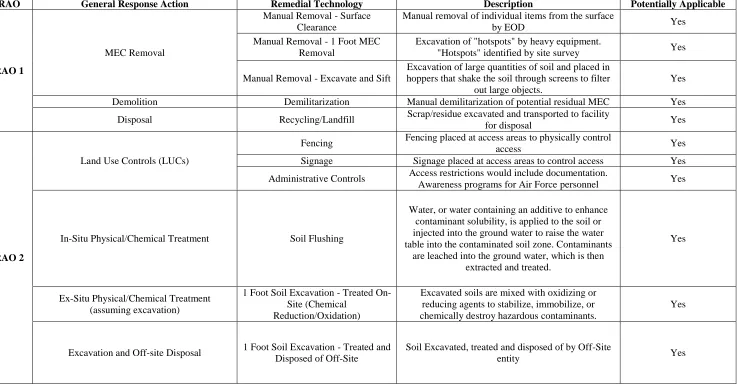
Appendix A - Identification and Initial Screening of Remedial Technologies
RAO General Response Action Remedial Technology Description Potentially Applicable
RAO 1
MEC Removal
Manual Removal - Surface Clearance
Manual removal of individual items from the surface
by EOD Yes
Manual Removal - 1 Foot MEC Removal
Excavation of "hotspots" by heavy equipment.
"Hotspots" identified by site survey Yes
Manual Removal - Excavate and Sift
Excavation of large quantities of soil and placed in hoppers that shake the soil through screens to filter
out large objects.
Yes
Demolition Demilitarization Manual demilitarization of potential residual MEC Yes
Disposal Recycling/Landfill Scrap/residue excavated and transported to facility
for disposal Yes
RAO 2
Land Use Controls (LUCs)
Fencing Fencing placed at access areas to physically control
access Yes
Signage Signage placed at access areas to control access Yes
Administrative Controls Access restrictions would include documentation.
Awareness programs for Air Force personnel Yes
In-Situ Physical/Chemical Treatment Soil Flushing
Water, or water containing an additive to enhance contaminant solubility, is applied to the soil or injected into the ground water to raise the water table into the contaminated soil zone. Contaminants
are leached into the ground water, which is then extracted and treated.
Yes
Ex-Situ Physical/Chemical Treatment (assuming excavation)
1 Foot Soil Excavation - Treated On-Site (Chemical
Reduction/Oxidation)
Excavated soils are mixed with oxidizing or reducing agents to stabilize, immobilize, or chemically destroy hazardous contaminants.
Yes
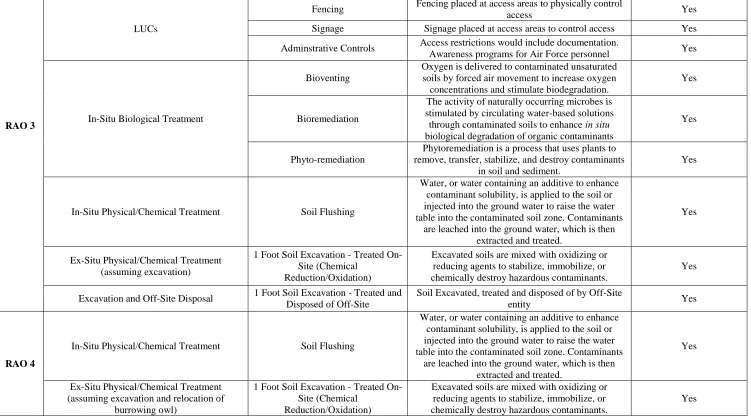
RAO 3
LUCs
Fencing Fencing placed at access areas to physically control
access Yes
Signage Signage placed at access areas to control access Yes
Adminstrative Controls Access restrictions would include documentation.
Awareness programs for Air Force personnel Yes
In-Situ Biological Treatment
Bioventing
Oxygen is delivered to contaminated unsaturated soils by forced air movement to increase oxygen concentrations and stimulate biodegradation.
Yes
Bioremediation
The activity of naturally occurring microbes is stimulated by circulating water-based solutions
through contaminated soils to enhance in situ
biological degradation of organic contaminants
Yes
Phyto-remediation
Phytoremediation is a process that uses plants to remove, transfer, stabilize, and destroy contaminants
in soil and sediment.
Yes
In-Situ Physical/Chemical Treatment Soil Flushing
Water, or water containing an additive to enhance contaminant solubility, is applied to the soil or injected into the ground water to raise the water table into the contaminated soil zone. Contaminants
are leached into the ground water, which is then extracted and treated.
Yes
Ex-Situ Physical/Chemical Treatment (assuming excavation)
1 Foot Soil Excavation - Treated On-Site (Chemical
Reduction/Oxidation)
Excavated soils are mixed with oxidizing or reducing agents to stabilize, immobilize, or chemically destroy hazardous contaminants.
Yes
Excavation and Off-Site Disposal 1 Foot Soil Excavation - Treated and
Disposed of Off-Site
Soil Excavated, treated and disposed of by Off-Site
entity Yes
RAO 4
In-Situ Physical/Chemical Treatment Soil Flushing
Water, or water containing an additive to enhance contaminant solubility, is applied to the soil or injected into the ground water to raise the water table into the contaminated soil zone. Contaminants
are leached into the ground water, which is then extracted and treated.
Yes
Ex-Situ Physical/Chemical Treatment (assuming excavation and relocation of
1 Foot Soil Excavation - Treated On-Site (Chemical
Excavated soils are mixed with oxidizing or
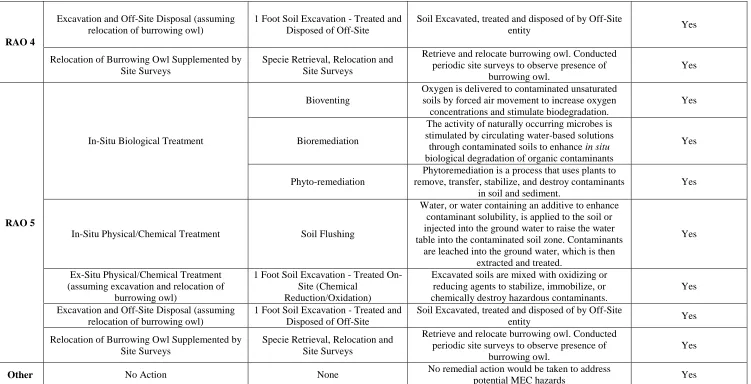
RAO 4
Excavation and Off-Site Disposal (assuming relocation of burrowing owl)
1 Foot Soil Excavation - Treated and Disposed of Off-Site
Soil Excavated, treated and disposed of by Off-Site
entity Yes
Relocation of Burrowing Owl Supplemented by Site Surveys
Specie Retrieval, Relocation and Site Surveys
Retrieve and relocate burrowing owl. Conducted periodic site surveys to observe presence of
burrowing owl.
Yes
RAO 5
In-Situ Biological Treatment
Bioventing
Oxygen is delivered to contaminated unsaturated soils by forced air movement to increase oxygen concentrations and stimulate biodegradation.
Yes
Bioremediation
The activity of naturally occurring microbes is stimulated by circulating water-based solutions
through contaminated soils to enhance in situ
biological degradation of organic contaminants
Yes
Phyto-remediation
Phytoremediation is a process that uses plants to remove, transfer, stabilize, and destroy contaminants
in soil and sediment.
Yes
In-Situ Physical/Chemical Treatment Soil Flushing
Water, or water containing an additive to enhance contaminant solubility, is applied to the soil or injected into the ground water to raise the water table into the contaminated soil zone. Contaminants
are leached into the ground water, which is then extracted and treated.
Yes
Ex-Situ Physical/Chemical Treatment (assuming excavation and relocation of
burrowing owl)
1 Foot Soil Excavation - Treated On-Site (Chemical
Reduction/Oxidation)
Excavated soils are mixed with oxidizing or reducing agents to stabilize, immobilize, or chemically destroy hazardous contaminants.
Yes
Excavation and Off-Site Disposal (assuming relocation of burrowing owl)
1 Foot Soil Excavation - Treated and Disposed of Off-Site
Soil Excavated, treated and disposed of by Off-Site
entity Yes
Relocation of Burrowing Owl Supplemented by Site Surveys
Specie Retrieval, Relocation and Site Surveys
Retrieve and relocate burrowing owl. Conducted periodic site surveys to observe presence of
burrowing owl.
Yes
Other No Action None No remedial action would be taken to address
Appendix B - Detailed Screening of Technologies and Process Options
General Response
Action
Remedial
Technology Description Effectiveness Implementability Cost
Screening Comments RAO 1 RAO 2 ROA 3 RAO 4 RAO 5 ROA 6 MEC Removal
Manual Removal - Surface Clearance
Manual removal of individual items from the surface by EOD
Medium: Very effective but does not address
subsurface MEC
Medium - High: Requires qualified EOD
technicians
Low -
Med Retained X
Manual Removal - 1 Foot MEC
Removal
Excavation of "hotspots" by heavy equipment. "Hotspots"
identified by site survey
Medium - High: Very effective but uncertainty remains regarding the presence
of subsurface MEC
Medium: Requires one of the highest degrees of direct MEC exposure
for workers. Intrusive actives add increased
risk to workers.
High
REJECTED: Small cost savings compared to insignificant decrease in risks over other surface
clearance alternatives.
X
Manual Removal - Excavate and Sift
Excavation of large quantities of soil and place in hoppers that shake the soil through screens to
filter out large objects.
High: Results in a high degree of confidence that MEC is effectively
removed.
Low: Requires multiple pieces of heavy, specialized, hardened and armored equipment
and skilled operators.
High
REJECTED: High degree of implementability
and high cost considering size of
site.
X
Demolition Demilitarization Manual demilitarization of potential residual MEC
Medium: MEC may be impacted in soil and EOD may not be able to
locate
High: Personnel available and no special
equipment needed.
Low Retained X
Disposal Recycling/Landfill
Scrap/residue excavated and transported to facility for
disposal
High: Removes debris from site and eliminates
potential human risks.
Medium: All hazardous materials must be
removed prior to release to commercial
Land Use Controls (LUCs)
Fencing Fencing placed at access areas
to physically control access
Medium: Is not effective against
trespassers
Medium: Fencing would be difficult to implement because of
the large area and terrain
Med Retained X X X
Signage Signage placed at access areas
to control access
Medium: Moderately effective in reducing risk associated with
potential MEC
High: Easily
Implemented Low Retained X X X
Administrative Controls
Access restrictions would include documentation. Awareness programs for Air
Force personnel
Low - Medium: Provides minimal measures to reduce
exposure risk for humans
High: Easily
Implemented Low Retained X X X
In-Situ Physical/C
hemical Treatment
Soil Flushing
Water, or water containing an additive to enhance contaminant
solubility, is applied to the soil or injected into the ground water
to raise the water table into the contaminated soil zone. Contaminants are leached into the ground water, which is then
extracted and treated.
High: Mobilizes metals/allows for
capture
Low: Significant amount of groundwater
required
High
REJECTED: Not cost effective than
alternative technologies
X X
Ex-Situ Physical/C hemical Treatment (assuming excavation)
1 Foot Soil Excavation - Treated On-Site
(Chemical Reduction/Oxidati
on)
Excavated soils are mixed with oxidizing or reducing agents to
stabilize, immobilize, or chemically destroy hazardous
contaminants.
Medium:
Low: Requires multiple pieces of heavy, specialized, hardened and armored equipment
and skilled operators.
High
REJECTED: High degree of implementability
and high cost considering size of
site.
X X X X
Excavation and
Off-site Disposal
1 Foot Soil Excavation -
Treated and Disposed of
Off-Site
Soil Excavated, treated and disposed of by Off-Site entity
High: Properly treated and disposed of
Low: Requires multiple pieces of heavy, specialized, hardened and armored equipment
and skilled operators.
High
REJECTED: High degree of implementability
and high cost considering size of
site.
In-Situ Biological Treatment
Bioventing
Oxygen is delivered to contaminated unsaturated soils
by forced air movement to increase oxygen concentrations
and stimulate biodegradation.
High: Effective at removing petroleum
products
Low: Soil moisture content of site extremely low
Low
REJECTED: Low soil moisture
content
X X
Bioremediation
The activity of naturally occurring microbes is stimulated
by circulating water-based solutions through contaminated
soils to enhance in situ
biological degradation of organic contaminants
High: Effective at removing petroleum
products
Low: Significant amount of groundwater
required Mediu m REJECTED: Requires significant amount of groundwater. Small cost savings
having to drill for deep groundwater.
X X
Phyto-remediation
Phytoremediation is a process that uses plants to remove, transfer, stabilize, and destroy
contaminants in soil and sediment.
Medium: Effective at removing petroleum products/can be rather
slow
Medium: Large site/lack of vegetation
in region Low REJECTED: Lack of vegetation/ suitability for vegetation
X X
Relocation of Burrowing
Owl Supplemen
ted by Site Surveys
Specie Retrieval, Relocation and
Site Surveys
Retrieve and relocate burrowing owl. Conducted periodic site surveys to observe presence of
burrowing owl.
Medium: Upon relocation, burrowing owl is no longer under the threat of PAH/lead
exposure.
High: Burrows can be located and owls can be
relocated by experts
Low Retained X X
No Action None
No remedial action would be taken to address potential MEC
hazards
Low: No MEC
removed High Low
Retained: Required for comparison
Appendix C - Detailed Evaluation of Technologies and Process Options
EVALUATION CRITERIA Alternative 1- No Action
Alternative 2 – LUCs/Relocation of
Burrowing Owl
Alternative 3 - MEC
Removal/LUCs/Relocation of Burrowing Owl
OVERALL PROTECTION OF HUMAN HEALTH AND THE ENVIRONMENT
Human Health Protection Would not reduce risk to
human health.
Would be protective of human health if institutional/engineering controls are properly
administered to limit MEC/receptor interaction
Would be protective of human health if institutional/engineering controls are properly administered to limit MEC/receptor interaction. Would reduce risk to receptors for MEC located on surface.
Environmental Protection Would not reduce risk to
burrowing owl health.
Would be protective of burrowing owl health. Not expected to have a negative impact on the
ecosystem.
Would be protective of Burrowing Owl health. Not expected to have a negative impact on the ecosystem.
COMPLIANCE WITH ARARs
Compliance with ARARs Not applicable. Would meet ARARs. Would meet ARARs.
Appropriateness of Waivers Not applicable. None should be required. None should be required.
LONG-TERM EFFECTIVENESS
Magnitude of Residual Risk Risks to potential future
receptors would remain indefinitely
Risks to potential future receptors would remain indefinitely. Risk to human health would be limited due to LUCs. Risk remains for burrowing owl that remain on site between semi-annual relocating.
Risks to potential future receptors would be reduced in cleared areas of the MRS. Risk would be further limited due to LUCs. Risk remains for Burrowing Owls that remain on site between semi-annual relocating.
Adequacy and Reliability of Controls Not applicable. Institutional controls would
educate, regulate, and ensure adequate warning to those allowed access to the MRS. Engineering controls would ensure limited access to the MRS.
Reduction of TMV None. None. Total volume of MEC would be reduced.
SHORT-TERM EFFECTIVENESS
Time Required to Achieve RAOs Would not achieve RAOs. RAOs 2,3,4,5 would be achieved
upon implementation of LUCs. Would not achieve RAO 1
RAOs would be achieved upon completion of surface MEC removal, implementation of LUCs and relocation of Burrowing Owl.
Protection of Community During Remedial Action Not applicable. The community would not be put
at risk during the remedial action.
The community would not be put at risk during remedial action.
Protection of Workers During Remedial Action Not applicable. Construction support and
oversight would be provided during the installation of LUCs.
Workers would follow proper safety precautions during site clearance, MEC removal and disposal. Aviary experts would be provided support and oversight while on site.
IMPLEMENTABILITY
Ability to Construct and Operate Not applicable. Easy to implement. Aviary
experts are available within State Fish and Game to relocate Burrowing Owl but moderately difficult to implement.
Detection and disposal technologies are readily available and would be moderately easy to implement. Aviary experts are available within State Fish and Game to relocate Burrowing Owl but moderately difficult to implement.
Technical Feasibility Not applicable. Technology is reliable and readily
available.
Technology is reliable and readily available.
Administrative Feasibility Not applicable. Moderately easy to implement
LUCs.
Moderately easy to implement LUCs.
COST
Project Duration (years) 0 30 30
Capital Cost $0 $126,000 $1,626,000
Annual O&M Cost $0 $9,600 $7,400