Improved Proxy Re-Encryption Schemes with Applications to
Secure Distributed Storage
∗Giuseppe Ateniese† Kevin Fu‡ Matthew Green† Susan Hohenberger‡
Abstract
In 1998, Blaze, Bleumer, and Strauss (BBS) proposed an application called atomic proxy re-encryption, in which a semi-trusted proxy converts a ciphertext for Alice into a ciphertext for Bob without seeing the underlying plaintext. We predict that fast and secure re-encryption will become increasingly popular as a method for managing encrypted file systems. Although efficiently computable, the wide-spread adoption of BBS re-encryption has been hindered by considerable security risks. Following recent work of Dodis and Ivan, we present new re-encryption schemes that realize a stronger notion of security, and we demon-strate the usefulness of proxy re-encryption as a method of adding access control to a secure file system. Performance measurements of our experimental file system demonstrate that proxy re-encryption can work effectively in practice.
1
Introduction
Proxy re-encryption allows a proxy to transform a ciphertext computed under Alice’s public key into one that can be opened by Bob’s secret key. There are many useful applications of this primitive. For instance, Alice might wish to temporarily forward encrypted email to her colleague Bob, without giving him her secret key. In this case, Alice the delegator could designate a proxy to re-encrypt her incoming mail into a format that Bob the delegatee can decrypt using his own secret key. Alice could simply provide her secret key to the proxy, but this requires an unrealistic level of trust in the proxy.
We present several efficient proxy re-encryption schemes that offer security improvements over earlier approaches. The primary advantage of our schemes is that they are unidirectional (i.e., Alice can delegate to Bob without Bob having to delegate to her) and do not require delegators to reveal all of their secret key to anyone – or even interact with the delegatee – in order to allow a proxy to re-encrypt their ciphertexts. In our schemes, only a limited amount of trust is placed in the proxy. For example, it is not able to decrypt the ciphertexts it encrypts, and we prove our schemes secure even when the proxy publishes all the re-encryption information it knows. This enables a number of applications that would not be practical if the proxy needed to be fully trusted.
∗An earlier version of this paper appeared in the Proceedings of the 12th Annual Network and Distributed System Security
Symposium (NDSS), February 2005, and a journal version has been accepted for publication in ACM Transactions on Information and System Security (TISSEC).
†Department of Computer Science; The Johns Hopkins University; 3400 N. Charles Street; Baltimore, MD 21218, USA. Email:
{ateniese,mgreen}@cs.jhu.edu.
‡Computer Science and Artificial Intelligence Laboratory; Massachusetts Institute of Technology; 32 Vassar Street; Cambridge,
We provide the first empirical performance measurements of applications using proxy re-encryption. To demonstrate the practical utility of our proxy re-encryption schemes, we measure an implementation of proxy re-encryption used in a secure file system. Our system uses a centralized access control server to manage access to encrypted content stored on distributed, untrusted replicas. We use proxy re-encryption to allow for centrally-managed access control without granting full decryption rights to the access control server.
1.1 Proxy Re-encryption Background
A methodology for delegating decryption rights was first introduced by Mambo and Okamoto [34] purely as an efficiency improvement over traditional decrypt-and-then-encrypt approaches.
In 1998, Blaze, Bleumer, and Strauss [7] proposed the notion of “atomic proxy cryptography,” in which a semi-trusted proxy computes a function that converts ciphertexts for Alice into ciphertexts for Bob without seeing the underlying plaintext. In their Elgamal based scheme, with modulus a safe prime p=2q+1, the proxy is entrusted with the delegation key b/amodq for the purpose of diverting ciphertexts from Alice to
Bob via computing (mgkmod p,(gak)b/amod p). The authors noted, however, that this scheme contained
an inherent restriction: it is bidirectional; that is, the value b/a can be used to divert ciphertexts from
Alice to Bob and vice versa. Thus, this scheme is only useful when the trust relationship between Alice and Bob is mutual. (This problem can be solved, for any scheme, by generating an additional, otherwise unused, key pair for the delegatee, but this introduces additional overhead.) The BBS scheme leaves several open problems. Delegation in the BBS scheme is transitive, which means that the proxy alone can create delegation rights between two entities that have never agreed on this. For example, from the values a/b and b/c, the proxy can re-encrypt messages from Alice to Carol. Another drawback to this scheme is that if the
proxy and Bob collude, they can recover her secret key as(a/b)∗b=a!
Jakobsson [30] developed a quorum-based protocol where the proxy is divided into sub-components, each controlling a share of the re-encryption key; here, the keys of the delegator are safe so long as some of the proxies are honest. A similar approach was considered by Zhou, Mars, Schneider and Redz [42].
Recently, Dodis and Ivan [16] realized unidirectional proxy encryption for Elgamal, RSA, and an IBE scheme by sharing the user’s secret key between two parties. They also solved the problem of the proxy alone assigning new delegation rights. In their unidirectional Elgamal scheme, Alice’s secret key s is divided into two shares s1and s2, where s=s1+s2, and distributed to the proxy and Bob. On receiving ciphertexts of
the form(mgsk,gk), the proxy first computes(mgsk/(gk)s1), which Bob can decrypt as(mgs2k/(gk)s2) =m. Although this scheme offers some advantages over the BBS approach, it introduces new drawbacks as well. These “secret-sharing” schemes do not change ciphertexts for Alice into ciphertexts for Bob in the purest sense (i.e., so that Bob can decrypt them with his own secret key), they delegate decryption by requiring Bob to store additional secrets (i.e., shares{s(2i)}) that may in practice be difficult for him to manage. For example, in our file system in Section 4, the number of secrets a user must manage should remain constant regardless of the number of files it accesses. One exception is the Dodis-Ivan IBE scheme [16] where the global secret that decrypts all ciphertexts is shared between the proxy and the delegatee. Thus, the delegatee need only store a single secret, but an obvious drawback is that when the proxy and any delegatee in the system collude, they can decrypt everyone else’s messages.
This work should not be confused with the “universal re-encryption” literature [28], which re-randomizes ciphertexts instead of changing the public key that they are encrypted under.
1.2 Applications of Proxy Re-encryption
Proxy re-encryption has many exciting applications in addition to the previous proposals [7, 16, 30, 42] for email forwarding, law enforcement, and performing cryptographic operations on storage-limited devices. In particular, proxy cryptography has natural applications to secure network file storage. The following paragraphs describe potential applications of proxy re-encryption.
Secure File Systems. A secure file system is a natural application of proxy re-encryption because the system
often assumes a model of untrusted storage.
A number of file systems build confidential storage out of untrusted components by using cryptographic storage [2, 6, 26, 32]. Confidentiality is obtained by encrypting the contents of stored files. These encrypted files can then be stored on untrusted file servers. The server operators can distribute encrypted files without having access to the plaintext files themselves.
In a single-user cryptographic file system, access control is straightforward. The user creates and re-members all the keys protecting content. Thus, there is no key distribution problem. With group sharing in cryptographic storage, group members must rendezvous with content owners to obtain decryption keys for accessing files.
Systems with cryptographic storage such as the SWALLOW object store [36] or CNFS [29] assume an out-of-band mechanism for distributing keys for access control. Other systems such as Cepheus [21] use a trusted access control server to distribute keys.
The access control server model requires a great deal of trust in the server operator. Should the operator prove unworthy of this trust, he or she could abuse the server’s key material to decrypt any data stored on the system. Furthermore, even if the access control server operator is trustworthy, placing so much critical key data in a single location makes for an inviting target.
In contrast, our system makes use of a semi-trusted access control server. We propose a significant security improvement to the access control in cryptographic storage, using proxy cryptography to reduce the amount of trust in the access control server. In our approach, keys protecting files are stored encrypted under a master public key, using one of the schemes in Section 3. When a user requests a key, the access control server uses proxy cryptography to directly re-encrypt the appropriate key to the user without learning the key in the process. Because the access control server does not itself possess the master secret, it cannot decrypt the keys it stores. The master secret key can be stored offline, by a content owner who uses it only to generate the re-encryption keys used by the access control server. In Section 4, we describe our implementation and provide a performance evaluation of our constructions.
Outsourced Filtering of Encrypted Spam. Another promising application of proxy re-encryption is the
re-encryption scheme presented in Section 3.2, a healthcare institution can periodically change filtering contractors without changing its public key.
1.3 Roadmap
The rest of this paper consists of the following sections describing the theory and implementation of proxy re-encryption. Section 2 gives number theoretic preliminaries and definitions necessary to understand our schemes and their security guarantees. Section 3 presents improved proxy re-encryption schemes as well as a discussion on the factors to consider when comparing proxy re-encryption schemes. Section 4 highlights the design, implementation, and performance measurements of our proxy re-encryption file system.
2
Definitions
Our protocols are based on bilinear maps [8, 9, 10, 31], which we implemented using the fast Tate pair-ings [25].
Definition 2.1 (Bilinear Map) We say a map e : G1×Gˆ1→G2is a bilinear map if: (1) G1, ˆG1are groups
of the same prime order q; (2) for all a,b∈Zq, g∈G1, and h∈Gˆ1, then e(ga,hb) =e(g,h)ab is efficiently
computable; and (3) the map is non-degenerate (i.e., if g generates G1 and h generates ˆG1, then e(g,h)
generates G2). (In our scheme descriptions we treat G1 and ˆG1as the same group. However we recognize
that, for some instantiations of the mappings, it is more efficient to let G1 and ˆG1be distinct groups of size
q. Our constructions will work in this setting as well.)
Now, we define what a unidirectional proxy re-encryption scheme is and what minimum security prop-erties it should have. We compare our definition to a similar definition due to Dodis and Ivan [16]. In remarks 2.4 and 2.5, we discuss some of the short-comings and benefits of this definition.
Definition 2.2 (Unidirectional Proxy Re-encryption) A unidirectional proxy re-encryption scheme is a tuple of (possibly probabilistic) polynomial time algorithms (KG,RG,~E,R,~D), where the components are defined as follows:
• (KG,~E,~D)are the standard key generation, encryption, and decryption algorithms for the underlying cryptosystem. Here~E and~D are (possibly singleton) sets of algorithms. On input the security
param-eter 1k, KG outputs a key pair(pk,sk). On input pkAand message m∈M, for all Ei∈~E the output is a
ciphertext CA. On input skAand ciphertext CA, there exists a Di∈~D that outputs the message m∈M.
• On input(pkA,sk†A,pkB,sk∗B), the re-encryption key generation algorithm, RG, outputs a key rkA→B
for the proxy. The fourth input marked with a ’∗’ is sometimes omitted; when this happens we say that RG is non-interactive since the delegatee does not need to be involved in the generation of the re-encryption keys. The second input marked with a ’†’ may in some cases be replaced by the tuple
(rkA→C,skC); see Remark 2.4 for more.
• On input rkA→Band ciphertext CA, the re-encryption function, R, outputs CB.
Correctness. Informally, a party holding a secret key skA should always be able to decrypt ciphertexts
encrypted under pkA; while a party B should be able to decrypt R(rkA→B,CA). ~E may contain multiple
to Alice and, say, her secretary. Whenever a re-encryption does take place, however, we require that the underlying plaintext remain consistent – i.e., Bob should get exactly what Alice was supposed to receive.1
More formally, let key pairs(pkA,skA)and(pkB,skB), generated according to KG, belong to parties A and B, respectively, and let rkA→B be generated according to RG. Then, for all messages m in the message
space M, the following equations hold with probability one:
∀Ei∈~E,∃Dj∈~D, Dj(skA,Ei(pkA,m)) =m,
∃Ei∈~E,∃Dj∈~D, Dj(skB,R(rkA→B,Ei(pkA,m))) =m.
We provide a security definition similar to that of Dodis and Ivan [16]. Although their definition was for CCA2 security, they instead used CPA security for the Elgamal, RSA, and IBE-based schemes; for simplicity, we focus directly on CPA security. The first main difference between our definitions is that we consider the security of a user against a group of colluding parties; for example, the security of a delegator against the proxy and many delegatees, whereas the Dodis-Ivan definition focused on a single delegatee. Secondly, we discuss the system’s security for circular delegation where the adversary watches Alice and Bob delegate to each other. Finally, we provide a new guarantee for the delegator – even if the proxy and all delegatees collude, they can not recover his master secret key. We discuss some benefits of this last feature in Remark 2.5.
Definition 2.3 (Security of Unidirectional Proxy Re-encryption)
LetΓ= (KG,RG,~E,R,~D)be a unidirectional proxy re-encryption scheme.
Standard Security. The underlying cryptosystem (KG,~E,~D) is semantically-secure [27] against anyone who has not been delegated the right to decrypt. We use subscript B to denote the target user, x to denote the adversarial users, and h to denote the honest users (other than B). That is, for all PPT algorithms Ak, Ei∈~E,
and m0,m1∈Mk,
Pr[(pkB,skB)←KG(1k),{(pkx,skx)←KG(1k)},
{rkx→B←RG(pkx,skx,pkB,sk∗B)},
{(pkh,skh)←KG(1k)},
{rkB→h←RG(pkB,skB,pkh,sk∗h)},
{rkh→B←RG(pkh,skh,pkB,sk∗B)},
(m0,m1,α)←Ak(pkB,{(pkx,skx)},{pkh},{rkx→B},{rkB→h},{rkh→B}),
b← {0,1},b0←Ak(α,Ei(pkB,mb)): b=b0]<1/2+1/poly(k).
The above definition captures B’s security, even when the proxy (with knowledge of all the re-encryption keys) and a group of adversarial users (with knowledge of their own secret keys) collude against B – provided that B never delegated decryption rights to any adversarial user.
We now turn our attention to what security can be guaranteed in the case that B does delegate decryption rights to an adversarial user. Obviously, in this case, the adversary can simply decrypt and trivially win the game above. However, we are now interested in determining whether or not an adversary (consisting of the
1Note, this only applies to ciphertexts that were honestly generated by the sender; no guarantee is implied in the case of
proxy and a group of colluding users) can recover B’s master secret key. (We will later see some examples where, for the same public key, two types of ciphertexts may be generated: one that can be opened by a delegatee, and one that can only be opened with the master secret key.) Thus, we define here (and later prove) that just because B delegates decryption rights to another party does not mean that B surrenders his digital identity (i.e., the meaningful parts of his secret key).
Master Secret Security. The long term secrets of a delegator (sometimes serving as a delegatee) cannot be
computed or inferred by even a coalition of colluding delegatees. We use subscript B to denote the target user and x to denote the adversarial users. For all PPT algorithms Ak,
Pr[(pkB,skB)←KG(1k),{(pkx,skx)←KG(1k)},
{rkB→x←RG(pkB,skB,pkx,sk∗x)},
{rkx→B←RG(pkx,skx,pkB,sk∗B)},
α←Ak(pkB,{(pkx,skx)},{rkB→x},{rkx→B}):
α=skB]<1/poly(k).
Remark 2.4 Unfortunately, achieving security based on the definition of the re-encryption key generation
function RG as originally stated is very difficult to realize. We do not know of any such scheme, including the prior work of Dodis and Ivan [16], that does not succumb to the follow attack: transfer of delegation
rights, where, on input skBand rkA→B, one can compute rkA→C. (Recall our discussion of non-transferability
in Section 3.) To see this in our second and third schemes, consider that on input b and gb/a, one can output
(gb/a)1/b=g1/a which would allow anyone to decrypt Alice’s second-level ciphertexts. Thus, we modify
the definition of RG to be executed with either the secret key of the delegator Alice skA or with both a
re-encryption key from Alice to Bob rkA→B and Bob’s secret key skB. This implies that Bob is allowed to
transfer Alice’s decryption capability. Arguably, this relaxed definition is not so damaging since Alice is already trusting Bob enough to delegate decryption rights to him.
Remark 2.5 At first glance, master secret security may seem very weak. All it guarantees is that an
ad-versary cannot output a delegator’s secret key skA. One might ask why this is useful. One motivation,
mentioned above, stems from the fact that some proxy re-encryption schemes define two or more types of ciphertext, some of which may only be decrypted using the master secret. A scheme which provides master secret security will protect those ciphertexts even in the event that the proxy and delegatee collude. A second motivation comes from the fact that most standard signature schemes, such as Elgamal [19] and Schnorr [38], are actually proofs of knowledge of a discrete logarithm value, such as skA=a∈Zq, turned
into a signature using the Fiat-Shamir heuristic [20]. Intuitively, if an adversary cannot output Alice’s secret key, then the adversary cannot prove knowledge of it either. Thus, using a proxy re-encryption scheme with master secret security means that a user may be able to safely delegate decryption rights (via releasing ga) without delegating signing rights for the same public key Za.
3
Improved Proxy Re-encryption Schemes
To talk about “improvements,” we need to get a sense of the benefits and drawbacks of previous schemes. Here is a list of, in our opinion, the most useful properties of proxy re-encryption protocols:
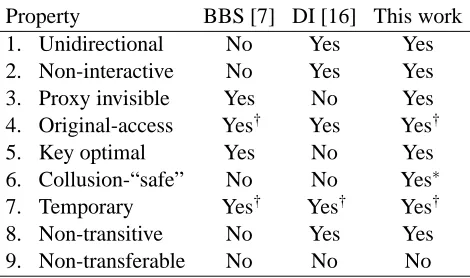
Property BBS [7] DI [16] This work 1. Unidirectional No Yes Yes 2. Non-interactive No Yes Yes 3. Proxy invisible Yes No Yes 4. Original-access Yes† Yes Yes† 5. Key optimal Yes No Yes 6. Collusion-“safe” No No Yes∗ 7. Temporary Yes† Yes† Yes† 8. Non-transitive No Yes Yes 9. Non-transferable No No No
Table 1: We compare known proxy re-encryption schemes based on the advantages described above; no scheme achieves property 9. We refer to the unidirectional schemes of Dodis-Ivan. ∗indicates master secret key only. † indicates possible to achieve with additional overhead.
2. Non-interactive: Re-encryption keys can be generated by Alice using Bob’s public key; no trusted third party or interaction is required. (Such schemes were called passive in BBS [7].)
3. Proxy invisibility: This is an important feature offered by the original BBS scheme. The proxy in the BBS scheme is transparent in the sense that neither the sender of an encrypted message nor any of the delegatees have to be aware of the existence of the proxy. Clearly, transparency is very desirable but it is achieved in the BBS scheme at the price of allowing transitivity of delegations and recovery of the master secrets of the participants. Our pairing-based schemes, to be described shortly, offer a weaker form of transparency which we call proxy invisibility. In particular, both sender and recipient are aware of the proxy re-encryption protocol but do not know whether the proxy is active, has performed any action or made any changes, or even if it exists (the proxy is indeed “invisible”). More specifically, we allow the sender to generate an encryption that can be opened only by the intended recipient (first-level encryption) or by any of the recipient’s delegatees (second-level encryption). At the same time, we can ensure that any delegatee will not be able to distinguish a first-level encryption (computed under his public key) from a re-encryption of a ciphertext intended for another party (we are assuming that the encrypted message does not reveal information that would help the delegatee to make this distinction).
4. Original-access: Alice can decrypt re-encrypted ciphertexts that were originally sent to her. In some applications, it may be desirable to maintain access to her re-encrypted ciphertexts. This is an inherent fea-ture of the Dodis-Ivan schemes (since the re-encryption key is a share of the original); the BBS scheme and the pairing schemes presented here can achieve this feature by adding an additional term to the ciphertext: for example, in BBS a re-encrypted ciphertext with original access looks like(mgk,gak,(gak)b/a). This may
impact proxy invisibility.
5. Key optimal: The size of Bob’s secret storage remains constant, regardless of how many delegations he accepts. We call this a key optimal scheme. In the previous Elgamal and RSA based schemes [16], the storage of both Bob and the proxy grows linearly with the number of delegations Bob accepts. This is an important consideration, since the safeguarding and management of secret keys is often difficult in practice. 6. Collusion-“safe”: One drawback of all previous schemes is that by colluding, Bob and the proxy can recover Alice’s secret key: for Dodis-Ivan, s=s1+s2; for BBS, a= (a/b)∗b. We will mitigate this
problem – allowing recovery of a “weak” secret key only. In a bilinear map setting, suppose Alice’s public key is e(g,g)aand her secret key is a; then we might allow Bob and the proxy to recover the value ga, but
The property of collusion “safeness” is extremely useful in our context since we allow the sender to generate first-level encryptions, that can be opened only by the intended recipient (Alice), or second-level ones that can be opened by any of the recipient’s delegatees (e.g., Bob). Indeed, this property implies that even if Bob and the proxy collude, they will not be able to open any of Alice’s first level-encryptions!
In general, collusion “safeness” allows Alice to delegate decryption rights, while keeping signing rights for the same public key. In practice, a user can always use two public keys for encryption and signatures, but it is theoretically interesting that she doesn’t need to do so. Prior work on “signcryption” explored this area (e.g., [41, 5, 3]); here we present, what can be viewed as, the first “signREcryption” scheme (although we will not be formally concerning ourselves with the security of the signatures in this work).
7. Temporary: Dodis and Ivan [16] suggested applying generic key-insulation techniques [17, 14, 15] to their constructions to form schemes where Bob is only able to decrypt messages intended for Alice that were authored during some specific time period i. Citing space considerations, they did not present any concrete constructions. In Section 3.2, we provide a bilinear map construction designed specifically for this purpose. In our construction, a trusted server broadcasts a new random number at each time period, which each user can then use to update their delegated secret keys. This is an improvement over using current key-insulated schemes where the trusted server needs to individually interact with each user to help them update their master (and therefore, delegation) secret keys.
8. Non-transitive: The proxy, alone, cannot re-delegate decryption rights. For example, from rka→band rkb→c, he cannot produce rka→c.
9. Non-transferable: The proxy and a set of colluding delegatees cannot re-delegate decryption rights. For example, from rka→b, skb, and pkc, they cannot produce rka→c.We are not aware of any scheme that
has this property, and it is a very desirable one. For instance, a hospital may be held legally responsible for safeguarding the encrypted files of its patients; thus, if it chooses to delegate decryption capabilities to a local pharmacy, it may need some guarantee that this information “goes no further.” First, we should ask ourselves: is transferability really preventable? The pharmacy can always decrypt and forward the plaintext files to a drug company. However, this approach requires that the pharmacy remain an active, online participant. What we want to prevent is the pharmacy (plus the proxy) providing the drug company with a secret value that it can use offline to decrypt the hospital’s ciphertexts. Again, the pharmacy can trivially send its secret key to the drug company. But in doing so, it assumes a security risk that is as potentially injurious to itself as the hospital. Achieving a proxy scheme that is non-transferable, in the sense that the only way for Bob to transfer offline decryption capabilities to Carol is to expose his own secret key, seems to be the main open problem left for proxy re-encryption.
3.1 New Unidirectional Proxy Re-encryption Schemes
A First Attempt. As Dodis and Ivan pointed out [16], one method for delegating decryption rights is to
create a cryptosystem that has a two-stage decryption procedure with two different secret keys. In practice, Alice’s secret key s is divided into two shares: s1, given to the proxy, and s2, given to Bob. A ciphertext
intended for Alice can be partially decrypted by the proxy via s1. Bob can complete the decryption process
by using s2 and then recover the message. We already noticed that this “secret sharing” approach does
providing a cryptosystem that generates ciphertexts that can be fully decrypted using either of two distinct keys. In particular, we consider a variant of the Paillier cryptosystem with two trapdoors proposed by Cramer and Shoup [13]. For simplicity, we will describe a version that is only semantically secure and we refer to the original work [13] for the full CCA2 secure scheme. This simplified scheme was described in [11] where the authors also show a variant of the scheme in [13] that works in the cyclic group of quadratic residues modulo n2.
The public key is(n,g,h=gx)with g of orderλ(n) =2p0q0, the master secret key is the factorization of n=pq (where p=2p0+1,q=2q0+1 are safe primes), and the “weak” secret key is x∈[1,n2/2]. (As remarked in [13], such a g can be easily found by selecting a random a∈Zn∗2 and computing g=−a2n.) To encrypt a message m∈Zn, select a random r∈[1,n/4]and compute: T1=gr,T2=hr(1+mn) (modn2).
If x is known, then the message can be recovered as: m=L(T2/T1x mod n2),where L(u) = u−1n ,for
all u∈ {u<n2 |u=1 mod n}.If (p,q) are known, then m can be recovered from T2 by noticing that
T2λ(n)=gλ(n)xr(1+mλ(n)n) = (1+mλ(n)n). Thus, given that gcd(λ(n),n) =1, m can be recovered as:
m=L(T2λ(n)modn2)[λ(n)]−1modn.
Part of the cryptosystem above can be seen as a variation of Elgamal when working modulo a squared composite number. So, similarly to the Dodis-Ivan scheme, we can divide x into two shares x1and x2, such
that x=x1+x2. The share x1is given to the proxy while x2is stored by Bob. The scheme is collusion-safe
since only the “weak” secret x is exposed if Bob and the proxy collude, but the factors of n, p and q, remain secret. Indeed, one could send only the value T2, rather than the ciphertext pair(T1,T2), to allow Alice, and
only her, to decrypt the message. (Remember that we are assuming that ciphertexts are generated correctly.) Although collusion-“safe,” this scheme is not key optimal or proxy invisible but it remains theoretically interesting because it is not based on bilinear pairings. However, it cannot yet be seen as a pure proxy re-encryption scheme since there is no transformation of ciphertexts computed under Alice’s key into ones under Bob’s.
One way to address this, which also applies to the Dodis-Ivan schemes, is to let the proxy store Bob’s shares encrypted under his own public key. For instance, in the case where Alice is the delegator, the proxy could store x1and x2, the latter encrypted under Bob’s public key. The encrypted share will be sent to Bob
along with the ciphertext partially decrypted by the proxy. This solution, however, is not satisfactory: It requires more bandwidth, it doubles the cost of decrypting, it forces Bob to perform distinct decryption procedures based on whether he receives ciphertexts intended for him or ciphertexts from the proxy, and it complicates the revocation of decryption rights.
A Second Attempt. To minimize a user’s secret storage and thus become key optimal, we present the
BBS [7], Elgamal based [19] scheme operating over two groups G1,G2of prime order q with a bilinear map
e : G1×G1→G2. The system parameters are random generators g∈G1and Z=e(g,g)∈G2.
• Key Generation (KG). A user A’s key pair is of the form pka=ga,ska=a.
• Re-Encryption Key Generation (RG). A user A delegates to B by publishing the re-encryption key rkA→B=gb/a∈G1, computed from B’s public key.
• First-Level Encryption (E1). To encrypt a message m∈G2under pkain such a way that it can only
be decrypted by the holder of ska, output c= (Zak,mZk).
• Second-Level Encryption (E2). To encrypt a message m∈G2under pkain such a way that it can be
decrypted by A and her delegatees, output c= (gak,mZk).
• Re-Encryption (R). Anyone can change a second-level ciphertext for A into a first-level ciphertext for B with rkA→B=gb/a. From ca= (gak,mZk), compute e(gak,gb/a) =Zbkand publish cb= (Zbk,mZk).
m=β/α1/a. To decrypt a second-level ciphertext c
a= (α,β) with secret key sk=a, compute m=
β/e(α,g)1/a.
Discussion of Scheme. This scheme is very attractive; it is unidirectional, non-interactive, proxy invisible,
collusion-safe, key optimal, and non-transitive. In particular, notice that first-level encryptions intended for Alice are safe even if Bob and the proxy collude. Indeed, the weak secret g1/a cannot be used to decrypt first-level encryptions (but only second-level ones, which Bob and the proxy can open anyway).
The scheme is also very efficient since both encryption and decryption operations are similar to those of plain Elgamal while the pairing computation is only performed by the proxy.
The security of this scheme depends upon (at least) the assumption that the following problem is hard in
(G1,G2):
Given(g,ga,gb,Q), for g←G1, a,b←Zq
and Q∈G2, decide if Q=e(g,g)a/b.
To see where the above assumption comes into play, think of gaas gbk for some k∈Zq. Now, consider
the second-level ciphertext c= (ga,mQ) encrypted for public key gb for message m. If Q=e(g,g)a/b= e(g,g)bk/b=e(g,g)k, then c is a proper encryption of m; otherwise, it is an encryption of some other message
m06=m. Thus, an adversary that can break the above decisional assumption can easily be made into an
adversary that breaks the semantic security of this scheme. Recently, the above assumption was proven hard in the generic group model by Dodis and Yampolskiy [18]. (Indeed, Dodis and Yampolskiy address a stronger version called q-Decisional Bilinear Diffie-Hellman Inversion (q-DBDHI) where for a random
g∈G1, x∈Zq, and Q∈G2, given(g,gx,gx
2
, . . . ,gxq,Q), it is hard to decide if Q=e(g,g)1/x or not.)
However, the security of the above scheme also appears to rely on the assumption that given(g,ga), the
value a cannot be derived from seeing the a-th root of a polynomial set of random values. (This appears necessary to generate the appropriate re-encryption keys). Although this assumption seems plausible in a group of prime order, by making a few alterations to this core idea we are able to provide a solution which makes fewer (and more standard) assumptions.
A Third Attempt. The global system parameters(g,Z)remain unchanged.
• Key Generation (KG). A user A’s key pair is of the form pka= (Za1,ga2)and sk
a= (a1,a2). (A user
can encrypt, sign, and delegate decryption rights all under Za1; if the value ga2 is present, it signifies that the user is willing to accept delegations.)
• Re-Encryption Key Generation (RG). A user A delegates to B publishing the re-encryption key rkA→B=ga1b2 ∈G1, computed from B’s public information.
• First-Level Encryption (E1). To encrypt a message m∈G2 under pka in such a way that it can
only be decrypted by the holder of ska, output ca,1= (Za1k,mZk)(to achieve proxy invisibility output
ca,2= (Za2k,mZk)).
• Second-Level Encryption (E2). To encrypt a message m∈G2under pkain such a way that it can be
decrypted by A and her delegatees, output ca,r= (gk,mZa1k).
• Re-Encryption (R). Anyone can change a second-level ciphertext for A into a first-level ciphertext
for B with rkA→B=ga1b2. From ca,r= (gk,mZa1k), compute e(gk,ga1b2) =Zb2a1k and publish cb,2=
(Zb2a1k,mZa1k) = (Zb2k0,mZk0).
• Decryption (D1,D2). To decrypt a first-level ciphertext ca,i= (α,β)with secret key ai∈ska, compute m=β/α1/ai for i∈ {1,2}. To decrypt a second-level ciphertext c
a= (α,β)with secret key a1∈ska,
Discussion of Scheme. This scheme is similar to the previous one, except to accept delegations, a user must
store two secret keys. If Bob and the proxy collude, they cannot decrypt first-level encryptions intended for Alice. Indeed, they can recover only the weak secret ga1 that can only be used to decrypt second-level encryptions (which Bob and the proxy can already open anyway).
As in our previous scheme, both encryption and decryption operations are similar to those of plain Elgamal, thus very efficient, while the pairing computation is performed only by the proxy.
The security of this scheme relies on an extension of the decisional bilinear Diffie-Hellman (DBDH) assumption [8, 12]; the proof of Boneh and Franklin [8] that the DBDH problem is hard in generic groups, in the sense of Shoup [40], can be easily extended to this problem, when one recalls that the additional parameter e(g,g)bc2
is represented as a random string in the range of the mapping. When no delegations are made, original first-level ciphertexts of the form(Za1k,mZk)are exactly like Elgamal [19] and thus their external security only depends on DDH in G2.
Theorem 3.1 The above scheme is correct and secure assuming the extended Decisional Bilinear Diffie-Hellman (eDBDH) that for random g←G1, a,b,c←Zq, and Q∈G2, given(g,ga,gb,gc,e(g,g)bc
2
,Q) it is hard to decide if Q=e(g,g)abc (standard security) and the discrete logarithm assumption (master secret security).
More precisely, any adversary that can break the standard security of this scheme with probability (1/2+ε)can be used to break the eDBDH problem in(G1,G2)with probability(1/2+ε/2). Any adversary
that can break the master secret security of this scheme with probabilityεcan be used to break the discrete logarithm problem in G1with probabilityε.
Proof. Our security definition quantifies over all encryption algorithms Ei∈~E; in this case, we have two
algorithms E1,E2, where an E1ciphertext takes the form(Za1k,mZk). This construction is equivalent to that
of the form(Zk,mZa1k)[19]. Now, it is clear if the E
2ciphertext of the form(gk,mZa1k)is secure, then so
are the E1versions, since E2ciphertexts reveal strictly more information (i.e., gk∈G1). Thus, it suffices to
argue the security of the E2ciphertexts only.
Standard Security. Suppose A distinguishes encryptions of E2 with non-negligible probability, we
simulate an adversary S that decides eDBDH as follows:
1. On eDBDH input(y,ya,yb,yc,e(y,y)bc2
,e(y,y)d), the simulator sets up a proxy re-encryption world
for the adversary A with the goal of using A to decide if d=abc or not. To begin, the simulator
outputs the global parameters for the system(g,Z). Here, for reasons we will later see, the simulator sets g=yc, Z =e(g,g) =e(y,y)c2
. Next, the simulator sends to adversary A the target public key
pkB= (e(y,y)bc2
=Zb,(yc)t =gt), where t is randomly selected fromZ
qby the simulator. Thus, we
can think of(b,t)as the secret key of the target user. 2. Next, for i=1 up to poly(k), A can request:
(a) rkx→B, a delegation to B from a party corrupted by A. A can generate these delegations for as
many corrupted users as it liked by internally by running(pkx,skx)←KG(1k)and computing rkx→B= (gt)sk(x,1), where skx= (sk(x,1),sk(x,2)).
(b) rkB→h, a delegation from B to an honest party h. The simulator randomly selects two values r(h,1),r(h,2)←Zq, sets rkB→h= (yb)r(h,2)=gb(r(h,2)/c)and pkh= (Zr(h,1),yr(h,2)=gr(i,2)/c), and sends (pkh,rkB→h)to A. The corresponding secret key is skh= (r(h,1),(r(h,2)/c)).
3. Eventually, A must output a challenge(m0,m1,τ), where m06=m1∈M andτis its internal state
in-formation. The simulator randomly selects s∈ {0,1}, computes the ciphertext cs= (ya,mse(y,y)d) = (ga/c,mse(g,g)d/c2), sends(cs,τ)to A, and waits for A to output s0∈ {0,1}.
4. If s=s0, then S guesses “d=abc”; otherwise S guesses “d6=abc”.
First, we observe that if d =abc, then the simulation is perfect; that is, the ciphertext output is of
the proper form (ga/c,mbZ(abc)/c2 =mbZb(a/c)) for the user with sk(B,1)=b. However, if d6=abc, then
mb is information-theoretically hidden from A, since d was chosen independently of a,b,c. Thus, if A
succeeds with probability 1/2+ε, then S succeeds with probability(1/2+ε)(when d=abc) and probability
exactly 1/2 (when d6=abc), for an overall success probability of(1/2+ε/2). This contradicts the eDBDH assumption whenεis non-negligible.
Master Secret Security. Suppose an adversary A can recover the secret key of a targeted user B (i.e., skB= (sk(B,1),sk(B,2))) with non-negligible probability εby interacting with B according to the second part of definition 2.3, then we can build an adversary S that takes discrete logs in G1with probabilityε. Let us
focus our attention on recovering only the value sk(B,1)(which is arguably the most valuable of the two). Our simulator S works as follows:
1. On input(g,ga)in G1, output the global parameters (g,Z=e(g,g))and the target public key pkB= (e(g,ga), gsk(B,2)), where sk
(B,2)is chosen at random fromZq. We can think of sk(B,1)=a. 2. Next, for i=1 up to poly(k), A can request:
(a) rkB→x, a delegation from B to a party corrupted by A. S randomly selects r(x,1),r(x,2)←Zq, sets rkB→x←gar(x,2), pkx= (Zr(x,1),gr(x,2)), and skx= (r(x,1),r(x,2)), and sends(pkx,skx,rkB→x)to A.
(b) rkx→B, a delegation to B from a party corrupted by A. A can generate these delegations internally
by running(pkx,skx)←KG(1k)and computing rkx→B= (gsk(B,2))sk(x,1).
3. Eventually, A must output a purported secret key for B of the form(α,β). The simulator returns the valueα.
The simulation is perfect; thus A must not be able to recover the master secret key of B, despite accepting and providing numerous delegations to B, because otherwise, S can efficiently solve the discrete logarithm
problem in G1. 2
3.2 Temporary Unidirectional Proxy Re-encryption
In this section, we improve our temporary unidirectional proxy re-encryption scheme over the conference version of this paper [4], by a slight alteration in the first-level encryption which does not increase the running time, but allows us to prove the scheme’s security under a more standard assumption.
In addition to the global parameters (g,Z), suppose there is a trusted server that broadcasts a random value hi ∈G1 for each time period i≥1 for all users to see. Let Zi=e(g,hi)∈G2. We enable Alice to
delegate to Bob only for time period i, say, while she is on vacation, as follows.
• Key Generation (KG). A user A’s key pair is of the form pka= (ga0,gar),ska = (a
0,ar), (plus a
temporary secret ai for time period i which will be generated in RG).
• Re-Encryption Key Generation (RG). A user A publicly delegates to B during time period i as
follows: (1) B chooses and stores a random value bi∈Zq, and publishes hbii; then, (2) A computes and
publishes rkiA→B=harbi/a0
• First-Level Encryption (E1). To encrypt m∈G2under pkaduring time period i in such a way that it
can only be decrypted by A, compute Zark
i =e(gar,hi)kand output ca,r= (Ziark,mZik).
• Second-Level Encryption (E2). To encrypt m∈G2under pkaduring time period i in such a way that
it can be decrypted by A and her delegatees, compute Zark
i =e(gar,hi)k, and output ca,i= (ga0k,mZiark).
• Re-Encryption (R). Anyone can change a second-level ciphertext for A into a first-level ciphertext
for B with rkA→B,i=h arbi/a0
i . From ca,i= (ga0k,mZiark), compute Z biark
i =e(ga0k,rkA→B)and publish cb,i= (Zibiark,mZ
ark
i ) = (Z
bik0
i ,mZk
0
i ).
• Decryption (D1,D2). To decrypt a first-level ciphertext ca,j= (α,β)with secret key aj∈ {ar,a1,a2, . . .}
(corresponding to a re-encryption from the jth time period or a first-level original ciphertext with per-manent key ar), compute m=β/α1/aj. To decrypt a second-level ciphertext ca,j= (α,β)with secret
key(a0,ar), compute m=βa0/e(α,hj)ar.
Discussion of Scheme. A single global change can invalidate all previous delegations without any user
needing to change their public key.
Theorem 3.2 The above scheme is correct and secure assuming the Decisional Bilinear Diffie-Hellman (DBDH) that for random g←G1, a,b,c←Zq and Q∈G2, given (g,ga,gb,gc,Q)it is hard to decide if
Q=e(g,g)abc(standard security) and the discrete logarithm assumption (master secret security).
More precisely, let T be the maximum number of time steps. Any adversary that can break the standard security of this scheme with probability(1/2+ε)can be used to break the DBDH problem in(G1,G2)with
probability (1/2+ε/(2T)). Any adversary that can break the master secret security of this scheme with probabilityεcan be used to break the discrete logarithm problem in G1with probabilityε.
Proof. Our security definition quantifies over all encryption algorithms Ei∈~E; in this case, we have two
algorithms E1,E2which produce different types of ciphertexts. Our security proof will address both styles
of ciphertexts.
Standard Security. Let T be the maximum number of time periods. Suppose A distinguishes E1
ciphertexts with non-negligible probability (we will address E2 shortly), we simulate an adversary S that
decides DBDH as follows:
1. On input(g,ga,gb,gc,Zd), the simulator sends A the global parameters(g,e(g,g) =Z)and the target public key pkB= (gt,ga), where t is randomly selected fromZq, and the corresponding secret key is skB= (t,a). The simulator also honestly generates and publishes the public keys of all other parties.
2. For j=1 up to T time periods, the simulator publishes the public delegation parameter for that time period hj=gxj, where xj is randomly selected fromZq. The simulator also publishes the delegation
acceptance value D(U,j)=h
z(U,j)
j for all users U , including B, where z(U,j) is randomly selected from
Zq.
(a) Next, for i=1 up to poly(k), A can request:
i. rkx→B, a delegation to B from a party corrupted by A. A can generate these delegations
internally by running (pkx,skx)←KG(1k), where skx = (sk(x,0),sk(x,r)), and computing
rkx→B=D
sk(x,r)/sk(x,0) (B,j) .
ii. rkB→h, a delegation from B to an honest party h with delegation acceptance value D(h,j)for
time period j. S computes and sends rkB→h←(ga)xjz(h,j)/t=Da(h/,tj)to A.
iii. rkh→B, a delegation to B from an honest party h with secret key skh= (sk(h,0),sk(h,r)). S trivially computes rkh→B=D
3. Eventually, during the last time period, A must output a challenge(m0,m1,τ), where m06=m1∈M and
τis its internal state information. The simulator randomly selects s∈ {0,1}, computes the ciphertext
cs= (Zd,e(gb,gc)ms), sends(cs,τ)to A, and waits for A to output s0∈ {0,1}. 4. If s=s0, then S guesses “d=abc”; otherwise S guesses “d6=abc”.
First, we observe that if d =abc, then the simulation is perfect; that is, the ciphertext output is of
the proper form(Zabc,Zbcms) for the user with sk(B,r)=a. However, if d 6=abc, then ms is information-theoretically hidden from A. Thus, if A succeeds with probability 1/2+εat distinguishing E1ciphertexts,
then S succeeds with probability(1/2+ε)(when d=abc) and probability exactly 1/2 (when d6=abc), for
an overall probability of(1/2+2/ε). This contradicts the DBDH assumption whenεis non-negligible. Now, suppose that A distinguishes E2ciphertexts with non-negligible probability, we simulate a different
adversary S that decides DBDH as follows:
1. On input(g,ga,gb,gc,Zd), the simulator sends A the global parameters(y=gc,e(y,y) =e(g,g)c2
)and
the target public key pkB= (y1/c=g,ya/c=ga/c)and the corresponding secret key is skB= (1/c,a/c).
The simulator also honestly generates and publishes the public keys of all other parties.
2. For j=1 up to T time periods, the simulator publishes the public delegation parameter for that time period hj =yxj = (gc)xj, where xj is randomly selected from Zq. The simulator also publishes the
delegation acceptance value D(U,j)=h
z(U,j)/c
j =gxjz(U,j) for all users U , including B, where z(U,j) is randomly selected fromZq. The simulator pretends to give the temporary secret(z(U,j)/c) to each honest party (it cannot actually do so, since it does not know the value 1/c). These acceptance values
are generated without the 1/c term for all corrupted users.
(a) Next, for i=1 up to poly(k), A can request:
i. rkx→B, a delegation to B from a party corrupted by A. A can generate these delegations
internally by running (pkx,skx)←KG(1k), where skx = (sk(x,0),sk(x,r)), and computing
rkx→B=D
sk(x,r)/sk(x,0) (B,j) .
ii. rkB→h, a delegation from B to an honest party h with delegation acceptance value D(h,j)for
time period j. S computes and sends rkB→h=D
sk(B,r)/sk(B,0) (h,j) =y
xjz(h,j)(a/c)/(1/c)= (ga)xjz(h,j).
iii. rkh→B, a delegation to B from an honest party h. S computes and sends rkh→B=D
sk(h,r)/sk(h,0) (B,j) to A.
3. Eventually, during the last time period, A must output a challenge(m0,m1,τ), where m06=m1∈M and
τis its internal state information. The simulator randomly selects s∈ {0,1}, computes the ciphertext
cs= (gb,ms(Zd)xj) = (yb/c,mse(y,h
j)d/c
2
), sends(cs,τ)to A, and waits for A to output s0∈ {0,1}. 4. If s=s0, then S guesses “d=abc”; otherwise S guesses “d6=abc”.
Now, we observe that if d =abc, then the simulation is perfect; that is, the challenge ciphertext is of
the proper form(ysk(B,0)b,mse(y,h
j)sk(B,r)b). However, if d6=abc, then msis information-theoretically hidden
from A. Thus, if A succeeds with probability 1/2+εat distinguishing E2ciphertexts, then S succeeds with
probability(1/2+ε)(when d=abc) and probability exactly 1/2 (when d6=abc), for an overall probability
of(1/2+2/ε). This contradicts the DBDH assumption whenεis non-negligible.
Master Secret Security. Let T be the maximum number of time periods. Suppose an adversary A can
1. On input(g,ga)in G1, output the global parameters (g,Z=e(g,g))and the target public key pkB= (gsk(B,0),ga), where sk
(B,0)is chosen randomly fromZq. We can think of sk(B,r)=a.
2. For j=1 up to T time periods, the simulator publishes the public delegation parameter for that time period hj=gxj, where xj is randomly selected fromZq. The simulator also publishes the delegation
acceptance value hzj(U,j) for all users U , including B, where z(U,j)is randomly selected fromZq.
3. Next, for i=1 up to poly(k), A can request:
(a) rkB→U, a delegation from B to a party corrupted by A. Let j be the current time period. S sets rkB→U= (ga)xjz(U,j)/sk(B,0) =h
az(U,j)/sk(B,0)
j =h
sk(B,r)z(U,j)/sk(B,0)
j .
(b) rkU→B, a delegation to B from a party corrupted by A. A can generate these delegations internally
using the public information of B.
4. Eventually, A must output a purported secret key for B of the form(α,β). The simulator returns the valueβ.
The simulation is perfect; thus A must not be able to recover the master secret key of B, despite accepting and providing numerous delegations to B, because otherwise, S can efficiently solve the discrete logarithm
problem in G1. 2
4
Encrypted File Storage
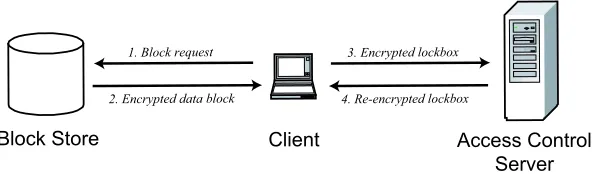
4. Re-encrypted lockbox 3. Encrypted lockbox 1. Block request
Block Store Client Access Control
Server
2. Encrypted data block
Figure 1: Operation of the proxy re-encryption file system. The user’s client machine fetches encrypted blocks from the block store. Each block includes a lockbox encrypted under a master public key. The client then transmits lockboxes to the access control server for re-encryption under the user’s public key. If the access control server possesses the necessary re-encryption key, it re-encrypts the lockbox and returns the new ciphertext. The client can then decrypt the re-encrypted block with the user’s secret key.
In this section we describe a file system which uses an untrusted access control server to manage access to encrypted files stored on distributed, untrusted block stores. We use proxy re-encryption to allow for access control without granting full decryption rights to the access control server. To our knowledge, our implementation represents the first experimental implementation and evaluation of a system using proxy re-encryption.
Overview. In our file system, end users on client machines wish to obtain access to integrity-protected,
Untrusted block stores make the encrypted content available to everyone. Users download the encrypted content from a block store, then communicate with an access control server to decrypt the lockboxes pro-tecting the content. The content owner selects which users should have access to the content and gives the appropriate delegation rights to the access control server.
Access Control Using Proxy Cryptography. We propose an improvement on the access control server
model that reduces the server’s trust requirements by using proxy cryptography. In our approach, the content keys used to encrypt files are themselves securely encrypted under a master public key, using a unidirectional proxy re-encryption scheme of the form described in this work. Because the access control server does not possess the corresponding secret key, it cannot be corrupted so as to gain access to the content keys necessary to access encrypted files. The secret master secret key remains offline, in the care of a content owner who uses it only to generate the re-encryption keys used by the access control server. When an authorized user requests access to a file, the access control server uses proxy re-encryption to directly re-encrypt the appropriate content key(s) from the master public key to the user’s public key.
This architecture has significant advantages over systems with trusted access control servers. The key material stored on the access control server cannot be used to access stored files, which reduces the need to absolutely trust the server operator, and diminishes the server’s value to attackers. The master secret key itself is only required by a content owner when new users are added to the system, and can therefore be stored safely offline where it is less vulnerable to compromise. Finally, the schemes in Section 3 are unidirectional and non-interactive, meaning that users do not need to communicate or reveal their secret keys in order to join the system. This allows content owners to add users to the system without interaction, simply by obtaining their public key. Because this system works with users’ long-term keys (rather than generating ephemeral keys for the user), there is an additional incentive for users not to reveal their decryption keys.
The proposed design fundamentally changes the security of an access control server storage system. In this new model, much of the security relies on the strength of a provably-secure cryptosystem, rather than on the trust of a server operator for mediating access control. Because the access control server cannot successfully re-encrypt a file key to a user without possessing a valid delegation key, the access control server cannot be made to divulge file keys to a user who has not been specifically authorized by the content owner, unless this attacker has previously stolen a legitimate user’s secret key.
Chefs. We implemented our file system on top of Chefs [22], a confidentiality-enabled version of the SFS
read-only file system [23]. Chefs is a single-writer, many-reader file system that provides decentralized ac-cess control in integrity-protected content distribution. A content owner creates a signed, encrypted database from a directory tree of content. The database is then replicated on untrusted hosts (e.g., volunteers). A client locates a replica, then requests the encrypted blocks. We chose the Chefs architecture because it allowed us to experiment with different granularities of encryption (per-file and per-block) while providing a transparent file system interface for our experiments.
Chefs tags each content block with a lockbox. In the original Chefs design, the lockbox contains a 128-bit AES key, itself encrypted with a shared group AES key. Chefs assumes an out-of-band mechanism for content owners to distribute group keys to users.
4.1 Design and Implementation
master public key using the “Third Attempt” bilinear Elgamal scheme from Section 3.1. This encryption results in a set of lockboxes stored with the file data, either in file or directory inodes (file and per-directory encryption) or within the blocks themselves (per-block encryption). The parameters of the proxy re-encryption scheme causes a sealed lockbox to expand to several hundred bits, even though the underlying plaintext is a 128-bit AES key.
When a client encounters a block for which it does not possess a content key, it asks the access control server to re-encrypt the lockbox from the master key to the client’s public key. If the access control server possesses an appropriate re-encryption key from the master key to the client’s key, it performs the appropriate proxy re-encryption and returns the resulting ciphertext to the client, which can then decrypt the lockbox under its own secret key. Figure 1 illustrates this procedure.
Each re-encryption call necessarily results in a round-trip network request, in addition to the proxy re-encryption and client-side decryption of the re-encrypted ciphertext. Thus, the choice of encryption granularity greatly affects the number of re-encryption calls made from the client to the access control server, which in turn affects the end-to-end performance of the system.
4.2 Experimental Results
In implementing a proxy re-encryption file system, we had two goals in mind. First, we wished to show that proxy re-encryption could be successfully incorporated into a basic cryptographic file system. Second, we sought to prove that the additional security semantics provided by a proxy re-encrypting access control server came at an acceptable cost to end-to-end performance.
To achieve this second goal, we conducted a number of benchmarks using the proxy-enabled Chefs file system using various granularities of content key usage (per-block and per-file). Along with these exper-iments, we conducted microbenchmarks of the proxy re-encryption functions used in our implementation, as well as application-level benchmarks measuring file system performance. To provide a standard of com-parison, we conducted the same experiments on an unmodified Chefs configuration with no access control server or proxy re-encryption, using only a single preset AES key to secure the contents of the database.
Experimental Setup. For the purposes of our testing, we used two machines to benchmark the
proxy-enabled Chefs file system. The client machine consisted of an AMD Athlon 2100+ 1.8 GHz with 1 Gbyte RAM and an IBM 7200 RPM, 40 Gbyte, Ultra ATA/100 hard drive. The server machine was an Intel Pentium 4 2.8 GHz with 1 Gbyte RAM and a Seagate Barracuda 7200 RPM, 160 Gbyte, Ultra ATA/100 hard drive. Both systems were running Debian testing/unstable with the Linux 2.6.8 kernel. The client and the server were situated in different cities, representing a distributed file system scenario. We measured the round-trip latency between the two machines at 13 msec, and the maximum sustained throughput of the network link at 7 Mbit/sec. We implemented the cryptographic primitives for the “Third Attempt” bilinear Elgamal scheme using version 4.83 of the MIRACL cryptographic library [39], which contains efficient implementations of the Tate pairing as well as fast modular exponentiation and point multiplication.
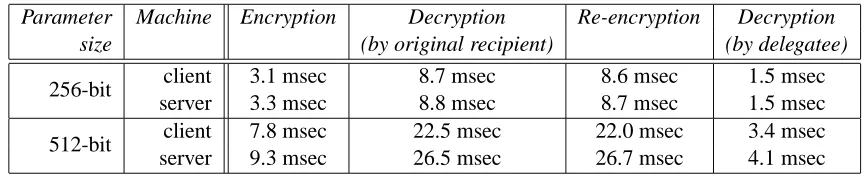
Cryptographic Benchmark. Table 2 presents average times over 100 runs of the cryptographic operations
Parameter Machine Encryption Decryption Re-encryption Decryption
size (by original recipient) (by delegatee)
256-bit client 3.1 msec 8.7 msec 8.6 msec 1.5 msec server 3.3 msec 8.8 msec 8.7 msec 1.5 msec
512-bit client 7.8 msec 22.5 msec 22.0 msec 3.4 msec server 9.3 msec 26.5 msec 26.7 msec 4.1 msec
Table 2: Average operation times for 100 runs of the “Third Attempt” bilinear Elgamal proxy re-encryption scheme on our client and server. All operations refer to re-encryptable “second-level” ciphertexts.
server, we suspect that the Intel server would perform better with proper selection of optimizations in MIR-ACL.
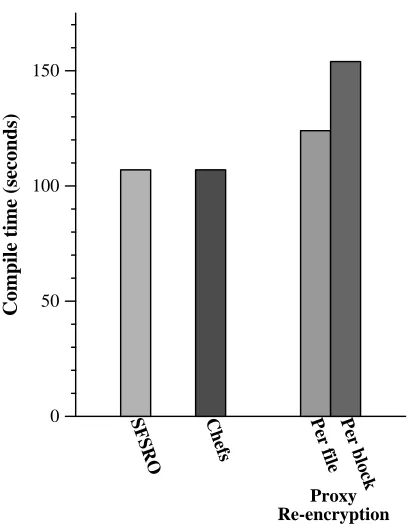
We conducted our remaining benchmarks using various encryption granularities, including per-block and per-file. For each measurement, we report the median result of five samples. In all measurements, the server has a warm block cache and the client has a cold block cache. Our microbenchmarks, presented in Figures 2 and 3, include runs of the small-file and large-file test from the LFS suite of file system perfor-mance tests [37]. We use the read phases of the LFS test to measure the fundamental perforperfor-mance of our system.
The first test reads several small files. The second test consists of a sequential read of a large file. These two tests capture common workloads in a typical file system. For each of these tests, we experimented with different encryption granularities, including per-block and per-file content keys. The small file benchmark in particular is a worst-case scenario for a proxy-enabled file system, as it requires a large number of lockbox re-encryptions relative to the amount of data read. On the other hand, the large-file workload tends to exhibit exactly the opposite effect, as the ratio of re-encryptions to data read is much smaller. In general, all per-block encryption scenarios tend to be the least efficient (and least practical) when proxy re-encryption is enabled.
Small-file Benchmark. The SFSRO and Chefs benchmarks each generate 2,022 RPCs to fetch content from
the block store (1,000 files, 10 directories, and one root directory — each generating two RPCs: one for the inode, one for the content).
Note that Chefs adds virtually no discernible overhead, even though the client decrypts every content fetch with 128-bit AES in CBC mode. With the round-trip time accounting for at least 26 seconds of the measurement, the network overshadows the cost of cryptography.
The proxy re-encryption file system first makes 2,022 fetches of content, just like Chefs. With per-file granularity of content keys, the small-per-file benchmark generates 1,011 re-encryption RPCs. The proxy re-encryption file system takes 44 seconds longer than Chefs. The 44 seconds corresponds exactly to the 13 msec round-trip time, 26.7 msec re-encryption time on the server, and 3.4 msec delegatee decryption time on the client for each of the 1,011 re-encryption RPCs (See Table 2).
With per-block granularity, the small-file benchmark generates 2,022 re-encryption RPCs. A file or directory consists of an inode and data block, thus each read now generates two re-encryptions. The proxy re-encryption file system takes 87 seconds longer than Chefs. Because the per-block re-encryption generates twice as many re-encryption RPCs as the per-file scenario, the results concur with our expectations.
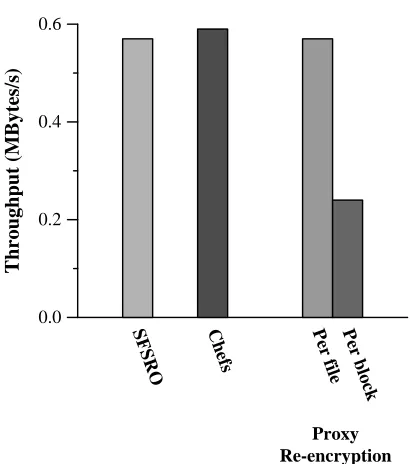
Large-file Benchmark. The large-file benchmark generates 5,124 RPCs to fetch 40 Mbyte of content from
0 50 100
Read time (seconds)
SFSRO Chefs Per file Per block
Proxy Re-encryption
Figure 2: Small-file microbenchmark from LFS suite. We perform a complete read on 1,000 1 Kbyte files dispersed in 10 directories.
0.0 0.2 0.4 0.6
Throughput (MBytes/s)
SFSRO Chefs Per file Per block
Proxy Re-encryption