A Linear Lower Bound on the Communication Complexity
of Single-Server Private Information Retrieval
∗Iftach Haitner† Jonathan J. Hoch† Gil Segev†
Abstract
We study the communication complexity of single-server Private Information Retrieval (PIR) protocols that are based on fundamental cryptographic primitives in a black-box manner. In this setting, we establish a tight lower bound on the number of bits communicated by the server in any polynomially-preserving construction that relies on trapdoor permutations. More specifically, our main result states that in such constructionsΩ(n) bits must be communicated by the server, wherenis the size of the server’s database, and this improves theΩ(n/logn) lower bound due to Haitner, Hoch, Reingold and Segev (FOCS ’07). Therefore, in the setting under consideration, the naive solution in which the user downloads the entire database turns out to be optimal up to constant multiplicative factors. We note that the lower bound we establish holds for the most generic form of trapdoor permutations, including in particular enhanced trapdoor permutations.
Technically speaking, this paper consists of two main contributions from which our lower bound is obtained. First, we derive a tight lower bound on the number of bits communicated by the sender during the commit stage of any black-box construction of a statistically-hiding bit-commitment scheme from a family of trapdoor permutations. This lower bound asymptotically matches the upper bound provided by the scheme of Naor, Ostrovsky, Venkatesan and Yung (CRYPTO ’92). Second, we improve the efficiency of the reduction of statistically-hiding commitment schemes to low-communication single-server PIR, due to Beimel, Ishai, Kushilevitz and Malkin (STOC ’99). In particular, we present a reduction that essentially preserves the communication complexity of the underlying single-server PIR protocol.
∗A preliminary version of this work appears as [19].
1 Introduction
A single-server Private Information Retrieval (PIR) scheme is a protocol between a server and a user. The server holds a databasex∈ {0,1}nand the user holds an indexi∈[n] to an entry of the database. Informally, the user wishes to retrieve theithentry of the database, without revealing the indexito the server. The notion of PIR was introduced by Chor, Goldreich, Kushilevitz and Sudan [4] to model applications that enable users to query public databases without revealing any information on the specific data that the users wish to retrieve. Chor et al. showed that in the information-theoretic setting any single-server PIR protocol has the server communicating at leastnbits. Therefore in this setting the naive solution in which the user downloads the entire database is optimal.
Kushilevitz and Ostrovsky [26] were the first to construct a non-trivial single-server PIR protocol relying on computational assumptions. Their result initiated a sequence of papers showing that there exist single-server PIR protocols with poly-logarithmic communication complexity based onspecific number-theoretic assumptions (see, for example, [2,3,12,26,28,41], and a recent survey by Ostrovsky and Skeith [35]). The only non-trivial construction based ongeneralcomputational assumptions is due to Kushilevitz and Ostrovsky [27], and is based on enhanced trapdoor permutations. In their construction, however, the server is required to communicaten−o(n) bits to the user.
Motivated by this ever-growing line of work, we study the communication complexity of single-server PIR protocols that are based on fundamental primitives. We establish a linear lower bound on the number of bits communicated by the server in constructions that rely on enhanced trapdoor permutations in a black-box manner. Therefore, in the setting under consideration in this paper, the naive solution in which the user downloads the entire database turns out to be optimal up to constant multiplicative factors. In the following paragraphs, we briefly describe the setting in which our lower bound is proved (a more formal description is provided in Section2).
Black-box reductions. As previously mentioned, under widely believed specific number-theoretic assump-tions, there are very efficient single-server PIR protocols. Therefore, if any of these assumptions holds, the existence of trapdoor permutations implies the existence of efficient single-server PIR protocols in a trivial sense. Faced with similar difficulties, Impagliazzo and Rudich [22] presented a paradigm for proving im-possibility results under a restricted, yet very natural and important, subclass of reductions calledblack-box reductions. Informally, a black-box reduction of a primitive P to a primitive Qis a construction of Pout ofQthat ignores the internal structure of the implementation of Qand uses it as a “subroutine” (i.e., as a black-box). In addition, in the case of fully-black-box reductions (see, for example, [36]), the proof of se-curity (showing that an adversary that breaks the implementation ofPimplies an adversary that breaks the implementation of Q), is black-box as well, that is, the internal structure of the adversary that breaks the implementation ofPis ignored.
The strength of cryptographic reductions. Luby [30] provides a classification of the strength of crypto-graphic reductions into three classes: linearly-preserving, polynomially-preserving and weakly-preserving. In our setting, this classification comes into play when comparing the size of the server’s database and the do-main of the trapdoor permutations. Very informally, a reduction of single-server PIR for ann-bit database to a family of trapdoor permutations is linearly-preserving or polynomially-preserving if it uses trapdoor permuta-tions overΩ(n) bits. Such a reduction is weakly-preserving if it uses trapdoor permutations overΩ(n) bits for
for a more comprehensive and complete discussion.
1.1 Related Work
Single-server PIR is one of the fundamental primitives in the foundations of cryptography. For example, non-trivial single-server PIR was shown to imply the existence of Oblivious Transfer protocols [5], and 2-move low-communication single-server PIR was shown to imply collision-resistant hash functions [23]. Single-server PIR was also shown to be tightly related to several other aspects of cryptography and complexity theory (see, for example, [6, 20, 24]). We note that it is far beyond the scope of this paper to present an exhaustive overview of the ever-growing line of work on single-server PIR, and we refer the reader to the recent survey of Ostrovsky and Skeith [35] for a more comprehensive discussion.
In the context of black-box reductions, Impagliazzo and Rudich [22] showed that there are no black-box reductions of key-agrement protocols to one-way permutations, and substantial additional work in this line followed (see, for example, [7, 13, 14, 37, 39]). Kim, Simon and Tetali [25] initiated a new line of impossibility results, by providing a lower bound on theefficiencyof black-box reductions (rather than on their feasibility). They proved a lower bound on the efficiency, in terms of the number of calls to the underlying primitive, of any black-box reduction of universal one-way hash functions to one-way permutations. This result was later improved, to match the known upper bound, by Gennaro and Trevisan [11], which together with Gennaro et al. [8,9] provided tight lower bounds on the efficiency of several other black-box reductions. Building upon the technique developed by [11], Horvitz and Katz [21] provided lower bounds on the efficiency of black-box reductions of statistically-hiding and computationally-binding commitment schemes to one-way permutations. In the above results the measure of efficiency under consideration is the number of calls to the underlying primitives.
Di Crescenzo, Malkin and Ostrovsky [5] showed that any single-server PIR protocol in which the server communicates at mostn−1 bits (wherenis the size of the server’s database) can be transformed in a fully-black-box manner to an Oblivious Transfer protocol. Gennaro, Lindell and Malkin [10] (refining Gertner et al. [13]) ruled out any black-box reduction of Oblivious Transfer to plain (i.e., non-enhanced) trapdoor permutations. The combination of these two results yields that there are no non-trivial black-box constructions of single-server PIR from non-enhanced trapdoor permutations. We note that although in this paper we rule out a more restricted class of constructions (that is, the class of fully-black-box constructions), our result holds for the most generic form of trapdoor permutations, including in particular enhanced trapdoor permutations.
Very recently, Haitner et al. [18], improving upon the work of Wee [42], proved that any polynomially-preserving fully-black-box reduction of a statistically-hiding bit-commitment scheme to trapdoor permuta-tions hasΩ(n/logn) communication rounds (wherenis the security parameter). As a corollary, they showed that any polynomially-preserving fully-black-box reduction of single-server PIR to trapdoor permutations has Ω(n/logn) communication rounds, where nis the size of the server’s database. In particular, the server is required to communicateΩ(n/logn) bits to the user. Haitner et al. also established similar lower bounds on the communication complexity of Oblivious Transfer that guarantees statistical security for one of the parties and for Interactive Hashing.
In a slightly different setting, Ostrovsky and Skeith [34] proved a lower bound on the communication complexity of single-server PIR protocols with certain algebraic properties. For a class of PIR protocols, referred to as abelian group algebraic PIR protocols, with user-side communication complexity g(n) and server-side communication complexityh(n) they proved thatg(n)h(n)= Ω(n).
1.2 Our Results
is the following:
Main Theorem (Informal). In any polynomially-preserving fully-black-box construction of a single-server PIR protocol from trapdoor permutations the server communicatesΩ(n)bits, where n is the size of the server’s database.
As mentioned above, the combination of the results of Di Crescenzo et al. [5] and of Gennaro et al. [10] rules out the more general class of black-box reductions of single-server PIR withn−1 bits of communication to trapdoor permutations. This result, however, does not apply to enhanced trapdoor permutations. We note that our lower bound holds for the most generic form of trapdoor permutations, and in particular for enhanced trapdoor permutations.1
In addition, we note that our lower bound holds only for constructions which are polynomially-preserving. The construction of Kushilevitz and Ostrovsky [27], which is based on enhanced trapdoor permutations in a fully-black-box manner and in which the server communicatesn−o(n) bits, is only weakly-preserving (i.e., it is significantly easier to break their protocol than to break the security of the underlying family of trapdoor permutations 2). Thus, the question of whether a tight linear lower bound can be established for weakly-preserving constructions as well remains open.
The main technical contributions. This paper consists of two main contributions from which our lower bound is immediately obtained. First, we derive a tight lower bound on the communication complexity of black-box constructions of statistically-hiding bit-commitment schemes from trapdoor permutations. Very re-cently, Haitner et al. [18] proved that any polynomially-preserving fully-black-box construction of statistically-hiding bit-commitment scheme from a family of trapdoor permutations hasΩ(n/logn) communication rounds, wherenis the security parameter of the scheme. In particular, this implies a lower bound on the number of bits communicated by the sender. In this paper we manage to improve their lower bound and prove the following theorem:
Theorem (Informal) 1.1. In any polynomially-preserving fully-black-box construction of a statistically-hiding bit-commitment scheme from a family of trapdoor permutations the sender communicatesΩ(n) bits during the commit stage, where n is the security parameter of the scheme.
This lower bound asymptotically matches the upper bound given by the statistically-hiding commitment scheme of Naor et al. [31].
In addition, we improve the efficiency of the reduction of statistically-hiding commitment schemes to single-server PIR, presented by Beimel et al. [1]. Our reduction essentially uses the reduction of Beimel et al. instantiated with a better extractor, which enables us to preserve the communication complexity of the underlying single-server PIR protocol. As stating this result turns out to involve subtle technical details, here we only state a very informal statement:
Theorem (Informal) 1.2. There is a linearly-preserving fully-black-box reduction of statistically-hiding com-mitment schemes to low-communication single-server PIR, which essentially preserves the communication complexity of the underlying single-server PIR protocol.
1Note that enhanced trapdoor permutations are, seemingly, stronger than plain trapdoor permutations. Therefore, although our result is weaker in terms of the class of reductions and the bound on the communication complexity, it provides the first evidence that enhanced trapdoor permutations are not sufficient to construct single-server PIR with sublinear communication (at least from a black-box perspective).
1.3 Paper Organization
In Section 2 we briefly present the notations and formal definitions used in this paper. In Section 3 we prove our tight lower bound on the number of bits communicated by the sender during the commit stage of statistically-hiding commitment schemes. In Section4 we describe an improved reduction of statistically-hiding commitment scheme to low-communication single-server PIR. Finally, in Section5we establish the lower bound for single-server PIR by combining our main technical contributions.
2 Preliminaries
We denote byΠn the set of all permutations over{0,1}n. For an integern, we denote byUn the uniform distribution over the set{0,1}n. For a finite setX, we denote byx←Xthe experiment of choosing an element ofXaccording to the uniform distribution. Similarly, for a distributionDover a setX, we denote byx ← D the experiment of choosing an element ofX according to the distributionD. For a distributionDwe denote by supp(D) set of elements having non-zero probability underD. The min-entropy ofDis defined as:
H∞(D)= min x∈supp(D) log
1 PrD[x]
!
.
The statistical distance between two distributionsXandY overΩis denoted SD(X,Y), and defined as
SD(X,Y)= 1 2
X
ω∈Ω
|PrX[ω]−PrY[ω]| .
Definition 2.1. A functionE :{0,1}n× {0,1}d → {0,1}mis a (k, )-extractor if for every distributionXover {0,1}n with H
∞(X) ≥ k the distributionE(X,Ud) is-close to uniform. E is astrong (k, )-extractor if the functionE0(x,y)=y◦E(x,y) is a (k, )-extractor (where◦denotes concatenation).
In our construction of a statistically-hiding commitment scheme from single-server PIR we will be using the following explicit construction of strong extractors, which is obtained as a corollary of [40, Corollary 3.4].
Proposition 2.2. For anyk ∈ ω(log(n)), there exists an explicit strong (k,21−k)-extractor EXT : {0,1}n × {0,1}3k → {0,1}k/2.
The following standard fact (see, for example [38, Fact 2.6]) will be useful for us in analyzing statistically-close distributions.
Fact 2.3. If X and Y are two distributions such thatSD(X,Y)< , then with probability at least1−2√over x←X it holds that
1− √·Pr [X= x]<Pr [Y = x]<1+ √·Pr [X= x] .
2.1 Trapdoor Permutations
We briefly present the notion of trapdoor permutations, and refer the reader to [15] for a more comprehensive discussion. A collection of trapdoor permutations is represented by a triplet of the formτ = G,F,F−1.
Informally,G corresponds to a key generation procedure, which is queried on a stringtd (intended as the “trapdoor”) and produces a corresponding public keypk. The procedureFis the actual collection of permu-tations, which is queried on a public keypk and an input x. Finally, the procedureF−1 is the inverse ofF:
IfG(td) = pk andF(pk,x) = y, then F−1(td,y) = x. In this paper, since we are concerned with providing a
lower bound, we do not consider the most general definition of a collection of trapdoor permutations. Instead, we denote byTnthe set of all tripletsτn =
Gn,Fn,Fn−1
1. Gn ∈Πn.
2. Fn :{0,1}n× {0,1}n→ {0,1}nis a function such thatF
n(pk,·)∈Πnfor everypk∈ {0,1}n.
3. F−1
n :{0,1}n× {0,1}n→ {0,1}nis a function such thatFn−1(td,y) returns the uniquex∈ {0,1}nfor which Fn(Gn(td),x)=y.
Our lower bound proof is based on analyzing random instances of such collections. A uniformly dis-tributedτn∈Tncan be chosen as follows:Gnis chosen uniformly at random fromΠn, and for eachpk∈ {0,1}n a permutationFn(pk,·) is chosen uniformly and independently at random fromΠn.
Definition 2.4. A familyτ=nτn =
Gn,Fn,F−n1
o∞
n=1of trapdoor permutations iss(n)-hardif for every
prob-abilistic Turing-machineAthat runs in times(n), and for all sufficiently largen,
PrhAτ(1n,Gn(td),y)=F−n1(td,y)
i
≤ 1 s(n) ,
where the probability is taken uniformly over all the possible choices oftd∈ {0,1}nandy∈ {0,1}n, and over all the possible outcomes of the internal coin tosses ofA.
Definition2.4refers to the difficulty of inverting a random permutationF(pk,·) on a uniformly distributed imagey, when given only pk = G(td) and y. Some applications, however, require enhanced hardness con-ditions. For example, it may be required (cf. [16, Appendix C]) that it is hard to invert F(pk,·) ony even given the random coins used in the generation ofy. Note that our formulation captures such hardness con-dition as well and therefore the impossibility results proved in this paper hold also for enhanced trapdoor permutations.3
2.2 Single-Server Private Information Retrieval
A single-server Private Information Retrieval (PIR) scheme is a protocol between a server and a user. The server holds a database x ∈ {0,1}n and the user holds an index i ∈ [n] to an entry of the database. Very informally, the user wishes to retrieve theithentry of the database, without revealing the indexito the server. More formally, a single-server PIR scheme is defined via a pair of probabilistic polynomial-time Turing-machines (S,U) such that:
• Sreceives as input a stringx∈ {0,1}n. Following its interaction it does not have any output.
• Ureceives as input an indexi∈[n]. Following its interaction it outputs a valueb∈ {0,1,⊥}.
Denote by b ← hS(x),U(i)i the experiment in which S and U interact (using the given inputs and uniformly chosen random coins), and thenUoutputs the valueb. It is required that there exists a negligible functionν(n), such that for all sufficiently largen, and for every string x= x1◦ · · · ◦xn ∈ {0,1}n, it holds that xi← hS(x),U(i)iwith probability at least 1−ν(n) over the random coins of bothSandR.
In order to define the security properties of such schemes, we first introduce the following notation. Given a single-server PIR scheme (S,U) and a Turing-machineS∗(a malicious server), we denote byview
hS∗,U(i)i(n) the distribution on the view ofS∗when interacting withU(i) wherei∈[n]. This view consists of its random coins and of the sequence of messages it receives fromU, where the distribution is taken over the random coins of bothS∗andU.
Definition 2.5.A single-server PIR scheme (S,U) is secure if for every probabilistic polynomial-time Turing-machinesS∗andD, and for every two sequences of indices{i
n}∞i=1and{jn}i∞=1 wherein,jn ∈[n] for everyn, it holds that
Prhv←viewhS∗,U(in)i(n) :D(v)=1
i
−Prhv←viewhS∗,U(jn)i(n) :D(v)=1i≤ν(n) ,
for some negligible functionν(n) and for all sufficiently largen.
2.3 Commitment Schemes
A commitment scheme is a two-stage interactive protocol between a sender and a receiver. Informally, after the first stage of the protocol, which is referred to as thecommit stage, the sender is bound to at most one value, not yet revealed to the receiver. In the second stage, which is referred to as thereveal stage, the sender reveals its committed value to the receiver. More formally, a commitment scheme is defined via a triplet of probabilistic polynomial-time Turing-machines (S,R,V) such that:
• Sreceives as input the security parameter 1nand a stringx∈ {0,1}k. Following its interaction, it outputs some informationdecom(the decommitment).
• Rreceives as input the security parameter 1n. Following its interaction, it outputs a state information
com(the commitment).
• V(acting as the receiver in the reveal stage4) receives as input the security parameter 1n, a commitment
comand a decommitmentdecom. It outputs either a stringx0∈ {0,1}k or⊥.
Denote by (decom|com) ← hS(1n,x),R(1n)ithe experiment in whichSandRinteract (using the given inputs and uniformly chosen random coins), and thenSoutputsdecomwhileRoutputscom. It is required that for alln, every stringx∈ {0,1}k, and every pair (decom|com) that may be output byhS(1n,x),R(1n)i, it holds thatV(com,decom) = x.5 In the remainder of the paper, it will often be convenient for us to identify
VwithR, and refer to a commitment scheme as a pair (S,R).
The security of a commitment scheme can be defined in two complementary ways, protecting against ei-ther an all-powerful sender or an all-powerful receiver. In this paper, we deal with commitment schemes of the latter type, which are referred to asstatistically-hidingcommitment schemes. In order to define the security properties of such schemes, we first introduce the following notation. Given a commitment scheme (S,R) and a Turing-machineR∗, we denote byview
hS(x),R∗i(n) the distribution on the view ofR∗when interacting withS(1n,x). This view consists ofR∗’s random coins and of the sequence of messages it receives from S. The distribution is taken over the random coins of bothSandR∗. Note that whenever no computational restrictions are assumed onR∗, without loss of generality we can assume thatR∗is deterministic.
Definition 2.6. A commitment scheme (S,R) is ρ(n)-hiding if for every deterministic Turing-machineR∗, and for every two sequences of strings{xn}∞i=1 and{x0n}∞i=1 wherexn,x0n ∈ {0,1}k(n) for everynthe ensembles {viewhS(xn),R∗i(n)}and{viewhS(x0
n),R∗i(n)}have statistical difference at mostρ(n) for all sufficiently largen. Such a scheme isstatistically-hidingif it isρ(n)-hiding for some negligible functionρ(n).
Our lower bound for commitment schemes holds in fact under a weaker hiding requirement. We derive our results even for commitment schemes in which the sender is statistically protected only against an honest receiver. Such schemes are referred to asstatistically-hiding honest-receivercommitment schemes. Formally,
4Note that there is no loss of generality in assuming that the reveal stage is non-interactive. This is since any such interactive stage can be replaced with a non-interactive one as follows: The sender sends its internal state to the receiver, who then simulates the sender in the interactive stage.
it is only required that the statistical difference between the ensembles{viewhS(xn),Ri(n)}and{viewhS(x0 n),Ri(n)} is some negligible function ofn.
Definition 2.7. A commitment scheme (S,R,V) isµ(n)-bindingif for every probabilistic polynomial-time Turing-machineS∗it holds that the probability that ((decom,decom0)|com) ← hS∗(1n),R(1n)i(where the probability is over the random coins of bothS∗andR) such that V(com,decom) , V(com,decom0) and V(com,decom),V(com,decom0) , ⊥ is negligible in n for all sufficiently large n. Such a scheme is computationally-bindingif it is µ(n)-binding for some negligible function µ(n), and isweakly-binding if it is (1−1/p(n))-binding for some polynomialp(n).
2.4 Black-Box Reductions
A reduction of a primitivePto a primitiveQis a construction ofPout ofQ. Such a construction consists of showing that if there exists an implementationCofQ, then there exists an implementationMC ofP. This is equivalent to showing that for every adversary that breaksMC, there exists an adversary that breaksC. Such a reduction issemi-black-boxif it ignores the internal structure ofQ’s implementation, and it isfully-black-box if the proof of correctness is black-box as well, i.e., the adversary for breakingQignores the internal structure of bothQ’s implementation and of the (alleged) adversary breaking P. Semi-black-box reductions are less restricted and thus more powerful than fully-black-box reductions. A taxonomy of black-box reductions was provided by Reingold, Trevisan and Vadhan [36], and the reader is referred to their paper for a more complete and formal view of these notions.
We now formally define the class of constructions considered in this paper. Our results in the current paper are concerned with the particular setting of fully-black-box constructions of single-server PIR and of statistically-hiding commitment schemes from trapdoor permutations. We focus here on specific definitions for these particular primitives and we refer the reader to [36] for a more general definition.
When examining efficiency measures of fully-black-box constructions, an essential parameter for such characterizations, as introduced by Haitner et al. [18], is thesecurity-parameter-expansion of the construc-tion. Consider, for example, a fully-black-construction of a commitment scheme from a family of trapdoor permutations. One ingredient of such a construction is a machine Athat attempts to break the security of the trapdoor permutation family given oracle access to any malicious senderS∗that breaks the security of the commitment scheme. Then,Areceives a security parameter 1n(and possibly some additional inputs) and invokesS∗ in a black-box manner. The standard definition does not restrict the range of security parame-ters thatA is allowed to invokeS∗ on. For example, Amay invoke S∗ on security parameter 1n2
, or even on security parameter 1Θ(s(n)), where s(n) is the running time of A. In this paper, we will use the notion `(n)-expanding for short, and note that according to Luby’s classification [30], any polynomially-preserving reduction isO(n)-expanding in our terminology.
Definition 2.8. A fully-black-box`(n)-expanding construction of a single-server PIR scheme from an s(n)-hard family of trapdoor permutations is a triplet of probabilistic oracle Turing-machines (S,U,A) for which the following hold:
1. Correctness:For every familyτof trapdoor permutations, (Sτ,Uτ) is a single-server PIR scheme.
2. Black-box proof of security: For every familyτ = nτn=
Gn,Fn,F−n1
o∞
n=1of trapdoor permutations
and for every probabilistic polynomial-time Turing-machineS∗, ifS∗with oracle access toτbreaks the security of (Sτ,Uτ), then
PrhAτ,S∗(1n,Gn(td),y)=F−n1(td,y)
i
for infinitely many values ofn, whereAruns in times(n) and invokesS∗on security parameters which are at most 1`(n). The probability is taken uniformly over all the possible choices oftd ∈ {0,1}n and y∈ {0,1}n, and over all the possible outcomes of the internal coin tosses ofA.
Definition 2.9. A fully-black-box`(n)-expanding construction of a weakly-binding and statistically-hiding honest-receiver commitment scheme from ans(n)-hard family of trapdoor permutations is a triplet of proba-bilistic oracle Turing-machines (S,R,A) for which the following hold:
1. Correctness: For every family τof trapdoor permutations, (Sτ,Rτ) is a statistically-hiding
honest-receiver commitment scheme.
2. Black-box proof of binding: For every familyτ = nτn=Gn,Fn,F−1
n
o∞
n=1 of trapdoor permutations
and for every probabilistic polynomial-time Turing-machineS∗, ifS∗with oracle access toτbreaks the binding of (Sτ,Rτ), then
PrhAτ,S∗(1n,Gn(td),y)=F−n1(td,y)
i
> 1 s(n) ,
for infinitely many values ofn, whereAruns in times(n) and invokesS∗on security parameters which are at most 1`(n). The probability is taken uniformly over all the possible choices oftd ∈ {0,1}n and y∈ {0,1}n, and over all the possible outcomes of the internal coin tosses ofA.
We remark that the above correctness requirements are very strict and are not essential for our results. For example, in the setting of commitment schemes, for everyτsuch that the protocol (Sτ,Rτ) is a weakly-binding
statistically-hiding honest-receiver commitment scheme, we construct a malicious senderS∗which breaks the binding property of the scheme. Therefore, we could have dealt with weaker correctness requirements as well, but stating such a weaker requirement in a meaningful way turns out to be quite subtle.
3 Communication Lower Bound for Statistically-Hiding Commitment Schemes
In this section we prove a lower bound on the communication complexity of fully-black-box constructions of statistically-hiding commitment schemes from trapdoor permutations. We establish a lower bound on the number of bits communicated by the sender during the commit stage of any such scheme. Since we are interested in proving an impossibility result for commitment schemes, it will be sufficient for us to deal with bit-commitment schemes. We prove the following theorem:
Theorem 3.1. In any fully-black-box O(n)-expanding construction of a weakly-binding statistically-hiding honest-receiver bit-commitment scheme from a family of trapdoor permutations, the sender communicates Ω(n)bits during the commit stage.
The proof of Theorem 3.1 follows the approach and technique of Haitner at el. [18] who constructed a “collision-finding” oracle in order to derive a lower bound on the round complexity of statistically-hiding commitment schemes. Given any fully-black-boxO(n)-expanding construction (S,R,A) of a weakly-binding statistically-hiding honest-receiver bit-commitment scheme from a family of trapdoor permutations τ, we show that relative to their oracle the following holds: (1) there exists a malicious senderS∗that breaks the binding of the scheme (Sτ,Rτ), and (2) if the sender communicates o(n) bits during the commit stage of
3.1 The Oracle
We briefly describe the oracle constructed by Haitner et al. [18] and state its main property. The oracle is of the formO = (τ,Samτ), whereτis a family of trapdoor permutations (i.e.,τ = {τn}∞n=1, whereτn ∈ Tnfor everyn), andSamτis an oracle that, very informally, receives as input a description of a circuitC(which may containτ-gates) and a stringz, and outputs a uniformly distributed preimage ofzunder the mapping defined byC. As discussed in [18], several essential restrictions are imposed on the querying ofSamthat prevent it from assisting in invertingτ.
Description ofSam. The oracleSamreceives as input a query of the formQ= (Cτ
next,Cτ,z), and outputs
a pair (w0,z0) wherew0 is a uniformly distributed preimage ofzunder the mapping defined by the circuitCτ,
andz0=Cτ
next(w0). We impose the following restrictions:
1. zwas the result of a previous query withCτas the next-query circuit (note that this imposes a forest-like
structure on the queries).
2. The circuitCτ
next is a refinement of the circuitCτ, where by a refinement we mean thatCτnext(w) =
(Cτ(w),Ceτ(w)) for some circuitCeτ and for everyw. In particular, this implies thatCτandCτnext have the same input length. Given a queryQ, we denote this input length bym(Q), and when the queryQis clear from the context we will write onlym.
3. Each query contains a security parameter 1n, andSamanswers queries only up to depthdepth(n), for some “depth restriction” functiondepth : N → N which is a part of the description of Sam. The security parameter is set such that a query with security parameter 1nis allowed to contain circuits with queries to permutations on up tonbits. Note that although different queries may have different security parameters, we ask that in the same “query-tree”, all queries will have the same security parameter (hence the depth of the tree is already determined by the root query).
In order to impose these restrictions, Sam is equipped with a family sign = {signk}∞
k=1 of (random)
functionssignk :{0,1}k → {0,1}2k that will be used as “signatures” for identifying legal queries as follows: in addition to outputting (w0,z0), Sam will also output the value sign(1n,Cτ
next,z0,dep +1), where dep is
the depth of the query, 1n is the security parameter of the query, and by applying the “function” signwe actually mean that we apply the function signk for the correct input length. Each query of the form Q = (1n,Cτ
next,Cτ,z,dep,sig) is answered bySamif and only ifCτnext is a refinement ofCτ,dep ≤ depth(n) and
sig=sign(1n,Cτ,z,dep).
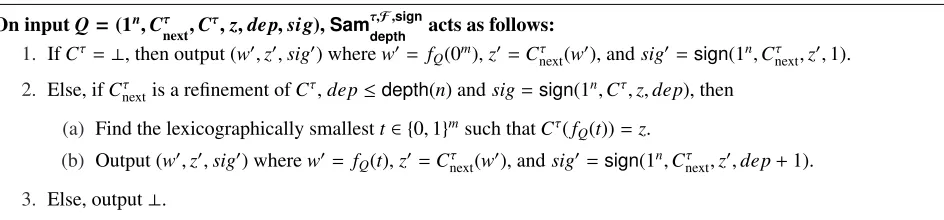
Finally,Samis provided with a family of (random) permutationsF ={fQ}, where for every possible query Qa permutation fQis chosen uniformly at random fromΠm(Q). Given a queryQ=(1n,Cnextτ ,Cτ,z,dep,sig),
the oracleSam uses the permutation fQ ∈ F in order to sample w0 as follows: it outputs w0 = f Q(t) for the lexicographically smallestt∈ {0,1}msuch thatCτ(fQ(t)) = z. Note that whenever the permutation fQis chosen fromΠm uniformly at random, and independently of all other permutations inF, thenw0 is indeed a uniformly distributed preimage ofz. In this paper, whenever we consider the probability of an event over the choice of the familyF, we mean that for each queryQa permutation fQis chosen uniformly at random fromΠm(Q) and independently of all other permutations. A complete and formal description of the oracle is
provided in Figure1.
Definition 3.2. We say that a circuitAqueries the oracleSamτ,depthF,signup to depthd, if for everySam-query Q=(1n,Cπ
next,Cπ,z,dep,sig) thatAmakes, it holds thatdep≤d.
On inputQ=(1n,Cτ
next,C
τ,z,dep,sig),Samτ,F,sign
depth acts as follows: 1. IfCτ=⊥, then output (w0,z0,sig0) wherew0= f
Q(0m),z0=Cnextτ (w0), andsig0=sign(1n,Cτnext,z0,1).
2. Else, ifCτ
nextis a refinement ofCτ,dep≤depth(n) andsig=sign(1n,Cτ,z,dep), then
(a) Find the lexicographically smallestt∈ {0,1}msuch thatCτ(f
Q(t))=z.
(b) Output (w0,z0,sig0) wherew0= f
Q(t),z0=Cnextτ (w0), andsig0=sign(1n,Cτnext,z0,dep+1).
3. Else, output⊥.
Figure 1:The oracleSam.
Haitner et al. managed to relate this success probability to the maximal depth of theSam-queries made by the
circuit, and to the size of the circuit. They proved the following theorem:
Theorem 3.3([18]). For every circuit A of size s(n)that queriesSamup to depth d(n)such that s(n)3d(n)+2< 2n/8, for every depth restriction functiondepthand for all sufficiently large n, it holds that
Prtd←{0,1}n,τ,F y←{0,1}n,sign
Aτ,Samτ,depthF,sign(Gn(td),y)= F−1
n (td,y)
≤ 2
s(n) .
3.2 Breaking Low-Communication Statistically-Hiding Commitment Schemes
We show that a random instance of the oracleSamcan be used to break the binding of any statistically-hiding
commitment scheme. Specifically, for every bit-commitment scheme (S,R) which is (1) weakly-biding, (2)
statistically-hiding against an honest-receiver, and (3) has oracle access to a familyτof trapdoor permutations,
we construct a malicious senderS∗which has oracle access toSamτ,F,sign
depth , and breaks the binding of (Sτ,Rτ)
with sufficiently high probability over the choices ofτ,F andsign. Formally, the following theorem is proved:
Theorem 3.4. For any statistically-hiding honest-receiver bit-commitment scheme(S,R,V)with oracle
ac-cess to a family of trapdoor permutations in which the sender communicates at most c(n) bits during the
commit stage, and for any polynomial p(n), there exists a polynomial-time malicious senderS∗such that
Prτ,F,sign,rR
((decom,decom0)|com)←
S∗Samτ,depthF,sign(1n),Rτ(1n,rR)
:
Vτ(com,decom)=0,Vτ(com,decom0)=1 >1−
1
p(n) ,
for all sufficiently large n, wheredepth(n)=llogc(n)nm+1.
In what follows we introduce the notation used in this section. We proceed with a brief presentation of
the main ideas underlying the proof of Theorem3.4. Then, we formally describe the malicious senderS∗and
analyze its success probability in order to prove Theorem3.4.
Notations. Let (S,R) be a bit-commitment scheme with oracle access to a family of trapdoor permutations.
We denote byb ∈ {0,1}andrS,rR ∈ {0,1}∗ the input bit of the sender and the random coins of the sender
and the receiver, respectively. We denote byc(n) the maximal number of bits communicated from the sender
to the receiver in the commit stage with security parameter 1n. In addition we denote byd(n) the number of
communication rounds in the scheme with security parameter 1n, and without loss of generality we assume
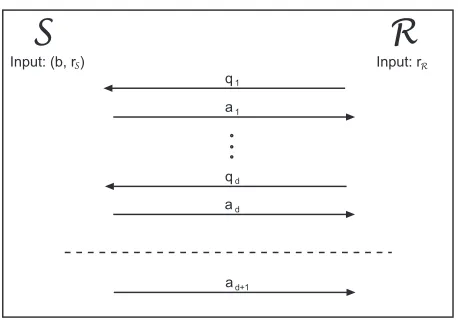
that the receiver makes the first move. Each communication round consists of a message sent from the receiver
to the sender followed by a message sent from the sender to the receiver. We denote byqiandaithe messages
1
q
1
a Input: (b, r )
S
R
S Input: rR
d
q
d
a
d+1
a
Figure 2:Ad-round bit-commitment scheme.
the sender in the reveal stage. Finally, we let ¯ai = (a1, . . . ,ai) and ¯qi = (q1, . . . ,qi). A generic d-round
bit-commitment scheme is described in Figure2.
Although the sender is a probabilistic polynomial-timeTuring-machine, in order to interact with the oracle
Samwe need to identify the sender with a sequence of polynomial-sizecircuits S1, . . . ,Sd+1 as follows. In
the first round,Ssendsa1by computinga1=S1(b,rS,q1). Similarly, in the following rounds,Ssendsaiby
computingai=Si(b,rS,q¯i).
Finally, in order to simplify the notation regarding the input and output of the oracleSam, in this section
we ignore parts of the input and output of Sam: we ignore the security parameter and the “signatures”
(since our malicious senderS∗ will only ask legal queries), and consider queries of a simplified formQ =
(Cτnext,Cτ,z), and answers that consist only of w0 (i.e., an answer consists only of a uniformly distributed
preimage ofz under the mapping defined byCτ). In addition, in what follows it will be more intuitive to
replacezin the queries by its preimagew, but this is clearly not essential.
A brief overview. Informally, recall that the oracleSamdescribed in Section3.1acts as follows: Samis
given as input a queryQ=(Cnext,C,z), and outputs a pair (w0,z0) wherew0is a uniformly distributed preimage
ofzunder the mapping defined by the circuitC, andz0 =C
next(w0). In addition, we imposed the restriction that
there was a previous query (C,·,·) that was answered by (w,z) (note that this imposes a forest-like structure
on the queries), and we only allow queryingSamup to depthO(n/logn).
Given a statistically-hiding bit-commitment scheme in which the sender communicatesc(n) bits during
the commit stage, we assume without loss of generality that the commit stage of the scheme hasc(n)
com-munication rounds, where in each round the sender communicates a single bit to the receiver. The malicious
senderS∗operates as follows: it chooses a random inputw(consisting of random coins and a random
com-mitted bit), and during the first lognrounds it simulates the honest sender. In these lognrounds, it receives
lognmessagesq1, . . . ,qlogn from the receiver. Then,S∗ constructs the circuitCq1,...,qlogn that receives as
in-put the sender’s inin-putw and outputs the lognsender’s messages corresponding to the receiver’s messages
q1, . . . ,qlogn. This circuit is used to querySamfor a random inputw1. It may be the case, however, thatw1
is not consistent with the actual messagesa1, . . . ,alognthatS∗sent in the first lognrounds. In this case,S∗
“rewinds”Samfor a polynomial number of times, and since the total length of the sender’s messages in these
logn rounds is only lognbits, then with sufficiently high probability S∗will obtain a consistent w
1. Now,
in the next lognrounds the malicious senderS∗simulates the honest sender with inputw1, and at the end
of these lognrounds it will query (and rewind)Sam again for another consistent inputwlogn+1, and so on.
Finally, after completing the commit stage,S∗queriesSamto obtain two random inputsw
with probability roughly half they can be used to break the binding of the protocol. A crucial point in this
description, is thatS∗ queriesSam only up to depthc(n)/logn (S∗ usedSam to obtainc(n)/logn values
w1,wlogn+1, . . . ,wc(n)). Therefore, ifc(n) = o(n), then an oracleSamthat answers queries only up to depth
c(n)/logncannot be used to invert a random trapdoor permutation, according to Theorem3.3.
A formal description ofS∗. Given a bit-commitment scheme (S,R) in which the sender communicatesc(n)
bits during the commit stage, we assume without loss of generality (and for simplicity of the presentation)
that the scheme hasc(n) communication rounds (i.e.,d(n) = c(n)) where in each round during the commit
stage the sender communicates a single bit to the receiver (i.e., each ofa1, . . . ,ad(n)is one bit). Furthermore,
in order to simplify the description ofS∗, we assume that lognis an integral value (where 1nis the security
parameter given as input toS∗) and thatc(n)=M·logn+1 for some integerM= M(n). We stress that these
assumptions are not at all essential, but avoiding them will result in a more complicated description. On input
1n, the malicious senderS∗with oracle access toSamτ,F,sign
depth interacts with the honest receiverRas follows.
1. The commit stage:
(a) In the first roundS∗ receivesR’s messageq1, and computes the description of the circuitC1 =
S1(·,·,q1) obtained from the circuitS1by fixingq1as its third input. Then,S∗queriesSamτ,depthF,sign with (C1,⊥,⊥), receives an answerw1 =(b1,r1) and sendsa1=S1(b1,r1,q1) toR.
(b) In every round i ∈ {2, . . . ,logn}, S∗ simulates the honest senderS with input w
1. That is, S∗
receivesR’s messageqi and replies withai =Si(b1,r1,q¯i).
(c) In round logn+1,S∗receivesR’s messageq
logn+1, and computes the description of the circuit
Clogn+1 = Slogn+1(·,·,q¯logn+1) obtained from the circuitSlogn+1by fixing ¯qlogn+1 as its third
in-put. Then,S∗queries Samτ,F,sign
depth with (Clogn+1,C1,w1) fort = 2n5c(n)p(n) times and receives
tanswers. If one of these answers is consistent with the transcript of the protocol so far, then
denote the first such answer bywlogn+1 = (blogn+1,rlogn+1), and in this caseS∗sends the
mes-sagealogn+1 = Slogn+1(blogn+1,rlogn+1,q¯logn+1) to R. Otherwise,S∗ aborts the execution of the protocol.
(d) In the remainder of the commit stageS∗acts as follows:
i. For every k and in every roundi ∈ {(k−1) logn+2, . . . ,klogn}, the malicious senderS∗
simulates the honest senderSwith inputw(k−1) logn+1.
ii. For every integerkand in every roundklogn+1 the malicious senderS∗receivesR’s
mes-sageqklogn+1, and computes the description of the circuitCklogn+1 = Sklogn+1(·,·,q¯klogn+1)
obtained from the circuit Sklogn+1 by fixing ¯qklogn+1 as its third input. Then, S∗ queries
Samτ,depthF,signwith (Cklogn+1,C(k−1) logn+1,w(k−1) logn+1) fort= 2n5c(n)p(n) times and receives
t answers. If one of these answers is consistent with the transcript of the protocol so far,
then denote the first such answer bywklogn+1=(bklogn+1,rklogn+1), and in this caseS∗sends aklogn+1 = Sklogn+1(bklogn+1,rklogn+1,q¯klogn+1) toR. Otherwise,S∗aborts the execution of the protocol.
2. The reveal stage:
(a) S∗queriesSamτ,F,sign
depth with (⊥,Cd(n),wd(n)) forntimes, and receivesnpairs n
b(dj()n)+1,r(dj()n)+1on
j=1. If there exist j0,j1∈[n] such thatbd(j(0n))+1=0 andb(dj(1n))+1 =1, thenS∗outputs the two values
decom= Sd(n)+1
b(j0)
d(n)+1,r (j0)
d(n)+1,q¯d(n)
decom0 = Sd(n)+1
b(j1)
d(n)+1,r (j1)
d(n)+1,q¯d(n)
Otherwise,S∗aborts the execution of the protocol.
Two minor technical details were omitted from the description. First, according to the description of
Sam(Section3.1), wheneverSamis queried multiple times with the same input, it returns the exact same
answer. Thus, wheneverS∗queriesSammore than once with the same input,S∗ has to make sure that the
queries are all different (for example, by artificially embedding the query number to one of the circuits in the
query). Second, in order forS∗’s queries to be legal, it should hold that the circuitCklogn+1is a refinement
of the circuitC(k−1) logn+1for every integerk (as discussed in Section3.1). This can be done very easily by
embedding the description of eachC(k−1) logn+1inside eachCklogn+1(i.e., the output ofCiis the sequence of
bits ¯aiinstead of only the bitai).
We proceed by arguing that the malicious senderS∗ successfully completes the commit stage with high
probability. Then, given thatS∗has successfully completed the commit stage, we prove that the transcript of
the commit stage is distributed identically to the transcript of the commit stage in an honest execution of the protocol. This enables us to use the fact that the commitment scheme is statistically-hiding, and therefore a
random transcript can be revealed both as a commitment tob=0 and as a commitment tob=1, with almost
equal probabilities.
Lemma 3.5. The malicious senderS∗successfully completes the commit stage with probability at least1−
1/(n3p(n))over the choices ofτ,F,signand r
R.
Proof. The malicious senderS∗may abort the commit stage only in rounds of the formklogn+1. For every
integer 1≤k≤ c(logn)−n1 we denote byEkthe event in whichS∗aborts in roundklogn+1 of the commit stage.
Then, the probability thatS∗fails to complete the commit stage is
Pr
c(n)−1 logn [
k=1 Ek
≤
c(n)−1 logn X
k=1
Pr [Ek] ,
where the probability is taken over the choices ofτ,F,signandrR. We show that for every 1≤k ≤ clog(n)−n1 it
holds that Pr [Ek] ≤ 1/(n3c(n)p(n)), which yields the correctness of the lemma. For simplicity, we first
con-sider the casek=1, and then show that the exact same argument generalizes for generalkin a straightforward
manner.
At the beginning of the protocol, after receivingq1from the receiver,S∗queriesSamwithQ1=(C1,⊥,⊥)
and receives an answerw1 =(b1,r1). The description ofSamimplies thatw1is uniformly distributed among
all possible inputs of the sender.S∗then usesw1to simulate the honest sender during the first lognrounds by
sending the bitai =Si(b1,r1,q¯i) in each of these rounds. In round logn+1, the malicious senderS∗queries
Samwith (Clogn+1,C1,w1) for t = 2n5c(n)p(n) times and receivestanswers. We claim that since eacha
i
is a bit and we consider here only logn of them, then at least one of these answers will be consistent with
the transcript of the protocol so far with high probability. Moreover, we show that this holds for any random coins of the receiver, and therefore from this point on we fix the random coins of the receiver. Note that by
the description ofSamand the circuitC1, thesetanswers are chosen independently and uniformly at random
from all possible inputs of the sender (Samoutputs each of thesetanswers using a different permutation from
the familyF provided toSam, and each permutations in this family is chosen independently and uniformly
at random). Since the random coins of the receiver are fixed, the valuesa1, . . . ,alogn can be viewed as a
deterministic function of the inputw1. Let us denote this function byh :{0,1}q(n) → {0,1}logn, whereq(n)
is the bit-length of the sender’s input. Then, it remains to analyze success probability ofS∗in the following
experiment:
• S∗is successful ifh(w1)=h
w(logi) n+1for somei∈[t].
In order to analyze this experiment, we consider a set of “bad” inputs forh. This set consists of all inputsw
for which the seth−1(h(w)) is very small relative to{0,1}q(n)(less than some polynomial fraction). In case that
w1is not in this bad set, thenS∗has a very high success probability, and the probability thatw
1is in this set
is rather low. More formally, let
BAD=
w∈ {0,1}q(n):
h−1(h(w))
2q(n) ≤
1 2n4c(n)p(n)
,
then since the range ofhcontains at mostnelements, we have that
Pr [w1∈BAD]≤n· 2n4c(n)p(n)1 = 2n3c(n)p(n)1 .
Therefore, the probability thatS∗aborts in round logn+1 can be upper bounded as follows
Pr [E1] ≤ Pr [w1∈BAD]+Pr [E1 | w1 <BAD]
≤ 1
2n3c(n)p(n) + 1−
1 2n4c(n)p(n)
!t
= 1
2n3c(n)p(n) + 1−
1 2n4c(n)p(n)
!2n5c(n)p(n)
≤ 1
2n3c(n)p(n) +exp(−n)
≤ 1
n3c(n)p(n) .
More generally, in every round of formklogn+1 fork > 1, the malicious sender S∗holds some input
w(k−1) logn+1, which is uniformly distributed among all inputs of the sender. Thisw(k−1) logn+1was used byS∗to
simulate the honest sender in rounds (k−1) logn+1, . . . ,klogn. Then,S∗usesSamto sample independently
and uniformly at randomt elements from the set of all inputs that are consistent with the transcript of the
protocol in the first (k−1) lognrounds. Therefore, it is only required that one of these inputs will be consistent
withw(k−1) logn+1on the answers it provided in rounds (k−1) logn+1, . . . ,klognand the same argument as
before goes through, with the only difference that in this case the functionhis defined only over the set of
inputs which are consistent with the first (k−1) lognrounds (and not over the whole set{0,1}q(n)).
In the following lemma we show that given thatS∗ has successfully completed the commit stage, the
transcript of the commit stage is distributed identically to the transcript of the commit stage in an honest execution of the protocol. Formally, we define two the following two distributions:
• D∗
n = viewhS∗,Ri(n) is the distribution of the view ofRin the commit stage when interacting with the
malicious senderS∗(1n). This view consists ofR’s random coins and of the sequence of messages it
receives fromS∗. The distribution is taken overR’s random coins and over the uniform choice ofτ,F
andsign.
• Dn = viewhS,Ri(n) is the distribution of the view ofR in the commit stage when interacting with the
honest senderS(1n,b,r
S). This view consists of R’s random coins and of the sequence of messages
it receives fromS. The distribution is taken over the random coins ofRandS, and over the uniform
Lemma 3.6. Given thatS∗successfully completed the commit stage, the distributionsDnandD∗nare
identi-cal.
Proof. We show that the distributionsDnandD∗nassign equal probabilities to every triplet (rR,q¯d,a¯d) given
thatS∗ did not abort during the commit stage. More specifically, we prove by induction on 1 ≤ i≤ d that
PrDn
rR,q¯d,a¯d=PrD∗ n
rR,q¯d,a¯d.
Fori=1, clearly we have that PrDn
rR,q1 =PrD∗ n
rR,q1sincerRis distributed exactly the same in the
two cases, andq1 is a deterministic function ofrR. Therefore we only have to show that PrDna1|rR,q1 =
PrD∗ n
a1|rR,q1. In the first round, the malicious sender S∗ queries Samdepthτ,F,sign with Q = (C1,⊥,⊥), and
receivesw1 = (b1,r1). Note that by the description ofSamτ,depthF,sign and ofF, there is a random permutation
fQwhich corresponds toQ, andSamτ,depthF,signoutputs (b1,r1)= fQ(0m), which is a uniformly distributed value.
That is,S∗ sendsa
1 = S1(b1,r1,q1) for a uniformly distributed pair (b1,r1) exactly as the honest senderS
should do.
Assume now that the claim holds for i−1, i.e., PrDn
rR,q¯i−1,a¯i−1 = PrD∗ n
rR,q¯i−1,a¯i−1. Again, we have that PrDnqi|rR,q¯i−1,a¯i−1 = PrD∗
n
qi|rR,q¯i−1,a¯i−1, since in both cases qi is a deterministic function ofrR, ¯qi−1 and ¯ai−1. It remains to show that PrDn
ai|rR,q¯i,a¯i−1
= PrD∗ n
ai|rR,q¯i,a¯i−1
. At this point we
have to distinguish between two possible cases. The first case is that in the current roundS∗computesa
iby
simulating the honest sender using an inputwwhich has already been sampled in an earlier round. Therefore
the distribution of the resulting ai is exactly as if the honest senderS had input w to begin with, and the
lemma follows inductively. The second case is that in the current roundS∗queriesSamτ,F,sign
depth multiple times
with some query Q and obtains some w which is consistent with the transcript of the protocol up to this
point. Note that by the description ofSamτ,depthF,signand ofF, the permutation fQwhich corresponds toQwas
chosen uniformly at random fromΠmand independently of all the other permutations inF. Therefore,wis
uniformly distributed among all inputs which are consistent with the protocol’s transcript until this point, and
therefore the distribution of the resultingai is exactly as if the honest sender Shad inputw to begin with.
Thus, PrDn
ai|rR,q¯i,a¯i−1=PrD∗ n
ai|rR,q¯i,a¯i−1, which yields the correctness of the lemma.
We conclude the proof of Theorem 3.4 by combining Lemmata 3.5 and 3.6, and by exploiting the
statistical-hiding property of the commitment scheme.
Proof of Theorem 3.4. Assuming that the malicious sender S∗ has successfully completed the commit
stage, then in the reveal stageS∗usesSamτ,F,sign
depth in order to sample uniformly and independently at random
ninput pairs nb(dj+)1,rd(j+)1on
j=1 from the set of all input pairs which are consistent with the transcript of the
commit stage. We prove that with overwhelming probability these inputs enableS∗to reveal both tob = 0
and tob=1.
Denote byD0
n = viewhS(0),Ri(n) the distribution of the honest receiver’s view in the commit stage when
interacting with the honest senderS(1n,0,rS). This view consists of its random coins and of the sequence
of messages it receives fromS, and the distribution is taken over the random coins of R andS and over
the choice ofτ. Similarly, letD1
n = viewhS(1),Ri(n). Then, the assumption that the commitment scheme is
statistically-hiding against an honest receiver, implies that the statistical difference between the distributions
D0
nandD1nis some negligible functionρ(n).
We define a set of “good” transcripts. This set consists of all transcripts of the commit stage which enable
S∗to reveal both tob = 0 and tob = 1 with overwhelming probability. We show that with overwhelming
probability the transcript is in this set. Formally, we define
GOOD=ntrans:1− pρ(n)·PrD0
n[trans]<PrD1n[trans]<
1+ pρ(n)·PrD0 n[trans]
Note that for every transcripttransof the commit stage and for every j∈[n], it holds that
Prτ,F,rR
b(dj+)1=0 trans
Prτ,F,rR
b(dj+)1=1 trans
= Prτ,F,rR h
b(dj+)1 =0 ∧ transi
Prτ,F,rRhb(dj+)1 =1 ∧ transi =
PrD0 n[trans]
PrD1 n[trans]
,
where the second equality follows from Lemma3.6. The definition of the setGOODimplies that iftrans ∈
GOOD, then for all sufficiently largenit holds that
min
Prτ,F,rR
b(dj+)1=0 trans
,Prτ,F,rR
b(dj+)1=1 trans
>1/3 .
Therefore,
Prτ,F,rRhS∗fails in the reveal stage trans∈GOODi<2· 2
3
!n ,
since a failure occurs only in the case that allninput pairs sampled in the reveal stage haveb(dj+)1 =0, or that
they all haveb(dj+)1 = 1. It remains to show that the transcript is inGOODwith overwhelming probability.
Lemma3.6and the fact that the statistical distance between the distributionsD0nandD1nis at mostρ(n) imply
that
Prτ,F,rR[trans∈GOOD] = PrDn[trans∈GOOD]
= 1
2·
PrD0
n[trans∈GOOD]+PrD1n[trans∈GOOD]
≥ 1
2·
2·PrD0
n[trans∈GOOD]−ρ(n)
> 1−2pρ(n)− ρ(n)
2 ,
where the last inequality follows from Fact2.3. Therefore,
PrS∗fails in the reveal stage ≤ Pr [trans<GOOD]+PrhS∗fails in the reveal stage trans∈GOODi
≤ 2pρ(n)+ρ(n)
2 +2·
2 3
!n .
Finally, Lemma 3.5 states that S∗ successfully completes the commit stage with probability at least 1 −
1/(n3p(n)), and therefore
Prτ,F,sign,rR
((decom,decom0)|com)←
S∗Samτ,depthF,sign(1n),Rτ(1n,rR)
:
Vτ(com,decom)=0,Vτ(com,decom0)=1
>1− 1
n3p(n) +2
p
ρ(n)+ ρ(n)
2 +2·
2 3
!n!
>1− 1
p(n) ,