CHAPTER 1
INTRODUCTION
Normally, the greatest challenge for commanders is to focus the intelligence effort, and to gain dissemination of intelligence to the right place in time for key decisions.
—FM 100-5
This manual provides the doctrinal framework for synchronizing the Intelligence System of Systems (IS0S), maximizing collection technologies in support of commanders.
The IS0S is a flexible and tailorable architecture of procedures, organizations, and equipment that supports the combat commander by meeting his intelligence needs. Key to this concept is the recognition that current and evolving collection, exploitation, and dissemination technologies provide commanders with an unprecedented capability to truly see the battlefield.
What Is It ?
Definition:
The set of procedures that orchestrate IS0S organizations and systems to focus the intelligence effort in support of warfighting and operations other than war.
Intelligence soldiers perform collection management at all echelons, across the scope of military operations.
For Example:
An Army collection manager at a theater Joint Intelligence Center (JIC) supports a JTF deployment with imagery coverage of an aerial port of debarkation.
A staff sergeant in the Corps Analysis and Control Company initiates action to task the Corps MI Brigade to report any increase in radar emissions from a series of tactical surface-to-air missile (SAM) sites.
An S2 briefs the scout platoon leader to perform reconnaissance along route ZEBRA and report any indications of enemy reconnaissance activity at named areas of interest (NAIs) 6 and 7.
Desired End Effect:
The collection manager acquires information that satisfies the command’s intelligence requirements within timelines that support operational decisions.
Success Results In:
Commanders receive the intelligence they require in time to make and execute operational decisions.
Consequences of Failure:
FM 34-2
CM includes three distinct sub-functions: Requirements management (RM). Mission management (MM). Asset management (AM).
These sub-functions distinguish between internal managers, requesters, and collectors during CM functional relationships.
and external relationships among collection operations. Figure 1-1 shows these
RM: Requester-collection manager interface occurs during RM, when intelligence questions are first asked and subsequently answered.
MM: MM assigns intelligence requirements to the available collection units or agencies best able to provide a timely answer.
At division, corps, and echelons above corps (EAC) there are individual “managers” and sections responsible for each sub-fiction. At brigade, and echelons below brigade, the S2 performs RM and MM, and sometimes AM, himself--often simultaneously.
Requirements Management (RM)
RM defines what to collect, when, and where.
The command’s intelligence collection requirements-both priority intelligence requirements (PIR) and information requirements (IR)--are initially developed during the "decision making” process. As planning continues and during the operation itself, these requirements are continuously updated based upon collection results and changes to the operational concept. In addition to the intelligence requirements of his own command, the collection manager receives requests for information from outside agencies. The requirements manager screens each request to ensure that it has been forwarded properly and that it is valid in terms of pertinence, feasibility, and completeness.
The requirements manager checks local data bases to determine if information satisfying the request is already on hand. If not, he creates a new requirement for collection or
exploitation. The requirements manager integrates new orders and requests for intelligence with the command’s own requirements, prioritizes the entire set of requirements, and refines them into specific information requirements (SIRS). Effective RM results in a “what to collect” that is clear, concise, and collectible.
Correlating intelligence reporting to the original requirement and evaluating that reporting are key sub-functions of RM. This is the quality control effort that helps ensure timely satisfaction of intelligence requirements. RM includes dissemination of reporting and related information to original requesters and other users. All of these functions require a recording system that allows the requirements manager to track the progress of each requirement and cross-reference incoming reports to outstanding requirements.
Creating and updating the collection plan and synchronization planning are a shared responsibility between the functions of RM and MM (see Chapters 2 and 3).
Mission Management (MM)
MM defines how to employ collection resources to satisfy requirements.
MM evaluates the suitability of systems, units, and agencies based upon capability and availability. It maps out the collection strategy, synchronizing collection schedules to PIR and deriving specific orders and requests (SORs) from SIRS. This strategy is captured in the collection plan. MM generates the actual collection task and requests and continually monitors resource readiness and performance.
MM is also exploitation management. Exploitation management uses intelligence processing equipment to make intelligence collected by theater or national agencies available to tactical users. Exploitation management is part of collection planning; it answers requirements without the commitment of additional collection resources. Exploitation management implements the “push and pull” concept behind intelligence echelonment (see FM 34-1).
Asset Management (AM)
FM 34-2
battalion mission or emplace a long-range surveillance (LRS) team. Unit commanders conduct AM.
The fielding of “shared” systems, such as Joint Surveillance Target Attack Radar System (Joint STARS), presents new perspectives on AM. For example, the presence of multiple Joint STARS ground station modules (GSMs), each capable of directly “tasking” Joint STARS, requires that tasking authority (and thereby AM authority) be clearly stated in the appropriate operations and air tasking orders. This authority may be time phased, as one command “hands over” tasking or targets to another.
AM tactics, techniques, and procedures (TTPs) are addressed in various echelon manuals (FMs 34-10,34-25, 34-37, and 34-80).
The collection management process itself consists of the following six steps. Chapter 3 discusses these steps in detail.
• Develop requirements. • Develop collection plan, • Task or request collection. • Disseminate.
• Evaluate reporting.
• Update collection planning.
The sub-functions of collection management overlap in these steps. Requirements development, report evaluation, and dissemination are the exclusive domain of RM.
However, RM and MM both contribute to collection plan development and update. MM and AM both task collection and exploitation resources.
Chapter 3 of this manual discusses in detail each step in the collection management process. We intentionally address RM and MM as functions performed by separate individuals and sections to clearly delineate responsibility. At some echelons this may not be the case; sometimes, one individual or section performs both functions. Chapter 5 discusses who does what at each echelon.
Joint doctrine (Joint Publication 2-01 ) divides collection management into two sub-functions: Collection requirements management (CRM) and collection operations management (COM). CRM corresponds directly to RM, with one exception--dissemination. Joint doctrine moves the responsibility for dissemination to COM, the joint equivalent of MM. Chapter 5
Doctrine, at its broadest reach is descriptive, not prescriptive. FM 100-5
This manual does not serve as a definitive “desktop” handbook for collection managers. Collection management TTP may vary according to mission, organization, echelon, and theater. While we provide current collection, exploitation, dissemination system
FM 34-2
CHAPTER 2
COLLECTION MANAGEMENT SUPPORT TO COMMANDERS
The primary purpose of collection management is to answer the commander’s intelligence requirements while making the best use of scarce intelligence collection resources. The secondary purpose is to answer intelligence requirements of other intelligence users.Intelligence requirements generally focus on intelligence required to prevent surprise, support planning, support decisions during execution of’ a friendly course of action (COA), and engage high payoff targets (HPTs) in support of that COA. They are products of the decision making and targeting processes. Collection management satisfies these requirements by synchronizing the activities of intelligence collectors and processors with the command’s operations.
The decision making process leads to the selection of a friendly COA. The selected COA includes a list of’ intelligence requirements, some of which the commander will designate as PIR. Each intelligence requirement supports a decision expected to occur during execution of the selected COA.
Mission Analysis
In this step, intelligence preparation of the battlefield (IPB) products enable the commander to assess facts about the battlefield and make assumptions about how friendly and threat forces will interact on the battlefield.
Mission analysis, supported by IPB, identities gaps in the command’s knowledge of threat forces, the battlefield environment, and its effects on potential COAs. Based on the
commander’s guidance, some of these gaps become the collection manager’s initial priorities for intelligence collection.
During mission analysis, the IPB process generates a set of threat COA models. which include situation templates. The significant differences between these COAs are the basis of the initial event template and its supporting matrix. The collection manager uses this initial event template and matrix to focus collection on identifying the COA the threat will adopt.
Develop Courses of Action
In this step the staff develops friendly COAs based on the facts and assumptions identified during mission analysis. Among other things, they ensure that the potential friendly COAs they develop have realistic expectations of the intelligence system.
Analyze and Compare COAs
During wargaming the staff “fights” the set of threat COAs against each potential friendly COA. This enables them to assess when and where they might require intelligence about possible enemy activities or other events at key areas within the area of interest (AI). These areas are NAIs.
The staff uses several tools to record the results of wargaming: The decision support template (DST) normally depicts—
° The location of the DP where activity will confirm or deny that the event which
will cue a decision has occurred.
° Time phase lines (TPLs) associated with the event and associated decision, and the
command’s expected response or options.
The battlefield operating system (BOS) synchronization matrix, which is shown at Figure 4-4, supports the DST and is usually included on the DST itself. It normally depicts—
° The threat activity or other event that keys a decision.
° The times by which the commander needs to know of the event’s occurrence (latest
time information of value [LTIOV]).
° The friendly command’s expected response or execution options (for each BOS).
° Timelines associated with the event and the command’s responses.
The event template is refined to include NAIs that support each decision as well as target development discussed below in Collection Management and the Targeting Process and the TPLs associated with them.
The event matrix is similarly refined to include the results of wargaming each COA. It depicts the indicators and timelines associated with each NAI and target area of interest (TAI).
During this process the collection manager advises the staff on the ability of the intelligence system to provide the intelligence required to support anticipated decisions. Participating in this process helps the collection manager better understand the concept of the friendly operation and the intelligence required to support it.
The collection manager uses the tools developed during wargaming to develop and evaluate rough outlines of collection strategies against each identified intelligence requirement; ensuring that intelligence collection is capable of supporting the friendly COA. He develops and depicts these strategies for each potential friendly COA using his own synchronization tools--the intelligence synchronization matrix (ISM) and collection plan.
Decision
Following staff recommendations, the commander decides upon a COA and issues
implementing orders. He also approves the list of intelligence requirements associated with that COA, developed before and during wargaming, and identifies the most important as PIR. During this step of the decision making process, the collection manager normally briefs the intelligence collection strategies that support each intelligence requirement. Once the commander selects and approves a COA, he also approves the collection manager’s collection plan. The collection manager then implements his plan by tasking and requesting collection.
Execution
FM 34-2
Collection assets are focused on the proper intelligence requirement at each stage of the operation.
Intelligence required to support decisions is delivered on time.
During execution the collection manager keeps abreast of both current operations and the intelligence situation. He maintains continuous coordination with asset managers to ensure effective cross-cueing and retasking of collection assets. This allows him to take advantage of presented opportunities, to prevent surprise, and to keep intelligence operations
synchronized with the command’s operation.
For a complete discussion of the decision making process, see FM 101-5. For a complete discussion of IPB, see FM 34-130.
The targeting process results in targeting guidance that supports the command’s COA. This guidance generates additional intelligence requirements in support of each potential friendly COA the targeting process supports.
Decide
As part of COA analysis and comparison, or immediately after, the staff generally starts the targeting process with a targeting conference. Using the results of staff wargaming and IPB as a guide, they decide—
What targets to acquire and attack HPTs.
What target selection standards (accuracy and timeliness) to use. Where and when these targets will likely be found (NAIs and TAIs). How to attack the targets, based on the commander’s targeting concept.
Whether battle damage assessment (BDA) on each target is required to support the commander’s intent or the command’s COA, and bow detailed it must be.
During the conference the collection manager advises the targeting team on the ability of available collection systems to acquire, identify, track, and assess BDA on HPTs. As needed, he assists them in developing an architecture that relays target intelligence to the attack systems in near-real time (NRT).
The targeting team further refines the event templates and matrices to include the information the collection manager will need to focus intelligence in support of targeting. He uses these products, as well as the target selection standards, to further develop and refine SIRS that directly support the targeting process.
Detect
During this step the collection manager develops collection strategies that will satisfy SIR which support the targeting process. He plans for synchronized collection, focusing on the proper HPT at each phase in the command’s COA. If BDA is required to support the command’s COA, the collection manager plans collection to satisfy that set of SIRS as well. When possible, he plans and arranges direct dissemination of targeting intelligence from the collector to the targeting cell or appropriate fire support element (FSE).
proper HPT (and their associated NAI and TAI) at each stage of the operation. As targets of opportunity present themselves, he tips off the appropriate FSE and cross-cues collection assets to support the targeting effort, arranging BDA as needed.
Deliver
During delivery, the collection manager cues NRT collectors and reporters to continue tracking targets during their engagement. Preplanned or cued BDA collection and reporting help determine if the engagement produced the desired effects; if not, continued tracking supports immediate re-engagement.
For a complete discussion of the targeting process, see FM 6-20-10.
Intelligence synchronization is the process that ensures the intelligence system provides answers to intelligence requirements in time to influence the decisions they support. Synchronization begins with the decision making and targeting processes. Taken together, these processes identify the decisions that must be made during execution of a COA and its branches and sequels. It is these decisions which drive the command’s intelligence
requirements. Every identified decision should be supported by an intelligence requirement. Other commands (higher, subordinate, and adjacent) develop their intelligence requirements through the same processes, They communicate their requirements to the collection manager in the form of specific orders (from higher commands) or specific requests (from subordinate or adjacent commands), The collection manager integrates their requirements into his planning to satisfy his own command’s requirements.
To facilitate coordination, the collection manager establishes intelligence handover lines between higher and subordinate units. Requirements for intelligence in a given area can then easily be directed to the unit with responsibility for that area of the battlefield. Intelligence handover lines are especially useful when tracking particular threat units or HPTs. “Handing over” responsibility for the target as it crosses the coordination line, accompanied by liaison, ensures that it is not lost in the transition.
Synchronization continues during the collection management process. The collection manager uses the products of IPB, the decision making process, and the targeting process to develop SOR sets that synchronize the activities of collectors with the command’s DPs. He ensures—
That all requirements are fully supported by a set of SORs.
That the collection and reporting timelines will deliver intelligence in time to influence each decision.
That he plans and allocates time for collection, processing, and dissemination. During execution the collection manager follows up and monitors the collection effort reporting to ensure synchronization. As needed, he prompts asset managers to meet timelines, cross-cueing, and retasking as necessary to keep intelligence operations synchronized with the command’s operations.
An Example
and
FM 34-2
1st Brigade completes its counterattack, I will want to divert the attack helicopters from the counterattack to reinforce the defense there.”
The collection manager coordinates with the G2 and G3 plans officers and learns that 1st Brigade’s counterattack should be completed by H + 12 (with H-hour defined as whatever time the enemy begins his main attack). The collection manager writes a draft intelligence requirement supporting the commander’s decision about diverting the attack helicopters to read: “Will the enemy commit more than one regiment to AA CAROL before H + 12?” Following the wargaming session, the collection manager coordinates with the all-source production section (ASPS) to further develop the intelligence requirement. They identify several SIRS and identify the NAIs and times, relative to H-hour, they should appear. One of these SIRS reads: “Are more than 24 artillery weapons located in NAI 17?”
This particular SIR is active only until H + 11, so the collection manager establishes an LTIOV of H + 11. (H+ 11 because the ASPS determined that the enemy would have the artillery in NAI 17 not later than (NLT) H + 11 to support the commitment of maneuver forces in AA CAROL by H + 12.) Similarly, based on current dispositions and the set of predicted enemy COAs, the ASPS deduces that H-3 is the earliest time the enemy would deploy the artillery in NAI 17 (see Figure 2-l).
The collection manager uses this information to focus collection on NAI 17 during a specific time window: H-3 to H + 11. This ensures the best use of assets by making them available for other missions during times outside this window.
After reviewing available collection systems, he decides to use a cueing strategy to answer this SIR. He plans to use Joint STARS coverage to monitor movement into NAI 17. If any is detected, he plans to cue unmanned aerial vehicle (UAV) coverage of the NAI to identify the specific numbers and types of equipment moving into the NAI. During those periods Joint STARS coverage is not available, he plans to use signals intelligence (SIGINT) to identify any artillery-associated activity within the NAI. Again, he will cue UAV coverage if any is detected.
Noting that Joint STARS coverage is available from H+ 2 to H+ 7, the collection manager requests moving target indicator coverage of NAI 17 during that complete period
(see Figure 2-2). He follows this with an order to the division’s GSM to monitor the mission results and " . . . report the arrival of more than 24 vehicles in NAI 17 ....”
capabilities. For example: “Report artillery associated communications within NAI 17 between H-3 and H +2 . . . . Negative reports required NLT H+2:30...”
To ensure that the UAV will be able to respond to cues expected from the other collectors, the collection manager writes an “on order” tasking.
In this case, it reads: “Between H-3 and H+11, be prepared to conduct reconnaissance of NAI 17. Report the presence of artillery weapons or associated equipment; include number and type of equipment. Negative reports required...” He coordinates with the division’s air space managers to ensure that air space to conduct the mission will be available during the entire period (see Figure 2-4).
The Collection Manager’s Role
As the link between the command’s intelligence requirements and the collectors that satisfy them, the collection manager is the key to intelligence synchronization.
The collection manager checks to ensure that all decisions identified during COA
FM 34-2
Collection supports all intelligence requirements. All SORs support some intelligence requirement.
Collection strategies are properly “backwards planned” to ensure timely receipt of intelligence.
Collectors and processors have dissemination guidelines.
Collectors execute the strategies within the timelines each intelligence requirement dictates.
Desired End Effect
During planning of the command’s COAs, the G2 or S2 can trace every— SOR to the operational decision it supports.
Operational decision to its supporting set of SORs.
During execution of the command’s COAs, the G2 or S2 ensures that the intelligence needed to support intelligence requirements reaches decision makers in time to influence their decisions.
So What?
Decisions made without the benefit of intelligence.
Collection against intelligence requirement that are no longer valid. Collection of intelligence that will not influence the COA.
Under- or over-used collection systems.
FM 34-2
CHAPTER 3
THE COLLECTION MANAGEMENT PROCESS
The collection management process is cyclic in nature. As you use the process to satisfy some intelligence requirements, you simultaneously use it to generate new requirements or reprioritize existing ones.
How To Do It:
As shown in Figure 3-1, each step of the collection management process consists of a series of judgment decisions. Taken together, they form the “how to” of collection management.
A Doctrinal Procedure:
Use the same procedural thought process shown in Figure 3-1 regardless of echelon, type operation, or time available. However, circumstances will dictate the nature and amount of detail you will be able to develop in the resulting products. For example:
A collection management section at the corps level might take several days to execute all the procedures described in this chapter to produce—
°An intelligence synchronization matrix. °A number of asset evaluation worksheets.
°A detailed collection plan reelecting several hundred SORs.
During an accelerated staff planning process, an experienced battalion S2 may take 5 minutes to execute exactly the same set of procedures described in this chapter. He then hands the event template and a simple reconnaissance and surveillance (R&S)
tasking matrix to his scout platoon leader. He also asks for a copy of the platoon leader’s plan to incorporate into the battalion R&S overlay.
Remember to always conduct every step. The time required to execute these steps depends upon the tools you choose to use and develop. If you are familiar with the capabilities of your assets, for example, you may speed up the process by not actually constructing asset evaluation worksheets. You will, however, consider the capabilities of your assets against the collection target before selecting them as part of your collection strategy.
What Is It?
Definition:
The identification, prioritization, and refinement of uncertainties concerning the threat and the battlefield environment that a command must resolve to accomplish its mission.
For Example:
After receiving taskings from division, participating in staff wargaming, and coordinating with the commander, a brigade S2 publishes the following list:
FM 34-2
PIR #2: Is the enemy defending NAI 3b with less than a battalion? (shifts brigade’s main effort to 3d Battalion-LTIOV 231300).
PIR #3: When will the enemy tank regiment counterattack through NAI 9b along AA 3? (triggers brigade’s reserve to OBJ LEE-LTIOV 23 1700).
Desired End Effect:
A prioritized list of exactly WHAT needs to be collected, precisely WHERE it needs to be collected, and WHEN it needs to be collected and reported in order for a unit to conduct operations as planned.
So What?
Success Results In:
Intelligence requirements that are synchronized with the command’s COA.
As collectors report, analysts receive the information they need to develop intelligence that drives the commander’s decisions.
Consequences of Failure:
Analysts receive information that—
Does not relate to the command’s intelligence requirements. Arrives too late for commanders to use.
Participate In Staff Wargaming:
Wargaming: Units generate intelligence requirements through staff wargaming.
Intelligence officers role play the enemy commander using enemy COAs developed during the IPB process.
As the remainder of the staff “fights” opposing COAs, the commander or his designated representative identifies decisions to be made during the actual execution of the mission. For each of these decisions, the staff identifies the precise intelligence criteria required to trigger the decision.
For example: During a corps wargarning session the G2, who is role-playing the enemy Army commander, commits a forward detachment of regimental size to seize a bridgehead over a major river at either bridge site #1 or #2.
The G3 responds by declaring: “Darn you, if that happens we’ll have to hit them with two attack helicopter companies. We will also have to blow the bridge they’re going for; but we can leave the other intact. ”
After further discussion the G2 writes the following notes, which the G3 and commander verify later:
MRR or TR hits NAI 7W-- 2 x ATK Helo Co to TAI 7W Blow Bridge #1 (prior to main attack)
MRR or TR hits NAI 7E-- 2 x ATK Helo Co to TAI 7E Blow Bridge #2 (prior to main attack)
Collection Management Participation: A collection management representative (normally the requirements manager) should participate in the wargaming session.
The CM representative determines whether the normally available collection assets can acquire the appropriate intelligence in a timely manner. If not, wargamers must plan contingencies around the predicted lack of intelligence.
The CM representative ensures that each proposed NAI can be covered by some sensor. If the command must rely on non-organic sensors to cover the NAI, he ensures that the remainder of the staff is aware of any risks and delays involved.
The commander will often designate certain decisions as more critical than others. This will enable the collection manager to appropriately prioritize requirements later in the CM process.
If wargamers identify more decisions than available collectors can support, the CM representative can prompt the commander to prioritize the decisions.
Wargamers often discuss the specific intelligence that will and will not support each decision. The details of this discussion may not appear in the intelligence requirements and SIRs sent to the CM section.
By sitting in on this discussion the collection manager will be better able to evaluate the relevance of incoming reports later in the CM process. The collection manager will also be able to develop collection strategies with higher reliability.
By sitting in on the wargaming session the collection manager will better understand the commander’s intent and concept of operation. This enables the collection manager to respond faster to changes in operational priorities during battle.
Participating in staff wargaming allows the collection manager to fully integrate the CM process into the decision making process. As a result, he is better able to synchronize the command’s collection operations with the remainder of its operations.
For more information on intelligence support to wargaming, see FM 34-130, Appendix A. For a discussion on how to determine the precise intelligence required for decisions, see Appendix D of this manual.
Analyze Requirements:
To ensure the most effective use of collection assets, first analyze each requirement to determine how best to satisfy it. Sometimes this does not require collection activity. Often, a newly received requirement can be satisfied by intelligence in the data base or duplicates one that has already been processed.
Use the following steps to ensure that each requirement is satisfied in the most efficient manner:
Record Requirements: In addition to the set of intelligence requirements produced during wargaming, you wilI receive intelligence requirements from—
Higher headquarters, in the form of specific orders.
FM 34-2
Validate Requirements: After beginning an audit trail by recording each requirement, validate requirements by considering—
Feasibility: Non-intelligence staff officers sometimes have unrealistic expectations of the IS0S. This manifests itself in intelligence requests that no collector could answer in a timely manner.
Sometimes feasibility is a fine line. Given enough time and resources, for example, expert human intelligence (HUMINT) assets might be able to answer the request,
“Which of the three COAs does el president intend to implement?” Generally, however, the most feasible response to such requests is an estimate of which COA “el president” is most likely to select.
When a request is not feasible, notify the requester with an explanation of why the request cannot be satisfied. Coordinate with the requester to establish possible alternatives that might satisfy his needs.
Completeness: All requirements should specify— WHAT (activity or indicator).
WHERE (NAI).
WHEN (time that the indicator is expected to occur and LTIOV). WHY (justification).
WHO (who needs the results). Necessity for Collection:
Check immediate data bases to see if someone has already collected the information or produced the intelligence. If a product already exists that answers the requirement, refer the requester to the agency that produced the product; if the requester does not have access to that agency’s data base, obtain and provide the product to the requestor. Refer requests for production to the appropriate agency. In such cases the intelligence already exists, but not in the format the requestor desires. One example of this is a unit that wants a photo-mosaic put together from pictures that already exist.
received. In particular, the specific request for intelligence from subordinate units often duplicate the intelligence requirements of their parent command.
Simplify the collection effort by merging similar requirements. Normally, replace the more poorly written requirement with the wording of the better justified or more specific
requirement. However, exercise caution to ensure that in merging requirements you do not lose the intent of’ either of the original requirements.
Also ensure that when merging requirements, you do not lose accountability of the replaced requirement. The audit trail must allow you to match the satisfied requirement against all requests for that intelligence; ensuring dissemination to every requesting headquarters when the requirement is satisfied.
Prioritize Requirements: After consolidation you will have a composite list of intelligence requirements. Some of these requirements are more important to mission success than others. Prioritize the list. This enables you to focus assets on the most important requirements, while economizing assets for less significant areas.
When prioritizing, do not automatically put specific orders from senior headquarters on top of the list, your own command’s requirements in the middle, and specific requests for intelligence from subordinates on the bottom. A subordinate command’s specific request may well be more important to the success of your command’s mission than all the other requirements. Likewise, a specific order from a senior command may be ranked near the bottom of the list.
Effective prioritization requires staying abreast of the operation. When prioritizing consider—
Justification. Requirements are justified by their links to decisions. Consider the following two requirements:
1. Specific order from higher: “Identify the shoulder insignia worn by the elite 12th Armored Division. ”
2. Specific request from a subordinate: “Is the enemy’s reserve tank battalion
assembled for counterattack in NAI 5 or NAI 6? (Triggers artillery strikes and decision to send attack helicopters to either TAI 5 or TAI 6.)”
In this case you should prioritize requirement #2 higher than #1, even though the first is a task from higher and the second is a request from a subordinate. You must accept and plan collection to satisfy the senior command’s specific order (a specified task) but, naturally, its priority is determined by the importance of the decision it supports. Specificity. Requirements should be narrowed and refined to the most specific WHAT, WHEN, and WHERE questions possible. The WHY is the justification. Consider the following two requirements:
1. Specific order from higher: “Will the enemy attack? If so, when, where, how, and in what strength?”
2. Specific request from a subordinate: “Will the enemy attack through AA 4 prior to 231900” March with more than one regiment? (Triggers repositioning of 2d Brigade to alternate sector, )”
FM 34-2
Requirement #2 is a thoroughly considered, focused question. The requester knows exactly what he wants, and stands a good chance of receiving the answer to his requirement.
Once again, you should rank #2 higher than #1.
Time-phasing. Normally, each intelligence requirement has a time relative to a point in the battle when answering it will be important, and another time when it will no longer be valid. Consequently, the relative priority of each requirement may change over time. The LTIOV is one obvious guide to shifting priorities. Other guides are the products of IPB and staff wargaming which show the times activity is expected in each NAI.
Time phasing of intelligence requirements, like synchronization, is a continuous process. The operation may progress more or less quickly than anticipated during staff
wargaming. Consequently, the expected timelines based on the original staff wargaming may change as the operation unfolds. Monitor the conduct of the operation and stay alert for changes in the LTIOV.
Relative significance to your commander’s intent. Some activities on the battlefield are more critical to your commander’s intent than others.
The commander may give some ideas as to what he considers most important during wargaming. If not, the commander’s intent is reflected in the priorities he assigns to each part of the operation. Use this as a basis for establishing a prioritized list from which to make recommendations to the commander for his approval.
After you prioritize the list and make your recommendations, the commander designates some of the most important requirements as PIR. By doing so, the commander declares that the answer to the PIR is mission essential. In other words, failure to answer the PIR endangers the command’s mission accomplishment. The PIR are themselves also arranged in priority order.
For maximum effectiveness you and the commander should refine the PIR to specific questions that are linked to operational decisions as discussed above. See Appendix D for ideas on how to refine PIR.
Develop Specific Information Requirement Sets:
What is it?
Identifying the sets of specific information that will provide an answer to each intelligence requirement.
SIRs break requirements into smaller, more specific questions which, when answered, can satisfy the larger intelligence requirement. SIRs describe what information is required, where on the battlefield it can be obtained, and when it is to be answered. SIRs are as detailed as possible. To support mission management and the development of SORs the requirements manager, normally with the assistance of the ASPS, develops sets of SIRs for each requirement.
This intelligence requirement already contains a reasonably detailed description of what the commander wants to know, where to find the intelligence, and when the event is expected to occur. However, the requirements manager needs to supply the mission manager with more detail in order to support his planning and the subsequent development of specific orders and requests. Therefore, the requirements manager and the ASPS develop the following set of SIRs, all designed to support the same basic intelligence requirement:
• Will more than 220 combat vehicles of the 3d Tank Division pass through NAI 8 or NAI 9 between 051400 and 060400 March?
• Will more than 17 reconnaissance vehicles subordinate to the 3d Tank Division or its regiments pass through NAI 8 or NAI 9 between 041800 and 052000 March?
• Will more than 38 artillery weapons subordinate to the 3d Tank Division enter NAI 8 or NAI 9 between 051200 and 060200 March?
• Are more than 2 R-xyz radios active in NAI 8 or NAI 9 before 060200 March?
How to do it:
Ideally, each intelligence requirement will contain all the information the requirements manager and ASPS section need to develop supporting SIRs. In such cases, the intelligence requirement states the “where” and “when” to collect; the requirements manager and ASPS need only refine the “what to collect” into specific items of information.
If you receive requirements which do not contain the information you need to establish the “where” and “when to collect, coordinate with the originator to obtain that information. The information you need should be contained in the IPB products that helped generate the requirement.
The event template shows the location of’ NAIs on the battlefield and TPLs associated with each NAI. The event matrix shows the threat activities, or indicators, to look for in each NAI, and the timelines during which each NAI should be active.
As the requirements manager develops SIR, he should coordinate with the mission manager to get an understanding of the types of SIRs and exact specificity required to support his planning. A technique is to develop SIR sets while the mission manager is developing the collection strategy for each requirement.
This process begins with identifying the activities that will confirm the event specified in the intelligence requirement. These activities, called indicators, are usually stated in general terms such as “forward deployment of artillery.”
The first step is to make each indicator more specific by identifying the “where to collect, ” tying it to a specific point on the battlefield. For example, use a specific NAI to replace the general idea of “forward” in the indicator “forward deployment of artillery” and rewrite it as
“artillery deployed in NAI 12.” If the intelligence requirement is well written, it will contain the NAI that allows you and the ASPS to do this.
FM 34-2
Develop more detail in the “ what to collect” by identifying the specific information which supports the indicator. For example, specific information which supports the indicator “artillery deployed in NAI 12“ might include—
• Presence of artillery weapons.
• Presence of tire direction control equipment or vehicles. • Presence of artillery associated communications equipment. • Presence of artillery ammunition carriers.
Develop each indicator further by coordinating with the ASPS to identify the specific types of equipment or other “collectible” associated with each developing SIR.
For example, replace the generic “artillery weapons” with specifics such as “M-109 or M-110 self-propelled artillery systems” if that is what should be present within the NAI. Similarly, replace “artillery associated communications” with “the QUASIT data signal” if that is the type used by the enemy unit in question. This helps asset managers to optimize their collection capabilities against the target in question.
Establish the LTIOV by backwards planning the timelines required to deliver the finished intelligence to the requester. Ensure that the LTIOV will deliver the intelligence at or before the DP it supports.
Because each intelligence requirement will generate a number of indicators, which will in turn generate a number of SIRs, finalize each SIR by labeling it with an identifier that allows the requirements manager to trace it back to the original intelligence requirement. A final SIR might be written as “SIR 2.12.7: Are there QUASIT data signals active in NAI 12 between 041200 and 060200 March? LTIOV: 060400 March. ”
Remember that indicators and SIRs are analytical tools for the ASPS. Ensure that when the collector satisfies the SIR, the analyst will have information that truly does indicate enemy actions that will solve the original requirement.
What Is It?
Definition:
The integrated and synchronized plan that selects the best collectors to cover each
requirement. It is a graphic representation of the collection strategy. This is the first step in the CM process that involves mission management.
An example of one collection planning problem:
Desired End Effect:
A collection strategy and employment scheme that will produce the intelligence required to effectively answer the command’s intelligence requirements.
So What?
Success Results in:
Synchronization of intelligence collection with the command’s COA through effective use of collection assets at the right time and place on the battlefield.
Consequences of Failure:
The wrong collector wastes time trying to answer a question beyond its capabilities. A false picture of the target develops from use of an inappropriate collector. A true picture of the target arrives too late, because you relied upon a collector with insufficient reporting timeliness.
Collection is focused on an unimportant area of the battlefield. The commander is forced to assume unnecessary risk.
How to do it:
Evaluate Resources:
Mission management takes prioritized requirements and begins matching them with suitable collection and exploitation assets using the following criteria:
Availability: Know the collectors and processors available to you at your own echelon, and above and below. Know their capabilities and how to access them. Aside from maintenance and operator readiness issues, you have influence over the availability of organic assets. For example, the corps collection manager will alert the MI brigade to prepare for a surge in Guardrail Common Sensor missions. In turn, the Brigade will regularly report aircraft readiness, factoring in such variables as phase maintenance and crew rest requirements. Determine higher echelon and other service asset availability by reviewing various scheduling mechanisms (for example, the air tasking order or Peacetime Application of Reconnaissance Programs (PARPRO) schedule). Airborne collectors often retain a reserve capability to respond during crises. This quick reaction capability provides an opportunity to request unscheduled collection in support of a critical requirement.
HUMINT assets are not tied to traditional “schedules”; their availability is linked to geographic access, support relationships, and workload.
Capability: This criteria is fairly straightforward with electronic collection and exploitation systems. Capability includes such things as—
Range (both actual distance and electromagnetic spectrum). Day and night effectiveness.
Technical characteristics. Reporting timeliness. Geolocational accuracy.
FM 34-2
The target--Can the system “see through” fog, smoke, hostle electronic warfare (EW). The platform--Can the aircraft launch in high winds or limited visibility? Can the
prime mover cross an area of very “RESTRICTED” terrain?
Determining HUMINT collector capability is often a subjective process. Access to the target and reporting timeliness may be key qualifiers.
A tool that can help you work through the capability evaluation is the asset evaluation worksheet (see Figure 3-3) developed as part of the Joint-Service Tactical Exploitation of National Systems (J-TENS) Manual. See Appendix C for a capability quick reference guide. Vulnerability: Evaluate the collector’s vulnerability to threat forces. Consider more than threat forces in the target area. For example, the flight path of a QUICKFIX helicopter makes its role as an intelligence collection system and high-value target (HVT) obvious. Determine the threat’s ability to locate, identify, and destroy the collectors anywhere their collection mission might take them.
Performance History: An experienced collection manager knows the “work horses” upon which he relies to meet the commander’s intelligence requirements. Readiness rates, responsiveness, and accuracy over time may raise one collector’s reliability y quotient. Certain sensors require confirmation, especially if targeting is an issue.
For example, target selection standards may require you to rely on systems capable of providing targeting accuracy, such as Advanced Synthetic Aperture Radar System (ASARS), Joint STARS, or UAV.
If experience shows that ASARS is often unavailable because of local weather patterns, the experienced collection manager considers this in evaluating the system’s performance history; perhaps leading to the selection of an alternate system.
Develop Collection Strategy:
After thorough study of availability, capability, and performance history, the collection manager performs the following:
Select Resources: Plan to task organic assets, request support from higher headquarters, and
recommend tasking to subordinate echelons. Organic assets are usually more responsive
and, as discussed above, you may directly influence their availability. However, avoid relying solely on your own resources if other systems are, based upon your evaluation, more capable.
Each echelon has unique, organic intelligence capabilities and the resultant hierarchy of task, request, or recommend relates directly to the IS0S “push and pull” concept of
“seamlessness.” EAC asset reporting “pushes” intelligence down to corps. Corps collectors support the intelligence requirements of division, brigade, and battalion. As we continue to develop multiple subscriber processors that complement the unique collectors, lower echelon units are increasing] y capable of “pulling” the information they need from higher
headquarters. Maximizing the “take” from those processors and the collection systems that feed them results from effective exploitation management.
Some processors that facilitate exploitation include— Enhanced Tactical Users Terminal (ETUT).
FM 34-2
Imagery Processing and Dissemination System (IPDS)/Tactical Radar Correlator (TRAC).
Mobile Integrated Tactical Terminal(MITT).
Foward area secondary imagery dissemination (SID) and TRAP-Improved (FAST-I). Joint STARS GSM.
These systems receive, process, and exploit SIGINT and imagery intelligence (IMINT) data from theater and national level collectors. They also transmit processed data to the mobile terminals using varied communications means. See Appendix C for more information. Some processors also allow the collection manager direct access to collection systems for new taskings. For example, given tasking authority during an ASARS or Joint STARS mission, TRAC and the Joint STARS GSM terminal can communicate new requirements to their respective collection platforms via their respective interactive data links. See Step 3, Task or Request Collection, for details on dynamic tasking.
In some cases, new collection tasking is not the most efficient approach to intelligence requirement resolution. Exploitation management allows you to “piggyback” on existing collection by tasking your processors to “pull” in the appropriate image or signals. For example:
A JTF requires multiple images of Shalimar Industrial Complex to determine activity levels and defensive posture. The supporting JIC knows that Shalimar is a daily Defense
Intelligence Agency (DIA) target of interest (TAI) and tasks the IMINT processor to ensure priority receipt and exploitation of all frames covering the complex.
The JIC does not generate a new collection requirement; it uses the exploitation system to acquire intelligence already available as a result of ongoing missions, saving considerable time and energy. Simultaneously, the JIC submits a time-sensitive collection requirement for screening and debriefing individuals knowledgeable of the facility.
Similarly, a brigade S2 who knows that the division is conducting UAV flights within his AI may tap into the downlink on his own GSM at those times it operates over his NAIs. Collection managers with access to these processors and terminals must establish pertinence filters to ensure the images or data received are of value to their commanders and analysts. Indiscriminate “pulling” from these systems can overload your analysts with too much irrelevant intelligence to process effectively.
Key to collection strategy development are cueing, redundancy, mix, and integration. Cueing involves the use of one or more sensor systems to provide data that directs collection by other systems. For example, sweeping the battlefield electronically with wide-area surveillance systems reveals activity that triggers direct collection by a more accurate, pinpoint sensor system. Cueing maximizes the efficient use of finite collection assets in support of multiple, often competing, intelligence collection priorities.
Plan to create opportunities for cued collection as part of your strategy. For example, you plan to use a low-level HUMINT source 24 hours prior to UAV launch to confirm or deny activity along a key corridor.
If the HUMINT source reports significant activity earlier than anticipated, you may accelerate the UAV launch sequence to collect supporting detail or, instead, retask it to another collection mission.
Cueing can also occur dynamically (outside the collection strategy) as one system or echelon tips the other off to an unexpected collection opportunity.
IEW collection systems also cue BOSs. For example:
An Apache mission “tipped-off” to specific threat ADA activity. Indirect artillery fires “cued” to more precise target areas.
Ground maneuver elements “tipped-off” to changes in an expected enemy COA. These examples further illustrate the need for synchronization among the BOS and for the collection manager’s active participation in the wargaming process. (See Step 1, Develop Requirements.)
Redundancy planning as part of collection strategy development involves the use of several same-discipline assets to cover the same target. Use redundant tasking against high priority targets when the probability of success by any one system is low. For example, if you focus several SIGINT collectors on a designated emitter at different times, the probability of intercept improves, even if the emitter operates intermittently. The chance of accurate geolocation is also improved through the use of redundant collection strategies.
Mix means planning for complementary coverage by a combination of assets from multiple disciplines. Sensor mix increases the probability of collection, reduces the risk of successful enemy deception, can facilitate cueing, and provides more complete reporting. For example, scouts report resupply activity within a known assembly area; SIGINT intercept of the associated logistics net provides unit identity, subordination, and indications of future activity.
Integration is the resource management aspect of collection strategy development. Barring a decision to use redundant coverage for a critical target, attempt to integrate new requirements into planned or ongoing missions. Integration also helps avoid the common problem of under-tasking very capable collectors. Examples of resource integration
Adding requirements to an armored cavalry regiment (ACR) performing a zone reconnaissance mission.
Inserting a new requirement during an ASARS mission or replacing an existing requirement with one of higher priority.
After selecting the resources, execute the next step in the strategy:
Synchronize Collection to Requirements: The RM function develops SIR sets from the consolidated, validated, and prioritized list of PIR and IR. The mission management function uses SIRs to complete the collection strategy by associating each requirement and its corresponding decision points and timelines. Match each SIR against the intelligence requirement that it supports to ensure that you fully understand the requirement. Starting at the point in time that the commander requires intelligence to effect a decision, backward plan to account for dissemination, analysis, processing, collection, and tasking time.
determined by the prioritized requirements and associated decision criteria, the matrix records NAIs from the event template and reflects timelines of expected enemy activity from the event template and the event matrix. The intelligence synchronization matrix provides the basic structure for the more detailed collection plan, which reflects the SOR assigned to selected collectors for each intelligence requirement.
Develop SOR Sets:
The development of detailed SIR during the RM function helps develop SOR sets during the MM function. You can easily translate a well written SIR into an effective SOR by making a directive vice inquisitive statement. Tailor the reporting criteria to the collection capabilities of the asset tasked. For example:
SIR 1: Will more than 17 reconnaissance vehicles subordinate to the 3d Tank Division or its regiments pass through NAI 8 or NAI 9 between 041800 and 052000 March? SOR 1A: Report the presence of reconnaissance vehicles in NAI 8 and NAI 9 between 041800 and 052000 March. Specify direction of movement and numbers and types of vehicles. LTIOV: 060400 March.
SOR 1B: Report the presence of communications nodes associated with reconnaissance elements of the 3d Tank Division or its subordinate regiments in NAI 8 or NAI 9 between 041800 and 052000 March. LTIOV: 060400 March.
Be specific; however, avoid overly restrictive reporting guidelines. Allow your collectors the latitude to provide information you and the analysts had not anticipated. Emphasis or amplification tasking supplies the specifics required without artificially restricting collector capability (see Figure 3-4).
Tailor the SOR to the selected collection system or organization. For example, some imaging systems require a basic encyclopedia (BE) number rather than a geographic or universal transverse mercator (UTM) coordinate for target location. Most Air Force airborne collection platforms recognize geographic coordinates only. HUMINT collectors need to have specific timeliness, reporting, and dissemination guidance. If your SOR are specific enough, they can roll over into the actual tasking or request mechanism or format.
Prioritize SORs for Collection Assets:
Collection plans are complex, with multiple requirements and collection assets. Each asset may have several SOR to which it must respond.
For example, Corps requests TRACKWOLF support to target high frequency (HF) communications associated with three deployed Army headquarters. You require DF locational data for each headquarters. You need to prioritize which headquarters is most important (perhaps a center of gravity?) according to the Corps operational concept.
FM 34-2
What is it?
Definition:
Implementation of the collection plan through execution of system-specific mechanisms.
An Example:
The collection manager uses the multiple assets tasking message (MATM)
tasking or request
format for IMINT taskings to pass immediate tasking to the analysis and control element’s (ACE’s) remote Joint STARS GSM.
Desired End Effect:
The collector receives properly formatted tasking with all necessary data fields and executes the mission.
So What?
Success Results in:
Tasking that makes immediate sense to the collector.
Consequences of Failure:
Loss of synchronization due to unnecessary delay in processing the task for collection. At worst, you miss the tasking timeline for an EAC airborne sensor or your requirement is rejected outright.
Collector focuses on the wrong priorities through misunderstanding.
How to do it:
Determine Tasking or Request Mechanism:
There are various tasking documents used to levy intelligence requirements on collection agencies. Some tasking mechanisms are theater or system unique. The J-TENS and various Defense Intelligence Agency Manuals (DIAMs) specify procedures and formats for
requesting support from EAC and national systems or agencies.
JCS Publication 6-04 establishes request and response formats, such as requests for information (RI) and response to a request for information (RRI). The IEW
Character-Oriented Message Catalog (COMCAT) contains the MATAM and Exploitation Requirement (ER) among other standard formats.
The intelligence annex to the operations order (OPORD) is a standardized tasking vehicle at echelons corps and below (ECB). Paragraph 3 of the intelligence annex, Intelligence Acquisition Tasks, implements the collection plan. It contains a complete list of current orders and RI. Use an appendix to the annex to relay lengthy intelligence tasking orders and requests. At brigade or battalion levels this appendix often takes the form of R&S overlays and plans.
reporting and dissemination of intelligence. Additionally, there are separate appendixes for SIGINT, counterintelligence (CI), and HUMINT operations.
Determination of the most efficient task or request mechanism depends upon system or agency requirements (some collectors will only recognize and react to one format) and the urgency of the task. For example, you may issue immediate tasking in response to a cue via voice. Quick reaction capability missions often launch with only telephonic tasking from the collection manager; fragmentary orders (FRAGOs) over the radio often redirect the scout platoon to new or changed missions.
Execute and Implement:
The tasking process provides the selected unit with a specific, prioritized requirement. Planning and conduct of the collection operation fall within the AM functional area of responsibility (AOR). Following the appropriate tasking chains established by unit standing operating procedures (SOPs) or “how-to” manuals (J-TENS) limits the confusion caused by duplicate or misrouted tasking.
At the joint level, in addition to system or agency specific tasking (an SOR developed for a specific collector), the theater J2 issues a statement of intelligence interest (SII) for all theater units. The SII provides the “collection intent” for a specified period of time, ensuring collective comprehension of collection priorities in support of theater operations. SII update is the first function of joint-level collection RM.
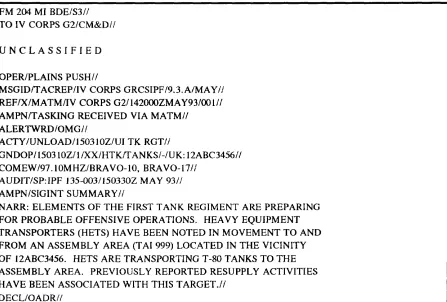
In addition to SII, division and corps collection managers use the collection emphasis message (see Figure 3-5). It is the IEW synchronization matrix in narrative format. You can broadcast your collection strategy to higher, lower, and adjacent units; collectors; and exploiters in addition to providing SORs.
The primary benefit of communicating “collection intent” is the “big picture” perspective it provides organizations which may be otherwise isolated from your planning process. An informed collector can often amplify reporting to provide an answer that goes beyond the immediate question. While the report stops short of analysis, it refines raw information and may facilitate cueing.
Related to cueing is dynamic retasking. The IS0S technological revolution continues to develop and field collection systems that truly report in NRT. Joint STARS, UAV, Guardrail Common Sensor (GRCS), and ASARS with their respective terminals (GSM, intelligence. processing facility [IPF], TRAC) bring the battle home fast enough to effect new collection operations almost simultaneously.
Interactive data links make these systems and their capabilities immediately available to the collection manager. Dynamic retasking may include new flight orbits or tracks in addition to new requirements and coverage areas; this requires coordination with the airspace manager as well as the asset manager. The following scenario illustrates dynamic retasking: The PARPRO schedule calls for a Corps GRCS mission and theater U2 flight. GRCS aircraft flying in a northern orbit report intercept of regimental units preparing to conduct a river-crossing in a major training area. River-crossing operations are a high priority on the SII. The IPF notifies the corps collection manager.
TRAC passes the new navigation plan and adjusted ASARS target deck to the U2 via its datalink. Within minutes of receipt, the aircraft is on the new, northern track collecting against the target area. Increased SIGINT collection and ASARS images of pontoon bridging operations combine to give the corps (and other intelligence users in theater) exceptional coverage of a priority collection requirement.
example, the CM directly tasks through the GSM remote workstation in the ACE. The GSM directly interfaces with the airborne platform via the surveillance and control data link. His corps has Radar Service Request priority, giving him the ability to direct the radar coverage of the Joint STARS, blurring the distinction between MM and AM. In most cases, however, you task or direct collection requirements to an agency or military command with AM authority rather than to a specific collector. Within the corps and division ACE, the MI brigade or battalion retains AM authority.
Collect and Exploit:
This final sub-function of Step 3, Task or Request Collection, belongs to the asset manager for planning purposes and to the collection and exploitation systems themselves for
execution. The final result is the production of information and intelligence that leads to the sat is faction of the initial intelligence requirements.
In addition to providing reports on the results of their collection operations, asset managers report on the status and availability of their collection systems. This ensures that the collection manager is able to make efficient use of the command’s intelligence collection capabilities as he continually updates and refines the collection plan.
The echelon manuals (FMs 34-10, 34-25, and 34-80) address MI operations in detail.
System handbooks and TTP manuals cover the “how to” aspect of collection and exploitation.
What Is It?
Definition:
The delivery of intelligence information to users who need it.
Two Examples:
While writing an SOR to support the division’s targeting plan, the direct dissemination of results to the FSE and targeting cell. The collection manager receives two messages from the division’s
mission manager specifies
MI battalion.
The first is an information copy of a direct response to an SOR. The collection manager notes that the information has already been sent directly to the original requestor. While closing out the requirement in his journal, the collection manager checks to determine if the report will satisfy any other open requests. Discovering that the report will partially satisfy an unrelated request by the 1st Brigade, the collection manager coordinates a retransmission of the report to the 1st Brigade.
Although not in direct response to an SOR, the second report satisfies a recently received request for intelligence from the aviation battalion. Since the report’s classification level exceeds the classification level of the aviation battalion’s communication system, the collect ion manager sanitizes the report and, after coordinating release with the special security officer (SSO), arranges for its transmission to the aviation battalion.
Desired End Effect:
Intelligence flows directly from collectors and processors to requesters.
FM 34-2
So What?
Success Results in:
Any unit that might act or consider acting upon a piece of information will have the opportunity to do so.
The collection manager is sure that all units to whom the information was passed actually received it.
Consequences of Failure:
Information will “stovepipe” into individual intelligence data bases. Units that would otherwise act upon the information will not be aware of its existence.
Information not relevant to a command’s intelligence needs will slow the processing and dissemination of more critical information.
How to Do it:
Arrange for Direct Dissemination:
Getting intelligence to the requester as soon as possible is key to successful CM operations. Whenever possible, write into the SOR the requirement for direct dissemination of
intelligence to the original requester. Include the required coordinating information such as call signs, frequencies, and routing addresses.
Direct dissemination is especially important for intelligence that supports targeting efforts. Whenever possible, arrange for direct dissemination of targeting intelligence to the FSE and targeting cells.
Even with direct dissemination, you must arrange a system that allows you to track the status of each request. Information copies of reports already provided directly to the original requester is one technique.
Sometimes direct dissemination is impossible due to communications system limitations or the classification level of the intelligence. Using the steps which follow below, arrange for dissemination that is as direct as possible. Since information already disseminated directly to requestors can often satisfy other requests, also apply the following procedures to
“information copies.”
Determine Perishability:
Determining the time sensitivity of each report allows you to make decisions about the best means of dissemination. Evaluating perishability requires you to stay abreast of the current and developing situation. Continuous coordination is essential with the ASPS, the targeting cell, and the operations staff.
Identify Users:
Check the report against outstanding requirements to determine who requested the
information. Ideally, this information is included in the report by way of a cross-reference to the SOR that generated the collection.
system for each SOR early in the requirements development process helps identify requirements that support each other in this manner.
Another technique is to conduct “hindsight wargaming. ” This technique is useful when determining the recipients of “unanticipated” intelligence. In this technique, the collection manager determines—
If an intelligence user failed to anticipate the event the intelligence indicates.
If the user would have established a DP based on that intelligence, had he anticipated it. If the intelligence will cause the user to modify a COA, or select a branch or sequel to a
COA.
Ask yourself the following questions:
Does this information indicate an unexpected threat to a friendly unit? Does this information indicate an unexpected opportunity for a friendly unit?
To do this well, acquire and understand the commander’s intent and attack guidance for all units you support. Acquire the HPT lists and attack plans (schedules of fire, air tasking order) for attack systems. Rely on the senior analysts and those involved in staff wargaming and decision making to assist in these decisions.
Determine How Much to Disseminate:
After determining WHO to send each report to, determine HOW MUCH of the report each user requires.
First, make sure that compartmented information is not disseminated to users who are only authorized collateral information. Legal restrictions may also prohibit the dissemination of information to allied or coalition forces. This is especially true during operations other than war where political considerations may dominate collection operations.
Today’s automation and communications technology will tempt you to try to send everything to everybody; resist the temptation. Competition for a limited number of communications trunks will force you to prioritize the dissemination schedule anyway. Additionally, pertinence filters at other headquarters will eliminate those elements of information that you should not have sent in the first place.
To determine how much information to send to each user, employ the same analytical techniques described above in “Identify Users.” Evaluate each element of reported information against the decisions, requirements, and supporting SIRs and SORs for the identified consumer. Disseminate each “block” of intelligence accordingly.
Identify Media for Dissemination:
Voice, Graphics, and Text Dissemination: When disseminating relatively small amounts of information, use a combination of voice, graphics, and text deliveries. Each of these means has advantages and disadvantages:
Voice is most useful in situations where speed in the transmission of a small amount of information is critical. It obtains instant feedback and acknowledgement, allowing for resolution of misunderstandings or ambiguity. On the other hand, when passing large amounts of information, voice systems are slow and prone to error.